Women in History: Eleanor of Aquitaine

One of the most powerful and influential women of her time, Eleanor of Aquitaine was born in the early 1120s and lived until 1204. 

By birth, she became Duchess of Aquitaine, a province in the southwest of France, when her father died in 1137. Independently wealthy and renowned for her beauty, she was the most sought-after bride in Europe.

Eleanor married King Louis VII of France in 1137, but the marriage was not happy. She sought an annulment of her marriage— one wonders how many women were in a position to do that for themselves back then— but it was rejected by the Pope.

It was not until 1152 and Louis’ agreement because she had not produced a son that Eleanor was able to obtain an annulment on the grounds of their family relationship. Louis kept their daughters, but Eleanor’s lands were restored to her and Eleanor was free to move on, which she did almost immediately.

Two months later, despite the efforts of two other lords to abduct and marry her, Eleanor married the Duke of Normandy, who would become King Henry II of England in 1154.

Five sons— three of whom became kings—and three daughters secured the line of inheritance to the English throne before Eleanor and Henry grew apart and became estranged, their marriage complicated by Henry’s frequent affairs and numerous illegitimate children.

While the idea of courtly love was not new, Eleanor and her daughters brought the concept to life at Poitiers, where they and their courtiers discussed matters of love and chivalry and adjudicated both theoretical questions and disputes between lovers. This gave rise to the great popularity of courtly love literature in Europe.

Suspicion that Eleanor was encouraging one or more of their younger sons to rebel and possibly ultimately challenge him for the throne led Henry to summon Eleanor to meet him at Rouen in 1173, from whence he took her captive and kept her as his prisoner at either Winchester Castle or Sarum Castle, and then at various other locations, for the next sixteen years. 

Eleanor was released from her albeit comfortable imprisonment by her son Richard, who became king on Henry’s death in 1189. She returned to Westminster and was welcomed with oaths of loyalty from the lords and, although not officially given any position or title, went on to rule for several years on behalf of her son Richard the Lionheart during his extended absences from England, both while on Crusade and while being held hostage by the Holy Roman Emperor, Henry VI. She was instrumental in raising the money needed and negotiating to secure Richard’s release. 

After John’s accession to the throne on the death of his brother, he sent Eleanor to Castile to bring back one of her granddaughters for an arranged marriage to secure a truce and alliance with Philip II of France. On her way there, Eleanor was kidnapped by Hugh IX of Lusignan who held her hostage, demanding land that his family had owned before selling it to Henry II be returned to him. An old hand at dealing with men who couldn’t think of a better way to solve their problems than to take someone captive and make demands before letting them go, and more than likely quite weary of men telling her what to do, she gave him what he wanted regardless of whether or not it was hers to give, negotiated her own release and went on her way.

That wasn’t the last of the trouble on her errand. On the way back, Eleanor and her granddaughter Blanche spent Easter at Bordeaux where they met a renowned soldier, Mercadier, who agreed to escort them back to Normandy. However, he was killed by the man-at-arms of one of his  rivals.  Shocked by his death, Eleanor retreated to Fontrevaud Abbey, committing her granddaughter to the care and escort of the Archbishop of Bordeaux. 

Despite ill health, Eleanor left Fontrevaud when hostilities once again broke out between England and France. She returned to Bordeaux to support John against the claims of her grandson Arthur, Duke of Brittany.

Not easily dissuaded, Arthur besieged her in the castle of Mirabeau until John arrived and captured Arthur, who was still only fifteen years old. One could be forgiven for suspecting he inherited some of his nerve from his grandmother.

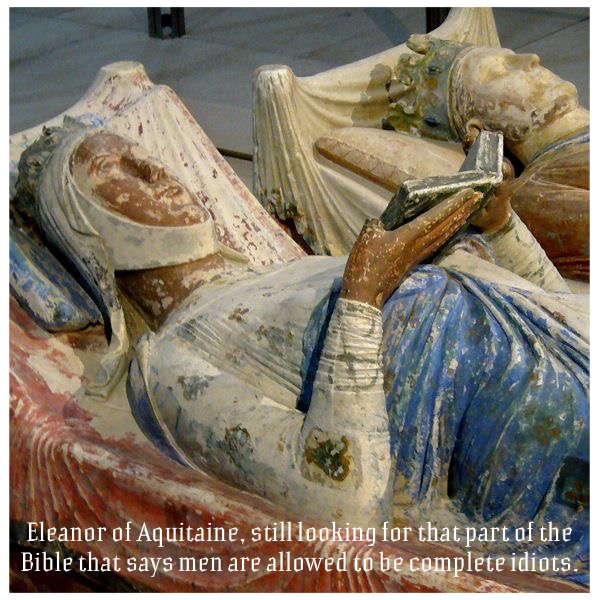
Eleanor returned to Fontrevaud Abbey, where she died and was entombed beside her husband Henry and her son Richard in 1204. Her effigy has her reading a book, presumably a Bible. 
By the end of her life, she had been queen of both France and England, and become the mother of not only two kings of England and one of France, but also of several queens of European nations and provinces. Eleanor had led armies into battle on more than one occasion, and had been a leader of the Second Crusade.  

She was clearly a woman of great temerity and independence of spirit. Even though she very obviously lived in a man’s world, she would never settle for not having just a bit of it for herself and leaving her mark on it when she left. 
Women in History: Æthelflæd

Meet one of my favourite women in history: Æthelflæd, Lady Of The Mercians.

In today’s Women’s History Month post, I want to introduce you to another favourite feisty English princess: Æthelflæd, Lady of the Mercians.

Born in 870  as the first daughter of King Alfred the Great and his wife Ealswith,  she grew up in a kingdom plagued by Viking invasions and increasing Danish domination of lands the had until recently been other Anglo-Saxon kingdoms. 

In 878, the tide began to turn when Alfred defeated the Danes at the Battle of Edington, and  Æthelred  became leader of the the half of Mercia that was still under English control. As Lord of the Mercians, he acknowledged Alfred as King over all the English people who lived in areas not controlled by the Vikings. This alliance was sealed by the marriage of Æthelflæd to Æthelred. 

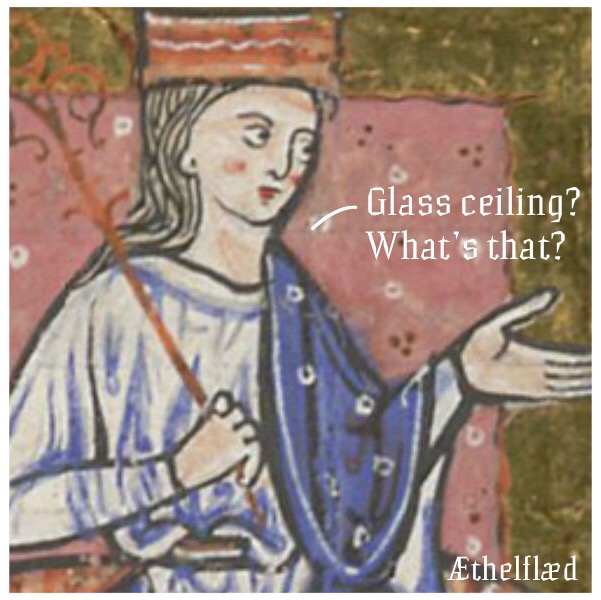
Not content to be a political pawn, Æthelflæd established herself in Mercia as a very capable co-ruler with Æthelred, and when his health began to fail, she took on the responsibilities of rule. When he died in 911, she assumed sole leadership of the kingdom and ruled in her own right as the Lady of the Mercians. 

This was the first time a woman had ruled an English kingdom, and she did a brilliant job of it. She fought against the Danes alongside her father and then he brother Edward, who became King on the death of Alfred in 899, enjoying victories that led to the Viking rulers of York offering her their loyalty in 918. However, Æthelflæd died before she was able to accept their offer and Edward absorbed Mercia into his own kingdom. 

RClearly, Æthelflæd was a woman who was not content to take a passive role in either history or her own life. She recognised no glass ceilings, and showed most of the men around her— including her own brother— how leadership should be done. 

To learn more about this fascinating woman, I recommend Annie Whitehead’s fabulous work of historical fiction, To Be A Queen.

Richard III’s Book of Hours.

Anyone who knows me at all knows that I’m a history nerd. I love reading it. I love studying it. I love teaching it. And my favourite period of history, ever? Medieval Britain.

So you can imagine my absolute joy when I learned that Leicester Cathedral has made a digital copy of Richard III’s personal prayer book, the ‘Book of Hours’, available to everyone, world-wide, absolutely free. Maybe they don’t realise that I, and many others like me, would have willingly parted with cold, hard cash for that. Needless to say, I went right over there and grabbed it.

RIII Book of Hours
Included with the digital version of Richard’s Book of Hours is a commentary by historians Anne F. Sutton and Livia Visser Fuchs, which offers insight and explanations for the text.

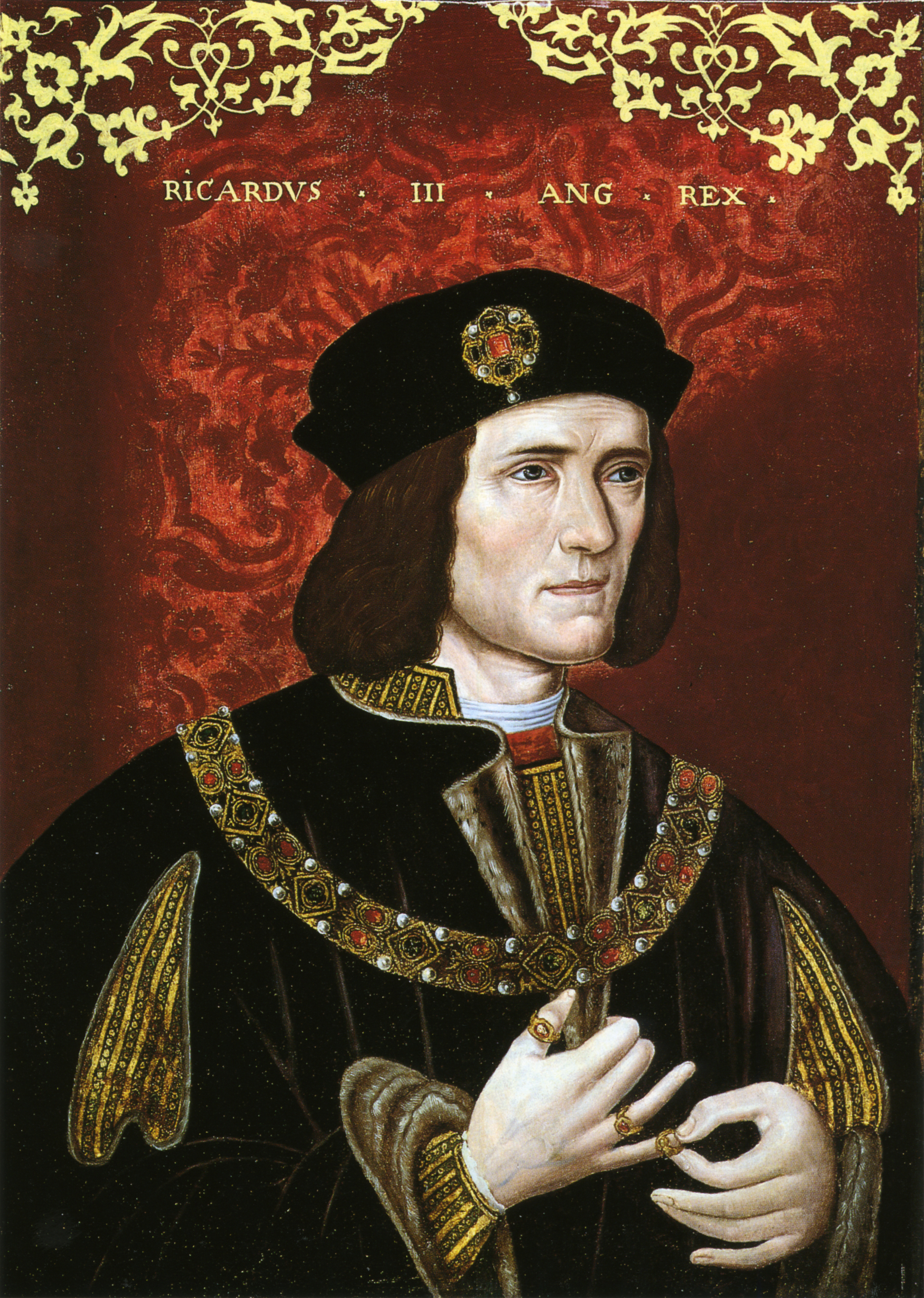
Richard III is possibly one of the most controversial English kings. He’s the one they dug up from underneath a public car park in Leicester in 2012, and re-buried in Leicester Cathedral in 2015. But that’s not why he’s controversial.
Richard is the key figure at theKing_Richard_III centre of the “did he, or did he not?” debate about the demise of the ‘Princes in the Tower’. Of course, nobody really knows. There’s a lot of evidence that he was the most likely suspect, but there’s also a number of good arguments for other parties being responsible. The fact is, we’ll probably never know.

Either way, the Tudors very cleverly had Richard portrayed in both history and popular culture as the entirely self-serving, greedy, murderous, deceitful and manipulative hunchbacked king who murdered his way to the throne and effectively stole the kingdom of England from anyone who was more entitled to it than he.

That story was most famously perpetuated in Shakespeare’s play ‘Richard III’, which also caused him to be the most misquoted king of England ever. How many people actually believe that “A horse! A horse! My kingdom for a horse!” meant that he was willing to swap his kingdom for a horse, presumably with the intention of escaping on it? In actual fact, even in Shakespeare’s play, he was saying that if he couldn’t get a horse to replace his own, which had been killed in battle, he would surely lose his kingdom to Henry Tudor. As I’ve pointed out to my own students, if Shakespeare had actually thought of making him look that cowardly and heartless about his own kingdom, he might have written it that way, but he didn’t. The Tudor bias in both the recorded history and in Shakespeare’s play did mean that for the last 550 years or so, most people have quite happily assumed the worst of Richard.

Richard’s Book of Hours suggests a different side to this man. Owning a prayer book is one thing; using it is another. Richard made personal notes in this book – a comment in the margin, a note about his birthday. Given the rarity of books at the time of Richard’s reign from 1483 until his death in 1485, one would be reluctant to write in a book unless they were actually using it. In some other similar books , there are occasional little notes written beside the text of the book by whichever priest was either writing or studying the text. We must understand, though, that it’s different than a teenager drawing winky faces next to the rude bits in Shakespeare.

One such note we can be absolutely certain was added by Richard to this book is “dolor”, which means ‘grief’. Having experienced the death of both his only son and then his wife, Richard was indeed a man familiar with grief.

When I consider the images of Richard’s Book of Hours, I think of a man who was conscious of his standing before God and who used this book daily. I think of the man contemplating his fate on the night before the Battle of Bosworth, where contemporary sources suggest he had a daily prayer book right there with him in his tent.  He was a man who prayed. Those records also tell us that Richard participated in a service of Mass before going into battle.  Obviously, I cannot vouch for his sincerity because I never met the man, but it does make one consider another perspective of this perhaps much-maligned king.

After the Battle of Bosworth where Richard died and Henry Tudor became Henry VII of England, Richard’s prayer book was gifted to Henry’s mother, Margaret Tudor. She didn’t scratch Richard’s name out of the front of the book, but she did write a short poem in the back that stated the book now belonged to her.

Thankfully, the book now belongs to Leicester Cathedral, who have generously shared it with all of us. Even in digital form, I find that very, very exciting.


Sources:
http://www.medievalists.net/2015/03/richard-iiis-book-of-hours/

http://www.medievalhistories.com/book-of-hours-of-richard-iii/

http://www.lambethpalacelibrary.org/content/annunciation

http://leicestercathedral.org/about-us/richard-iii/book-hours/

The 21st Century Burial of a 15th Century King.

This evening I’ve been watching the committal of Richard III’s grave to Leicester Cathedral from the University and the “funeral” ceremony in the cathedral.

RIII

Richard III: The Reburial (Channel 4)

It’s mind-boggling to think that I’m watching the funeral of a medieval king whose life, actions and legacy I have studied at length in both history and literature, more than 500 years after his death.

Despite the heated and lively historical debate over whether or not he was responsible for the disappearance of his two nephews, the sons of Edward IV known as ‘the princes in the tower’, and the hideous portrayal of Richard by Tudor historians and, in turn, Shakespeare’s famous play, his reign was characterised by many things that recommend him.

It’s most likely that the significant question of the fate of those young boys will never be answered. Richard was by no means the only person with both a motive and the means to do away with them, and there are some very good arguments as to why he would not have taken such an opportunity, not the least being the risk of losing his integrity and the loyalty and love of the English people.

I find it bizarre that the British royals, who are descended from his sister, have only sent a token representative in the Queen’s daughter-in-law, Sophie, Countess of Wessex. Richard was, after all, a King of England. He was the last King of England to die in battle, defending his throne and his country.

The Queen’s cousin, Richard, Duke of Gloucester was also present, He bears the same name and title that Richard III held before his accession to the throne, and is the royal patron of the Richard III Society.

I am pleased to see Richard III’s physical remains being treated with dignity and respect. I’m delighted to be able to be a witness to his reburial via the wonders of historical and scientific research and the internet.

It’s also great to see that the result of the discovery of Richard’s remains buried under a car park in Leicester, in what used to be the choir of the Greyfriar’s church, is an increased interest in the history of his reign and of England at the time.