Alternate ed.

While in Detroit staying with my cousins, I spent a day visiting the school where my cousin David teaches.  It’s an alternate ed school on the same campus as a regular high school in the suburb of Birmingham. Classes are open age and not organised by grade level. 

I’ve had some interaction with one of the Hunanities teachers here before, as we have set up some interaction and communication between our history classes. It was great for our students to share their experiences and perspectives, and to find out their similarities and differences in the ways they view and understand world events and the ways in which they enjoy recreation, sports and entertainment. It was wonderful to meet with Mallory and continue our collaboration in person. 

I took the opportunity to share with several classes about the similarities and differences between the USA and Australia. Geography, politics, government, food, popular culture, flora and fauna, and history have all been topics of conversation. The students have been really interested and keen to discuss things, so I’ve really had a lot of fun. Talking with teens comes naturally to me, so I have been very blessed to have these opportunities. 

I also had the chance to watch my cousin teach geometry to a student who hates math. In his words, “Every moment of this is agony for her.” By the end of this one-on-one instruction time, she is mentally exhausted but she has achieved two learning goals and shown that she is making progress. She takes a nap for the remainder of the session: this is both her reward and essential recovery time after a lesson in which she has fought to achieve mastery of skills and knowledge that many students might take for granted as “basic”. 

I can understand where she is coming from. I hated math too: I found it very difficult, and my teacher was neither patient nor understanding of my weaknesses. I have to say that if my math teacher had been as gentle and encouraging as my cousin is with his students, I might have leaned more. There really is a art to teaching “math as a foreign language”, as David so neatly puts it. Other students in the room are more self-driven and work quietly in the relaxed learning environment where there’s blues music playing and the communication is casual and comfortable, even though the expectations and academic standards are maintained.  

I am so impressed. The students here are getting a chance to succeed and graduate where the regular classroom did not work for them. The staff are very proactive and constructive in their communication. In that, they are very much like the teachers with whom I work and, I’m sure, most teachers the world over.  It’s not really a unique thing that we do, but each of us has incredible opportunities to impact every student’s day, every student’s willingness to learn, and the outcomes of that in every student’s life. Here, where the kids face other issues in addition to those generally faced by teens in regular schools, there’s some powerful work being done to engage and mentor young people who are at very real risk of otherwise “falling through the cracks” or dropping out altogether. 

As David and I walked out at the end of the day, I was struck by the difference in appearance between his school and the one upstairs, which clearly gets more funding and attention than the other. It may look nicer up there, but I have developed a very soft spot for the students and the staff at Lincoln St Alternate Ed. What happens there is very, very special indeed. 
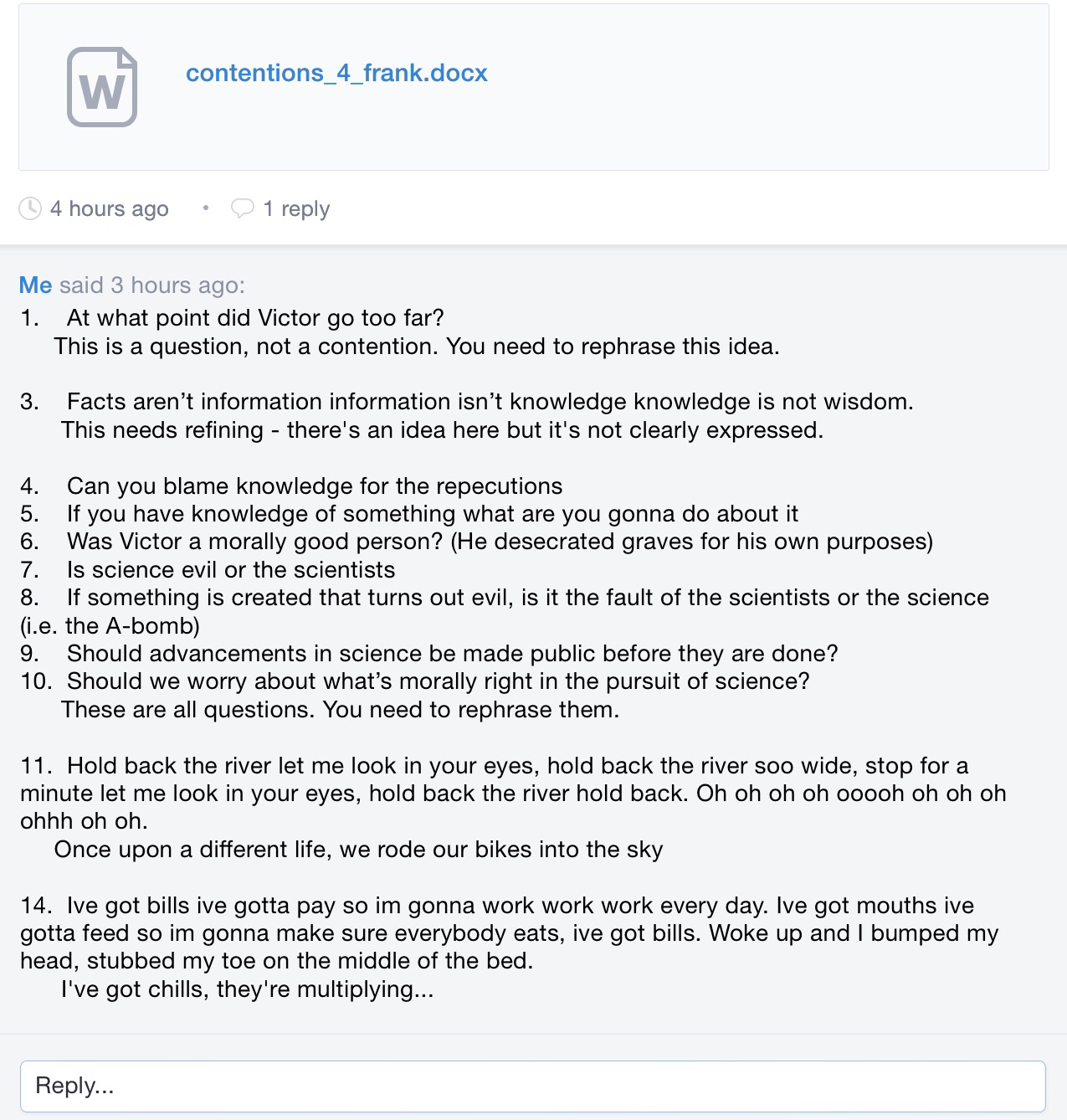
Contentious. 

Today I asked my senior English class to formulate some contentions drawn from the set text, Mary Shelley’s ‘Frankenstein’.

This is the submission from one group of students, and my responses. 

  
Gosh, I love these kids. 

Day made. 

They think what???

Remember the old joke where Billy says, “But I don’t want to go to school! Nobody likes me!” and the punch line follows: “You have to go… You’re the teacher!”

I always thought it was pretty corny, but that’s exactly how I felt this morning.

As a teacher, it’s a really awful feeling finding out from a third party that some of my students think that I don’t like them.
I know there are people who probably shouldn’t be teachers because they make their students and colleagues feel that way all the time.
I’ve always been sure that I was not one of those people.
Now I’m left wondering if I am.

I have no idea where all this came from.
Yesterday was bad enough before my boss dropped the bombshell: long, frustrating and plagued with physical pain.
Since then, I’ve been questioning myself and wondering where I’m going wrong.

I’m not trying to sound self-righteous or indignant.
I’m so incredibly hurt, and I’m fearful that I have had that same effect on other students who were just too nice to say so.
Whether or not it was what they intended, I’m devastated.

When criticism filters down from my boss and people prefer to not be named, it’s hard to know how to react because you don’t know if it’s one, two, or seventeen of your students who feel that way.
It’s hard to not take it personally. It leaves you questioning yourself and, at the very least, your professional integrity.
Am I not really the teacher or the person that, until now, I believed I was?
How did this happen?
Am I one of those hateful, hurtful teachers?
Is it even possible to be one of those people when I actually like my students and enjoy my classroom interaction with them? Or without even realising?
Why didn’t anyone tell me?
Is it so hard to say something to me?
Am I that unapproachable?
Am I past it?
Do teachers have “use by” or “best before” dates?

If only they knew how much I really do like them.
If only they knew how hard I work for them.
If only they knew how I agonise over marking their work and writing constructive comments to help them improve.
If only they knew how much I want each of them to do their best, not for me but because it’s an investment in their own future.
If only they knew the level of physical pain I endure without ever letting them know what’s going on under the surface, simply because that’s my problem, not theirs.

And how am I supposed to fix this?
Walking into the classroom and saying, “Hey guys, I hear you think I don’t like you. Well, you’re wrong. I do…” is just going to look and sound phoney.
If they can’t tell from the way I try to encourage them and give positive feedback, faking a smile when I’m hurting isn’t going to convince anyone.

Besides, smiling wasn’t really possible today. I was proud of myself for just holding it together and not crying in front of them. Talking about this with them in class wasn’t an option.

Maybe I should just give them the link to this blog. Or maybe that’s too impersonal.
Maybe I just can’t do anything right anymore.
Maybe I need to sleep on it… again… and hope that tomorrow is better.

Encountering Inspiration.

My students are discussing various ideas about the ways in which people encounter and respond to conflict as part of our Year 12 English course.

As I observe their interactions and tune into different conversations around the room, I am so impressed by the maturity and thoughtfulness they are bringing to these discussions. They are taking this really seriously. They are asking questions that I might never have thought to ask.

I had hoped that they would inspire and encourage each other to extend their thinking through this exercise.
They have gone further than that – they are inspiring me.

I am a very blessed teacher.