He did laugh out loud in class when he received this.
Mission accomplished.
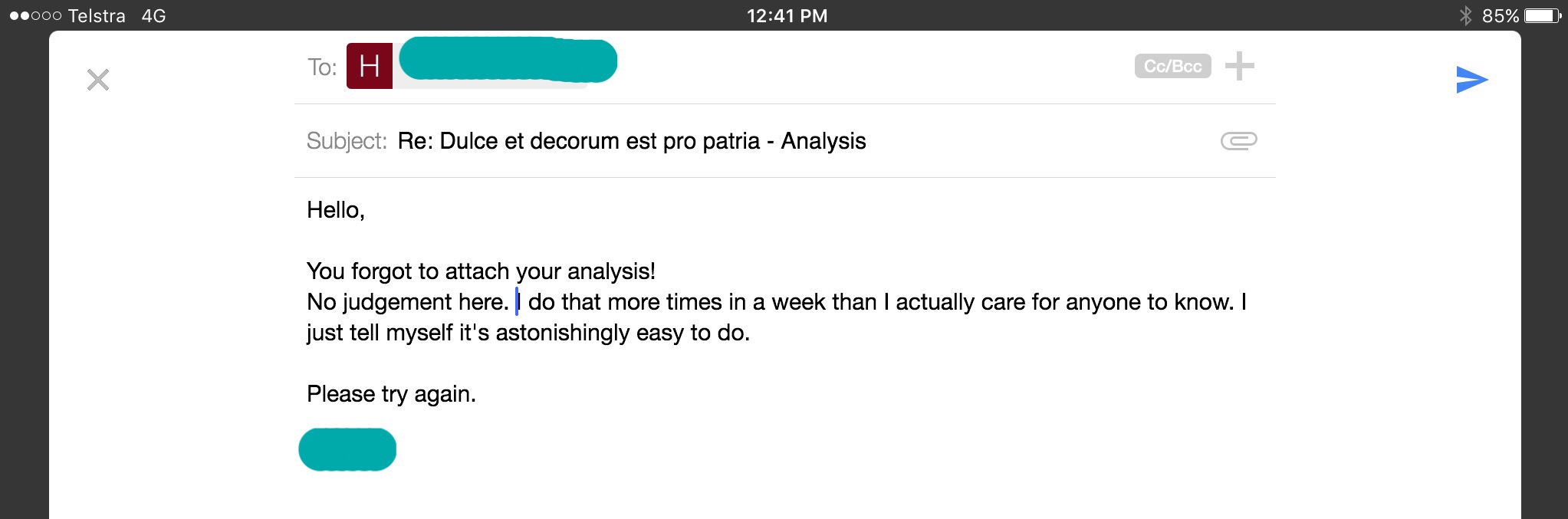
He did laugh out loud in class when he received this.
Mission accomplished.
From time to time, teachers are asked to cover lessons for colleagues who are absent for some reason.
Today I had the privelege of covering a Y10 Health and Human Development class.
They could have been discussing exercise, nutrition or health… but, no.
That would have been waaayyy too easy. They had to be learning about male and female body parts and their functions.
While I was busy asking myself why these lessons always seem to be handed to me, I was interrupted by a student asking a question.
Student 1: “What’s the cervix again?”
Student 2: “It’s the trapdoor thing that stops the baby coming out.”
Wait. The what??
Very diplomatically, I suggested he might like to look things up in a dictionary, or at least the printed notes they had been given to read and highlight. I don’t think he did, though.
A little later, Student 1 had another question: “Are the uterus and the urethra the same thing?”
Again, I pointed him to the printed notes and the dictionary.
“How is that going to help me?” he asked.
“How indeed?” I thought to myself.
I’m sorry, Miss K. I tried.
My office buddy just called someone on the phone and said, “Hello, I’d like to order 16 brains, please…”
She got a little distracted when I laughed and asked who they were for.

Three Prep girls are playing “school” in the library.
“Stop laughing and draw some socks!”
Too cute.
Student essay “Quote of the Day”: “The wealthy people in ‘Pride and Prejudice’ have big houses, expensive horses and carriages, and big balls.”
I’m still laughing.
While in Detroit staying with my cousins, I spent a day visiting the school where my cousin David teaches. It’s an alternate ed school on the same campus as a regular high school in the suburb of Birmingham. Classes are open age and not organised by grade level.
I’ve had some interaction with one of the Hunanities teachers here before, as we have set up some interaction and communication between our history classes. It was great for our students to share their experiences and perspectives, and to find out their similarities and differences in the ways they view and understand world events and the ways in which they enjoy recreation, sports and entertainment. It was wonderful to meet with Mallory and continue our collaboration in person.
I took the opportunity to share with several classes about the similarities and differences between the USA and Australia. Geography, politics, government, food, popular culture, flora and fauna, and history have all been topics of conversation. The students have been really interested and keen to discuss things, so I’ve really had a lot of fun. Talking with teens comes naturally to me, so I have been very blessed to have these opportunities.
I also had the chance to watch my cousin teach geometry to a student who hates math. In his words, “Every moment of this is agony for her.” By the end of this one-on-one instruction time, she is mentally exhausted but she has achieved two learning goals and shown that she is making progress. She takes a nap for the remainder of the session: this is both her reward and essential recovery time after a lesson in which she has fought to achieve mastery of skills and knowledge that many students might take for granted as “basic”.
I can understand where she is coming from. I hated math too: I found it very difficult, and my teacher was neither patient nor understanding of my weaknesses. I have to say that if my math teacher had been as gentle and encouraging as my cousin is with his students, I might have leaned more. There really is a art to teaching “math as a foreign language”, as David so neatly puts it. Other students in the room are more self-driven and work quietly in the relaxed learning environment where there’s blues music playing and the communication is casual and comfortable, even though the expectations and academic standards are maintained.
I am so impressed. The students here are getting a chance to succeed and graduate where the regular classroom did not work for them. The staff are very proactive and constructive in their communication. In that, they are very much like the teachers with whom I work and, I’m sure, most teachers the world over. It’s not really a unique thing that we do, but each of us has incredible opportunities to impact every student’s day, every student’s willingness to learn, and the outcomes of that in every student’s life. Here, where the kids face other issues in addition to those generally faced by teens in regular schools, there’s some powerful work being done to engage and mentor young people who are at very real risk of otherwise “falling through the cracks” or dropping out altogether.
As David and I walked out at the end of the day, I was struck by the difference in appearance between his school and the one upstairs, which clearly gets more funding and attention than the other. It may look nicer up there, but I have developed a very soft spot for the students and the staff at Lincoln St Alternate Ed. What happens there is very, very special indeed.
Today I was privileged to accompany 45 students on a visit to the Courage to Care exhibition in Portland.
We heard the personal story of a man named Harry, a Holocaust survivor from Poland. Harry’s story was incredibly powerful. So were the tears he shed while telling it. You couldn’t help but be moved by this first-hand account of the terrible things that were done during World War II.
Courage to Care exists because they are passionate about telling many, many stories just like Harry’s. Given that we are celebrating the 70th anniversary of the end of the war, they know that it won’t be long before there are no survivors left to tell their stories to the generations that follow them.
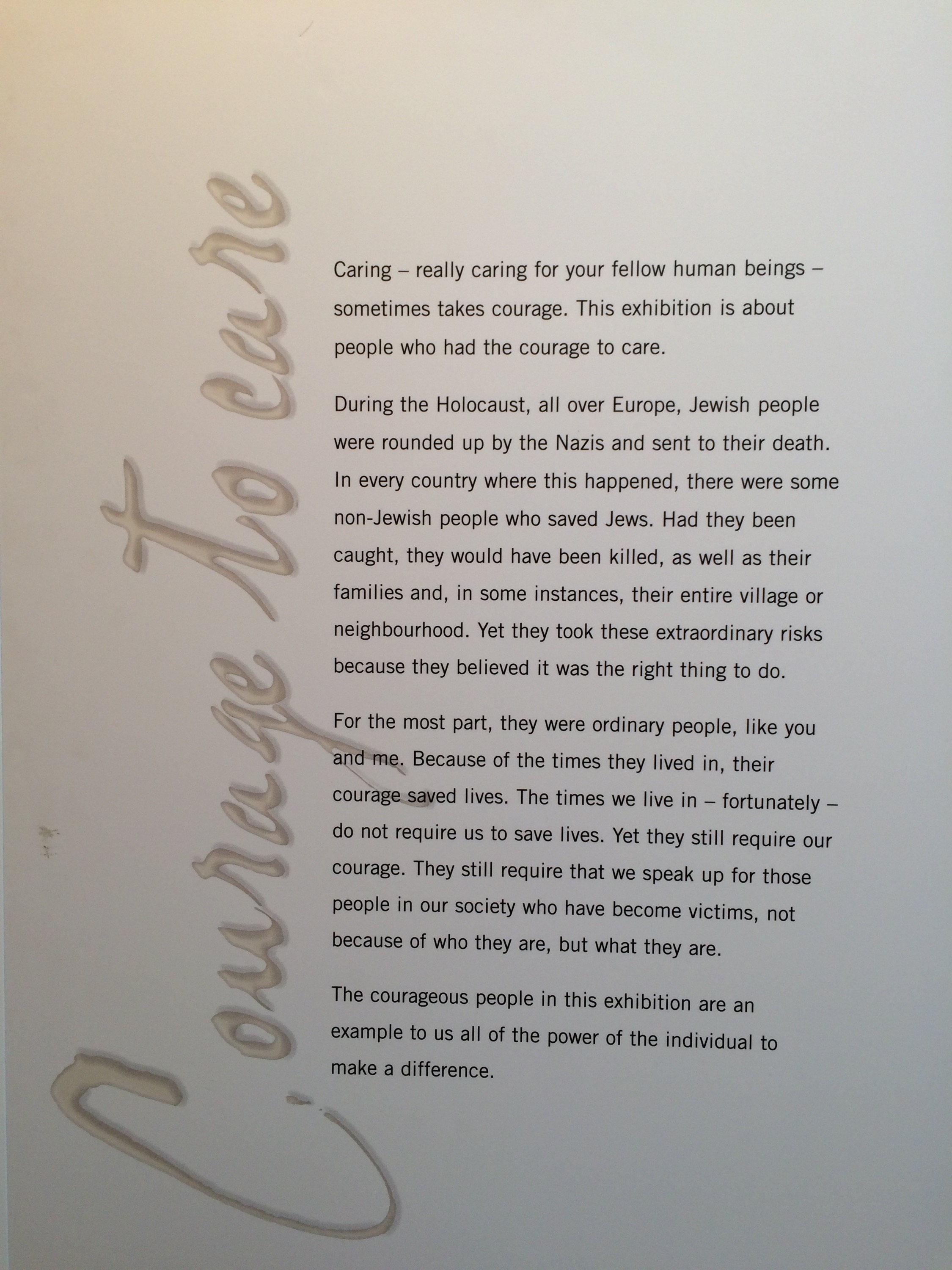
The message is not just about the Holocaust. It’s a message against any form of prejudice, hatred, intolerance or bullying. Differences between people are only ever superficial; underneath our skin, we’re all the same.
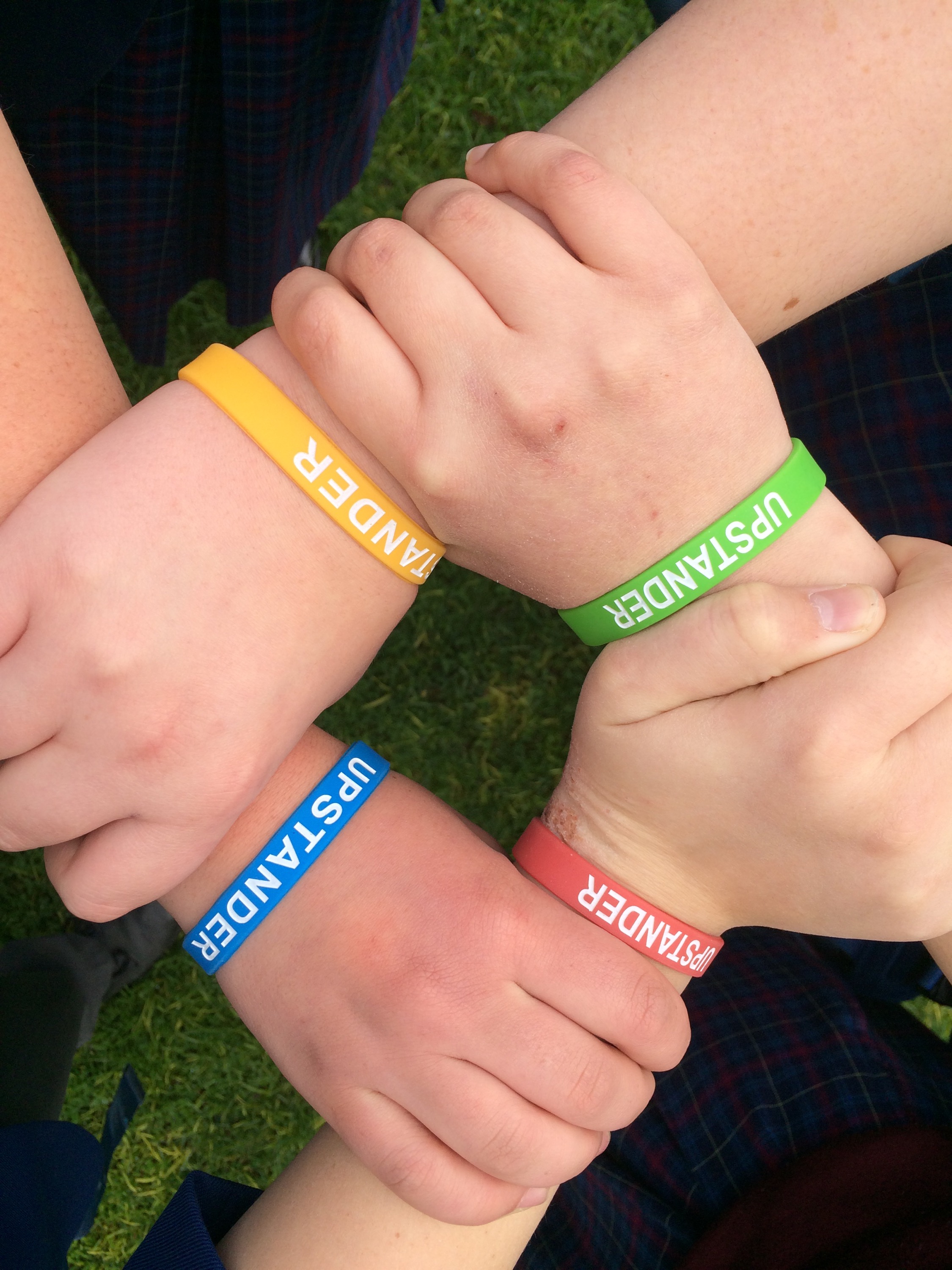
Everyone who visits the exhibition is encouraged to be “Upstanders, not Bystanders”. It’s hard to leave without experiencing the conviction that you will never accept or condone discrimination again.
I cried as Harry told his story, not just for Harry but for every family who lived through the same thing. I cried for parents who lost children, children who lost parents, and siblings who lost each other.
I cried again when I read the stories of two families in Rotterdam who worked with the Dutch Resistance and help save Jewish people from the Nazis. They almost certainly knew my grandfather, who worked for the Dutch Reaistance throughout the war, and was personally hunted by the Nazis as a result.
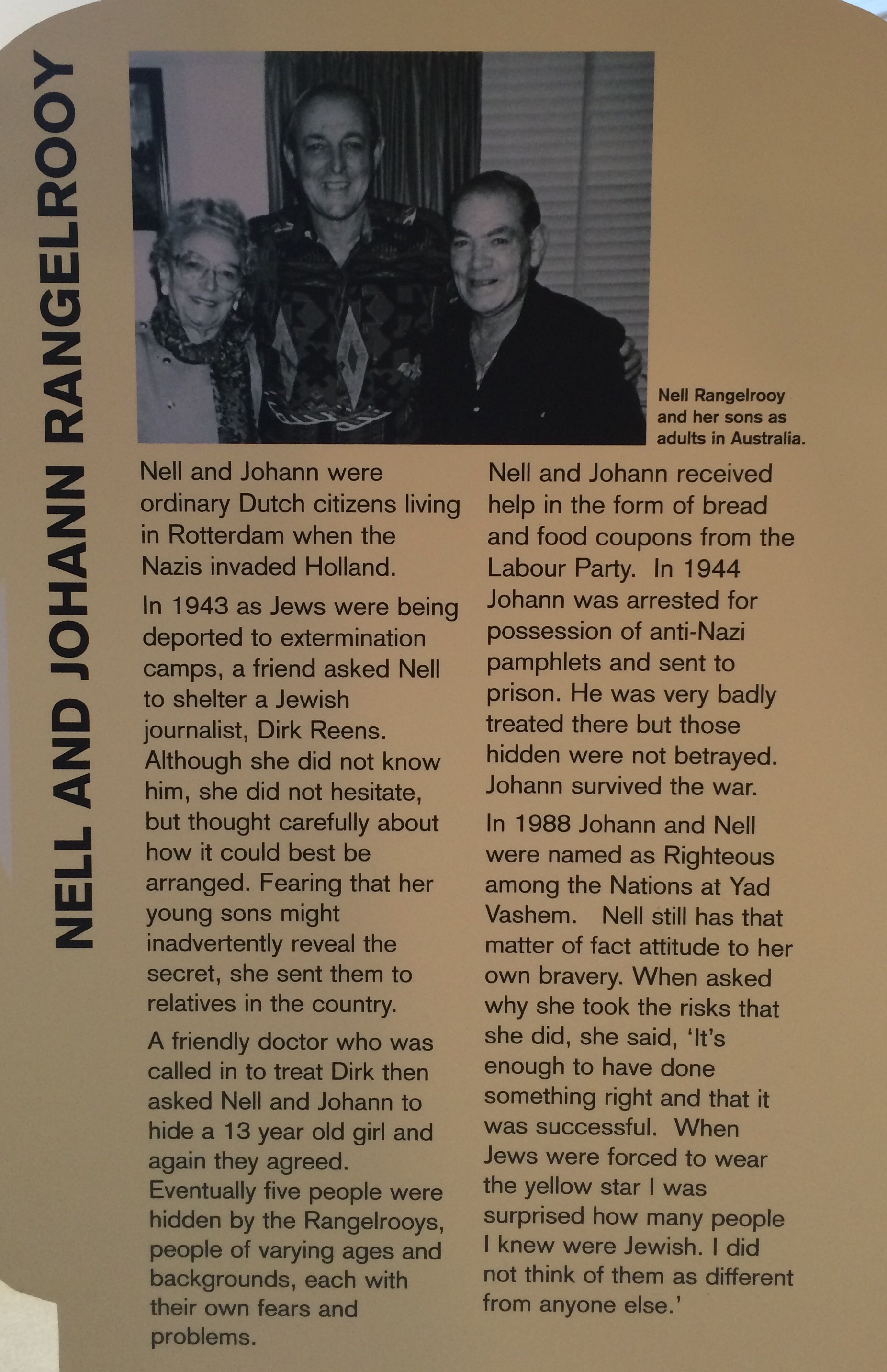
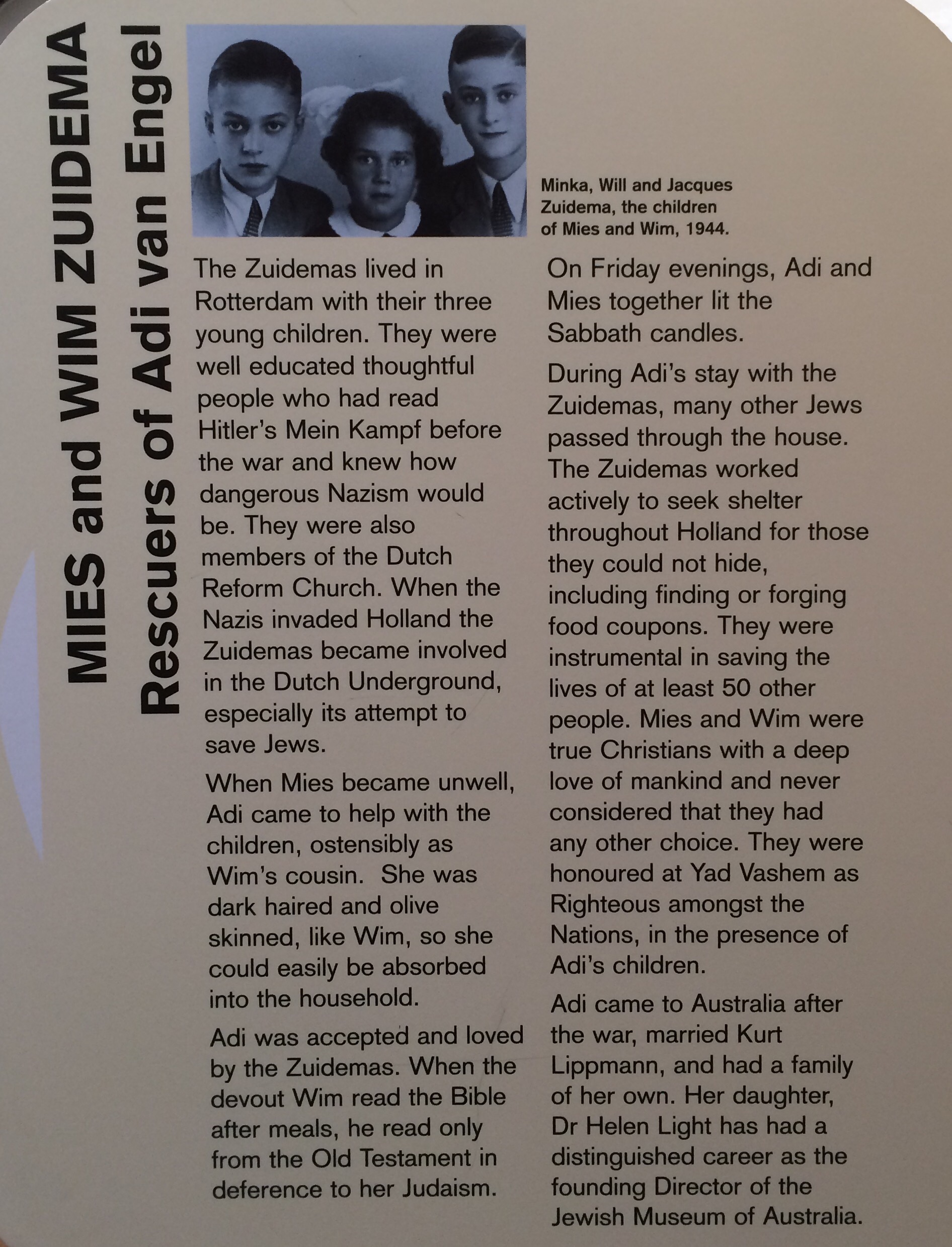
My Opa told me stories about his experiences during the war when I was a young girl reading books like ‘The Hiding Place’ and The Diary of Anne Frank’. They were always very serious and quite emotional conversations. It was very important to him that I understood how important it is to oppose evil and to stand against hatred.
He told me more of his story when I was a little older and studying history. I guess he thought I could handle more of the horrible truth then. It certainly made my studies more personally relevant.
It also explained why he would leave the room or turn the TV off whenever there was a scene where German soldiers marched or where Hitler addressed the crowd. I don’t know why I hadn’t made that connection before, but after that, I could not watch those scenes without thinking about how powerfully real and haunting it still was for him and, doubtless, everyone else who had survived it. I was very privileged today to meet Harry, to shake his hand and talk with him. I told him about my grandfather and the connection with the stories displayed in the exhibition, and cried again. He hugged me and we shed tears together.
Honestly, I’ve never been such a sook in public. The whole experience was very moving, and not just because it made me think about my grandfather.
I saw the students responding in a similarly emotional way. They spoke up about bullying, booing at footballers, and the way different ethnic groups in Australia are perceived and treated. One of my students, a young man who generally seems to have not a care in the world, had tears in his eyes, just like I did.
I saw the light in the eyes of the Courage to Care members as they were inspired by the responses of the young people in front of them. The conversations were serious and sombre.
Every student took a wristband and put it on immediately, proud to be an Upstander.
There is hope yet for our nation and our world. Young or old, we can make a stand against hatred and vilification.
All that is needed is the courage to care and to stand up for what is right.
After being a teacher for twenty-six-and-a-half years, I’m surprised that it has only just occurred to me that the effect of report writing on the body is much like pregnancy cravings.
I’m working away, absorbed in the delicate task of crafting a finely constructed, highly expressive report of the achievements and needs of each student when all of a sudden, my body speaks to me.
“Sugar. I need sugar.”
I think of ice cream, then of oreos. Ice cream with oreos. Awesome.
I’m about to get out of my chair and go foraging, but then I remember that I have an enormous amount of work to do and I don’t want to get too distracted. Instead, I look for sweets in the drawers beside my chair. An almost-empty packet yields two licorice allsorts which are consumed in quick succession, shortly after which I decide that this may not have been a good idea, even if the choice of licorice did seem healthier than the unholy amount of chocolate consumed while writing Year 10 English until 1.45 am. Feeling a little queasy, I continue working.
“Mmmm. Pickles. I’d love a pickle.”
Subsequent investigation in the kitchen leads to the conclusion that there are no pickles in the house and then to the discovery that a couple of large slices of tinned beetroot makes a fabulous substitute. Who knew?
Feeling surprisingly sated, I return to my work and let my creative juices flow.
The industry with which the words flow from my mind to my fingertips and onto the screen is impressive. This lasts for at least fifteen minutes, until the dilemma of how to write about young Miss Elsie Whosiewhich’s failure to submit any work at all for the entire semester leaves one wondering if there are any cheese and onion flavoured potato chips in the house.
These thoughts are set aside with determination to at least finish writing half of the Year 10 history reports before I take another break, but before long the jar of coffee on the counter is calling out to me and I’m powerless to resist. Caffeine will keep me alert and help me concentrate, right?
I walk into the kitchen to make coffee but get distracted by thoughts of a peanut butter sandwich. Suddenly it’s all too much work, so I pour another glass of Coke Zero and head back to my study. It occurs to me just how freaking awesome cold coke tastes and feels. Delicious, ice-cold bubbly goodness delivering caffeine to my brain with every sip. Then I realise that I am a bit hungry and I should have grabbed that peanut butter sandwich while I was up. Dammit. I hunt for one of my Reese’s cups that I’ve hoarded in case of an emergency, and almost cry with happiness when I find it. Oh, that delicious peanut-buttery goodness…
Oh, wait. The caffeine was supposed to help me concentrate, wasn’t it?
Right. Back to it then.
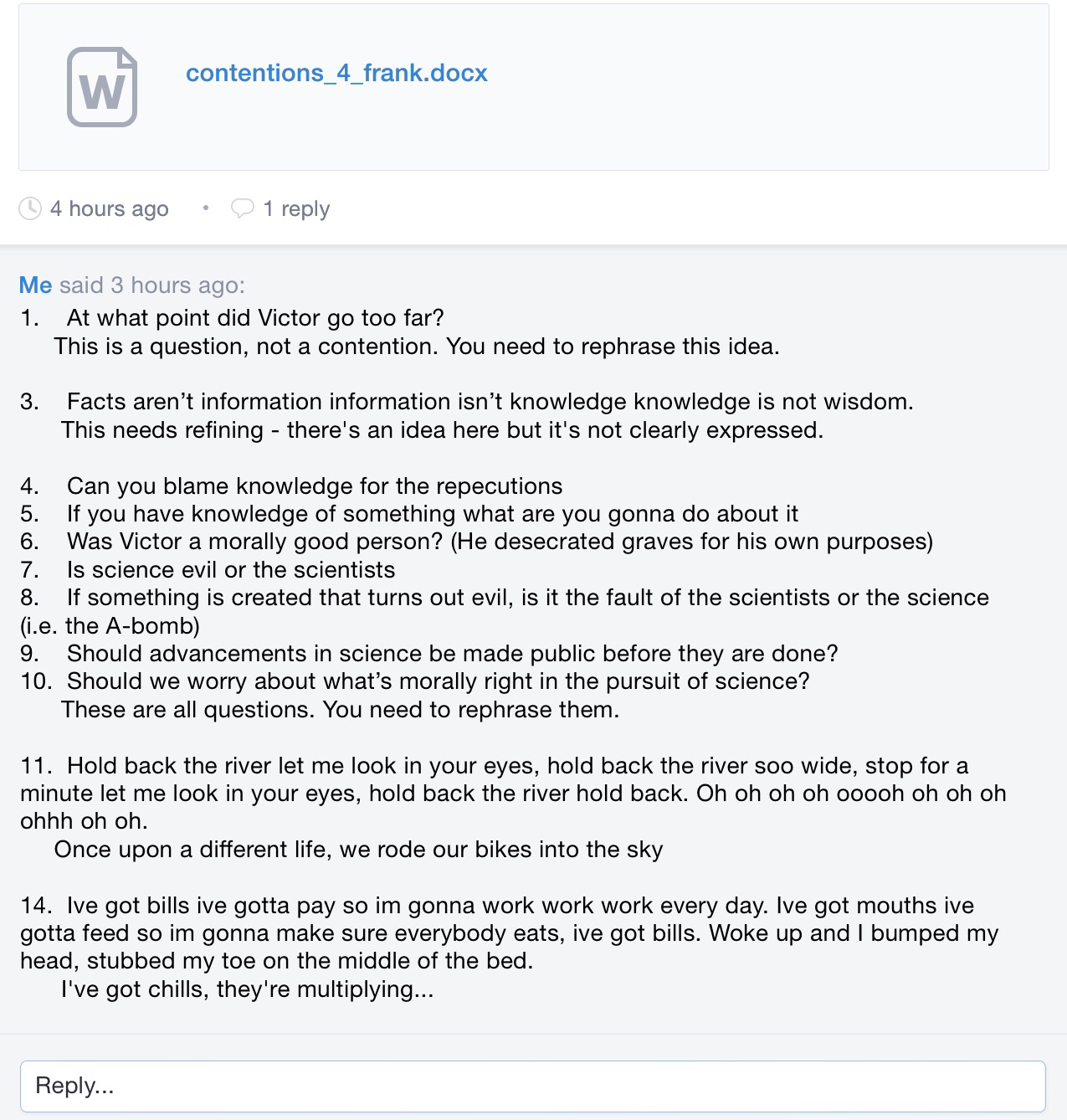
Today I asked my senior English class to formulate some contentions drawn from the set text, Mary Shelley’s ‘Frankenstein’.
This is the submission from one group of students, and my responses.
Gosh, I love these kids.
Day made.
I’m about to embark on an international classroom collaboration with my Year 10 History class and some students who attend the school where my cousin teaches in Detroit, USA. Our students will discuss world events, their interests, and their perspectives on issues and challenges that they face as young people in an increasingly globalised world.
This has not been done at my school before, so I am very aware of breaking new ground for my students and of my responsibility to mentor them and protect them while flinging them out of the proverbial comfort zone of our classroom “nest”. The online classroom environment where this collaboration will take place will be monitored and moderated by myself and the American students’ teacher, who I’m sure shares my anxieties and my excitement as we embark on this experimental educational journey together.
I’m excited because while these kids’ lives are worlds apart, they live in the same world and witness the same events from their own unique perspectives. I’m excited about collaborating with another teacher and having our personal professional horizons broadened, too.
My hope is that they will broaden their horizons and see things from different points of view while becoming more aware of what is happening in the world around them.
Hopefully we will all be inspired as well as informed.
 WordyNerdBird