My kingdom for a pencil!

My drama class was rehearsing a play which includes excerpts from a number of Shakespeare’s plays. 

While creating a donkey mask, the actor who briefly plays Richard III said, “A pencil! A pencil! My kingdom for a pencil!”

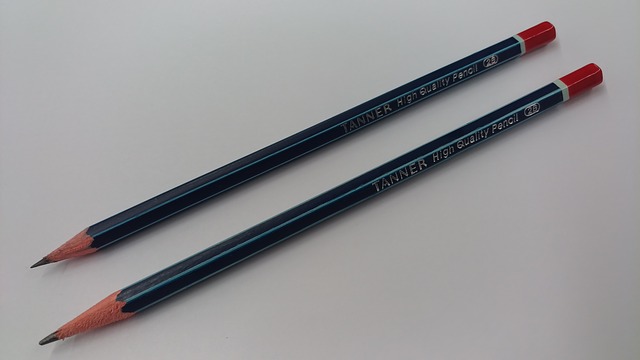
Not missing a beat, another student replied, “2B or not 2B? That is the question!”

I am so very, very proud. 

Lesson from ‘Othello’: How not to be a husband. 

My students have obviously learned something from studying Shakespeare’s ‘Othello’. 

A student wrote the following assessments in this week’s essay: 

“Desdemona is Othello’s wife; the least he could do is talk to her, but apparently that’s too much to ask of our protagonist.”

“Othello is a dirtbag husband that took advantage of Desdemona’s love for him.”

Spot on, I say. 

Things kids say in the library #3

Two boys ran to the door of the library and looked in to see which teacher was on duty.
One says to the other, “Ohhhh rats, it’s the mean one! She doesn’t let us play games on the computers!”
Both looked at me with a mixture of misery and disgust on their faces, then walked away.

Go me.

Reader. Teacher. Writer.

Until recently, everything I have written in my blogs is truth. Some of it is allegory, concealing a kernel of truth in a story that few will recognise or understand.

A couple of weeks ago, I started an online course in writing fiction. I thought it would be great professional development as an English teacher to expand my horizons in writing techniques, crafting meaning, and creating and developing plot and characters.

So far, it has confirmed for me that my approach to teaching students about writing is effective and valuable. It has also confirmed for me that my classroom emphasis on drafting, editing and proof-reading is not misplaced.

Beyond that, I have really enjoyed the challenge of assignments that require me to respond to a prompt or to create something new.

Obviously, I draw on my own experiences and people I know for inspiration. I believe every writer does that. It’s near impossible to write about something you have not felt, experienced, or at least imagined in some detail. The stories that endure are those which relate strongly to common human experience.

If you read my pieces of fiction, you will probably recognise me in some of them. Others will see a glimpse of themselves, or a quality that they share with one of my characters.
Please don’t read anything into that. I am not commenting on real people, but rather taking an element of a character or situation that interests me, and doing something different with it.

It’s encouraging that professional development has also become personal development.

I don’t believe that anything I write will actually be published anywhere other than on my blog. I don’t aspire to that. I do enjoy writing, and I hope that you might enjoy some of my work if you take the time to read it.

You can find my writing at wordynerdbirdwrites.wordpress.com
Feel free to leave feedback if you would like to. Constructive comment is always appreciated.

Encountering Inspiration.

My students are discussing various ideas about the ways in which people encounter and respond to conflict as part of our Year 12 English course.

As I observe their interactions and tune into different conversations around the room, I am so impressed by the maturity and thoughtfulness they are bringing to these discussions. They are taking this really seriously. They are asking questions that I might never have thought to ask.

I had hoped that they would inspire and encourage each other to extend their thinking through this exercise.
They have gone further than that – they are inspiring me.

I am a very blessed teacher.

Why report writing stresses teachers out.

We’ve all seen those funny things that teachers post about writing school reports.
Some of them suggest things we’d love to write, but we know we never could… no matter how tempted we might be.
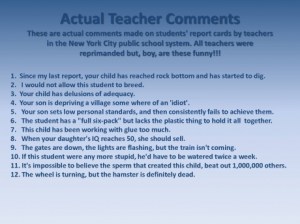
Others are translations of teachers’ comments commonly found in school reports. Here’s an example:

“Murgatroyd is highly social and engages well with his classmates.”
In other words, Murgatroyd doesn’t shut up and distracts the entire class from what they are supposed to be doing.

“Murgatroyd demonstrates strong interest in science, and is very creative in his use of hypothesis and experiment.”  That is, Murgatroyd isn’t scared of bugs or creepy-crawlies, and was brave enough to put a snake in Prissy’s school bag and a venomous spider in the teacher’s desk drawer. He figured they would be upset, but he did it just to see what would happen.

Okay, so we can laugh at those examples.

However, it is really hard to balance the need for both honesty and diplomacy when writing school reports. It’s important to let parents know what their little treasures are doing at school and how they are progressing.   It’s important for our students to know what they are doing right, and how they can further improve their learning.

It’s also really important for parents to understand that writing reports is not an easy job. It adds pressure  because we are so keen to get it right. It adds stress because we are working to an extra deadline while we’re still teaching classes, grading exams, doing yard duty, marking students’ work, and attending meetings.  We go home to our homes and families, where all the regular things parents and spouses do needs to keep happening.  It often means late nights of unpaid overtime, looking at a computer screen until our eyeballs threaten to bleed or we get nauseous because we’re sleep deprived, not eating properly, and surviving on caffeine and sheer determination.

When kids are well-behaved, attentive, cooperative and soak up information like a sponge, their reports are quite easy to write.  The biggest danger is falling into the trap of making things sound like the kid has it made and just has to show up to get those As. It’s easy to praise, encourage and motivate those students.

Don’t let that fool you into assuming that every kid in every class is like that. It’s simply not true.

Writing a report for a student that hates your subject, or one  who doesn’t want to behave, or one who is determined to see just how many times they can be told off, sent out, given detention or how quickly they can make the teacher cry… that is a really hard job. Especially when schools all have guidelines and rules for writing reports that prevent teachers from telling it like it really is.

Sometimes you want to tell parents that their kid is a law unto themselves, and that they won’t take correction or discipline without a fight. Sometimes you want to tell parents that even though their child behaves like an angel, her self-righteousness and conceit make her really hard to have around… especially when she insists on telling the teachers how they should be doing their job, or on trying to do their job for them.  Sometimes you want to tell parents that their child has given them the term, semester or year from  hell, and that both you and the student in question are lucky to have made it through alive.  Sometimes you wish you could let parents know, just in case they haven’t realised, that their child is among the laziest human beings on the planet and he’s not going to make it into rocket science with his attitude and work ethic. 

Having to be diplomatic about those things is a really tough gig.  And there is at least one kid like that in every class.

Parents, for the love of everything educational, if there are things in your child’s report that you don’t like reading… please consider that perhaps your little treasure may not be quite as well-behaved and super-intelligent as you believe.  Please consider that the teacher isn’t making it up, singling out your child, or blaming a student for their own lack of ability or patience.  Please consider that maybe the teacher is saying something you need to know and understand about your child.  Understanding that might make a bigger difference in your parenting and in your child’s life than detentions, notes, consequences and meetings with teachers ever will.

And if you are lucky enough to have a child who brings home reports that glow with praise and encouragement, be very, very thankful.  You can bet their teachers are.
Happy 449th birthday, Mr Shakespeare!

Very few of my friends understand my love of the works of Shakespeare.
They’re not even interested in my explanations. I suspect they prefer to believe that I’m slightly crazy, or that I’m some kind of intellectual snob who talks about Shakespeare because I think it makes me look smart… or something like that.

It seems to me, those friends of mine must have had very poor English teachers at school.
The language is so beautiful. Shakespeare’s works express powerful ideas with clarity and passion. They provoke thought. They inspire discussion and debate. They touch on issues of the heart, the soul, and the human experience in ways that anyone can understand.

The ideas that are the foundations of Shakespeare’s works are still so relevant today. Which of us living in the 21st century do not understand anger, love, jealousy, greed, fear, insecurity, loneliness, or wishing that life were different than the way it is? Which of us cannot learn from seeing someone else handle their situation the wrong way?

When I teach one of Shakespeare’s texts in my classes, the key question I always bring my students to answer is, what does it mean? What message is Shakespeare delivering here? How would the Elizabethan audience understand it? How, and why, is that different than the way we understand it in the 21st century?

Engaging in interpretation of a text like Othello, Macbeth or Henry IV part I is less intimidating than it seems. It doesn’t take a teenager long to work out that Iago is not only jealous but also both manipulative and vindictive. They have an instinctive understanding of the ways in which Hal displeased Harry, but also of the ways in which Harry must have frustrated and discouraged Hal. Young men are quick to work out that any modern girl whose attitude resembles that of Lady Macbeth is, in all likelihood, not the girl for them. 

It’s all about common human experiences and what lessons can be drawn from the actions and misfortunes of others. The art of interpretation is discerning what the lessons are and how they should be understood. This can only be achieved if the text is known well, and thought about, and discussed, and debated, and challenged with different perspectives.
That’s what we do in my classes on Shakespeare.

Happy birthday, Will.

I still love you.