Woulda Coulda Shoulda.

One of the biggest battles I face as a high school English teacher is the plague of “would of”, “could of” and “should of”. 

These incorrect terms have arisen from the corruptions of “would’ve”, “could’ve” and “should’ve”. Of course, those are contractions of “would have”, “could have” and “should have”.

The irony is that people use “would of” instead of “would’ve” because they think they are speaking or writing better English. 
However, using “of” instead of “have” is never correct. 

If you really want to set yourself apart from the masses, this is a great place to start. Say it correctly and write it correctly. Join the resistance, and lead by example. 

‘Definitely’ and ‘Defiantly’ Are Different Words.

I am still coming to terms with the fact that this post needed to be written. How do people not know these are different words?

Apparently, though, it’s an all-too-common problem. Social media is littered with posts where someone has answered with “Defiantly!” when what the responder really meant to say was “Definitely!”.

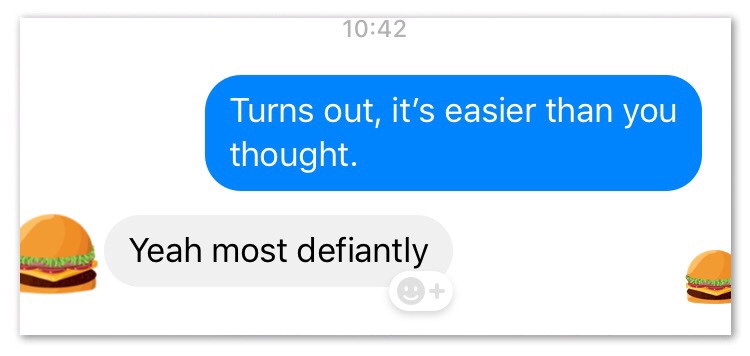
It happens in my own conversations several individuals on a regular basis. In fact, it happened again just yesterday, so I took a screenshot with this blog post in mind.

Yes. I most definitely did turn my friend into a hamburger to protect their identity. 

I don’t know whether autocorrect is to blame, presumably as a result of poor typing, or if it’s just plain old-fashioned ignorance. The answer to that probably varies from one perpetrator to another, but  either way, continuing to mistake one for the other is inexcusable. 

Definitely means “for sure” or “absolutely”. 
In fact, those are excellent choices for anyone who wants to agree with something, but doesn’t actually know how to spell “definitely”. 

Here’s a hint, though.
Definitely even sounds exactly as it is spelt: def-in-it-ely.
It’s phonetically straightforward.

Therefore, anyone trying to spell it should get to the ‘a’ in ‘defiantly’ and know they’re making bad choices. 

Defiantly is a word most often used by parents or teachers describing the way in which a child refused to do as they were told. 
Examples:
The child sat in stony silence, arms crossed defiantly. 
“No!” Robin yelled defiantly, “I won’t apologise for being a grammar snob!” 

You get the idea. 

It’s definitely in your interests to get this right.

Make good choices, people… please?

Frequently Mistaken: ‘who’s’ and ‘whose’

Today I received an email which included the line, “It doesn’t matter who’s responsibility it is…”

Written by a professional who should know better, it was ironic that it was me, and not them, doing a massive facepalm.

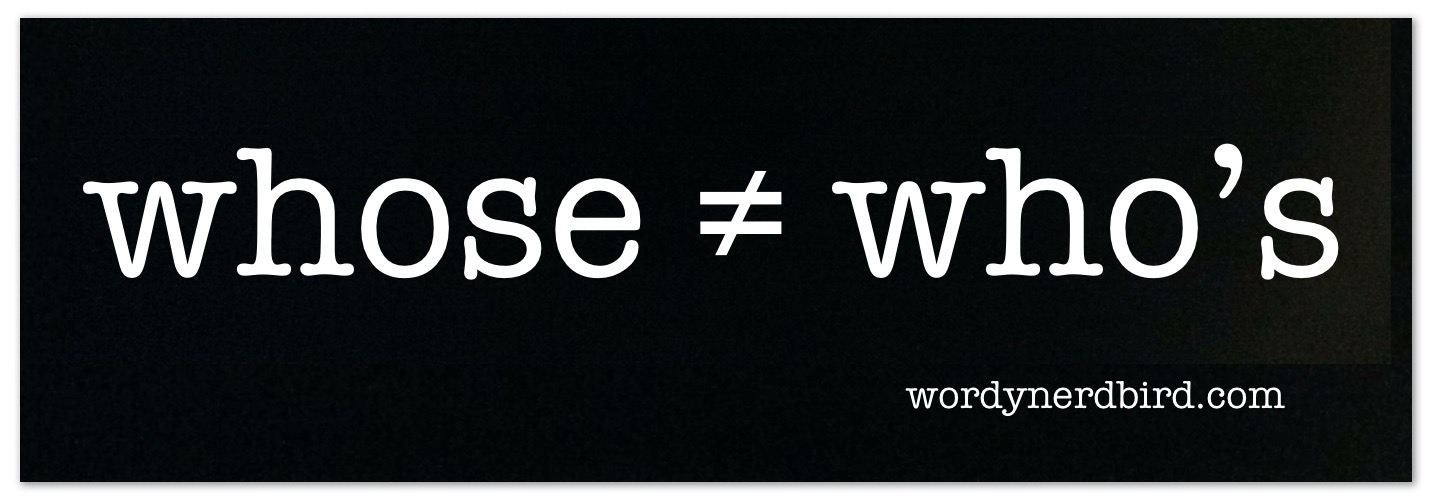
This incorrect use of the homophone “who’s” instead of “whose” is a common error, but that doesn’t make it excusable.

The apostrophe in “who’s” signals that it is a contraction— a shortening of two words into one, so that “who is” becomes “who’s”. Alternatively, it can also be a contraction of “who has”. You can tell which one it is by determining if the sentence is in past or present tense,

Examples:
That’s the boy who’s a really good actor.
Who’s in charge around here?
Who’s been eating my porridge?

‘Whose’ is a pronoun of ownership. 

Examples:
This is the farmer whose cows ate all my corn. 
Whose car is that? 

Once you know the difference, it’s fairly straightforward. That means there is absolutely no excuse for getting them wrong, even if they do sound the same when spoken.

Fun fact: “it’s” and “its” work exactly the same way.

‘Then’ and ‘Than’ Are Not The Same Word.

Some word confusions are understandable, especially if they sound the same when spoken. We call those homophones, and they sound the same even if they are spelt differently.  Examples are peak/pique/peak or there/their/they’re.

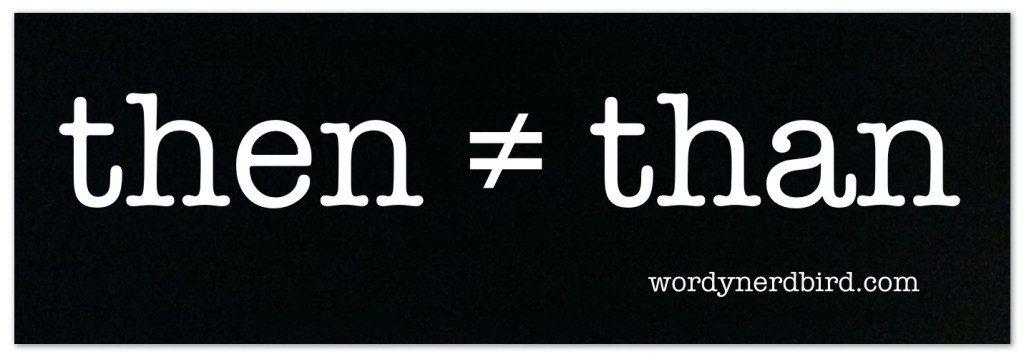
The confusion between ’then’ and ’than’, however, is a completely different matter.

Sadly, this is happening more and more, especially on social media. I don’t even spend that much time on Facebook, but it feels like I see someone saying something like “Nothing is better then this!”  or “I love you more then anything!” at least twice a day. 

Yes, they are similar. 
However, they are clearly not the same.
They don’t look the same.
They don’t sound the same. 
If one doesn’t mix up ’then’ or ’than’ with ’thin’, there is no excuse for mistaking them for one another. 

I swear, it makes my eyes want to bleed.

The two words’ meanings are so vastly different that getting them wrong just makes the person writing look  either poorly educated or plain stupid, even if they are neither. 

This is one of the best and most self-evident arguments in existence for proofreading what one is writing, anywhere and every time. 

‘Then’ rhymes with ‘when”— which is an easy way to remember that it relates to time or sequence. 
Examples: 
He put on his shirt, then his jeans, and then his boots. 
She ran up the hill, then back down again. 
When you have tidied your room, then you can go to the movies. 

‘Than’ rhymes with ‘man’ and is used for making a comparison. 
Examples:
His piece of pizza is bigger than mine. 
A triangle has fewer angles than a square. 
I would rather stay home and read a book than go to work. 

Knowing which is which, and taking care to use the right words all the time, is a simple way to protect your credibility.

And for the love of Merlin’s beard, if you call yourself an author or a teacher, get it right. It’s not that hard. 

Misunderstood Shakespeare: ‘Sea Change’

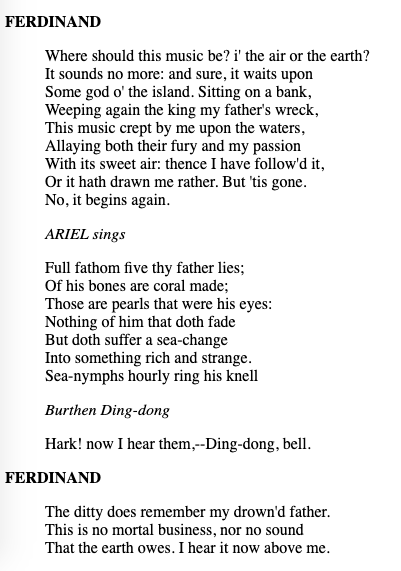
These days we understand the phrase “sea change” to reflect something new and positive in one’s life. It is frequently used to describe a significant transformation in a person or in one’s lifestyle.

In Australia, it has also come to mean a physical move from the city or the country to live closer to the ocean, or even taking a holiday at the beach. 

The phrase hasn’t always had such positive associations. 

In Act 1, Scene 2 of Shakespeare’s play ’The Tempest’, Prospero’s familiar spirit Ariel sings a song that makes Ferdinand believe that his father, Alonso, has drowned in a shipwreck, and that his father is buried at sea “full fathom five”, or five fathoms deep. Through the action of the water on his remains, his body is undergoing substantive changes: his eyes are turning into pearls and his bones into coral. There is nothing left of him that has not been transformed by the sea. 

Even worse, this story of the shipwreck and drowning is not true. It is, in fact, a ruse by Prospero to orchestrate a marriage match between his daughter, Miranda, and Ferdinand. Prospero is quite comfortable with using trickery and misleading magic to achieve what he wants to, and this is not the only time during this play that he willingly deceives others to get what he wants. 

So, even though it does still reflect a significant transformation, it has much darker connotations than the term does now. Deceit, manipulation, grief and emotional blackmail all factor into the origins of this phrase that we use so differently today. 

Being Conscious of One’s Conscience

Said to me today: “I don’t want that on my conscious.”
Me: “You probably don’t want it on your conscience, either.” 
Them: “Huh?”
Me: “They are different words.” 
Them: “Really?”
Me: “I promise you.”

These commonly confused words sound similar but they are not homophones. 

Conscious is an adjective. It is a descriptive word that means awake or aware. 

Examples:
I’m conscious of the confusion between words that sound similar but which are very different in meaning.
He passed out, but he is conscious again now. 

Conscience is a noun. It’s the name given to that part of our being that tells us not to do something we know we shouldn’t, and accuses us when we have done something wrong so that we feel bad about it. 

Examples:
She was good at acting innocent, but her conscience was plagued by guilt.
His conscience reminded him daily of the things he had done. 

The difference in the way these words sound is minor, but the difference in meaning is significant

Don’t Waver Over Your Waivers!

A mistake frequently made in writing is to say that someone “did not waiver” in their faith, or from a decision they had made.  What they really mean is that the person in question did not waver

Once again, it is a failure to choose between differently spelled homophones that is the problem here. 

Waiver: the renunciation or surrendering of  ownership, a right  or a claim
Example: The council decided to waive the annual fee for dog registration. The waiver resulted in more households registering  their pets. 

Waver: to hesitate or falter, or to flicker, quiver or tremble.
Examples: Her feelings for him wavered between passionate love and indifference. 
He did not waver in his support for the mayor, who was a woman of integrity. 
The flame of the candle wavered in the gentle breeze.

At least when one waves at the waves, the spelling is the same so you can’t get it wrong!

Podcast Review: ‘Fry’s English Delight’

As soon as I discovered the existence of this podcast I knew it was going to be good. 

Steven Fry, actor, comedian, TV host, really needs no introduction. He has a nice voice, charming style and ease of delivery that really suit these enjoyable and varied excursions into different aspects of the English language.

The fact that the title is a play on Fry’s Turkish Delight is an indication of the defining qualities of the show: clever, witty, rather English, and most enjoyable. 

The podcast is very easy listening, presented in language anyone can understand. Each episode runs for just under half an hour, so it fits well into the time people might spend commuting, exercising or having lunch. It’s obviously a show designed to be interesting and entertaining for everyone, not just for academics or linguists, although as an English teacher of more years that I care to admit, I certainly don’t feel as though it over-simplifies or talks down to people, either. 

Apart from being great entertainment, the value of a podcast like this is that it not only teaches or reminds us about elements of the English language that we use every day without thinking, it also helps us to appreciate the beauty and intricacy of language and the ways it can be used to create and shape meaning so that our communications are more thoughtful and effective. 

The podcast is available via Audible, and is free of charge for members. 

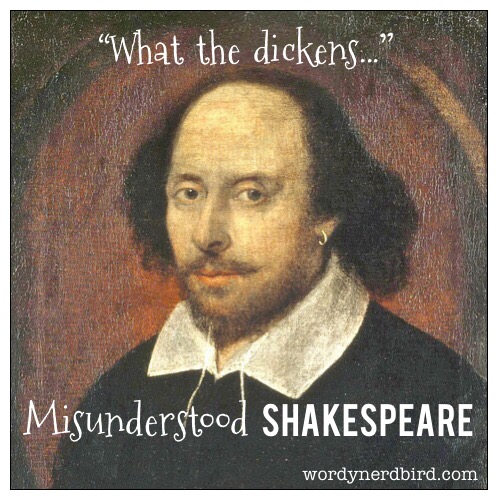
Misunderstood Shakespeare: “What The Dickens”

Many people assume that “What the dickens?” is a reference to the author Charles Dickens. 

Considering that Shakespeare wrote this expression in ‘The Merry Wives of Windsor’ in 1600 and Charles Dickens was born in 1812, that is entirely impossible. 

Instead, ‘dickens’ is a euphemism for ‘devil’, as is ‘deuce’. When Mrs Page says “I cannot tell what the dickens his name is…” she really means ‘what the devil”.

It’s a more polite way of expressing strength of an idea or emphasising their intent, in this case, that she has no idea of the identity of the person she is being asked about. It’s exactly the same as people saying ‘heck’ instead of hell, ‘gosh’ instead of ‘God’ and ‘jeez’ instead of ‘Jesus’, and is probably  done for the same reason: superstitious avoidance of using religious terms, or “using in vain” the names of religious entities. 

There’s also a chance that, for some folks, old-fashioned good manners may enter into it, too. 

In short, this is a euphemism: an inoffensive word or phrase used to replace an impolite or offensive one. We use euphemism when we talk about “powdering my nose” or “going to see a man about a dog” instead of “going to the bathroom”, or “bathroom” instead of “toilet”.

Like many of Shakespeare’s words and phrases, “what the dickens” has stood the test of time and is still used as a euphemism today.

A Fit of Pique.

I get really annoyed when I see people writing about peaking someone’s interest. 

A mountain is peaked. A cap can be peaked. 
People can even look peaked: in this sense, it means they are pale. 
A career can peak. 
In fact, someone’s interest in something can peak, right before it declines again. 

While they sound the same, the correct term for having caused intense interest or curiosity, is piqued

To pique someone’s interest is to heighten or arouse it. In other words, it is to stimulate their curiosity or attention. 

A fit of pique is an episode of annoyance or irritation – such as might happen, for example, if someone’s negative emotions are piqued. 

A related word is piquant, which means provocative, tantalising, spicy or tangy. Food that excites the taste buds or a story that excites the imagination can both be described as piquant. 

The other homophone is peeked. This is the past tense of peek: to take a quick look, or a sneaky one. 

So… now that I’ve piqued your interest with my fit of pique, and you’ve peeked at my post… I’m sure your interest has long since peaked. 

See? Homophones can be fun!