This poem is something of a tardis – it’s bigger on the inside. It’s not very long, but it tells a story that takes the reader from the wide-angle scenery of the landscape at night and a small boat on the water to the intimacy of a cabin in which the secretive lovers meet. It’s Romantic, but it’s really all about the stealth and secrecy that was even more typical of Victorian England than its Romanticism.
The imagery is magnificent and the storytelling is clever: the meaning is clear, even though much is left to the reader’s own imagination. This is the art of poetry: to evoke what the reader already knows, and yet to make it new at the same time.
Meeting at Night
I The grey sea and the long black land; And the yellow half-moon large and low; And the startled little waves that leap In fiery ringlets from their sleep, As I gain the cove with pushing prow, And quench its speed i’ the slushy sand.
II Then a mile of warm sea-scented beach; Three fields to cross till a farm appears; A tap at the pane, the quick sharp scratch And blue spurt of a lighted match, And a voice less loud, thro’ its joys and fears, Than the two hearts beating each to each!
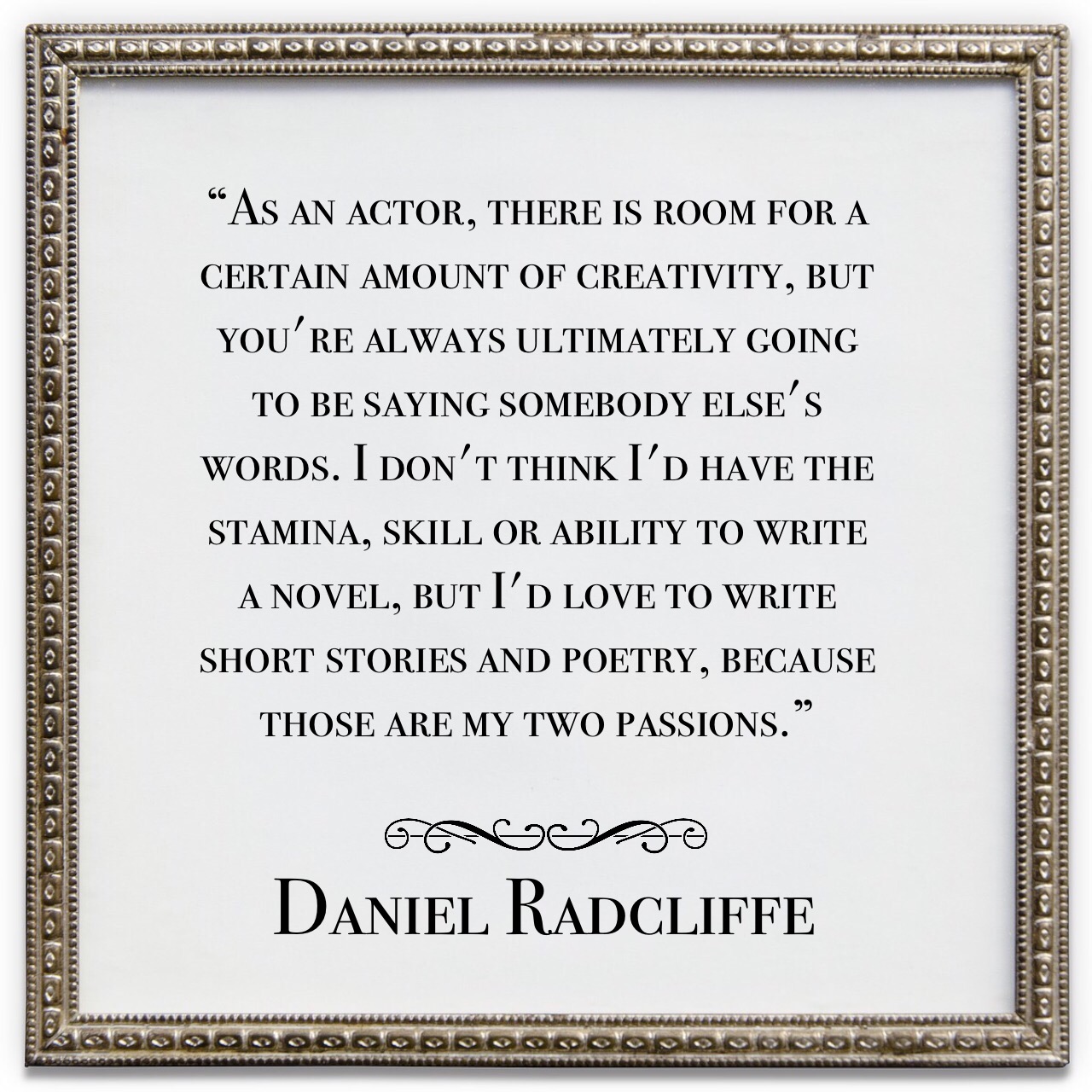
Daniel Radcliffe is a man who obviously loves good poetry. This is an indication to me that he has good taste. In fact, in my mind it’s a genre recommending a person, instead of the other way around.
While I’m thrilled to see that short stories and poetry are his two literary passions- they are, after all, my favourite forms of writing- I do dispute that writing a novel takes more stamina, skill or ability. In fact, it’s a different set of skills and abilities, and using them requires as much stamina as writing a novel.
He is right, though, about the ability to use one’s own words to create and communicate meaning. It’s incredibly liberating and empowering.
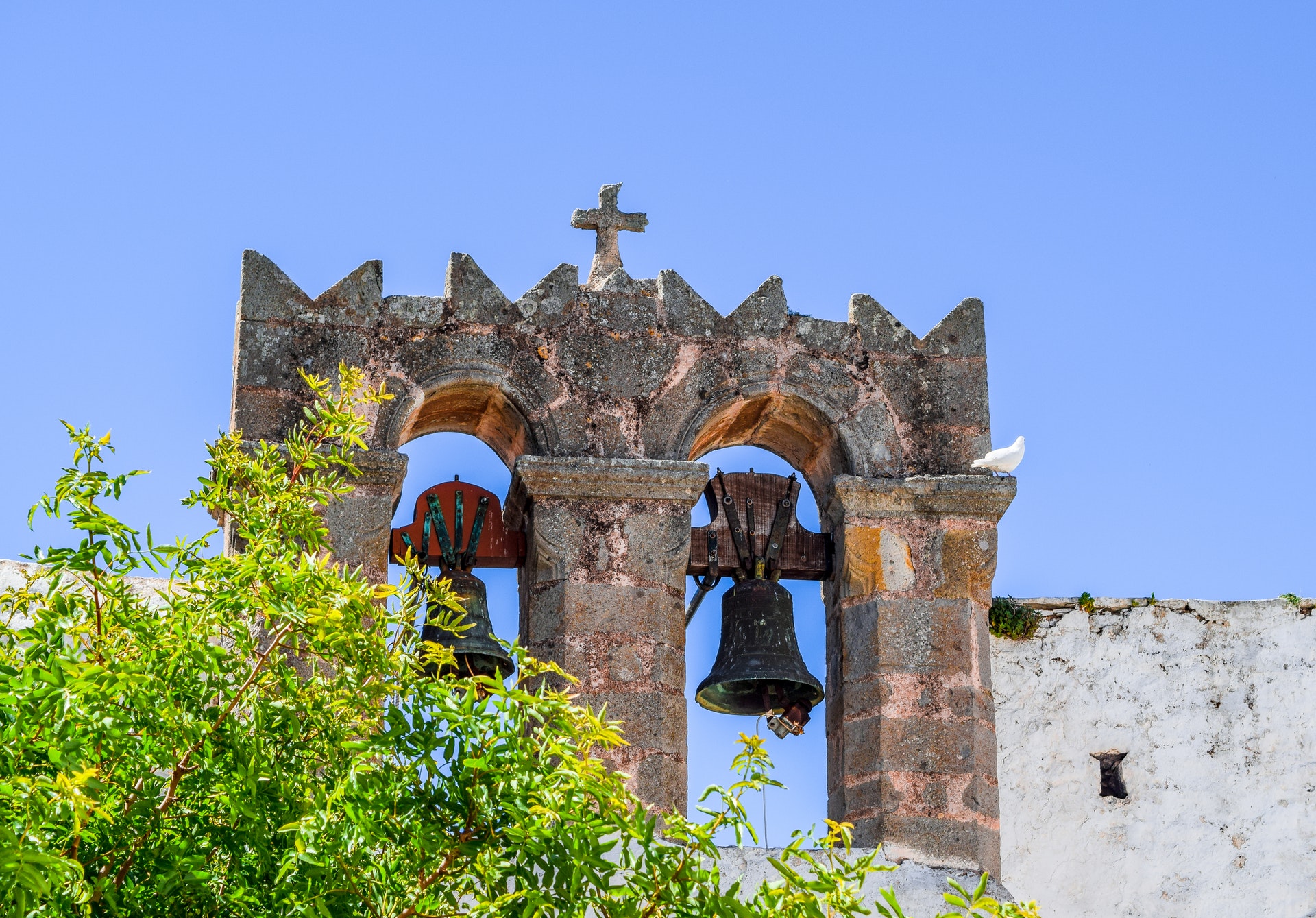
Many people think that ‘For whom the bell tolls’ is a phrase coined by Hemingway. Not so.
In his famous novel set during the Spanish Civil War, Hemingway was quoting this poem by John Donne.
In a very direct and yet still poetic manner, Donne delivers the key idea of the poem: what happens to all of humanity happens to each of us individually. The tolling of the funeral bells is a reminder that when someone— anyone— dies, we are all diminished.
These days, bells are seldom rung for funerals. It’s really only the famous or important – and they are different things in my mind – whose passing is announced in that way. Yet every funeral I attend, or death notice I read, or social media post announcing someone’s passing, brings this poem to my mind.
For Whom The Bell Tolls
No man is an island, Entire of itself. Each is a piece of the continent, A part of the main. If a clod be washed away by the sea, Europe is the less. As well as if a promontory were. As well as if a manor of thine own Or of thine friend’s were. Each man’s death diminishes me, For I am involved in mankind. Therefore, send not to know For whom the bell tolls, It tolls for thee.
Just imagine a world Where more people read poetry Instead of giving breath To things that divide and cause fear.
Imagine a world Where more people picked up a pen Than a gun or a sword Or even a lawyer.
Imagine a world Where poets were the dealers That troubled souls turned to for a hit; Where people self-medicated with poetry Rather than drugs or alcohol To help them deal With their demons; Where addiction brought life and hope, Mindfulness and restoration To the broken, The hurting, The needy.
Imagine a world Where everyone knew and understood That they are not alone, That someone understands, That they are enough.
This is a poem that makes history really memorable. Longfellow tells the story of Paul Revere riding through Massachusetts late at night in 1775, warning of the impending arrival of the British military during the American War of Independence.
A story well known to Americans, Paul Revere’s ride became known to me- and probably many other Australians- through this poem long before I knew anything else about why it mattered that the British were coming.
It is an exciting poem that draws the reader in, even though they know how it ends. The pace and rhythm seem to echo the galloping of the horse’s hooves, evoking the urgency and importance of Revere’s late-night mission, and taking the audience along for the ride.
Listen my children and you shall hear Of the midnight ride of Paul Revere, On the eighteenth of April, in Seventy-five; Hardly a man is now alive Who remembers that famous day and year.
He said to his friend, “If the British march By land or sea from the town to-night, Hang a lantern aloft in the belfry arch Of the North Church tower as a signal light, One if by land, and two if by sea; And I on the opposite shore will be, Ready to ride and spread the alarm Through every Middlesex village and farm, For the country folk to be up and to arm.”
Then he said “Good-night!” and with muffled oar Silently rowed to the Charlestown shore, Just as the moon rose over the bay, Where swinging wide at her moorings lay The Somerset, British man-of-war; A phantom ship, with each mast and spar Across the moon like a prison bar, And a huge black hulk, that was magnified By its own reflection in the tide.
Meanwhile, his friend through alley and street Wanders and watches, with eager ears, Till in the silence around him he hears The muster of men at the barrack door, The sound of arms, and the tramp of feet, And the measured tread of the grenadiers, Marching down to their boats on the shore.
Then he climbed the tower of the Old North Church, By the wooden stairs, with stealthy tread, To the belfry chamber overhead, And startled the pigeons from their perch On the sombre rafters, that round him made Masses and moving shapes of shade, By the trembling ladder, steep and tall, To the highest window in the wall, Where he paused to listen and look down A moment on the roofs of the town And the moonlight flowing over all.
Beneath, in the churchyard, lay the dead, In their night encampment on the hill, Wrapped in silence so deep and still That he could hear, like a sentinel’s tread, The watchful night-wind, as it went Creeping along from tent to tent, And seeming to whisper, “All is well!” A moment only he feels the spell Of the place and the hour, and the secret dread Of the lonely belfry and the dead; For suddenly all his thoughts are bent On a shadowy something far away, Where the river widens to meet the bay, A line of black that bends and floats On the rising tide like a bridge of boats.
Meanwhile, impatient to mount and ride, Booted and spurred, with a heavy stride On the opposite shore walked Paul Revere. Now he patted his horse’s side, Now he gazed at the landscape far and near, Then, impetuous, stamped the earth, And turned and tightened his saddle girth; But mostly he watched with eager search The belfry tower of the Old North Church, As it rose above the graves on the hill, Lonely and spectral and sombre and still. And lo! as he looks, on the belfry’s height A glimmer, and then a gleam of light! He springs to the saddle, the bridle he turns, But lingers and gazes, till full on his sight A second lamp in the belfry burns.
A hurry of hoofs in a village street, A shape in the moonlight, a bulk in the dark, And beneath, from the pebbles, in passing, a spark Struck out by a steed flying fearless and fleet; That was all! And yet, through the gloom and the light, The fate of a nation was riding that night; And the spark struck out by that steed, in his flight, Kindled the land into flame with its heat. He has left the village and mounted the steep, And beneath him, tranquil and broad and deep, Is the Mystic, meeting the ocean tides; And under the alders that skirt its edge, Now soft on the sand, now loud on the ledge, Is heard the tramp of his steed as he rides.
It was twelve by the village clock When he crossed the bridge into Medford town. He heard the crowing of the cock, And the barking of the farmer’s dog, And felt the damp of the river fog, That rises after the sun goes down.
It was one by the village clock, When he galloped into Lexington. He saw the gilded weathercock Swim in the moonlight as he passed, And the meeting-house windows, black and bare, Gaze at him with a spectral glare, As if they already stood aghast At the bloody work they would look upon.
It was two by the village clock, When he came to the bridge in Concord town. He heard the bleating of the flock, And the twitter of birds among the trees, And felt the breath of the morning breeze Blowing over the meadow brown. And one was safe and asleep in his bed Who at the bridge would be first to fall, Who that day would be lying dead, Pierced by a British musket ball.
You know the rest. In the books you have read How the British Regulars fired and fled, How the farmers gave them ball for ball, From behind each fence and farmyard wall, Chasing the redcoats down the lane, Then crossing the fields to emerge again Under the trees at the turn of the road, And only pausing to fire and load.
So through the night rode Paul Revere; And so through the night went his cry of alarm To every Middlesex village and farm, A cry of defiance, and not of fear, A voice in the darkness, a knock at the door, And a word that shall echo for evermore! For, borne on the night-wind of the Past, Through all our history, to the last, In the hour of darkness and peril and need, The people will waken and listen to hear The hurrying hoof-beats of that steed, And the midnight message of Paul Revere.
It is no secret that I love Tennyson’s poetry, and consider him one of my great literary inspirations.
It’s hard to pin down which of his poems is my favourite, because so many of them are brilliant. Several of my favourites, though, do belong to the poetry he wrote about the world of King Arthur and Camelot: The Lady of Shalott, The Idylls of the King, and Morte d’Arthur.
Morte d’Arthur is written in blank verse, which means it doesn’t rhyme, but it flows naturally because of its rhythm. Iambic pentameter means there are five sets of a ‘ba-boom’ rhythm in each line – think of a heart beat, or the way we say words like ‘beyond’ or ‘afar’. It gives poetry an easy lilt that lures the reader into the feeling of the poem and the words, which is why it has proven to be very popular among poets and readers alike.
This poem tells the story of the end of King Arthur’s life, and his conversations with Sir Bedivere about what should be done with Excalibur, the sword which he had received from the Lady of the Lake. As with all great fantasy stories, there is tragedy, a challenge to loyalty, and some lovely magical moments.
It’s a long poem, but well worth reading. I hope you enjoy it.
Image: Public Domain. ‘The Death of King Arthur’ by John Garrick
Morte d’Arthur
So all day long the noise of battle roll’d Among the mountains by the winter sea; Until King Arthur’s table, man by man, Had fallen in Lyonnesse about their Lord, King Arthur: then, because his wound was deep, The bold Sir Bedivere uplifted him, Sir Bedivere, the last of all his knights, And bore him to a chapel nigh the field, A broken chancel with a broken cross, That stood on a dark strait of barren land. On one side lay the ocean, and on one Lay a great water, and the moon was full.
Then spake King Arthur to Sir Bedivere: “The sequel of to-day unsolders all The goodliest fellowship of famous knights Whereof this world holds record. Such a sleep They sleep—the men I loved. I think that we Shall never more, at any future time, Delight our souls with talk of knightly deeds, Walking about the gardens and the halls Of Camelot, as in the days that were. I perish by this people which I made,— Tho’ Merlin sware that I should come again To rule once more—but let what will be, be, I am so deeply smitten thro’ the helm That without help I cannot last till morn. Thou therefore take my brand Excalibur, Which was my pride: for thou rememberest how In those old days, one summer noon, an arm Rose up from out the bosom of the lake, Clothed in white samite, mystic, wonderful, Holding the sword—and how I row’d across And took it, and have worn it, like a king: And, wheresoever I am sung or told In aftertime, this also shall be known: But now delay not: take Excalibur, And fling him far into the middle mere: Watch what thou seëst, and lightly bring me word.”
To him replied the bold Sir Bedivere: “It is not meet, Sir King, to leave thee thus, Aidless, alone, and smitten thro’ the helm. A little thing may harm a wounded man. Yet I thy hest will all perform at full, Watch what I see, and lightly bring thee word.”
So saying, from the ruin’d shrine he stept And in the moon athwart the place of tombs, Where lay the mighty bones of ancient men, Old knights, and over them the sea-wind sang Shrill, chill, with flakes of foam. He, stepping down By zigzag paths, and juts of pointed rock, Came on the shining levels of the lake.
There drew he forth the brand Excalibur, And o’er him, drawing it, the winter moon, Brightening the skirts of a long cloud, ran forth And sparkled keen with frost against the hilt: For all the haft twinkled with diamond sparks, Myriads of topaz-lights, and jacinth work Of subtlest jewellery. He gazed so long That both his eyes were dazzled, as he stood, This way and that dividing the swift mind, In act to throw: but at the last it seem’d Better to leave Excalibur conceal’d There in the many-knotted water-flags, That whistled stiff and dry about the marge. So strode he back slow to the wounded King.
Then spake King Arthur to Sir Bedivere: “Hast thou perform’d my mission which I gave? What is it thou hast seen, or what hast heard?”
And answer made the bold Sir Bedivere: “I heard the ripple washing in the reeds, And the wild water lapping on the crag.”
To whom replied King Arthur, faint and pale: “Thou hast betray’d thy nature and thy name, Not rendering true answer, as beseem’d Thy fealty, nor like a noble knight: For surer sign had follow’d, either hand, Or voice, or else a motion of the mere. This is a shameful thing for men to lie. Yet now, I charge thee, quickly go again As thou art lief and dear, and do the thing I bade thee, watch, and lightly bring me word.”
Then went Sir Bedivere the second time Across the ridge, and paced beside the mere, Counting the dewy pebbles, fixed in thought; But when he saw the wonder of the hilt, How curiously and strangely chased, he smote His palms together, and he cried aloud,
“And if indeed I cast the brand away, Surely a precious thing, one worthy note, Should thus be lost forever from the earth, Which might have pleased the eyes of many men. What good should follow this, if this were done? What harm, undone? deep harm to disobey, Seeing obedience is the bond of rule. Were it well to obey then, if a king demand An act unprofitable, against himself? The King is sick, and knows not what he does. What record, or what relic of my lord Should be to aftertime, but empty breath And rumours of a doubt? but were this kept, Stored in some treasure-house of mighty kings, Some one might show it at a joust of arms, Saying, ‘King Arthur’s sword, Excalibur, Wrought by the lonely maiden of the Lake; Nine years she wrought it, sitting in the deeps Upon the hidden bases of the hills.’ So might some old man speak in the aftertime To all the people, winning reverence. But now much honour and much fame were lost.”
So spake he, clouded with his own conceit, And hid Excalibur the second time, And so strode back slow to the wounded King.
Then spoke King Arthur, breathing heavily: “What is it thou hast seen, or what hast heard?”
And answer made the bold Sir Bedivere: “I heard the water lapping on the crag, And the long ripple washing in the reeds.”
To whom replied King Arthur, much in wrath: “Ah, miserable and unkind, untrue, Unknightly, traitor-hearted! Woe is me! Authority forgets a dying king, Laid widow’d of the power in his eye That bow’d the will. I see thee what thou art, For thou, the latest-left of all my knights, In whom should meet the offices of all, Thou wouldst betray me for the precious hilt; Either from lust of gold, or like a girl Valuing the giddy pleasure of the eyes. Yet, for a man may fail in duty twice, And the third time may prosper, get thee hence: But, if thou spare to fling Excalibur, I will arise and slay thee with my hands.”
Then quickly rose Sir Bedivere, and ran, And, leaping down the ridges lightly, plunged Among the bulrush-beds, and clutch’d the sword, And strongly wheel’d and threw it. The great brand Made lightnings in the splendour of the moon, And flashing round and round, and whirl’d in an arch, Shot like a streamer of the northern morn, Seen where the moving isles of winter shock By night, with noises of the northern sea. So flash’d and fell the brand Excalibur: But ere he dipt the surface, rose an arm Clothed in white samite, mystic, wonderful, And caught him by the hilt, and brandish’d him Three times, and drew him under in the mere. And lightly went the other to the King.
Then spoke King Arthur, drawing thicker breath: “Now see I by thine eyes that this is done. Speak out: what is it thou hast heard, or seen?”
And answer made the bold Sir Bedivere: “Sir King, I closed mine eyelids, lest the gems Should blind my purpose, for I never saw, Nor shall see, here or elsewhere, till I die, Not tho’ I live three lives of mortal men, So great a miracle as yonder hilt. Then with both hands I flung him, wheeling him; But when I look’d again, behold an arm, Clothed in white samite, mystic, wonderful, That caught him by the hilt, and brandish’d him Three times, and drew him under in the mere.”
And answer made King Arthur, breathing hard: “My end draws nigh; ‘t is time that I were gone. Make broad thy shoulders to receive my weight, And bear me to the margin; yet I fear My wound hath taken cold, and I shall die.”
So saying, from the pavement he half rose, Slowly, with pain, reclining on his arm, And looking wistfully with wide blue eyes As in a picture. Him Sir Bedivere Remorsefully regarded thro’ his tears, And would have spoken, but he found not words, Then took with care, and kneeling on one knee, O’er both his shoulders drew the languid hands, And rising bore him thro’ the place of tombs.
But, as he walk’d, King Arthur panted hard, Like one that feels a nightmare on his bed When all the house is mute. So sigh’d the King Muttering and murmuring at his ear, “Quick, quick! I fear it is too late, and I shall die.” But the other swiftly strode from ridge to ridge, Clothed with his breath, and looking, as he walk’d Larger than human on the frozen hills. He heard the deep behind him, and a cry Before. His own thought drove him like a goad. Dry clash’d his harness in the icy caves And barren chasms, and all to left and right The bare black cliff clang’d round him, as he based His feet on juts of slippery crag that rang Sharp-smitten with the dint of armed heels— And on a sudden, lo! the level lake, And the long glories of the winter moon.
Then saw they how there hove a dusky barge Dark as a funeral scarf from stem to stern, Beneath them; and descending they were ware That all the decks were dense with stately forms Black-stoled, black-hooded, like a dream—by these Three Queens with crowns of gold—and from them rose A cry that shiver’d to the tingling stars, And, as it were one voice, an agony Of lamentation, like a wind, that shrills All night in a waste land, where no one comes, Or hath come, since the making of the world.
Then murmur’d Arthur, “Place me in the barge,” And to the barge they came. There those three Queens Put forth their hands, and took the King, and wept. But she that rose the tallest of them all And fairest, laid his head upon her lap, And loosed the shatter’d casque, and chafed his hands, And call’d him by his name, complaining loud And dropping bitter tears against his brow Striped with dark blood: for all his face was white And colourless, and like the wither’d moon Smote by the fresh beam of the springing east; And all his greaves and cuisses dash’d with drops Of onset; and the light and lustrous curls— That made his forehead like a rising sun High from the daïs-throne—were parch’d with dust; Or, clotted into points and hanging loose, Mix’d with the knightly growth that fringed his lips. So like a shatter’d column lay the King; Not like that Arthur who, with lance in rest, From spur to plume a star of tournament, Shot thro’ the lists at Camelot, and charged Before the eyes of ladies and of kings.
Then loudly cried the bold Sir Bedivere: “Ah! my Lord Arthur, whither shall I go? Where shall I hide my forehead and my eyes? For now I see the true old times are dead, When every morning brought a noble chance, And every chance brought out a noble knight. Such times have been not since the light that led The holy Elders with the gift of myrrh. But now the whole Round Table is dissolved Which was an image of the mighty world; And I, the last, go forth companionless, And the days darken round me, and the years, Among new men, strange faces, other minds.”
And slowly answer’d Arthur from the barge: “The old order changeth, yielding place to new, And God fulfils Himself in many ways, Lest one good custom should corrupt the world. Comfort thyself: what comfort is in me? I have lived my life, and that which I have done May He within Himself make pure! but thou, If thou shouldst never see my face again, Pray for my soul. More things are wrought by prayer Than this world dreams of. Wherefore, let thy voice Rise like a fountain for me night and day. For what are men better than sheep or goats That nourish a blind life within the brain, If, knowing God, they lift not hands of prayer Both for themselves and those who call them friend? For so the whole round earth is every way Bound by gold chains about the feet of God. But now farewell. I am going a long way With these thou seëst—if indeed I go— (For all my mind is clouded with a doubt) To the island-valley of Avilion; Where falls not hail, or rain, or any snow, Nor ever wind blows loudly; but it lies Deep-meadow’d, happy, fair with orchard-lawns And bowery hollows crown’d with summer sea, Where I will heal me of my grievous wound.”
So said he, and the barge with oar and sail Moved from the brink, like some full-breasted swan That, fluting a wild carol ere her death, Ruffles her pure cold plume, and takes the flood With swarthy webs. Long stood Sir Bedivere Revolving many memories, till the hull Look’d one black dot against the verge of dawn, And on the mere the wailing died away.
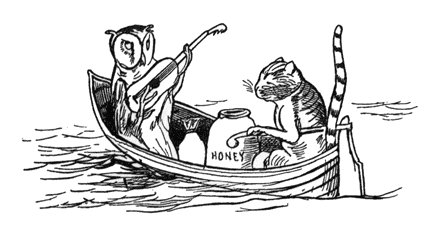
As a child, I always enjoyed this poem. I enjoyed the silliness of it, the musical rhythm and the sense of Fantasy.
I The Owl and the Pussy-cat went to sea In a beautiful pea-green boat, They took some honey, and plenty of money, Wrapped up in a five-pound note. The Owl looked up to the stars above, And sang to a small guitar, ‘O lovely Pussy! O Pussy, my love, What a beautiful Pussy you are, You are, You are! What a beautiful Pussy you are!’
II Pussy said to the Owl, ‘You elegant fowl! How charmingly sweet you sing! O let us be married! too long we have tarried: But what shall we do for a ring?’ They sailed away, for a year and a day, To the land where the Bong-Tree grows And there in a wood a Piggy-wig stood With a ring at the end of his nose, His nose, His nose, With a ring at the end of his nose.
III ‘Dear Pig, are you willing to sell for one shilling Your ring?’ Said the Piggy, ‘I will.’ So they took it away, and were married next day By the Turkey who lives on the hill. They dined on mince, and slices of quince, Which they ate with a runcible spoon; And hand in hand, on the edge of the sand, They danced by the light of the moon, The moon, The moon, They danced by the light of the moon.
Image:Public Domain Edward Lear’s Own illustration of The Owl and the Pussy Cat
I must confess, though, that I hadn’t thought about this poem for many years until a friend quoted it in her newly-released paranormal romance novel. Having read and reviewed the book, it left me pondering the poem.
In the poet’s Victorian setting it was classified as nonsense poetry, a bit of whimsy and silliness for the entertainment of children.
I do wonder now, though, if there is a hint of rebellion against Victorian society’s moral and class standards in the unlikely union of those two mismatched creatures, and if that’s why they had to go away to be together. It could just be my 21st century sensitivities talking, but I’d like to think that maybe, back in the late 1860s, Lear was sending a subtle message to the morality police of the time that if two people were in love, they should be able to be together.
I know people accuse English teachers of overthinking these things all the time, but just stop and think about it for a moment.
The owl and the pussycat weren’t supposed to be together, but they were quite free in expressing their feelings for one another and very happy together. Which of the two is male, and which is female? Or are they really even one of each? They do seem remarkably neutral in that regard, especially if you think of the strict gender stereotypes apparent in other Victorian literature such as that by Dickens, Thackeray, Trollope and the Brontes.
It is just a curious thought, and I don’t want to shatter anyone’s enjoyment of a much-loved children’s poem. Maybe it is just whimsical make-believe. Maybe it’s not. We will never know.
But it’s also a possibility that there are a whole bunch of people out there who might appreciate this poem a whole lot more on consideration of my uncommon little theory. Oh, I hope so!
In my post on Songs and Poetry, I explored the idea that lyrics of songs are often poetry. Indeed, one could argue that the more poetic and emotive the lyrics, the greater chance of that song becoming an anthem for some listeners. This is certainly true in my own experience.
One of the artists in my “Anthems” playlist is P!nk. I love her attitude, her style, and her voice. Even more, I have found some of her lyrics to be enormously powerful and emotive, and very relatable. She may be a rock goddess who knows how to entertain, but she is also a poet who knows how touch someone’s soul.
That’s why it came as no surprise to me that she used to write poetry. It shows.
What P!nk says about the therapeutic effects of writing poetry is true, too. It does feel good to get the darkness out, and to shape it into something that is meaningful to others as well as oneself. As I have often commented, writing poetry is the most effective therapy I have ever had.
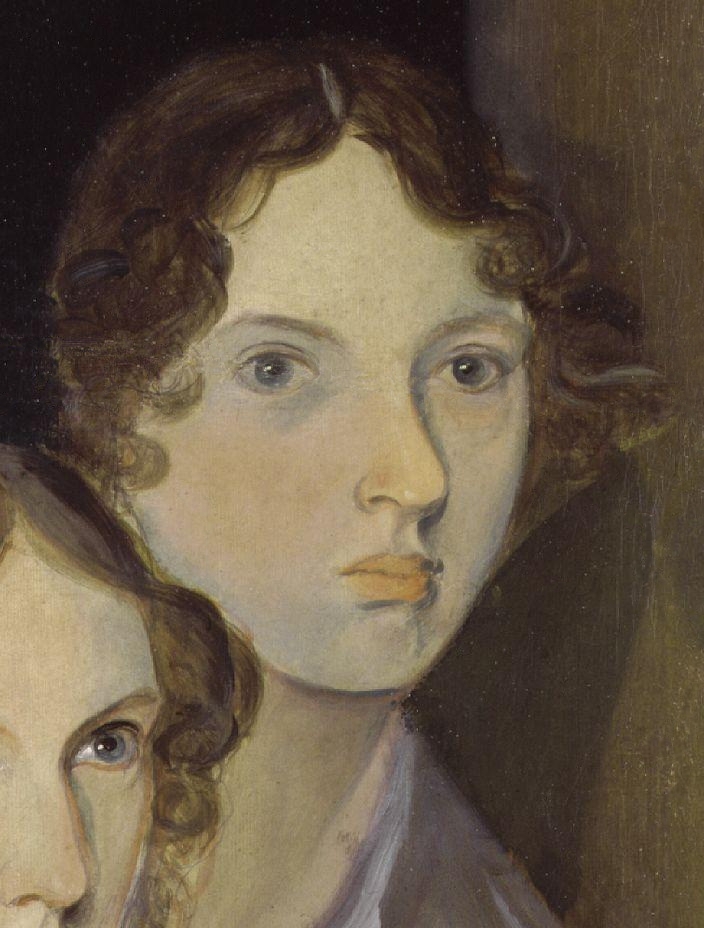
Emily Bronte, famous for her classic Victorian gothic novel Wuthering Heights, also wrote poetry.
Her poems do share some qualities with Wuthering Heights: themes of misery, loneliness and grief, and dark, powerful imagery that makes Bronte’s thoughts come to life and leap off the page.
While fewer people are familiar with her poems than that magnificent book, her poetry really does deserve to be more widely read.
This poem captures that feeling of complete isolation and the despair of inner conflict experienced by one agonising over the situation they are in while someone else sleeps peacefully, unaware of the torment of the other.
Honour’s Martyr
The moon is full this winter night; The stars are clear, though few; And every window glistens bright, With leaves of frozen dew.
The sweet moon through your lattice gleams And lights your room like day; And there you pass, in happy dreams, The peaceful hours away!
While I, with effort hardly quelling The anguish in my breast, Wander about the silent dwelling, And cannot think of rest.
The old clock in the gloomy hall Ticks on, from hour to hour; And every time its measured call Seems lingering slow and slower:
And oh, how slow that keen-eyed star Has tracked the chilly grey! What, watching yet! how very far The morning lies away!
Without your chamber door I stand; Love, are you slumbering still? My cold heart, underneath my hand, Has almost ceased to thrill.
Bleak, bleak the east wind sobs and sighs, And drowns the turret bell, Whose sad note, undistinguished, dies Unheard, like my farewell!
To-morrow, Scorn will blight my name, And Hate will trample me, Will load me with a coward’s shame? A traitor’s perjury.
False friends will launch their covert sneers; True friends will wish me dead; And I shall cause the bitterest tears That you have ever shed.
The dark deeds of my outlawed race Will then like virtues shine; And men will pardon their disgrace, Beside the guilt of mine.
For, who forgives the accursed crime Of dastard treachery? Rebellion, in its chosen time, May Freedom’s champion be;
Revenge may stain a righteous sword, It may be just to slay; But, traitor, traitor, from that word All true breasts shrink away!
Oh, I would give my heart to death, To keep my honour fair; Yet, I’ll not give my inward faith My honour’s name to spare!
Not even to keep your priceless love, Dare I, Beloved, deceive; This treason should the future prove, Then, only then, believe!
I know the path I ought to go; I follow fearlessly, Inquiring not what deeper woe Stern duty stores for me.
So foes pursue, and cold allies Mistrust me, every one: Let me be false in others’ eyes, If faithful in my own.
This was the first Elizabethan sonnet with which I ever fell in love.
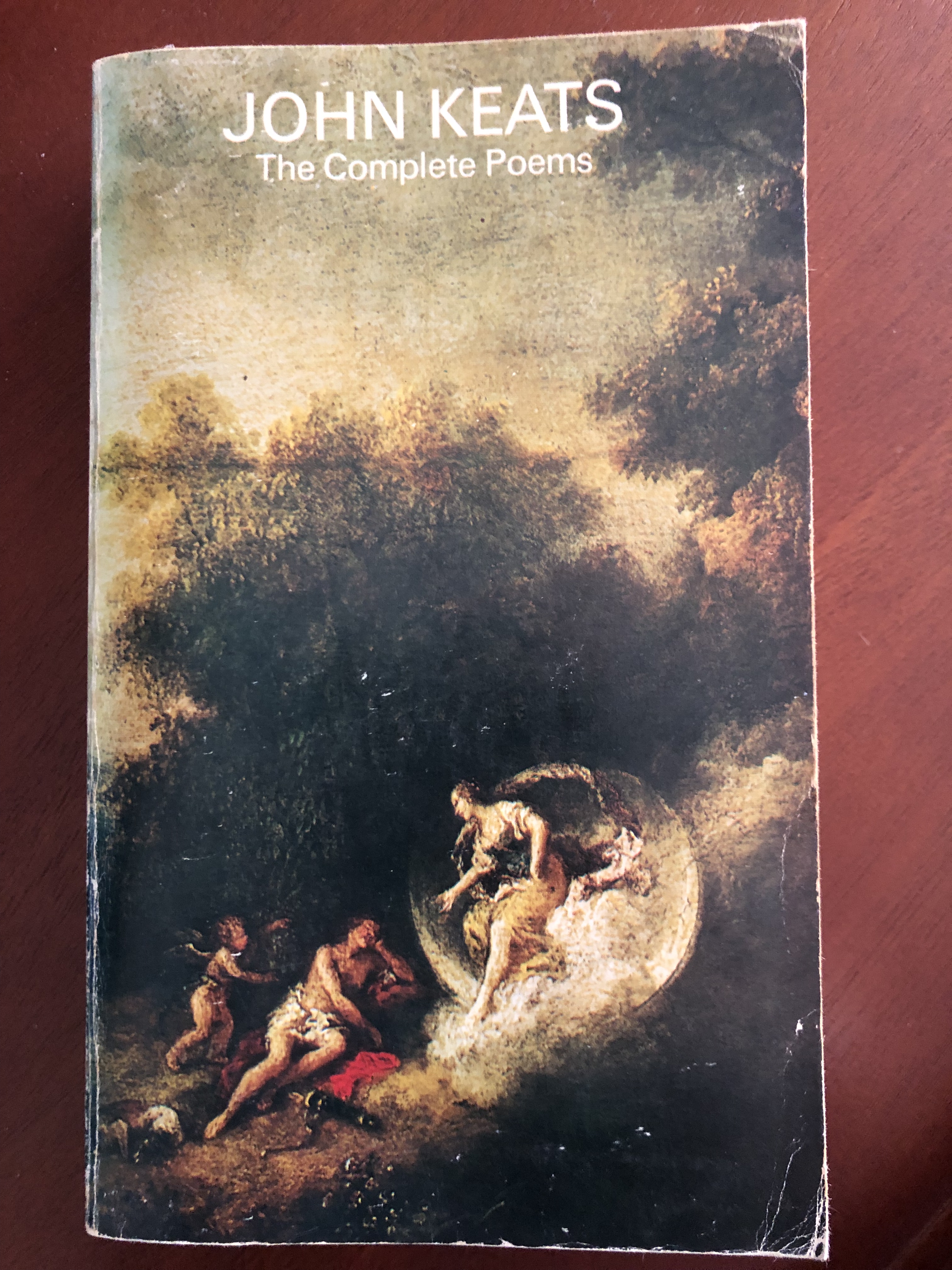
My English teacher lent me a book of John Keats’ poetry when I was in Year 9 at school, and this poem captured my heart. The eloquence, the imagery, the pathos… before the day was out, I had committed this poem to memory.
When I told the teacher the following day, and recited the poem for him, he gave me the book to keep. That I still have it, and that it automatically falls open at this poem should surprise nobody.
Sure, it’s dramatic and very ‘over-thinky’, but who of us hasn’t had those moments?
When I Have Fears that I May Cease to Be
When I have fears that I may cease to be Before my pen has glean’d my teeming brain, Before high piled books, in charact’ry, Hold like rich garners the full-ripen’d grain; When I behold, upon the night’s starr’d face, Huge cloudy symbols of a high romance, And think that I may never live to trace Their shadows, with the magic hand of chance; And when I feel, fair creature of an hour! That I shall never look upon thee more, Never have relish in the faery power Of unreflecting love!—then on the shore Of the wide world I stand alone, and think Till Love and Fame to nothingness do sink.
If you enjoyed this poem and would like to read more Keats, I suggest either ‘To Autumn’ or ‘Bright Star’ – my other favourites!







 WordyNerdBird