Lyrics and Poetry: what’s the difference?

Many people don’t realise where the term “lyrics” came from.

In my first post related to National Poetry Month, I issued this challenge: “Listen carefully to songs on the radio. You might be surprised how many of them are poetry set to music. ”

Many people don’t realise that’s where the term “lyrics” came from.

A lyric poem is one that focuses on the feelings and thoughts of the poet, rather than describing something (an ode) or telling a story (a ballad). These poems were often set to music, especially that of a lyre – this is where the term “lyrics” for the words of a song came from. So when people talk about the lyrics of a song, it’s a throwback to the origins of the love song in popular poetry, centuries ago.

That’s the sort of poetic wordy-nerdy-ness that makes me ridiculously happy.

One of the most famous lyric poems in the English language is Wordsworth’s poem that is commonly, and somewhat affectionately, called Daffodils – even though that’s not actually its title. It gets quoted – and misquoted – a lot in films, TV shows and books.
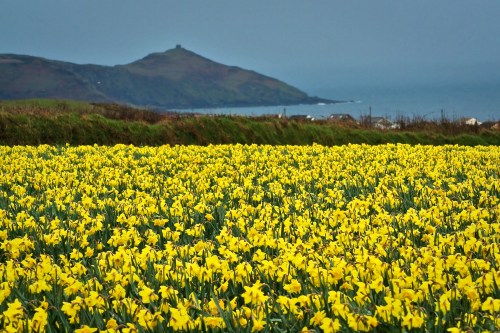
Daffodils.jpg

It’s a beautiful poem that transports the reader’s vision to the field of daffodils, but also transports their thoughts into the reader’s mind to explore how the flowers made him think and feel.

As with all older poems, there are some words in it that don’t really get used much anymore:

  • Jocund means joyful or cheerful.
  • Gay – in the context of this poem – means happy.
    (To clarify further, daffodils are, like most things in the plant kingdom, completely uninterested in one’s sexuality. I like to think that this is probably why they’re happier than many people.)
  • Pensive means thoughtful.

Now that those tricky words are sorted, you should be able to make perfect sense of this beautiful poem.

‘I Wandered Lonely as a Cloud’ by William Wordsworth

I wandered lonely as a cloud
That floats on high o’er vales and hills,
When all at once I saw a crowd,
A host, of golden daffodils;
Beside the lake, beneath the trees,
Fluttering and dancing in the breeze.

Continuous as the stars that shine
And twinkle on the milky way,
They stretched in never-ending line
Along the margin of a bay:
Ten thousand saw I at a glance,
Tossing their heads in sprightly dance.

The waves beside them danced; but they
Out-did the sparkling waves in glee:
A poet could not but be gay,
In such a jocund company:
I gazed—and gazed—but little thought
What wealth the show to me had brought:

For oft, when on my couch I lie
In vacant or in pensive mood,
They flash upon that inward eye
Which is the bliss of solitude;
And then my heart with pleasure fills,
And dances with the daffodils.

If you’d like to hear a magnificent reading of this poem, I suggest you try the recording by English actress Noma Dumazweni.  The reading by Jeremy Irons is quite nice, too.


If you appreciated this post, please click like just below. It really does help to make my blog more visible to other potential readers. Thanks in advance.

 

Six 21st Century Poets You Should Be Reading.

Six 21st Century Poets and Why You Should Be Reading Them.

I’m the first to admit that I’m fussy about the poetry I read. I want to experience something moving and powerful in a unique style. I want imagery, colour and movement. I want depth, and I want to be able to feel and hear the poet’s soul. It may be considered “old-school” by some, but I still want to find the music of rhythm and rhyme among the various techniques that a poet uses to deliver their ideas.

So, when I tell you that these are the poets you should be reading, please understand that this is not just a nod to people I like or who have pretty book covers. These people don’t just write poetry— they are poets, and they take their craft seriously. These poets can really take a reader beyond themselves, open a reader’s mind, and influence them so that they see things in a completely new way.

These Six 21st Century Poets You Should Be Reading are not listed in any order of preference. If you want to explore their work further, simply click on the cover of each book.

Lyra Shanti

Author of ‘Sediments’.

Lyra Shanti Sediments

Shanti’s poetry is rich and sensory, full of imagery that draws the reader into the emotion and wellsprings of the poet’s mind.
Drawing on mythological themes and elements of Biblical allegory, although it is by no means religious poetry, Shanti explores her place in time, relationships, and the universe through themes of belonging, human vulnerability, equality, and home. She is a master of contrast and balance, weighing sensitivity against images of those things that overwhelm, and confidence in belonging despite her humility, framed within a very real sense of awareness of the immeasurable breadth and depth of the universe.


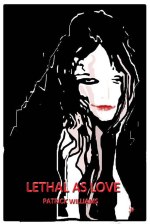
Patrick Williams
Author of ‘Lethal As Love’.

Patrick Williams Lethal As Love
Patrick Williams’ poems are beautiful in the simplicity and honesty of the feelings they convey, even though the feelings they communicate are at times complex and conflicted. There is no pretence or affectation in Williams’ writing, nor is there any strict observance of rhythm, rhyme or other particular poetic techniques. Instead, he uses language and form to evoke a strong sense of love and longing that is almost tangible as he leads the reader on a journey through the highs and lows of the love he so powerfully communicates in these poems.
Some of this poetry is quite erotic, so it’s definitely only for an adult audience, but there’s nothing gratuitous or tawdry about it. One could learn quite a lot about how to love deeply and sensuously from reading ‘Lethal as Love’, but there is also a more sombre lesson to be heeded: nothing lasts forever.  It is clear from ‘Lethal as Love’, though, that the pleasure and passion were definitely worth the pain.


Sarah Northwood
Author of ‘The Truths We Tell’.
Sarah Northwood The Truths We Tell
Sarah Northwood gives voice to thoughts and feelings commonly experienced, but often not so thoughtfully expressed, by people in all walks of life.
Northwood explores the ways in which we respond to the situations and feelings that challenge us and those things that fill and complete us. The reality of being haunted by regret and the “what ifs” of life is contrasted with the whimsy of fleeting happiness and the irresistible, transforming power of love.
Through all of this is the reminder that life is what it is: “Feeling the breeze on her cheek she knew, the wind can never be the sun.” (Unique)


Joseph Ferguson
Author of ‘Reflections of a Scurvy Bastard’

Joseph Ferguson Reflections of a Scurvy Bastard
Ferguson writes with a very strong sense of realism and a degree of world-weariness in his profound poems that work like snapshots of different events and memories. He has a gift for creating vivid images that transport the reader to another time and place, and making it seem absolutely real.
When Joseph Ferguson’s poetry is recognised as ‘classic’ and he is regaled world-wide as a master poet, it shall come as no surprise to me.


Shelby Leigh
Author of ‘It Starts Like This’
Shelby Leigh It Starts Like This

Leigh’s poetry is thoughtful and often intense in its exploration of love, loss, anger,   loneliness and grief, and is highly relatable for anyone who has experienced the breakdown of a relationship or been let down by someone they trusted.
Her poetry and expression are accessible and easily understood, and Leigh’s imagery is often quite stark and raw, but that is where her strengths as a poet lie.


Joanne Van Leerdam 
Author of ‘Leaf’, ‘Nova’, ‘Stained Glass’ and ‘The Passing Of The Night’. 


Yes, that’s me, and those are my own books. Obviously, I write the type of poetry I want to read. Don’t take my word for it, though – I have compiled this description with quotations from different Amazon reviewers. 

“Joanne Van Leerdam is a master poet who combines an old-worldly feel to her poetry with a modern flavor.”
“Joanne Van Leerdam’s poems are about the emotional fragility of human existence, about the brittleness of love and about living with love lost. She expresses both the sense of frailty and the strength of resilience in her reflections, as if a lonely survivor on a faraway island.”
“Many of her poems are conventional in structure, with a regular rhyme scheme, traditional yet so sensitive and vulnerable that they emerge as special, standing out like novae in the vast night sky.
Her poems don’t crash through the door, flourishing their creative uniqueness, but in a quiet voice Van Leerdam almost whispers to us to let her poems come in as she both exposes the emotional pains of life and provides comfort for them.”

I’d love to know if you are encouraged to try any of these poets’ works, and if you do, what you think of them. You’re always welcome to leave a comment on this, or any other, post. 

One Poet’s Approach to Writing Poetry

Today, I’d like to share with you my own approach to writing poetry.

If you’re not really a poetry reader, it may reassure you to know that it’s not always super-formal language and words that are hard to understand.  Sometimes it is- especially if you’re approaching poetry written a hundred  or more  years ago. In my mind, though, making it so elegant and clever that people are resistant to it or almost afraid of it really defeats the purpose. I want the reader to connect with what I’m saying, not feel like I’m some self-important hyper-intellectual with an overactive sense of rhyme.


npm_2018_poster-e1520635983486

It’s also helpful to understand that there are different types of poetry. Some types, like sonnets, are formal in structure and rhyme pattern, and a poet really has to stick to those rules.  Haiku is said to be one of the most popular types of poetry in the world at the moment, and while it seems quite simple, it still has formal rules that have to be followed. Other types, like free verse, is much more liberated and often easier to understand because those same rules don’t apply.

Some people these days insist that poems shouldn’t rhyme at all – to that, I say– possibly rather loudly and perhaps quite rudely – “Poppycock!”. There is nothing wrong with using rhyme, or any other tool in the poet’s toolbox, as long as meaning is not sacrificed for the sake of making that device work. I write poetry that rhymes, but I also write poetry that doesn’t.

I don’t aim for things to sound pretty and sing-song, or to rhyme neatly, but I do try to use language that sounds beautiful when its read. The important thing is to choose words, and language styles and poetic techniques that suit my subject and deliver the meaning the way I want it to be understood.

I aim for my ideas and feelings to be communicated in a way that makes someone stop and think, and maybe see something or someone in a new way.

Sometimes my writing helps me – and other people – make sense of what’s going on in my head or in my life. It’s the best therapy, because I get to explore and deal with my thoughts and feelings as I work with the ideas, and I always have an outlet to say what’s on my heart and mind.

And sometimes I write poems because it’s the only way I can find to say what other people are afraid to say. I’m happy to provide a voice for others, and I’m always keen to have my readers see situations or experiences from different perspectives.

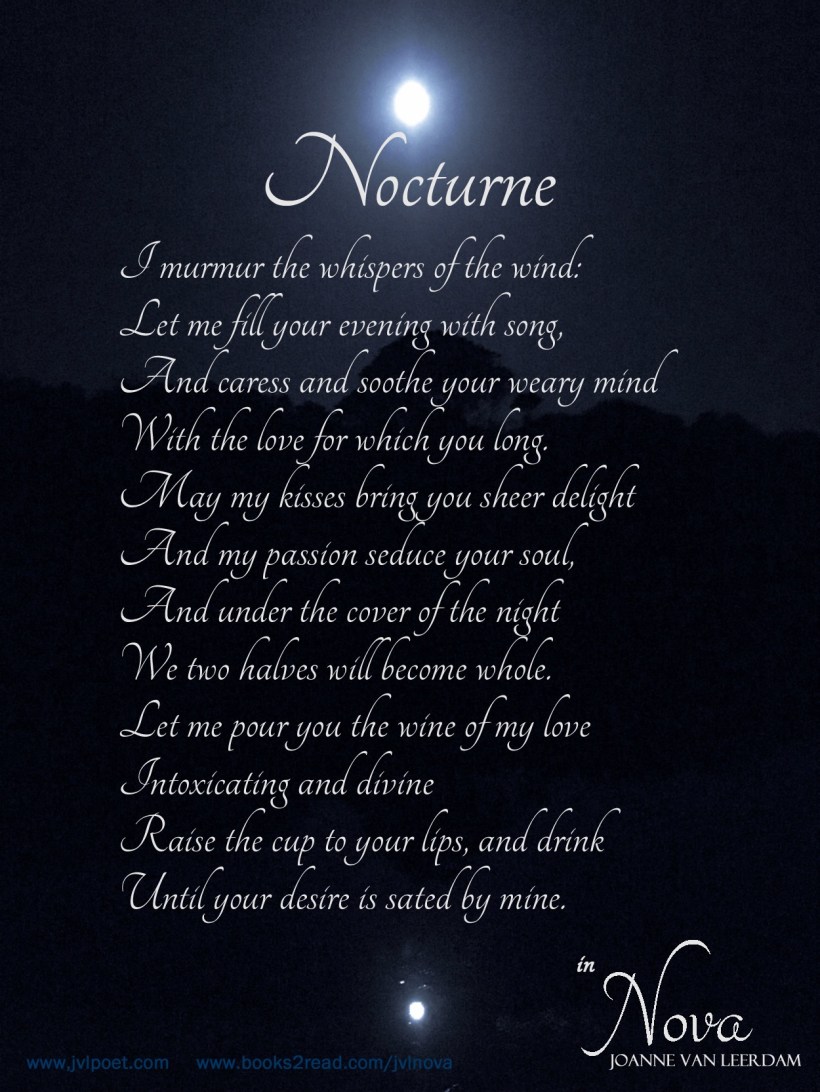
Let me give you an example. One of my favourite poems among those I’ve written is the one titled ‘Nocturne’. Try reading it aloud, not worrying about the rhythm but just letting the language carry you along.

promo nova nocturne poem

When reading it, you’ll see that it rhymes,  and the lines are of similar length when read aloud. This enabled me to achieve a musical type of rhythm in the words, which suits the idea of a nocturne, given that that’s the name of a piece of music written to be played or listened to at night – which is also when the poem is also set at night, for which the idea of a nocturne is also really appropriate. Despite all of that, it’s still quite plain in its meaning.

I’d love to know what you think of it, so feel free to leave a comment below.

You’re also welcome to jump over to WordyNerdBird Writes and read some of my other poems and stories.

April is National — or, more correctly, International Poetry Month.

Poetry Month is a great opportunity to enjoy great poetry.

npm_2018_poster-e1520635983486

National Poetry Month started as a national celebration in the US back in 1996 as an initiative of the Academy of American Poets but has become something that is celebrated more and more internationally, with not just publishers but bookstores, schools, libraries, and poets themselves joining in the celebrations. As you know, I’m a poet, so I’m absolutely in favour of all of that.

As the month progresses, I’ll be sharing some of my poems with a bit of context about why they were written and how I went about crafting my initial idea into a poem that delivered the message I wanted to put out there.  I’ll also be sharing some of my favourite poems that I’ve loved for a long time, and introducing you to some new poets that you may not yet have heard of.

If you’re not into poetry, don’t worry – my blog posts won’t be exclusively poetry related. I hope to share some more insights about writing and social media for authors, too.

To encourage you to get involved in small ways, I have compiled a list of ten ways in which you can celebrate Poetry Month this April. Choose one, or choose all– it’s up to you.

  1. Read a poem that is new to you.
  2. Memorise a poem, or part of one.
  3. Support a poet by following their blogs or websites. Follow my blogs – here and at WordyNerdBird Writes where you can read my new writing, including recent poems and one or two from each of my books.
  4. Support a poet on social media by following and sharing their posts. I’ll be posting some more suggestions in the coming week about where you might like to start, but for now, my social media links are at the bottom of the post!
  5. Support a poet by buying a book of poetry. I’ll be posting some suggestions in a day or two, but you can check out last year’s suggestions here! They’re all really good.
  6. Participate in the Dear Poet project, even if just by enjoying the fantastic videos on the website.
  7. Subscribe to Poem-A-Day, where you will receive a brand new poem  and some insights from the poet each day.
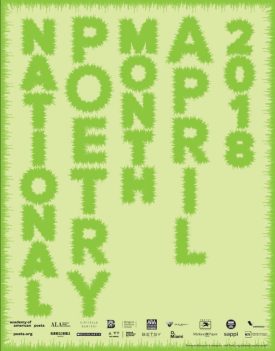
  8. Put the National Poetry Month poster image on your social media, website, notice board, shop window or anywhere else you think it might make a good impression.
  9. Write your own poem for someone special.
  10. Listen carefully to songs on the radio. You might be surprised how many of them are poetry set to music.


Follow me on
FACEBOOK |TWITTER |INSTAGRAM | GOOGLE+TUMBLR | GOODREADS | WEBSITE