Pretty much anywhere you go, whoever you talk to, if they know only one thing about any play by Shakespeare, it’s the balcony scene from Romeo and Juliet. It’s possibly the most famous scene ever written.
There’s just one problem with that: there was no balcony.
That’s correct.
There. Never. Was. A. Freaking. Balcony.
In the script, the stage direction is clear: JULIET appears above at a window.
I don’t know who invented it, but it was a killer idea that I bet Shakespeare would wish he had thought of, were he still alive today.
Of course, directors can stage a play however they like, and make use of whatever structures and sets the theatre provides.
Filmmakers can do likewise, but one must keep in mind their tendency to just change whatever they want. Hollywood is notorious for that. The mayhem that comes from mass misunderstanding occurs when directors think they know better than the author, and when people watch a movie instead of reading the book.
It makes people and their assumptions about the original text wrong, and leaves them marinating in their wrongness until their wrongness is so commonly accepted that most people think it’s right.
It just goes to show that what your English teacher always said is true: there really is no substitute for reading the book.
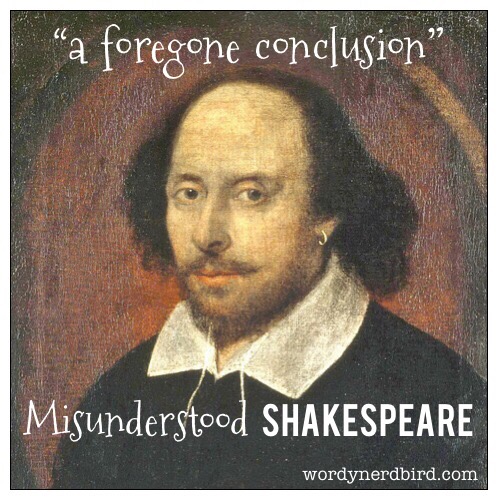
These days, when people talk about a “foregone conclusion” they mean something is a given: it is inevitable, it will happen, it may safely be assumed. As certain as it sounds, it is still a statement of conjecture about an event that is yet to occur.
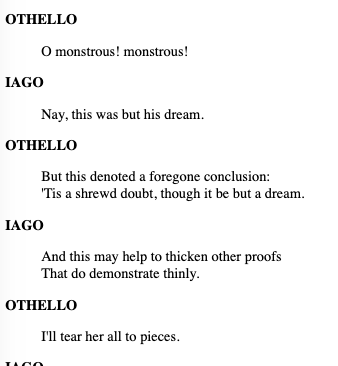
When Shakespeare had Othello speak those words in Act 3, Scene 3 of the play that bears his name, it had quite the opposite meaning. In this scene, Iago is manipulating Othello’s thoughts and making him believe that Desdemona has cheated on him.
Othello says, “But this denotes a foregone conclusion: Tis a shrewd doubt, though it be a dream.”
Here, he is speaking of the adultery between Desdemona and Cassio as something that he is certain has already happened. This gives the phrase “foregone conclusion” the opposite meaning to that which it holds today.
This, and statements such as “I’ll tear her all to pieces” and “O blood, blood, blood!” are evidence that Othello has already made up his mind about the guilt of his wife and former second-in-command.
The scene ends with Othello swearing his loyalty to Iago and thinking of ways to kill Desdemona. Charming, I know.
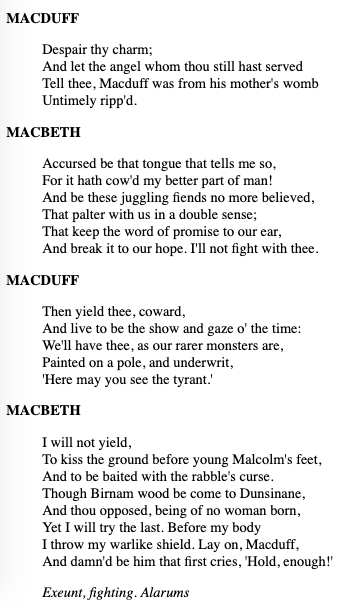
“Lead on, Macduff!” is a phrase often used to say “after you” when people are being polite and opening doors for someone, or showing that they will follow another person’s lead.
People who use this phrase think they are quoting Shakespeare’s ‘Macbeth’, but they’re not quite doing so: those are not the words Shakespeare wrote.
Both the phrase and its meaning have been changed over time.
What Shakespeare wrote was “Lay on, Macduff”, and Macbeth wasn’t opening any doors or following Macduff’s lead when he said it. Macbeth and Macduff were fighting one another, and only one of them would survive. The words “Lay on, Macduff” were Macbeth saying “come on, fight me!”
So, next time you open a door, or commit to following someone else’s lead, be careful about saying “Lead on, Macduff”. If they know their Shakespeare, they might just fight you!
This morning’s conversation in my kitchen is a clear demonstration of just how much of a Shakespeare Nerd I really am.
H: I need egg cartons. Where do I get egg cartons? Me: How many do you want? I pointed to the top of my fridge where there sat a stack of egg cartons. Me again: Take them all. H: Oh wow! Thanks! K: That’s awesome! I’ll grab them in one foul swoop and put them in the car. Me: Well, that’s decided my blog post for today. K: Huh?
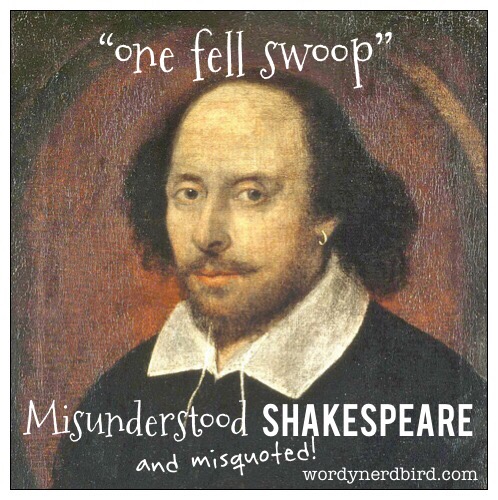
In Act 4, Scene 3 of ‘Macbeth’, Malcolm and Macduff engage in testing one another’s loyalty to Scotland rather than to Macbeth, who has become king. During that conversation, Macduff learns of the murders of his wife and children at the order of Macbeth, whom he describes as a “hell-kite” who has slain his “chickens” in “one fell swoop”.
The deed was certainly foul, but that isn’t what Shakespeare wrote. He wrote “one fell swoop” which is an entirely different thing.
Here, fell means ‘fierce’.
It’s an image of violent attack, of hunting, and of predator and prey, which leaves the audience in no doubt that these murders were calculated and precise. The term “hell-kite” leaves the audience in no doubt of the evil motivations behind the slaying.
These days we understand the phrase “sea change” to reflect something new and positive in one’s life. It is frequently used to describe a significant transformation in a person or in one’s lifestyle.
In Australia, it has also come to mean a physical move from the city or the country to live closer to the ocean, or even taking a holiday at the beach.
The phrase hasn’t always had such positive associations.
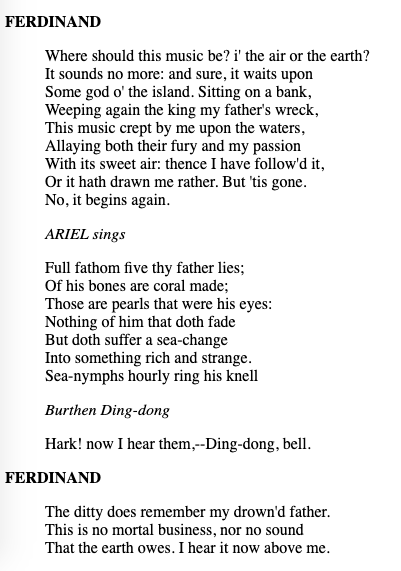
In Act 1, Scene 2 of Shakespeare’s play ’The Tempest’, Prospero’s familiar spirit Ariel sings a song that makes Ferdinand believe that his father, Alonso, has drowned in a shipwreck, and that his father is buried at sea “full fathom five”, or five fathoms deep. Through the action of the water on his remains, his body is undergoing substantive changes: his eyes are turning into pearls and his bones into coral. There is nothing left of him that has not been transformed by the sea.
Even worse, this story of the shipwreck and drowning is not true. It is, in fact, a ruse by Prospero to orchestrate a marriage match between his daughter, Miranda, and Ferdinand. Prospero is quite comfortable with using trickery and misleading magic to achieve what he wants to, and this is not the only time during this play that he willingly deceives others to get what he wants.
So, even though it does still reflect a significant transformation, it has much darker connotations than the term does now. Deceit, manipulation, grief and emotional blackmail all factor into the origins of this phrase that we use so differently today.
I have witnessed so many people talking about Romeo and Juliet as “star-cross’d lovers” in the sense of their meeting and relationship being their destiny, and that the two were somehow fated to be together.
This couldn’t be more wrong.
The actual meaning of the term becomes clearer if one thinks of it in terms of the stars actually crossing them.
Romeo and Juliet were never meant to be together. The fates were against them, right from the start, and it was never going to work out well.
It’s important to remember that ‘Romeo and Juliet’ is a tragedy, not a comedy or romance. In Shakespeare’s tragedies, the main characters always die. There are no happy endings. That’s a convention of the genre, and it is pointless to expect anything else.
Not only that, but Shakespeare gives us the spoilers right there in the prologue, the opening speech of the play, which is where the phrase comes from. They’re going to die, and as they are laid to rest, so too will be buried the feud between their families, which is what made their love forbidden in the first place.
The prologue to Romeo and Juliet by William Shakespeare.
If, as some believe they do, the stars were to control one’s fortunes in life, the last thing you’d wish for is to be “star-crossed” in any way.
Written in 1603 or 1604, ‘Measure for Measure’ is a play with enormous relevance to the 21st century.
As I listened to the play on the BBC’s ‘The Shakespeare Sessions’ podcast yesterday, it struck me just how timely and relevant it is.
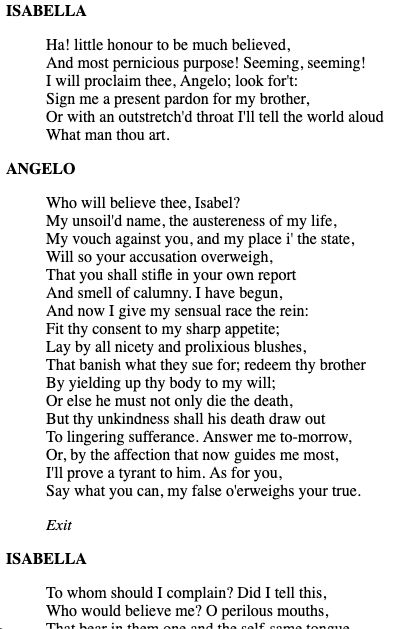
The play features a man named Angelo who, having been left in charge by the Duke, totally abuses his power in the interests of sexual gratification. He tells Isabella he will pardon her brother Claudio, who has been sentenced to death, if she has sex with him. When Isabella refuses and threatens to tell everyone what he has suggested, he simply asks, “Who will believe you?”
from ‘Measure for Measure’, Act 2, Scene 4
Angelo is clearly relying on his powerful position, and his ability to hold something over her, to get away with sexual abuse and bribery. And he dares to call it “love”, when it is anything but that. He is attempting to romanticise his proposed rape and abuse of power, as abusers so often do.
This is exactly the kind of behaviour we’ve seen exposed by the #metoo movement. Men abusing their positions of power and pressuring women to give in to them because they have the power to grant what the women need – a job, justice, whatever… and relying on their position to give them more credibility than a woman in a weaker position in society. It really does foreshadow those now infamous words spoken in 2017 by yet another reprehensible character: “And when you’re a star they let you do it. You can do anything.”
Not easily intimidated, Isabella points out that what he is suggesting is exactly the crime for which he has sentenced her brother to death. His hypocrisy is abundantly obvious to not only Isabella, but also to the audience. That she calls him out on it demonstrates her integrity and intelligence. Bravo to Isabella for not taking his crap or falling prey to his greasy manipulation.
Caught in between wanting to save her brother’s life and not wanting to have sex with Angelo, Isabella verbalises the impossibility of her situation in that very poignant and thought-provoking line: “To whom should I complain? Did I tell this, who would believe me?”
Still, even though she understands that what he says is probably true, she neither yields to him or gives up on her brother. Instead, she finds another way to solve her problems and expose the bad behaviour of Angelo.
As suggested in the title, justice is received at the end of the play in the same measure with which it is meted out at the beginning.
In this, we see a woman standing up for what is right, defending herself, refusing to give in to a man’s manipulation and sexual pressure, and winning. Angelo is punished for his corruption, and Isabella saves both herself and her brother.
This is a powerful contrast to most of the women in Shakespeare’s other plays, and indeed in the early modern times in which he lived and wrote, few of whom had any real agency or ability to stand up for themselves against the will of men.
‘Measure for Measure’ is a thought-provoking and entertaining play which demonstrates that while times have changed, the effect of power and position on human nature has not. Even so, it does remind us that evil people can, and should, be resisted, and we should never stop pursuing justice just because it’s difficult to do so.
That is truly a message pertinent to life in the 21st century.
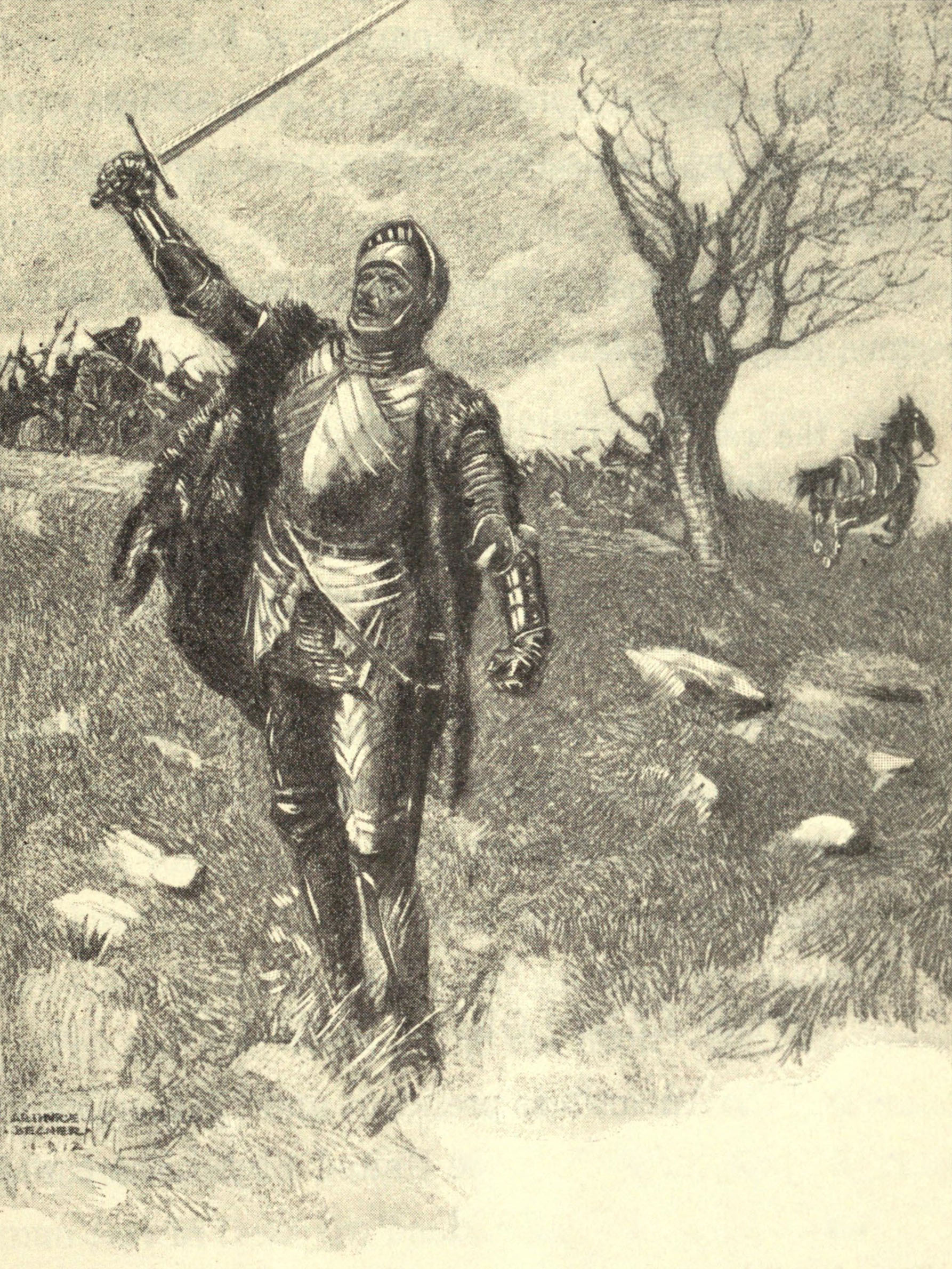
Written by Shakespeare in around 1593, these words have become immortalised as the final words of desperation spoken by King Richard III of England as he battled Henry Tudor for control of the throne of England.
These words are also possibly the most frequently misinterpreted Shakespeare quotation in history, although Prince Hal’s “The first thing we do, let’s kill all the lawyers!” from Henry Vl is right up there on the list.
Shakespeare very cleverly painted Richard III to be entirely evil and villainous, self-serving and single-minded in his pursuit of the throne at the expense of all others who stood between him and the ultimate royal goal.
As evil and villainous as Shakespeare’s Richard is, it’s crucial to remember that Richard was fighting for both his kingdom and his life. It makes absolutely no sense, therefore, that he would have been wandering around Bosworth Field offering someone his kingdom in exchange for a horse.
What this line actually means is that Richard knew he was going to lose the battle if he couldn’t get back on a horse and keep fighting. His horse had just been killed in battle, while he was still riding it. On foot, he was without means of either strategic defence or meeting the enemy in an even fight. He was an easy target that travelled much slower and far less deftly than his mounted opponent.
The line could be interpreted as meaning, “Without a horse, I’m going to lose my kingdom!” It was a cry of despair, not an attempt at last-minute marketing.
The urgency and foreboding in Richard’s words make this scene a magnificent piece of drama. If there’s anything the audience loves more than a villain getting it in the neck, it’s the villain realising that it’s coming.
When understood properly, this oft-misinterpreted quotation reveals once again the genius of the wordsmith.
If you have a line or scene of Shakespeare you’d like explained, feel free to ask a question or make a suggestion in the comments and I’ll give it a red hot shot.
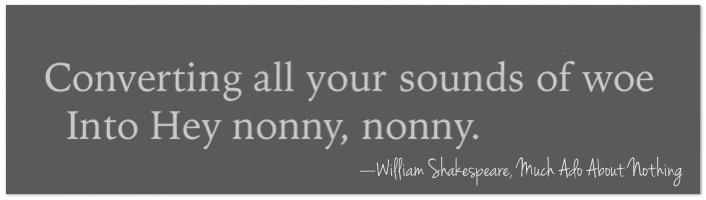
‘Hey nonny nonny’ is a curious little phrase found in Shakespeare’s ‘Much Ado About Nothing’. The character Balthasar sings a song to the ladies in which he recommends that instead of worrying about what the men are up to, they should convert their sighs of despair into ‘hey nonny nonny’.
The phrase ‘Hey nonny nonny’ has no direct translation into modern English, but is understood from the context that it could be taken to mean a dismissal of circumstances as we do today with expressions like “whatever”, “what the heck?” or “that’s life”, or simply refer to general merry-making.
As such, it is a phrase that can be safely used in circumstances where less appropriate responses cannot be uttered. In my experience, expressing one’s umbrage using Shakespearean quotations is almost as satisfying as actually swearing anyway. There is something remarkably cathartic about speaking in Elizabethan English, although that will likely never be understood by anyone who does not appreciate and enjoy the language as I do.
I have decided to add “hey nonny nonny” into my repertoire as a worthy companion exclamation to my renowned-among-those-who-know-me question, “What manner of nitwittery shall plague me on the morrow?” In writing this post, however, I’ve come to one realisation: I will have to teach my devices that I intend to type “hey sonny sonny” or “hey nanny nanny” about as much as I ever mean to type “oh shot”.
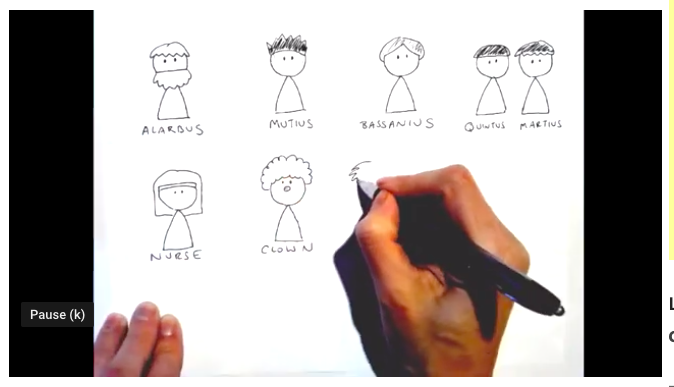
For Shakespeare Sunday this week, I want to share with you the wonderful work of cartoonist Mya Gosling at Good Tickle Brain.
Mya takes the vast works of Shakespeare and condenses them into cartoons that even those with very little knowledge of Shakespeare can read, understand and appreciate.
For Shakespeare nerds like me, it presents a lot of fun and great “oh yeah!” moments. For those new to the plays or wondering what on earth the characters are saying and doing, Mya’s cartoons make the complex much more straightforward.
This website contains a wealth of play summaries, character spotlights, analysis and audience insights. I frequently share Good Tickle Brain with my students because it really does help to make whatever play we are studying more accessible and relatable for them.
Even if you haven’t seen or read the play Titus Andronicus — and let’s face it, most people haven’t— make sure you watch the video titled ’Titus Andronicus: All The Deaths’. The way she draws all the characters and then depicts how they died in the play is brilliant!
Also incredibly insightful is the non-Shakespeare section titled ‘Keep Calm and Muslim On’, which is Mya’s exploration of the way in which Muslims and non-Muslims get along together in American society, which I find highly relevant to Australia too. I always enjoy seeing the simple but profound ways in which Mya breaks down the barriers and embraces the differences while still showing how similar we really all are.
It’s a great website that holds lots of fabulous little surprises. I really hope that you’ll take a look, and I hope that you enjoy it as much as I do.








 WordyNerdBird