What’s on your list?
I’d love to hear your ideas!

What’s on your list?
I’d love to hear your ideas!

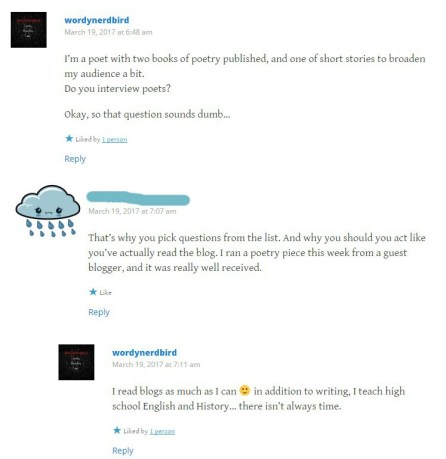
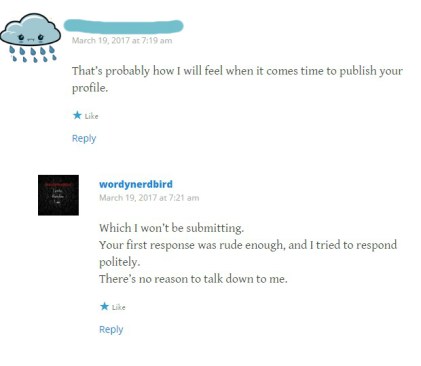
The choice between being either the low point or a bright spot in someone’s day isn’t so complicated.


Sure, my question might not have been the brightest or best he’s ever read. Even so, his response was condescending and made me feel really low. Who needs that kind of negativity in their life? I certainly don’t.
Make sure you’re sending the message you actually want to send to your audience, every time.

For the first time in a long time, I’ve recently abandoned reading a book. I’m usually fairly persistent, but I couldn’t get past the second chapter. It’s so full of basic errors, I’d be giving any of my students who wrote it a D. That book – any book – has no business being for sale on any platform, Indie or otherwise, until it has been properly edited and corrected.
The same goes for what authors – and any other professional writers – put on social media.
If I had a dollar for every time I have face-palmed over glaring errors of spelling, word choice or punctuation in someone else’s social media posts, I would be considerably richer than I am today.
As people who promote ourselves as writers, it’s crucial that we don’t make those mistakes.
I’m not talking about the occasional typo, and I’m not talking about the type of formatting error that can happen to absolutely anyone when converting a book to eBook format. I’m talking about really basic errors – missing punctuation, terrible sentence structure, shocking spelling. Of course, not differentiating correctly between “your” and “you’re” is always going to frustrate people. There will always be people who put apostrophes where they don’t belong and omit them where they are needed. The same is true for commas.
It boils down to the issue of credibility. If I cannot correctly construct a sentence to encourage people to buy my book, what is going to make people believe I could possibly write a whole book? A writer should be able to communicate their ideas and messages clearly and effectively, without frustrating the reader or making their eyes bleed.
Quite honestly, if someone’s social media posts are full of errors, I’m not going to be buying their book. I’m not even going to put my hand up for a free copy. And it’s not going to change my mind if people laugh it off and say, “It’s just Facebook… relax!”
I may be called judgemental or overly critical. That’s okay.
As a reader and a frequent buyer of books, I’m entitled to be.
As a writer, nothing less should be expected.

If we want people to believe that Indie books are just as good as traditionally published books, we have to make sure they are. We must edit, and have them edited, as professional authors. We must promote both ourselves and our books as engaging, intelligent, and literate. The example we set on social media is part of that, because that’s where we hope to find readers.
Please, folks, for credibility’s sake – in the interests of your own integrity – proof-read all your posts. Make sure you’re sending the message you actually want to send to your audience, every time.

Following my previous post about how to use hashtags effectively, I thought it might be helpful to provide you with a list of hashtags that work well for Indie authors.
My aim in this post is not to give you every hashtag that writers use, but to provide you with a functional list of the most common, and therefore the most valuable.
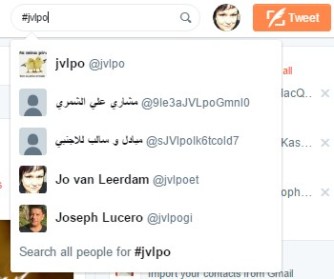
In addition to these, you can also make a hashtag for your own book or brand.
However, if you’re going to do this, make sure it’s unique to you or your book so that you don’t get lost in a haze of brand confusion.
You can see here that #jvlpo was good, but not good enough.

However, #jvlpoet was completely unique to me. I did this same search on both Twitter and Google when deciding on my domain name, jvlpoet.com.

per tweet.For example, during Women’s History Month in March, I added either #CelebratingWomen or #WomensHistoryMonth to my tweets that were relevant – but not to all of them.
Adding those tags to a post about spelling or writer’s block simply wouldn’t be appropriate, and would definitely look opportunistic rather than professional.
Similarly, given that April is #NationalPoetryMonth, I’ve added that to my tweets inviting people to read my poetry on my blog, but not to the ones where I’m offering advice to authors learning to use social media.
Using hashtags that nobody is looking for is a waste of time and effort.
Using the search bar near your profile menu and Tweet button, you can type in key words to see which hashtags are the most popular.

The hashtags that come up will change as you keep typing – see from the illustration here the difference between typing ‘book’ and ‘bookw’.

This is a handy way to see what is most popular among the relevant terms that you could choose from.

It also means that even when the feed condenses your post, people see the most important things first – your content, your message, and your website.


It can be really tempting to send your post from Instagram to all your other social media accounts. However, that’s not always the best thing to do.
Don’t share directly from Instagram to Twitter unless you’re under that 140 character limit.
A longer message will get cut off, leaving your tweet looking like you don’t know what you’re doing. Nobody wants that.
Don’t share directly from Instagram to Facebook if you want your post to look professional. A bunch of hashtags look completely out of place on Facebook. They’re not really needed there at all.

Something many people don’t understand is the value of leaving a comment on a blog.

It’s easy to read a post and move on, and even easier to like a blog post without reading it.
But stop and think for a moment. How much more valuable to the writer, and other readers, if you actually bothered to respond. Isn’t that what you’d hope for when writing your next blog post? Nobody wants to invest time in writing something that people are just going to skim over.
Not only that, but you will gain more from the post and from the interaction with others than you realise.
It doesn’t have to be a long or complicated post. Even just saying “thank you” or “I liked this!” does the trick.


However, commenting on a blog post is more useful than just propping up the ego of some blogger who hopes to be discovered one day.
Leaving a comment on a blog post doesn’t have to take more than five seconds, but it can make a huge difference to the blogger by helping them, and whatever they have to say, to become more “discoverable”.
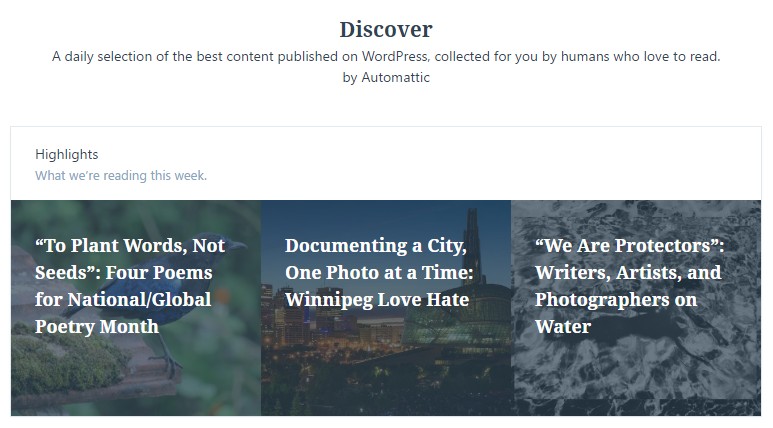
Leaving a comment on a blog directly affects the ranking and therefore the visibility of that blog on both the platform – such as WordPress or Blogger – and consequently on the web. Rankings and visibility affect which posts are chosen to be featured on the highlights pages of blogging platforms, such as the ‘Discover’ page on WordPress which pick up the posts that have had the most interaction and engagement, not just the ones with the most likes or views.

One of the author support groups on Facebook to which I belong has been conducting an experiment over the past few weeks. We’ve made a deliberate effort to read, like and comment on a selected blog post by each of the others.
Those posts have consistently attracted more viewers beyond that initial group. These new viewers also seem more willing to read, like, and comment. This boosts the visibility of the individual post and of the blog overall, and helps to attract even more viewers.
In short, it’s a highly valuable snowball effect in drawing attention to both the post and the blog.
Let’s face it. That’s a pretty cool thing to be able to do for someone.
Leave a comment and let me know what you think!