Achieving Balance… Slowly.

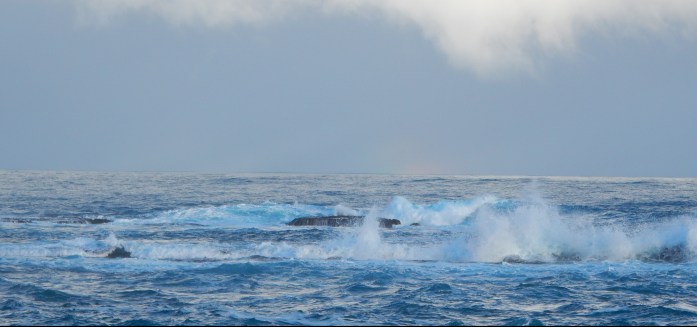
As a poet, I am always inspired by the beach and the sea.

2018-05-02 23.00.53

I posted recently about needing to write some positive poetry to balance the number of dark and melancholy poems that I’ve written, so that my next collection isn’t entirely moody, angry and defiant.

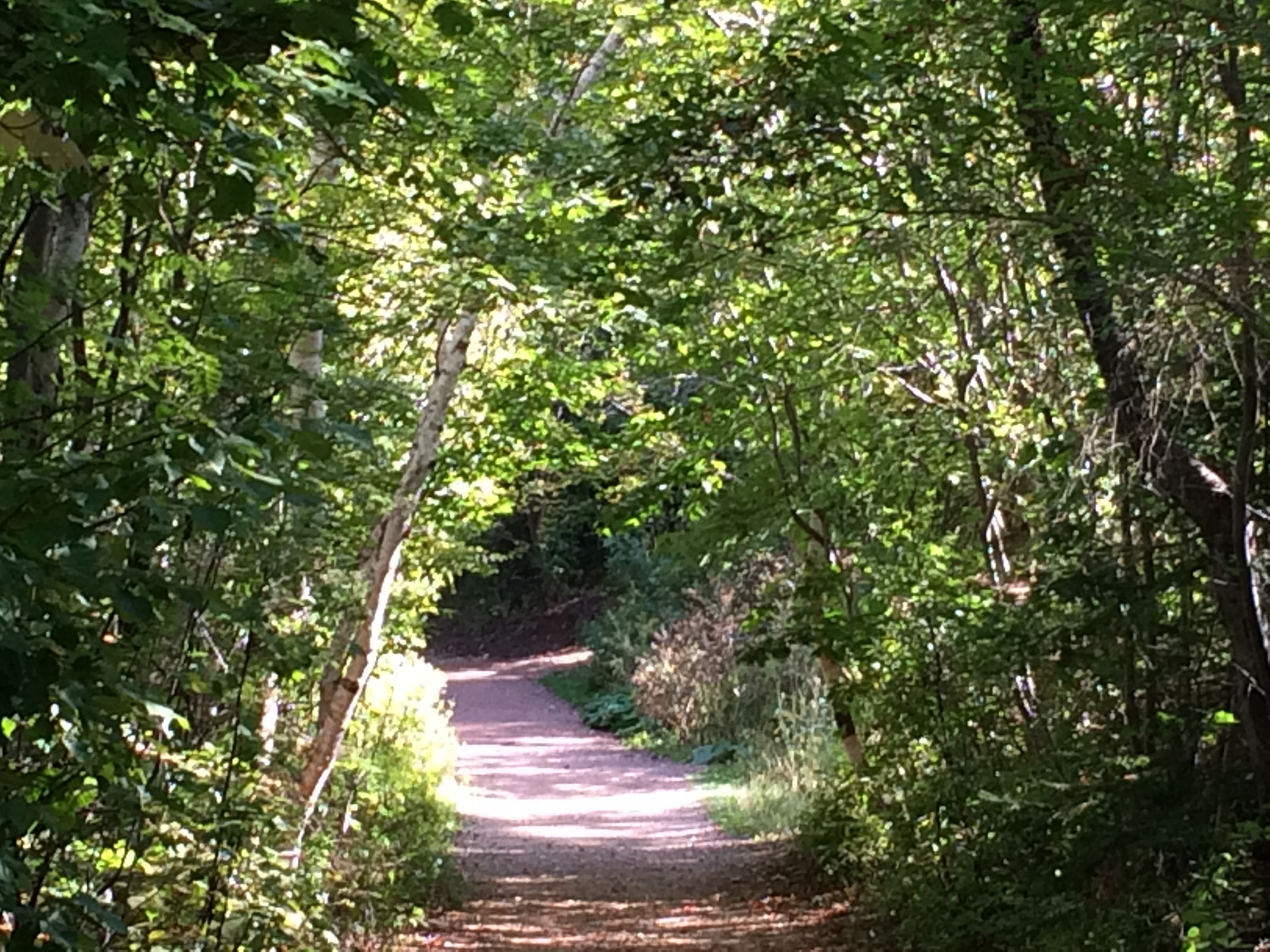
On Wednesday evening, between a meeting and a theatre company rehearsal, I grabbed some dinner and headed to one of my favourite spots – the beach. It was an unseasonally mild evening for early May— still 24 celcius when I got there— so I took off my shoes and grounded myself in nature with some deep breaths and my bare feet on the earth. It felt so good to find quietness and solitude there, just the sea, a few gulls and me.

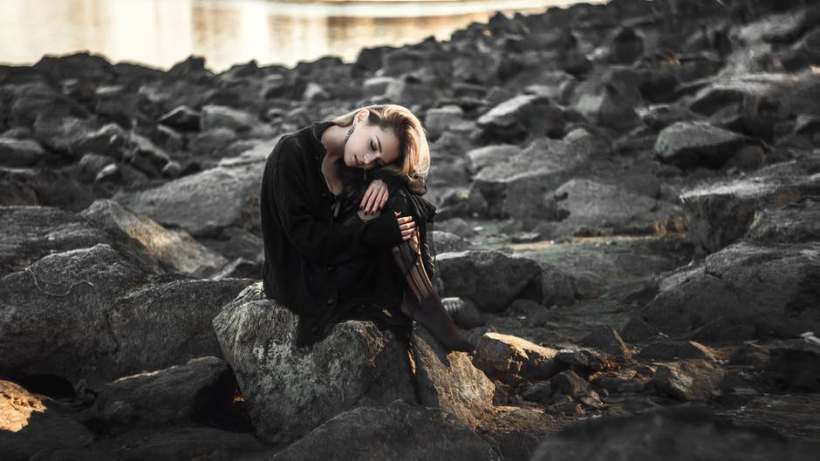
While I sat on the foreshore and pondered the scene before me as evening fell, the beginnings of a poem came to me. Now that it’s finished, I’m pretty happy with it. I love the sensuous, joyful feel of a lovers’ reunion, and I think I’ve captured the moment well.

Consider me encouraged.


Joey'sMapleLeafTatt


Thank you to everyone who took the time to encourage or inspire me with ideas, whether as a comment or in a private message. It means a lot to me that you would do that, and that you’re interested enough in my writing to help me in that way.


Joey'sMapleLeafTatt


If you appreciated this post, please leave a comment or simply click “like“.
This helps my post to be seen by others. 
I’d also appreciate any feedback on the poem. 

Thanks in advance, 
WNB

‘Anne with an E’ – It’s Just Not The Same!

Why can’t directors just leave an excellent story line alone?

A life-long devotee of L.M. Montgomery and ‘Anne of Green Gables’, I’ve read all the books several times. I’ve watched the miniseries starring Megan Follows more times than I can count. I’ve enjoyed various other film versions of the story. I’ve visited Prince Edward Island and the original house that was the inspiration for Green Gables, where I walked along the original Lover’s Lane and stood outside the Haunted Forest. I visited Montgomery’s birthplace and the first school in which she taught, which served as the inspiration for the school Anne Shirley attended.

I’m not an expert, but it’s fair to say I know my stuff when it comes to all things ‘Anne of Green Gables.

`My life is a perfect graveyard of buried hopes.’ That’s a sentence I read in a book once, and I say it over to comfort myself whenever I’m disappointed in anything.”
This is a line and a scene from Montgomery’s book which has always stayed with me. I found myself saying it again today, shortly after I started watching the series titled ‘Anne with an E’. I instantly liked this new Anne, and the new Matthew. I found Geraldine James’ portrayal of Marilla suitably crisp and direct. I was delighted by the way in which the story had started, and by Amybeth McNulty’s delivery of that favourite line of mine. I began to fall in love, all over again.

And then they changed the story. Before the first episode was over, the plot had taken a completely different direction than anything written by Montgomery. “WHY?!” I yelled. “WHY do people DO that?”

Still, I persevered, telling myself it might get better. It didn’t.
I made it to 13 minutes into the third episode, where I clicked off in disgust after yet another change to the original story.

I won’t watch any more of it. It had so much potential, and I had so many hopes… and all it did was desecrate my favourite story and make me angry. This series, like so many other abominations of great books, is yet another corpse buried in that perfect graveyard.

Seriously, Universe… What Am I Doing Wrong?

Apparently, I never learn.

Promo X Cold Shoulder Plain

Only on rare occasions am I ever tempted to feel as though I might just get on top of things.

Other days, like today, I realise yet again just how little most people value me, or anything I do.

Seriously, universe, what am I doing wrong?

I work hard, I’m a loyal friend, and I care more about people than most of them will ever realise. It’s true that I don’t come in the smallest package with the sleekest, glossiest wrapping, but if I’m given the choice of someone who “fits an image” or someone who will both help me and defend me or die trying, I know which person I’d pick to have on my team. I’m not perfect, but who is?

So, tonight I’ve spent a few hours trying to think through and process how I feel and why, In that process, the words of one of my own poems came back to me. I wrote ‘Cold Shoulder’ on a previous occasion when other people’s behaviour left me feeling a similar way.

COLD SHOULDER

Many years I’ve lived on the Cold Shoulder
An inhospitable, stony place –
Where there’s little but frosty silence,
No allowance for comfort or grace.

The chill wind of indifference
Cuts the air without making a sound,
Skittering icy flakes of apathy
And leaves’ skeletons over the ground.

A fine specimen of resilience,
I’m a fine diamond in the rough,
A survivor of hostile conditions
Where life is invariably tough.

I suffer no delusions of love –
For that loss I have frequently wept;
But knowing I don’t matter at all
Is the hardest of truths to accept.

Weary of relentless erosion,
I implore the stone lords for reprieve,
But there is no reward for devotion
To those in whom you don’t believe.

Let them preach not to me of salvation
When they hold all the power in their hands
To inflict such complete desolation –
One could never meet all their demands.

So I remain here on the Shoulder
In this treacherous, heartless place:
Although frigid, this landscape is honest,
And each rock only has the one face.

©2017 Joanne Van Leerdam


This is not new territory for me. I have survived every other “kick in the head”, and I’ll survive this one, because I refuse to lay down, shut up and die. And I’ll make all seven people who do actually care about me proud in the process… again.

It does make me wonder, though, why I fall into that same trap of assuming that anyone else ever actually tries to see my worth, or cares about it.
Apparently, I never learn.


2017-08-10 20.28.53


‘Cold Shoulder’ is published in ‘The Passing Of The Night’
by Joanne Van Leerdam.

ANZAC Day: It’s Part Of Who We Are.

ANZAC Day is more than just a very special day. It’s part of who we are.

Today is ANZAC Day: the day on which Australians and New Zealanders stop to commemorate and reflect on the sacrifice of all those who served our countries – very often side by side – in World War I, and ever since.

113 years after the ANZAC forces stormed the beaches and clambered up the cliffs at Gallipoli, we stand in sombre silence and remember the enormous losses of life suffered on that day, and every other day, during major conflicts like the two World Wars. Every year, attendance at dawn services, ANZAC Day marches, and commemoration ceremonies around Australia grows, even though all the soldiers who fought in World War I, and many who fought in World War II, have passed away.

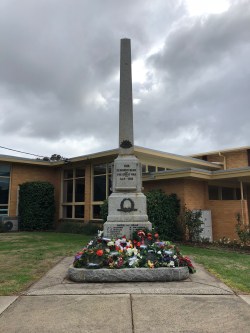
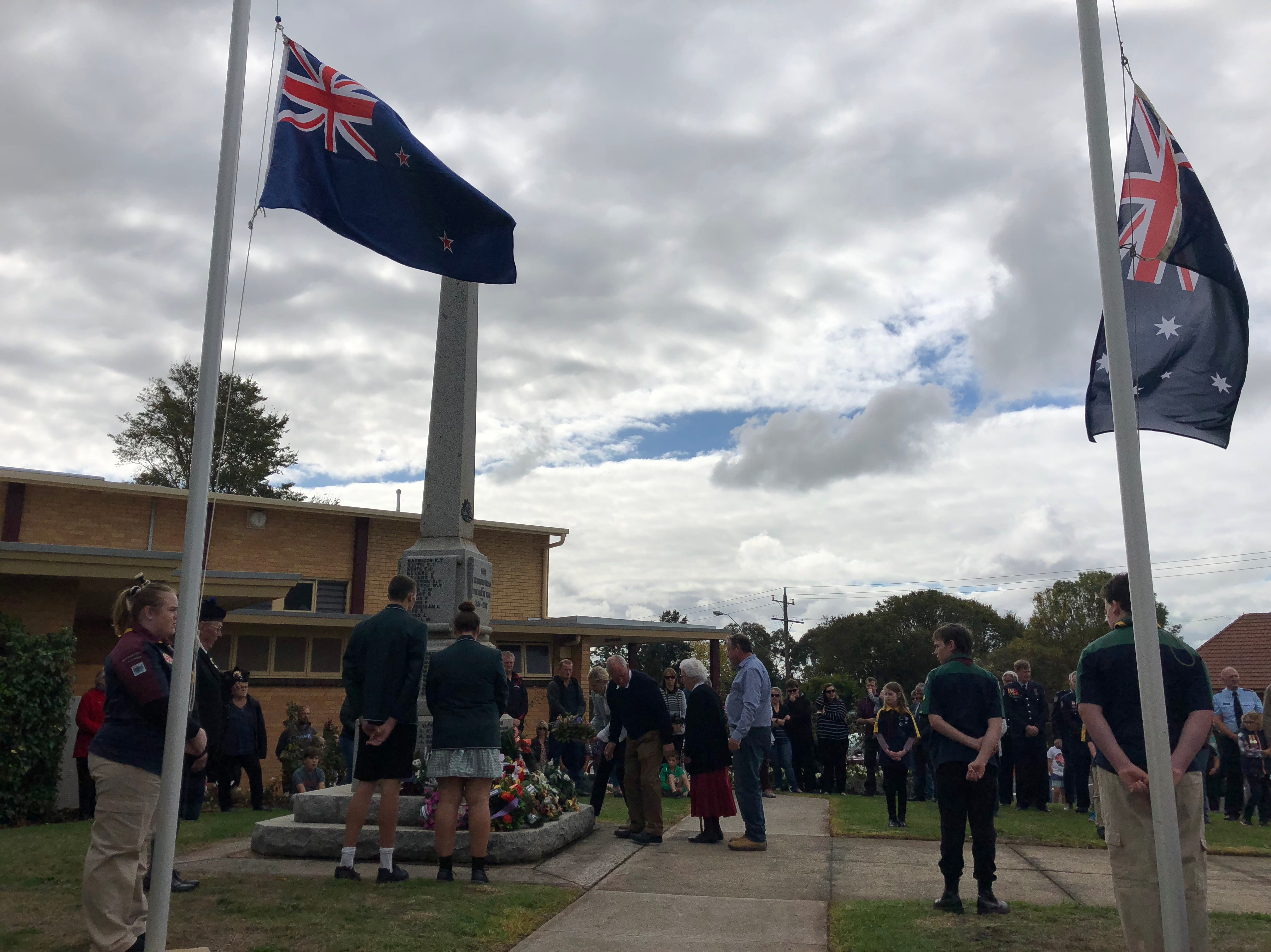
2018-04-25 12.13.17Peter Rock, the MC at this morning’s ceremony at the cenotaph in my local town, made a profound observation in the early moments of his opening speech: “Those who are surprised by the fact that ANZAC Day commemorations continue to draw record attendance understand very little of our national character.” He went on to speak about how and why we remember those who fought and sacrificed themselves for our freedom. Their bravery is renowned, but so is their commitment despite adversity, their mateship, and their love for their country. He’s absolutely right – those are qualities that have indeed become part of our national character. Our freedom and our mateship are the rewards of their courage and service.

That’s something my town has been reminded of in recent weeks. This time, our enemy was fire, and our battle was fought with water and fire retardant foam, not with bullets and mortars. Those who faced the danger and fought to keep the rest of us safe did so knowing they were putting themselves at risk, but that didn’t stop them. Behind the fire front, they were supported by others who worked tirelessly to supply and feed them, but also to care for those who had to flee from the fires, and for all those who were traumatised by them in various ways. Of course, it’s a very different scale to what was experienced by the soldiers who went to war, but the selflessness and the determination to serve and protect is the same.

Thankfully, no lives were lost in that particular war, although there were numerous casualties in terms of homes and livelihoods. It has been relentless and exhausting, yet our community has come together yet again to help, support, and defend. People may have lost their houses, but they are not homeless: we are their home, and we will make sure they have what they need to start over and keep going. In true Aussie fashion, our local community has been incredibly generous, as have many people from beyond the local area. There really is no better place to live.

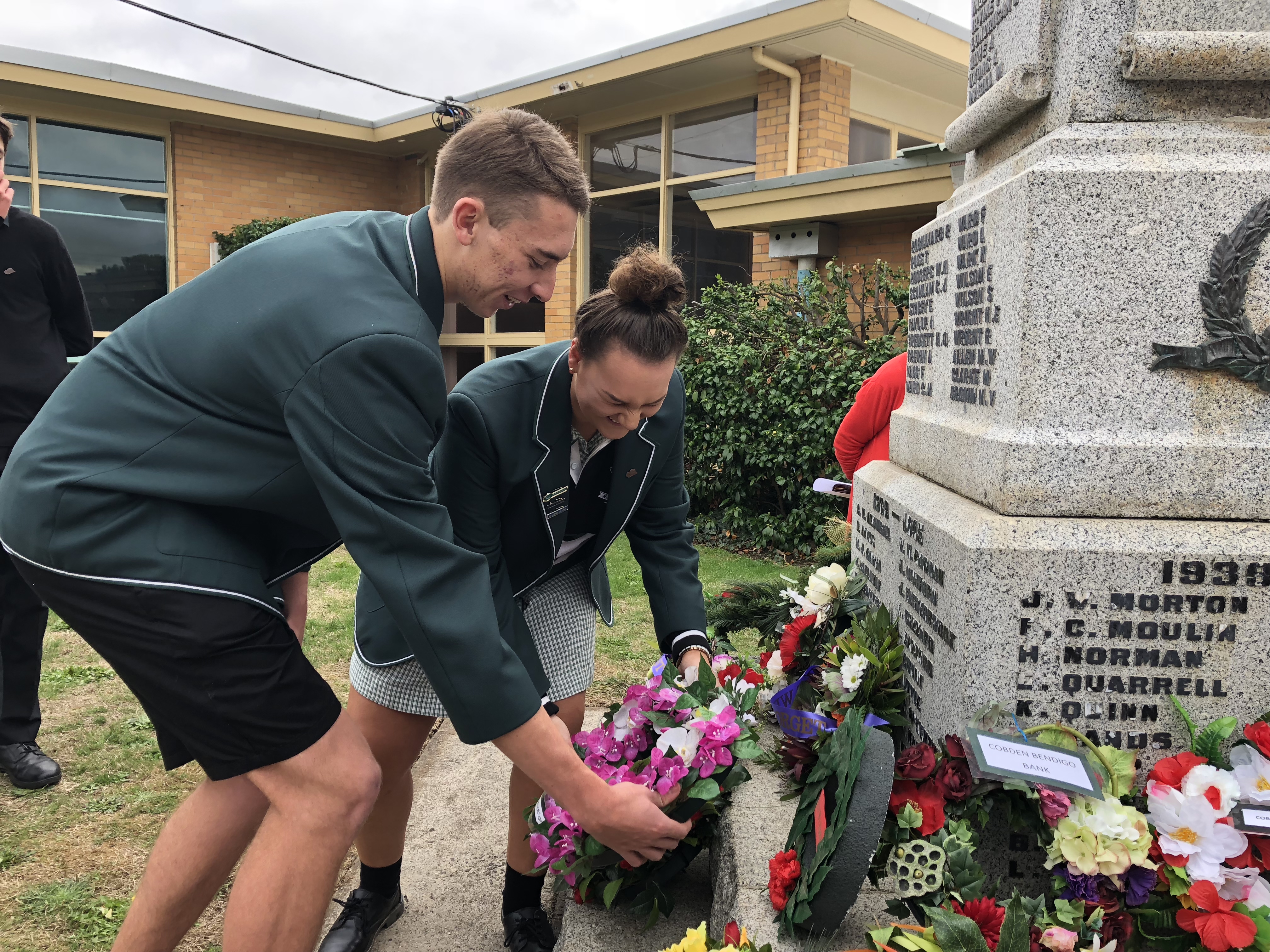
Today’s ceremony was, as always, very well attended. Representatives from service groups, churches, local government organisations, school students and professional organisations laid wreaths in memory of the fallen. Families stood together, some wearing medals that belonged to fathers, uncles, or grandparents who served in the military and have since passed on. The flags of both Australia and New Zealand were flown at half mast until after the minute of silent reflection, and the national anthems of both countries were sung. Tears – whether of sorrow for the fallen, of thankfulness for the freedom we enjoy, of patriotic pride, or a combination of all those factors – were shed.


This afternoon, there’s a big concert being held on the local football ground, not just to raise funds for fire relief, but also to give some joy and celebration back to a community that has done some really hard yards over the past six weeks. Talents from both the local area and further afield will be performing. Local businesses are providing catering, entertainment, and every other service that’s needed.

And you can bet your bottom dollar that the locals are going to turn out in force to support that concert, and each other, because that’s what we do. We stick together in times of trouble, and we cheer each other on in our victories. In doing that on ANZAC Day, we will continue to remember the lessons we learned from the ANZACS and all our other diggers.

At the going down of the sun, just as we did in the morning, we WILL remember them.

When Evil Seems To Win.

A poet reflects on what inspired her latest piece of dark poetry.

One of the things I find hardest to deal with in life is the perception that sometimes, evil seems to win.

I don’t know why it should surprise me each time it happens, but it still does. I don’t know why people’s cruelty and evil actions still shocks me, but it does.

Let me explain where this train of thought originated.

Not long ago, I witnessed the complete and irreversible downfall of someone I’ve known for some time. I haven’t always necessarily liked that person – less, in fact, as time went on, although that’s not really relevant to this post. I honestly thought that their behaviour couldn’t get any lower than what I had already witnessed, and what I already knew of him. I was wrong.

Please understand that in writing this post, I do not for one moment mean to suggest that I feel sorry for him. I don’t.
I do feel incredibly sorry for those whose trust he, and every other person like him, has broken and abused. My heart breaks for those who find themselves and the rest of their lives shattered among the trail of destruction they leave behind. These things leave permanent scars from which some people never recover.

And there is no denying that I am incredibly angry. How dare he? He can’t say he didn’t know it was wrong. He can’t say he didn’t know what he was thinking. He knew, and he went ahead and did it anyway.

So, as his life unravelled before my eyes, I was left feeling the same about him as I do about everyone who betrays the trust of the people they should be protecting.

Whether it’s broken friendship, corruption, or an absolute degradation of one person by another, I believe that there are powers in this world that celebrate when someone who has always taken a strongly moral stand falls from a position of leadership and finds themselves in a downward spiral of shame and humiliation, especially if it’s a person of faith.

2018-03-16 23.47.07

It was this chain of thought that led me to write ‘The Demons Dance’. It is grim imagery of demons dancing and celebrating around the crumpled form of their latest victim, upon whos miery and death they are completely drunk.

In this poem, as in a number of my others, my love of writing horror and the macabre has combined with my penchant for poetry to produce what I believe is poetry that is both grotesque and beautiful at the same time.

Click to read The Demons Dance.

Joey'sMapleLeafTatt

If you appreciated this post, please click like just below. It really does help to make my blog more visible to other potential readers. Thanks in advance.

When The Words Won’t Come.

Writer’s Block can be brutal, but agonising over it is only going to make things worse.

There are times in every writer’s life when the words just won’t come. Sometimes that lasts an hour. Sometimes it lasts weeks, or months. It’s certainly frustrating, but I refuse to stress over it. 2018-04-19 17.51.23

I’ve been in a “writing dry patch” over the past couple of months. For a while, there was nothing happening: the only thing I was writing was note after note full of ideas. I don’t know why I couldn’t write anything. I just couldn’t.

That came as something of a shock after last year which, although turbulent, painful and draining on both personal and emotional levels, was also incredibly productive. Three books of poetry, two of mild horror, and two fairy tale novellas in an anthology in a year is impressive for someone who teaches high school and needs to sleep occasionally. In one sense, it’s no wonder I ran out of steam. I’m only human, after all.

It was poetry that recently broke the drought for me. In fact, it usually is. Ironically, it was local tragedy in the form of wildfires around my home town on St Patrick’s Day that got the words flowing again. Since the middle of March, I’ve written some poems that I’m really happy with, and I have some others started.

I have so many stories I want to write, but now just doesn’t seem to be the time for that, so I’m saving the notes and plans and outlines until it happens naturally. I know it will. And when it does, I’ll be ready.

In all honesty, my mind is tired. Today at work, I struggled to remember the word for “chair”– and I was in a classroom, surrounded by at least 25 of them at the time! If I forced myself to write those stories now, they’d be rubbish.

So, I’m going to be kind to myself. I’m going to give my mind and my spirit time to rest, and not worry about all the things I want to write, or feel I should be writing. I’m certainly not going to churn out a bunch of garbage and try to persuade people that it’s “art”. I’m happy to wait, and I think my readers will prefer that, too.

Hopefully in the meantime I’ll be able to write a few more good poems.

A Favourite Poem: ‘The Bells’ by Edgar Allan Poe

‘The Bells’ is a magnificent poem that is best read aloud.

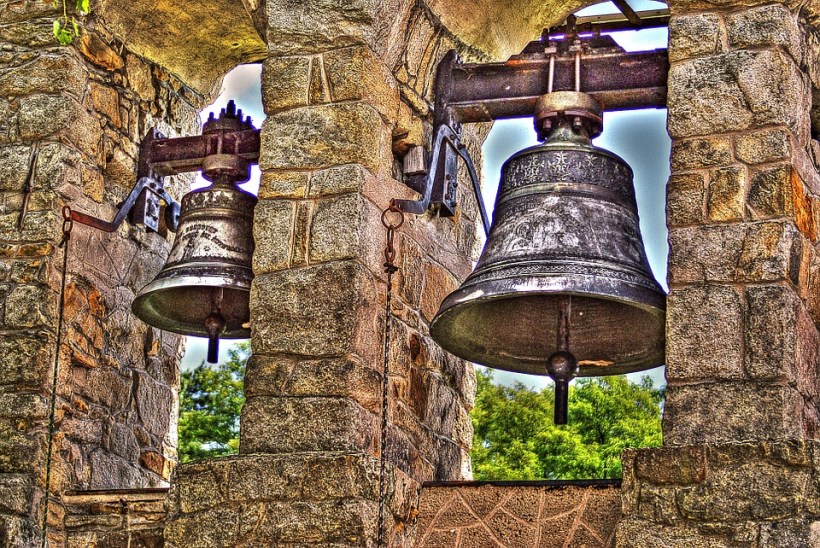
‘The Bells’ is a poem that Poe wrote in the final year of his life, as he battled writer’s block that seemed to have developed with his grief for his wife, who died from tuberculosis. It is highly reflective of the way in which he perceived the changes that happen in one’s life – as one gets older, the ringing of the bells is less about happiness and increasingly about grief and fear. From courtship, to marriage, then grief and despair, and finally one’s own death, each stanza grows darker and longer than the one preceding it. The haunting tone of the final stanzas is powerful and chilling, leaving the reader with a strong sense of impending doom and terror.

For me, this poem also reflects how happy times seem to fly past quickly, while periods of darkness and sorrow seem to linger and to obscure the light of those happier memories and thoughts.

It’s a beautiful thing to quietly read and reflect on the poem, but it is possible to overlook some technical elements of the poetry if one reads it silently. Reading the poem aloud adds another dimension altogether to one’s understanding and experience of the poem.

In each stanza, the bells are made of particular metals that reflect the purpose and symbolism of the bells, but which also have different sounds when they ring in that verse of the poem.
The verbs used by Poe to describe the way in which the bells ring have been purposefully chosen to shape the meaning by controlling the speed and temperament of the reading. Short vowel sounds in “jingling” and “tinkling” are replaced with successively longer vowel sounds that slow the reading down and lower the register of the voice, so that the mood becomes more serious and sombre. By the end, the “moaning and the groaning of the bells” is oppressive and fearful, evoking horror and fear in the reader.

I really enjoy the onomatopoeia – words that sound like their meaning – of the poem as it grows progressively louder and heavier, emphasising and compounding the darkening tone and message of the poem. It is the sounds of the bells that tell us what is going on, as much as the other narrative provided by the poem.
the-bells-419677_960_720

THE BELLS

I
Hear the sledges with the bells–
Silver bells!
What a world of merriment their melody foretells!
How they tinkle, tinkle, tinkle,
In the icy air of night!
While the stars that oversprinkle
All the heavens, seem to twinkle
With a crystalline delight;
Keeping time, time, time,
In a sort of Runic rhyme,
To the tintinnabulation that so musically wells
From the bells, bells, bells, bells,
Bells, bells, bells–
From the jingling and the tinkling of the bells.

II
Hear the mellow wedding bells
Golden bells!
What a world of happiness their harmony foretells!
Through the balmy air of night
How they ring out their delight!
From the molten-golden notes,
And all in tune,
What a liquid ditty floats
To the turtle-dove that listens, while she gloats
On the moon!
Oh, from out the sounding cells,
What a gush of euphony voluminously wells!
How it swells!
How it dwells
On the Future! how it tells
Of the rapture that impels
To the swinging and the ringing
Of the bells, bells, bells,
Of the bells, bells, bells, bells,
Bells, bells, bells–
To the rhyming and the chiming of the bells!

III
Hear the loud alarum bells–
Brazen bells!
What tale of terror, now, their turbulency tells!
In the startled ear of night
How they scream out their affright!
Too much horrified to speak,
They can only shriek, shriek,
Out of tune,
In a clamorous appealing to the mercy of the fire,
In a mad expostulation with the deaf and frantic fire,
Leaping higher, higher, higher,
With a desperate desire,
And a resolute endeavor
Now–now to sit or never,
By the side of the pale-faced moon.
Oh, the bells, bells, bells!
What a tale their terror tells
Of Despair!
How they clang, and clash, and roar!
What a horror they outpour
On the bosom of the palpitating air!
Yet the ear, it fully knows,
By the twanging,
And the clanging,
How the danger ebbs and flows;
Yet, the ear distinctly tells,
In the jangling,
And the wrangling,
How the danger sinks and swells,
By the sinking or the swelling in the anger of the bells–
Of the bells–
Of the bells, bells, bells, bells,
Bells, bells, bells–
In the clamour and the clangour of the bells!

IV
Hear the tolling of the bells–
Iron bells!
What a world of solemn thought their monody compels!
In the silence of the night,
How we shiver with affright
At the melancholy meaning of their tone!
For every sound that floats
From the rust within their throats
Is a groan.
And the people–ah, the people–
They that dwell up in the steeple,
All alone,
And who, tolling, tolling, tolling,
In that muffled monotone,
Feel a glory in so rolling
On the human heart a stone–
They are neither man nor woman–
They are neither brute nor human–
They are Ghouls:–
And their king it is who tolls;
And he rolls, rolls, rolls, rolls,
Rolls
A pæan from the bells!
And his merry bosom swells
With the pæan of the bells!
And he dances, and he yells;
Keeping time, time, time,
In a sort of Runic rhyme,
To the pæan of the bells–
Of the bells:
Keeping time, time, time,
In a sort of Runic rhyme,
To the throbbing of the bells–
Of the bells, bells, bells–
To the sobbing of the bells;
Keeping time, time, time,
As he knells, knells, knells,
In a happy Runic rhyme,
To the rolling of the bells–
Of the bells, bells, bells–
To the tolling of the bells,
Of the bells, bells, bells, bells–
Bells, bells, bells–
To the moaning and the groaning of the bells.

Joey'sMapleLeafTatt

If you enjoyed this post, please click “like” to increase its visibility to other readers.
Shares and comments are also appreciated.

Songs and Poetry

Songs and Poetry: Sometimes it’s hard to tell the difference.

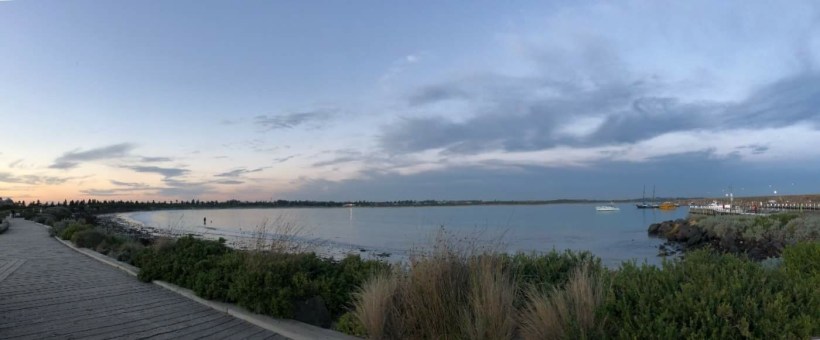
2015-07-18-17-11-28-warrnambool-breakwater-blog-e1523956844938.jpg

In an earlier post, I referred to song lyrics as being a form of poetry.

There are many songwriters who write deeply poetic songs. Elton John and Bernie Taupin, John Lennon and Paul McCartney, Paul Simon, Billy Joel— they are among the greats. Today, singer/songwriters like Ed Sheeran and Katy Perry are among the artists whose songs contain some incredibly powerful poetry.

While it might be fun to come up with more examples, I have no desire to try to list them all – I don’t even think that’s really possible. Chances are, some who make my list might not be included in yours. I just named a few to get you thinking.

While many songs rely on a catchy hook or a beat that makes people want to dance, it’s the poetry of others that gives them the power to move a person emotionally, or to profoundly affect someone’s thoughts and actions.

Consider the influence John Lennon’s ‘Imagine’ had on an entire generation. Similarly, Simon & Garfunkel touched hearts and lives worldwide with the soaring power of “Bridge Over Troubled Water”, while the poignant emotion of Elton John’s “Candle In The Wind” or “Sorry Seems To Be The Hardest Word” is still hard to resist.

I don’t know if this happens to everyone, but poetic songs seem to attach themselves to part of my soul and remain there, indelible and timeless.

This line of thinking led me to trying to work out which song contains my favourite “song poetry”. That’s actually a really tough question, so I decided I’d listen to a few of my favourites and try to narrow it down.
A week later, I think I have an answer. (Disclaimer: this answer is likely to change at any moment.)

I am a rock 2018-04-17 11

This song is a brilliant extended metaphor about identity and finding one’s place in the world. The contrast between a rock or an island with the vulnerability of being human, and the paradox of isolation being a form of sanctuary, are ideas which should be jarring, yet they are delivered with such finesse that we’re left thinking, “I totally get that!” They’re ideas and images we all understand, and the poet communicates uses a depth of emotion and human experience to say things that many other people could never bring themselves to verbalise.

The clincher for me is the final verse. “I have my books and my poetry to protect me.” That’s exactly what I do! I retreat into fictional worlds. I write stories and poems that help me to deal with life. I use poetry to crystallise my thoughts and feelings, and use my writing to communicate what it’s hard to say any other way.

As I was reflecting on that final verse, a poem I wrote last year came to mind. I’m not suggesting that I think I’m as good as Paul Simon, but it does explore similar ideas of hiding behind – or within – the books and words I have written.

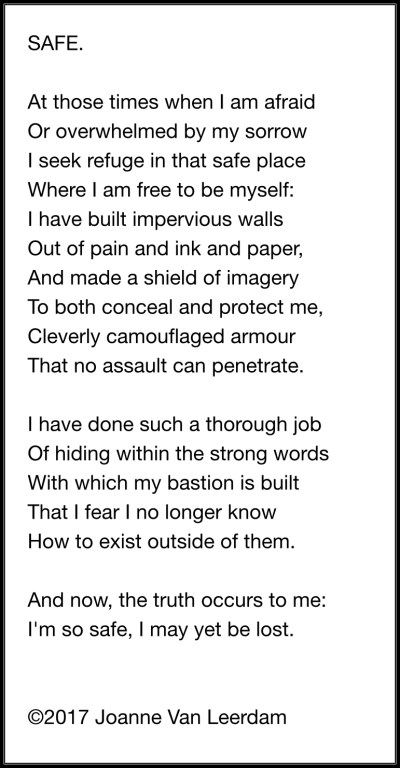
Poem Safe 2018-04-17 13

It was written during a time of great personal conflict and turbulence, and expresses the refuge I found in my writing. In different poems written during this period, I portrayed myself at different times as a fighter, as a hostage, and as a traveler. At no time did I portray myself as willing to surrender to the storm that raged around me, nor to anything else that tried to do me in. In my writing, I was strong. I was safe.

When I went back to read that poem as part of the process of writing this post, I was stunned to discover the similarity of the ideas to those explored by Paul Simon, even though my poem was neither based on nor drawn from his lyrics.

I was also confronted by the warning of the last two lines. I have to take care when I feel or experience something, or when I write something powerful, that I can’t afford to unpack and live there. I still have to live my life and be who I am, and I still have to deal with whatever life throws at me.

After all, I am neither a rock nor an island, no matter how much I might sometimes wish I were.


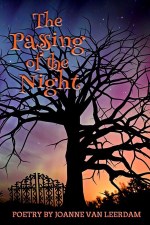
‘Safe’ is published in my book, ‘The Passing Of The Night’.


Joey'sMapleLeafTatt

If you enjoyed this post, please click “like” to increase its visibility to other readers.
Shares and comments are also appreciated.
The Poet’s Insights: ‘The Artist’

The poet tells the story behind her poem, ‘The Artist’.

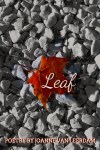
‘The Artist’ is one of my favourite poems from ‘Leaf’, my first published book of poetry.


2016-07-16-15-09-161.jpg
The inspiration for this poem came from my long-time friend Nicky, who is an gifted artist.
Nicky was one of the people who really pushed me to pursue publication of my poetry. She is an infinite source of encouragement and support, but more than that, she is a loyal and constant friend and confidant.

I should preface this story by pointing out that I’ve never been good at drawing or painting. My grandfather was an artist. My sister once painted a brilliant life-size portrait of Charlie Chaplin that covered her bedroom door for years. My mother could draw animals, people, and groovy designs with a ball point pen and make them look fantastic.

And then, there’s me. The only thing I can draw is cash from an ATM, and the occasional stick figure.

One day, Nicky showed me one of her beautiful paintings, which she had just completed. I gazed at it for a while, and sighed,”I wished I could do that.”

The Artists Plain

Without missing a beat, she replied, “You do. You just do it with words.”

That came as a real revelation to me. At that point in my life, I just wrote poetry for myself, and shared the ones I liked with a couple of friends. I didn’t really consider myself a poet as such, nor did I think I’d ever be published.

With those words, she inspired this poem.

The Artist.

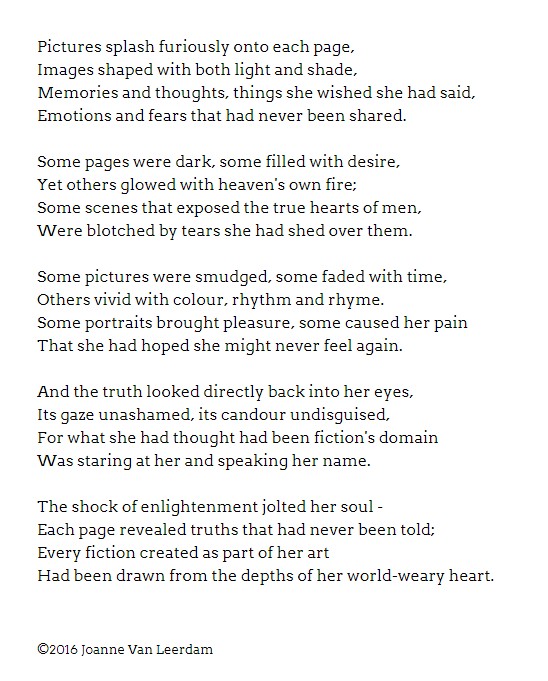
ScreenHunter_439 Apr. 11 11.03

As a poem, I believe it hass integrity. It feels and sounds good when reading it aloud, and the rhythm works well with the ideas of making brush strokes and splashing a bit of paint around. At the end, it’s a reflection of that moment when the artist stands back and is surprised by what she finds on the easel in front of her.

The artist in the poem is definitely me. Like the artworks in the poem, some of my writing is vivid and colourful, while other pieces are dark and tear-smudged. Even a poem that appears to be fictional, like ‘Misery’ – which has been included in a fairy tale anthology! – is deeply rooted in my own reality.

I have very great affection for ‘The Artist’ for the truth it tells about my own experience as a poet, but I also love the fact that it will always be about my friendship with Nicky, too. Without her inspiration and encouragement, I might still just have a bunch of notebooks full of poems that nobody else would ever read.

Leaf 2nd Ed eBook Cover 6x9 350ppi

I first told ‘The Artist’s story when Nicky spoke at my book launch for ‘Leaf’ in June, 2016. Completely unaware of the story behind the poem or the fact that she had inspired it, Nicky chose ‘The Artist’ as the poem she would like to read to the guests. When she finished her reading and speech, I followed with the account of the poem’s inspiration. It was a beautiful moment in time that highlighted the wonderful thing that we share in our friendship.


Joey'sMapleLeafTatt

I hope you enjoyed ‘The Artist’ and the story behind it. If you appreciated this post, please click “like” below so that others find it more easily. You’re also welcome to leave a comment.
Thank you in advance.


Writing What I Know.

One of the simplest pieces of advice given to writers is to “write what you know”.

One of the simplest pieces of advice that is given to writers, especially those just starting out, is to “write what you know”.2018-04-08 18.10.55

It’s good advice.
It doesn’t take long, though, before it gets more complicated: it’s what you do with it after the first draft that makes any piece of writing effective and powerful.

While I don’t have any personal experience of unicorns or magical black cats— yes, it’s hard to believe, isn’t it?— my poetry is full of what I know. Every poem is inspired by real-life experience, either mine or that of someone close to me, or my own observations of other people and their actions. Even those poems that appear to be fictional are grounded in personal truth.

For this reason, there really isn’t anything that I won’t write about.
Grief. Fear. Joy. Sadness. Depression. Temptation. Despair. Determination. Anger.
It’s all there.

Writing poetry is the most effective therapy that I have ever experienced. At different times in my life, I’ve sat through grief counselling, infertility counselling, and therapy sessions to help with my depression. Each was worthwhile in its own way but, for me, none of that has come close to the healing power of ink on paper, working through ideas, shaping and crafting meaning with the words I choose, so that I can express my thoughts and feelings effectively.

Late last week, for example, I found myself confronted by the actions of a particular individual whom I had not seen for some time. Churning inside with revulsion and anger, I knew I was not ready to get into the car and drive home in that state, so I went and found a place where I could think and write and start to deal with both the new knowledge and the way it made me feel.

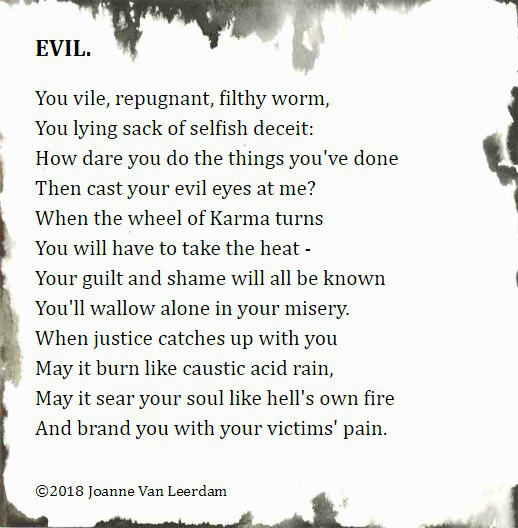
I didn’t write one poem. I started several, and have made progress on three. Only one is finished- at least, I think it is. It doesn’t identify anyone, nor is the finished poem specific to only my situation, but it leaves the reader in no doubt whatsoever about how I feel. It’s a poem that is entirely relatable for anyone who finds themselves horrified by the unsavoury actions and/or evil intentions of another.

My hope in publishing it is that, if someone in a similar situation to mine should read it, they will know they’re not alone in their feelings. There is, after all, solidarity in numbers.

Evil

I haven’t decided whether or not ‘Evil’ will make it into a future collection for a book.
I do know that I felt a great deal better when I had written it than before I started. And really, that was the whole point.

If you’d like to read more of my poems, there are a number of them published on WordyNerdBird Writes.

Joey'sMapleLeafTatt

If you appreciated this post, or the poem included, please like the post by clicking the button below, or leave a comment. All constructive feedback is welcome.