There are times in every writer’s life when the words just won’t come. Sometimes that lasts an hour. Sometimes it lasts weeks, or months. It’s certainly frustrating, but I refuse to stress over it.
I’ve been in a “writing dry patch” over the past couple of months. For a while, there was nothing happening: the only thing I was writing was note after note full of ideas. I don’t know why I couldn’t write anything. I just couldn’t.
That came as something of a shock after last year which, although turbulent, painful and draining on both personal and emotional levels, was also incredibly productive. Three books of poetry, two of mild horror, and two fairy tale novellas in an anthology in a year is impressive for someone who teaches high school and needs to sleep occasionally. In one sense, it’s no wonder I ran out of steam. I’m only human, after all.
It was poetry that recently broke the drought for me. In fact, it usually is. Ironically, it was local tragedy in the form of wildfires around my home town on St Patrick’s Day that got the words flowing again. Since the middle of March, I’ve written some poems that I’m really happy with, and I have some others started.
I have so many stories I want to write, but now just doesn’t seem to be the time for that, so I’m saving the notes and plans and outlines until it happens naturally. I know it will. And when it does, I’ll be ready.
In all honesty, my mind is tired. Today at work, I struggled to remember the word for “chair”– and I was in a classroom, surrounded by at least 25 of them at the time! If I forced myself to write those stories now, they’d be rubbish.
So, I’m going to be kind to myself. I’m going to give my mind and my spirit time to rest, and not worry about all the things I want to write, or feel I should be writing. I’m certainly not going to churn out a bunch of garbage and try to persuade people that it’s “art”. I’m happy to wait, and I think my readers will prefer that, too.
Hopefully in the meantime I’ll be able to write a few more good poems.
In an earlier post, I referred to song lyrics as being a form of poetry.
There are many songwriters who write deeply poetic songs. Elton John and Bernie Taupin, John Lennon and Paul McCartney, Paul Simon, Billy Joel— they are among the greats. Today, singer/songwriters like Ed Sheeran and Katy Perry are among the artists whose songs contain some incredibly powerful poetry.
While it might be fun to come up with more examples, I have no desire to try to list them all – I don’t even think that’s really possible. Chances are, some who make my list might not be included in yours. I just named a few to get you thinking.
While many songs rely on a catchy hook or a beat that makes people want to dance, it’s the poetry of others that gives them the power to move a person emotionally, or to profoundly affect someone’s thoughts and actions.
Consider the influence John Lennon’s ‘Imagine’ had on an entire generation. Similarly, Simon & Garfunkel touched hearts and lives worldwide with the soaring power of “Bridge Over Troubled Water”, while the poignant emotion of Elton John’s “Candle In The Wind” or “Sorry Seems To Be The Hardest Word” is still hard to resist.
I don’t know if this happens to everyone, but poetic songs seem to attach themselves to part of my soul and remain there, indelible and timeless.
This line of thinking led me to trying to work out which song contains my favourite “song poetry”. That’s actually a really tough question, so I decided I’d listen to a few of my favourites and try to narrow it down.
A week later, I think I have an answer. (Disclaimer: this answer is likely to change at any moment.)
This song is a brilliant extended metaphor about identity and finding one’s place in the world. The contrast between a rock or an island with the vulnerability of being human, and the paradox of isolation being a form of sanctuary, are ideas which should be jarring, yet they are delivered with such finesse that we’re left thinking, “I totally get that!” They’re ideas and images we all understand, and the poet communicates uses a depth of emotion and human experience to say things that many other people could never bring themselves to verbalise.
The clincher for me is the final verse. “I have my books and my poetry to protect me.” That’s exactly what I do! I retreat into fictional worlds. I write stories and poems that help me to deal with life. I use poetry to crystallise my thoughts and feelings, and use my writing to communicate what it’s hard to say any other way.
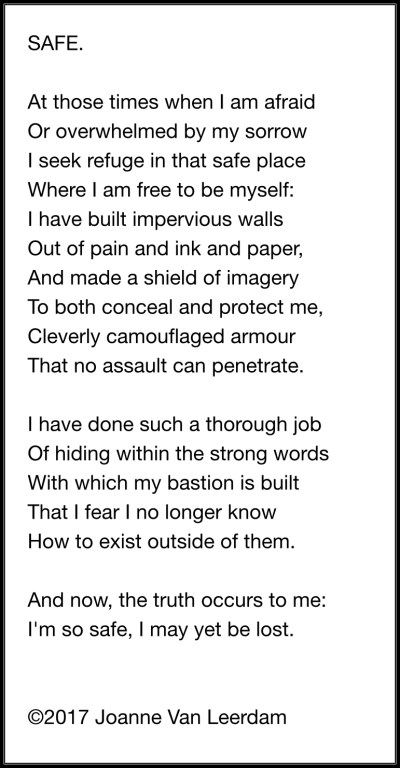
As I was reflecting on that final verse, a poem I wrote last year came to mind. I’m not suggesting that I think I’m as good as Paul Simon, but it does explore similar ideas of hiding behind – or within – the books and words I have written.
It was written during a time of great personal conflict and turbulence, and expresses the refuge I found in my writing. In different poems written during this period, I portrayed myself at different times as a fighter, as a hostage, and as a traveler. At no time did I portray myself as willing to surrender to the storm that raged around me, nor to anything else that tried to do me in. In my writing, I was strong. I was safe.
When I went back to read that poem as part of the process of writing this post, I was stunned to discover the similarity of the ideas to those explored by Paul Simon, even though my poem was neither based on nor drawn from his lyrics.
I was also confronted by the warning of the last two lines. I have to take care when I feel or experience something, or when I write something powerful, that I can’t afford to unpack and live there. I still have to live my life and be who I am, and I still have to deal with whatever life throws at me.
After all, I am neither a rock nor an island, no matter how much I might sometimes wish I were.
Two weeks ago, I had finished an incredibly busy first term at school and was looking forward to a well-earned break for a couple of weeks.
When people asked me, “Are you doing anything for the holidays?” I gave them my standard answer: “As little as possible.”
You’d think I’d learn not to tempt fate like that, but apparently not.
Family came to stay, visitors called in, things happened. I just needed to rest… but when was that ever going to happen? I wanted to write, but there was no time for that, either. I began to feel as though life was out of control.
And then, I started to get angry. It wasn’t directed at anyone or anything in particular – instead, it was a rumbling discontent within me. As the only introvert in a house full of rampant extroverts, I felt misunderstood and somewhat neglected.
One afternoon, my house fell quiet for a few moments. I sat in the comfy chair in my study with a book, took a deep breath, and before I knew it, I had dozed off. It didn’t last long.
I woke up to a barrage of sound from the football blaring on the TV in the adjoining room, people talking loudly to be heard over it, and others talking loudly with a phone on “speaker” mode. They could have gone to another room. They could have closed my study doors and left me there in peace. But they didn’t.
That was when this poem erupted from within me.
The imagery of a dragon is not accidental: I wanted to incinerate them them all, or at least toss them around a bit with my tail. Knowing that I couldn’t breathe fire on them all like I wanted to – they are family, after all – I escaped to my bedroom, closed the door, closed the drapes, and promised myself that whoever dared to knock on that door— or, heaven forbid, walk through it— and interrupt me again definitely had it coming. Then, as I generally do, I unloaded my feelings in the most therapeutic way I know: angry poetry.
It doesn’t tell the complete story. It’s really just a brief glimpse of a scene, but it reveals enough for the reader to understand. And I’m sure every exhausted teacher or parent, every person who is exhausted by constant demands, and every introvert who reads it will totally get it.
As you’re probably already aware, today is Friday the 13th.
For many, superstition is just old-fashioned silliness. Others set very strong store in superstitions, old wives tales, and various other traditions.
My affection for Friday 13th is different than mere superstition. I wrote Friday’s first story for Friday the 13th back in October last year. When I wrote what I thought was going to be a single piece of flash fiction, I had no idea how that cat was going to take over. Honestly, sometimes I wonder if I actually created him at all.
Between Friday 13th of October and Halloween last year, Friday demanded that thirteen stories be told. He’s a typical insistent cat in that sense… he just kept showing up and swatting my creative juju with his paw until I agreed to do his bidding. He has similarly demanded since then that his stories of Christmas Eve, New Years Eve and Valentine’s Day be told. And then, out of the blue, he whispered to me, “Tomorrow’s Friday the 13th. You should put Curious Things on sale for 99c.”
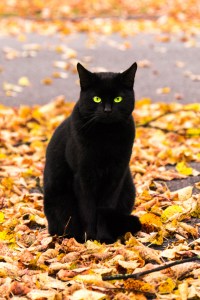
I’m really very fond of Friday. He’s a magnificent black cat with a lucky habit of being present when curious things take place.
He’s highly intelligent, fiercely loyal and devilishly handsome.
And I have to tell you– if someone were to give me a hard time, I’d want Friday on my side.
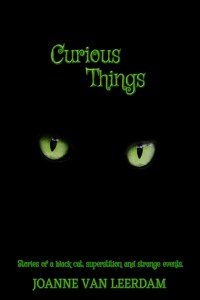
Curious Things delivers thirteen stories of people encountering justice for their wrongdoings, all as Friday watches on. Is he responsible? Or is it just lucky coincidence that he is present when these strange events take place?
If you’ve ever wished for karma to move a little faster, indulged in uncharitable thoughts about certain annoying people, or suspected that having a black cat cross your path was not quite as unlucky as people seem to think, this book is for you.
The book is full of dark humour, macabre events and mild-to-medium intensity horror, but it’s not just splatter for splatter’s sake. It’s really all about poetic justice and people getting what’s coming to them, via a very special feline.
Don’t just take my word for it, though. As the author, I’m clearly biased.
So, as a means of reassuring you, here’s what some of the reviewers on Amazon have said:
” Vengeance may be sweet—but, meting out justice vigilante-style just isn’t practical. Then along comes Friday, a black cat whose intelligence and curiosity gets the better of those who deserve their just desserts. Obvious or implied, Friday shows up where the wrath of Biblical justice is called for. And, it’s so gratifying to watch the gruesome details unfold!” – Reviewer
“I really like this book’s blend of dark humour and horror – that really appeals to me. I liked the way the author made each story about something different, and that the things that happened to the bad guys were all different to what happened to the others. The horror bits were good enough to make my skin crawl and give me a shudder, which is what I love in a spooky book. I really like Friday because he’s such a typical cat, but you also realise that he’s something more than that, too.
Don’t start reading this book thinking it’s just a story about a nice kitty. Read it because you want to see his dark side.” – Reviewer
“13 awesome stories with 13 lessons to think about. I adore the cat, Friday. I reckon if I had Friday in my life, I would feel way safer. This cat is like Karma on four legs.” – Reviewer
” A lovely collection of tales, overseen by a cat who defends his person with almighty power.
A little gory, and a lot killy!” – Reviewer
Curious Things is available on Amazon and in all other major digital stores.
Even if horror isn’t your “thing”, some of my author friends have their books in Book Squirrel’s Friday 13th 99c sale today, too.
Why not pop over and check them out?
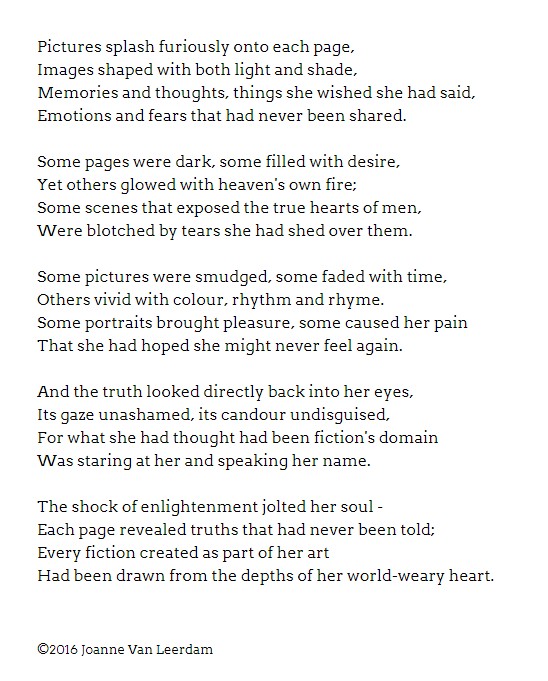
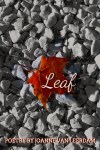
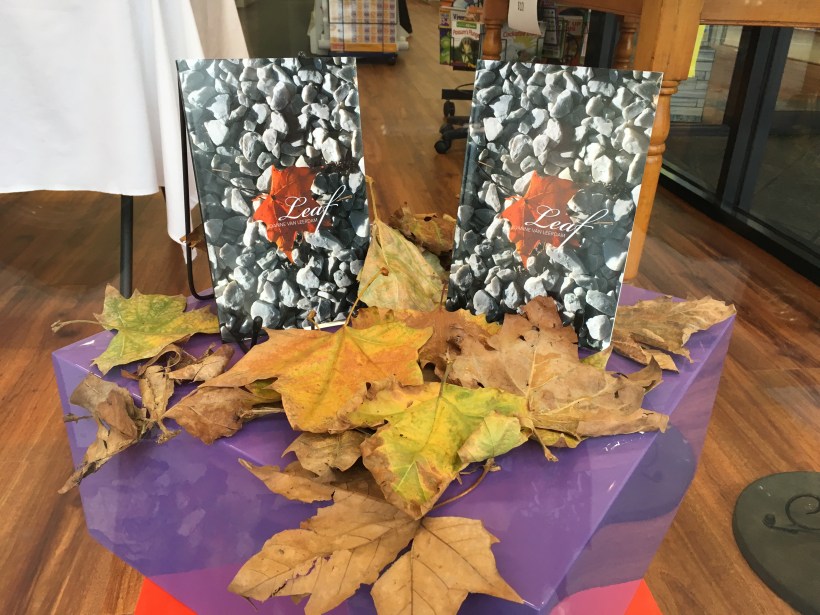
‘The Artist’ is one of my favourite poems from ‘Leaf’, my first published book of poetry.
The inspiration for this poem came from my long-time friend Nicky, who is an gifted artist.
Nicky was one of the people who really pushed me to pursue publication of my poetry. She is an infinite source of encouragement and support, but more than that, she is a loyal and constant friend and confidant.
I should preface this story by pointing out that I’ve never been good at drawing or painting. My grandfather was an artist. My sister once painted a brilliant life-size portrait of Charlie Chaplin that covered her bedroom door for years. My mother could draw animals, people, and groovy designs with a ball point pen and make them look fantastic.
And then, there’s me. The only thing I can draw is cash from an ATM, and the occasional stick figure.
One day, Nicky showed me one of her beautiful paintings, which she had just completed. I gazed at it for a while, and sighed,”I wished I could do that.”
Without missing a beat, she replied, “You do. You just do it with words.”
That came as a real revelation to me. At that point in my life, I just wrote poetry for myself, and shared the ones I liked with a couple of friends. I didn’t really consider myself a poet as such, nor did I think I’d ever be published.
With those words, she inspired this poem.
The Artist.
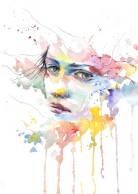
As a poem, I believe it hass integrity. It feels and sounds good when reading it aloud, and the rhythm works well with the ideas of making brush strokes and splashing a bit of paint around. At the end, it’s a reflection of that moment when the artist stands back and is surprised by what she finds on the easel in front of her.
The artist in the poem is definitely me. Like the artworks in the poem, some of my writing is vivid and colourful, while other pieces are dark and tear-smudged. Even a poem that appears to be fictional, like ‘Misery’ – which has been included in a fairy tale anthology! – is deeply rooted in my own reality.
I have very great affection for ‘The Artist’ for the truth it tells about my own experience as a poet, but I also love the fact that it will always be about my friendship with Nicky, too. Without her inspiration and encouragement, I might still just have a bunch of notebooks full of poems that nobody else would ever read.
I first told ‘The Artist’s story when Nicky spoke at my book launch for ‘Leaf’ in June, 2016. Completely unaware of the story behind the poem or the fact that she had inspired it, Nicky chose ‘The Artist’ as the poem she would like to read to the guests. When she finished her reading and speech, I followed with the account of the poem’s inspiration. It was a beautiful moment in time that highlighted the wonderful thing that we share in our friendship.
I hope you enjoyed ‘The Artist’ and the story behind it. If you appreciated this post, please click “like” below so that others find it more easily. You’re also welcome to leave a comment. Thank you in advance.
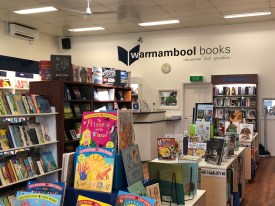
Yesterday was somewhat traumatic. Having confronted a face from the past that I’d really rather not ever see again, I was left with time on my hands and too much on my mind. So I defaulted to my usual sanctuary – books. I didn’t have my device with me, so I headed to my favourite book store to find something to read. My need for ink on paper and a pretty, nicely textured cover in my hands was just too strong.
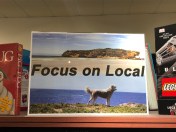
It’s a luxury, you know, having a local bookshop. The town in which I live doesn’t have one, but the larger town in which I work has two, as well as a fantastic place that sells second hand and antique books.
For me, the choice is simple. I will always support locally owned, independent businesses rather than larger chains or big department stores.
As an Indie author, I know how hard it is to compete against the bigger fish that swim in the same pond. Among other advantages, traditionally published authors have someone else’s marketing budget on their side, along with a team of people to help them get their books in front of readers.
It’s actually not a lot different for independently owned shops, whether they sell books or anything else. Consider for a moment what they have to compete with: not just the huge online companies that control the world of desktop shopping, but also those local shops owned by large commercial chains which, while they may have a local presence, are generally not owned by anyone who lives down the street from you or whose kids go to the same school as yours. The owner of that local store has to pay the rent and insurance, stock the shop, pay employees, and make a living in an increasingly difficult and competitive marketplace.
That’s why I buy my physical books at an independent store rather than from a book retail chain, or a big department store. The price for the same book is no different, but I know that I’m helping to put food on the table of a local family, or helping them to pay the neighbourhood mechanic for fixing the family car. My $30 probably won’t make much of a difference at all to an international company, but it makes a huge difference to an individual business owner.
I admit that the local store doesn’t have everything I want. I like to read some fairly specialised history, and I completely understand why they don’t usually stock that: I’m more nerdy about my history than most of the population. I can handle shopping further afield for that if I have to – but if I ask them to order a particular history book for me, they will.
They do, however, have a large range of children’s books, teen and young adult fiction, adult fiction, biographies, and new releases.
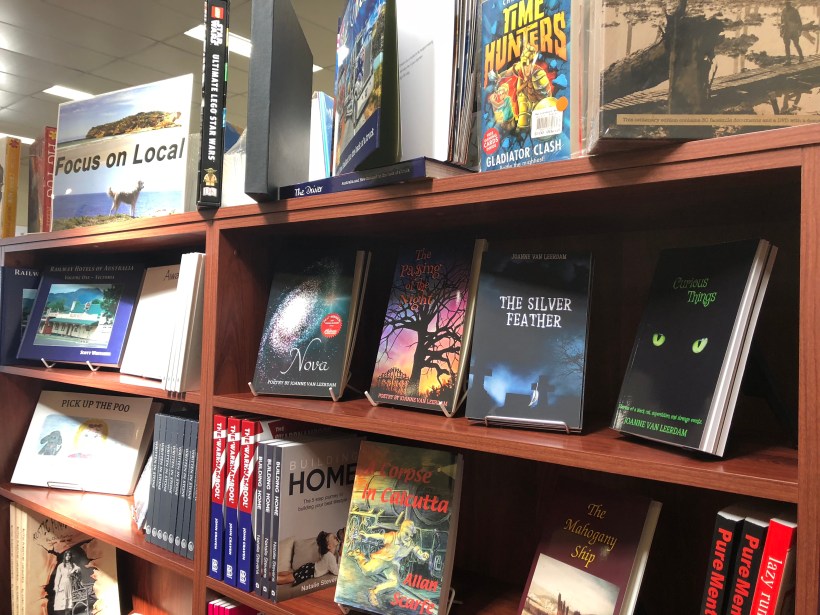
They also have a great selection of books written by local authors, whom they happily and actively support and promote.
Did the local book chain store agree when I asked them to stock my books on their shelves? No, they did not.
My local independent store not only agreed, but went way beyond that: they not only stock and display all of my books, they actually organised and hosted my first book launch.
They also host regular events at which local authors are welcome to meet and greet readers, sign books, and give readings from their work. That kind of support is pure gold to an author.
If we don’t support our local businesses, we will lose them. We will be left with fewer options, poorer service, and towns and communities that no longer prosper and thrive the way they once did.
Writing about family can be fraught with danger. The last thing you want to do as a writer is offend or alienate your family, especially if things are already fragile in some way.
That poses a challenge: what happens when there’s something you desperately want to write about? For starters, writers should know to always, always change names and details. If possible, don’t mention names at all. Even when writing about positive feelings or experiences, people who aren’t used to putting themselves out into the public eye might hesitate to have something written about them and published. A great idea for a story or poem should never be pursued at the cost of an important relationship.
When I do write something about friends or family, I make sure they’ve seen it first, and I tell them I’m going to publish it. That way, they can’t say they didn’t know.
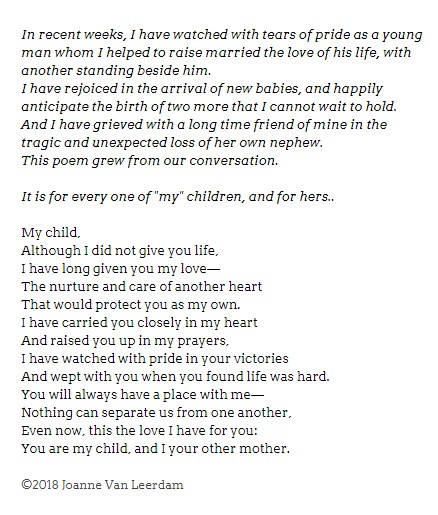
For example, I recently wrote a poem after two completely separate events: one was the wedding of my nephew, the other was a conversation with a friend who had recently lost her own nephew in tragic circumstances. The poem, titled My Child, does not mention anyone by name, nor does it mention those particular situations. It is an expression of my feelings – and my friend’s feelings – for those whom we have loved, held, and helped to raise. This is what I sent to “my children” and to my friend, well over a week before I posted it. That same text is what I posted on my writing blog where I published the poem today.
The other alternative, of course, if you feel you must write about something or someone, is to disguise the situation and details enough so they don’t know it’s about them. I’ve written plenty of poems about broken friendships, people in my life who have been determined to cause me trouble, and others who really deserve some special treatment from Karma, but it’s always been presented as me facing an invisible, unnamed challenger or enemy… or a certain black cat named Friday who metes out justice to people who really deserve it. It is not possible for anyone to identify who I was writing about at the time, and that’s a very good thing.
As a writer, it’s important to protect oneself. The last thing you want is something coming back to haunt you.
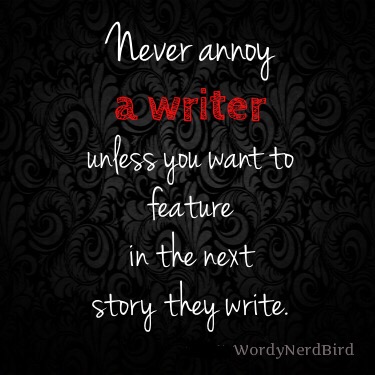
And if you’re a friend or family member of a writer, remember that age old piece of advice: Never annoy a writer, or they might put you in a book and kill you. It’s true.
When completing an author interview recently, I was surprised to find a question about my mission statement. My immediate reaction was, “My what?”
My next thought was of Jake and Elwood saying, “We’re on a mission from God!” in The Blues Brothers.
Image from tenor.com
Of course, it makes sense. If I can crystallise my goals in writing into a statement, it’s going to make them easier to achieve.
I do that all the time as a teacher. I think about objectives, learning intentions and success criteria all the time. So why didn’t I think about my objectives, intentions and success criteria as a writer?To be completely honest with you, I have no idea.
So, I started to work on my mission statement by writing down some basic questions:
What do I want to achieve?
What do I want my readers, or potential readers, to know?
How do I measure success?
Simple, right?
Wrong.
They’re actually really complex questions.
What does success as an author mean? Is it selling a million copies of my books? Well, that would be nice, of course, but it’s not just going to happen without me doing anything to achieve that. Who is going to buy my books if they’re not actually any good? My goal has to be one that I can achieve, and it has to be one that I can measure to see if I’ve met the mark. My goal , therefore, is to write something that people enjoy and benefit from, not to become a millionaire. Because it’s more achievable, and measurable through both feedback and sales, it’s far more satisfying and encouraging than hoping for something that might never happen.
What do I want my readers to know? Recluses are mysterious, sure, but that only has limited appeal. What I really want them to know is that I understand what I’m writing about – grief, love, pain, pleasure, excitement, fear, exhaustion, joy. I want them to know that what I’m writing is real and meaningful. I want them to know that if they’re going through something really awful and difficult, I get that because I’ve been through some awful and difficult stuff too. Particularly in my poetry, I want them to catch a glimpse of my soul, or see some blood on the page – metaphorically speaking, of course. I want there to be understanding between us. I want to connect.
So, measuring success isn’t in how many copies of each book I’ve sold, or how many dollars I’ve made. For me, success is in knowing that I’ve touched someone’s heart, or encouraged them, or entertained them. If they read my horror stories, I want to know that I scared them and they loved it.
The beauty of this process of setting goals and working toward them is that I can see with every review that I am achieving my goal, even more effectively than I can with each sale.
I owe enormous thanks to the person who asked me about my mission statement. They helped me clarify my goals in a way that I had not done before./div>
So, without further ado, this is my mission statement as an author:
Joanne Van Leerdam is an award winning poet and multi-genre author who is committed to writing meaningful and thought-provoking literature for the enjoyment of her audience.
Joanne is a thinker and puzzler, a reader and musician, a traveller, and a teacher who has never lost the joy of learning.
Joanne draws inspiration from her own experiences and observations of the world around her, crafting those ideas into works which will encourage those who struggle to persevere and inspire others to see the world from a new perspective. This is as true of her blog posts as it is of her works of poetry and fiction. She aims to continue to grow her readership into a fully global and inclusive audience.
It is not possible to adequately put into words how thankful we all are for the firefighters, first responders, police, and support crews who have kept us safe.
On Friday afternoon when I left town for a family wedding a couple of hours’ drive away, my greatest concern was that my father wouldn’t feel too lonely while we were away. When we left the wedding reception on Saturday night, and I checked my phone, my heart leapt into my throat as I began to realise what hell had unleashed back at home.
Wildfire.
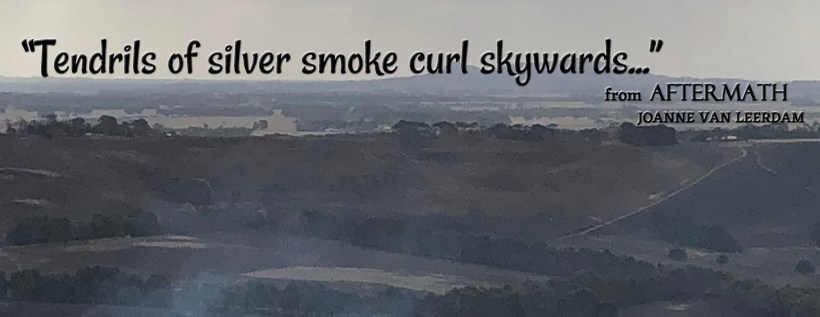
It is late in the season for fires, but there has been very little rain and the region has been tinder dry. Hot and very windy weather conditions created the opportunity for fire to take hold and spread rapidly through both farmland and natural bush.
One outbreak led to another, and another, and then another. My town, and those nearby, were experiencing the greatest crisis in decades. Surrounded by a ring of fire, people watched, worried, and sought refuge in the middle of town.
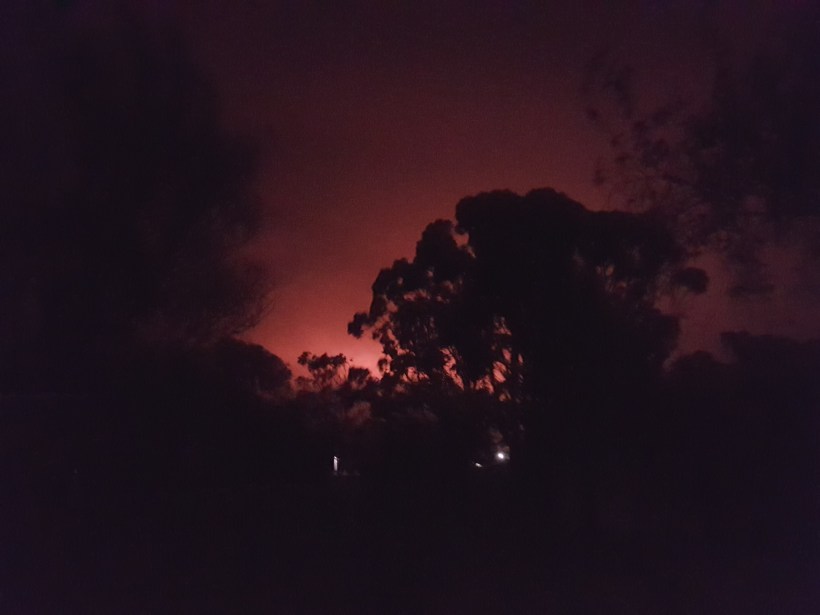
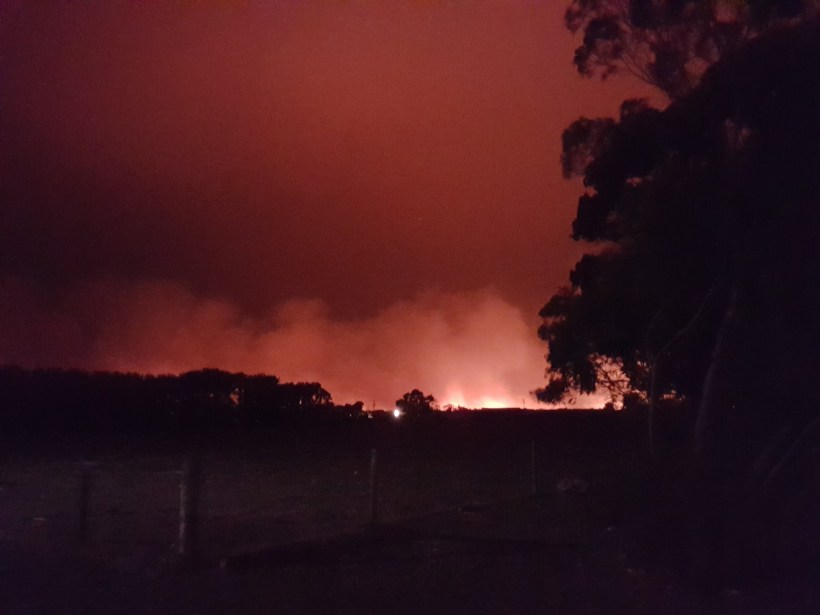
Social media posts showed what locals could see from their yards or where they had been driving. A friend who lives nearby posted photos of what she could see – and it was terrifying.
Photo by Wendy Bernhardt. Saturday March 17 2018 22.19 Cobden VictoriaPhoto by Wendy Bernhardt. Saturday March 17 2018 23.46 Cobden Victoria
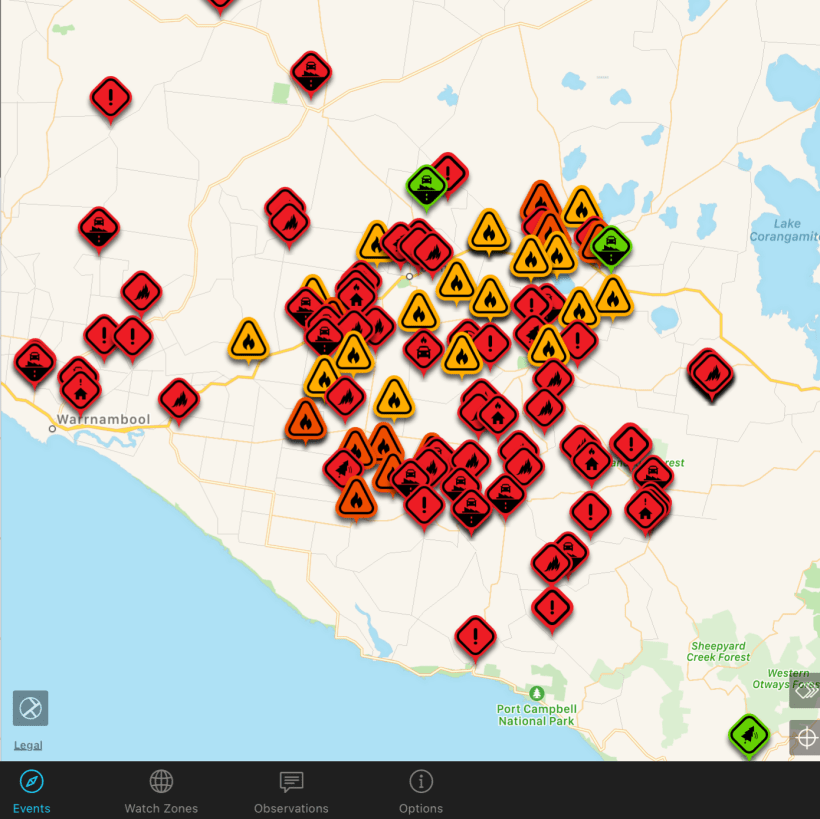
The emergency services website showed incidents all across the region, one after the other, spreading in a grim pattern of danger and destruction.
That little white dot in the middle of the map is my town – Cobden, in southwestern Victoria.
Roads were closed. Authorities forbade people from driving into the area. The situation was officially described as catastrophic. And my 86 year old father was at home on his own. Nausea swept over me as I struggled not only with fear, but also with feelings of absolute uselessness: there was absolutely nothing I could do.
Needless to say, I didn’t sleep much. The radio stations weren’t forthcoming with updates until after 3am, so I turned to social media for information. With the aid of Facebook, I consulted with neighbours and made sure that our uncle had taken steps to make sure Dad was okay. I tried to call, but was unable to make contact. In the end, I just had to trust that things at home were as under control as they could be.
The fires continued to burn and spread throughout the night and the following day. As people’s stories of loss and devastation were told, offers of help were made and communities rallied, even while the fires still raged. There is no doubt about Aussies – they know how to help a mate, and they don’t hesitate to step in where needed.
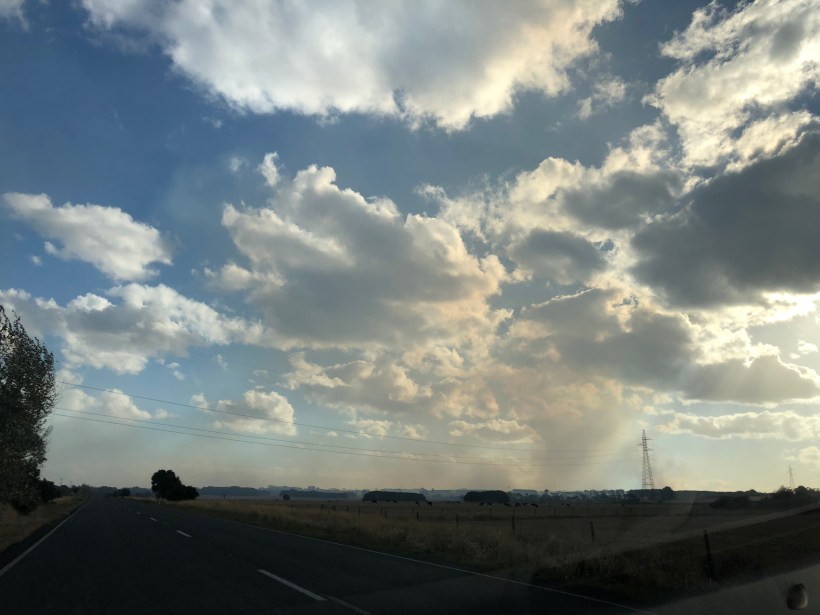
Even late into the afternoon, the roads to home were all still closed, so we made our way back to a neighbouring town to wait until we could get home. One road opened at 5.50pm; we only needed one road, so we headed home. We knew that even though the road was open, authorities didn’t want people just driving into the area without good reason, but my dad was a very good reason to be making the trip.
Smoke rising above Cobden as we drove home from Camperdown on Sunday evening.
We were very glad to find that Dad was fine, our home was safe, and the town itself was untouched except for smoke. Our local football oval was filled with emergency service manpower and vehicles from other places. They had come to help fight the fires and provide relief to the local crews, many of whom are volunteers, who had been working for many long hours to defend and protect people, properties and towns.
Fifteen minutes after returning home, a succession of five fire trucks went zooming down our no-through road, and my heart was in my throat again. Whatever had them rushing out had to be close, as there’s only about two kilometres of road past our place before the road ends. Within half an hour they had sorted the issue and came trundling back. My neighbours and I applauded them, gave them the thumbs up, and cheered them to show our gratitude for their quick response. They waved back and returned the thumbs up, their smiles letting us know that they understood and were thankful for our response, too.
Not long after that, new plumes of smoke not too far away indicated that there were new fires springing up. I could hear the sirens as they rushed out of town to meet the new emergencies, and reminded myself that the crisis wasn’t over just because my immediate surroundings were relatively safe.
Thick smoke once again settled over the town. We took encouragement from the fact that warnings were downgraded to critical from catastrophic, and the symbols on the emergency services’ online fire map gradually began to change from red to orange.
Incredibly, no human lives have been lost and very few serious injuries have been suffered. This is testament to the dedication, hard work and training of our first responders, particularly our firefighters and State Emergency Service volunteers.
Despite the smoke in the air and the knowledge that the crisis wasn’t over yet, I slept so much better last night knowing that we were being protected by hundreds of committed and able firefighters, first responders, police, and support crews. It is not possible to adequately put into words how thankful we all are for the job they’ve done and continue to do.
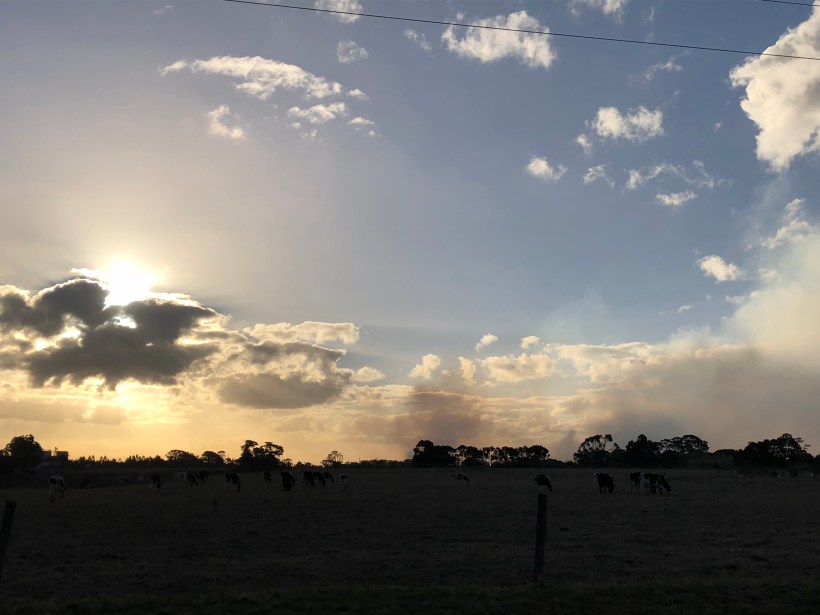
This morning the pall of smoke blanketing our town was thick. It stings the eyes and the throat, and it smells. Yet that is the only discomfort I suffer, and for that I am incredibly thankful. What a blessing to be able to say that.
This slideshow requires JavaScript.
The waterbombers and helicopters are flying overhead, and the work to control and extinguish these fires continues. People who are much, much braver than I are working in difficult and dangerous conditions, and for that we are all incredibly thankful.
The warnings for my town have been downgraded to Watch and Act but others are still in danger. We all have to remain vigilant.
Beyond that, we all have to care for each other.
People have lost homes, or farms, or herds… or all of that.
Our local community in the southwest of Victoria has been shaken and found strong, supportive and caring – and now, we must continue that by caring for those who have lost so much.
I have no doubt that Cobden will ace that – we’ve done it before, and we’ll do it again.
As I’ve said on numerous occasions, we’re incredibly blessed to live in Cobden. It’s a great community, and I’m thankful that it has passed this most recent test.





 I admit that the local store doesn’t have everything I want. I like to read some fairly specialised history, and I completely understand why they don’t usually stock that: I’m more nerdy about my history than most of the population. I can handle shopping further afield for that if I have to – but if I ask them to order a particular history book for me, they will.


 WordyNerdBird