Bereavement.

Photo by Kat Jayne on Pexels.com

I’ve been thinking today about different words we use to communicate to others that we are grieving. It seems to me that in the 21st century, we talk more about ‘personal loss’ and one’s ‘grief journey’ than we do about bereavement.

Bereavement, although old fashioned, is a beautiful word. To me, it evokes a sense of that sense of deprivation that remains after the immediate, more aggressive emotions of immediate have subsided, and acknowledges that phase of grieving in which deep sadness fills the space left by the person who has passed away.

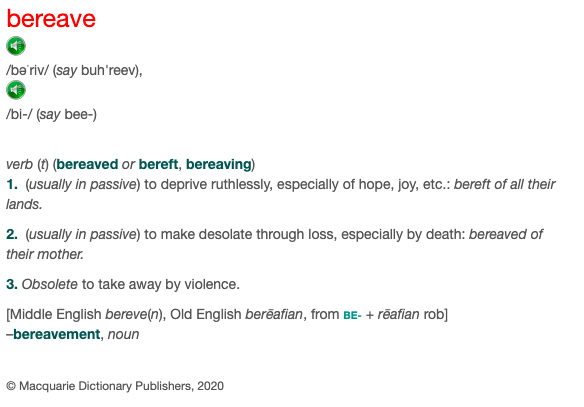
‘Bereave’ is a very old word. In Middle English, the word was ‘bireven’, and before that, the Old English word was ‘bereafian’, both of which meant to deprive, to steal, or take away by violence. It shares a common Germanic root with similar words in many other old languages. Old Frisian had ‘biravia’; Old Dutch had ‘berooven’; Old Saxon had ‘biroban’; Od High German had ‘biroubon’ and Gothic had ‘biarubon’.

Today, Dutch still has ‘beroeven’ which means ‘bereavement’. German still has rauben meaning ‘to rob’ and ‘berauben’ to mean ‘deprived’.

In English, ‘bereave’ has come to refer primarily to loss of life or loved ones. It can also be used in relation to the loss of something that has immaterial value, like love or hope or joy. It has been used that way since the mid 17th century. The past tense form ‘bereaved’ applies to these senses of loss.

English also has the past tense word ‘bereft’ which is used to describe the kind of grief and sadness that comes from loss or diminution of one’s personal circumstances, such as the loss of wealth or home or possessions.
Sources:
Macquarie Dictionary
Online Etymology Dictionary
Wordhippo
Bereaved.
#words #language #emotions
Easily Confused Words: Slither v. Sliver

I was watching a documentary with a friend on Wednesday evening. I nearly spat my drink out when I heard the presenter say, “There was just a slither of a new moon…”

I looked at my friend, only to find she was already looking at me. We were both wondering if we had misheard, but we had not.

What should have been said was, “There was just a sliver of a new moon…”

‘Sliver’ and ‘slither’ may sound similar, but they are neither homophones nor synonyms. They are very different words indeed, and therefore should not be confused.

‘Sliver’ is a noun that means a very thin slice.  There can definitely be a sliver of a new moon in the sky. One can have a sliver of chocolate, or a sliver of cake, although they may wish for more. A sliver of a chance is also likely to leave one wanting for more. A very slender piece of wood or metal – such as that created by shaving  or planing– may also be referred to as a sliver.

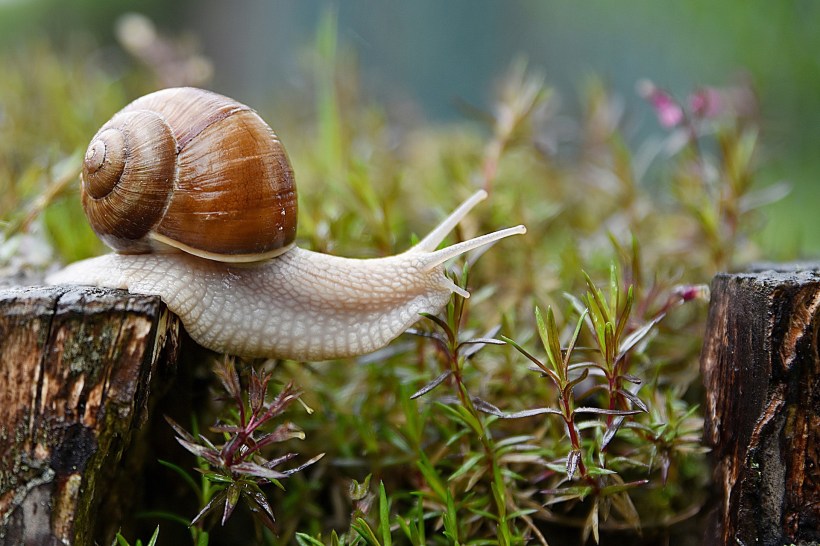
‘Slither’  is a verb that means to slide or to move in a squirmy way, as animals without legs do. Snakes and eels contract their muscles so they look to move sideways. So do some worms. Snails and slugs slither in a different way again, looking as though they simply contract and then stretch forward.

So, If someone claims to see a slither of a new moon, they may need to either get their eyes checked or give up drinking.

Easily Confused Words: Slither v. Sliver
#words #language #blogpost

Doomscrolling.

Image by geralt on Pixabay.

Doomscrolling is the act of continually updating and reading  one’s social media feed for the latest news on a significant event. It is closely related to doomsurfing, which is scouring the Internet for the same kind of information.

The term has been around for a few years, but found new popularity as a hashtag earlier  this year, predominantly in response to Covid-19. It is surging again on Twitter today as people try to stay updated on the results of the US election.

It may be a relatively recently coined term, but it’s fair to say the activity to which it refers has probably existed for as long as  easy access to the Internet, especially via platforms such as Twitter and Facebook, has been available.

It’s an understandable behaviour – we want to stay informed, after all. These things matter. We want to know. However, it can also be a very effective self-torture device, as it compels us to focus on what is actually causing our anxiety and distress.  It seems that the worse the news is, the more people tend to keep on watching or reading. Some people even become fixated on that event, to the exclusion of other things, no matter how sad or angry it makes them.

The term also hints at the subjectivity of the behaviour: what one interprets as ‘doom’ is likely to be the exact inverse of what another person interprets it to be. It all depends on what outcome one is hoping for whether the course of events is classified as doom or a reprieve.

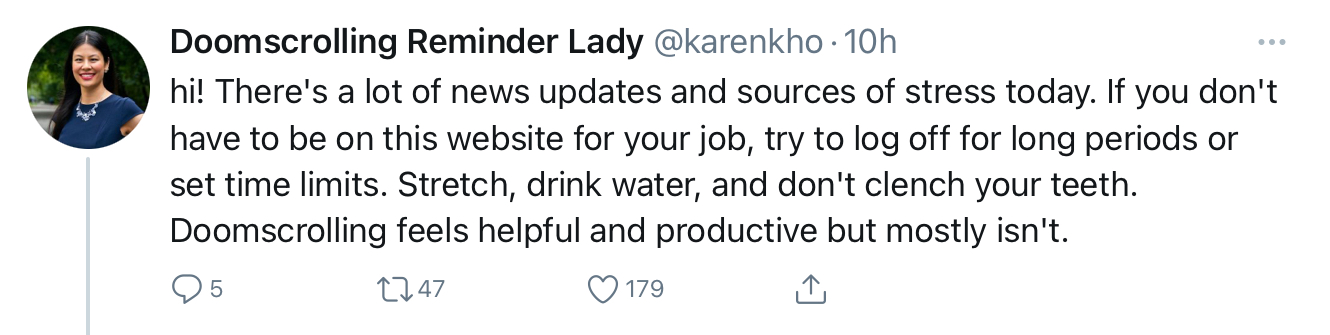
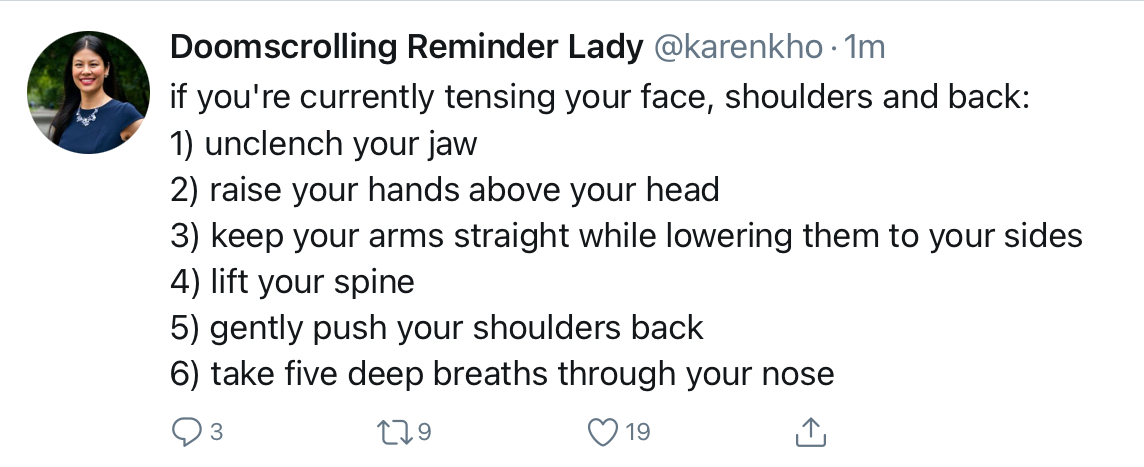
A highly relevant and helpful Twitter account is Doomscrolling Reminder Lady, who repeatedly tells people to get off the internet and take care of themselves instead.

It’s good advice.

Sources:
Merriam-Webster
Doomscrolling, Explained
Urban Dictionary

Doomscrolling
#words #DoomScrolling #behavior

Eerie.

Image by Free-Photos on Pixabay.

Eerie, occasionally spelt ‘eery’, is an adjective that means creepy, spooky, weird, or unsettling. 

It is a very old word that has an interesting past. It has been part of our language since the time of Old English, but it is one of a small group of words whose meanings have actually reversed over time. 

Originally, ‘eerie’ had a meaning similar to ‘fearful’ or ‘timid’. Over time, though, it’s meaning has flipped to meaning something that induced those feelings instead. This sense of the word was first recorded in 1792, and is the meaning we still attribute to it today. 

Eerie.
#words #language #Halloween

Horripilation: Hair-Raising Stuff!

We all know what it is to have goosebumps.

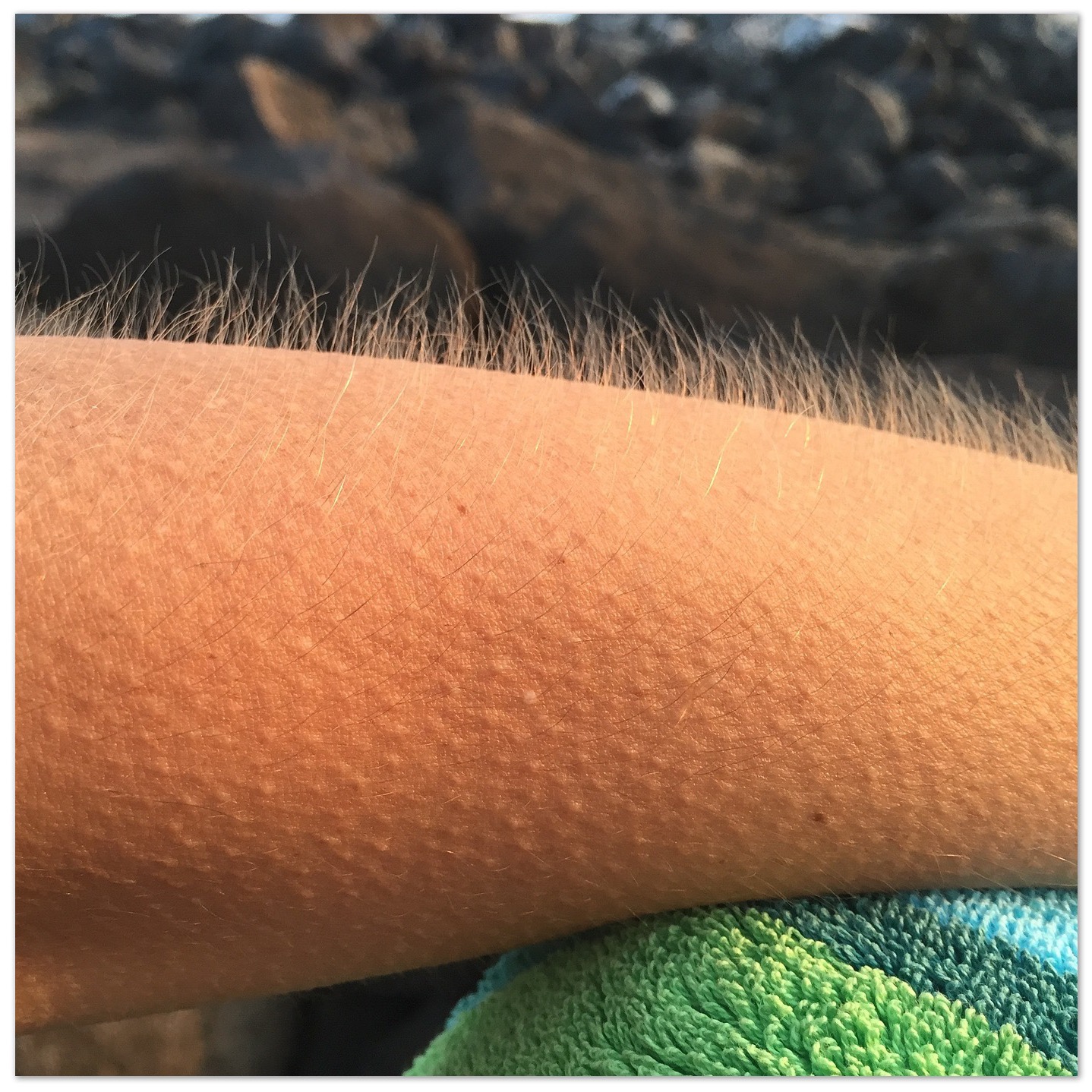
It refers to the way in which the little hairs on our skin stand on end in response to certain sensations or experiences. It makes our skin tingle and can feel as though something with tiny feet is walking over our skin.

This is called goosebumps because  The term, which reflects the way in which the skin looks like the skin of plucked poultry, goes back to the mid 1800s. Earlier than that, it was referred to as goose-flesh in 1801, goose-skin in 1761, goose’s skin in 1744 and, as far back as the early 1400s, hen-flesh. 

It’s very interesting to see the evolution of the term over time, and then to see it persist for so long now because there really is no better way to describe the appearance of the skin.

Also interesting is the fact that goosebumps also has two other descriptive names: piloerection and horripilation.

Piloerection, meaning the actual standing up of the hair, comes from the same word pilus  and the Latin ‘erectio’  which  is the source of words such as ‘erect’ and ‘erection’, and beyond that needs no further explanation.Horripilation comes from the Latin word ‘horripiliatio’, from horripilāre  which means ‘bristle’. This in itself is a portmanteau of the Latin words horrere meaning ‘shudder’ and pilus meaning ‘hair’.

This makes horripilation a relative of ‘horror’ as they share the same Latin root, although ‘horror’ took another detour and came into English via the French word ‘horreur’.

To refer to something frightening or exciting as ‘hair-raising’ is, therefore, not a metaphor, but is rather a direct description of the physical effects of the experience.  We’ve got the nerdy words to prove it.

Sources:
Macquarie Dictionary
Merriam-Webster.com
Online Etymology Dictionary

Horripilation: it’s hair-raising stuff!
#words #horror #SpookySeason

Octothorpe

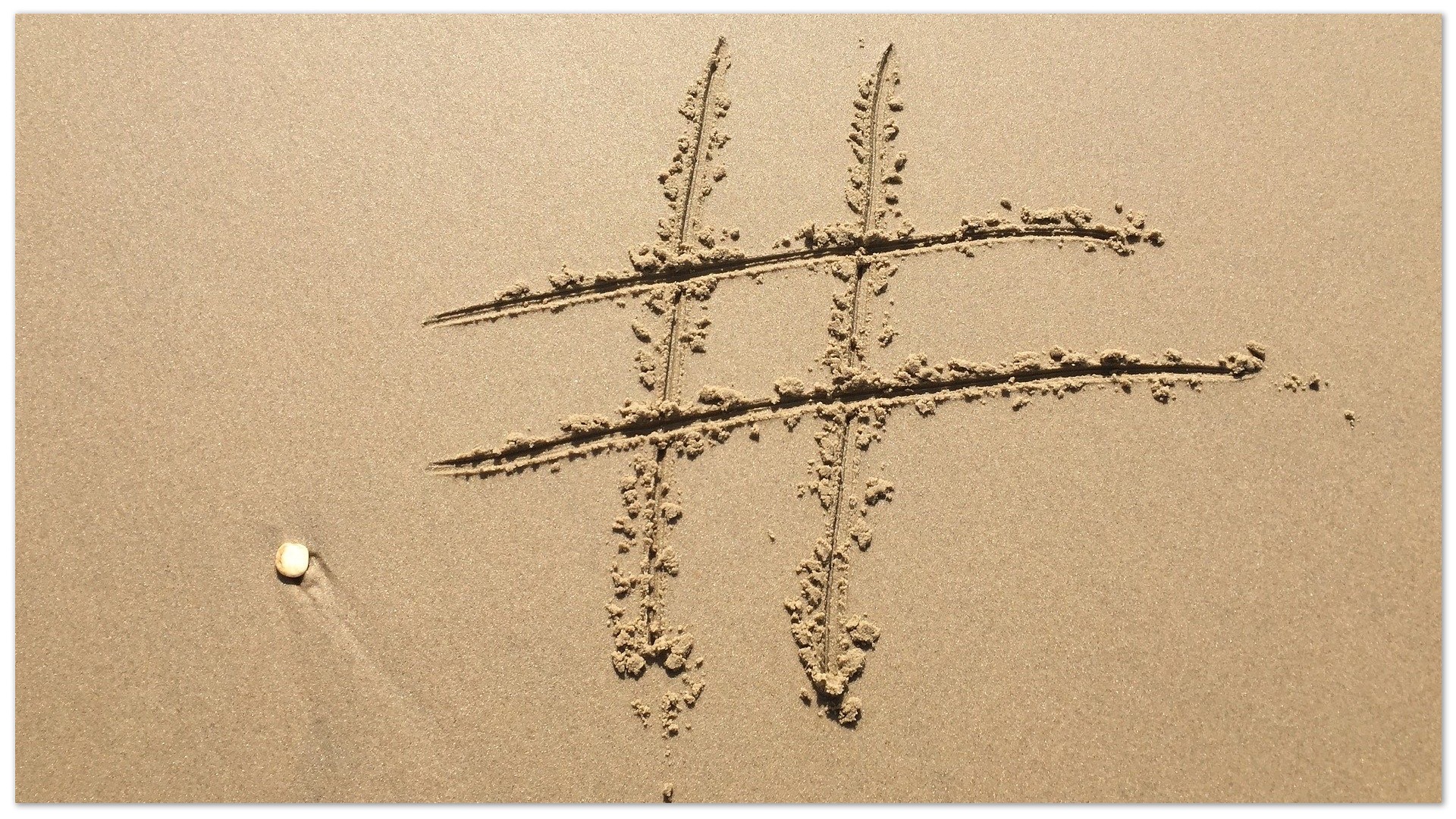
Hashtag Octothorpe Drawn in sand
Image by yourschantz on Pixabay

Octothorpe is a less-well known name for that beloved symbol we call the hash symbol. It has been used for a plethora of functions for centuries, but it has really taken on new life in the 21st century with the proliferation of hashtags on social media. 

Octo comes from the Latin for eight, just as it does in words like octopus or octagon, and in October— which used to be the eighth month, but that’s another story. When you look at the hash symbol, it has eight points. That part is logical enough. 

The origin of the rest of the word is much more recent and much less clear.. 

The popular story is that it was named after Jim Thorpe, an athlete whose Olympic medals were taken from him because he had been a professional basketballer. Workers at Bell Laboratories, who happened to be fans of his, named the symbol in his honor at some point on the 1960s or 1970s. 

That’s a pretty cool story, supported by some dictionaries, but it’s not the only one. The name was almost certainly coined at Bell Laboratories, but the real story behind it is unclear. 

One theory is that it comes from a team member burping while talking about the hash symbol with his co-workers. A third theory is that it comes from an Old English word for “village.” Yet another is that the Bell Laboratories workers deliberately chose something that non-English speakers would find hard to pronounce. Of all the possible options, I really hope that wasn’t it. 

Octothorpe
#words #vocabulary #Explained

Sources:

Ultracrepidarian.

Ultracrepidarian judgement critical
Image by LKP_LKD on Pixabay

Ultracrepidarian is an old word that can be used as either a noun or an adjective to describe someone who is critical and judgemental, or who gives advice or opinions, about matters in which they have little or no knowledge, experience or expertise. 

Although somewhat different to a malapert, it is entirely possible for a person to be both.  

The earliest record of the word ultracrepidarian comes from the early 1800s, when it was derived from the  Latin phrase ultrā crepidam which means  “above the sole”. This was a reference to a story relayed by Pliny the Elder about a Greek painter named Apelles, who when criticised by a cobbler, said something to the effect of “nē suprā crepidam sūtor jūdicāre” or “let the cobbler not judge above the sandal”. 

People generally don’t welcome advice or critique that they have not sought. If advice must be given, it’s probably wise to stick to one’s actual area of knowledge and expertise. Even more importantly, it’s essential to be kind and gentle about it, and to try to be humble. That’s how to avoid being ultracrepidarian. 

Sources:
dictionary.com
Merriam-Webster.com

Ultracrepidarian: that annoying person who knows everything.
#language #words #etymology #blogpost

Malapert

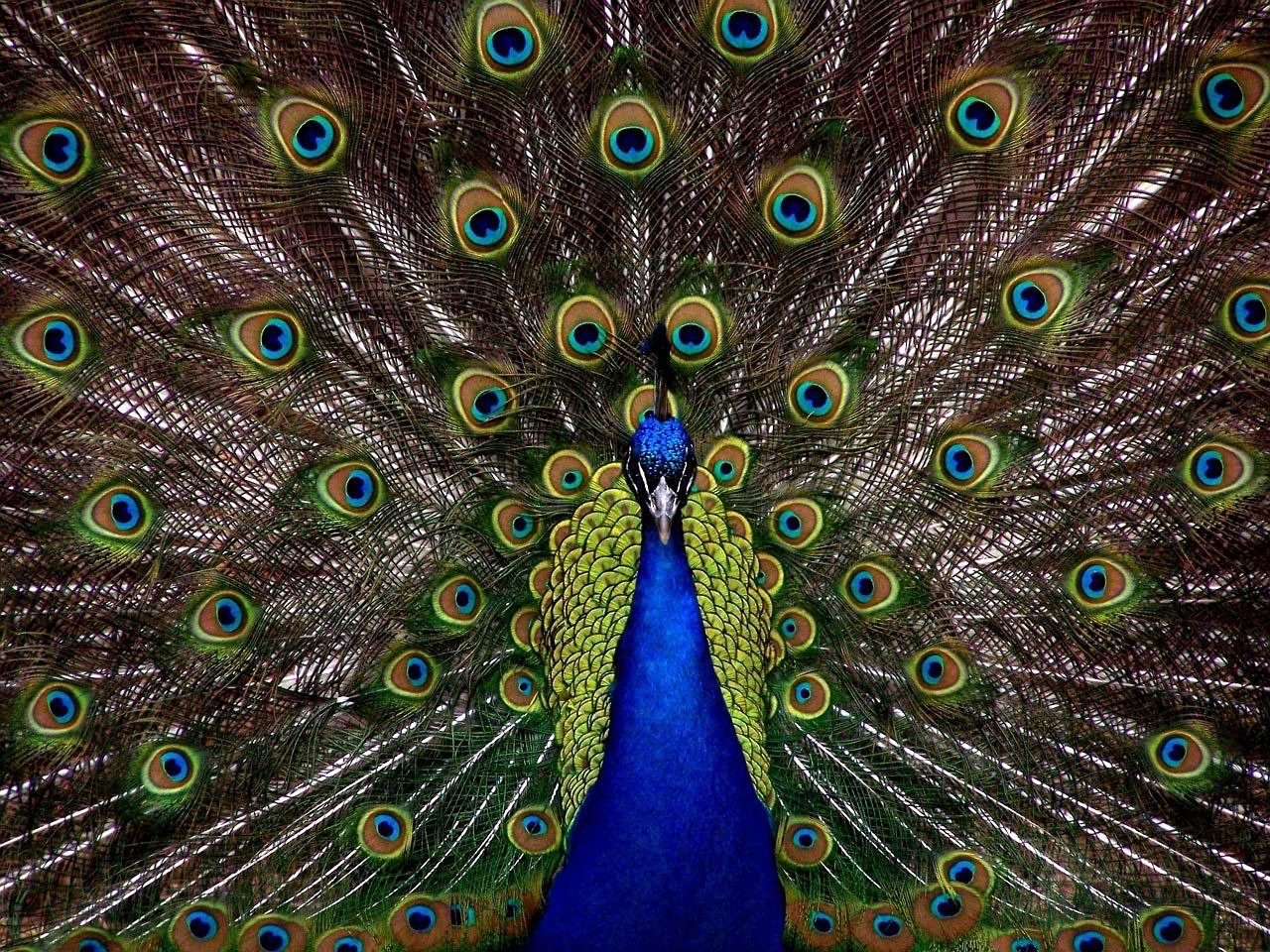
Peacock malapert know-it-all overconfident showy
Image from PublicDomainPictures on Pixabay

A malapert is a person who acts like they know everything and is confident that they are always right. 

These days, we might call them a know-it-all.  
We could also call them a wise guy, a smart aleck, or an expert on everything. There are a number of less polite terms available to those willing to use them, too. 

The difference between a pedant and a malapert is that a pedant knows they are right about something in particular, while a malapert thinks they are right about everything. 

Malapert is a word that dates back to the 14th century, coming into English from the Old French words mal meaning bad or badly, and apert meaning skilful or clever. By the mid1400s, it was being used to describe a type of person rather than just a behaviour or attitude. Given that Shakespeare uses the word three times in his plays, each time without any explanation, one can assume that the word was commonly used and understood throughout the medieval and early modern periods.

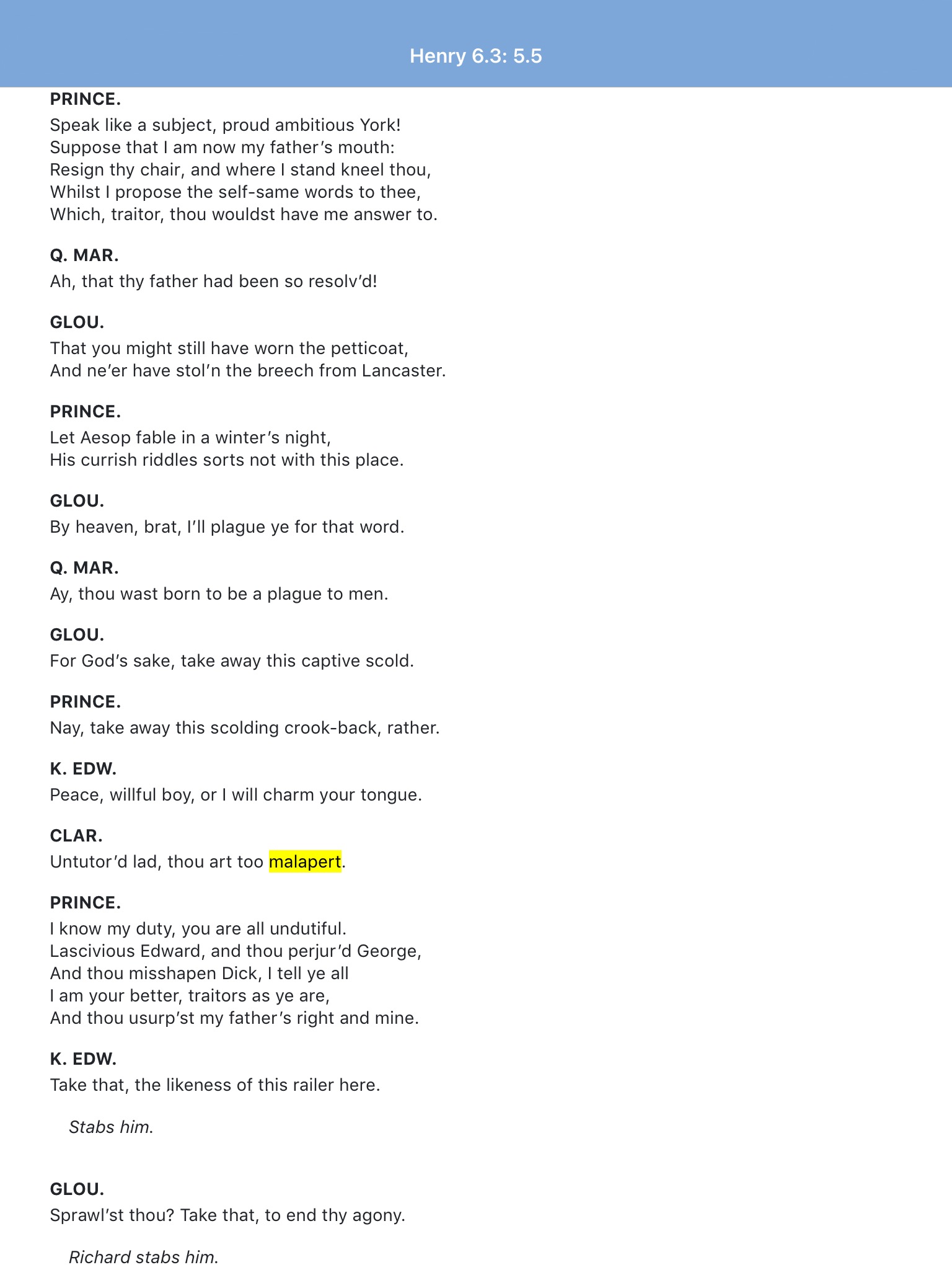
In Henry 6, Queen Margaret and her son, the young Lancaster Prince Edward, engage in a contest of insults with their captors: Clarence and Gloucester. As sons of Richard, Duke of York these two are the Lancastrian King Henry’s enemies, as the two houses are rivals for the English throne. Clarence calls the young prince malapert, highlighting his youthful confidence by calling him an “untutor’d lad”. 

Almost as proof of Clarence’s assessment, the prince responds by insulting them again. Despite the clevernesand bravery of his words, this proved to be a bad move, as “perjur’d George” and “misshapen Dick” respond by stabbing him to death. End of argument. 

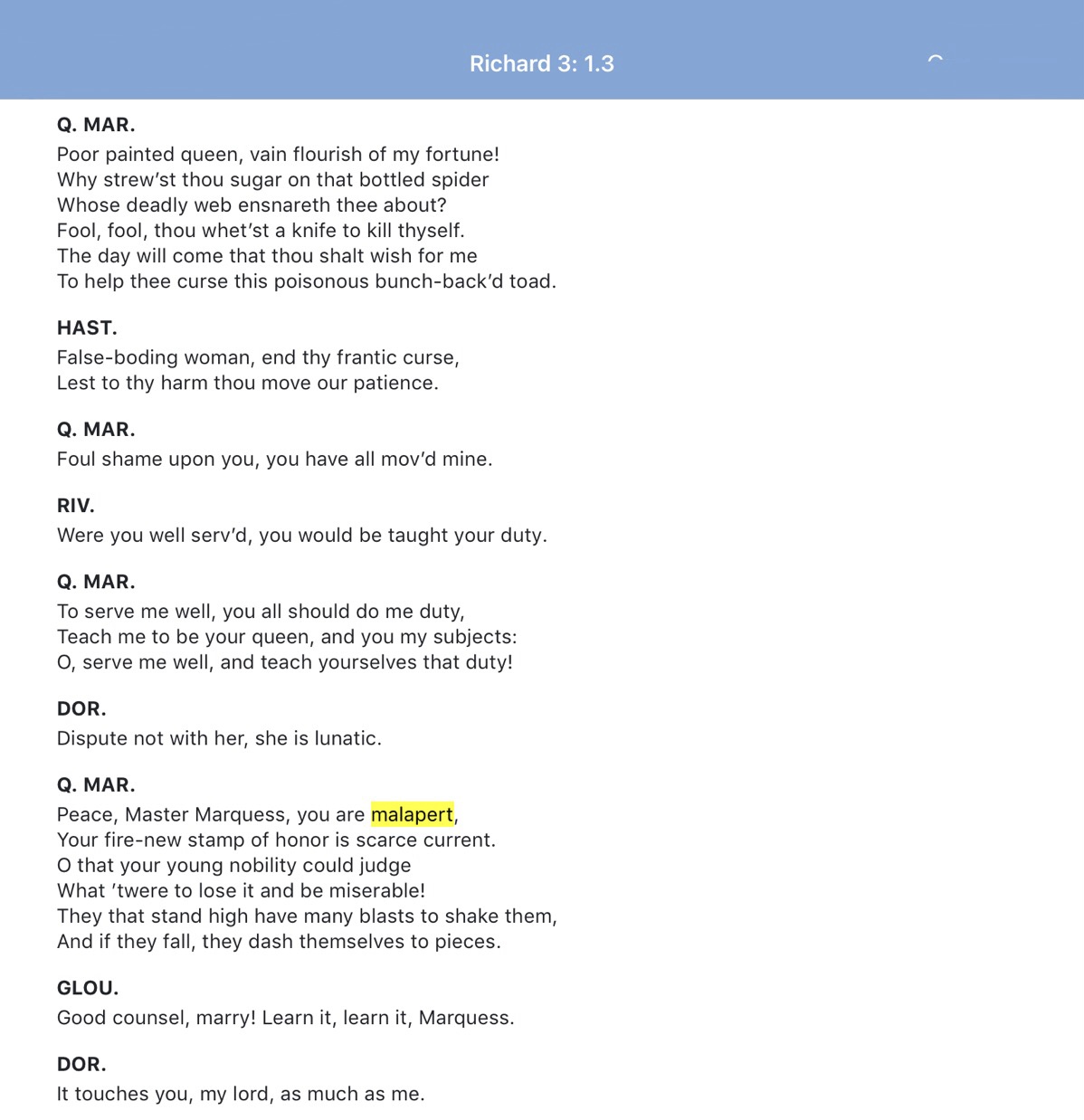
In Richard III, the same Queen Margaret tells the Marquess of Dorset that he is malapert and warns him that his newly found nobility won’t protect him from being destroyed by the Yorks, particularly Richard (Gloucester) whom  she describes as a “bottled spider” and a “poisonous bunch-back’d toad”. Richard turns the insult back on Margaret, and Dorset promptly turns it right back on him. 

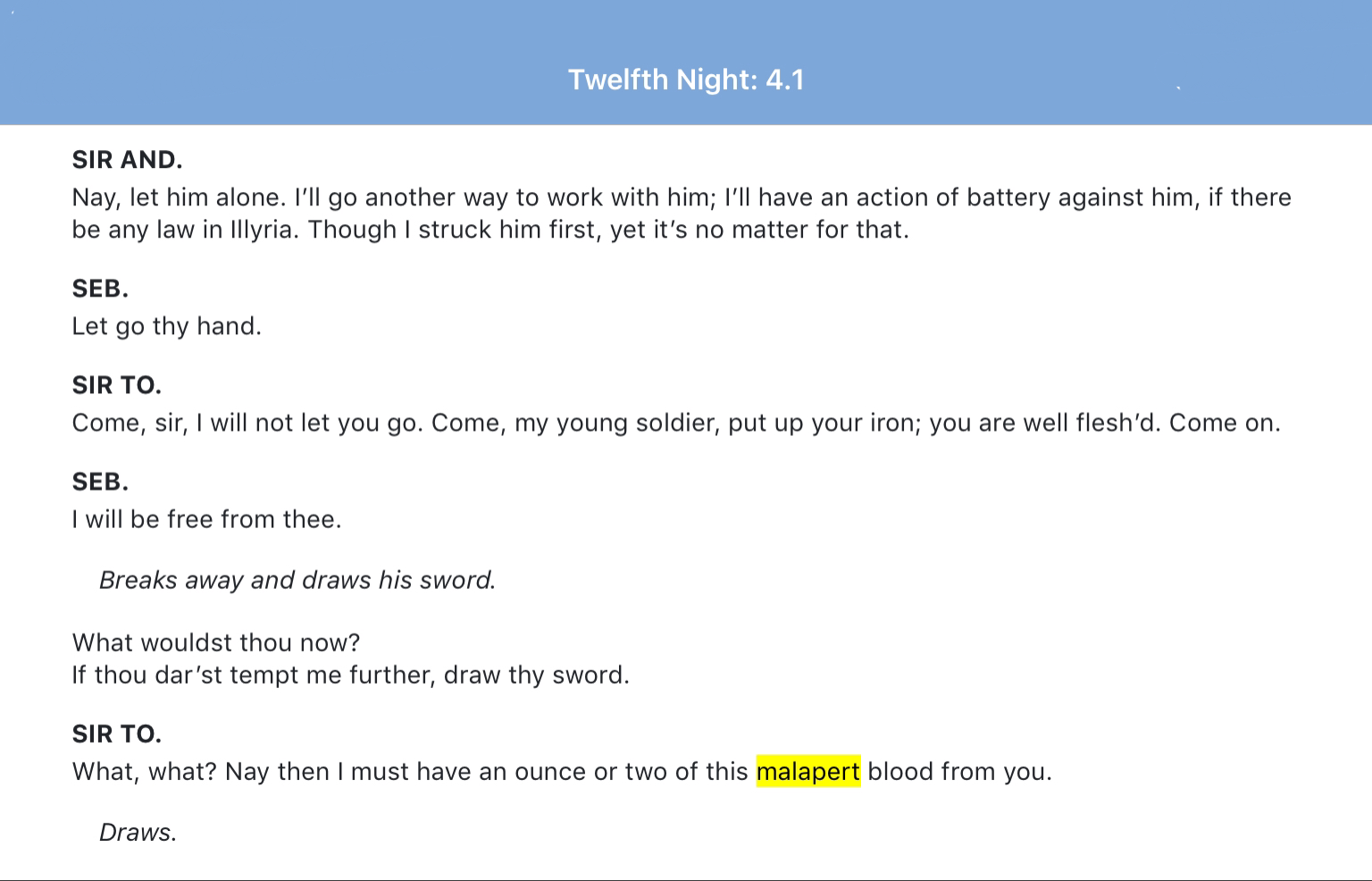
In the comedy Twelfth Night, Sir Toby Belch and Sebastian are engaged in an argument when Sir Toby insists that he “must have an ounce or two of this malapert blood” from his rival. 

This is a word I have long been aware of, yet I have definitely not made as good use of it as I could have done. This, however, is likely to change in the near future. 

Malapert
#words #language #etymology #blogpost

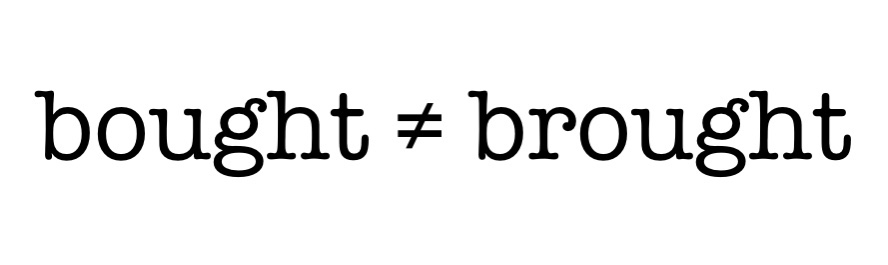
Easily Confused Words: Bought vs. Brought

Bought and brought are words that lots of people get mixed up. They may look similar, but they are very different words.

These words are by no means interchangeable, so in the interests of both being clearly understood and preserving one’s credibility, it is beneficial to know which is which, and how to use them confidently at the right times

Bought is the past tense of buy. If you buy something, you have bought it. 

Brought is the past tense of bring.  If you bring something home, you have brought it home. 
Note: neither ‘brang’ nor ‘brung’ is standard English. 

The easy way to remember which is which is that there is an r in bring and brought, but not in buy or bought. That makes pairing the correct words much easier. 

Easily Confused Words: Bought vs Brought
#grammar #English #explanation

Grawlix.

Grawlix is an unusual word that most people haven’t heard of, although they’ve probably seen grawlixes many times before. 

A grawlix is a combination of symbols— most commonly the ones above the numbers on the keyboard— used in place of a offensive language in comics, cartoons and illustrations. It works as a visual, rather than verbal, euphemism.

The term was coined in the 60s by Mort Walker , the creator of the comic strip Beetle Bailey, although the practice had already been in use long before it was given a name.The grawlix is a clever and very effective way to express emotions like anger or frustration without actually offending anyone or causing problems with editors and censors. 

An alternative term that has been suggested is the obscenicon, which is very clever but doesn’t seem to be getting a lot of traction. Time will tell, as it always does when it comes to words and language. 

Somehow, grawlix just sounds more evocative and kind of sweary in itself.

Sources:
Lexico
Merriam-Webster
Grammarphobia

 Grawlix.
#language #words #swearing #interesting #language #blogpost