Duplicity: The Many Unattractive Faces of Scott Morrison

A person who shows different sides of their personality to different people or in different situations is commonly called two-faced
Another word for this is duplicity

duplicitous person varies the way they act and speak in various situations in order to conceal the truth and try to make themselves look good, to save face, or to increase their popularity. 

The problem with that kind of behaviour is that nobody likes being lied to and, sooner or later, the truth will expose the lies. 

It must be enormously difficult for any person to maintain the deceit, and exponentially difficult for someone in a position of power or celebrity. 

Scott Morrison, the Prime Minister of Australia, is also our Prime Example of Duplicity. Like most politicians, he has made an art of duplicity for years, but it seems that now the carefully constructed facades are crumbling. 

After two months full of allegations of heinous behaviour by members of parliament and other employees of the government, one after another after another, closely followed by revelations of concealment and obfuscation by others in positions of power and responsibility, Morrison’s default ‘Thumbs Up’ and ‘Daggy Dad’ personas are insufficient for dealing with the fallout of the current scandals, both in Parliament and in the media. 

He says one thing to reporters he feels are antagonistic, another to reporters he thinks are his allies, and something else in Parliament. You can bet he says something different again behind closed doors when talking with his colleagues, and something else entirely when talking with those who have been accused of a range of very nasty behaviours or of sweeping the offences under a very large piece of Parliament House carpet.

What we are seeing now is an astounding array of very unattractive faces of Scott Morrison:
Overconfident Morrison is glib and supercilious. 
Angry Morrison is vindictive and thoughtless. 
Mansplaining Morrison is condescending and dismissive. 
Misogynistic Morrison assumes the men are telling the truth and the women are always lying— and this is, perhaps, the most telling of all his faces. 

The man who declares that an alleged rapist and another man accused of saying horrible things about his victim are both innocent, without listening to or looking at a scrap of evidence and without any official investigation into either allegation, is disregarding the law  and demonstrating complete and utter disregard for the experiences of every woman who has ever been harassed, abused, assaulted, raped, or gaslighted. He is bringing the government, the political party, and the law of the land into disrepute. 

While Morrison proclaims that his wife and daughters are the centre of his world, his actions communicate something different to Australian women: he and his own power are in fact his first priority. He speaks warmly about the women in his family when he doesn’t want to appear entirely heartless, but his emotions are never for the victims of the plethora of offences against women committed by the other privileged and powerful blokes he knows. 

If he ever stopped for three minutes, like his wife Jen suggested,  to think about any of the women who have been raped, assaulted, publicly denounced as liars, and vehemently slut-shamed over recent weeks as if they were his daughters, it doesn’t appear to have had any effect on his determination to protect the perpetrators in Parliament House. It hasn’t stopped him trying to deflect attention with corny staged photo opportunities and questionable claims about how well Australia’s Covid-19 vaccination program is going. It hasn’t stopped him attempting to explain it all away as storytelling and hysteria, or tut-tutting about the complainants’ mental health. 

Like many Australian women, I am angry at the continued failure of our nation’s leader to make a meaningful stand on the current scandals rocking the nation. I am furious that the accounts of victims are dismissed, and that there is no responsibility taken at any level for the absence of belief and the lack of justice experienced by victims. I am disgusted that the women themselves are blamed for what has happened to them. I am sickened by the fact that this goes all the way to the highest levels of the Australian government: Members of Parliament and SenatorsCabinet ministers, senators, the Attorney-General and the Prime Minister have both had their integrity besmirched in different ways. 

These issues aren’t going away anytime soon. The credibility of the Prime Minister and his government are damaged, probably beyond  any hope of repair, and many Australians— mostly, but not all, women— are insistently demanding justice for the victims and genuine cultural change. Scott Morrison has a choice: he can lead it, or he can be left behind by it. The longer he leaves it, though, the latter is the far more likely option.

Duplicity: The Many Unattractive Faces of #ScottMorrison

Carnival

Photo by Julia Kuzenkov on Pexels.com

I mentioned to someone yesterday that I would be at my school’s athletics carnival today.

“Ooooh, car-nee-vah-lee!” they exclaimed with a twinkle in their eye.

Brightly coloured images of vivid costumes, scantily clad women and wild parties in Rio de Janeiro flashed through my mind.
“Er… not quite!” I responded. “It’s not that colourful! And it’s a school event, so let’s keep it family-friendly, shall we?”

This got me thinking about the different meanings of carnival, and wondering what a rowdy celebration or a colourful parade might have to do with a school track and field sports day.

In my mind, the answer was obvious: not much.
So, as is my usual habit, I turned to Etymonline for some insights.

Photo by Nishant Aneja on Pexels.com

The English word carnival dates back to the 1540s, when it was used to refer to a “time of merrymaking before Lent”. This was derived from French carnaval, which in turn came from the Italian word carnevale which referred to Shrove Tuesday. This came from older Italian forms such as Milanese carnelevale and Old Pisan carnelevare which meant to remove meat, presumably referring to changing one’s diet for the period leading up to Easter.

Etymonline also offered the folk etymology — that is, a popular but generally untrue story about the origins of a word— that carnival came from the Medieval Latin words carne and vale meaning ‘flesh, farewell!’

In the late 1500s , carnival had come to mean feasting or revelry in general.

Carnival being used in reference to a circus, sideshow or amusement fair developed in American English in the early 20th century.

Photo by Elly Fairytale on Pexels.com

That was as far as Etymonline got me, so I looked up a few other websites, but none of them shed any more light on the answer to my question.

I am still no closer to understanding why a series of track and field events is called a carnival.

Consequently, I am left performing some folk etymology of my own: perhaps it relates to the celebration of the physical achievements of the competitors, or the cheering and noise made by the spectators.  It could even relate to the pre-competition parading of competitors, team colours and mascots that used to be popular but, thankfully, is much less fashionable now.

Perhaps, though,  it’s just one of those weird quirks of English that I’ll never really understand.

Sources:
Celebrating an Etymological Carnival
Etymonline

Knowing When To Use ‘Me’ and ‘I’

Photo by Olya Kobruseva on Pexels.com

Confusion over when to use the pronouns ‘I’ and ‘me’ is widespread, and it’s not limited to the less-well-educated: in my own experience, people with university degrees get it wrong equally as often as anyone else.

It’s not that others won’t understand you if you get it wrong — they will.
It’s not even about being judged by others, although there are people out there who will either judge you or correct you.
It’s actually about communicating as clearly and effectively as possible. That’s why the “rules” and conventions of grammar exist.

Using the right pronouns is not actually that hard. Perhaps it just needs clearer explanation than has been experienced in the past.

We instinctively know when to use the pronouns when it’s just ourselves we are talking about. We know to say “I am happy”, not “Me is happy”.  We know to ask “What do you want me to do?” Or “Can I do anything for you?”

We can use that basic knowledge to help get it right when we add someone else into the sentence.

If you are talking about two or more people , simply remove the other subject(s) from the sentence for a moment and think about which pronoun you would use if it were just you.

Then pop them back into the equation, always putting yourself after the others because that’s good manners.

Jules and I are happy.
Do you want Kim and me to do that for you?
If you need help, please see Robin, Beck or me.

If you are adding possession to the mix, such as talking about something that belongs to both of you or a friend in common, the same rule applies.

Kim is a friend of Robin’s.
Kim is a friend of mine.
Kim is a friend of Robin’s and mine.
This is Jules’ and my house.
When can I see Beck’s and your new puppy?

These guidelines will enable you to know which pronouns to use, and so help you speak and write with more confidence, which is a great thing.

Knowing When To Use ‘Me’ and ‘I’
#language #grammar #pronouns

Frequently Confused Words: Conscious vs Conscience

This post was inspired by the numerous social media posts I saw this week either stating that certain Australian politicians “have no conscious” or wishing that they would “have a conscious”.While that is, quite ironically, a remarkably astute observation, what those comments obviously meant was that certain Australian politicians have no conscience

Screen shot from Google taken on March 7th, 2021

Conscious is an adjective which means awake, aware, alert, responsive, or possessing mental or moral faculty. If the tweets had been observing a lack of those qualities in said politicians, the word should have been consciousness, as that is the noun form.

Of course, given the behaviour of certain members of the government in recent weeks, and of certain journalists who defend them without investigation or proof of innocence, there is a very strong argument to be made that they lack any number of types of consciousness.

Conscience is the innate, internal knowledge or recognition of right and wrong behaviour, speech, thoughts or motives, or one’s inner sense of fairness and justice. It can also refer to one’s mental or moral faculty that makes decisions based on such knowledge or recognition.

Given the behaviour of certain members of the government in recent weeks, and of certain journalists who defend them without investigation or proof of innocence, there is also a very strong argument to be made for a complete and utter lack of conscience among them.

The two words are crucially different… unless, of course, one lacks both. In that case, the distinction is somewhat irrelevant.

Frequently Confused Words: Conscious vs Conscience
#vocabulary #words

Raspberry.

A raspberry can be one of two things.

First and foremost, a raspberry is a small red, black or yellow fruit which grows on a bramble or vine-like style of bush, and which generally tastes delicious.

Photo by Pixabay on Pexels.com

In English, the word raspberry goes back to the early 1600s, but its actual origins are a matter of contention: it could have come from Old French, Medieval Latin, or one of the Germanic languages.

Photo by cottonbro on Pexels.com

The second sense of the word raspberry dates to the late 19th century, and relates to the rude sound made with one’s tongue and lips. This meaning is derived from ‘raspberry tart’, which is rhyming slang for ‘fart’, which is precisely what a raspberry sounds like.

Blowing a raspberry is also called a Bronx cheer, a term which came from the sound being used to express derision or displeasure during sporting matches in the area of New York City called the Bronx.

In linguistic terms, blowing a raspberry is an unvoiced labial fricative. This may seem like somewhat useless information for anyone other than linguists and language enthusiasts, but rude children can be quite effectively stunned into submission with reprimands such as “Don’t you dare address me with your unvoiced labial fricatives!” I know this, because I have achieved it more than once with other people’s teenagers.

This term has also been immortalised in the Golden Raspeberry Awards or Razzies, a parody of the Oscars in which the awards are given for terrible performances in film.

Finally, raspberry is also used as an adjective to describe any shade of purplish red colour, as referenced by Prince in Raspberry Beret. You don’t need to thank me for the earworm – you’re welcome!

Raspberry beret
Photo by Roel Wijnants on Flickr. Reproduced without alteration under Creative Commons licence.

Sources:
Etymonline
The Razzies
Wiktionary

Raspberry.
#words #language #blog

Zucked.

I do the love the Macquarie Dictionary.

It is the dictionary of Australian English, expressive of all classes and of our multicultural society. Regular readers of this blog will be familiar with it because of my frequent reference to it in my word-nerdy posts.

Today, though, the editors excelled themselves.

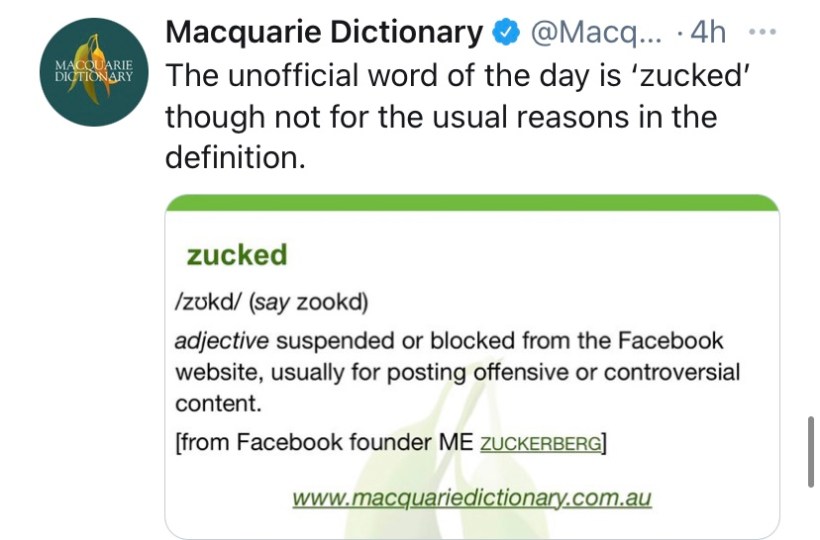
On the day when Facebook cut off access to all Australian news channels— sadly including sources of information relied upon by particular social groups such as  Indigenous communities, domestic violence support groups for women and families, and local information networks— as a result of a disagreement with the Australian government over market share and finances, the Macquarie tweeted that Australians have been zucked.

An obvious play on the F-bomb and Zuckerberg, it’s a clever new portmanteau word.

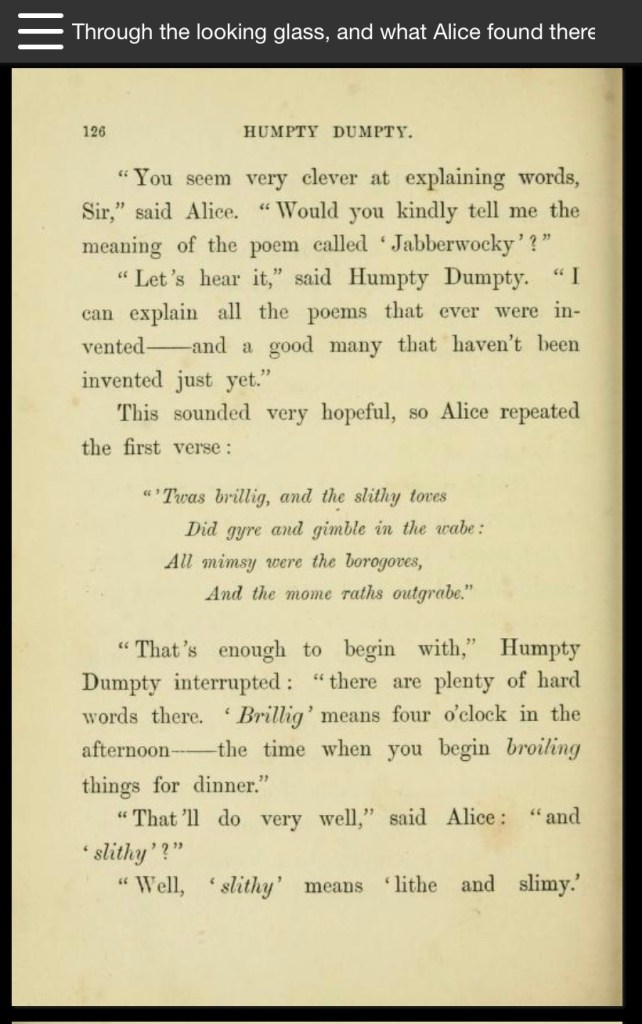
A portmanteau word is one created by blending two existing words or parts of words to create a new word. The name comes from a portmanteau, which is a type of suitcase that opens into two halves. This  dates back to Lewis Carroll’s ‘Through the Looking Glass’:

from ‘Through the Looking Glass’ by Lewis Carroll, courtesy of archive.org

We use portmanteau words every day, without many of us realising how they were created:

  • Botox —  botulism toxin
  • Brexit — British exit from the European Union
  • Bollywood — Bombay and Hollywood
  • Email — electronic mail
  • Fortnight — fourteen nights, so two weeks
  • Sitcom — situation comedy
  • Webinar — web seminar

English is actually full of these words, as it’s a form of wordplay that has been around for hundreds of years.

Sources:
Britannica
Etymonline
Macquarie Dictionary

Zucked.
#words #language #facebooknewsban

Kvetch.

As Victoria enters a five day lockdown designed to halt the spread of that dratted virus after its recent escape from a quarantine hotel, there’s a lot of kvetching going on.

Photo by Andrea Piacquadio on Pexels.com

Yes, it’s our third lockdown. Yes, we all saw this coming when the Australian Open was allowed to go ahead. Naturally, we’d all rather not. We’d all like to be able to do whatever we want to do. I know it’s inconvenient. I had to cancel my plans, too. 

Still, there is nothing to be achieved by blaming anyone. Contrary to what some people like to say, our state government is not a dictatorship. They’re doing their best to manage a pandemic, balancing the health of the community with what millions of individuals perceive as their rights and needs.

The fact is, this virus is highly contagious, airborne and invisible. The pandemic is not yet over, and these things are going to happen from time to time. It may actually be a fact of life for the foreseeable future, even when we are careful about wearing masks, social distancing and sanitising everything. One of the fundamental truths of a pandemic disease is that it is not easily controlled: that’s how it became a pandemic in the first place. At best, it can be well managed.

At least it’s only five days this time, not months like the last one.

Even so, I have lost count of how many times I have felt the need to tell people to stop kvetching about it in the last 24 hours.

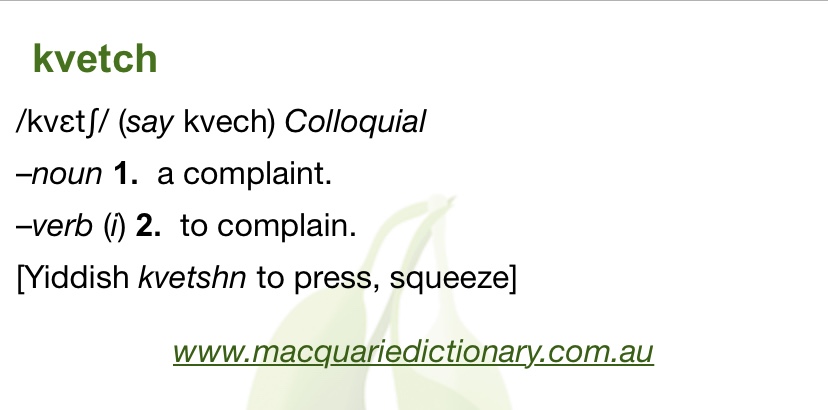
Kvetch is a wonderful word, donated to English from Yiddish in the mid-20th century. It is as satisfying to say as ‘bitch’ with far less possibility of offending anyone, and it is so much more expressive than other synonyms such as ‘whine’, ‘complain’ or ‘moan’.

Perhaps the only synonym that is as expressive is the one that my grandfather used when we were kids: “Stop your bellyaching,” I haven’t thought about that expression in decades, and it has just come back to me riding on a wave of memory and emotion. I think I’ll have to start saying that now, too.

Kvetch.
#wordsofwisdom #pandemic

Word Nerdy Book Recommendations

If there’s something word nerds love, it’s word-nerdy books.

Personally, I love a great dictionary or thesaurus. I also enjoy books that explore different aspects of the English language and how we use it.

These three books are books I have particularly enjoyed over recent months.

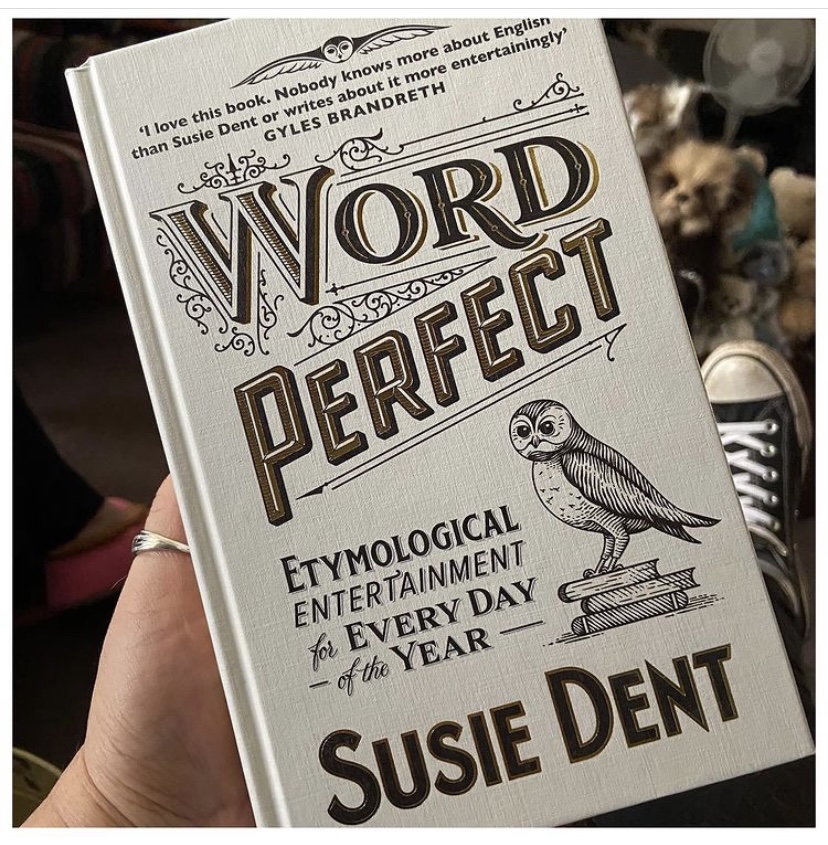
Word Perfect by Susie Dent

This is a wonderful compilation that will please any word lover or etymology enthusiast.

Dent writes with clarity and good humour. The word for each day, and Dent’s definition and etymology of each, are interesting and quirky.

The challenge is to only read each day’s offering instead of running ahead an consuming it more quickly.

Grab a copy, keep it by your favourite chair, and enjoy a wordy treat each day. You won’t be sorry.

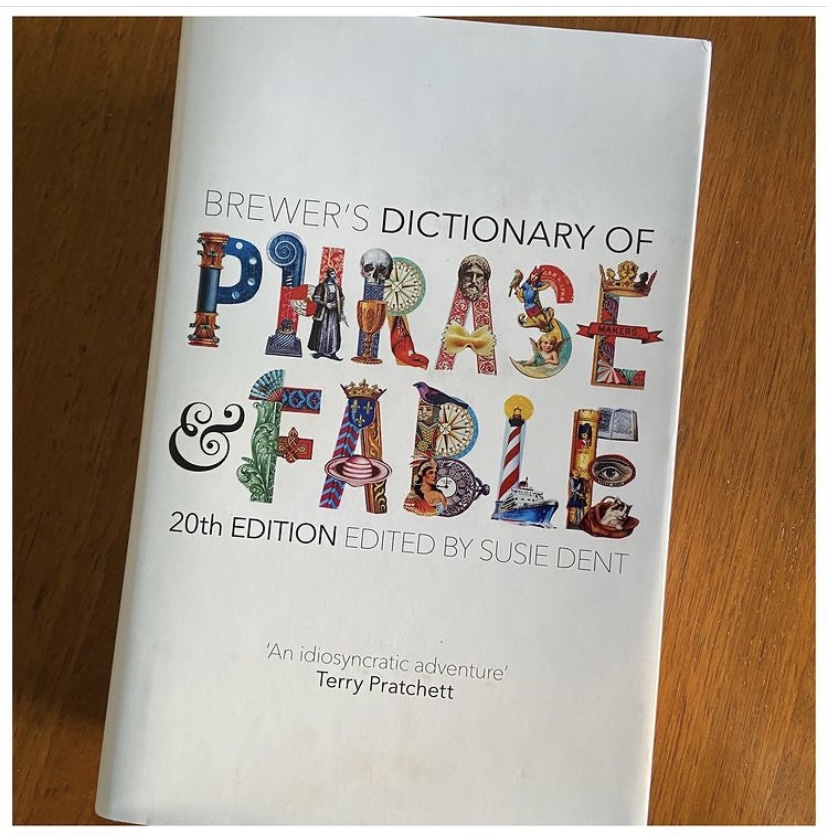
Brewer’s Dictionary of Phrase and Fable

This is a most interesting and entertaining book that traces the histories of words and phrases used in English.

It is a collection of most diverting rabbit holes in print: a world of fascinating information that draws you deeper in each time. Not once have I managed to look up the word or phrase I wanted to reference without discovering another entry nearby that was just as captivating as the first… or second… or third entry I had read.

It really is a treasure trove of words, etymology and history that will delight any lover of the English language.

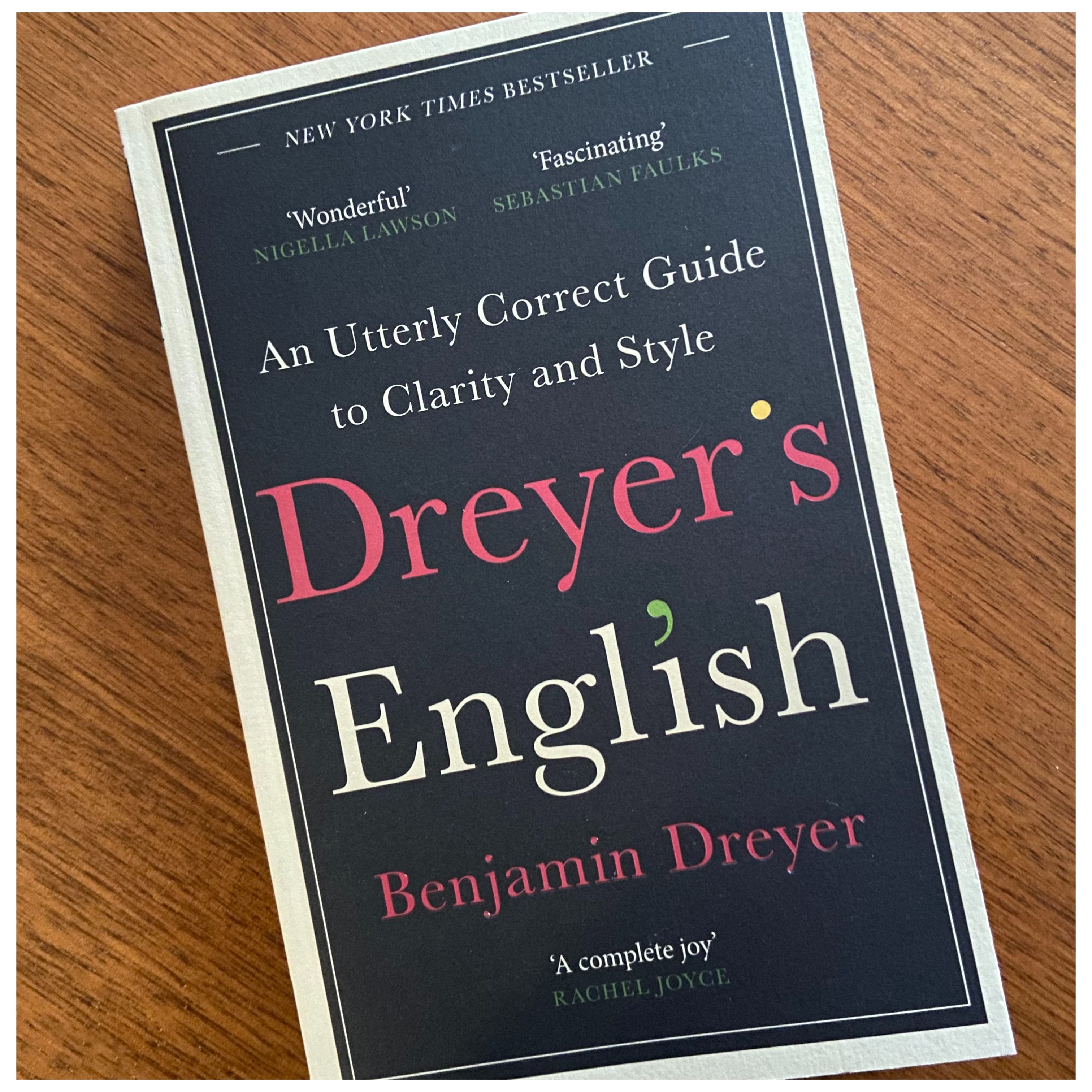
Dreyer’s English: An Utterly Correct Guide to Usage and Style by Benjamin Dreyer

This book is a delight. With the aim of helping writers achieve greater clarity and better style, Dreyer examines the “rules” of English as we know them, and provides a clear and understandable guide to using the English language most effectively.

The book is written with humour and a relaxed tone, and delivers content that is far more accessible for the everyday reader and writer than my beloved and very worn copy of Fowler’s Modern English Usage, which is now far less modern than it was when I first obtained the book.

Dreyer’s English is an ideal reference for today’s writers, regardless of their preferred form or the purpose for which they write. It’s also entertaining enough to pick up and read on a Saturday afternoon, without feeling at all like it’s time you’ll never get back.

Highly recommended.

Word Nerdy #BookRecommendations
#words #language

Pretty.

Photo by Simon Berger on Pexels.com

‘Pretty’ is quite a versatile word because we use it in a variety of ways:

One can drive a pretty nice car.
A child, a pet, a garden, and a picture can all be pretty.
Pleasant or attractive music , noises or words sound pretty.
An ornament or decoration can be called a pretty.
Something expensive is said to cost a pretty penny.
Someone in a safe or comfortable position is sitting pretty.
A person can pretty themselves up for a special occasion.
A request or plea is made more emphatic and emotive when someone adds pretty please.

On a more negative note, someone who is in trouble or said to be in a pretty mess.
If someone or something is only moderately attractive, they might be described as prettyish.
An event or a relationship can be pretty much over.

It is also interesting in that none of those meanings relate to the original meaning of pretty.

Pretty comes from the Middle English word ‘pratie’ which meant cunning, crafty, or clever”
This is related to a number of Old English words:

  • prættig – West Saxon
  • pretti – Kentish
  • prettig  – Mercian

These are all adjectives that mean cunning, skilful, artful, wily, or astute.

Before that, the words prætt or prett meant a type of trick, wile or craft. These words have a Proto-Germanic origin in *pratt- , which has closely related words in Old Norse , Frisian, Old Dutch, and Flemish.
Bt the beginning of the 15th century, pretty had evolved to also mean something manly or masculine, gallant, and something cleverly made.  By the mid 1400s, it had developed further to include the senses of attractiveness to the senses or holding aesthetic appeal, and of being slightly beautiful.

The use for pretty to express degree or amount developed by the mid 1500s, and pretty much had evolved by the mid 1600s.

A collection of pretty tho gs was called a prettiness in the late 1600s, while the use of pretty as a noun, such as “my pretty” developed in the 1700s, first in reference to things and then people.

The earlier meaning related to masculinity,  bravery and cleverness did an about-turn by the late 1800s, when the term pretty-boy came to be used as a derogatory term for any man deemed to be effeminate or suspected of being a homosexual.

In the early 1900s, pretty became a verb, meaning to make something or oneself more attractive.

It turns out that pretty is more than just a rather versatile word: it’s also fairly old and quite interesting.

Sources:
Macquarie Dictionary
Etymonline

Pretty.
#words #language #blog

Easily Confused Words: Sputter vs. Splutter

Photo by Andrea Piacquadio on Pexels.com

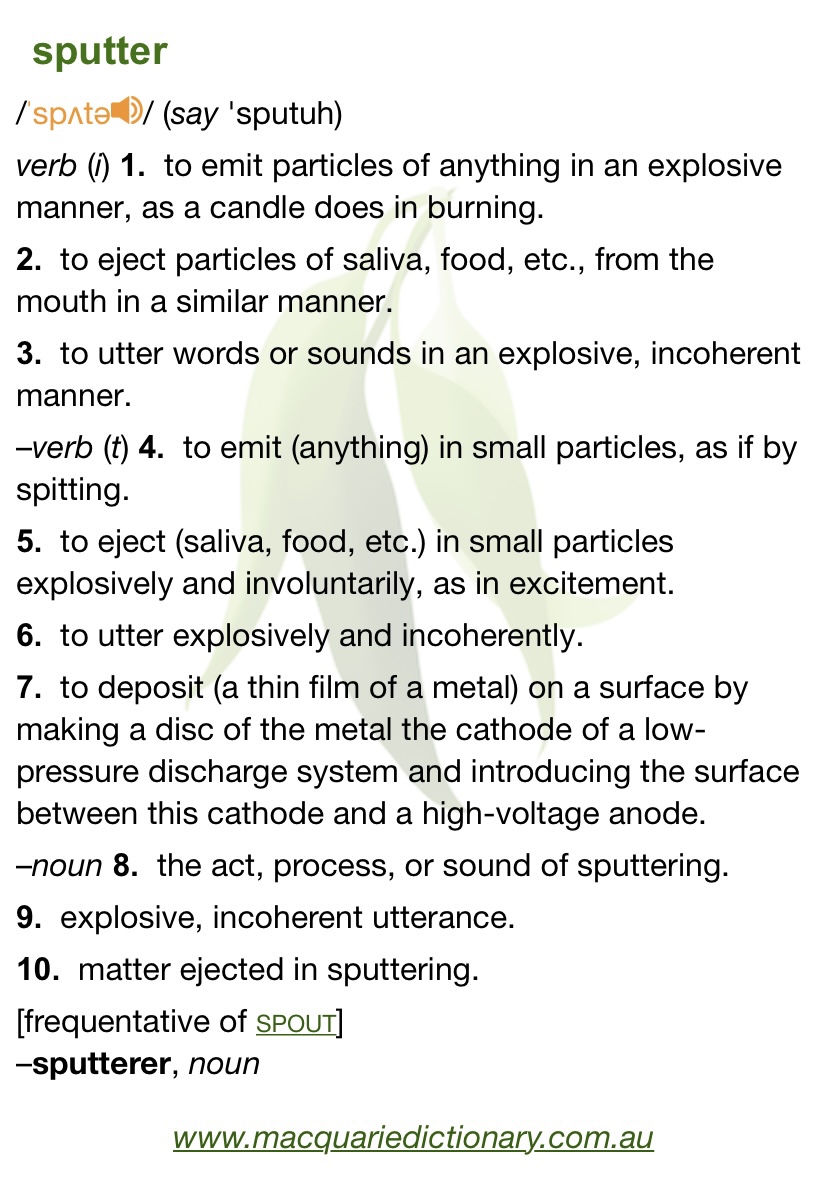
Today’s post comes in response to a heartfelt plea for clarification between sputter and splutter:

These two words are easily confused, not just because they sound so similar, but also because they can both relate to the way in which people speak. 

Both suggest a degree of incoherence or inability to express oneself in a composed manner. The difference is in the manner of expression: sputter is more explosive and suggestive of anger or violence, while splutter suggests confusion that comes from excitement or struggling to find the right words. 

Dona may be reassured that she has not in fact been making a terrible mistake, and most of her readers might not ever have noticed the difference.

When writing about how people speak, the choice between sputter and splutter is one of nuance and tone rather than being right or wrong. 

Easily Confused Words: Sputter vs. Splutter #words #language #blog

PS: Dona Fox writes excellent horror stories. If that’s your thing follow her and read her books!