Baubles.

‘Bauble’ is a word used more in December than at any other time of the year.

Photo: Joanne Van Leerdam

On Saturday night we were out for a family dinner — we’re finally allowed to go out here, now, after months of lockdown and restrictions— and one of the young kids at the gathering commented to me that they liked the pretty balls on the light fittings, and then asked me if that’s what they were called.

I explained that they are called baubles, and added that the beads on her bracelet could also be called baubles because they are pretty things designed for decoration. They’re both different kinds of ornaments, and it’s cool how there are often multiple useful words to use for things.

This got me wondering about the origin of the word ‘bauble’. I suspected it was French, simply because of how it sounded,  but such assumptions are not safe. As always, my trusty Macquarie dictionary and Etymonline had my back.

‘Bauble’ came into English in the early 14th century, meaning a decorative trinket or ornament. It came from the Old French word ‘baubel’ meaning a child’s toy or trinket. That may have come from the Latin word ‘bellus’ meaning “pretty” which gave us belle, as in ‘belle of the ball’,  or it could be related to ‘babe’ or ‘baby’. The sense of bauble meaning something of little or no value is later, dating from the early 1600s.

Long ago, ‘bauble’ was also the name given to a staff with a decorated or carved head, carried by a court jester and designed to mock the sceptre carried by a monarch. This meaning has fallen out of use, much as the position of court jester and the practice of a monarch carrying a sceptre have done.

So, now ‘bauble’ only relates to the pretty things. It is important to understand, though, that just because something can be called a bauble does not automatically mean that it has no value. It’s fair to say that while some baubles, such as Christmas decorations and the beads in a child’s bracelet, might usually be fairly inexpensive, there are other kind of baubles that tend to be more valuable.

Thus, the two meanings of bauble remain distinct, even though they can both apply at the same time.


The Proud Man’s Contumely.

In Hamlet’s most famous soliloquy — the one that stars with “To be or not to be…” — the overthinking prince lists a number of problems that make life hard to bear. Most of these are things to which we can relate quite easily: oppression, love that is not returned, the wheels of justice turning too slowly, and people being rude to you.

Hamlet, Act 3, Scene 1

Most people, though, would read the speech and get to the phrase ‘the proud man’s contumely’ and be completely stumped.  It’s not a word one comes across terribly often. In all honesty, it’s probably only literature scholars and high school students studying ‘Hamlet’ that are likely to come across the word, and only one of those groups are likely to know right away what it means.

Contumely is a very old word that means disrespectful, offensive or abusive speech or behaviour.

Contumely is interesting in that most English words that end in -ly are adverbs, which describe verbs, but this is a noun. It doesn’t follow the grammatical pattern of English because it is not originally an English word.

It came into English in the late 14th century from the Old French word contumelie,. That came from the Latin word contumelia, which meant’ reproach’ or insult’, and is related to ‘contumax’ with means ‘haughty’ or ‘insolent’.

These days, we’re far more likely to use terms like ‘insolence’, ‘disrespect’ ‘scorn’ or  ‘abuse’ instead. 

Still, it could be fun to respond to someone’s arrogance with ‘I do not have to tolerate your contumely’. Hopefully, it would leave them as perplexed as those high school students reading Hamlet’s soliloquy for the first time.

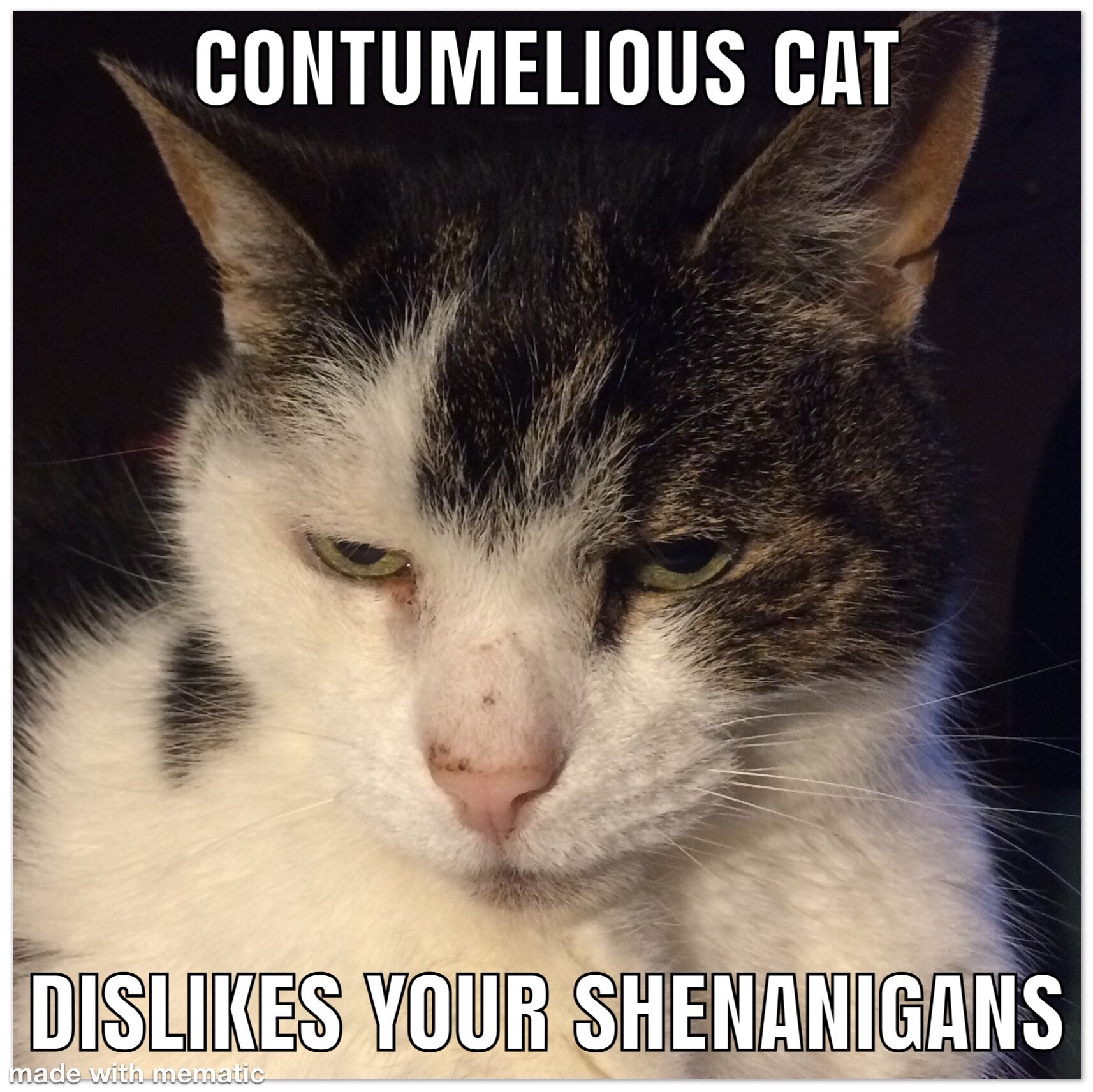
It could also be useful to know that someone behaving with contumely would be described as contumelious.

This word evolved in the 15th century, so it follows the common pattern of the noun form being used first and the adjective coming afterwards.  Mr Darcy’s haughty dismissal of Elizabeth Bennet at their first meeting, a lawyer strutting and posturing in the courtroom, or one’s mother-in-law’s disdain for their general existence could all be described as contumelious.

References:
Vocabulary.com
wordsmith.org
Online Etymology Dictionary

The Proud Man’s Contumely.
#words #Shakespeare #language

The Curious Origins of the Word ‘Wuthering’ – via Interesting Literature

My love of Emily Bronte’s ‘Wuthering Heights’ is no secret to anyone who knows me, nor to readers of this blog.

I was delighted to find this great post on the etymology of the word ‘wuthering’, which is definitely a word that should be more widely used!

Photo by Harrison Haines on Pexels.com

In this week’s Dispatches from The Secret Library, Dr Oliver Tearle explores the literary history of a distinctive word During the eight years I’ve been running this blog and combing every book, we…

Source: The Curious Origins of the Word ‘Wuthering’ – Interesting Literature

Bereavement.

Photo by Kat Jayne on Pexels.com

I’ve been thinking today about different words we use to communicate to others that we are grieving. It seems to me that in the 21st century, we talk more about ‘personal loss’ and one’s ‘grief journey’ than we do about bereavement.

Bereavement, although old fashioned, is a beautiful word. To me, it evokes a sense of that sense of deprivation that remains after the immediate, more aggressive emotions of immediate have subsided, and acknowledges that phase of grieving in which deep sadness fills the space left by the person who has passed away.

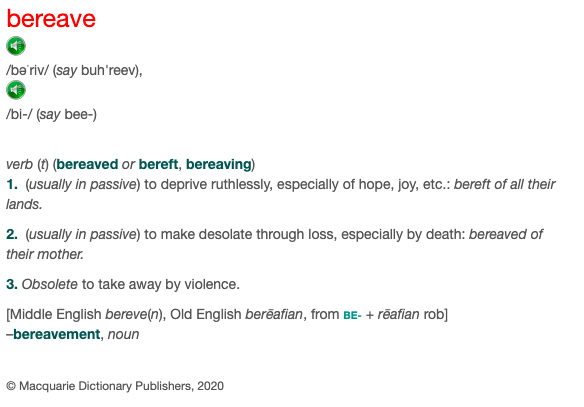
‘Bereave’ is a very old word. In Middle English, the word was ‘bireven’, and before that, the Old English word was ‘bereafian’, both of which meant to deprive, to steal, or take away by violence. It shares a common Germanic root with similar words in many other old languages. Old Frisian had ‘biravia’; Old Dutch had ‘berooven’; Old Saxon had ‘biroban’; Od High German had ‘biroubon’ and Gothic had ‘biarubon’.

Today, Dutch still has ‘beroeven’ which means ‘bereavement’. German still has rauben meaning ‘to rob’ and ‘berauben’ to mean ‘deprived’.

In English, ‘bereave’ has come to refer primarily to loss of life or loved ones. It can also be used in relation to the loss of something that has immaterial value, like love or hope or joy. It has been used that way since the mid 17th century. The past tense form ‘bereaved’ applies to these senses of loss.

English also has the past tense word ‘bereft’ which is used to describe the kind of grief and sadness that comes from loss or diminution of one’s personal circumstances, such as the loss of wealth or home or possessions.

Sources:
Macquarie Dictionary
Online Etymology Dictionary
Wordhippo

Bereaved.
#words #language #emotions

Eerie.

Image by Free-Photos on Pixabay.

Eerie, occasionally spelt ‘eery’, is an adjective that means creepy, spooky, weird, or unsettling. 

It is a very old word that has an interesting past. It has been part of our language since the time of Old English, but it is one of a small group of words whose meanings have actually reversed over time. 

Originally, ‘eerie’ had a meaning similar to ‘fearful’ or ‘timid’. Over time, though, it’s meaning has flipped to meaning something that induced those feelings instead. This sense of the word was first recorded in 1792, and is the meaning we still attribute to it today. 

Eerie.
#words #language #Halloween

Spooky.

Spooky is a word that is fun to say, and feels good in the mouth when you say it. It is perceived as a more positive term than its synonyms, so it can be used to make scary things seem less threatening or terrifying. Perhaps that is why it’s used so much around the time of Halloween. 

Spooky is an adjective that means frightening, scary or creepy, or which is used to describe someone who is easily frightened.

The earliest written record of spooky to mean ‘frightening’ dates back to 1854, and to describe someone who was easily frightened goes back to 1926.

Spooky is derived from the Dutch word spook which is much older. It came into English from Dutch, where it had been used for centuries to mean ‘ghost’.  it shares a Germanic root with similar words in other languages: the Swedish call a scarecrow a ‘spok’, while the Norwegians cale a ghost or spectre a ‘spjok’.

The use of spook as a verb, meaning to move or act like a ghost dates to 1867, and meaning to haunt goes back to 1881, while the sense of startling or unnerving someone is first recorded in 1935. 

In the 20th century, spook took on some new meanings. During World War I, spook was used as a term for a wireless operator or signaller in the army. In the 1940s, people began to use spook as a term for a spy or undercover agent.

So, when you see or hear the word ‘spooky’, remember that it’s more than just a fun word: it also has a long and interesting history.

Sources:
Etymonline
Merriam-Webster
Macquarie Dictionary

Spooky.
#words #spooky #spookyseason

Ultracrepidarian.

Ultracrepidarian judgement critical
Image by LKP_LKD on Pixabay

Ultracrepidarian is an old word that can be used as either a noun or an adjective to describe someone who is critical and judgemental, or who gives advice or opinions, about matters in which they have little or no knowledge, experience or expertise. 

Although somewhat different to a malapert, it is entirely possible for a person to be both.  

The earliest record of the word ultracrepidarian comes from the early 1800s, when it was derived from the  Latin phrase ultrā crepidam which means  “above the sole”. This was a reference to a story relayed by Pliny the Elder about a Greek painter named Apelles, who when criticised by a cobbler, said something to the effect of “nē suprā crepidam sūtor jūdicāre” or “let the cobbler not judge above the sandal”. 

People generally don’t welcome advice or critique that they have not sought. If advice must be given, it’s probably wise to stick to one’s actual area of knowledge and expertise. Even more importantly, it’s essential to be kind and gentle about it, and to try to be humble. That’s how to avoid being ultracrepidarian. 

Sources:
dictionary.com
Merriam-Webster.com

Ultracrepidarian: that annoying person who knows everything.
#language #words #etymology #blogpost

Malapert

Peacock malapert know-it-all overconfident showy
Image from PublicDomainPictures on Pixabay

A malapert is a person who acts like they know everything and is confident that they are always right. 

These days, we might call them a know-it-all.  
We could also call them a wise guy, a smart aleck, or an expert on everything. There are a number of less polite terms available to those willing to use them, too. 

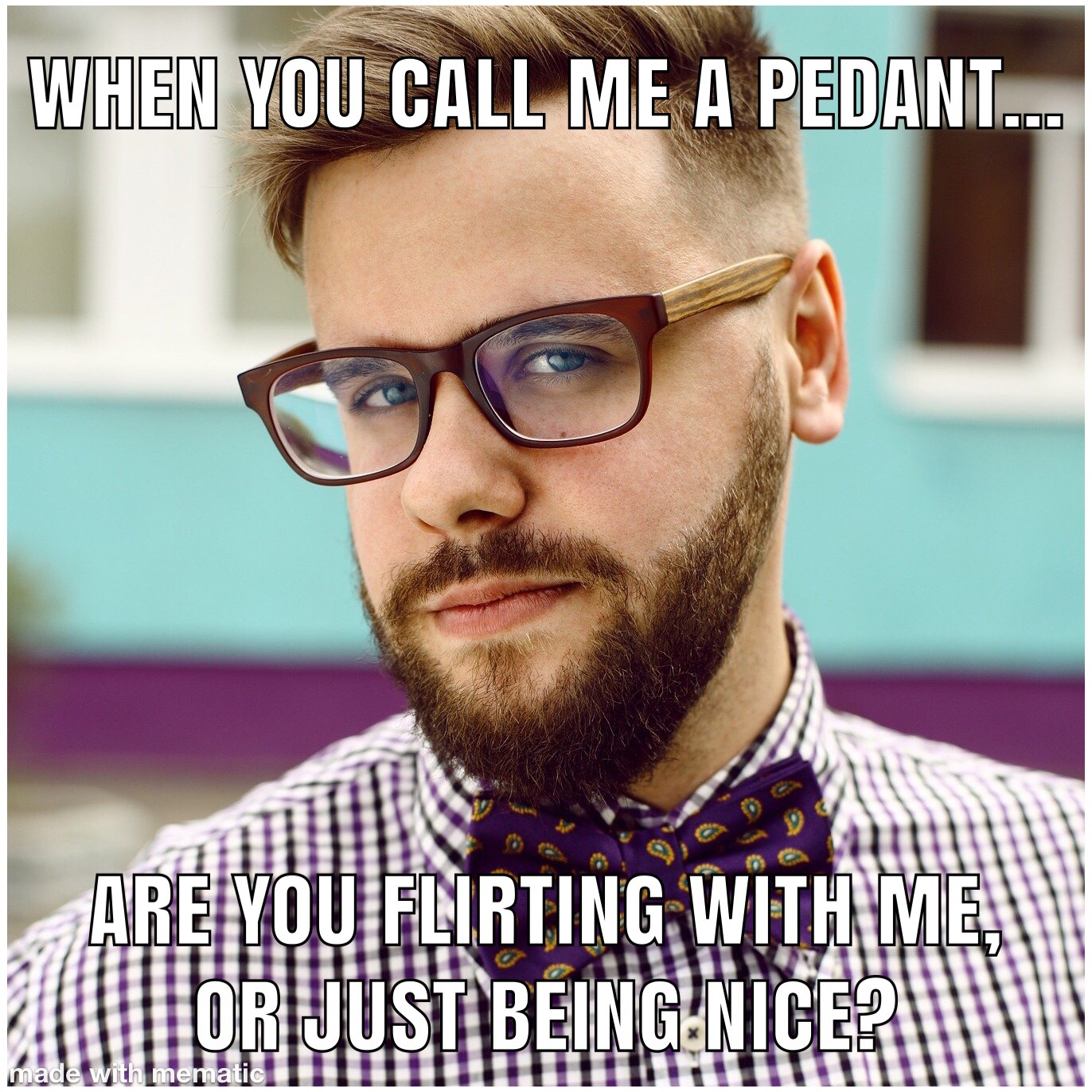
The difference between a pedant and a malapert is that a pedant knows they are right about something in particular, while a malapert thinks they are right about everything. 

Malapert is a word that dates back to the 14th century, coming into English from the Old French words mal meaning bad or badly, and apert meaning skilful or clever. By the mid1400s, it was being used to describe a type of person rather than just a behaviour or attitude. Given that Shakespeare uses the word three times in his plays, each time without any explanation, one can assume that the word was commonly used and understood throughout the medieval and early modern periods.

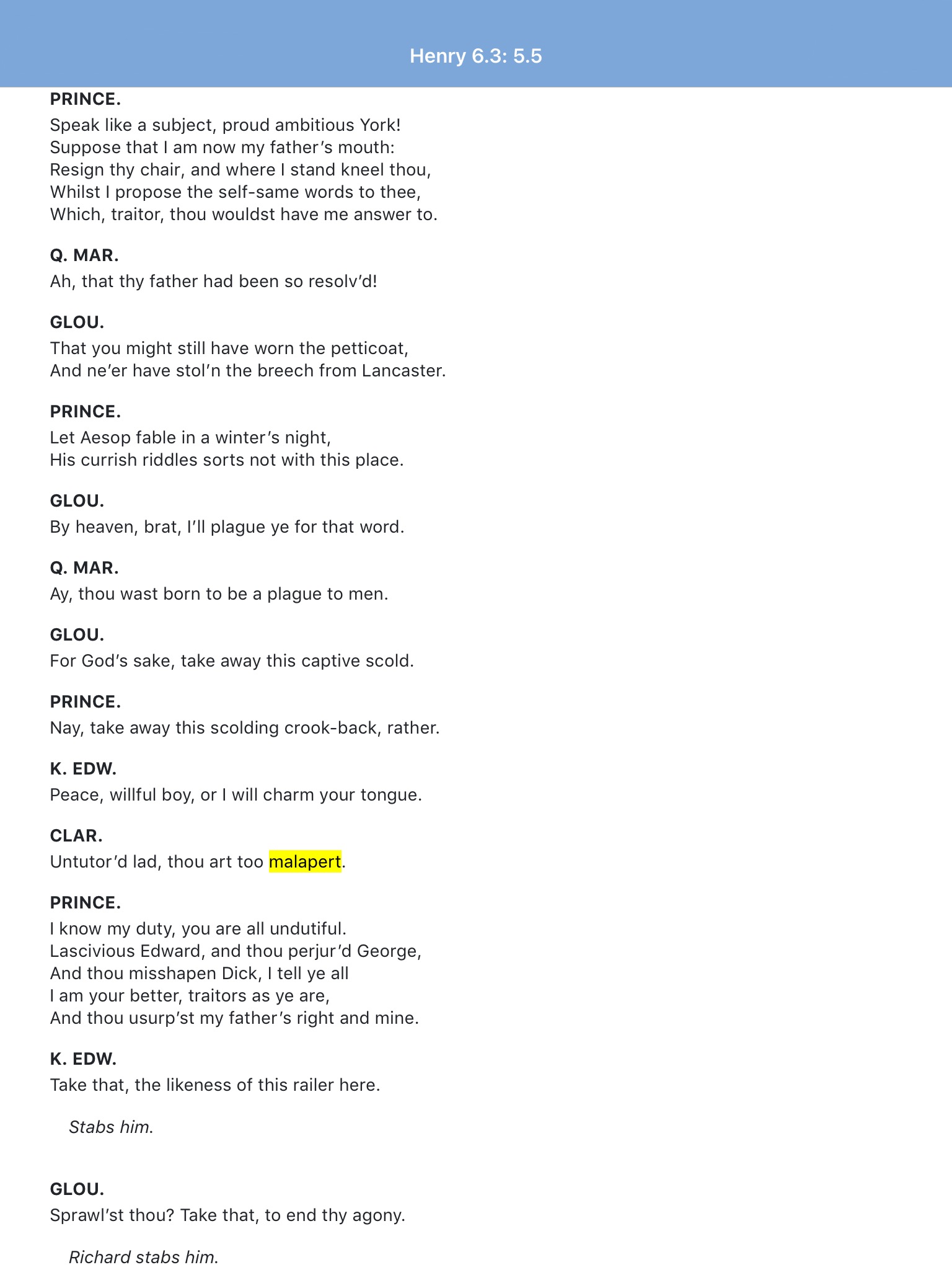
In Henry 6, Queen Margaret and her son, the young Lancaster Prince Edward, engage in a contest of insults with their captors: Clarence and Gloucester. As sons of Richard, Duke of York these two are the Lancastrian King Henry’s enemies, as the two houses are rivals for the English throne. Clarence calls the young prince malapert, highlighting his youthful confidence by calling him an “untutor’d lad”. 

Almost as proof of Clarence’s assessment, the prince responds by insulting them again. Despite the clevernesand bravery of his words, this proved to be a bad move, as “perjur’d George” and “misshapen Dick” respond by stabbing him to death. End of argument. 

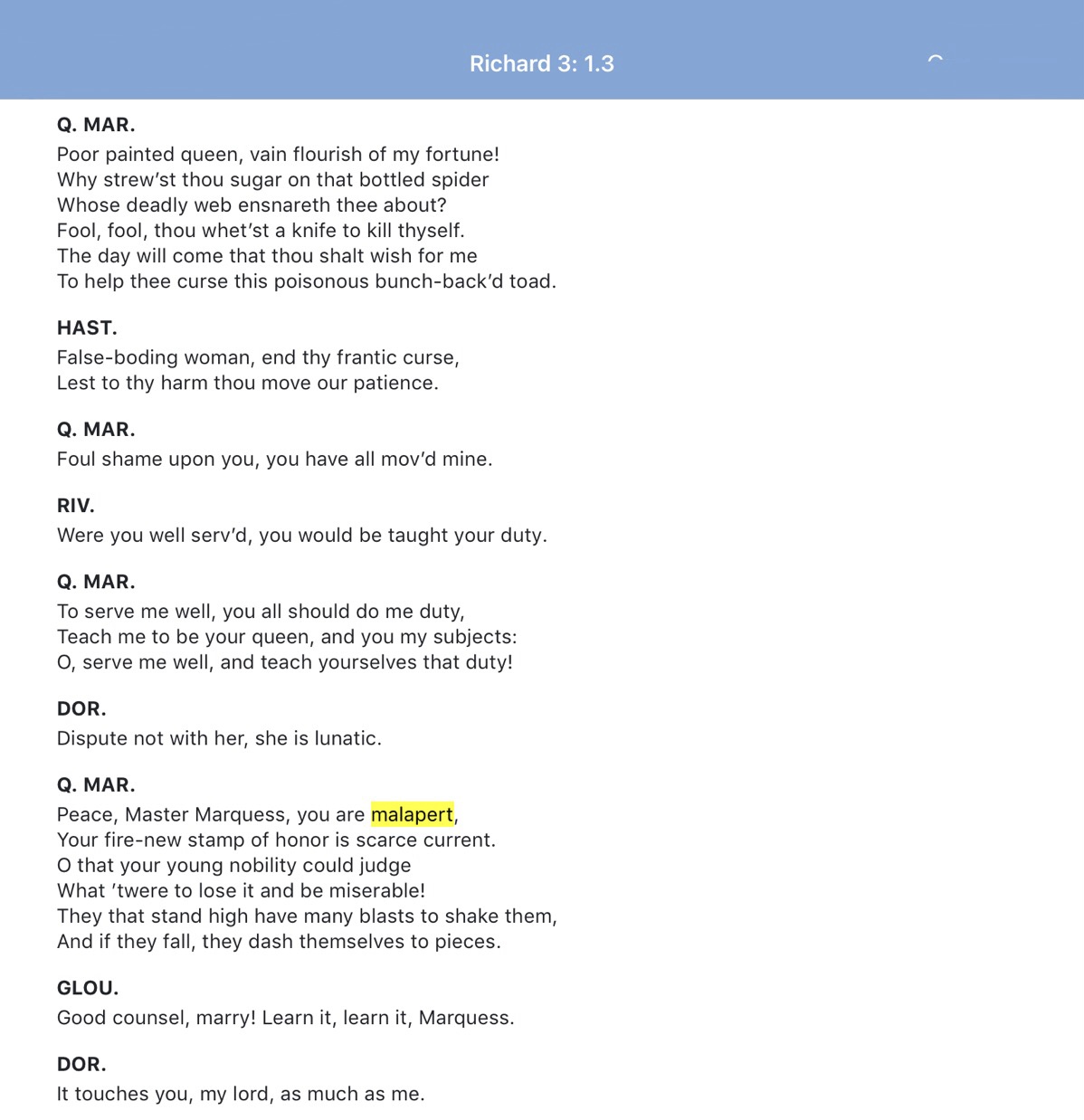
In Richard III, the same Queen Margaret tells the Marquess of Dorset that he is malapert and warns him that his newly found nobility won’t protect him from being destroyed by the Yorks, particularly Richard (Gloucester) whom  she describes as a “bottled spider” and a “poisonous bunch-back’d toad”. Richard turns the insult back on Margaret, and Dorset promptly turns it right back on him. 

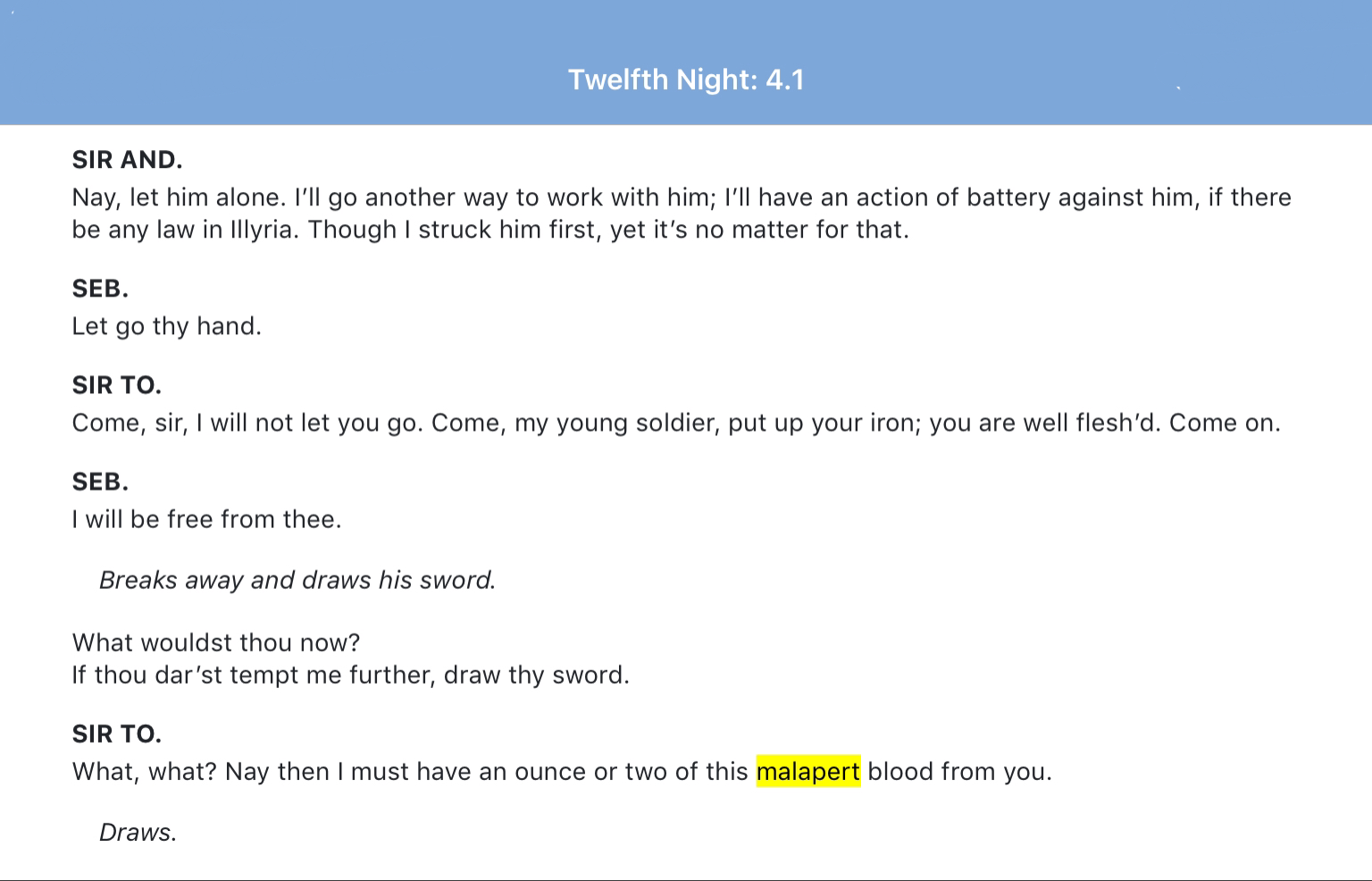
In the comedy Twelfth Night, Sir Toby Belch and Sebastian are engaged in an argument when Sir Toby insists that he “must have an ounce or two of this malapert blood” from his rival. 

This is a word I have long been aware of, yet I have definitely not made as good use of it as I could have done. This, however, is likely to change in the near future. 

Malapert
#words #language #etymology #blogpost

Pedant vs. Teacher

Most people use the term ‘pedant’ in a derogatory way, usually in reference to someone they perceive as being too fussy or too strict about rules. 

On the occasions when I have been called a “grammar pedant”, I have generally responded as though someone is paying me a huge compliment. I invariably say something like “Oh stop it, you flatterer!” or “One day you’ll say that like it’s a bad thing!”

As a lover of the English language and words in general, there are things to we should be paying careful attention. There is value in pointing out where a student needs an apostrophe or a comma in their writing, or where they can express an idea or key point of information more clearly. That is part of being a teacher. It’s my job.

However, I try to restrain myself from correcting people’s grammar on social media, though, for two reasons:

  1. I don’t have time. I have a life to live, and I need sleep to function.
  2. They tend not to like it much.

What many people don’t know is that the word pedant was actually derived from the world of teaching and education. It came to English from either the  Italian word ‘pedante’ or from its descendant, the later Middle French word pédant, both of which referred to a schoolmaster or teacher.  It may be one of those words that came into English from more than one source. The Italian word is derived from the Latin word paedagogantem, which is the origin of the words pedagogue and pedagogy, which are also related to teaching and education. 

By the late 16th century, though, the English were using the term in a negative rather than a neutral way.  ‘Pedant’ had already come to be used for one who placed undue emphasis on the minor details of learning, or someone who focused on details or technicalities  instead of looking at overall issues or taking a wider view of general learning and practice. 

In that sense, correcting someone’s grammar on social media when it is clearly not appreciated is being unnecessarily pedantic. Perhaps that is the distinction that really needs to be made.

Alternatively, it might be a somewhat uncomfortable yet valuable opportunity to improve both one’s learning and professional credibility in an age where prospective employers and customers look at social media profiles before deciding to give a job or order to a particular person. This is particularly true for anyone who should be reasonably expected to have a sound grasp on the language, such as teachers, writers, bloggers and professionals who rely on clear communication in their work. 

Let’s face it. I may not care if someone misspells an uncommon word, or one they’ve only heard and not read, but if they don’t bother to differentiate between ‘your’ and ‘you’re’ on social media, I’m neither going to buy their book, nor hire them to write my copy or teach my kids. 

Fussy? Yes. 
Pedantic? Probably. 
Apologetic? Not one bit. 

Reference: Online Etymology Dictionary

Pedant vs. Teacher
#grammar #English #language #words

Asterisk.

The asterisk is the handy little star symbol* that we use to indicate that there is more information attached to something, to denote the existence of a footnote, to add emphasis to a word or point of notice, or to blank out letters in offensive words that we don’t want to type or write in full. 

The word asterisk means ‘little star’ and has been used as a noun since the late 14th century— well before the invention of the printing press— while the verb form “to asterisk something” was first recorded in 1733. 

Asterisk comes to use from Latin via Greek, but actually goes back to Proto-Indo-European roots, which is about as far back as any language or individual words can be traced. The PIE root *ster- is the source of the words for star in numerous languages including Hittite, Sanskrit, Greek, Latin and, thus, English. 

Therefore, the word asterisk is related to asteroid, aster daisies, disaster, constellation and starfish, among others. It is also a cousin of names such as Esther, Estelle and Stella.**  

More recently, the asterisk also inspired the name of Asterix, the hero of the classic comics by Goscinny and Uderzo. Those books are characteristically full of puns and word play, and the names of Asterix and Obelix are derived from mispronunciations of asterisk and obelisk respectively. 

* located above the 8 on a keyboard
** They are not close cousins, but more like the kind who are jealous of each other because they all want to be the most popular starlet in the family, and only make small talk with one another at family reunions. 

Source: Online Etymology Dictionary

Asterisk
#etymology #words #history #asterisk #language #typography