Understanding Shakespeare’s English

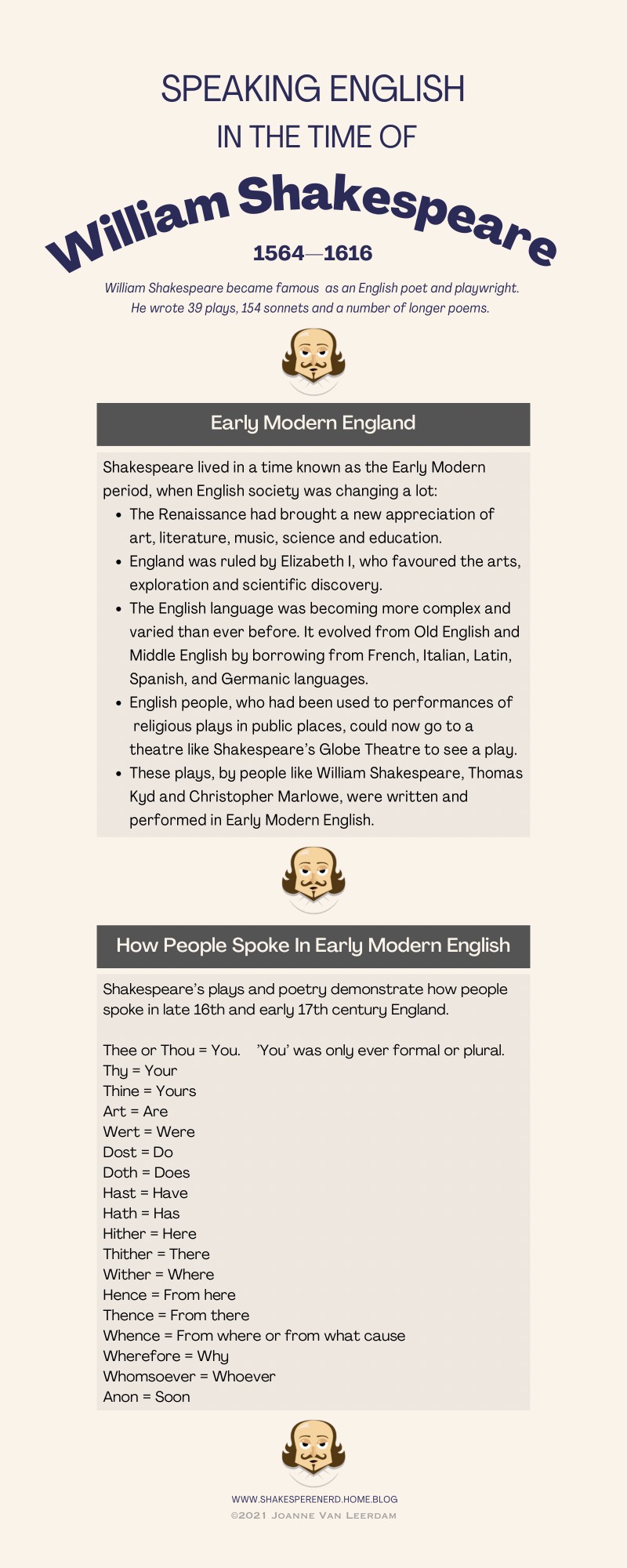
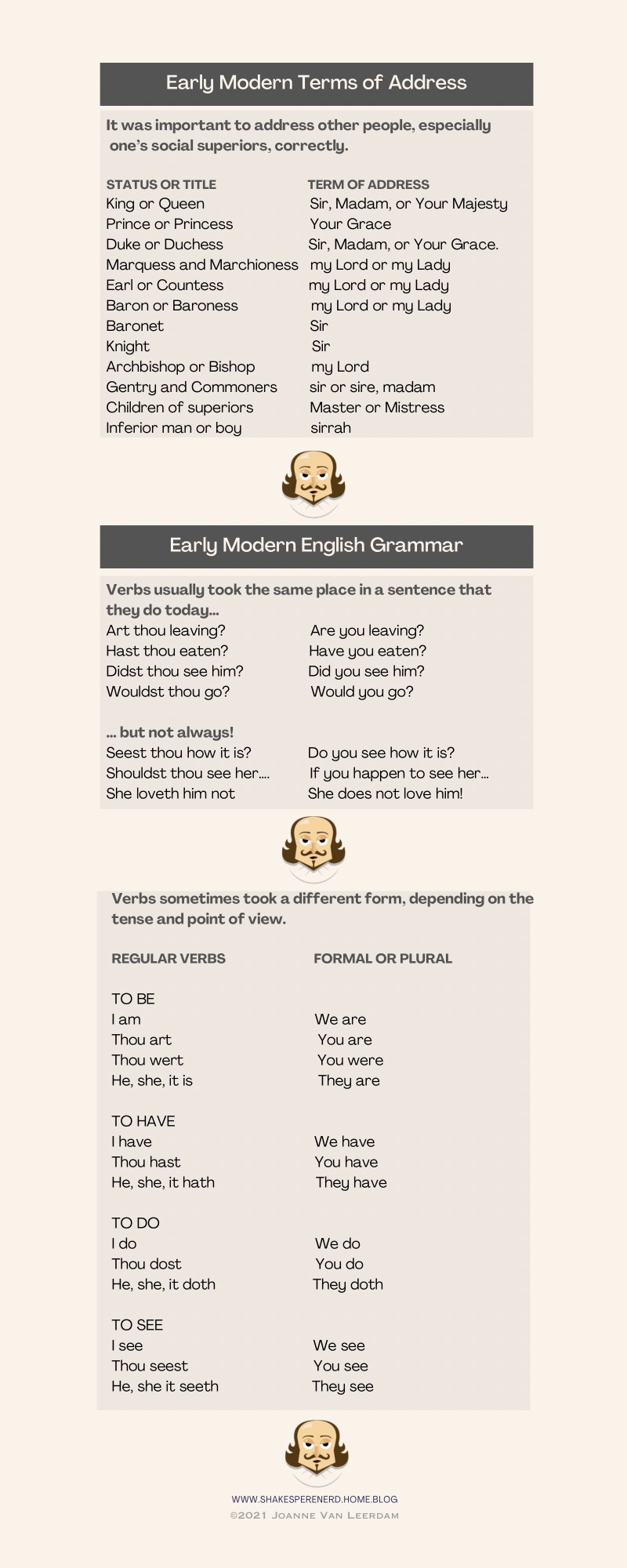
One of the biggest obstacles for people who have not previously watch or read Shakespeare is a perception that the language is hard to understand. While there are definitely some words that are unfamiliar because they are no longer used, the most commonly perceived challenge is understanding thee and thou, art and wert, and the like.

Before I ask my students to read or listen to Shakespeare, I teach them the basics of Early Modern English and what all those old-fashioned words mean. I give them a translation guide, and get them to practise speaking and writing basic sentences before moving on to the most fun lesson of the year: Shakespearean Insults!

Once they have played with the language, they are far more receptive to it in a film or written text.

Like anything in life, the path ahead is smoothed by breaking down barriers and removing obstacles.

This infographic is designed to present the basics of Early Modern English simply and directly, to serve as a memory aide and a translation guide as needed.

Understanding Shakespeare’s English
#Shakespeare #English #infographic

Hurly-Burly

Photo credit: Sergey Katyshkin via Pexels

This morning I made a to-do list in addition to the one I live by from day to day. The intent of this list is inherent in its title: When the Hurly-Burly’s Done

That is a quote from the opening scene of Macbeth, where the Wyrd Sisters chant in the midst of thunder and lightning:

1st WITCH.

When shall we three meet again?

In thunder, lightning, or in rain?

2nd WITCH.

When the hurly-burly’s done,

When the battle’s lost and won.

3rd WITCH.

That will be ere the set of sun.

In the context of war, treachery, the death of a king and the consequent struggles of a nation, it means they will get together again when the mayhem is over. Given their manipulation of Macbeth himself, it’s mayhem they are actively involved and interested in.

While I am not in any way playing with anyone’s life or ambitions, nor the future of the country, there is plenty of hurly-burly in my life at this point in time .

Hurly-burly or hurlyburly is a word from the early 1500s which means commotion or tumult, which grew out of the  phrase hurling and burling which was used as early as the 1300s. Hurling time was the name applied by chroniclers of the time to the period of tumult and commotion around the Peasants’ Revolt against the young Richard II, led by Wat Tyler in 1381.

It is a wonderfully expressive word that is quite evocative of  the chaos and tumult of its meaning, particularly when delivered with a Scottish accent as it might well be spoken in Macbeth.

Juggling a show, a job, a couple of blogs and a personal life takes some coordination and requires self-care as well as caring for the needs of those around me. It’s busy and demanding, and it definitely feels like hurly-burly to me. Consequently, there are some things that will simply have to wait until after the hurly-burly’s done. The new list should help me ensure they aren’t forgotten.

Sources:

Etymonline.

Middle English Compendium

William Shakespeare, Macbeth

Applause.

Photo by Brett Sayles on Pexels.com

The weekend just gone was super busy but highly rewarding: Camperdown Theatre Company returned to the stage after the enforced shut downs and restrictions of Covid, and launched its 2021 season of Mystery At Shady Acres. It’s a fun whodunnit show with plenty of audience interaction as guests try to solve the mystery presented in the first act.

It was wonderful to be back in the theatre with an audience, and to see the hard work of the past few months come to fruition. Even better was the enthusiasm of the audience: tickets sold out early, people arrived with excitement on their faces, and there was a buzz of anticipation in the theatre as the time drew near for the show to start.

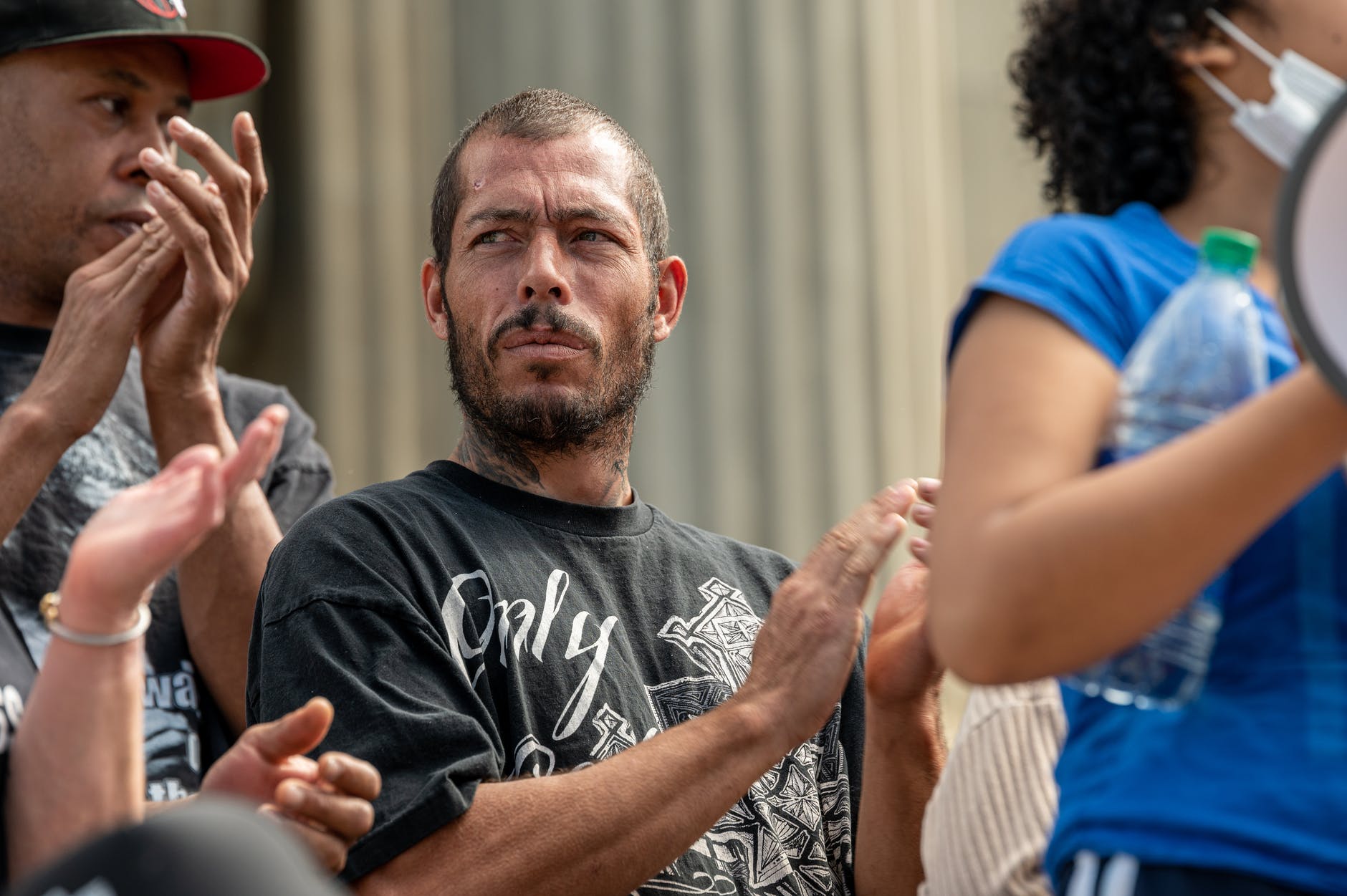
The audiences on both Friday and Saturday nights were very responsive and enthusiastic in their applause. Many made very positive comments after the show, and the actors and directors finished the night feeling very positive and enormously encouraged as a result.

Applause is a noun that came into English in the early 1400s from the Latin word applausus, which means commendation or praise.

In the 16th and 17th centuries, English folk used the word  applausible to refer to anything worthy of praise or applause. That word fell out of favour, though, and now we might use the term praiseworthy or commendable instead.

Within a century of applause entering the English language, applaud appeared as its verb form, meaning to express approval or to praise. This came from the Latin verb applaudere, meaning to clap the hands inaffirmation or agreement, to approve by clapping hands. This word was a combination of ad (to) and plaudere  (to clap). 

The use of applaud to mean clap one’s hands dates back to the 1590s; which shows that they were using the word to refer to giving praise or commendations in general well before they were using it so literally.

This also gave English speakers the word plaudit, which can mean a round of applause, but it can also mean any other expression of approval or praise, whether clapping one’s hands is involved or not. they were using the word before that to refer to giving praise or commendations in general before that.

The power of applause should not be underestimated: nothing stimulates a performer more directly than acknowledgement and praise of their work.

As we head into another busy week and another weekend of performances, I plan to encourage the cast and crew with the positive comments made by members of last week’s audiences.

When each show is done, we will continue to be thankful as  the audiences clap  their hands and praise us however they will. We at CTC will welcome their applause and their plaudits for as long as they will give continue to applaud. 

The Insidious Return of Impostor Syndrome

Photo by Ibolya Toldi on Pexels.com

Over the past couple of weeks, I have been an unwilling host to an enormous case of impostor syndrome.

This post  is not a plea for reassurance or confidence.
Nor is it an accusation against anyone else.

Rather, it is an honest, soul-wrenching confession of someone who doesn’t want to be a fake, but at times desperately fears she might be.

I may well be a poet and author, but I haven’t managed to write much at all in the past few months. I have a collection of poems edited and ready for publication, and I can’t quite seem to manage that next step. Part of that is being extraordinarily busy — the other part is fear that it won’t be welcomed or appreciated by readers.

The play I have been co-directing for Camperdown Theatre Company has been in full swing of rehearsals, set design and construction, venue preparation and various other elements of production and promotion.
My co-director is sensational, and the cast, crew and set are all excellent. My doubts keep telling me that they would all have done just as fine a job without me.

I have a three-quarters-written blog post that I have been working on for a couple of weeks now I know what I want to say, I just haven’t had time to write it. This has been a source of both frustration and disappointment, particularly given that it involves two of my favourite things: words and Shakespeare!

A good proportion of the demands on my time over recent weeks has come from a considerable increase in my teaching load, which arose without warning and with some urgency: unexpected events meant that the school needed people to step up, so I did. That my boss asked me to do it demonstrated  confidence in my ability and professionalism. I know I am a good teacher, but I’m not feeling that way at the moment. I have been so stressed and stupidly exhausted lately that I feel like I am continually not quite keeping up.

All of this combines to play on my insecurities and doubts about myself.

Last week I hit a real low— I knew it was happening, I could recognise it for what it was and analyse it as it was happening, but I could neither stop it nor escape it. And the barbs came thick and fast:

You’re a fake.

Give up now – nobody will even notice. Your poetry sucks anyway. Nobody would miss you if you didn’t show up. As if anyone actually wants to be with you.

You’re a terrible friend.
All you do is hurt people.

You’re so selfish – thinking about your own feelings instead of what others need.

You’re useless.Do you even know what you’re doing?

Maybe that student is right: you’re a terrible teacher and a horrible person.

Pathetic, feeling sorry for yourself like this. Who do you think you’re kidding?

A day as lousy as this is exactly what you you had coming.

It has been quite awful. The emotions that rage within me at these times are raw and powerful, but they are also subtle and stealthy in the ways that they lurk in the dark corners, preying subtly on every raw nerve ending and every perceived failure. The tears have often been close to the surface, and have been quickly blinked back each time they threaten to overflow. The sense of powerlessness has been overwhelming.

On one level, I know those accusations are not true but, at the same time, it honestly feels as though they are. The more my brain says those things, the more believable they become.

I also know from previous experience that it won’t last. It may come and go, but it’s not permanent.

That doesn’t make getting through it any easier, though.
Because … what if it *is* true?

That’s the fear that keeps me from confessing how I feel until afterwards. Even if I told someone, any reassurance they gave me would be met with the doubt that they might just be saying it for my benefit. I would continue to doubt the legitimacy of any encouragement they might give me. So, I just hold on and wait for it to pass. So how do I weather this kind of storm?

I have got through it with the support and encouragement of a few key people who remind me that I am valued, loved and wanted.
They have helped me in small ways to do what I needed to do, often without realising they were doing that. None of them knew the truth of how I have been feeling.

Support from a colleague helped me walk into the next classroom.

A message from a family member asking hopefully if I was leaving work and coming home soon reassured me that  I was missed, and would be welcomed when I got there.

A little kiss on my forehead and ‘I love you’ from my niece reminded me that I didn’t have to prove anything to her.

The sensitive empathy of my dog demonstrated, like she has done so many other times,  that love is sometimes as unconditional as it should be.

A kind word of appreciation from a couple of different cast members made me feel valued, despite my doubts.

Once again, all those things demonstrated that I don’t need to be able to control the storm. I just need to be able to know where I can find shelter.

Photo by Pixabay on Pexels.com

Author’s Note: the fact that I have posted this means that I have started to come out the other side of this negativity. I’m okay.