Sonnets are hard to write. There are rhyme and rhythm patterns that one must observe and maintain, which force the poet to refine and craft their words meticulously so that no nuances of meaning are lost in the interests of obeying the rules.
I have written one sonnet of which I am very proud.
I have also written several others which are pretty rubbish, and therefore will never publish them. I firmly believe that their value lies in the learning and the practice, rather than in the reading. Failure can, after all, be a most effective instructor.
I hope you enjoy the poems this post has to offer, and find yourself more informed about the beauty and complexity of the sonnet when you leave it than when you arrived.
***
10 Classic Examples of the Sonnet Form via Interesting Literature
The sonnet form is one of the oldest and most popular poetic forms in European literature, having been invented in the thirteenth century and used since by poets as varied as Petrarch, Shakespeare, Wordsworth, Elizabeth Barrett Browning, Christina Rossetti, Tony Harrison, Carol Ann Duffy, and Simon Armitage. Below, we offer […]
Tonight
Through the tears
That sprang from your pain
And fell from my eyes,
I looked into the sky
Where there was one less star shining,
And I wept for the world
Where life carries on
Just that bit darker
Than before
You left.
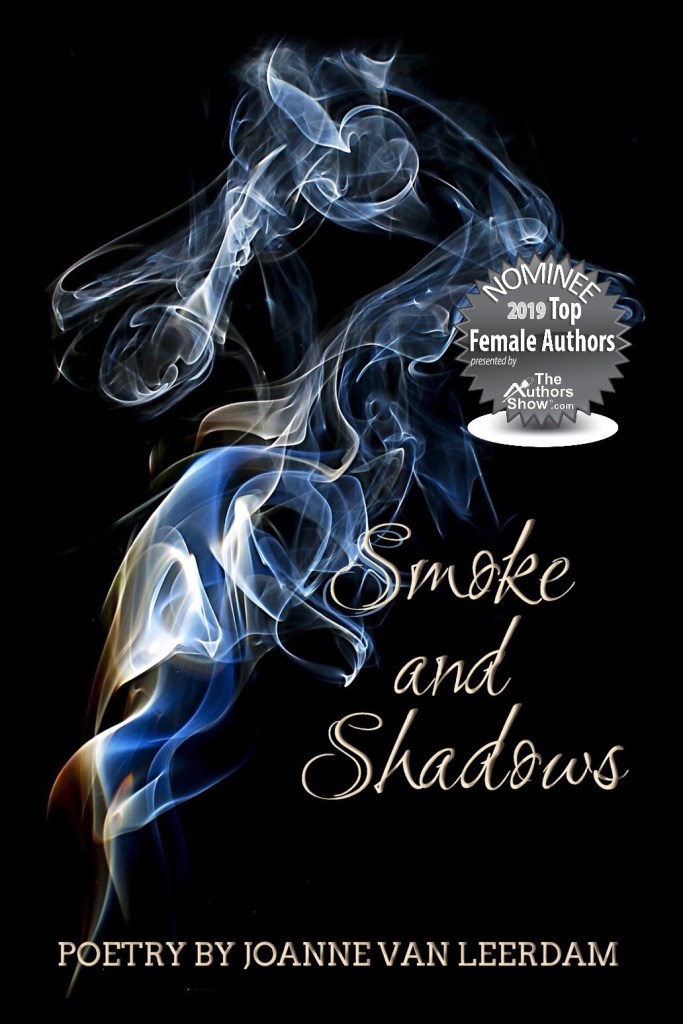
Guess who got nominated again for Top Female Author 2019?
I did, that’s who!
‘Smoke and Shadows’ has been nominated in the Poetry category – the same one in which Nova won in 2017.
It’s fair to say I am excited!
It couldn’t have come at a better time. The crazy busy pace and emotional demands of the last three weeks and the stress I have been under because of things outside my control have really worn me down, and while I’ve enjoyed the release of ‘A Rose By Any Other Name’, I haven’t really given my books or my writing the attention they deserve at all the past month or so. I’ve started a number of poems lately, but haven’t finished any of them… yet.
It’s really nice to know someone loved my book enough to nominated it. I love it, and I’m proud of it for so many reasons – but that is no guarantee that anyone else is going to. The reviews have been good, though, so I have reason to hope that others will enjoy reading it, too.
It’s also very timely reminder that there are things which transcend those times of stress and exhaustion in our lives that seem to take over and leave no time or energy for anything else.
Of course, we know that, but sometimes we forget to keep that thought in our mind. It’s amazing the difference a little bit of encouragement and support can make.
Winners are announced on July 8th. I’ll be sure to let you know if I win!
I really enjoy the Interesting Literature blog. It’s well organised and curated, and has lots of excellent posts about all sorts of different literature. There are collections of poems or novels by theme, and various authors’ and poets’ “best of” lists.
If you liked my Poetry Month or Classic Novels posts, you may well appreciate their posts as much as I do. (If you missed them, you can find them easily by clicking on those tags on this post.)
This post about Maya Angelou’s poetry is a great example of the excellent content you’ll find at Interesting Literature.
A sonnet is a poem of fourteen lines with strict patterns of rhythm and rhyme that give it both formality and musicality.
I have read and studied many sonnets, and have written two that I love and one very poor one that shall never see the light of day, let alone be published. Let’s call that third one an important exercise in keeping the poet humble!
This sonnet by Charles Best, a contemporary of Shakespeare, is beautifully evocative, bringing to mind images of moonlight on the water and the movement of the tides before transforming, as sonnets often do, into a declaration of love and devotion.
Sonnet of the Moon
Look how the pale queen of the silent night Doth cause the ocean to attend upon her, And he, as long as she is in his sight, With her full tide is ready her to honor. But when the silver waggon of the moon Is mounted up so high he cannot follow, The sea calls home his crystal waves to moan, And with low ebb doth manifest his sorrow. So you that are the sovereign of my heart Have all my joys attending on your will; My joys low-ebbing when you do depart, When you return their tide my heart doth fill. So as you come and as you do depart, Joys ebb and flow within my tender heart.
I learned this poem when I was in 5th grade. My teacher loved poetry sand set us all a poem to memorise and recite. ‘Going to School’ was mine.
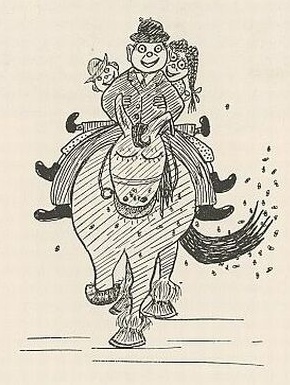
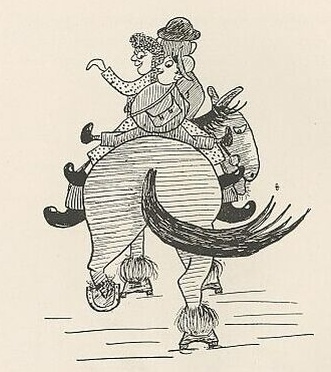
Published in ‘A Book for Kids’ in 1938 with a collection of similarly excellent poems, this is a fun poem with a very musical rhythm and rhyme pattern that are instantly engaging. It conjures images of a time when kids in Australian country schools might ride a horse to school if they loved too far away to walk and didn’t own a bicycle or three.
Dennis was a man of many talents: in addition to working as a journalist and poet, he also illustrated his own books with delightful pictures that were almost as much fun as the poetry.
Did you see them pass to-day, Billy, Kate and Robin,
All astride upon the back of old grey Dobbin?
Jigging, jogging off to school, down the dusty track-
What must Dobbin think of it – three upon his back?
Robin at the bridle-rein, in the middle Kate,
Billy holding on behind, his legs out straight.
Now they’re coming back from school, jig, jog, jig.
See them at the corner where the gums grow big;
Dobbin flicking off the flies and blinking at the sun-
Having three upon his back he thinks is splendid fun:
Robin at the bridle-rein, in the middle Kate,
Little Billy up behind, his legs out straight.
Dennis’ images for ‘Going to School’ from ‘A Book for Kids’ Public Domain via Project Gutenberg
…
If you’d like a copy of A Book for Kids, Project Gutenberg has it available in a variety of formats, including for Kindle and other eReaders, free of charge. This is a legal download as the copyright on both the work and the illustrations included has expired.
Last year during Poetry Month, I shared Paterson’s magnificent poem ‘The Man From Snowy River’. This year, I thought it would be good to share a city-dweller’s perspective of the Australian stockman’s life in the 19th century through another of Paterson’s much-loved works.
The Stockman by S.T. Gill (1818-1880) Public Domain.
Clancy Of The Overflow
I had written him a letter which I had, for want of better
Knowledge, sent to where I met him down the Lachlan, years ago,
He was shearing when I knew him, so I sent the letter to him,
Just “on spec”, addressed as follows: “Clancy, of The Overflow”.
And an answer came directed in a writing unexpected,
(And I think the same was written in a thumbnail dipped in tar)
‘Twas his shearing mate who wrote it, and verbatim I will quote it:
“Clancy’s gone to Queensland droving, and we don’t know where he are.”
In my wild erratic fancy visions come to me of Clancy
Gone a-droving “down the Cooper” where the western drovers go;
As the stock are slowly stringing, Clancy rides behind them singing,
For the drover’s life has pleasures that the townsfolk never know.
And the bush hath friends to meet him, and their kindly voices greet him
In the murmur of the breezes and the river on its bars,
And he sees the vision splendid of the sunlit plains extended,
And at night the wondrous glory of the everlasting stars.
I am sitting in my dingy little office, where a stingy
Ray of sunlight struggles feebly down between the houses tall,
And the foetid air and gritty of the dusty, dirty city
Through the open window floating, spreads its foulness over all.
And in place of lowing cattle, I can hear the fiendish rattle
Of the tramways and the buses making hurry down the street,
And the language uninviting of the gutter children fighting,
Comes fitfully and faintly through the ceaseless tramp of feet.
And the hurrying people daunt me, and their pallid faces haunt me
As they shoulder one another in their rush and nervous haste,
With their eager eyes and greedy, and their stunted forms and weedy,
For townsfolk have no time to grow, they have no time to waste.
And I somehow fancy that I’d like to change with Clancy,
Like to take a turn at droving where the seasons come and go,
While he faced the round eternal of the cashbook and the journal —
But I doubt he’d suit the office, Clancy, of “The Overflow”.
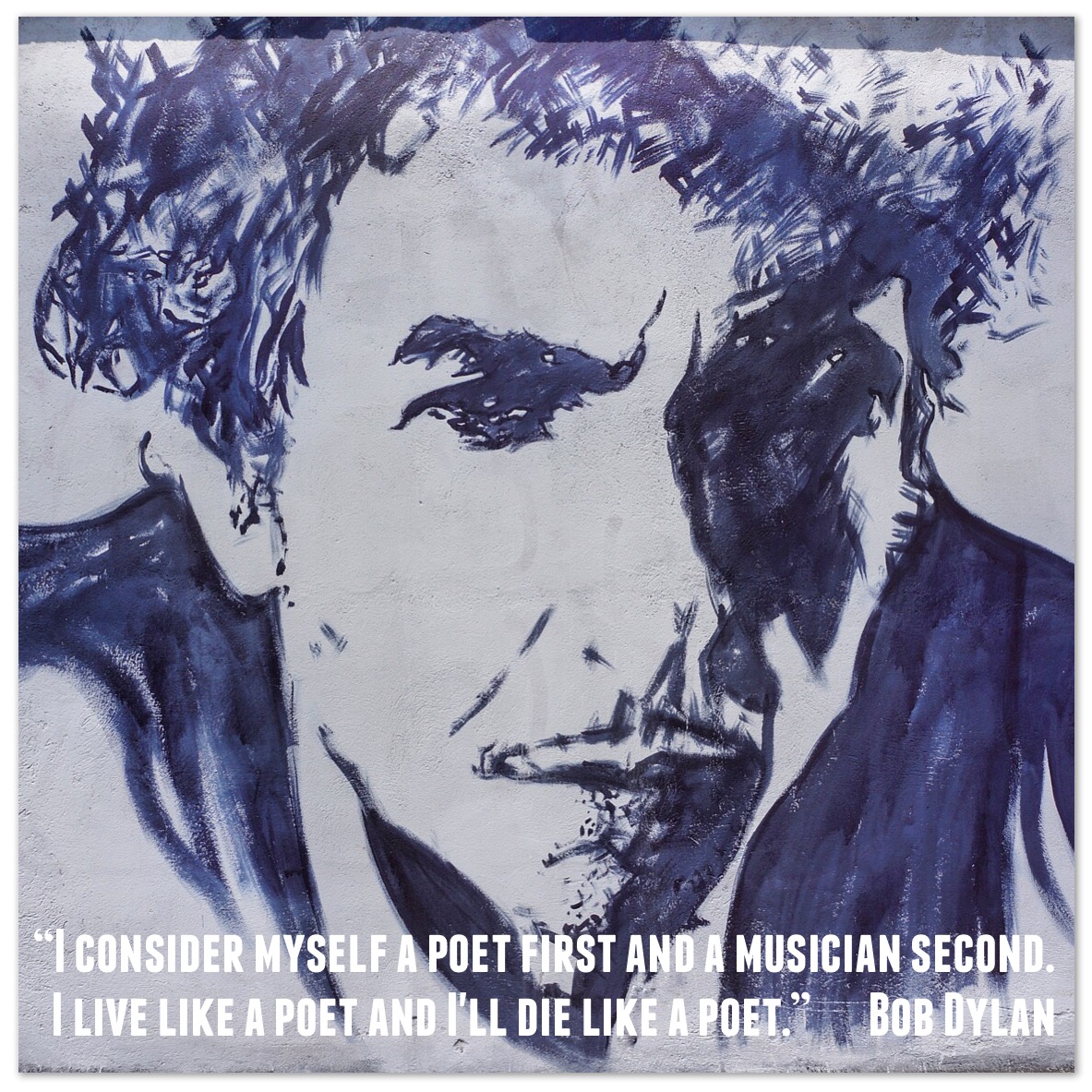
Bob Dylan knows a thing or thirteen about poetry: that’s why he was awarded the Nobel Prize for Literature in 2016.
Listening to his lyrics, there is no doubt of the poetic qualities of his writing. And in his own words, he considers himself a poet first and foremost.
Dylan’s songs became anthems of the 1960s before attaining legendary status in later decades. Love him or hate him, there’s no denying that Dylan’s words carry great meaning and importance.
Of all the protest songs of the 60s, Bob Dylan’s ‘Blowin’ in the Wind’ is still one of my favourites. Enjoy.
This poem expresses what I suspect many people, even very committed Christians, feel on Good Friday: we should weep more than we do, we should feel more than we feel, in response to Christ’s death on the cross.
While it’s true that faith and feelings are very different and distinct from one another, Rosetti observes here the misery and doubt that comes from knowing and believing in Jesus yet feeling as though she remains unaffected by her knowledge and faith, and expresses most eloquently the desire for God to help her to believe more fervently.
Whether or not one is a Christian does not limit their ability to be affected by the pathos in this poem, nor to consider the power of the imagery with which the poet evokes that sense of lonely difference from other people that pervades it.
‘Good Friday’
Am I a stone, and not a sheep, That I can stand, O Christ, beneath Thy cross, To number drop by drop Thy blood’s slow loss, And yet not weep?
Not so those women loved Who with exceeding grief lamented Thee; Not so fallen Peter, weeping bitterly; Not so the thief was moved;
Not so the Sun and Moon Which hid their faces in a starless sky, A horror of great darkness at broad noon– I, only I.
Yet give not o’er, But seek Thy sheep, true Shepherd of the flock; Greater than Moses, turn and look once more And smite a rock.
‘Easter Day’ is a sonnet about seeing the Pope on Easter Sunday. It is not, however, as reverent of the pontiff as it first appears.
After describing the scene, Wilde observes that while the ceremony he observes is impressive, it actually has little to do with the reality of Jesus’ life. It’s all about thethe Pope, far more than it is about the death and resurrection of the Messiah.
This is a very powerful observation, and one that certainly resonates with me. As I have said many times before, “I love Jesus. I just have significant problems with the actions of many who claim to represent Him.”
This poem, then, serves as a reminder to not put faith in man-made institutions, regardless of who or what they claim to be, but instead to focus on Christ himself, what He taught, and on one’s own faith in Him as a personal, intimate relationship.
Easter Day
The silver trumpets rang across the Dome: The people knelt upon the ground with awe: And borne upon the necks of men I saw, Like some great God, the Holy Lord of Rome.
Priest-like, he wore a robe more white than foam, And, king-like, swathed himself in royal red, Three crowns of gold rose high upon his head: In splendour and in light the Pope passed home.
My heart stole back across wide wastes of years To One who wandered by a lonely sea, And sought in vain for any place of rest: ‘Foxes have holes, and every bird its nest, I, only I, must wander wearily, And bruise my feet, and drink wine salt with tears.’