Epidural.

I am writing this while waiting for today’s instalment of treatment on my problematic lower back and spine.

An accurate representation of my life.

I’ve been having increasingly constant and aggressive pain in my back and sciatic pain in both my legs over recent months. I cannot sit, stand, or lie down without pain, which is both affecting everything I do and depriving me of sleep.

My neurosurgeon has prescribed an epidural injection of steroids into my back, done under CT scan guidance.

I know it is a treatment a lot of people have, but that doesn’t stop me feeling anxious about it. I am looking forward to the respite from constant pain, but it’s not a process I am looking forward to.

So, I am filling in the time by wondering about the meaning and origin of the word ‘epidural’. It’s a frequently used word in relation to one of the kinds of anaesthetic used during childbirth, and people generally understand that is blocks pain from the waist down, but that is not my circumstance. I’m definitely not giving birth today!

The Macquarie Dictionary definition, while accurate, was not entirely helpful.
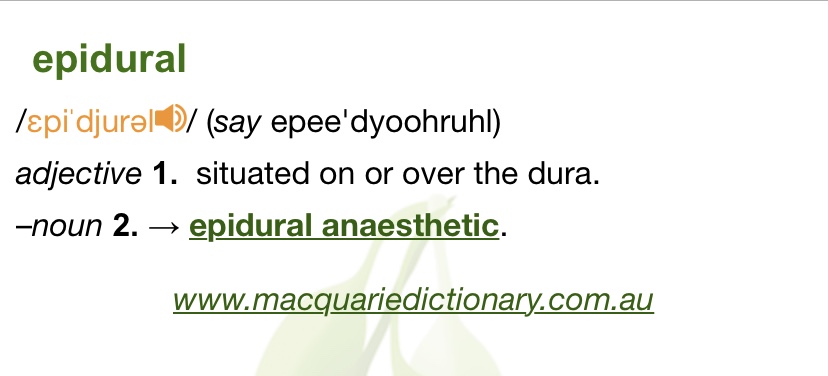
Having looked up ’epidural’, I then had to look up ‘dura’.
Just like that, I’m already learning things I didn’t know.
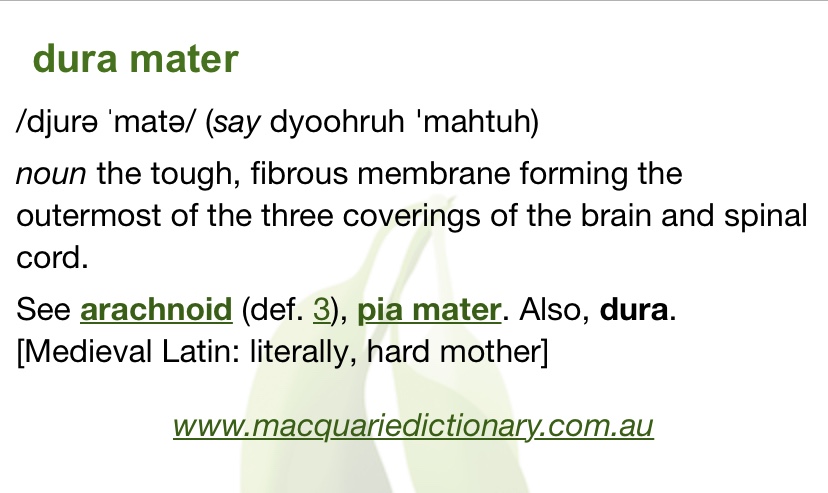
So, I can deduce that I am having an injection through the tough outer lining of my spinal cord.

To be honest, this research isn’t really reassuring me about the procedure at all.

According to Etymonline, the prefix epi- means on or above, and came into English from Greek.
The term dura mater dates back to about 1400 AD, coming from the Medieval Latin ‘dura mater cerebri’ which translates to “hard mother of the brain,” a term which was borrowed from the Arabic ‘umm al-dimagh as-safiqa’, which means “thick mother of the brain.”

And so I wait, informed and still apprehensive of what is to come.

All I can say is I really, really hope this works.

What’s Your ‘Word of the Decade’?

At the end of every year, there is much discussion about which words particularly define the year.

Now, the team at the Macquarie Dictionary is inviting us to vote for what we believe has been the word or term that defines the past decade.

There are some very good inclusions that still carry meaning and import, while others have already fallen in popularity and are not so commonly used.

Even so, the list is a interesting read and an insightful commentary on the past ten years.

Anyone can vote, so have a read and have your say in about the words and terms that evoke the 2010’s most clearly.

Source: Macquarie Dictionary

What’s Your ‘Word of the Decade’?
#words #language #blogpost

Bivouacked.

This morning I read a tweet that made me stop and think, “Wait.. what?”

The word that got my attention was ‘bivouacked’.  Despite the fact that I am a passionate reader and a scholar and teacher of History, I had no idea what this word meant. Obviously, I wasn’t the only one: plenty of people responded that they had to look the word up. 

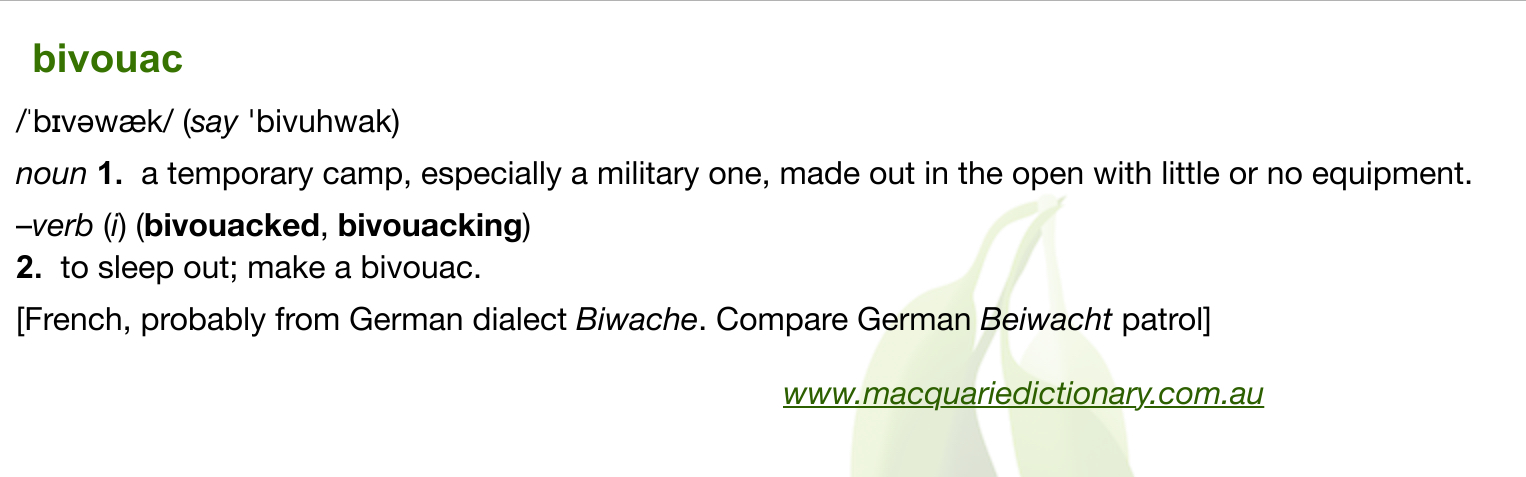
My trusty Macquarie Dictionary gave me the definition. 


Etymonline explains that the use of bivouac in English dates back to 1702, meaning an “encampment of soldiers that stays up on night watch in the open air, dressed and armed.” 

It is an image of readiness to defend and protect, which was exactly the context of the tweet. These images of bivouacked soldiers in the Capitol building, Washington DC, are confronting and comforting at the same time. That it is even necessary is heartbreaking, yet in the current political climate, I am thankful they are there.

Images by Igor Bobic, Huffington Post photographer. 
Igor Bobic on Twitter.  See the full post here

The word came from French, and before that from the 17th century Swiss/Alsatian word ‘biwacht’ which meant “night guard”. 

By 1853, bivouac was also used as a noun to mean an outdoor or open-air camp. 

The use of the verb ‘to bivouac’, meaning to post troops in the night dates to 1809, and meaning to camp or sleep out-of-doors without tents dates to 1814. It should be no surprise that the noun became a verb in the context of the Napoleonic Wars and the War of 1812, during both of which the practice would have been common.

Bivouacked.
#words #language #History

Easily Confused Words: Spoilt vs. Spoiled

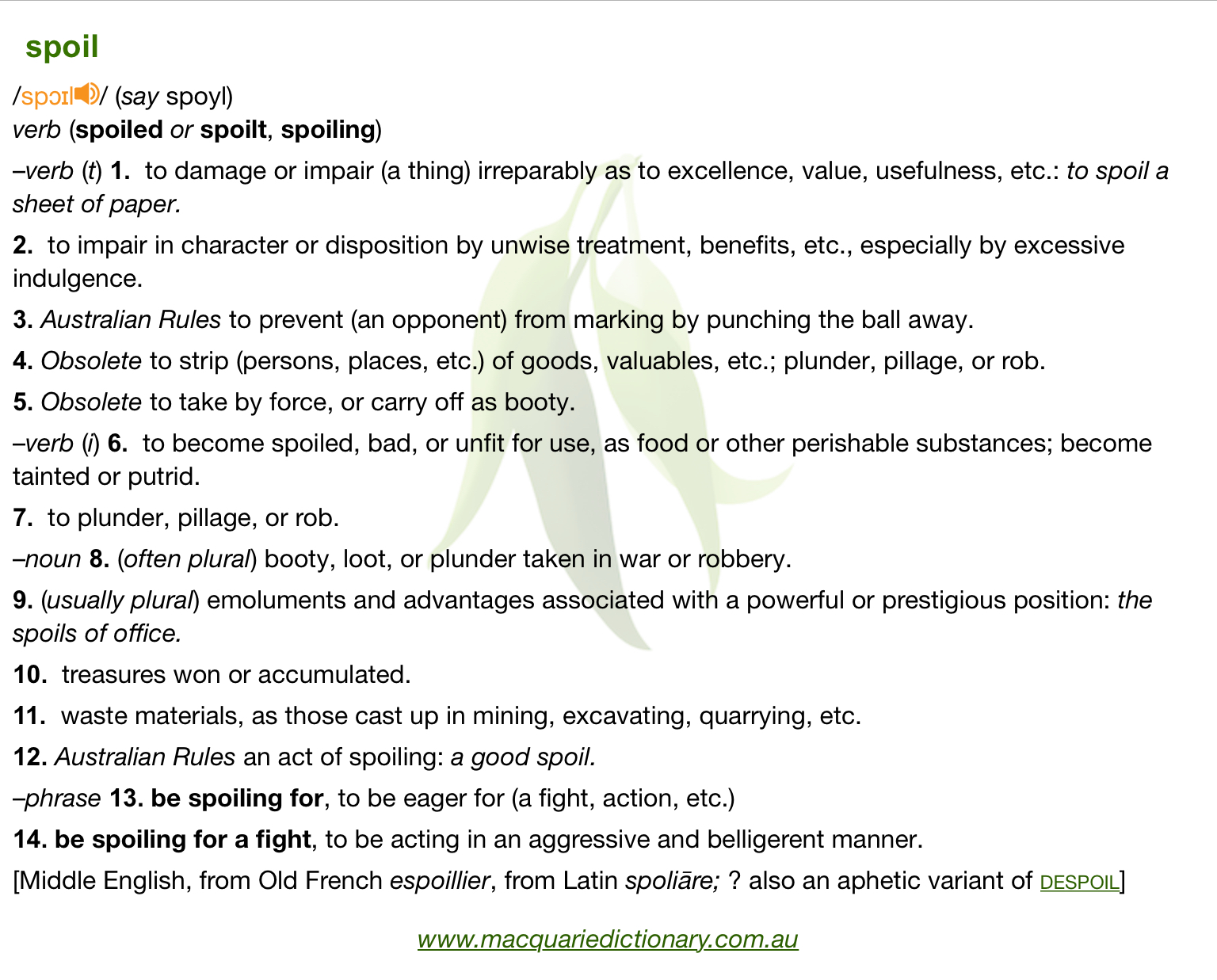
In response to describing myself on Christmas Day as spoilt, one of my acquaintances corrected me, saying that the word I should have used was ‘spoiled’. Their intentions were good, I’m sure, but they were, to put it bluntly… wrong.

‘Spoiled’ and ‘spoilt’ are similar words that are easily confused with one another. Both come from the word ‘spoil’ which has a number of meanings of its own.

In the US, they use ‘spoiled’ for everything. That certainly simplifies things!

In the UK and Australia, however, the two variants of the word are used differently.

Spoiled’ is generally used as the past tense verb of ‘spoil’, although it is not incorrect to use ‘spoilt’ instead.
Therefore, last week’s roast that has gone rancid, a sheet of paper that has had something spilled on it,  and a natural landscape defaced by deforestation, mining or construction are most often referred to as spoiled, but can be described as having been spoilt.

Spoilt is favoured as the adjective for things that have been spoiled.
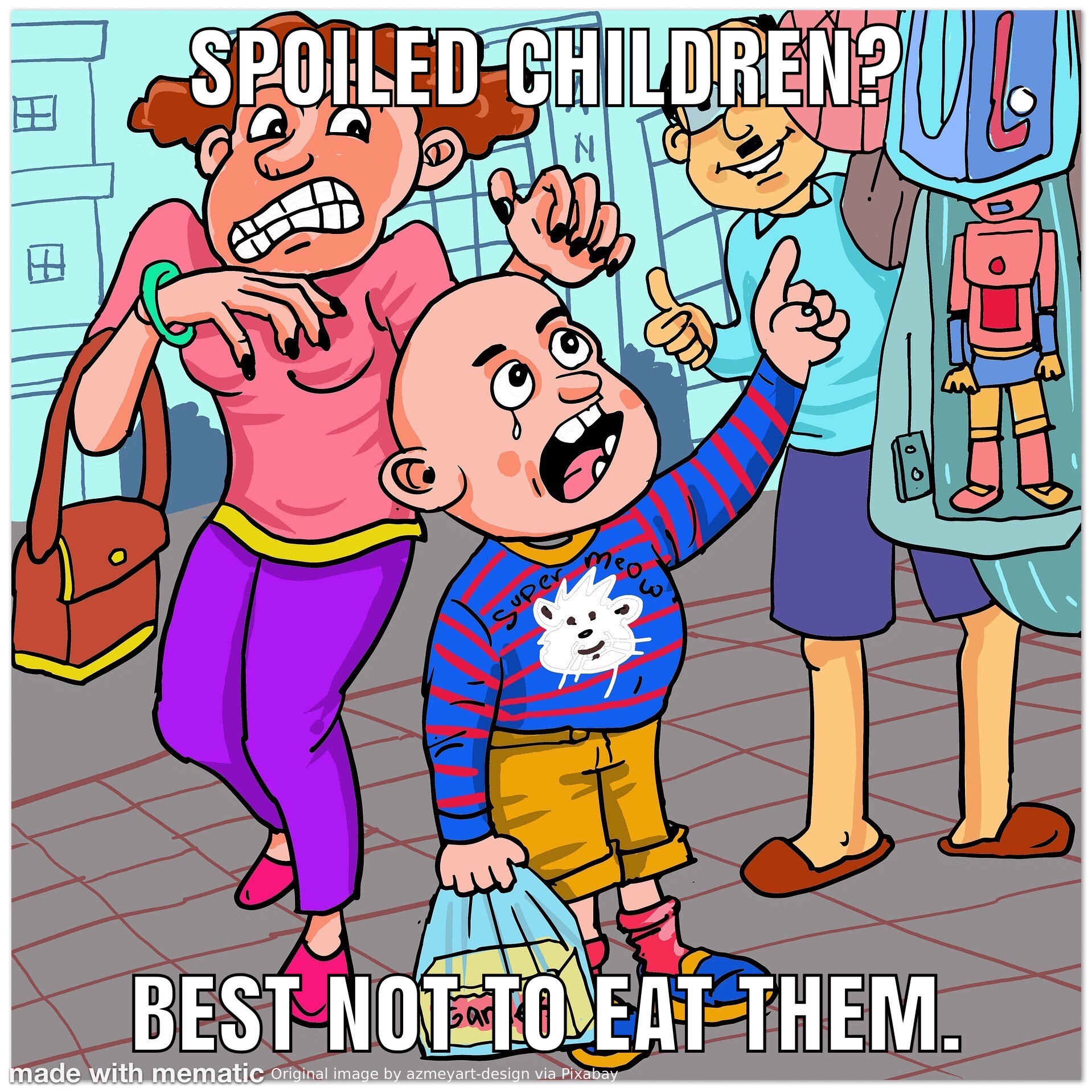
Children — and occasionally adults — who have received too many presents for Christmas or a birthday, enjoyed too many indulgences, or experienced too little discipline in their lives are often said to be spoilt or, in excessive cases, spoilt rotten.

So, over Christmas, I could quite rightly describe myself as spoilt or spoilt rotten. Given that I looked, felt and smelled fine, I am confident that I wasn’t spoiled at all.

Sources:
Macquarie Dictionary
https://grammarist.com/usage/spoiled-spoilt/
https://www.writerscentre.com.au/blog/qa-spoilt-for-choice/

Easily confused words: spoiled vs. spoilt.
#words #englishteacher #blogpost

Shakespeare’s Baubles.

wordynerdbird's avatarShakespeare Nerd

Because it’s December and Christmas decorations are everywhere, I wrote last night about the meanings and etymology of the word ‘bauble’ on WordyNerdBird. I wondered then if it were a word used by Shakespeare. To my delight, it was indeed!

Interestingly, Shakespeare references one of the continued senses and the obsolete sense of the word, and creates double entendre with it for extra credit.

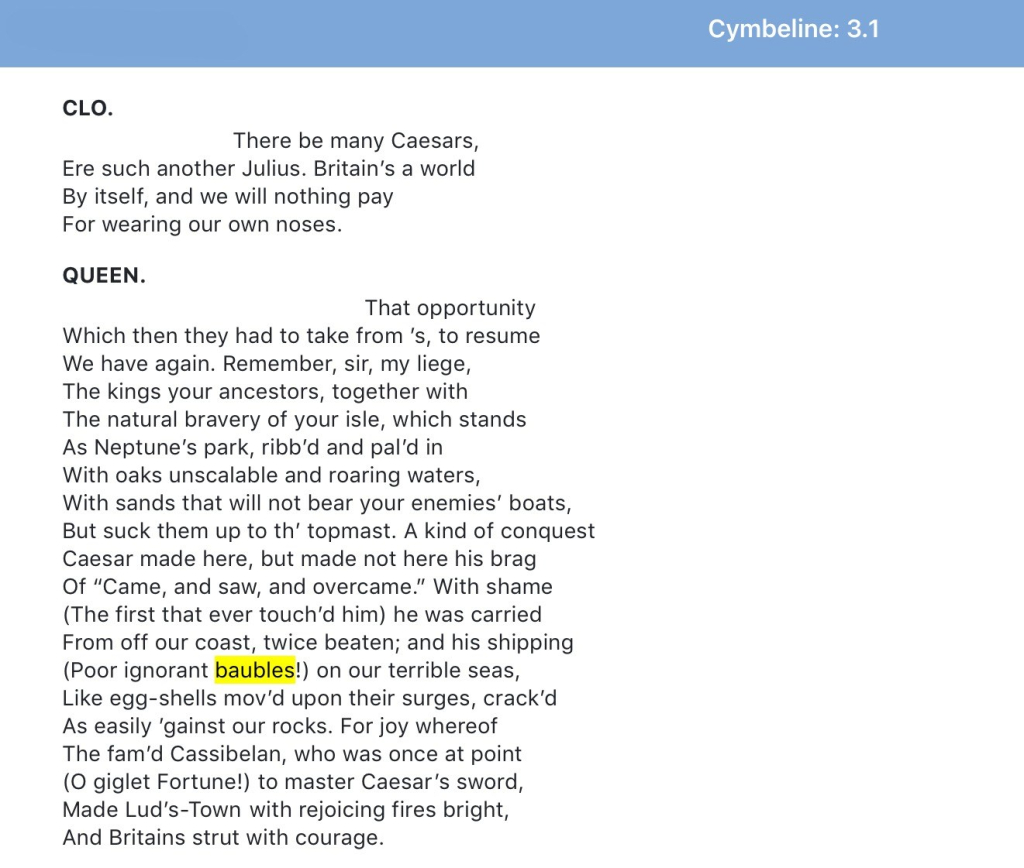
In ‘Cymbeline’, the queen refers to Caesar’s ships bobbing around on the sea as ‘ignorant baubles’, describing them further as being like egg shells, being thrown and broken against the rocks.

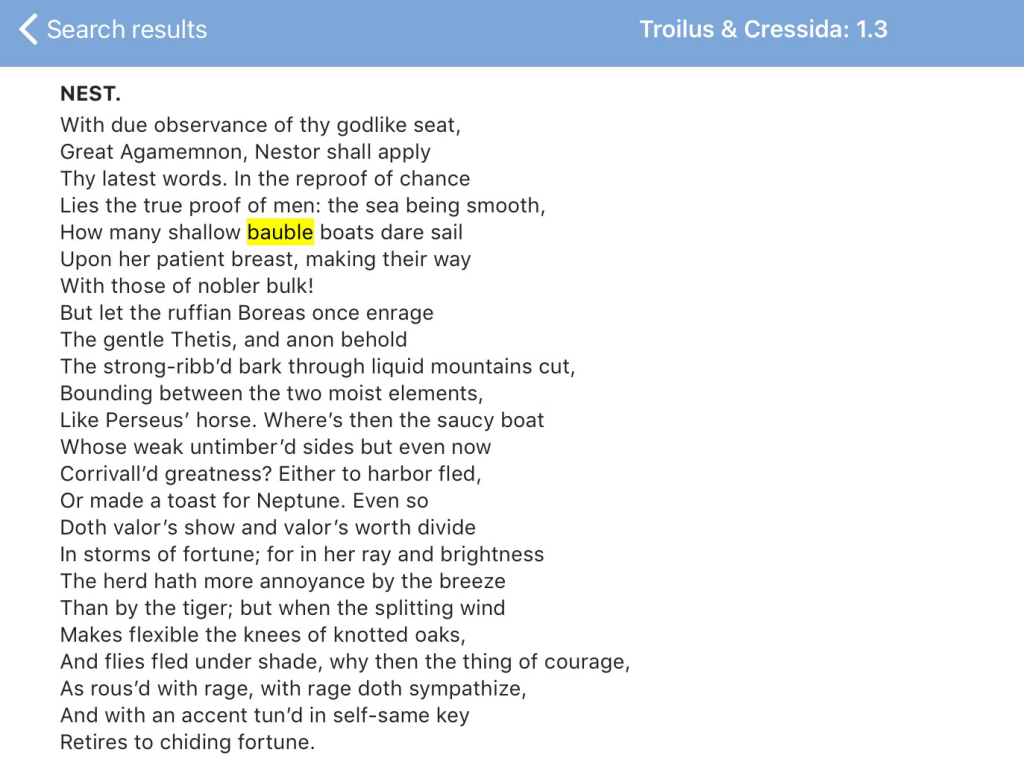
A similar reference to boats as ‘baubles’ is made in ‘Troilus and Cressida.

In ‘Othello’, Cassio shows his disregard for Bianca by describing her as a bauble that follows him around and tries to make him fall in love with her. That his companions laugh with him demonstrates that this use of the word…

View original post 193 more words

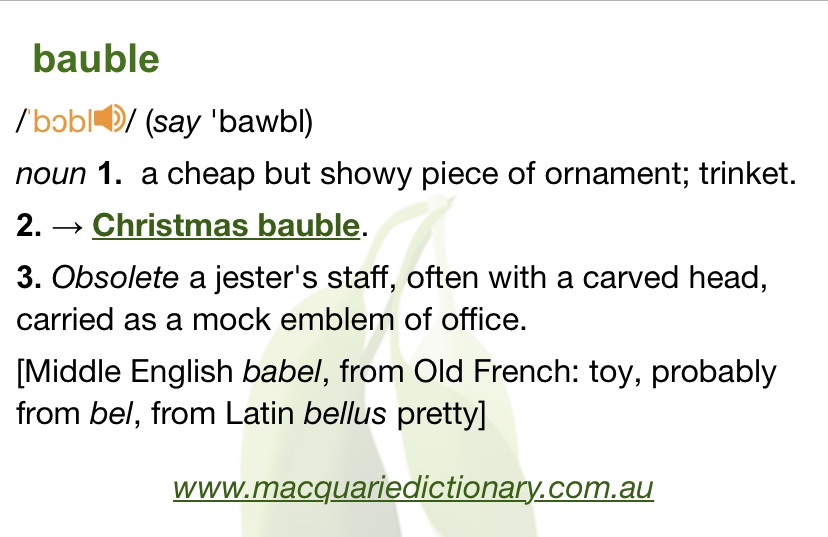
Baubles.

‘Bauble’ is a word used more in December than at any other time of the year.

Photo: Joanne Van Leerdam

On Saturday night we were out for a family dinner — we’re finally allowed to go out here, now, after months of lockdown and restrictions— and one of the young kids at the gathering commented to me that they liked the pretty balls on the light fittings, and then asked me if that’s what they were called.

I explained that they are called baubles, and added that the beads on her bracelet could also be called baubles because they are pretty things designed for decoration. They’re both different kinds of ornaments, and it’s cool how there are often multiple useful words to use for things.

This got me wondering about the origin of the word ‘bauble’. I suspected it was French, simply because of how it sounded,  but such assumptions are not safe. As always, my trusty Macquarie dictionary and Etymonline had my back.

‘Bauble’ came into English in the early 14th century, meaning a decorative trinket or ornament. It came from the Old French word ‘baubel’ meaning a child’s toy or trinket. That may have come from the Latin word ‘bellus’ meaning “pretty” which gave us belle, as in ‘belle of the ball’,  or it could be related to ‘babe’ or ‘baby’. The sense of bauble meaning something of little or no value is later, dating from the early 1600s.

Long ago, ‘bauble’ was also the name given to a staff with a decorated or carved head, carried by a court jester and designed to mock the sceptre carried by a monarch. This meaning has fallen out of use, much as the position of court jester and the practice of a monarch carrying a sceptre have done.

So, now ‘bauble’ only relates to the pretty things. It is important to understand, though, that just because something can be called a bauble does not automatically mean that it has no value. It’s fair to say that while some baubles, such as Christmas decorations and the beads in a child’s bracelet, might usually be fairly inexpensive, there are other kind of baubles that tend to be more valuable.

Thus, the two meanings of bauble remain distinct, even though they can both apply at the same time.

Dysphemism.

Euphemism— using neutral or pleasant terms in place of offensive or negative terms— has been mentioned multiple times on this blog.

Photo by Maria Orlova on Pexels.com

Most people, though, have never heard of dysphemism, which is the opposite practice: using harsh or negative terms in place of neutral or positive language.

To refer to dying as “passing away” or “graduating to heaven” is euphemism.
To refer to it as “kicking the bucket” or “carking it” is dysphemism.

To refer to having a cold as “being under the weather” is euphemism.
To refer to it as “having the plague” is dysphemism.

English is full of examples of dysphemism. What’s your favourite?
Alternatively, is there one you really dislike?

Dysphemism.
#language #EnglishLanguage #blog

Is ‘Doomscrolling’ The Word Of The Year?

So, it turns out I was right in my observations about the word doomscrolling.

Doomscrolling has just been announced as the Macquarie Dictionary Editorial Committee’s Choice Macquarie Dictionary Word of the Year 2020.

You can still vote in the People’s Choice category if you’d like to have your say.
Read the full article, see what the other options are, and vote here: Macquarie Dictionary Word of the Year 2020

Source: Macquarie Dictionary

Doomscrolling.
#wordoftheyear #words #blog

Beyond Tired.

It’s almost the end of a school year that has been perpetually exhausting. Every teacher I know is beyond worn out.

I’ve used the words ‘tired’ and ‘exhausted’ so much in recent times, they have started to lose their currency. Not only are they becoming cliched, neither one really adequately describing the profundity or the long-term nature of the tiredness we’re feeling.

So, in the interests of communicating more effectively, I’d like to suggest some more expressive words to use instead.

Toilworn is a lovely word that reflects the nature of the tiredness that comes from hard work. It can also be used for something showing the effects of that kind of tiredness, or of the work that caused it.

Forswunk, as I’ve mentioned before, is one of my favourites. It’s a very old word that means exhausted by hard work.

Knackered is a term that is certainly expressive, and remarkably pleasing to say. I don’t know where else in the world people say this, but it’s certainly well understood in Australia as a term that means absolutely worn out.

If you have any other suggestions, I’d love to hear them.

Beyond Tired.
#language #vocabulary #tired

The Proud Man’s Contumely.

In Hamlet’s most famous soliloquy — the one that stars with “To be or not to be…” — the overthinking prince lists a number of problems that make life hard to bear. Most of these are things to which we can relate quite easily: oppression, love that is not returned, the wheels of justice turning too slowly, and people being rude to you.

Hamlet, Act 3, Scene 1

Most people, though, would read the speech and get to the phrase ‘the proud man’s contumely’ and be completely stumped.  It’s not a word one comes across terribly often. In all honesty, it’s probably only literature scholars and high school students studying ‘Hamlet’ that are likely to come across the word, and only one of those groups are likely to know right away what it means.

Contumely is a very old word that means disrespectful, offensive or abusive speech or behaviour.

Contumely is interesting in that most English words that end in -ly are adverbs, which describe verbs, but this is a noun. It doesn’t follow the grammatical pattern of English because it is not originally an English word.

It came into English in the late 14th century from the Old French word contumelie,. That came from the Latin word contumelia, which meant’ reproach’ or insult’, and is related to ‘contumax’ with means ‘haughty’ or ‘insolent’.

These days, we’re far more likely to use terms like ‘insolence’, ‘disrespect’ ‘scorn’ or  ‘abuse’ instead. 

Still, it could be fun to respond to someone’s arrogance with ‘I do not have to tolerate your contumely’. Hopefully, it would leave them as perplexed as those high school students reading Hamlet’s soliloquy for the first time.

It could also be useful to know that someone behaving with contumely would be described as contumelious.

This word evolved in the 15th century, so it follows the common pattern of the noun form being used first and the adjective coming afterwards.  Mr Darcy’s haughty dismissal of Elizabeth Bennet at their first meeting, a lawyer strutting and posturing in the courtroom, or one’s mother-in-law’s disdain for their general existence could all be described as contumelious.

References:
Vocabulary.com
wordsmith.org
Online Etymology Dictionary

The Proud Man’s Contumely.
#words #Shakespeare #language