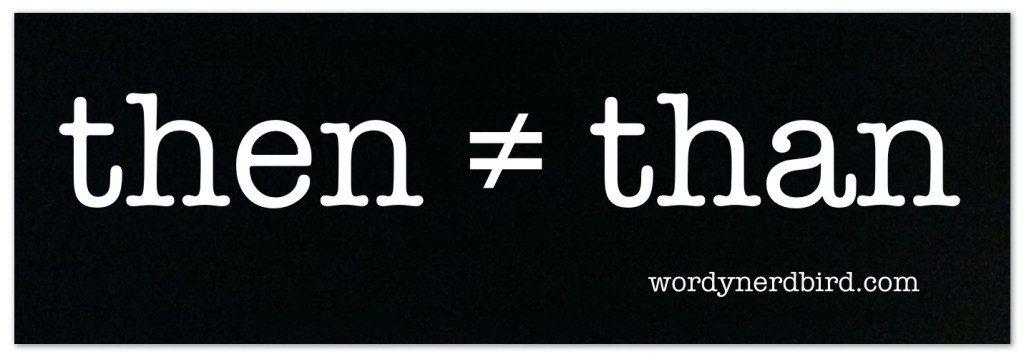
‘Then’ and ‘Than’ Are Not The Same Word.

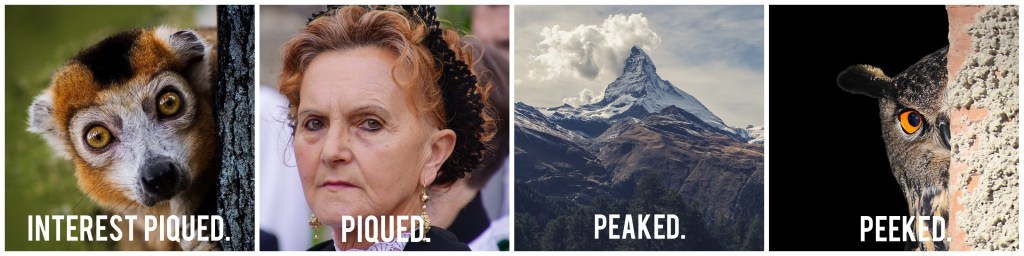
Some word confusions are understandable, especially if they sound the same when spoken. We call those homophones, and they sound the same even if they are spelt differently.  Examples are peak/pique/peak or there/their/they’re.

The confusion between ’then’ and ’than’, however, is a completely different matter.

Sadly, this is happening more and more, especially on social media. I don’t even spend that much time on Facebook, but it feels like I see someone saying something like “Nothing is better then this!”  or “I love you more then anything!” at least twice a day. 

Yes, they are similar. 
However, they are clearly not the same.
They don’t look the same.
They don’t sound the same. 
If one doesn’t mix up ’then’ or ’than’ with ’thin’, there is no excuse for mistaking them for one another. 

I swear, it makes my eyes want to bleed.

The two words’ meanings are so vastly different that getting them wrong just makes the person writing look  either poorly educated or plain stupid, even if they are neither. 

This is one of the best and most self-evident arguments in existence for proofreading what one is writing, anywhere and every time. 

‘Then’ rhymes with ‘when”— which is an easy way to remember that it relates to time or sequence. 
Examples: 
He put on his shirt, then his jeans, and then his boots. 
She ran up the hill, then back down again. 
When you have tidied your room, then you can go to the movies. 

‘Than’ rhymes with ‘man’ and is used for making a comparison. 
Examples:
His piece of pizza is bigger than mine. 
A triangle has fewer angles than a square. 
I would rather stay home and read a book than go to work. 

Knowing which is which, and taking care to use the right words all the time, is a simple way to protect your credibility.

And for the love of Merlin’s beard, if you call yourself an author or a teacher, get it right. It’s not that hard. 
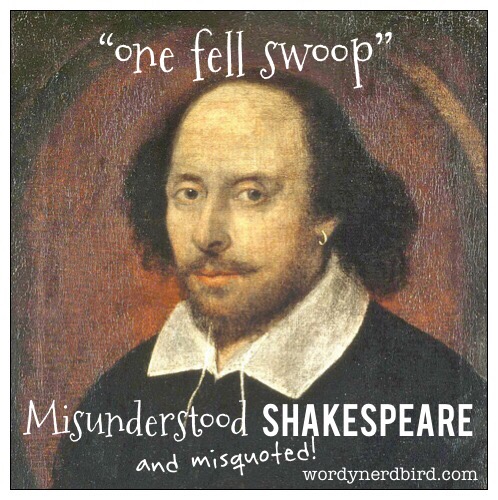
Misunderstood and Misquoted Shakespeare: “One Foul Swoop”

This morning’s conversation in my kitchen is a clear demonstration of just how much of a Shakespeare Nerd I really am.

H: I need egg cartons. Where do I get egg cartons? 
Me: How many do you want? 
I pointed to the top of my fridge where there sat a stack of egg cartons. 
Me again: Take them all. 
H: Oh wow! Thanks! 
K: That’s awesome! I’ll grab them in one foul swoop and put them in the car.
Me: Well, that’s decided my blog post for today. 
K: Huh? 

In Act 4, Scene 3 of ‘Macbeth’, Malcolm and Macduff engage in testing one another’s loyalty to Scotland rather than to Macbeth, who has become king. During that conversation, Macduff learns of the murders of his wife and children at the order of Macbeth, whom he describes as a “hell-kite” who has slain his “chickens” in “one fell swoop”. 


The deed was certainly foul, but that isn’t what Shakespeare wrote. He wrote “one fell swoop” which is an entirely different thing. 

Here, fell means ‘fierce’. 

It’s an image of violent attack, of hunting, and of predator and prey, which leaves the audience in no doubt that these murders were calculated and precise. The term “hell-kite” leaves the audience in no doubt of the evil motivations behind the slaying.

Being Conscious of One’s Conscience

Said to me today: “I don’t want that on my conscious.”
Me: “You probably don’t want it on your conscience, either.” 
Them: “Huh?”
Me: “They are different words.” 
Them: “Really?”
Me: “I promise you.”

These commonly confused words sound similar but they are not homophones. 

Conscious is an adjective. It is a descriptive word that means awake or aware. 

Examples:
I’m conscious of the confusion between words that sound similar but which are very different in meaning.
He passed out, but he is conscious again now. 

Conscience is a noun. It’s the name given to that part of our being that tells us not to do something we know we shouldn’t, and accuses us when we have done something wrong so that we feel bad about it. 

Examples:
She was good at acting innocent, but her conscience was plagued by guilt.
His conscience reminded him daily of the things he had done. 

The difference in the way these words sound is minor, but the difference in meaning is significant

I Deal with Imposter Syndrome Daily and I Haven’t Quit Writing Yet

I can relate to this post on so many levels. As a writer. As a teacher. As a performer. As a director. Sometimes, even as a decent human being.

I may have proven myself time and time again, but it doesn’t stop that sensation that maybe I’m not any good, nor does it quell the fear that one day someone will expose me or my work as being rubbish.

Fear isn’t rational.
Anxiety doesn’t care about track records.
And Impostor Syndrome is relentless.

I don’t know why it happens, but I know it plagues creative people and sometimes renders them unable to keep going.

I haven’t given in to it yet. I don’t ever want to. But my goodness, trying to resist it is tiring.

theryanlanz's avatarRyan Lanz

by Meg Dowell

Writing is hard enough. Add imposter syndrome into the mix and it becomes the kind of challenge you have to remind yourself, quite often, is still worth pursuing.

View original post 818 more words

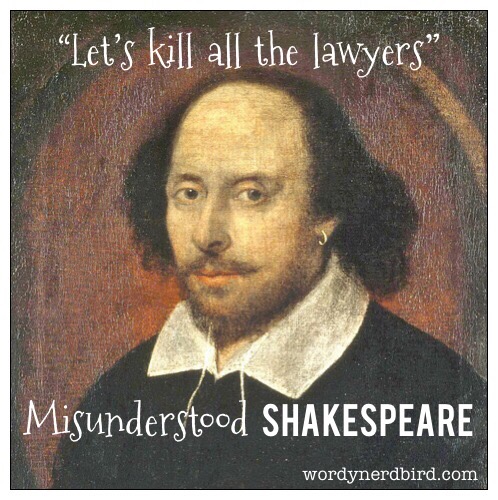
Misunderstood Shakespeare: “Let’s Kill All The Lawyers”

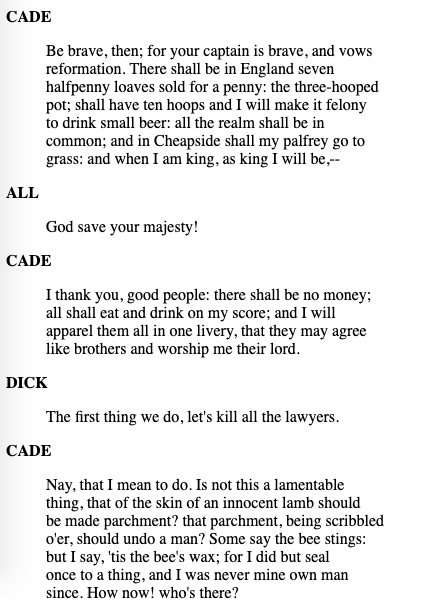
This line comes from Henry VI, Part 2, written in 1598. It was spoken by Dick the Butcher, a character nobody remembers except for this line, who was hanging about with his fellow rebels in a field at Blackheath.

It’s often quoted by people who are disillusioned with the legal system, or feel that certain members of the legal profession have less integrity than they should do. It is with these people for whom Dick the Butcher is likely to identify and sympathise. 

It is important to understand that the intent of the line was to be funny — a sardonic response from the sort of character who is likely to have suffered at the hands of a lawyer or witnessed them acting less than judiciously— rather than a serious suggestion or a statement of intent. When you read the scene as a whole, the jaded weariness of Dick and his mates is clearly evident as a contributing factor to their rebellion. This is the context in which this quotation must be read. 

Dick the Butcher is part of a group of rebels led by Jack Cade, who is extolling his qualifications to be king because of his noble connections, while the others are having a bit of a laugh at him because, realistically, he’s anything but noble. Jack does have ideas about a more egalitarian society, which form the context for Dick the Butcher’s punch line. As far as he’s concerned, if there were going to be some kind of ideal society, it wouldn’t have any lawyers in it. 

Cade concurs with Dick: lawyers using parchment to create documents is a waste of good lambs’ skins, and the beeswax used as a seal stings more than the bee does. He agreed to something legally once, and somehow gave up his freedom or rights by doing so. He doesn’t clarify what the issue was, but the audience certainly understands his sentiments regarding lawyers. 

The misunderstanding and misuse of this quotation arise from the interpretation that Shakespeare is saying that it’s the lawyers and upstanding citizens who would stand in the way of such a rebellion working because of their integrity and commitment to enforcing the law. 

I would be willing to put money on that theory having been dreamed up by a lawyer in the first place.  

If the predominant population of Shakespeare’s audiences were made up of lawyers, judges and clerks, this theory may have more credence.

However, the audiences were comprised of a much wider representation of society as a whole, only a small percentage of which was made up of lawyers. Many were quite common folk who stood throughout the performances, known as groundlings, while others were wealthier and could afford to pay for a seat. While some of those may have been lawyers, most were lords and ladies and members and other members of the gentry. 

It does seem that even in Shakespeare’s time there was a fair degree of scepticism about lawyers. While Shakespeare mentions the legal profession more than any other, this is by no means the only play in which Shakespeare makes a joke at their expense. Mercutio, for example, talks about lawyers grasping for money in ‘Romeo and Juliet’, while the Fool in ‘King Lear’ makes a pointed statement about lawyers not saying or doing anything unless you pay them first. 

Shakespeare was not trying to incite violence against lawyers, but he certainly wasn’t suggesting that they are the protectors or upholders of society, either.  Dick’s statement is clearly satire, expressing cynicism about lawyers in ways that people understood even then. 

Don’t Waver Over Your Waivers!

A mistake frequently made in writing is to say that someone “did not waiver” in their faith, or from a decision they had made.  What they really mean is that the person in question did not waver

Once again, it is a failure to choose between differently spelled homophones that is the problem here. 

Waiver: the renunciation or surrendering of  ownership, a right  or a claim
Example: The council decided to waive the annual fee for dog registration. The waiver resulted in more households registering  their pets. 

Waver: to hesitate or falter, or to flicker, quiver or tremble.
Examples: Her feelings for him wavered between passionate love and indifference. 
He did not waver in his support for the mayor, who was a woman of integrity. 
The flame of the candle wavered in the gentle breeze.

At least when one waves at the waves, the spelling is the same so you can’t get it wrong!

A Fit of Pique.

I get really annoyed when I see people writing about peaking someone’s interest. 

A mountain is peaked. A cap can be peaked. 
People can even look peaked: in this sense, it means they are pale. 
A career can peak. 
In fact, someone’s interest in something can peak, right before it declines again. 

While they sound the same, the correct term for having caused intense interest or curiosity, is piqued

To pique someone’s interest is to heighten or arouse it. In other words, it is to stimulate their curiosity or attention. 

A fit of pique is an episode of annoyance or irritation – such as might happen, for example, if someone’s negative emotions are piqued. 

A related word is piquant, which means provocative, tantalising, spicy or tangy. Food that excites the taste buds or a story that excites the imagination can both be described as piquant. 

The other homophone is peeked. This is the past tense of peek: to take a quick look, or a sneaky one. 

So… now that I’ve piqued your interest with my fit of pique, and you’ve peeked at my post… I’m sure your interest has long since peaked. 

See? Homophones can be fun!

Don’t Pour Over Those Books!

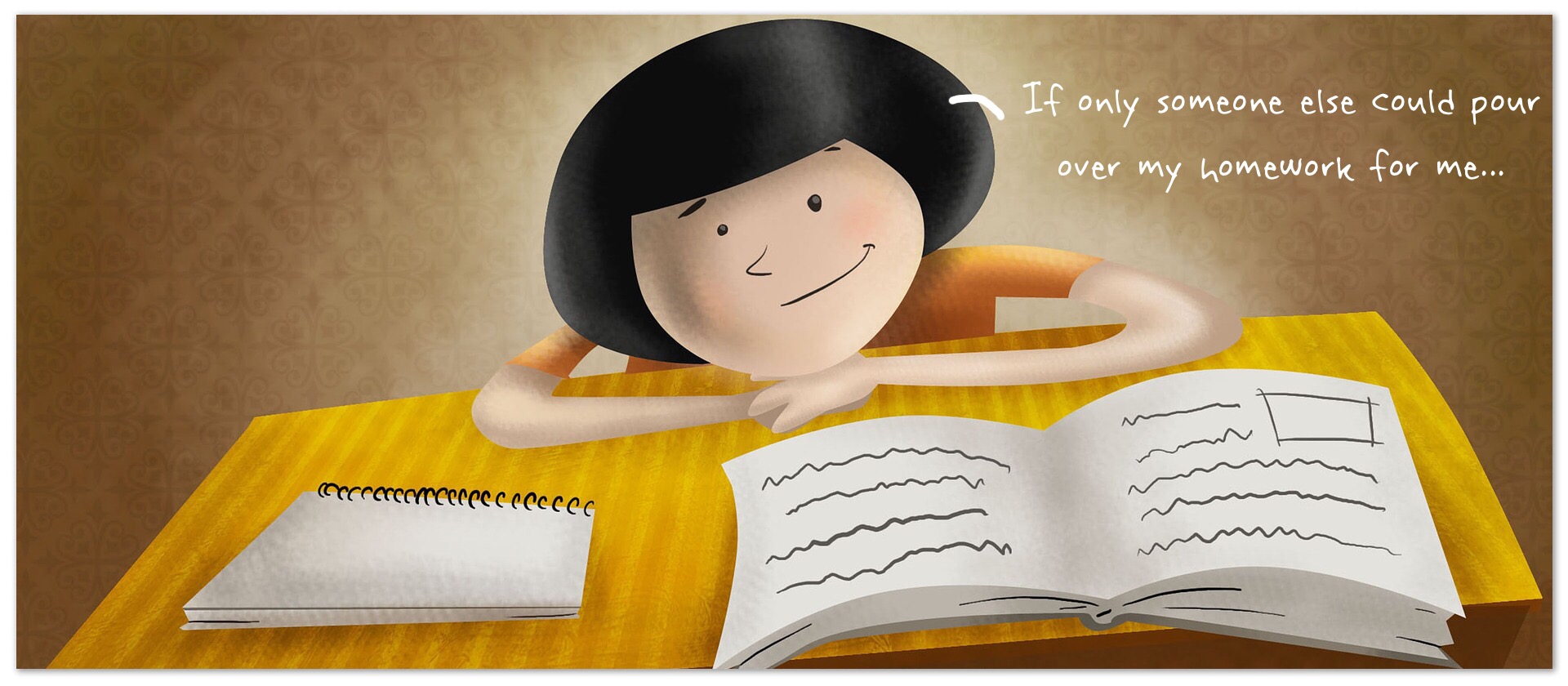
I’ve read a couple of different posts and even in a couple of books recently about people “pouring over” documents or books. 

I wondered at first if this was one of those things Americans do with words that nobody else does, but I checked, and it’s not. It’s simply an error caused by confusion by words that sound the same even though they are spelt differently and mean completely different things. 

What the people in question should be doing is poring over their books. 
To pore over books or documents is to be completely absorbed in what one is reading or studying. It suggests thoughtful application and concentration. 
The gerund is poring. 

To pour over books is just going to make a mess, and probably ruin them completely.  It’s really not advisable.

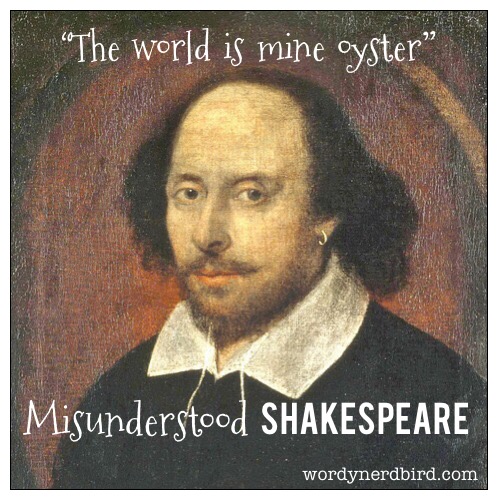
Misunderstood Shakespeare: “The World’s Mine Oyster”

When people say this, they usually assume it means that the world is at their feet and they are in a position where everything is going to work in their favour. Others say it to imply that they are “the pearl” and they are being cultivated for greatness. 

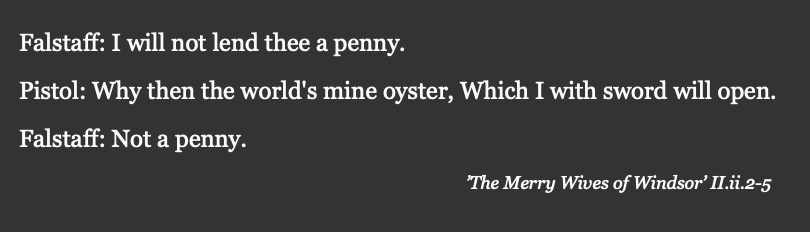
However, when these lines were spoken in Shakespeare’s ’The Merry Wives of Windsor’, the intention is actually quite different. 

In a conversation between two less-than-reputable characters, this conversation takes place: 

In other words, if Falstaff won’t give him money, Pistol will go and take it forcibly from other people. It’s about taking what one is not entitled to, and it has quite violent connotations. 

An oyster does not willingly open – it has to be forced.
An oyster does not willingly give up its pearl, which can take years to develop, and the oyster is often damaged or killed in the process of extracting the pearl. 

This is an image of violence, and not one of happy or fortunate circumstances at all. 

Misunderstood Shakespeare: “Star-cross’d Lovers”

Just like ‘Wherefore art thou Romeo?”, this commonly misunderstood famous line comes ‘Romeo and Juliet’

I have witnessed so many people talking about Romeo and Juliet as “star-cross’d lovers” in the sense of their meeting and relationship being their destiny, and that the two were somehow fated to be together. 

This couldn’t be more wrong. 

The actual meaning of the term becomes clearer if one thinks of it in terms of the stars actually crossing them. 

Romeo and Juliet were never meant to be together. The fates were against them, right from the start, and it was never going to work out well. 

It’s important to remember that ‘Romeo and Juliet’ is a tragedy, not a comedy or romance. In Shakespeare’s tragedies, the main characters always die. There are no happy endings. That’s a convention of the genre, and it is pointless to expect anything else. 

Not only that, but Shakespeare gives us the spoilers right there in the prologue, the opening speech of the play, which is where the phrase comes from. They’re going to die, and as they are laid to rest, so too will be buried the feud between their families, which is what made their love forbidden in the first place. 

The prologue to Romeo and Juliet by William Shakespeare.

If, as some believe they do, the stars were to control one’s fortunes in life, the last thing you’d wish for is to be “star-crossed” in any way.