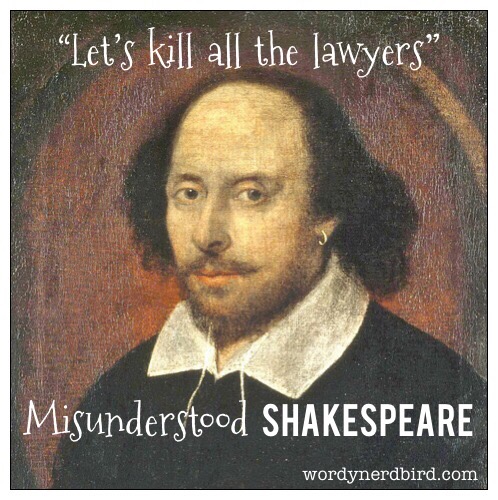
Misunderstood Shakespeare: “Let’s Kill All The Lawyers”

This line comes from Henry VI, Part 2, written in 1598. It was spoken by Dick the Butcher, a character nobody remembers except for this line, who was hanging about with his fellow rebels in a field at Blackheath.

It’s often quoted by people who are disillusioned with the legal system, or feel that certain members of the legal profession have less integrity than they should do. It is with these people for whom Dick the Butcher is likely to identify and sympathise. 

It is important to understand that the intent of the line was to be funny — a sardonic response from the sort of character who is likely to have suffered at the hands of a lawyer or witnessed them acting less than judiciously— rather than a serious suggestion or a statement of intent. When you read the scene as a whole, the jaded weariness of Dick and his mates is clearly evident as a contributing factor to their rebellion. This is the context in which this quotation must be read. 

Dick the Butcher is part of a group of rebels led by Jack Cade, who is extolling his qualifications to be king because of his noble connections, while the others are having a bit of a laugh at him because, realistically, he’s anything but noble. Jack does have ideas about a more egalitarian society, which form the context for Dick the Butcher’s punch line. As far as he’s concerned, if there were going to be some kind of ideal society, it wouldn’t have any lawyers in it. 
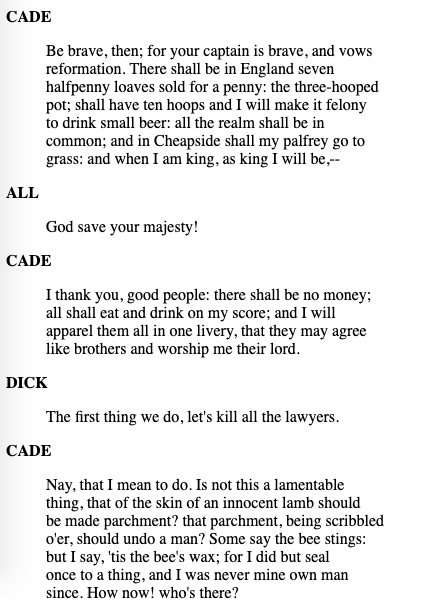
Cade concurs with Dick: lawyers using parchment to create documents is a waste of good lambs’ skins, and the beeswax used as a seal stings more than the bee does. He agreed to something legally once, and somehow gave up his freedom or rights by doing so. He doesn’t clarify what the issue was, but the audience certainly understands his sentiments regarding lawyers. 

The misunderstanding and misuse of this quotation arise from the interpretation that Shakespeare is saying that it’s the lawyers and upstanding citizens who would stand in the way of such a rebellion working because of their integrity and commitment to enforcing the law. 

I would be willing to put money on that theory having been dreamed up by a lawyer in the first place.  

If the predominant population of Shakespeare’s audiences were made up of lawyers, judges and clerks, this theory may have more credence.

However, the audiences were comprised of a much wider representation of society as a whole, only a small percentage of which was made up of lawyers. Many were quite common folk who stood throughout the performances, known as groundlings, while others were wealthier and could afford to pay for a seat. While some of those may have been lawyers, most were lords and ladies and members and other members of the gentry. 

It does seem that even in Shakespeare’s time there was a fair degree of scepticism about lawyers. While Shakespeare mentions the legal profession more than any other, this is by no means the only play in which Shakespeare makes a joke at their expense. Mercutio, for example, talks about lawyers grasping for money in ‘Romeo and Juliet’, while the Fool in ‘King Lear’ makes a pointed statement about lawyers not saying or doing anything unless you pay them first. 

Shakespeare was not trying to incite violence against lawyers, but he certainly wasn’t suggesting that they are the protectors or upholders of society, either.  Dick’s statement is clearly satire, expressing cynicism about lawyers in ways that people understood even then. 

Shakespeare Nerd.

In an attempt to organise all my Shakespeare-related posts so they might actually reach the readers they were written for, I have a new Facebook page called Shakespeare Nerd

It’s easy to find those posts on WordPress because you can search, or simply click on a category like Shakespeare or a tag like Shakespeare Nerd and they will magically appear.

Finding specific posts on Facebook is not that straightforward, and so my new page was born. 

It’s already full of all sorts of hey nonny nonny and hurly burly, and waiting to be discovered by my fellow Shakespeare lovers.

If you are on Facebook, love Shakespeare, and want to make my day, please give it a like. 

If you’re not, or you don’t, or don’t want to, there is absolutely no obligation. You won’t miss a thing, because you’re already here, right at the front of the line waiting for me to serve up the wordy nerdy goods.

Thank you for being a supporter and reading my posts, by the way. It’s very much appreciated.

Misunderstood Shakespeare: “What The Dickens”

Many people assume that “What the dickens?” is a reference to the author Charles Dickens. 

Considering that Shakespeare wrote this expression in ‘The Merry Wives of Windsor’ in 1600 and Charles Dickens was born in 1812, that is entirely impossible. 

Instead, ‘dickens’ is a euphemism for ‘devil’, as is ‘deuce’. When Mrs Page says “I cannot tell what the dickens his name is…” she really means ‘what the devil”.

It’s a more polite way of expressing strength of an idea or emphasising their intent, in this case, that she has no idea of the identity of the person she is being asked about. It’s exactly the same as people saying ‘heck’ instead of hell, ‘gosh’ instead of ‘God’ and ‘jeez’ instead of ‘Jesus’, and is probably  done for the same reason: superstitious avoidance of using religious terms, or “using in vain” the names of religious entities. 

There’s also a chance that, for some folks, old-fashioned good manners may enter into it, too. 

In short, this is a euphemism: an inoffensive word or phrase used to replace an impolite or offensive one. We use euphemism when we talk about “powdering my nose” or “going to see a man about a dog” instead of “going to the bathroom”, or “bathroom” instead of “toilet”.

Like many of Shakespeare’s words and phrases, “what the dickens” has stood the test of time and is still used as a euphemism today.

Misunderstood Shakespeare: “The World’s Mine Oyster”

When people say this, they usually assume it means that the world is at their feet and they are in a position where everything is going to work in their favour. Others say it to imply that they are “the pearl” and they are being cultivated for greatness. 

However, when these lines were spoken in Shakespeare’s ’The Merry Wives of Windsor’, the intention is actually quite different. 

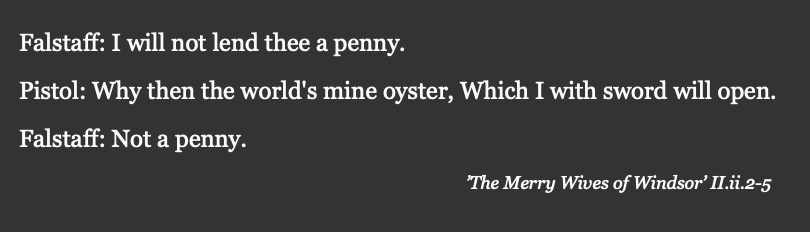
In a conversation between two less-than-reputable characters, this conversation takes place: 

In other words, if Falstaff won’t give him money, Pistol will go and take it forcibly from other people. It’s about taking what one is not entitled to, and it has quite violent connotations. 

An oyster does not willingly open – it has to be forced.
An oyster does not willingly give up its pearl, which can take years to develop, and the oyster is often damaged or killed in the process of extracting the pearl. 

This is an image of violence, and not one of happy or fortunate circumstances at all. 

An Interesting Character Study: Macbeth

Macbeth is certainly one of Shakespeare’s very interesting characters. 

Macbeth and his wife present an interesting study of power, control and submission. A proven warrior, he lets not only his imagination, but also his wife’s, run away with him, and completely submits to her manipulation and taunting. Instead of waiting for things to take their natural course, they took matters into their own hands in pursuit of the position and power promised in the prophecy of the wyrd sisters. 

As things are wont to do in Shakespeare’s tragedies, things get way out of hand and end up with a bunch of people dead. 

I hope you enjoy this very good character study of Macbeth, courtesy of the Interesting Literature blog. 

An Interesting Character Study: Macbeth

Macbeth is one of Shakespeare’s most famous tragic heroes, not least because he represents the Man Who Has It All (seemingly) and yet throws it away because of his ‘vaulting ambition’ to have Even …

Source: An Interesting Character Study: Macbeth

Misunderstood Shakespeare: “Star-cross’d Lovers”

Just like ‘Wherefore art thou Romeo?”, this commonly misunderstood famous line comes ‘Romeo and Juliet’

I have witnessed so many people talking about Romeo and Juliet as “star-cross’d lovers” in the sense of their meeting and relationship being their destiny, and that the two were somehow fated to be together. 

This couldn’t be more wrong. 

The actual meaning of the term becomes clearer if one thinks of it in terms of the stars actually crossing them. 

Romeo and Juliet were never meant to be together. The fates were against them, right from the start, and it was never going to work out well. 

It’s important to remember that ‘Romeo and Juliet’ is a tragedy, not a comedy or romance. In Shakespeare’s tragedies, the main characters always die. There are no happy endings. That’s a convention of the genre, and it is pointless to expect anything else. 

Not only that, but Shakespeare gives us the spoilers right there in the prologue, the opening speech of the play, which is where the phrase comes from. They’re going to die, and as they are laid to rest, so too will be buried the feud between their families, which is what made their love forbidden in the first place. 

The prologue to Romeo and Juliet by William Shakespeare.

If, as some believe they do, the stars were to control one’s fortunes in life, the last thing you’d wish for is to be “star-crossed” in any way. 

Misunderstood Shakespeare: “Wherefore art thou Romeo?”

Of all the lines written by Shakespeare, this is possibly the single most misunderstood by a 21st century audience.

While it might be a romantic notion for a lovesick teenager to look out her window— not a balcony, by the way— and wonder where her beloved might be, that’s all it is. That is not what is happening in this scene. 

In early modern English, “wherefore” meant “why”.

Juliet is not asking where Romeo is.  She is asking why, of all the families in Italy, did her new boyfriend have to belong to the family with which hers had been feuding? Why did he have to carry a name that would be an immovable obstacle to them both? 

She goes on to insist “that which we call a rose by any other name would be as sweet”— in other words, it’s not the name that makes someone what they are.  If Romeo were to change his identity, he would still be the same person. What his name is should not matter — what sort of person he is, and the fact that she loves him, is what should determine their compatibility. 

That’s why when you’re waiting for a friend or looking for your dog, it’s incorrect to ask “Wherefore art thou, Buddy?”
It may sound cute, but it will make your Shakespeare-loving friends cringe, at least on the inside. 

‘Measure for Measure’: When Shakespeare is More 21st Century Than You Realise

Written in 1603 or 1604, ‘Measure for Measure’ is a play with enormous relevance to the 21st century. 

As I listened to the play on the BBC’s ‘The Shakespeare Sessions’ podcast yesterday, it struck me just how timely and relevant it is. 

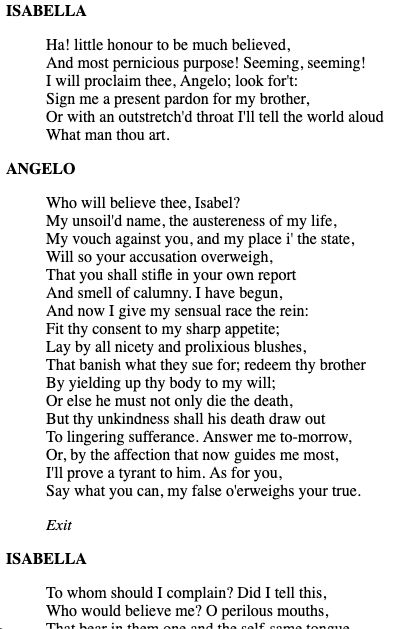
The play features a man named Angelo who, having been left in charge by the Duke, totally abuses his power in the interests of sexual gratification. He tells Isabella he will pardon her brother Claudio, who has been sentenced to death, if she has sex with him. When Isabella refuses and threatens to tell everyone what he has suggested, he simply asks, “Who will believe you?” 

from ‘Measure for Measure’, Act 2, Scene 4

Angelo is clearly relying on his powerful position, and his ability to hold something over her, to get away with sexual abuse and bribery. And he dares to call it “love”, when it is anything but that. He is attempting to romanticise his proposed rape and abuse of power, as abusers so often do. 

This is exactly the kind of behaviour we’ve seen exposed by the #metoo movement. Men abusing their positions of power and pressuring women to give in to them because they have the power to grant what the women need – a job, justice, whatever… and relying on their position to give them more credibility than a woman in a weaker position in society. It really does foreshadow those now infamous words spoken in 2017 by yet another reprehensible character: “And when you’re a star they let you do it. You can do anything.”

Not easily intimidated, Isabella points out that what he is suggesting is exactly the crime for which he has sentenced her brother to death.  His hypocrisy is abundantly obvious to not only Isabella, but also to the audience.   That she calls him out on it demonstrates her integrity and intelligence. Bravo to Isabella for not taking his crap or falling prey to his greasy manipulation. 

Caught in between wanting to save her brother’s life and not wanting to have sex with Angelo, Isabella verbalises the impossibility of her situation in that very poignant and thought-provoking line: “To whom should I complain? Did I tell this, who would believe me?”

Still, even though she understands that what he says is probably true, she neither yields to him or gives up on her brother. Instead, she finds another way to solve her problems and expose the bad behaviour of Angelo.

As suggested in the title, justice is received at the end of the play in the same measure with which it is meted out at the beginning. 

In this, we see a woman standing up for what is right, defending herself, refusing to give in to a man’s manipulation and sexual pressure, and winning. Angelo is punished for his corruption, and Isabella saves both herself and her brother. 

This is a powerful contrast to most of the women in Shakespeare’s other plays, and indeed in the early modern times in which he lived and wrote, few of whom had any real agency or ability to stand up for themselves against the will of men. 

‘Measure for Measure’ is a thought-provoking and entertaining play which demonstrates that while times have changed, the effect of power and position on human nature has not. Even so, it does remind us that evil people can, and should, be resisted, and we should never stop pursuing justice just because it’s difficult to do so. 

That is truly a message pertinent to life in the 21st century. 

My New Favourite Shakespeare Podcast

A few weeks back, I posted about the most popular post published on this blog thus far, which happened to be about my ‘Top Four Shakespeare Podcasts’. 

While they’re definitely great podcasts to check out, I do have a new favourite!

I recently discovered The Hurly Burly Shakespeare Show, a fabulous podcast by Aubrey Whitlock and Jess Hamlet, AKA Whamlet. Both are vivacious and highly entertaining ‘lady academics’ – their words, not mine – who use their knowledge and expertise to make the plays accessible to new audiences and inspiring them to enjoy and appreciate Shakespeare’s works.

Both hosts are very engaging and easy to listen to, although the podcast does come with a ‘bawdy language’ warning which would be well heeded by those offended by expletives. 

The podcast explores each play at a 101 level, giving the listener all the basics they need to know about that play to help them understand it better. Plot, characters, key themes and points of interest are discussed in a relaxed and relatable way.

Each episode also presents insights into the performance or staging of the plays, dramatic devices used by Shakespeare in crafting his works, and various developments in the worlds of studying or performing Shakespeare.

Some plays are revisited at a 201 level, exploring central themes and ideas at a deeper level. 

In addition to exploring Shakespeare’s work, there are some really interesting episodes dedicated to the writing of Shakespeare’s contemporaries – Thomas Kidd, Christopher Marlowe, Ben Johnson, and Thomas Middleton. 

The Hurly Burly Shakespeare show is both highly entertaining and informative. It has not only reinforced my knowledge, but also motivated me to read more widely and to expand my knowledge of the world in which Shakespeare lived and wrote. 

If you enjoy Shakespeare, or if you’d just like to know more about his work, I recommend this excellent podcast. 

WEBSITE  |  TWITTER  |  INSTAGRAM

Dear Internet: That Quote You Love? It’s Not By Shakespeare.

I wrote a few weeks back about the things I enjoy , and the things I don’t enjoy so much, about Pinterest

Since then, I’ve noticed one really annoying thing when I’ve been scrolling through my feed. It’s not actually the fault of Pinterest, but it is there that I am continually reminded of a matter that really needs to be corrected.

There’s a super popular quote that keeps coming up on my feed because Pinterest knows I love Shakespeare. It’s all over the internet, and it seems every second person on Pinterest is sharing it. 

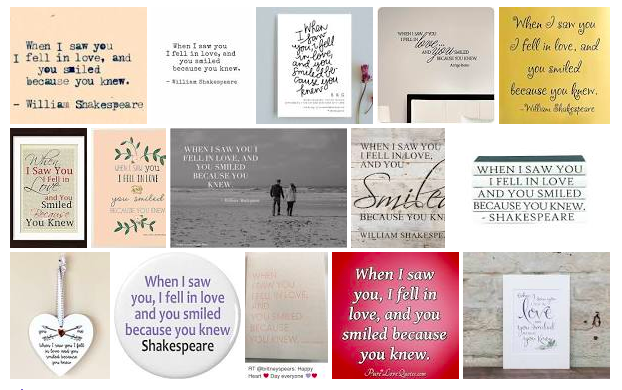
This quote is the darling of the Internet. But it’s not by Shakespeare.

The problem is, while it sounds like something Shakespeare might have written, those lines do not appear anywhere in the plays or poetry of the Bard… not even close, actually.

The quote is a translation from an Italian opera by Arrigo Boito titled ‘Falstaff’, based on one of Shakespeare’s plays, and which uses a number of lines from several other plays, too. Given that Boito borrowed from the Bard quite freely, it’s not really surprising that other lines from the libretto have been wrongly attributed back to Shakespeare. Some might suggest it’s karma, but it’s really just careless.

I’m more than happy for people to continue posting pretty images of the quote, but it would be great to see them attributed to the right person.  

Too much to hope for?
Yeah… it probably is.