In an attempt to organise all my Shakespeare-related posts so they might actually reach the readers they were written for, I have a new Facebook page called Shakespeare Nerd.
It’s easy to find those posts on WordPress because you can search, or simply click on a category like Shakespeare or a tag like Shakespeare Nerd and they will magically appear.
Finding specific posts on Facebook is not that straightforward, and so my new page was born.
It’s already full of all sorts of hey nonny nonny and hurly burly, and waiting to be discovered by my fellow Shakespeare lovers.
If you are on Facebook, love Shakespeare, and want to make my day, please give it a like.
If you’re not, or you don’t, or don’t want to, there is absolutely no obligation. You won’t miss a thing, because you’re already here, right at the front of the line waiting for me to serve up the wordy nerdy goods.
Thank you for being a supporter and reading my posts, by the way. It’s very much appreciated.
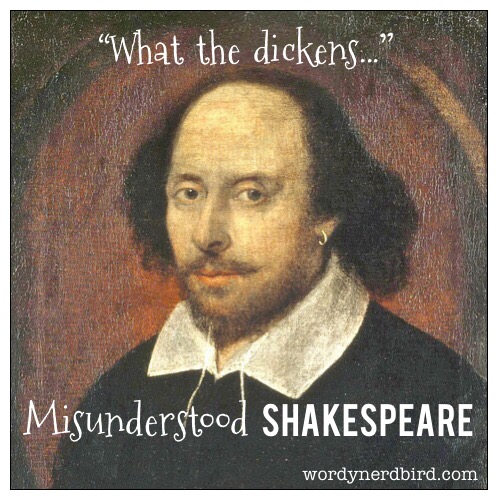
Many people assume that “What the dickens?” is a reference to the author Charles Dickens.
Considering that Shakespeare wrote this expression in ‘The Merry Wives of Windsor’ in 1600 and Charles Dickens was born in 1812, that is entirely impossible.
Instead, ‘dickens’ is a euphemism for ‘devil’, as is ‘deuce’. When Mrs Page says “I cannot tell what the dickens his name is…” she really means ‘what the devil”.
It’s a more polite way of expressing strength of an idea or emphasising their intent, in this case, that she has no idea of the identity of the person she is being asked about. It’s exactly the same as people saying ‘heck’ instead of hell, ‘gosh’ instead of ‘God’ and ‘jeez’ instead of ‘Jesus’, and is probably done for the same reason: superstitious avoidance of using religious terms, or “using in vain” the names of religious entities.
There’s also a chance that, for some folks, old-fashioned good manners may enter into it, too.
In short, this is a euphemism: an inoffensive word or phrase used to replace an impolite or offensive one. We use euphemism when we talk about “powdering my nose” or “going to see a man about a dog” instead of “going to the bathroom”, or “bathroom” instead of “toilet”.
Like many of Shakespeare’s words and phrases, “what the dickens” has stood the test of time and is still used as a euphemism today.
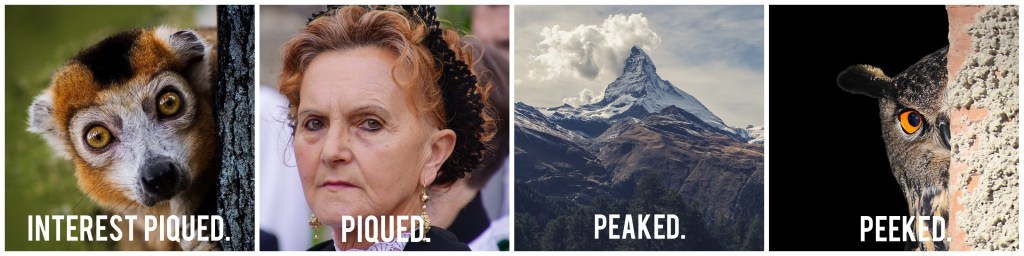
I get really annoyed when I see people writing about peaking someone’s interest.
A mountain is peaked. A cap can be peaked. People can even look peaked: in this sense, it means they are pale. A career can peak. In fact, someone’s interest in something can peak, right before it declines again.
While they sound the same, the correct term for having caused intense interest or curiosity, is piqued.
To pique someone’s interest is to heighten or arouse it. In other words, it is to stimulate their curiosity or attention.
A fit of pique is an episode of annoyance or irritation – such as might happen, for example, if someone’s negative emotions are piqued.
A related word is piquant, which means provocative, tantalising, spicy or tangy. Food that excites the taste buds or a story that excites the imagination can both be described as piquant.
The other homophone is peeked. This is the past tense of peek: to take a quick look, or a sneaky one.
So… now that I’ve piqued your interest with my fit of pique, and you’ve peeked at my post… I’m sure your interest has long since peaked.
I love the fact that my students have great senses of humour. They’re quirky and fun, and they know they have the freedom to express that in my classes.
Last week, one of my students told me a funny story about what he did in Biology class. To his delight, I appreciated the humour a lot more than his classmates or the Biology teacher had done.
He was more than willing to give me permission to write his story creatively. I decided a Drabble would be perfect for creating a snapshot of that moment in the classroom.
I hope you enjoy his very classy humour as much as I did.
And thank you, James, for making me laugh on a regular basis. You’re a legend.
The teacher stood at the front of the room, textbook in hand, as the students settled down to business.
“Please open your text book to page four hundred and four, and… yes, James?”
The teacher looked with anticipation at the young man sitting in the second row, hand raised and an awkward smile on his face.
“That page cannot he found.”
His classmates looked confusedly at James, and then at the specified page in their own books.
The teacher frowned. “Are you sure? There must be some kind of mistake.”
James’ smile became a triumphant grin. “It’s an error 404.”
***
Credit for this story must be given to my student, James, who actually did this in one of his classes, and gave me permission to write it as a drabble.
Even though I’m still in the final weeks of directing and preparing ‘Joseph and the Amazing TechnicolorTM Dreamcoat’ to go on stage at my school in September, I’m already thinking a couple of shows ahead.
Not only do the musical director and I have some definite ideas about what show we’d like our school to do next year, I’ve also been in discussion and negotiations with a small group of likeminded individuals to put a show on stage for the local theatre company of which we are all active members.
The idea was hatched when we were all still riding high on the endorphins of a wonderful production of Monty Python’s Spamalot! in May. The fact that things are still in the budding stage is evidence that bringing it to fruition is a lot more complicated than simply deciding on a show and just doing it.
All sorts of things have to be considered: Can we cast it? Can we stage it? How will we achieve this effect or that outcome? How much is it going to cost? Who is going to fill the various roles on the production team? These are the sorts of details a theatre company will want before deciding to proceed.
I’ve just finished preparing the pitch for a show, which I hope to present to the theatre company on Wednesday night. I won’t reveal what show it is yet, because we have to get approval from the committee, apply for and secure the licensing rights, and make sure everything is in order before we announce what we’re planning to do.
The team and I are super excited about the possibilities and we hope that the committee embraces our ideas.
In the meantime, I’ll continue unintentionally mashing the two very different shows together in my mind, with a bit of Spamalot thrown in for good measure. I’m frequently amused by the “variant lyrics” that happen in my mind, which is at the very least an unexpected bonus.
I read a book this week that I was really enjoying. It kept me hooked right to the end, and then came the death blow: a sudden, out-of-nowhere, poorly executed ending. Without warning, or even the slightest hint that it was coming, the story just stopped.
I hate that. I hate it so much that I am deferring writing my review until I’ve got over my annoyance at it. The story was so good, and the characters so interesting, that I was completely absorbed in it. And then? Suddenly, POOF! It’s all over.
I dislike cliffhanger endings to books at the best of times. This one was not even the best of times. It wasn’t really a cliffhanger, either. It was more like the whole book got snatched out of my hands and thrown over the cliff, and might never be seen again.
It was possibly the worst sudden ending to a story I’ve ever experienced. It made me think that maybe the author did not know how to properly end a story, even though they obviously knew how to write the rest of one.
I fully understand why authors design those suspenseful endings – they want to keep readers guessing and anticipating what comes next so they’ll read the next book.
Here’s the thing, though: if the book is good, I’m going to buy and read the next one anyway. If the writing or editing is poor, or the storyline is weak, a cliffhanger isn’t going to make me buy or read the next one.
If there has to be a sudden ending, or a cliffhanger, there should at least be enough resolution in the final chapters to answer some of the questions raised in the book. By all means, leave questions unanswered. Just— not all of them.
I do quite like suspense and anticipation. I love the sensation of looking forward to the next book. I do not enjoy an ending that leaves me wondering if the author’s computer crashed and the final chapter was irretrievably lost.
I read a lot of books, and for me, a quality conclusion is as important as the opening paragraphs. You can win or lose readers right there, regardless of how good the rest of the book might be.
Of all the lines written by Shakespeare, this is possibly the single most misunderstood by a 21st century audience.
While it might be a romantic notion for a lovesick teenager to look out her window— not a balcony, by the way— and wonder where her beloved might be, that’s all it is. That is not what is happening in this scene.
In early modern English, “wherefore” meant “why”.
Juliet is not asking where Romeo is. She is asking why, of all the families in Italy, did her new boyfriend have to belong to the family with which hers had been feuding? Why did he have to carry a name that would be an immovable obstacle to them both?
She goes on to insist “that which we call a rose by any other name would be as sweet”— in other words, it’s not the name that makes someone what they are. If Romeo were to change his identity, he would still be the same person. What his name is should not matter — what sort of person he is, and the fact that she loves him, is what should determine their compatibility.
That’s why when you’re waiting for a friend or looking for your dog, it’s incorrect to ask “Wherefore art thou, Buddy?” It may sound cute, but it will make your Shakespeare-loving friends cringe, at least on the inside.
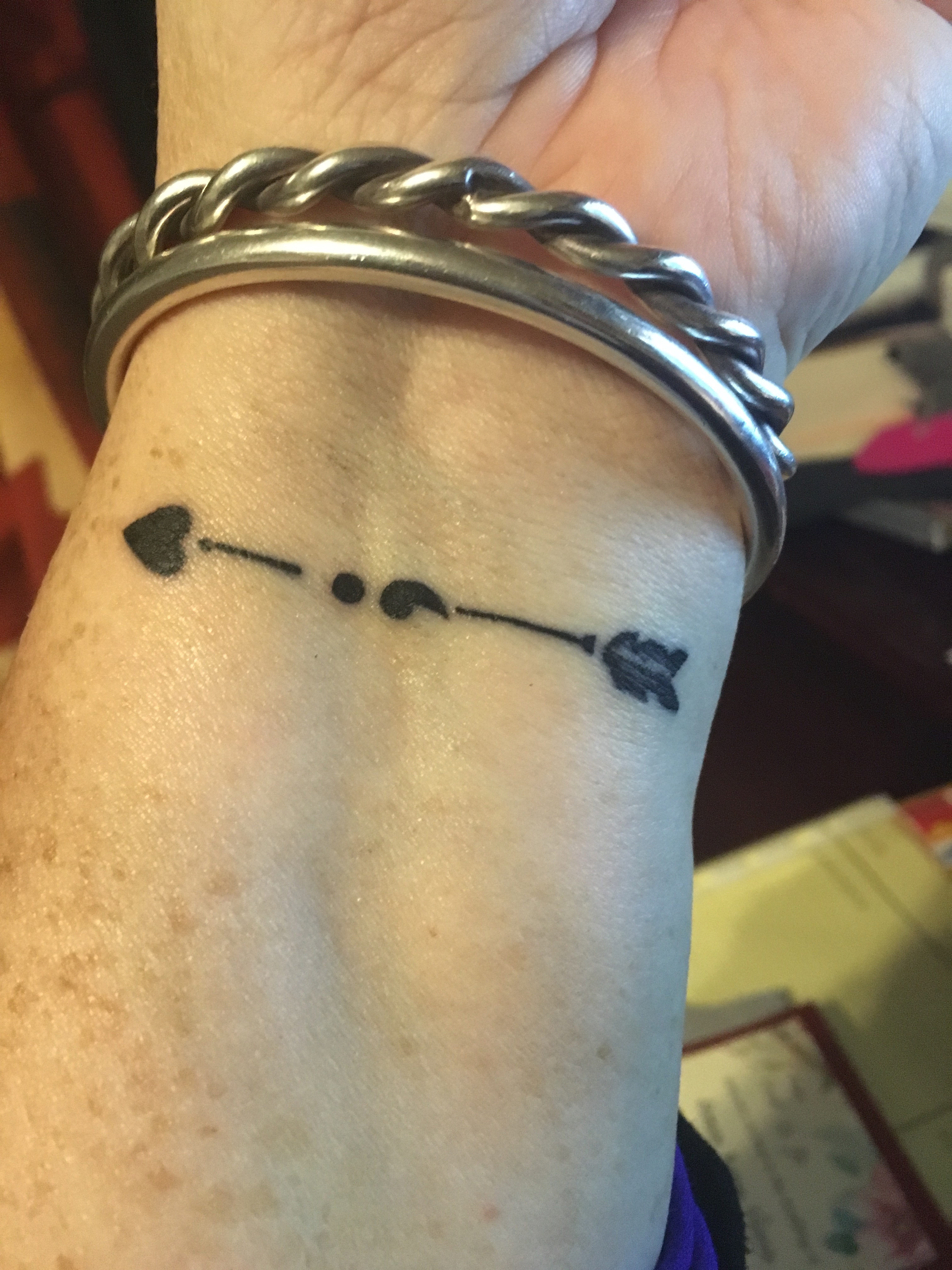
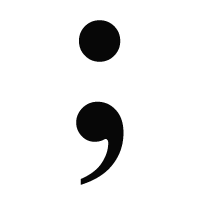
A semi-colon forms part of a highly symbolic tattoo on my inner wrist. Like many others who bear the symbol on their skin, I chose it because I, too, have struggled with depression, mental illness, self-harm and suicide. It’s a reminder that “this” is not all there is, and it’s not the end of the story.
As a punctuation mark, I am a big fan of the semicolon. It has the power to make someone wait momentarily, to hold a thought or their breath for a moment, and to anticipate what is to come next. It’s the symbol that tells the reader that there is more to come.
I really enjoyed this article by Celia Watson which discusses how the semicolon came to be.
And if you’re a grammar nerd like me, you’ll understand the appeal of Watson’s book on that wonderful, versatile little punctuation mark, simply titled ’Semicolon’, which I discovered via Stan Carey’s review.
The article titled The Birth of the Semicolon published in The Paris Review (August 1, 2019) by Cecilia Watson is not to be missed. Here is just the beginning to whet your appetite for arcane knowledge offering clues to the development of formal language.
The semicolon was born in Venice in 1494. It was meant to signify a pause of a length somewhere between that of the comma and that of the colon, and this heritage was reflected in its form, which combines half of each of those marks. It was born into a time period of writerly experimentation and invention, a time when there were no punctuation rules, and readers created and discarded novel punctuation marks regularly. Texts (both handwritten and printed) record the testing-out and tinkering-with of punctuation by the fifteenth-century literati known as the Italian humanists. The humanists put a premium on eloquence and excellence in writing…
Written in 1603 or 1604, ‘Measure for Measure’ is a play with enormous relevance to the 21st century.
As I listened to the play on the BBC’s ‘The Shakespeare Sessions’ podcast yesterday, it struck me just how timely and relevant it is.
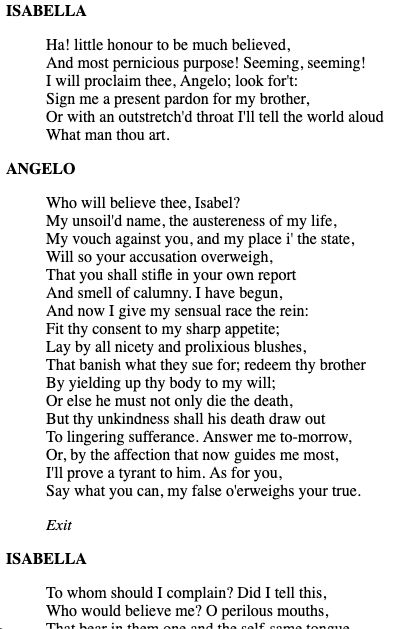
The play features a man named Angelo who, having been left in charge by the Duke, totally abuses his power in the interests of sexual gratification. He tells Isabella he will pardon her brother Claudio, who has been sentenced to death, if she has sex with him. When Isabella refuses and threatens to tell everyone what he has suggested, he simply asks, “Who will believe you?”
from ‘Measure for Measure’, Act 2, Scene 4
Angelo is clearly relying on his powerful position, and his ability to hold something over her, to get away with sexual abuse and bribery. And he dares to call it “love”, when it is anything but that. He is attempting to romanticise his proposed rape and abuse of power, as abusers so often do.
This is exactly the kind of behaviour we’ve seen exposed by the #metoo movement. Men abusing their positions of power and pressuring women to give in to them because they have the power to grant what the women need – a job, justice, whatever… and relying on their position to give them more credibility than a woman in a weaker position in society. It really does foreshadow those now infamous words spoken in 2017 by yet another reprehensible character: “And when you’re a star they let you do it. You can do anything.”
Not easily intimidated, Isabella points out that what he is suggesting is exactly the crime for which he has sentenced her brother to death. His hypocrisy is abundantly obvious to not only Isabella, but also to the audience. That she calls him out on it demonstrates her integrity and intelligence. Bravo to Isabella for not taking his crap or falling prey to his greasy manipulation.
Caught in between wanting to save her brother’s life and not wanting to have sex with Angelo, Isabella verbalises the impossibility of her situation in that very poignant and thought-provoking line: “To whom should I complain? Did I tell this, who would believe me?”
Still, even though she understands that what he says is probably true, she neither yields to him or gives up on her brother. Instead, she finds another way to solve her problems and expose the bad behaviour of Angelo.
As suggested in the title, justice is received at the end of the play in the same measure with which it is meted out at the beginning.
In this, we see a woman standing up for what is right, defending herself, refusing to give in to a man’s manipulation and sexual pressure, and winning. Angelo is punished for his corruption, and Isabella saves both herself and her brother.
This is a powerful contrast to most of the women in Shakespeare’s other plays, and indeed in the early modern times in which he lived and wrote, few of whom had any real agency or ability to stand up for themselves against the will of men.
‘Measure for Measure’ is a thought-provoking and entertaining play which demonstrates that while times have changed, the effect of power and position on human nature has not. Even so, it does remind us that evil people can, and should, be resisted, and we should never stop pursuing justice just because it’s difficult to do so.
That is truly a message pertinent to life in the 21st century.







 The article titled The Birth of the Semicolon published in

 WordyNerdBird