Sleuth

Photo by cottonbro on Pexels.com

A sleuth is a detective: most often, the word is used to describe an amateur or privately employed detective rather than a police officer. As a word, it was very popular in early detective fiction such as that written by Sir Arthur Conan Doyle or Agatha Christie, and is perhaps less popular now than in previous generations. Even so, it it is a word with a fascinating history.

As a keen reader of mystery fiction for many years now I am familiar with many sleuths. I started with Tricia Belsen, the Hardy Boys and the like. Scooby Doo and the gang were my favourite TV sleuths, but my parents loved Jessica Fletcher. As an adult, Sherlock Holmes, Miss Marple, and Phryne Fisher rank among my favourites. As much as I love Agatha Christie’s work, I always found Hercule Poirot to be insufferably smug and somewhat condescending, but that is a different discussion.

Sleuth had come into English at some point before 1200 AD, meaning ‘a definite track or trail left by someone or something’. This came from the  Old Norse word sloð  which means trail. This word was used to describe dogs skilled at tracking and following a scent or trail, known as sleuth-hounds. Thus, the first sleuths were not people, but dogs!

Eventually, the  word came to be used for a person who tracked prey, or fugitives, or anything else in need of finding. It was used as a noun for a keen investigator by the mid 1800s, and for someone looking for clues to solve a crime in 1872.  “detective” is 1872, shortening of sleuth-hound “keen investigator” (1849), a figurative use of a word that dates back to late 14c. meaning a kind of bloodhound.

Sleuth was not used as a verb until the early 20th century, when it was used to mean the act of investigating. The first written record of sleuth as a verb was in 1905.  To sleuth out meant to investigate or discover, and the act of doing so was sleuthing.
Sources:

Etymonline
Sesquiotica
The Word Detective

Sleuth.
#vocabulary #etymology

Ploce: It Is What It Is.

One of the catch-all phrases of the 21st century is “It is what it is.” On the surface, it seems like a no-brainer, but when you think about it, it’s a statement that can indicate acceptance, resignation, or simple acknowledgement of a thing or situation. It can communicate “that’s all you’re going to get” or “that’s the best I could do” or “that will have to do. Despite its apparent simplicity, it’s a versatile statement to keep up one’s sleeve.

The repetition in this phrase is known as ploce, pronounced plo-chay .

Photo by Cristian Rojas on Pexels.com

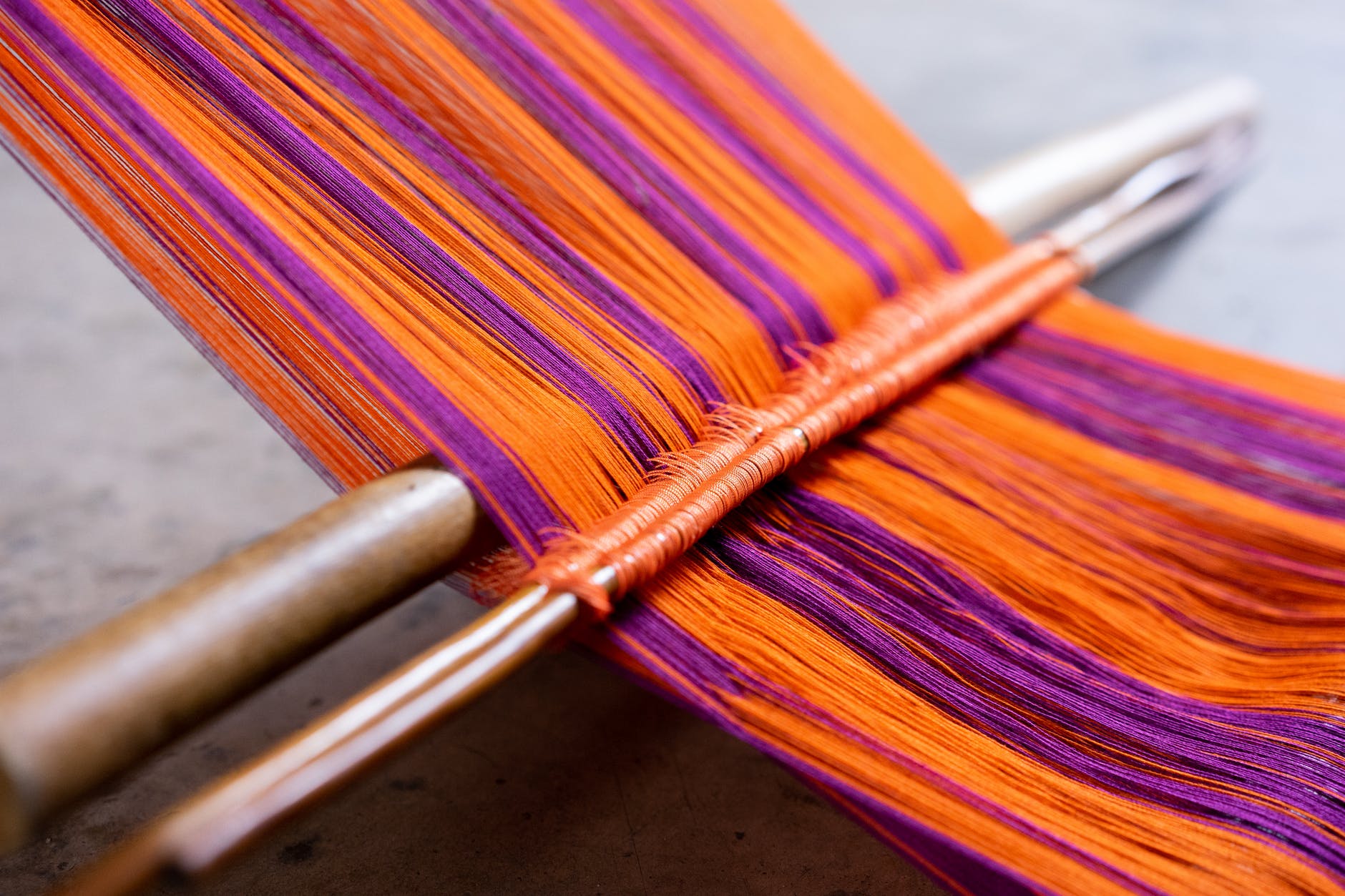
Ploce is a very old word which came into English from Latin from the Greek work plokē meaning complication or twisting, which came from the ancient Greek word plekein which means to plait or weave.
That in itself is fascinating, as it gives a clear impression of the words twisting or weaving around themselves as they are repeated. It’s quite a visual image of what the language is doing.

Ploce is a literary and rhetorical device by which a word is repeated for emphasis.

  • It can be simple repetition, like Popeye saying “I am what I am, and that’s all I am”.
  • It can involve a change in the meaning of the word: 
    Examples:
    “When the going gets tough, the tough get going.”
    “I don’t want to hear you talk the talk, I want to see you walk the walk.”

    Note: This is also called antanaclasis, but you’ll probably never need to know that unless you’re studying Rhetoric, Classics or Shakespeare.
  • It can involve a change in the form of the word.
    Example:
    “She cried until there was no crying left in her.”

    This is also called polyptoton. You’ll probably never need to know that either, unless you’re studying… you get the idea.

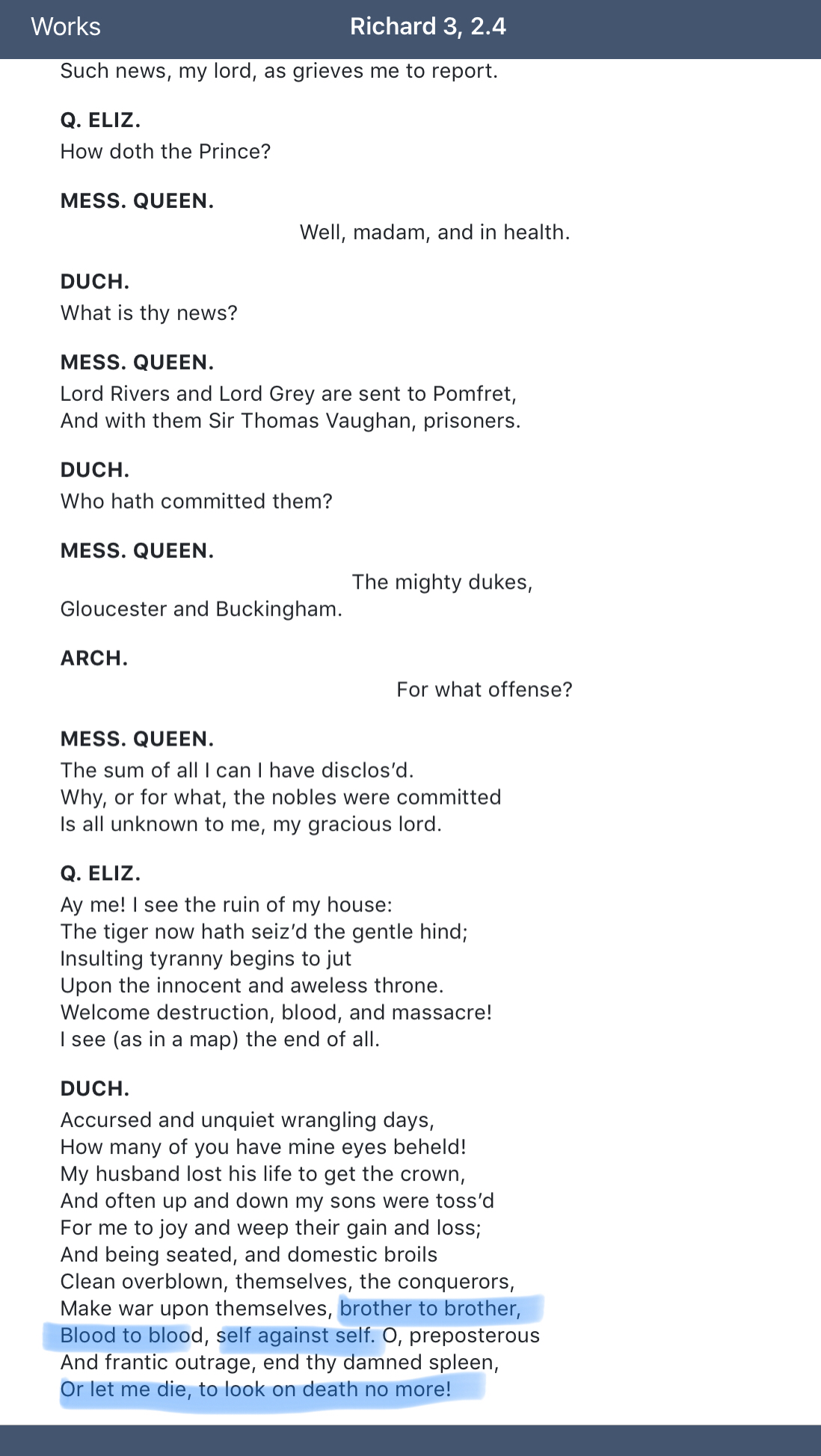
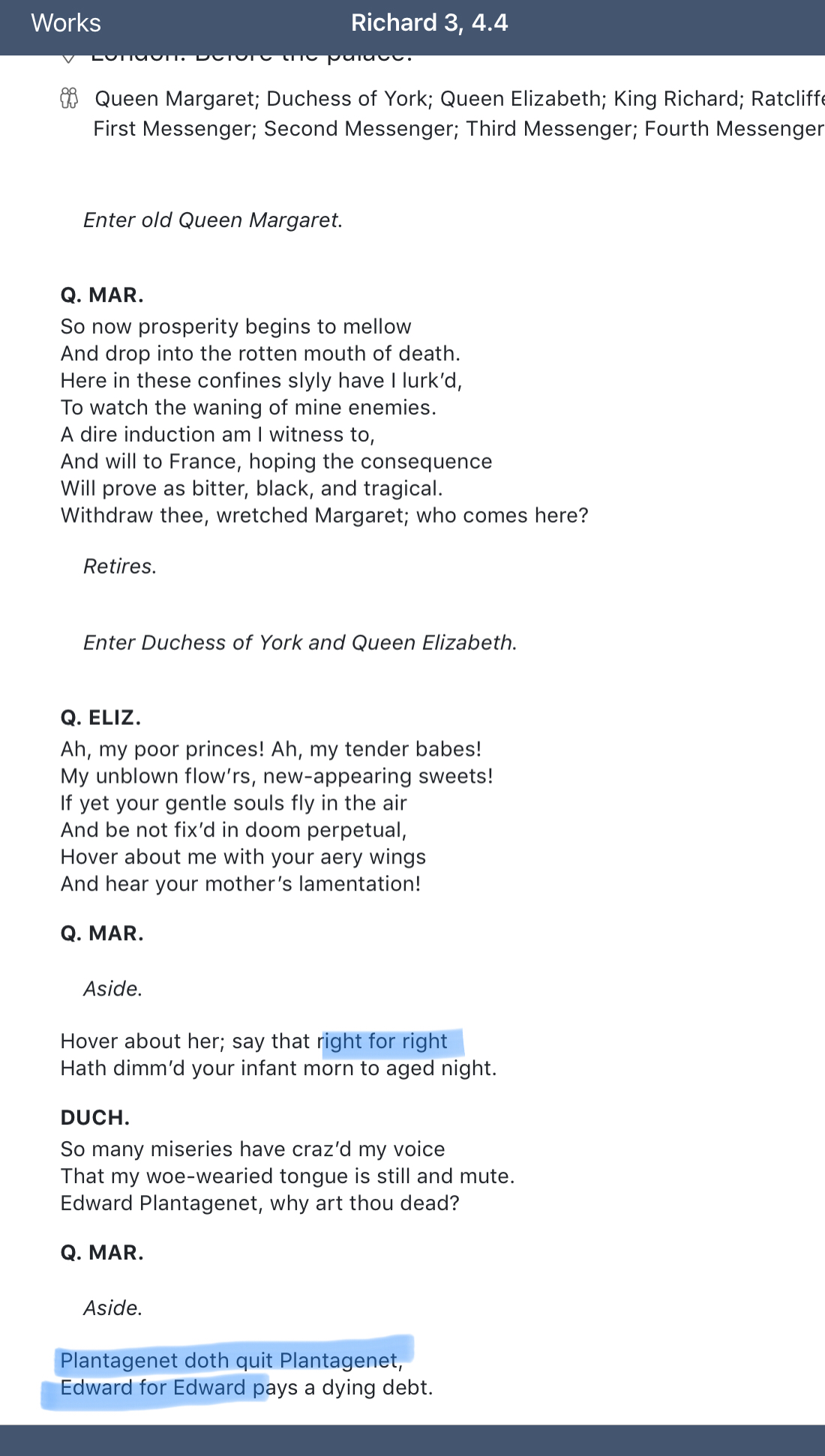
Shakespeare made regular use of ploce in his plays, but my favourite examples are to be found in speeches by Queen Margaret in Richard III:

Screenshot made using Shakespeare Pro v.5.5.2.3

Margaret often makes use of elegant imagery and rhetoric in her speeches, and her use of ploce is certainly eloquent.

Sources:
Silva Rhetorica
ThoughtCo.
Britannica.com

Ploce: It Is What It Is
#words #vocabulary #Shakespeare

Carnival

Photo by Julia Kuzenkov on Pexels.com

I mentioned to someone yesterday that I would be at my school’s athletics carnival today.

“Ooooh, car-nee-vah-lee!” they exclaimed with a twinkle in their eye.

Brightly coloured images of vivid costumes, scantily clad women and wild parties in Rio de Janeiro flashed through my mind.
“Er… not quite!” I responded. “It’s not that colourful! And it’s a school event, so let’s keep it family-friendly, shall we?”

This got me thinking about the different meanings of carnival, and wondering what a rowdy celebration or a colourful parade might have to do with a school track and field sports day.

In my mind, the answer was obvious: not much.
So, as is my usual habit, I turned to Etymonline for some insights.

Photo by Nishant Aneja on Pexels.com

The English word carnival dates back to the 1540s, when it was used to refer to a “time of merrymaking before Lent”. This was derived from French carnaval, which in turn came from the Italian word carnevale which referred to Shrove Tuesday. This came from older Italian forms such as Milanese carnelevale and Old Pisan carnelevare which meant to remove meat, presumably referring to changing one’s diet for the period leading up to Easter.

Etymonline also offered the folk etymology — that is, a popular but generally untrue story about the origins of a word— that carnival came from the Medieval Latin words carne and vale meaning ‘flesh, farewell!’

In the late 1500s , carnival had come to mean feasting or revelry in general.

Carnival being used in reference to a circus, sideshow or amusement fair developed in American English in the early 20th century.

Photo by Elly Fairytale on Pexels.com

That was as far as Etymonline got me, so I looked up a few other websites, but none of them shed any more light on the answer to my question.

I am still no closer to understanding why a series of track and field events is called a carnival.

Consequently, I am left performing some folk etymology of my own: perhaps it relates to the celebration of the physical achievements of the competitors, or the cheering and noise made by the spectators.  It could even relate to the pre-competition parading of competitors, team colours and mascots that used to be popular but, thankfully, is much less fashionable now.

Perhaps, though,  it’s just one of those weird quirks of English that I’ll never really understand.

Sources:
Celebrating an Etymological Carnival
Etymonline

Raspberry.

A raspberry can be one of two things.

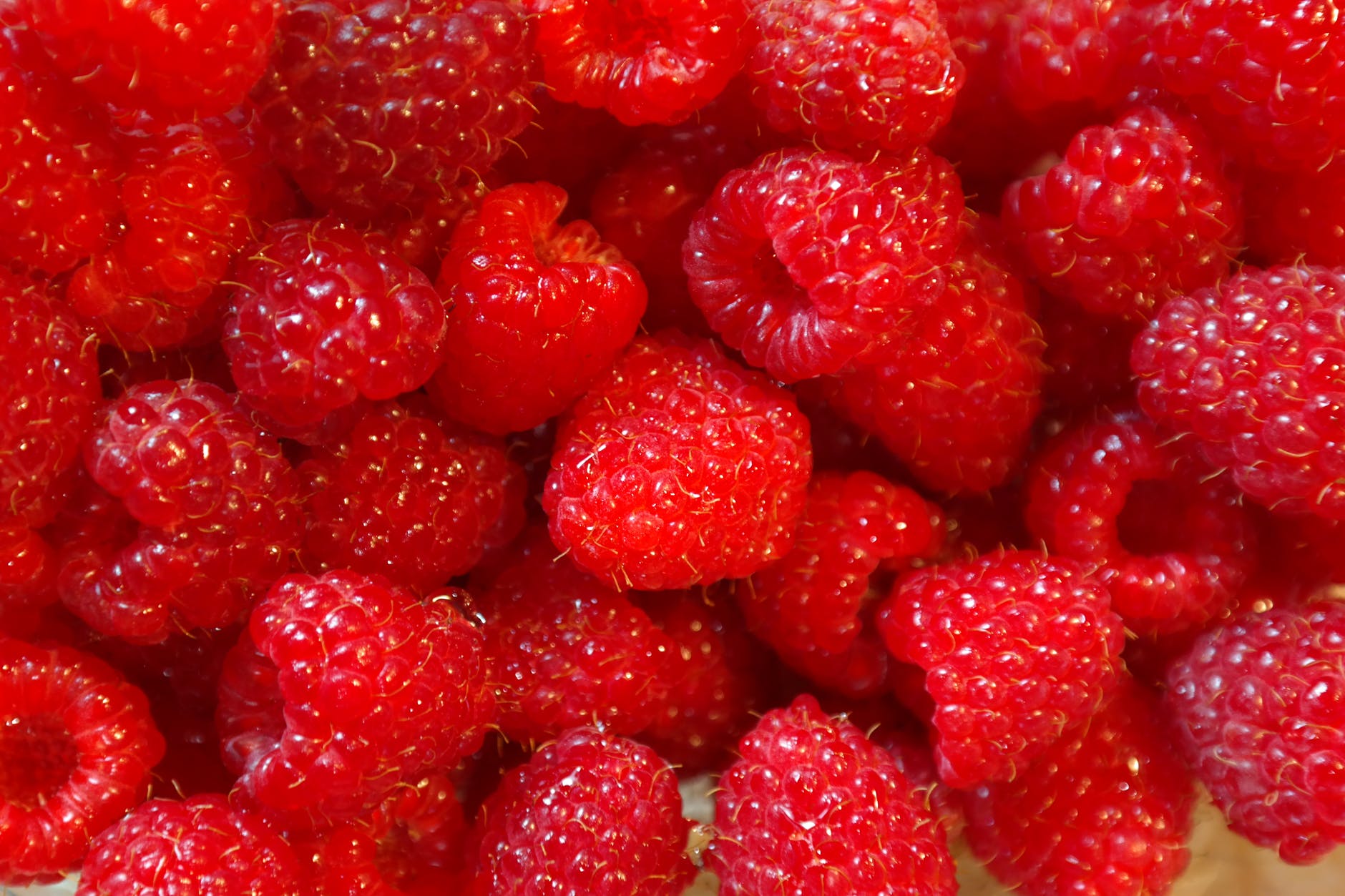
First and foremost, a raspberry is a small red, black or yellow fruit which grows on a bramble or vine-like style of bush, and which generally tastes delicious.

Photo by Pixabay on Pexels.com

In English, the word raspberry goes back to the early 1600s, but its actual origins are a matter of contention: it could have come from Old French, Medieval Latin, or one of the Germanic languages.

Photo by cottonbro on Pexels.com

The second sense of the word raspberry dates to the late 19th century, and relates to the rude sound made with one’s tongue and lips. This meaning is derived from ‘raspberry tart’, which is rhyming slang for ‘fart’, which is precisely what a raspberry sounds like.

Blowing a raspberry is also called a Bronx cheer, a term which came from the sound being used to express derision or displeasure during sporting matches in the area of New York City called the Bronx.

In linguistic terms, blowing a raspberry is an unvoiced labial fricative. This may seem like somewhat useless information for anyone other than linguists and language enthusiasts, but rude children can be quite effectively stunned into submission with reprimands such as “Don’t you dare address me with your unvoiced labial fricatives!” I know this, because I have achieved it more than once with other people’s teenagers.

This term has also been immortalised in the Golden Raspeberry Awards or Razzies, a parody of the Oscars in which the awards are given for terrible performances in film.

Finally, raspberry is also used as an adjective to describe any shade of purplish red colour, as referenced by Prince in Raspberry Beret. You don’t need to thank me for the earworm – you’re welcome!

Raspberry beret
Photo by Roel Wijnants on Flickr. Reproduced without alteration under Creative Commons licence.

Sources:
Etymonline
The Razzies
Wiktionary

Raspberry.
#words #language #blog

Zarf.

Zarf is a word you might never have heard or used, but it relates to something with which most of us are quite familiar.

These days, the word zarf refers to that cardboard or silicone band on a portable coffee cup that insulates it and stops your fingers getting too hot while holding your drink. Some call it a cup sleeve or a cup holder: zarf is a far more evocative and interesting word.

The word zarf comes from Arabic via Turkish, and simply means ‘envelope’. Thus, its adoption for a cardboard sleeve to go around a disposable coffee cup is logical, and it soon came to be applied to anything that went around or held a cup to make it more comfortable to hold.

Many people assume that the zarf was a late 20th century invention that came about with the advent of the disposable, followed by the the reusable, takeaway coffee cup. Those people are wrong.

The zarf began as a holder for a hot coffee cup in Turkey and across the Middle East as early as the 1600s.

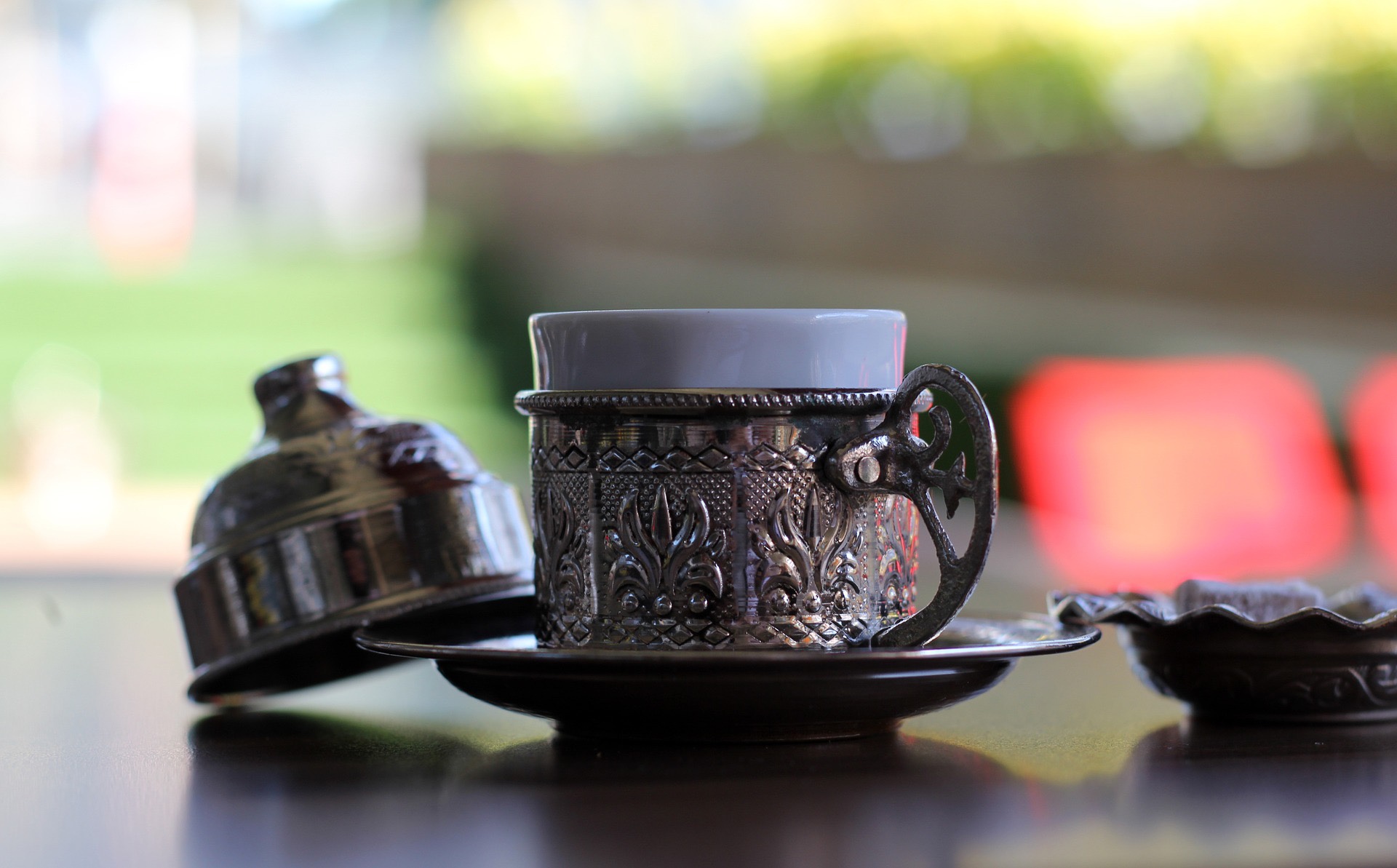
Image credit: nokta_cizgi on Pixabay.

When the Ottoman Empire banned alcohol in the 16th century, coffee became the premier drink of the people. Within one hundred years, coffee houses became such important centres of gathering, culture and political discussion that the Empire banned coffee, too.

As any coffee lover could predict, that didn’t work. The people responded so profoundly that the Empire decided not to stand between the people and their caffeine ever again, but added a significant tax on coffee instead, in keeping with the age-old governmental proverb: if you can’t beat them, tax them. 

image credit: Activedia on Pixabay

As the traditional coffee cups had no handles, the zarf evolved as a functional holder, but soon became elaborately decorative. These are still used today.

Traditionally, the  more ornate and beautiful the zarf, the higher the esteem in which the drinker is held. An ornate zarf can indicate status or affection and respect, which means that a lover, a close friend or a family member might serve coffee in a zarf as beautiful as that served to a sultan or emir.

The zarf and the coffee served in it are just two of the many wonderful things we have inherited from Eastern history and culture. Coffee houses are still cultural and social hubs in the Middle East, a legacy reflected in the popularity of coffee shops and cafes worldwide.

Anyone inclined toward prejudice against Eastern and Muslim cultures should remember that when sipping their morning cup of joe: it would be impossible to live as we do without their contributions and influence.

Sources:
Macquarie Dictionary
The Story of the Zarf
What is a zarf? The bizarre story behind this everyday object.

Zarf.
#words #coffee #coffeelovers

Zucked.

I do the love the Macquarie Dictionary.

It is the dictionary of Australian English, expressive of all classes and of our multicultural society. Regular readers of this blog will be familiar with it because of my frequent reference to it in my word-nerdy posts.

Today, though, the editors excelled themselves.

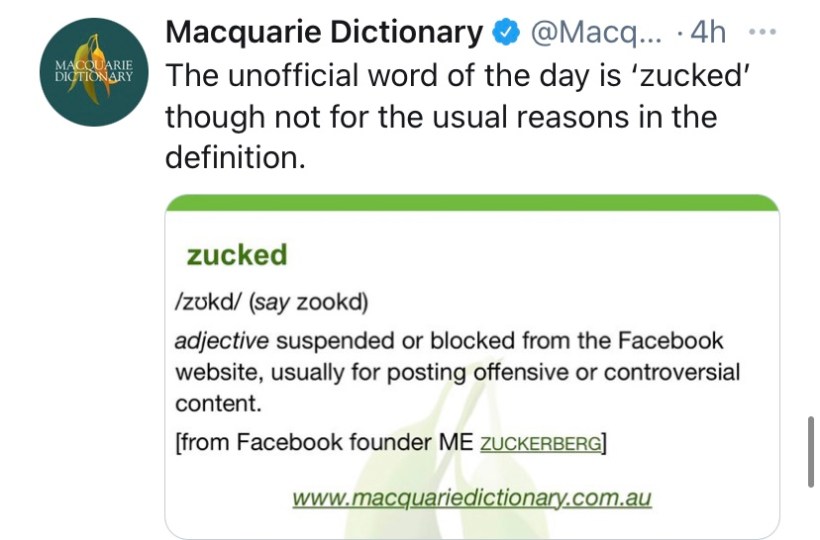
On the day when Facebook cut off access to all Australian news channels— sadly including sources of information relied upon by particular social groups such as  Indigenous communities, domestic violence support groups for women and families, and local information networks— as a result of a disagreement with the Australian government over market share and finances, the Macquarie tweeted that Australians have been zucked.

An obvious play on the F-bomb and Zuckerberg, it’s a clever new portmanteau word.

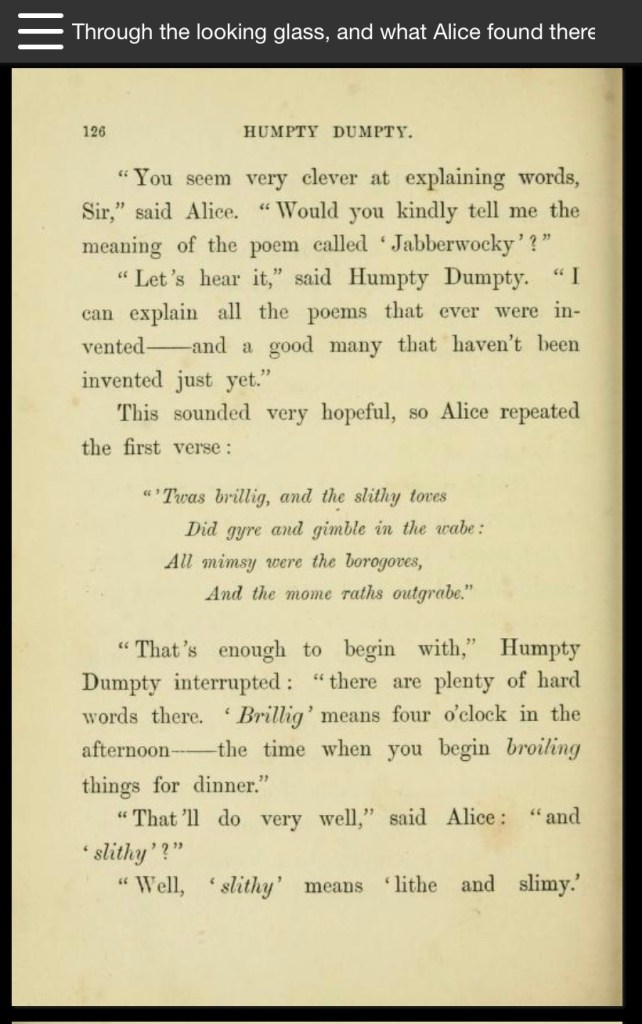
A portmanteau word is one created by blending two existing words or parts of words to create a new word. The name comes from a portmanteau, which is a type of suitcase that opens into two halves. This  dates back to Lewis Carroll’s ‘Through the Looking Glass’:

from ‘Through the Looking Glass’ by Lewis Carroll, courtesy of archive.org

We use portmanteau words every day, without many of us realising how they were created:

  • Botox —  botulism toxin
  • Brexit — British exit from the European Union
  • Bollywood — Bombay and Hollywood
  • Email — electronic mail
  • Fortnight — fourteen nights, so two weeks
  • Sitcom — situation comedy
  • Webinar — web seminar

English is actually full of these words, as it’s a form of wordplay that has been around for hundreds of years.

Sources:
Britannica
Etymonline
Macquarie Dictionary

Zucked.
#words #language #facebooknewsban

Kvetch.

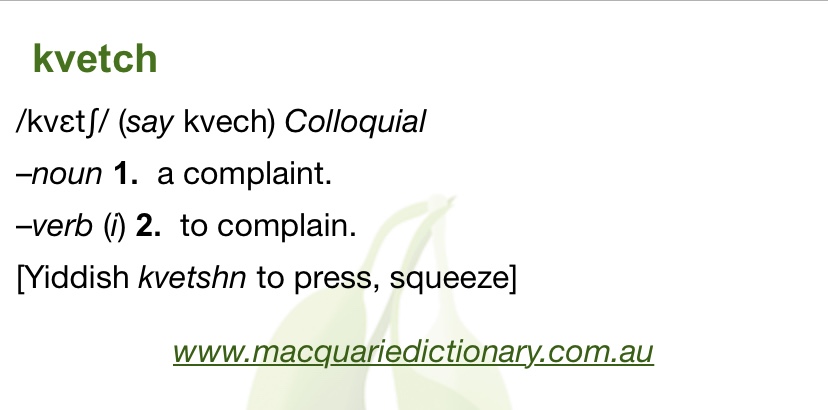
As Victoria enters a five day lockdown designed to halt the spread of that dratted virus after its recent escape from a quarantine hotel, there’s a lot of kvetching going on.

Photo by Andrea Piacquadio on Pexels.com

Yes, it’s our third lockdown. Yes, we all saw this coming when the Australian Open was allowed to go ahead. Naturally, we’d all rather not. We’d all like to be able to do whatever we want to do. I know it’s inconvenient. I had to cancel my plans, too. 

Still, there is nothing to be achieved by blaming anyone. Contrary to what some people like to say, our state government is not a dictatorship. They’re doing their best to manage a pandemic, balancing the health of the community with what millions of individuals perceive as their rights and needs.

The fact is, this virus is highly contagious, airborne and invisible. The pandemic is not yet over, and these things are going to happen from time to time. It may actually be a fact of life for the foreseeable future, even when we are careful about wearing masks, social distancing and sanitising everything. One of the fundamental truths of a pandemic disease is that it is not easily controlled: that’s how it became a pandemic in the first place. At best, it can be well managed.

At least it’s only five days this time, not months like the last one.

Even so, I have lost count of how many times I have felt the need to tell people to stop kvetching about it in the last 24 hours.

Kvetch is a wonderful word, donated to English from Yiddish in the mid-20th century. It is as satisfying to say as ‘bitch’ with far less possibility of offending anyone, and it is so much more expressive than other synonyms such as ‘whine’, ‘complain’ or ‘moan’.

Perhaps the only synonym that is as expressive is the one that my grandfather used when we were kids: “Stop your bellyaching,” I haven’t thought about that expression in decades, and it has just come back to me riding on a wave of memory and emotion. I think I’ll have to start saying that now, too.

Kvetch.
#wordsofwisdom #pandemic

Pretty.

Photo by Simon Berger on Pexels.com

‘Pretty’ is quite a versatile word because we use it in a variety of ways:

One can drive a pretty nice car.
A child, a pet, a garden, and a picture can all be pretty.
Pleasant or attractive music , noises or words sound pretty.
An ornament or decoration can be called a pretty.
Something expensive is said to cost a pretty penny.
Someone in a safe or comfortable position is sitting pretty.
A person can pretty themselves up for a special occasion.
A request or plea is made more emphatic and emotive when someone adds pretty please.

On a more negative note, someone who is in trouble or said to be in a pretty mess.
If someone or something is only moderately attractive, they might be described as prettyish.
An event or a relationship can be pretty much over.

It is also interesting in that none of those meanings relate to the original meaning of pretty.

Pretty comes from the Middle English word ‘pratie’ which meant cunning, crafty, or clever”
This is related to a number of Old English words:

  • prættig – West Saxon
  • pretti – Kentish
  • prettig  – Mercian

These are all adjectives that mean cunning, skilful, artful, wily, or astute.

Before that, the words prætt or prett meant a type of trick, wile or craft. These words have a Proto-Germanic origin in *pratt- , which has closely related words in Old Norse , Frisian, Old Dutch, and Flemish.
Bt the beginning of the 15th century, pretty had evolved to also mean something manly or masculine, gallant, and something cleverly made.  By the mid 1400s, it had developed further to include the senses of attractiveness to the senses or holding aesthetic appeal, and of being slightly beautiful.

The use for pretty to express degree or amount developed by the mid 1500s, and pretty much had evolved by the mid 1600s.

A collection of pretty tho gs was called a prettiness in the late 1600s, while the use of pretty as a noun, such as “my pretty” developed in the 1700s, first in reference to things and then people.

The earlier meaning related to masculinity,  bravery and cleverness did an about-turn by the late 1800s, when the term pretty-boy came to be used as a derogatory term for any man deemed to be effeminate or suspected of being a homosexual.

In the early 1900s, pretty became a verb, meaning to make something or oneself more attractive.

It turns out that pretty is more than just a rather versatile word: it’s also fairly old and quite interesting.

Sources:
Macquarie Dictionary
Etymonline

Pretty.
#words #language #blog

Bivouacked.

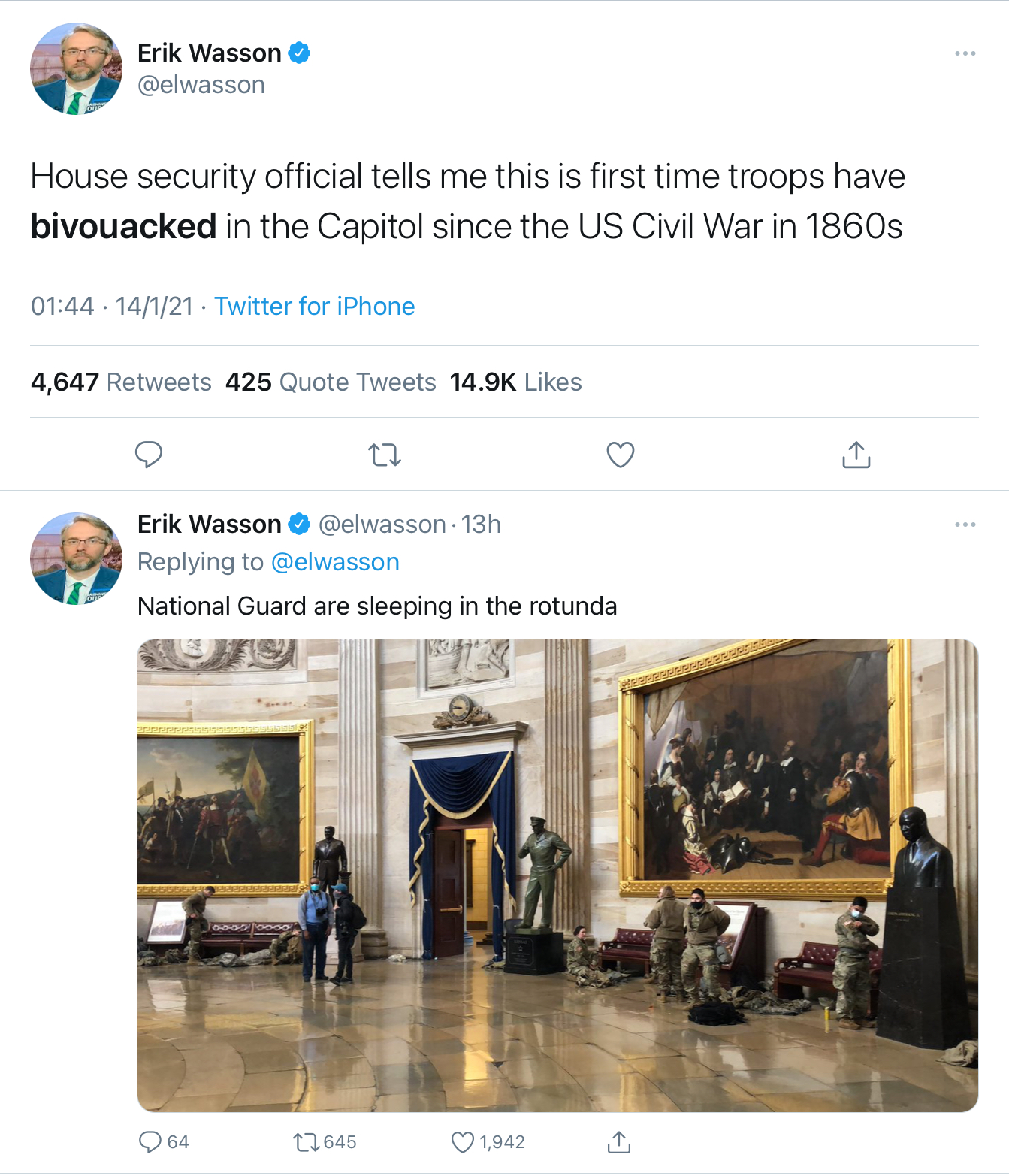
This morning I read a tweet that made me stop and think, “Wait.. what?”

The word that got my attention was ‘bivouacked’.  Despite the fact that I am a passionate reader and a scholar and teacher of History, I had no idea what this word meant. Obviously, I wasn’t the only one: plenty of people responded that they had to look the word up. 

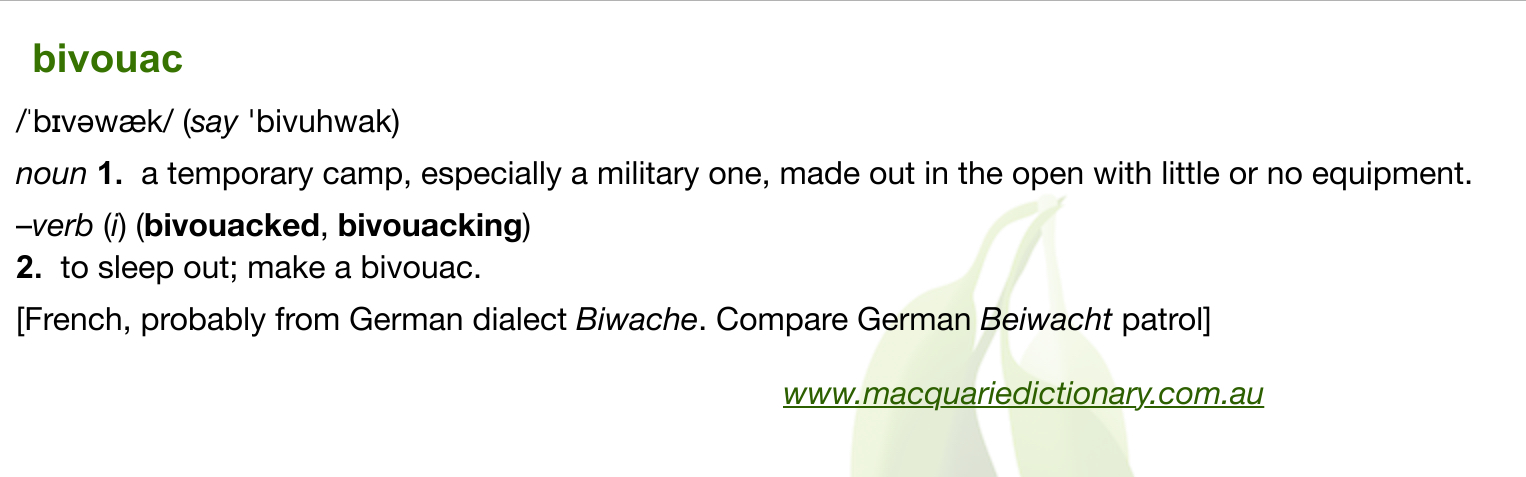
My trusty Macquarie Dictionary gave me the definition. 


Etymonline explains that the use of bivouac in English dates back to 1702, meaning an “encampment of soldiers that stays up on night watch in the open air, dressed and armed.” 

It is an image of readiness to defend and protect, which was exactly the context of the tweet. These images of bivouacked soldiers in the Capitol building, Washington DC, are confronting and comforting at the same time. That it is even necessary is heartbreaking, yet in the current political climate, I am thankful they are there.

Images by Igor Bobic, Huffington Post photographer. 
Igor Bobic on Twitter.  See the full post here

The word came from French, and before that from the 17th century Swiss/Alsatian word ‘biwacht’ which meant “night guard”. 

By 1853, bivouac was also used as a noun to mean an outdoor or open-air camp. 

The use of the verb ‘to bivouac’, meaning to post troops in the night dates to 1809, and meaning to camp or sleep out-of-doors without tents dates to 1814. It should be no surprise that the noun became a verb in the context of the Napoleonic Wars and the War of 1812, during both of which the practice would have been common.

Bivouacked.
#words #language #History

Auld Lang Syne.

The fireworks over Sydney Harbour were sensational.

Last night, at the turn of the new year, we watched the fireworks over Sydney Harbour on TV, followed by this beautiful rendition of ‘Auld Lang Syne’ by the cast of the musical Hamilton.

Traditionally sung on New Year’s Eve, ‘Auld Lang Syne‘ is a song about remembering the friends and loved ones we have known in the past.

For the first time in my lifetime of knowing this song, it brought tears to my eyes: not only was 2020 brutal in numerous ways, I knew I was not the only one who was painfully aware of missing a beloved someone. I was blown away by the realisation that this song is as much about grief as it is about wistfulness, friendships of the past, and happy memories.

“Should auld acquaintance be forgot
And never brought to min’?
Should auld acquaintance be forgot
And auld lang syne?”

Robert Burns, 1796

The song we sing now is part of a longer song written by the Scottish poet Robert Burns in the late 18th century. Sadly, though, many people sing it without really knowing what it means.

Auld Lang Syne is a sweet little Scots phrase that means ‘for old time’s sake’. It translates literally to “old long since”.
This song was a reinvention of an older song. Burns wrote about his song in separate letters to different people:

“It is the song of the olden times, which has never been in print… I took it down from an old man’s singing.”
“Light be on the turf of the heaven-inspired poet who composed this glorious fragment.”

Robert Burns

Just as the original song was much older than Burns’ version, the words themselves are very old. Auld and lang both come from the Old English of the Anglo-Saxons, while syne dates to the 1300s.

It is a beautiful phrase to say: it feels nice in the mouth, and it sounds just lovely, especially when spoken with a Scottish accent.

From now on, when I hear ‘Auld Lang Syne’, I shall think of the wonderful people I have known and loved in my life, and of the happier times of the past, but I will also think of the beautiful words that have been passed down to use from auld lang syne, too.

I’d like to take this opportunity to wish all my readers a happier, more hopeful new year. Lang may yer lum reek.

Auld Lang Syne.
#words #AuldLangSyne #NewYear2021

These books, both in my personal library, were used as references in the preparation of this post.