Shakespeare’s Sonnet 18: An Expression of Grief

Today was hard. It is the anniversary of both Helen’s passing and of Dad’s funeral. I still love them and miss them both enormously. They are both still part of me, and always will be.

Photo by Joanne Van Leerdam: A rose from Helen’s funeral.

I tried to stay busy and keep my mind on other things. That only works to an extent: the knowledge and the memories are always right there, whispering into every moment and activity.

Poems like this help me to remember and they help me to heal and keep going. I love the beauty of the language and the power of the ideas and message.

I hope you enjoy it, too.

wordynerdbird's avatarShakespeare Nerd

Shall I compare thee to a summer’s day?
Thou art more lovely and more temperate:
Rough winds do shake the darling buds of May,
And summer’s lease hath all too short adate;
Sometimetoo hot the eye of heaven shines,
And often is his gold complexion dimm’d,
And everyfairfrom fair sometime declines,
By chance or nature’s changing courseuntrimm’d:
But thy eternal summer shall not fade,
Nor lose possession of that fair thouow’st,
Nor shall Death brag thou wand’rest in his shade,
When in eternal lines to time thou grow’st.
So long as men can breathe or eyes can see,
So long lives this, and this gives life to thee.

William Shakespeare, Sonnet 18

This sonnet is popularly believed to be a poem of love and admiration. That may be a fair interpretation of the first two lines, and I suppose that might be as far as some people read.

However, when…

View original post 382 more words

A Reflection on the Relentlessness of Time.

I have been contemplating Shakespeare’s 65th sonnet this weekend:

Since brass, nor stone, nor earth, nor boundless sea,
But sad mortality o’ersways their power,
How with this rage shall beauty hold a plea,
Whose action is no stronger than a flower?
O how shall summer’s honey breath hold out
Against the wrackful siege of batt’ring days,
When rocks impregnable are not so stout,
Nor gates of steel so strong, but Time decays?
O fearful meditation! Where, alack,
Shall Time’s best jewel from Time’s chest lie hid?
Or what strong hand can hold his swift foot back?
Or who his spoil of beauty can forbid?
	O none, unless this miracle have might,
	That in black ink my love may still shine bright.

                                           William Shakespeare, Sonnet 65
		 

A year ago today, I was sitting beside my father in the last days of his life. Three days later, it was my beloved cousin and friend Helen whose hand I was holding as she, too, fell prey to time and mortality.

Saying my final farewells to them both in the space of five days was certainly a “wrackful siege of batt’ring days”. I wrote poetry and reflections to both express and process my thoughts and feelings. I wanted people to know how I felt. I wanted people to understand who both these jewels were and why they would always matter, despite their having been being reclaimed from  this life.

I learned more about grief, and I learned more about letting go. I had no choice, because there is no human hand or will strong enough to hold back the relentless march of time and mortality.

This sonnet expresses a reality of life: nothing can withstand the relentless power of time.  Erosion, degradation, and decay overwhelm not only the frail, but also the mighty. True, rocks and brass may outlast flowers and flesh, but they too will yield eventually.

It is a poem of contemplation and resignation, but also one of defiance: time may be relentless, and there may be no way to “hold his swift foot back”, but one who is immortalised or memorialised in ink lives on, albeit in a different way. We can continue to remember and honour them, and to express our love for them.  Our memories and mementos remain long after those who have fallen prey to time and mortality.

In Shakespeare’s time, they had fewer options for immortalising those who passed away than we do. They had eulogies and poetry – the black ink  in which “my love may still shine bright”. They could create drawings and paintings. Now, in addition to those, we have photographs, video, and voice recordings.

Poetry and eulogies still touch our souls just as powerfully, though— whether written in the 21st century or the 16th, our written tributes and reflections endure and move us still.

Some of my own black ink, in which my love shines bright:
Old Man written for my father
Farewell, My Friend written for Helen

Satisfying Shakespearean Ways To Tell Someone To Go Away

There are times when each of us needs to tell someone to go away. Adding a Shakespearean flavour to it lends both style and emphasis to any ejection of a bothersome person.

Begone is the base level entreaty for someone to leave. To say “Fellow, begone!” is the equivalent of “Okay mate, out you go…” today. If not addressing someone who is actually a fellow, you can use any other form of address, or simply say “Begone!” with an imperative tone. A flick of the hand toward the door could add a nice dramatic touch.

Get thee gone! adds a touch of urgency. It’s more like saying “Go, quickly!” or “Get out now!” This is used forty times throughout Shakespeare’s plays, usually when there is a sense of timeliness or hurry about the leaving. It can also suggest impatience or frustration with the person to whom the command is addressed.

Get thee hence! is equivalent to “Get out of here!” or “Get away from here!” It often seems stronger and more urgent than begone! or get thee gone!

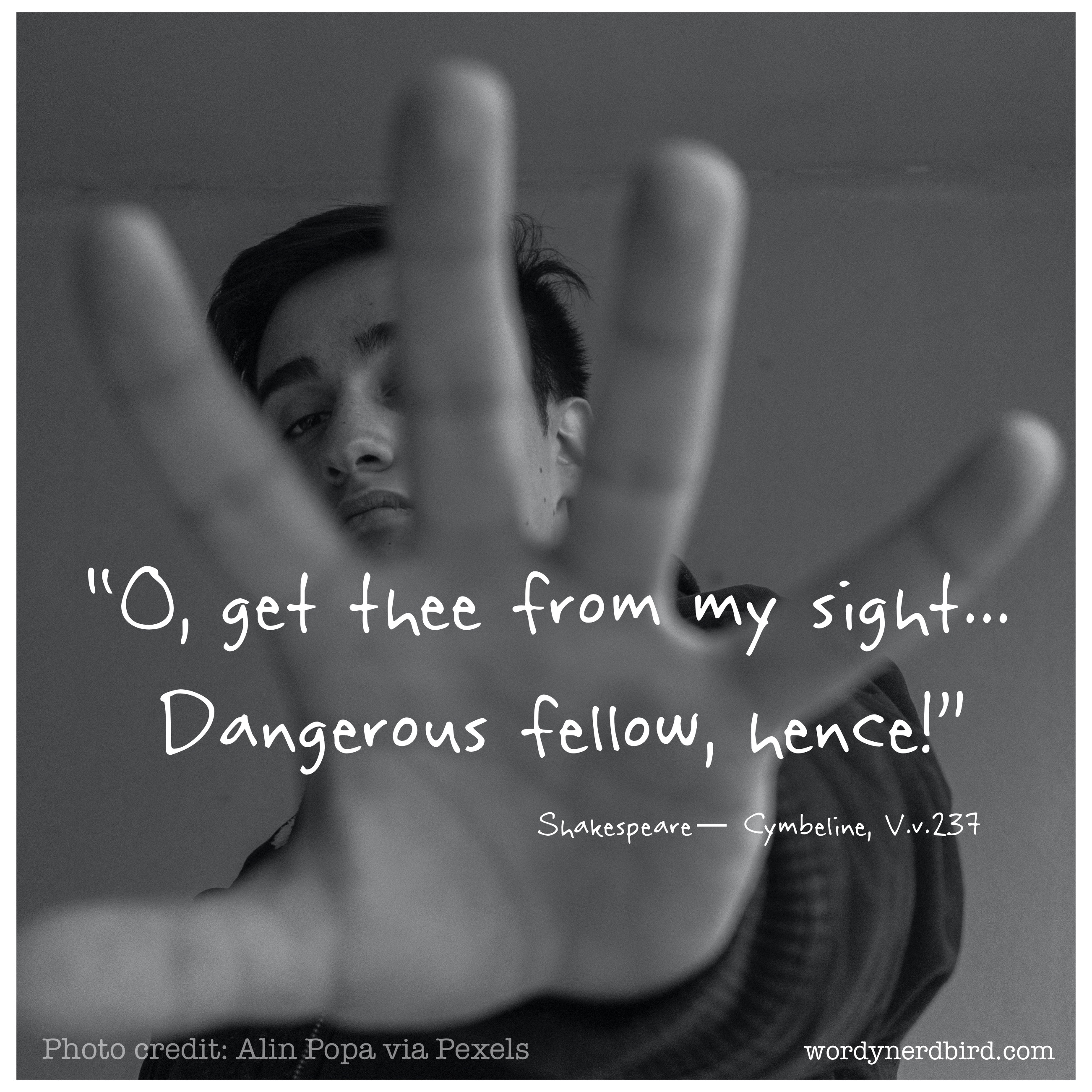
It is certainly expressive and delivers a satisfying sense of Shakespearean drama to your demand to be left alone. Of course, if they don’t go when you tell them to, you can always try mixing it up a little just as Imogene did in Cymbeline: “O, get thee from my sight… Dangerous fellow, hence!”

Aroint thee! Is stronger again because of its implied disrespect for the recipient of the command.It really just means ‘go away’ or ‘begone’, but at the same time indicates that the speaker holds higher status or demands more respect than those to whom they are speaking. It also has supernatural or spiritual connotations, as it was commonly used to eject witches from one’s presence.

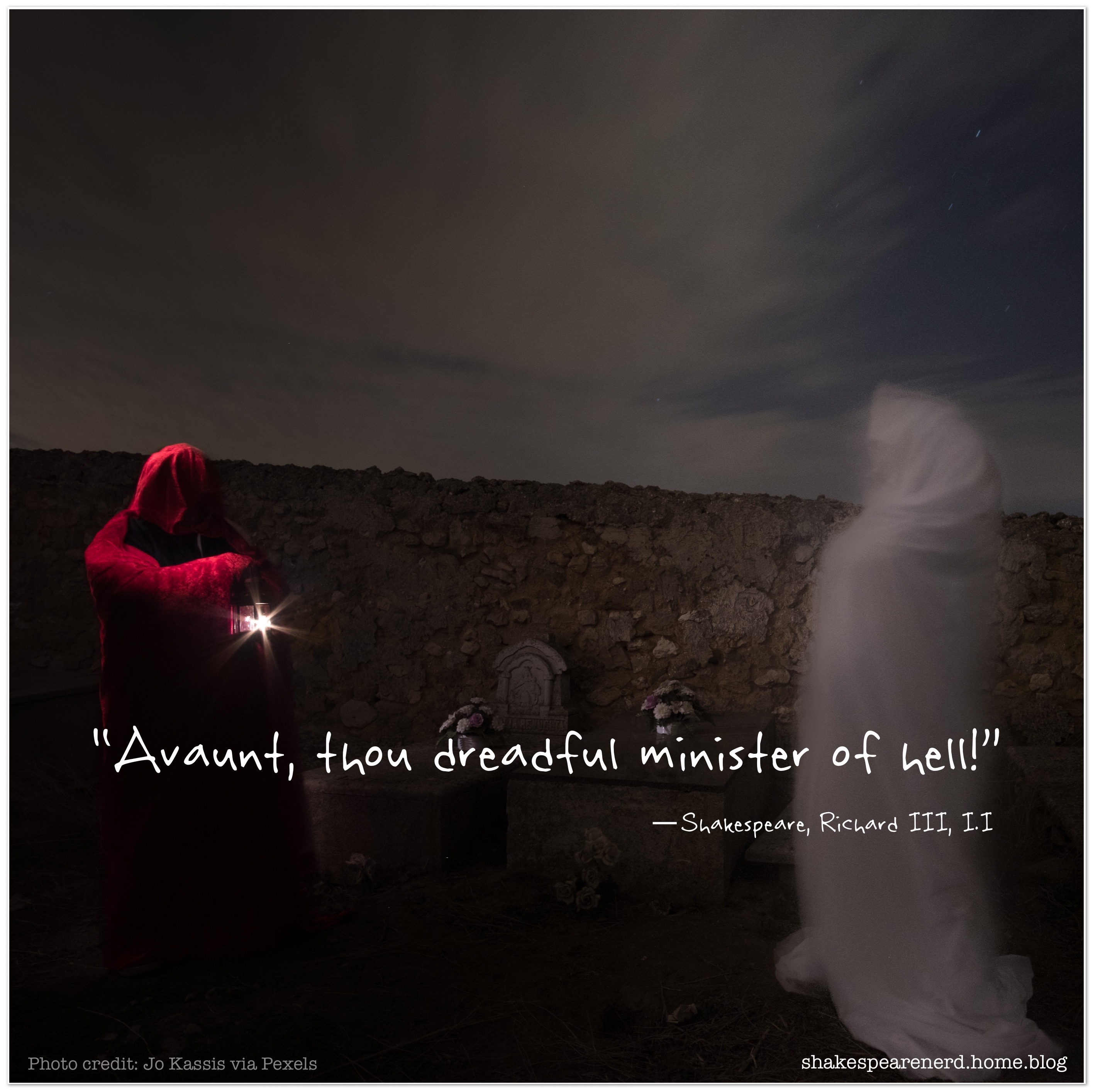
Avaunt takes telling someone to get lost to another level, as it carries even greater spiritual or superstitious weight. This is the word one would use for commanding demons or any other evil presence to leave. When directed at people rather than the supernatural, it carries connotations of derision, hatred, or fear; that the speaker seeks to protect themselves from those to whom they speak is understood from this choice of word.

It is important to note that a great deal of suspicion toward witches existed at the time at which both plays were written and performed, and at both points in time in which each play was set. Therefore, Shakespeare’s use of injunctions such as aroint thee and avaunt is a clear indication that the characters on the receiving end are either held in contempt and/or malevolent.

A longer, more detailed exploration of each of these terms is available at Shakespeare Nerd.

Shakespearean Ways To Tell Someone To Go Away.
#Shakespeare #words #communication

Hibernation.

Photo by Pixabay on Pexels.com

Now really is the winter of my discontent.

I know I’m misquoting – in Richard III’s famous soliloquy, Richard continues the line to say that the winter of the Plantagenets’ discontent is made glorious by the success of the Yorks in succeeding to the English throne and achieving prosperity for England. The civil conflicts experienced in the Wars of the Roses are over, and the turmoil of decades of striving for supremacy has subsided into feasting and celebration. Richard amd his family are in a pretty good place.

I, on the other hand, am not. I’m exhausted, I’m not sleeping, my pain levels are skyrocketing… and the hits just keep coming.

Many of the pressures and expectations are beyond my control, and because it doesn’t look as though things are going to back off anytime soon, I find myself having to give up something I love doing.

Consequently, I’ve made a really hard but necessary decision: I’ve decided to put my Book Squirrel in his nest and let him hibernate for a while. I will put off making a permanent decision about the until the end of the year, when I hope to be able to get some rest and some perspective.

I have spent five and a half years building up that particular blog, dedicated to Indie books and Indie authors, and working hard to develop a following. Now, it has all just stopped.
It hurts. It feels unfair.
Even so, giving the squirrel a rest is my own choice.

I am discontented, without a doubt.

Contrary to apparent popular perceptions, I can’t actually do everything, and I don’t have unlimited time or energy. Something has to give or else I’m going to break, and although it makes me incredibly sad, right now it’s one less thing for me to think about and feel guilty about neglecting.

I am calling it a hibernation for Book Squirrel.

Interestingly, the word hibernation comes from the Latin word hibernationem, which referred to the Roman army’s practice of passing the winter in a specific location or quarters. Interestingly, it was a military word long before it became a zoological one.

It was not until the 1660s that various plants and insects’ different ways of slowing down or suspension of growth during the winter months was called hibernation. Think of a naked deciduous tree, having cast off its leaves in autumn, or a bulb waiting underground for spring, when it would burst forth in furious growth and then bloom to show that winter had come to an end. It was later still— in the 1780s— that the term was used to refer to the way some animals go dormant or sleep through winter, which is the sense in which we most frequently use the word now.

It seems fitting, then, to respond to a winter of discontent with a squirrel’s hibernation.

I do plan to keep blogging here and on Shakespeare Nerd, so those of you who never followed Book Squirrel’s blog dedicated to Indie books and Indie authors will probably not perceive much difference.

To those of you who have come to love the Squirrel and his bookish enthusiasm: I’m sorry. I tried.

To my beloved Book Squirrel: I really am sorry. I’ll miss you. Bye for now.

Photo by Myriams Fotos on Pexels.com

Sources:

Etymonline
Macquarie Dictionary
Anti.

Photo by NICE GUYS on Pexels.com

Yesterday I read a book that featured some excellent characters and a most intriguing plot. One of the reasons the story worked so well was because, in a wicked twist revealed toward the end of the book, one of those characters who had appeared throughout the story as an heroic figure turned out to be both an antihero and an antagonist, albeit unwillingly.  

An antihero is a character who appears to be a champion of the cause but lacks the usual heroic qualities one might expect, such as bravery or honesty. An antagonist works against the hero or protagonist and their efforts to resolve the conflicts and complications of the plot. 

Interestingly, antihero and antagonist both have roots in the same word element: anti

To be anti-something is to oppose it in belief, thought and/or action. 

The prefix anti- is very old, dating back to Ancient Greek and, even before that, Sanskrit and Proto-Indo-European. It means against, opposed to, or opposite of. It can also mean in front of or before.

From the Greek, it made its way into Latin, and thence into Italian, Spanish, English and French. That makes it a prefix that is very widely understood around the world, and one that is attached to many, many words to add a sense of opposition or contrast. 

Thus, although anti-masker is a quite recent term and antichrist is a designation as old as the Gospel itself, we understand both equally well because of the simple clarity and strength of the anti-  prefix. 

Sources: 
Etymonline
Macquarie Dictionary

Overwhelm.

Photo by Thirdman on Pexels.com

Because I have both a very dodgy spine and fibromyalgia, I frequently find myself overwhelmed by pain and fatigue. People can find things such as motion,  loud noise, emotion or anxiety overwhelming.

Overwhelm is an old word with even older roots: it evolved from Old English, and from Proto-Germanic and Proto-Indo-European before that. The original Middle English sense of the word was quite physical, but it soon became less literal in its application.

In the mid-14th century, the word overwhelmen meant to turn upside down, overthrow, or knock over. This word was derived from the Middle English word whelmen, meaning to turn upside down“, which is the origin of the word whelm, meaning submerge or engulf

Whelm was a Middle English blend of whelve and helm, which had evolved from the Old English words gehwelfan, meaning bend over and helmian meaning cover.

Overwhem had come to mean to submerge completely by the early 15th century, which made whelm rather redundant. It is evocative of a boat being thrown about and overcome by waves, or a person at the mercy of a current, waves or tide of a body of water.

Photo by Andre Moura on Pexels.com

By the 1520s, overwhelm had gained another sense: to cause complete ruin or devastation. Thus, one could be overwhelmed by a storm or by debt, rather than just by liquid.

Underwhelm is a relative newcomer to the party: it was not recorded until the mid-20th century as a somewhat derisory play on overwhelm. To underwhelm is to fail to gain approval or favour, while be underwhelmed by something or someone is to be less than impressed.

Overwhelm.
#words #etymology #language