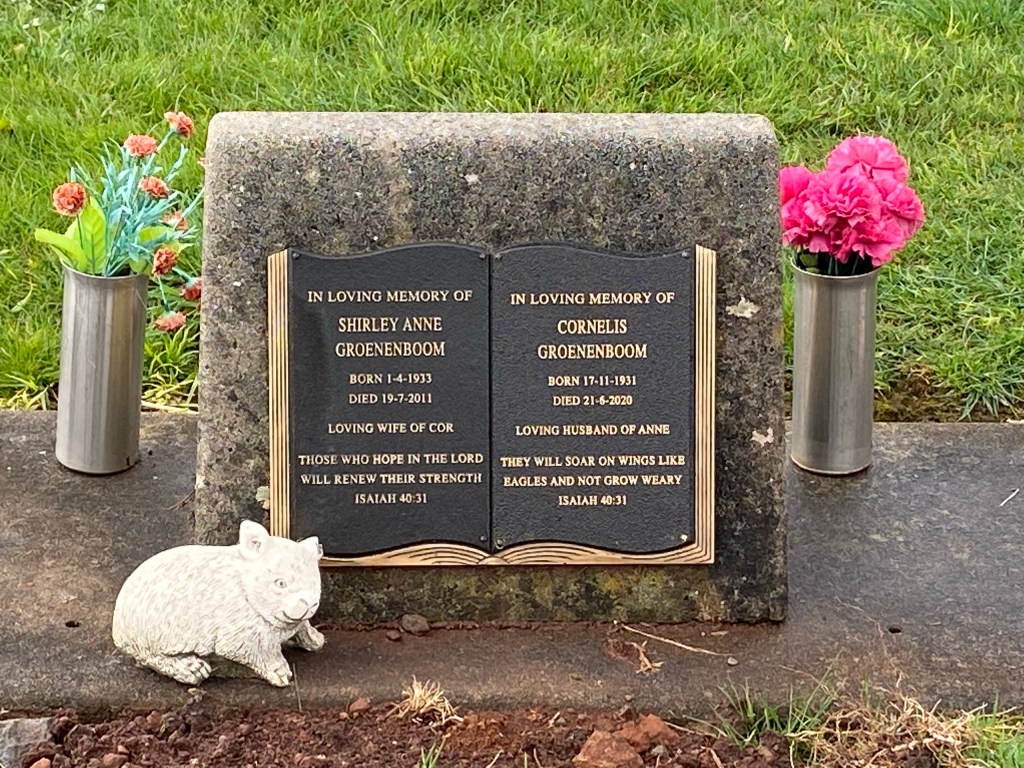
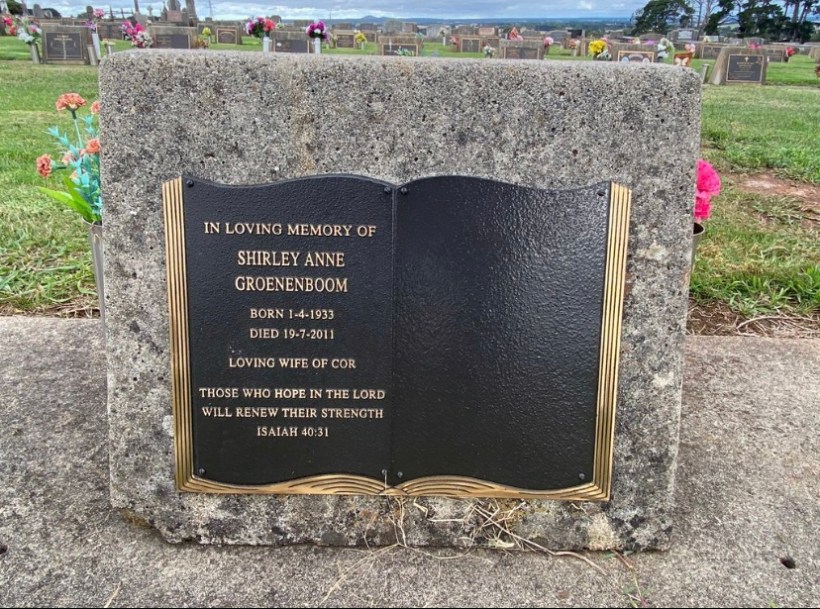
Today my best friend and I went to visit my parents’ grave to see the new plaque that has been added for my dad. It signifies another landmark, of you’ll pardon the pun: all of my responsibilities for Dad’s funeral and memorial have been met. All the jobs are done.
Photo: Joanne Van Leerdam
The past few weeks have seen the dispersal of the last few things that needed to find new homes. Dad’s bed and walker went to an elderly chap who will benefit from them as much as Dad did. The last things to go were some bookshelves, some framed art prints, an organ stool, a couple of shower chairs, and an odds-and-sods collection of Tupperware containers that are too good to throw out but surplus to our needs.
The plaque was the last thing that needed to be finished. It looks lovely, and matches Mum’s plaque perfectly. It’s completion leaves me with a profound sense of achievement and satisfaction, but also one of being at a loose end. Those tasks have kept me busy and feeling like I could do something useful to help process my grief. When I took the photo of the finished headstone this morning, and placed one of my own beloved wombats beside it, I knew it was all done.
And now I don’t know what to do with myself. Oh, I have work and books and all the demands of life to keep me busy, just as I have always done. But that sense of purposeful mourning has run its course, and I am not sure what comes next.
I guess I am about to find out.
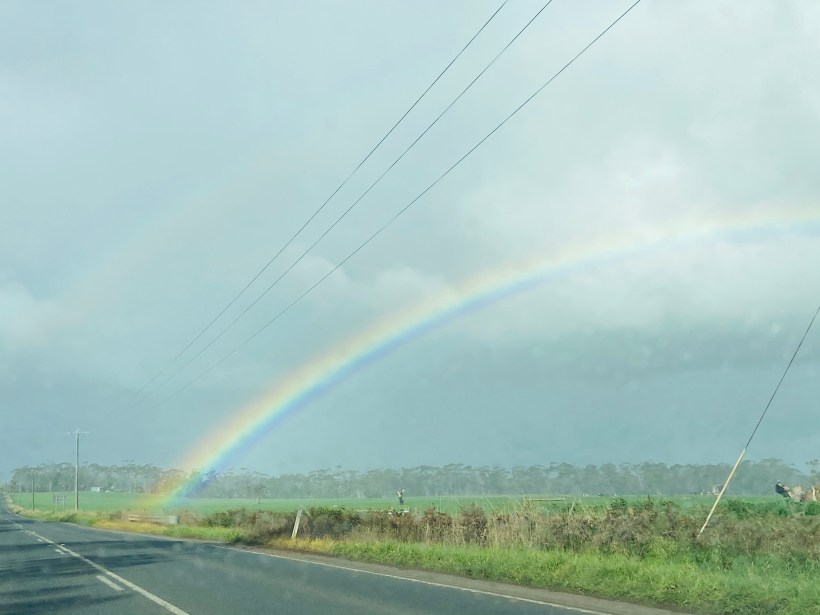
This afternoon I was talking about these feelings with my best friend as we drove home. We were blessed with the most beautiful, bright rainbow — not in the distance, but touching the side of the road as we drove. At one point, we could see the whole rainbow just outside the front and side windows of the car, but I couldn’t successfully take a photo of it.
Image Joanne Van Leerdam
“After today, and everything I was just saying… it’s like God telling me everything is going to be okay. It sucks that Dad is gone, but I’ll be alright.”
“it absolutely is,” she said. “You’ll be alright. We all will.”
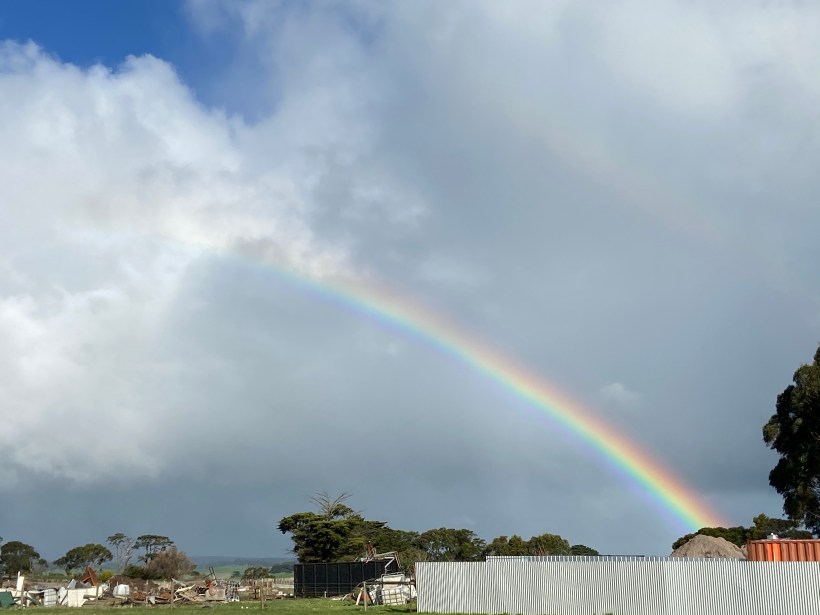
And when we got home, we were greeted with another rainbow.
While I’ve been on my own grief journey recently, many others are experiencing grief of their own. And in this time of social and travel restrictions in Australia and elsewhere, people’s sorrow and grief is being complicated by distance and isolation.
I have seen this happen multiple times within my own circle of family and friends in just the past few weeks.
My brother in Canada lost his own brother a couple of weeks ago. It was unexpected, and therefore an enormous shock.
Talking with my brother and trying to support him via instant messaging has been a blessing for both of us – to share the pain eases it somehow, if only slightly. But what I really wanted to do was get on a plane and go there to hug him and support him in person. Even if I couldn’t go immediately, the knowledge that I’d be there at some point soon would encourage him enormously.
Sadly, it’s just not possible. My state is in lockdown. We are under strict conditions for leaving home. International travel for personal reasons is not possible. Heck, going anywhere at all beyond my local supermarket or pharmacy in the time of COVID-19 is ridiculously problematic, and probably not really safe given my lousy immunity. As it is, I have to stay here and he has to be there.
He knows I’m with him in spirit, but it just doesn’t seem enough. I know how hard it was to lose a loved family member and a close friend within five days of each other, and his brother was both those things to him. I know how hard it was to deal with the trauma, and I had my family around me. I’ve been painfully aware of the fact that he lives on his own, some distance from the rest of the family, and hasn’t had the close support that I’ve had.
After losing our father in June, my sister has lost two good friends and another friend she has known for more than forty years in the space of a month. I’ve been able to talk with her and listen to her express her shock and sadness, but I haven’t been able to hug her or help her in any physical way because we’re hundreds of kilometers apart.
A friend lost his uncle this week, and be there to grieve with his family because his uncle lived interstate and our border is closed. It doesn’t matter to the authorities how close he was to his uncle, nor do they care that his uncle was a father figure for him and helped raise him. The rules apply to everyone, regardless of personal circumstance. It’s understandable, but it makes the pain and misery so much worse.
It’s not just immediate grief that is complicated by distance, either, My beloved late friend’s husband and son have both had birthdays in the past couple of weeks, and I would have so loved to be there to support them as they struggled with not wanting to celebrate, and not being able to see the rest of the family because their lockdown restrictions are so tight. They’re all dealing with curfews, stay home orders, and only being allowed to travel within five kilometres of home for essential purposes. It’s not so restricted here, but nobody is allowed to visit Melbourne for social reasons, so that’s that.
The result for all of them, and for everyone experiencing grief in the time of corona, is a vicious cycle of mental and emotional distress as sorrow and isolation feed on each other. The effect on one’s wellbeing is profound.
My heart aches for everyone in that situation. I can’t imagine how much worse it must be for those who have actually lost loved ones to the virus and haven’t been able to be with them, or with their family members as they grieve.
We are all struggling with the impact of the virus and the social restrictions it has brought to our lives, but let’s remember that there are some who are really, really doing it tough. It certainly puts the inconveniences of wearing a mask outside of home and sanitizing our hands fifty times a day into perspective.
It may not seem like much, but a phone call or message to someone can make a huge difference in their day and in their mental and emotional health. Being willing to care and to listen is an act of love and support of immense value.
Tristful is an archaic word that means to be melancholy or full of sadness. Like forswunk and forwallowed, it is a word which is said to be obsolete now, but it is so beautiful that I want to bring it back.
It came into the English language, as many words did, courtesy of the Normans and the Plantagenets, in medieval times. The Latin word tristis gave French the word triste, which gave English trist meaning sad or gloomy, and thus tristful.
I discovered this word today while looking for words to describe my feelings and state of mind at this point in my grief journey. Over the past few days, I have been feeling as though everything is too hard, and I just want to withdraw into my cocoon and wallow. I’m not angry, nor am I ungrateful, but I am definitely not numb. My emotions are very close to the surface, and at times I am unable to hold back the tears.
I know all of that is completely natural, and I know I need to accept it and work through it. I know it won’t last forever.
But I also needed the words to understand and express my emotions.
I have been using the term ‘melancholy’ a lot, and it describes my condition perfectly. However, I know that while one cannot actually wear a word out, it is entirely possible to cheapen it with overuse. Melancholy is a word that I love because it is so expressive, and because it’s beautiful to say and to hear, so I would hate to be guilty of turning it into a cliche.
Sad isn’t deep enough. Miserable would be appropriate, but it feels more temporary and somehow more minor than what I am experiencing.
I very quickly rejected morose and in a funk because both suggest sullenness or a bad mood, which is not reflective of my feelings or state of mind. Moody was no better.
When I saw tristful listed in my thesaurus under the entry for melancholy, I had an immediate sense of having discovered a gem that most people had laid aside and forgotten about. As I researched its meaning and etymology, I knew I had discovered the perfect alternative.
Tristful: to be melancholy or full of sadness. #words #emotions #etymology #English #blogpost
I woke up this morning miserably aware that not only is it exactly four weeks since the day my dad passed away, in is also the anniversary of my mother’s passing.
I miss them both enormously, but somewhat differently. It as yet another vivid reminder that grief doesn’t necessarily get easier; instead, it changes over time.
The emotions I feel over Dad’s passing are still quite raw and very close to the surface. They often overflow, especially in the quiet times and in the mornings, and when I see something or go to a place that was meaningful to Dad, or hear a piece of music he loved, and even more so when I do something on my own that we used to do together.
Still, I recognise that my grief for Dad is mellowing. The abject misery and gut-wrenching sobs of fresh mourning are giving way to less intense, but just as abiding, sadness that overlays each day.
There are reminders when I’m in the supermarket because I only need to feed two people, but I have to remember to pick up extra cat food because his beloved kitty is waiting for her new people to move into the house. Each day, I spend cuddle time with her because she is lonely, too. And spending time in his house without him is a bit weird, so I am keen for the house to be filled those people and life and conversations and music and laughter again, too. They have started to move some things in, and it actually helps to see their cups in the cupboard and their pictures on the wall instead of his.
Some days, like today, are harder than others. Other days, the demands of life, the mental challenges of teaching and interacting with kids, and time spent with those close to me are things that provide welcome distractions.
I have been really surprised, though, by my lack of desire to stay home on my own for any length of time, which is most unusual for my introverted self.
I think that comes from home being full of reminders and triggers that prompt me to think about how much I miss Dad, and about how things changed so quickly. It’s not just the obvious things like his hat or his walking stick, which I have kept. It’s the emptiness of his favourite chair in my study, and the fact that he isn’t coming in asking to go to the shops, and suddenness of having complete freedom on my days off because I don’t have to take him to appointments, and he’s just not there to pop in and visit, either.
For almost nine years, I would drive past Lovelybanks and think about how that was where Mum had been in care, and how hard it was to visit her when she barely remembered me anymore. I would think about the day she died: it was a grey, cold day, much like today is. When Dad moved in there, the hardest thing about visiting him was walking past the room where Mum spent the last months and that last day of her life, when I sat with her and held her hand and said my last goodbyes. Now, I drive past and it feels strange to not call in to visit Dad, as was my habit when he was there. I wonder how that came to feel so normal when he was only there for three weeks.
I have also been contending with the sneaky, private guilt that tries to insinuate itself into those times when I think or say things like “I no longer have to do x or y” or “We can do whatever we want to now that we’re not caring for Dad anymore”. I refuse to accept or allow that guilt, because I know that I faithfully and lovingly did everything possible to take care of my dad, and so did my husband and the rest of the family. And yet, that guilt keeps on showing up and trying to get its foot in the door.
My grief for Mum is definitely gentler most of the time. Her birthday, Mother’s’ Day, their wedding anniversary and the anniversary her passing are days when the emotions are more powerful and painful. Every year, I think maybe it won’t happen, but it does. It seems grief has a mind and a memory as sharp as my own.
I’ve also been confronted with lots of memories of Mum while organising things for Dad. Going through old photos, writing his eulogy, retelling family stories and memories with my siblings and their partners, children and grandchildren, and cleaning out the home Mum and Dad shared have all been healthy but highly emotional experiences.
Dad used to tell me I was just like my mother. And in many ways, I am: her love of words and word play, her love of poetry, her gift of teaching, her sense of justice, her art of mediation and moderation. Some people say I look like her, although I don’t think I particularly do. Perhaps it’s mannerisms or expressions that make them think so. I know that sometimes I open my mouth and my mother comes out of it, especially when admonishing one of my less cooperative students. She was really good at that— I can testify from personal experience. Mum always wanted to write a book, but never did, so I know she would have been proud of me for achieving that not just once, but thirteen times.
I know that I am a lot like my Dad, too. I’m pretty sure that is where my cheeky humour comes from, and my impatience when I am frustrated or in pain is a lot like his.
There is a lot of me that comes from both of them, though: my faith, my love of books and reading, my love of learning, my love for and commitment to my family, and my loyalty. They taught me perseverance and a strong work ethic. They taught me far more than I can possibly identify or list here.
When they lost their own parents and other loved ones, they taught me that it’s okay to grieve and necessary to cry, and they taught me that life keeps going regardless.
The one thing they never taught me was how to not to miss them. That’s one lesson I don’t think I will ever learn.
The Mellowing of Grief #grief #griefjourney #emotions #personal #blogpost
I love willow trees. They look so graceful, and yet they can also be be wistful or sad or dramatic at different times. You can hide within the curtain of the branches, where the sunlight is filtered to be much more gentle and mellow, and the branches become an almost translucent veil that conceals you from the world. It’s a wonderful shady place to hide on a hot afternoon. At night, under moonlight, they can be eerie or downright spooky depending on the weather.
Recently, I have felt as though the trailing habit and bare branches of the willows — it’s winter here in Australia— provide imagery that I can really relate to. I’ve been sad and mournful. I have looked to the quiet beauty of nature for comfort. I have strong roots in faith, family and friendship that have held me firm during a turbulent month of anguish, loss and grief. And even when I don’t seem to be thriving, I’m alive on the inside.
Those are the truths that I drew on when writing this poem. I wanted to evoke sadness, but maintain hope of better things to come. I wanted to look forward to spring while experiencing winter.
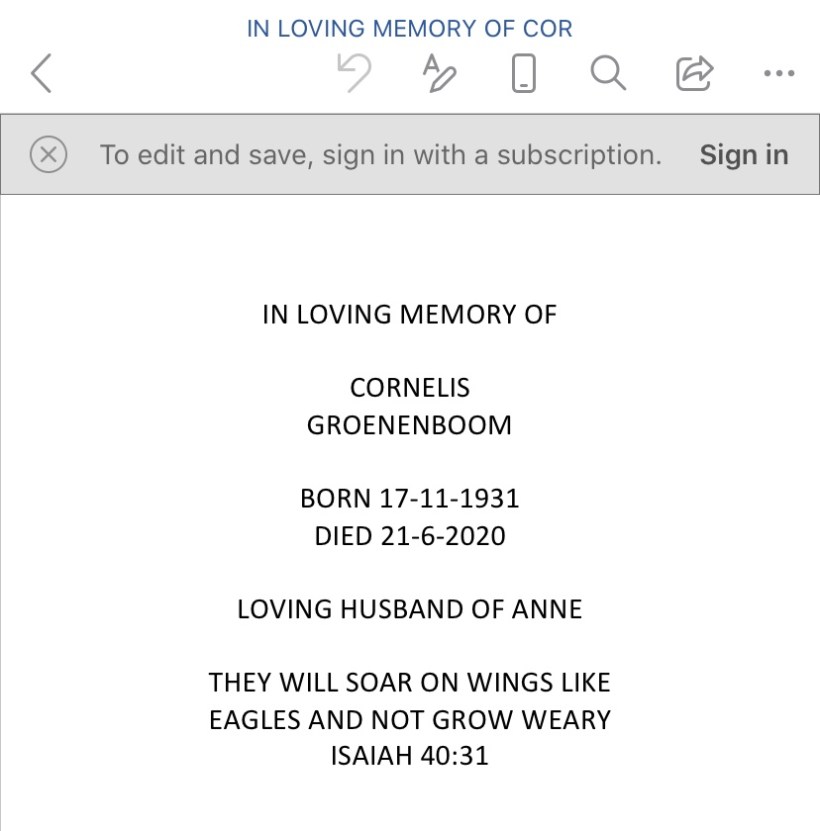
Today’s important task was to finalise the wording for the plaque on Dad’s half of the headstone he shares with Mum, so that we could order it and have it done.
Most of the inscription was easy enough – name, dates of birth and death, and “loving husband of Anne”.
The challenge for my brother, sisters and myself was which bible verse to include. We knew Dad’s favourite passage was Romans 8, but that was way too long, and far too complex, to include or even simplify. We’re limited to 10-12 words, so it needed to be short but still meaningful, and reflect Dad’s faith as his final message.
There were some really good suggestions made.
This morning I texted my siblings a list of the “top eight” for their consideration and vote.
As it turned out, the decision almost made itself when my sister asked, “Why don’t we just continue the verse that’s on Mum’s?”
The simplicity and beauty of that idea took my breath. Mum’s side of the plaque has the first line of Isaiah 40:31 “They that hope in the Lord shall renew their strength”.
It was the verse that Dad chose for Mum’s inscription, so we knew Dad would have approved. It was a way of embracing their unity, too. They shared 58 years of marriage, they shared five different homes in that time, and they shared four amazing and super-talented children. Now, their earthly remains share a final resting place while their souls share eternity in heaven. Sharing such a beautiful Scripture on their headstone seemed to be a lovely reflection of their shared faith.
Still, it was another reminder that Dad is gone, another challenge to meet head on, and another emotional hurdle to overleap.
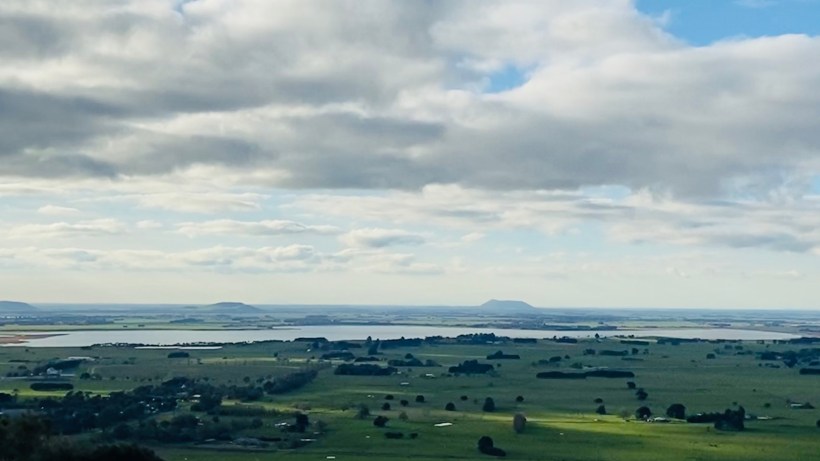
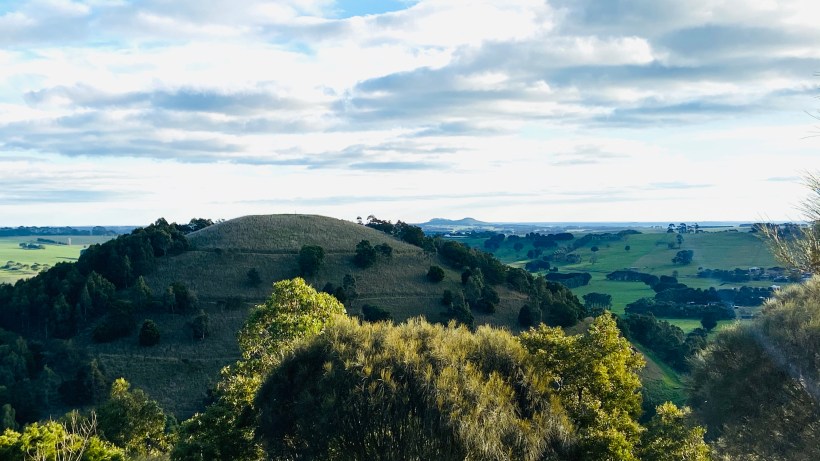
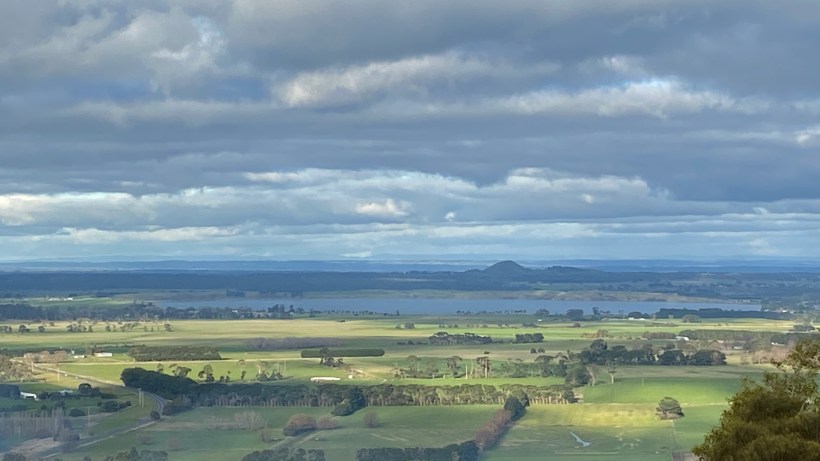
Feeling the weight of the moment, I went for a drive to one of my favourite thinking places: on top of Mt Leura, overlooking Camperdown and the volcanic plains and lakes of the area, where I have sat and thought, or taken photos, or walked, or written, or listened, or prayed, or rested, or had dinner before a theatre company rehearsal, at least a hundred times.
The inscription we chose for Dad’s plaque.
I typed up the text of the inscription for Dad’s plaque, ready for ordering. I knew the words, and I am pro at typing, but still, that was hard.
“Maybe I shouldn’t be on my own right now,” I whispered to nobody but me.
I got out of the car, and walked the short distance up to the top of the lookout.
And then, for the first time ever in all the times I have been there, a wedge-tailed eagle flew overhead, soaring in the sky above me.
It was there, and then it was gone. I was so caught up in the moment that I didn’t even manage to get my phone out of my pocket in time. I so wish I had, though.
I’m not the biggest believer in coincidences. In that moment, I accepted it as a sign: a reminder that although I was by myself, I wasn’t actually alone at that point in time.
Hm. I think there’s a poem in that.
On Eagle’s Wings. #TrueStory #MyLife #grief #coincidence #eagle #personal #blogpost
Today’s professional development day at school focused on Positive Education and how we can help our students and our communities to flourish.
One of the aspects I found most thought-provoking was the discussion about positive or comfortable emotions and negative or uncomfortable emotions. It was particularly relevant to many of the things I have been experiencing and observing about life in recent weeks, and I want to share my observations and reflections on those things with you here.
Before I go any further, though, I want to make it absolutely clear that I am not a medical or psychological expert or professional. I am, however, a high school teacher of 30 years’ experience, so I have had time and opportunity to make some observations about the things that happen in life and how we deal with them.
More personally, as someone who experiences chronic physical issues and mental health challenges, and who has experienced many conflicting emotions recently due to profound personal loss, I’m confident I know at least a little bit about dealing with adversity, and I’ve learned a few things about the importance of balancing negative emotions with positive ones.
Both positive and negative emotions can be powerfully motivating. Fear of failure or embarrassment is as strong, or stronger, in some people as desire for success is in others.
Negative or uncomfortable emotions can motivate and fuel positive outcomes such as creativity, empathy, and relationship building.
Positive and negative emotions can actually be highly effective ‘companion emotions‘. I don’t expect that this is a scientific term at all, but it seems to me a useful term that describes how contrasting emotions experienced at the same time can provide some healthy balance and perspective.
I can testify from the past few weeks that gratitude can moderate grief, and enjoying a few quiet moments in the beauty of nature can transform abject misery into much gentler sadness.
In different contexts, fear can be a healthy addition to awe or wonder – think of a child at the zoo, for example, for whom interest and desire to engage with the animals should always be balanced with both respect and a little fear or mistrust, so that the child and the animals all remain safe. In yet another situation, a little anxiety or nervousness can actually heighten deliberate preparation and performance if it is paired with intentional and thoughtful preparation, because it can stop one from making rushed or careless errors, or from taking success for granted.
Life is not about always avoiding the feelings that make us uncomfortable or sad. Hoping to do so isn’t realistic at all, given that there are many situations that we can neither actually control or entirely avoid.
Instead, it’s crucial that each of us learns to manage those negative or uncomfortable feelings and use the situations in which we encounter them to develop and consolidate our personal strengths and resilience. Learning to look for the positives in life and choosing to find a balance for the negative experiences or emotions we encounter is how we grow and move forward in life.
“Whether dealing with a major lifeshattering event or a small bump in the road, we can use gratitude to help boost our happiness and change our outlook. While gratitude won’t change our circumstances, experts say gratitude can change how we feel about them.”
That’s certainly what I’m seeking to do while working through my grief. It’s okay to take the time to mourn my losses, but I can’t afford to unpack and live there. Finding a constructive way through my pain will enable me to heal, and come out stronger at the other end.
In being honest about how I feel and what I’m thinking in my posts on this blog, my hope is that my words will help and encourage someone else get through their personal challenges, whatever they are, and to deal with both their circumstances and their feelings.
I have no doubt that knowing we are not the only ones going through grief or pain or whatever trial it is that is burdening us actually helps us to start to heal. That’s why empathy and compassion are so powerful. That’s why the support and love of family and friends is what we yearn for and seek out when things are hard.
Tonight, as I reflected on these ideas and considered the fact that I had no evidence for my inexpert assertions, I did find a number of articles that show my conclusions are consistent with current science and research surrounding emotional and mental health.
Of those articles, some were quite wordy and far too academic to be accessible, but I did find two easily readable and very interesting pieces that discuss the ways in which positive emotions such as gratitude and self-compassion can help individuals deal with adverse situations more constructively. They are: ‘Your Brain on Gratitude’ by Paula Felps via livehappy.com ’The Reason You Make Unhealthy Choices’ by Mandy Oaklander via time.com
“Being kind to yourself, as opposed to tearing yourself down, leads to fewer bad feelings and, in turn, healthier actions.”
Tonight, I am contemplating — somewhat anxiously — what tomorrow will bring. That’s fairly standard territory the night before returning to school for a new term, but right now it’s even more complicated than usual.
Phrases like “back into routine” and “good to keep busy” have been bandied about altogether too casually by people who don’t understand how I feel. In one sense, things may seem as though they are “returning to normal”, but I don’t feel that way at all. Instead, it feels very much like I’m stepping into the vast unknown.
The world out there is anything but normal.
The state in which I live ihas been cut off from the rest of the country by border restrictions because of the COVID-19 outbreak in Melbourne. We’ve all been quarantined to an extent, and Melbourne itself is locked down much tighter than we are out here in the western region of the state.
The distance between us and Melbourne is no room for complacency, though. Just today we heard the news that Warrnambool, the regional city in which I work, has reported its first active case in months. It’s sobering news, and terrible timing for the beginning of a new school term. Honestly, it just adds a greater sense of impending doom to the craziness that is going on out there.
I’m keen to see my students, though. My hope is that they will take my mind off things through each school day and keep me motivated when I’m feeling low.
So, I’ve invested in masks and extra sanitiser. I even have sprays to disinfect any work the kids hand in. I will be even more conscientious and deliberate about social distancing, because I don’t trust other people to do the right things. At least my natural cynicism about human nature is intac which, I suppose, is something.
Life isn’t ‘normal’ on a personal level either.
I miss Dad. I miss Helen. Enormously.
I have lost two of the constant, consistent encouragers in my life. I keep thinking of things I want to tell them, and photos I want to show them, and I can’t. I want them to know about my new great-nephew. I want to tell them I love them. It’s really, really hard.
I’m trying to work through my grief, but that isn’t going to happen according to any timetable. That’s a process that will take as much time as it will take.
The past three weeks have changed me, although I can’t define exactly how.
I feel like I should be more resilient, or better at handling things, or at least better at faking an appearance of being able to manage, but I’m not.
I feel like I should look different somehow, but I probably don’t.
That is, of course, if you don’t look too closely at the dark circles under my eyes. Sleep has been evasive ever since Dad was admitted to hospital with coronary issues on June 16. During the week in which both he and Helen passed away, I barely slept at all. Last night I managed seven hours, but it was in two instalments with an hour off at half time. It’s no wonder I feel like rubbish.
My purpose in expressing my thoughts and feelings here is not to moan or whine. I know I am not the only person experiencing these things. I am not the only person experiencing grief, or lugging emotional baggage everywhere.
I want others in similar situations to understand that there is nothing wrong with feeling the way they do. All of this is part of the grieving process, and it’s crucial to be kind and patient with ourselves while we sort our various burdens out.
I want other people to understand that they can’t expect people who are grieving, or anxious, or caring any other kind of burden for that matter, to feel a certain way or simply “get over things” in any set period of time.
Grief is not a tidy and well-organised domain. Everyone experiences it differently. It brings with it a whole variety of secondary emotions that are unpredictable at best. Denying it, suppressing it, or trying to make our grief fit preconceived expectations are futile and unhealthy ways of dealing with it.
That means each of us has to deal with it in our own time, and each of us can expect to be as messy as our grief. Each of us will, at some point, have to step out into a world that has changed significantly and irreversibly.
Acceptance, kindness, patience and self-care will help to make that a healthier process for everyone.
Stepping Back Into A Changed World #grief #emotions #anxiety #personal #blogpost
I was asked to write a poem for my friend’s funeral, and to read it during the graveside ceremony.
In all honesty, I’m not sure how I managed to do that. It was hard, and confronting, and very emotional.
But I wanted to honour her. I valued the opportunity to speak what we were all feeling. And I cherished the fact that they asked me to do this for them.
I drew on every skill I have as an actor and a public speaker to do it, but it was no performance. It came from the very depths of my heart and soul.
I love her enormously and I miss her terribly. And, in that, I am not alone. She was a wonderful, wise, caring, loyal and inspiring woman.
With the permission of her husband, I am sharing the poem I wrote for her, and for her family, with you today.
Image: MoiraKarem via Pixabay
For you, no more waiting for heaven, And no more praying for peace: Your fight is over, your work is done, You have found your eternal release.
I wasn’t ready for you to leave— But I never would have been, So I remain here, without you, In this miserable in-between.
My heart is broken, my words are gone, I have cried a million tears, And the hurt cascades inside me Each time I realise you’re not here.
We made a lifetime of memories, Full of family, friendship and song, And I know it was just a rehearsal For where you are now, all along.
But this feels nothing like heaven: I so miss your warmth and your smile, The music you brought to every day, The way you made each day worthwhile.
I will always love you and miss you, And life will never be the…






 WordyNerdBird