The Workers Australia Can't Do Without.

When half the country seems to be working from home, there are some very dedicated people keeping the place going.

As Australia has begun the process of going into partial lockdown in response to the corona virus pandemic, it is becoming astoundingly clear who the country cannot do without. 

Here’s the thing: it’s not the billionaires, the movie stars or rock singers, the football players or the fashion models. 

Don’t get me wrong. They’re important people. But who are the ones we rely on to keep doing what they do so that the majority of the population can actually isolate or socially distance themselves in comfort and safety? Who is actually unable to stop working and stay home in the interests of self-preservation?

It’s the doctors and nurses, police officers, firefighters, and paramedics, the people who stack supermarket shelves and work the checkouts, and the teachers. It’s the people who work the service stations and fast-food and takeaway restaurants, the cleaners, the truck drivers, the retail workers… and the list goes on. 

They are the people who are still going to work every day, regardless of their potential exposure to germs – and not just Covid-19, either — and to the frustrations, anxieties and hostility of the general public. 

Most of them can’t work from home. And, with the possible exception of the doctors, most are paid nowhere near what they are worth. 

Teachers could, of course, deliver their lessons online as my own school is planning to do if we are ordered to close the college. That’s not as easy as it sounds, either, especially with younger students. It’s a lot more planning and preparation every day, as the curriculum will still need to be delivered as fully as possible. There won’t be any less marking, either. 

Of course, whether or not schools will be closed is still a matter of debate in Australia. The government doesn’t want to close the schools, because that would mean the people in medical jobs would have to stay home to look after their kids. Who would look after the sick people then? 

So when you are out shopping for groceries and annoyed that the shelves are half empty, don’t take your frustrations out on the store workers: they can’t stack shelves with what has not been supplied. Save the blame for the people hoarding basic goods out of selfishness and greed. They’re the real reason you can’t buy the basics at the moment. And let’s be honest: when those people are at home self-isolating and eating ten people’s worth of pasta and rice, and the loo gets blocked up with all that hoarded toilet paper… they’ll still want the plumber to come out and fix it. 

When you have to wait in a longer-than-usual line to collect takeaway food, don’t give the servers attitude for the delay. They are doing their best under extremely demanding circumstances. And remember, they are saving you the effort of cooking for yourself, so there’s that to be thankful for. 

When you see a medical worker or first responder getting coffee or taking a break, don’t kvetch about them having some downtime. Instead, thank them for the tough job they’re doing, especially if it’s a job you wouldn’t want to be doing during a global health crisis. 

When you hear about nursing homes, hospitals and schools closing their doors and not allowing visitors in, don’t complain about inconvenience or behave like its an overreaction. Thank them for being proactive in taking extra measures to protect the people for whom they have a duty of care. 

When you hear people complain about the inconvenience of social distancing and working from home, remind them that some people don’t have the ability to do so. 

They are the workers on the front line, keeping the country going while everyone else stays home. They should not be on the receiving end of anyone’s bad behaviour.

A Punny Thing Happened In My History Class Today…

Image by Gerd Altmann from Pixabay

I’ve mentioned here before that I enjoy a good pun. Today, to my delight, one of my students came up with a pretty good one, so I responded in kind.

It happened in history, where my students were mapping the three arenas of WWII.

Student A: Syria. Sy-ri-a. *grins* Are you…syyyyyyrias? 
Me: Hey, I was just dam-ask in’…
Student B: That’s SO bad. 

Well, we laughed hard. And then student A explained it to the rest of the class, and they laughed too.

Poor Student B, though. As Student A explained, he put his head on the table and moaned, “It’s like having my dad in the room… twice!”

Still, it it wasn’t enough to stop him from piping up a little later.

Student B: Did you know that it wasn’t just Darwin, Broome got bombed too? 
Me: Yes, the Japanese swept right across north-west Australia…
Student A: Haha! That’s genius! 
Student B: No. NO. That’s awful! 
Me: I didn’t expect you to bristle like that. 
Student B: I’m leaving. *walks out of the room*
Student C: Where’s B? 
Me: *just as B is walking back in* I made a joke and he flew off the handle. 
Student B: No. *walks out again*

It was a fun moment which we all enjoyed, but it also made the facts the students were working with more memorable. Once we’d had a laugh, they all just kept on working.

Opportunities like that don’t happen all the time, but when they do, they are welcome.

Humour is such good medicine, and it makes excellent social glue. It was wonderful to be able to laugh together during a week when the world seems far more uncertain and a lot less enjoyable than it did a couple of weeks ago.

I’m thankful that my students have the confidence to express themselves in my classroom, and that they do it in ways that are clever and fun. It really is a huge blessing to be able to have such great rapport with my students, and these kids make it easy to keep going to work every day.

These anecdotes were retold here with the permission of the students involved.

History isn’t “horrible”, it’s essential….!

Image by Walkerssk from Pixabay

While I agree with the author of this post that, in many places, history is taught differently and with a much more recent focus than in previous years, there are places where a broad spectrum of history is taught well.

In Victoria, Australia, the history curriculum is quite comprehensive in that it includes the study of ancient, medieval and modern civilisations and the issues and events that shaped and defined them.

By the time students at my school finish their compulsory education at the end of Year 10, for example, they will have studied Ancient Egypt, Israel and Babylon, medieval civilisations in Europe and Asia, the Agricultural and Industrial Revolutions, both World Wars, the Civil Rights Movements in the US and Australia, and various elements of life in 20th Century Australia.

Like the author of this post, I am passionate about history, and I strive to make it interesting, relevant and engaging for my students. My interactions and experience with other teachers of the Humanities leads me to believe that this is true of most. We may all have different areas of particular interest and expertise, but we have a common goal: to inspire and teach so that students have an awareness of where we’ve come from, how far we’ve come, and how to apply that knowledge so that we avoid repeating the mistakes of the past in the future.

viscountessw's avatarmurreyandblue

Richard III – from ‘Horrible Histories’

“…Imagine knowing the entire list of British monarchs by heart at age 10. Imagine knowing about cavemen courting rituals or what soldiers ate during World War I. Imagine becoming so invested in the life of the infamous King Richard III of England that you joined the Richard III Society, a group dedicated to finding his bones and solving the mystery of what happened to his nephews over 500 years ago…”

The extract above is from this study breaks article which, as you might guess, is all about ‘Horrible Histories’!

It made me think, because I did know my English/British monarchs by the age of 10…by 8/9 in fact. There was a chart on my bedroom wall and it faced me when I sat up in bed. I noticed Richard III even then, because he was so different from the rest. Slender, dark-haired, troubled…or so…

View original post 185 more words

Classy Humour.

I love the fact that my students have great senses of humour. They’re quirky and fun, and they know they have the freedom to express that in my classes.

Last week, one of my students told me a funny story about what he did in Biology class. To his delight, I appreciated the humour a lot more than his classmates or the Biology teacher had done.

He was more than willing to give me permission to write his story creatively. I decided a Drabble would be perfect for creating a snapshot of that moment in the classroom.

I hope you enjoy his very classy humour as much as I did.

And thank you, James, for making me laugh on a regular basis. You’re a legend.

wordynerdbird's avatar

The teacher stood at the front of the room, textbook in hand, as the students settled down to business. 

“Please open your text book to page four hundred and four, and… yes, James?”

The teacher looked with anticipation at the young man sitting in the second row, hand raised and an awkward smile on his face. 

“That page cannot he found.” 

His classmates looked confusedly at James, and then at the specified page in their own books.

The teacher frowned. “Are you sure? There must be some kind of mistake.”

James’ smile became a triumphant grin. “It’s an error 404.”

***

Credit for this story must be given to my student, James, who actually did this in one of his classes, and gave me permission to write it as a drabble.

View original post

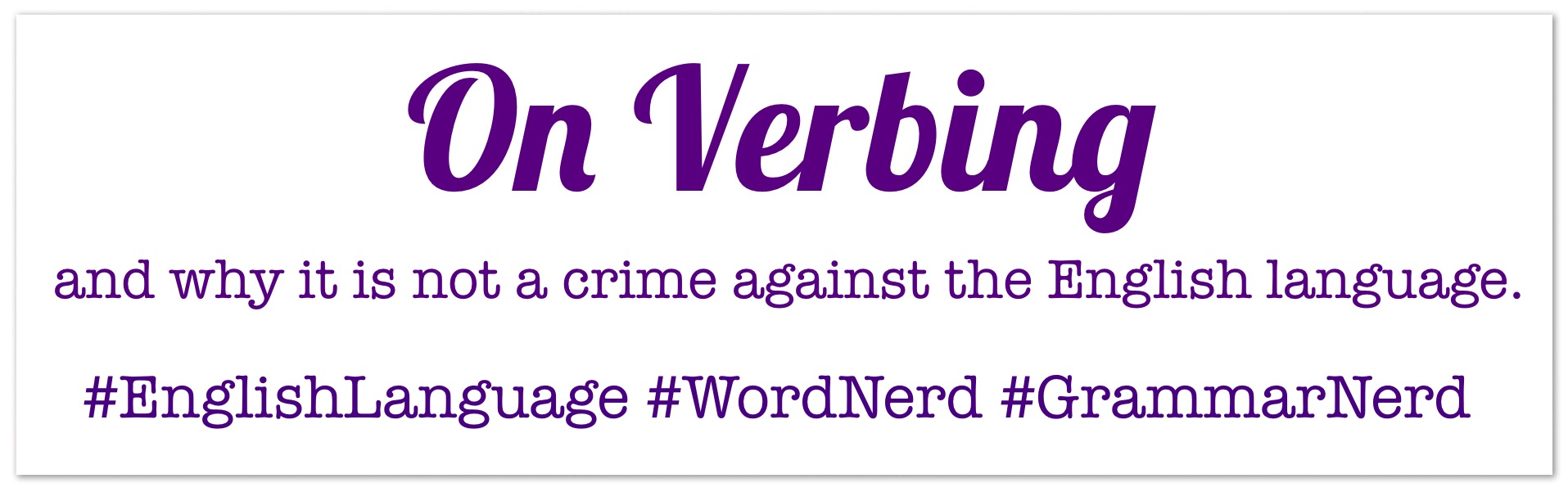
On Verbing

Most of the time, when people protest about the way the English language is abused, it’s a case of the language continuing to evolve as it has always done.

One such example is the practice of verbing, which takes the noun form of a word and transforms it into a verb form… like ‘verb’ and ‘verbing’. 

Just last week, I was talking with a friend about how annoying she finds it when people say “I’m going to action that.” I’m sure she sought me out for the conversation because I’m both a word nerd and an English teacher. 

“Action is a noun! A bloody noun! How can so many otherwise intelligent people get that wrong?”

“It grates on us because it’s recent,” I said. “We’ll get used to it.”

“No, I won’t! It’s just wrong!”

“You know Shakespeare did it?”

“What?” 

“Verbing. He did it all the time.”

“You and your Shakespeare. It’s like he’s the answer to everything.” 

“You know he invented the word ‘friending’, right?”

She rolled her eyes and walked away. She didn’t even flinch at my use of the term “verbing”, which is exactly the same thing as “actioning” in terms of the language. After all, ‘verb’ is a noun, too. 

It is the recent examples of verbing, such as “actioning” an idea, that we notice because we’re not used to hearing them yet. When Facebook was new, people complained the same way about “friending”, but these days nobody thinks twice about that. At some point in time, someone decided that it was okay to talk about bottling  fruit, or shelving books, and now those terms are just everyday language. 

It is also true, however, that some things people commonly say are, quite simply, wrong

My pet peeve is when my students are talking about sport or some other kind of competition, and they say “We versed Team X”. 

This is a common bastardisation of the Latin versus, which means ‘against’. It is commonly used for sporting matches and legal cases, and is generally abbreviated as v. or vs., as in Black v. White or Blue vs. Red. 

My first response is always to ask whey they wrote poetry about another team. “You played them. You opposed them. You clashed with them. You competed with them. You did not write poetry about them.” Then I explain how the different words work, and what they actually mean. 

The reason “versed” is wrong is because the words ‘versus’ and ‘verse’ have absolutely nothing to do with each other. Because ‘against’ is a preposition, it simply doesn’t make sense to say “We againsted them”. It is not verbing, by any stretch of the imagination. 

The first time we have that conversation, they look at me with confusion. Some have a glazed look of fear, like the proverbial deer caught in the headlights. This never fails to entertain me. The second and third times, they roll their eyes.

Over time, the tedium of having the same grammar-nerdy conversation persuades them to start using the language correctly. They learn, I win, and so does the English language. 

The Squirrels Have Checked Out.

It’s the last day of term. 

Even though I am, like every other teacher, exhausted and keen for that bell to ring at the end of the day, I am still trying desperately to keep the kids on task and get things finished before then. 

The problem is, they’ve already checked out. 
They just don’t care. 
They’re restless. 
They’re talkative. 
They’re twitchy. 
Their eyes have glazed over with the promise of freedom, of late sleep-ins and no school uniforms or restrictions on their social media life for the next two weeks. 

If you’ve ever watched a squirrel running around in a park or a forest, that is the precise image of the mental and emotional engagement in my classroom today.
One or two are evolving into chipmunks as I watch. 

Except for that one kid at the back, who is working like a champion to get everything completed. 
I don’t have favourites, but today I really love that kid. 

Being Fontist.

I am a person who takes others at face value. I don’t immediately classify someone as pretty or ugly, gay or straight, progressive or conservative (unless, either way, they are hateful or prejudiced – then the deal is off) , black or white or some other colour, blonde or brunette, or anything else. I don’t care if they’re plain or fancy, nor do I care if they’re pretty or not. I try to take each person as they are and let their integrity speak louder than their features. I like to get to know them before I make any decisions about them.

When it comes to fonts, however, i am nowhere near as open-minded. Don’t get me wrong – there are plenty of fonts I like, and many others that I will view with an open mind depending on context and purpose. 
But there ARE two or three fonts I really hate. I refuse to use them. I have handed back an assignment or two, asking for it to be reprinted in a more acceptable typeface. It’s true: I am Fontist. 

I wasn’t raised that way.  We didn’t really need to think about fonts back then. When I was growing up, it seemed as thought books were printed in two, maybe three different standard fonts. From memory, there was something like Times New Roman,  a basic Sans Serif, and possibly another standard typewriter-style serif font. There was never a question of what typeface to submit our work in, because computers weren’t a thing and our school work was all handwritten. When I started university, assignments and essays had to be typed and double-spaced, so I used my parents’ typewriter. Of course, it only got to the typing stage when one or two hand-written drafts had been painstakingly written, proofread, edited, and revised. 

Don’t get me wrong: I’m glad those days are over. I appreciate the ease of writing using my laptop as much as anyone else, and I’m happy for my students to do some – but not all – of their work on their devices. 
My underlying Fontism rears its ugly head, though, when someone hands in an assignment or broadcasts a presentation on the screen that screams “ridiculous font” louder than anything the student is trying to communicate. The same thing happens in meetings and seminars where the important information is obscured by the poor choice of font on the screen or handout. 

You might think I’m overreacting. But consider this: I might read fifty student assignments in less than a week, or sit through twenty five student presentations in two or three days. When their font suggests I shouldn’t be taking their work seriously, that’s a complication neither they nor I need. 

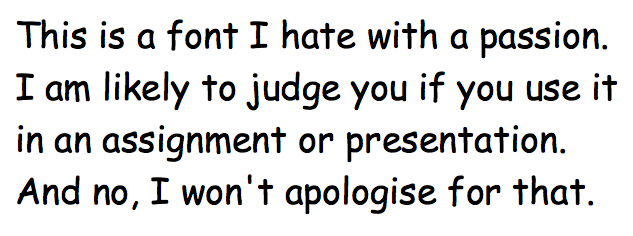
Right at the top of my hate list is Comic Sans. It looks childish, and gets increasingly ridiculous as the size increases, to the point where it is almost impossible for me to take anything printed in that font seriously. It is a font that should never be used for school work of any description by anyone older than six, nor should it be used for slide shows and presentations.  Yes, it is “nice and clear for people to read”, but so are about 3000 other fonts one could choose. If your audience is not entirely in the First Grade, choose something else. 

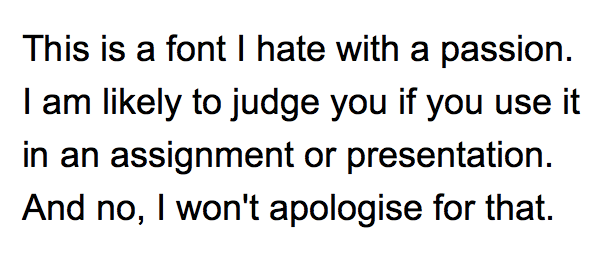
Another font I hate is Arial. Yes, it is also nice and clear for people to read. It is also entirely bland and unimaginative. Arial is the font equivalent of still having that original iPhone Marimba ring tone from 2008 on your new iPhoneX when you have 2500 different songs on your playlists.  It is the font for lazy people who don’t care how their work looks. It doesn’t take much effort to switch so something equally clear but which looks a lot more polished and professional. In a word: boring. 

The other fonts I really dislike fall into two groups: anything over-decorative and wrongly sized formatting

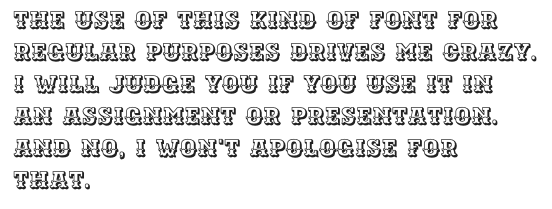
Over decorative fonts have their place, but trying to read a block of text printed in anything full of swirls and flourishes or trippy lines and shadows will make a teacher’s eyes bleed in less than three minutes. Decorative fonts can work really well for titles, or for a special capital letter or character to start a page or chapter, but they fail miserably for anything that needs to communicate information or arguments clearly and effectively. 

In a similar vein, text printed too small or too large is equally frustrating. If it’s too small and condensed, it’s hard to read and… you guessed it, bleeding eyeballs. At the other end of the equation, students may think they can fool me into believing their 337words meets the 500 word minimum word count if their work is formatted in size 15 Helvetica, but my teacher brain knows better. My teacher brain has been doing this a lot longer than they have. 

So, I guess this is me coming out of the classroom cupboard and acknowledging the ugliness of the deep-seated prejudice that lies deep within me. It is equally as rampant and undeniable as the grammar nerdism that I make no attempt to hide.

Call me fussy. Call me Fontist. I’m okay with that. But don’t call me to complain if I’ve asked your teen cherub to reprint an assignment so that I can read it without tears. Trust me – it’s better that way, and I’ve tried to be nice about it. Well, I’ve probably been nice.. 

Maybe. 

Unless they are a repeat offender. In that case, there are no guarantees. 

Women in History: Claudette Colvin

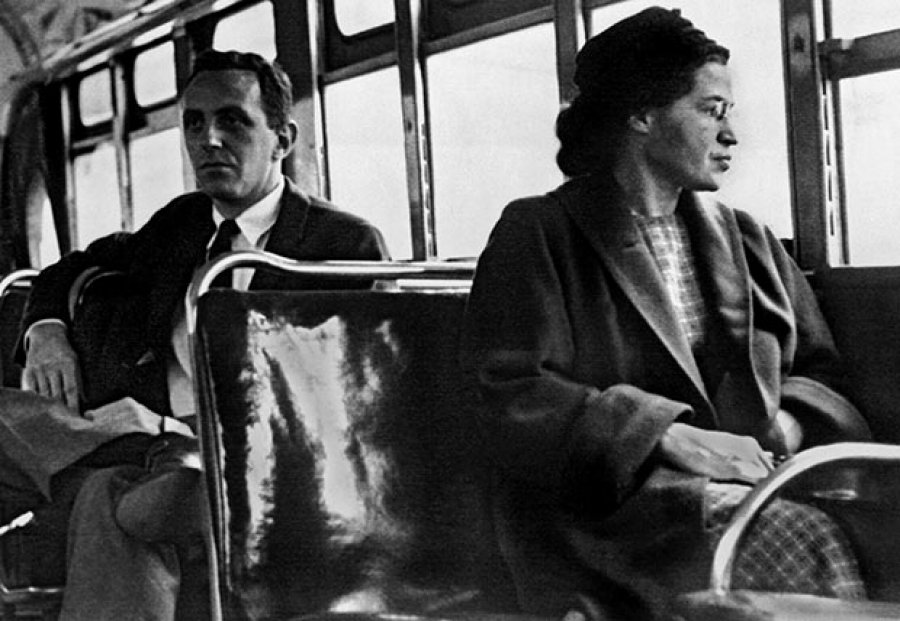
We’ve all heard of Rosa Parks, and rightly so. Her refusal to give up her seat to a white person on a segregated bus sparked the Montgomery Bus Boycott and was a pivotal moment in the Civil Rights Movement in the United States. 

The very bus on which she rode is in the Henry Ford Museum in Detroit, commemorating her actions and their importance in the history of the nation. 

Have you, though, heard of Claudette Colvin? 
Probably not. But you should have. 

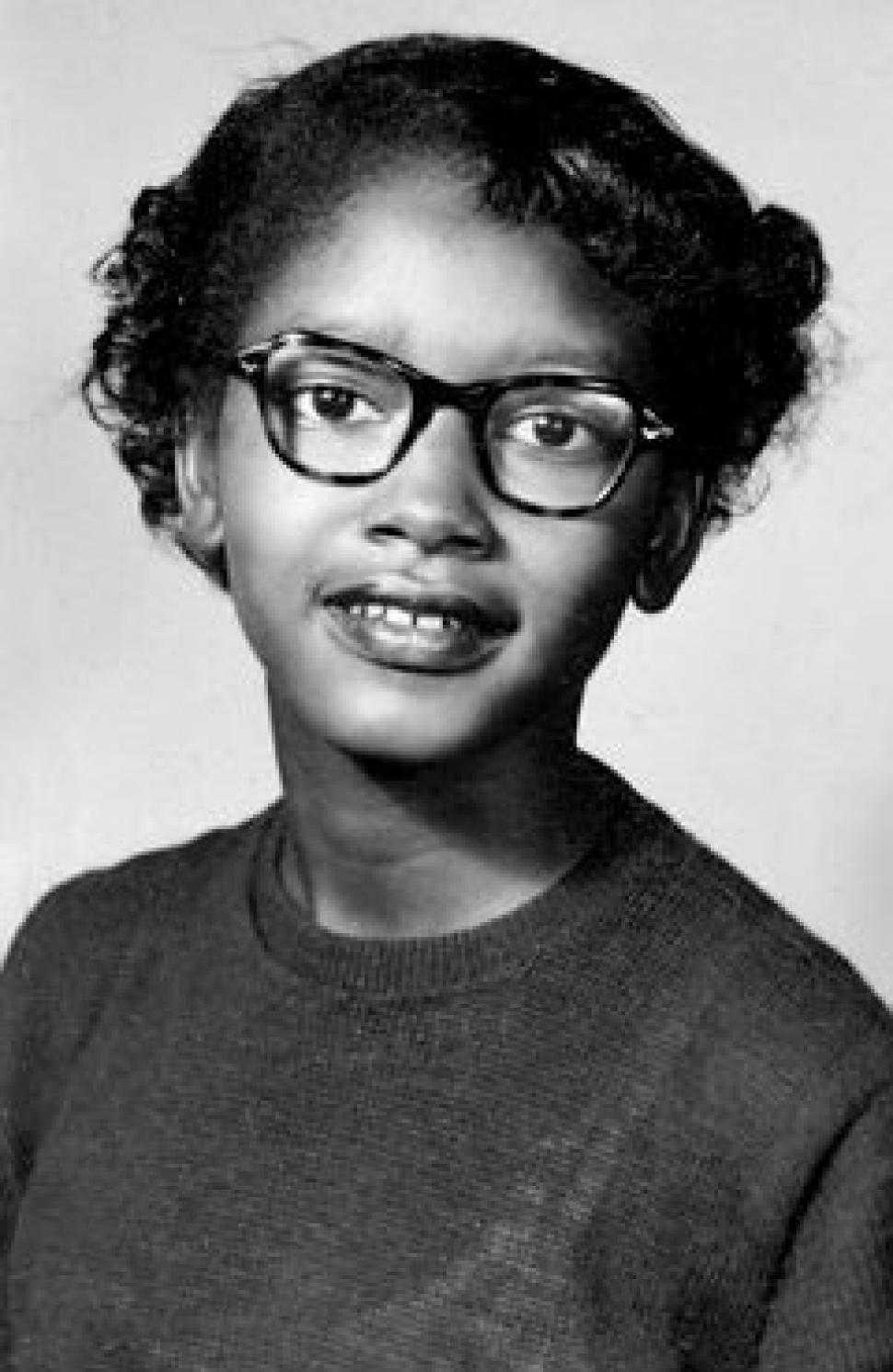
Nine months before Rosa Parks’ defiant actions, fifteen year old Claudette Colvin was riding a segregated bus home from school in Montgomery, Alabama, and refused to give her seat up for a white woman. 

Source: Claudette Colvin Biography, https://www.biography.com/people/claudette-colvin-11378 Accessed March 13, 2019

Colvin was arrested and tried in juvenile court for her defiance.  Her mother discouraged her from speaking publicly about her actions, preferring to let Rosa Parks take the spotlight. 

I have to wonder, though: just how much did Claudette Colvin inspire Rosa Parks to refuse to give up her seat? And why aren’t we taught with equal admiration about this brave young woman who made her stand by remaining seated?

I am sure of one thing, though: I will be including Claudette Colvin in my lessons on the Civil Rights Movement from now on. My fifteen year old students need to know that nobody is too young to change the world for the better. 

International Women’s Day: March 8th, 2019

“Happy International Wormn’s Day!” one of my students announced as I walked into the classroom today. 

“Ha!” said one of the boys. “How come women get a special day?

“Are you serious?” another girl challenged him.

“Yeah,” he said, “when is it men’s day?”

The girl who had welcomed me rolled her eyes. “Every day is men’s day!”

It seems like a lighthearted story. You could just laugh and keep doing whatever you were doing and not think any more about it. 

Still, there are deeper issues here that I felt the need to address.

These are teenagers. Without quizzing them to find out where they stand individually, some generalized conclusions can be drawn.

The girls are aware enough to know that inequality still exists, but have been raised in a generation that knows we can demand better treatment than what those who have gone before have experienced. 

The boys are less understanding of the issues that still exist.. there are probably as many reasons why as there are boys present in the room. 

So, we had a discussion about recognising and addressing inequality— of various types, about mistakes of the past and not perpetuating them, and about our concepts of respect, acceptance and difference.

Obviously, we didn’t manage to solve all the problems of the world during that lesson. We did, however, leave with the girls feeling both acknowledged and respected, and everyone more aware of the importance of treating one another as equals, regardless of what types of differences exist between us. 

As a Humanities teacher, that made for a happy International Women’s Day indeed.

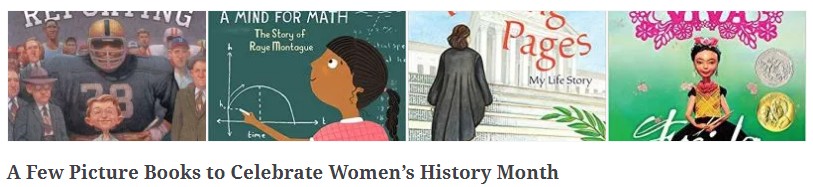
A Few Picture Books to Celebrate Women’s History Month

This is a wonderful collection of children’s books that celebrate significant women in history.

I’m also very encouraged to see that the women featured in these stories are from different countries and cultures.

What a brilliant way to celebrate Women’s History Month in a way that inspires and educates our kids!

Pernille Ripp's avatarPernille Ripp

Last week, before the calendar switched to March, I changed our book displays in our classroom. Not because we stop celebrating Black history and excellence but because we wanted to add the component of females in history.

I was asked if I would share my list here, and while I don’t mind sharing it, I will say that it has holes. While I wanted to showcase an inclusive mix of picture books, I am still adding picture books that go beyond the well-known stories. I feel like there are many unknown women whose picture books are not on our shelves at the moment, so I am working on finding these for the future. I also want to continue to work on including more indigenous or First Nation stories, as well as stories of women who defy the narrow definition of their gender.

So what is gracing our shelves right now?

View original post 76 more words