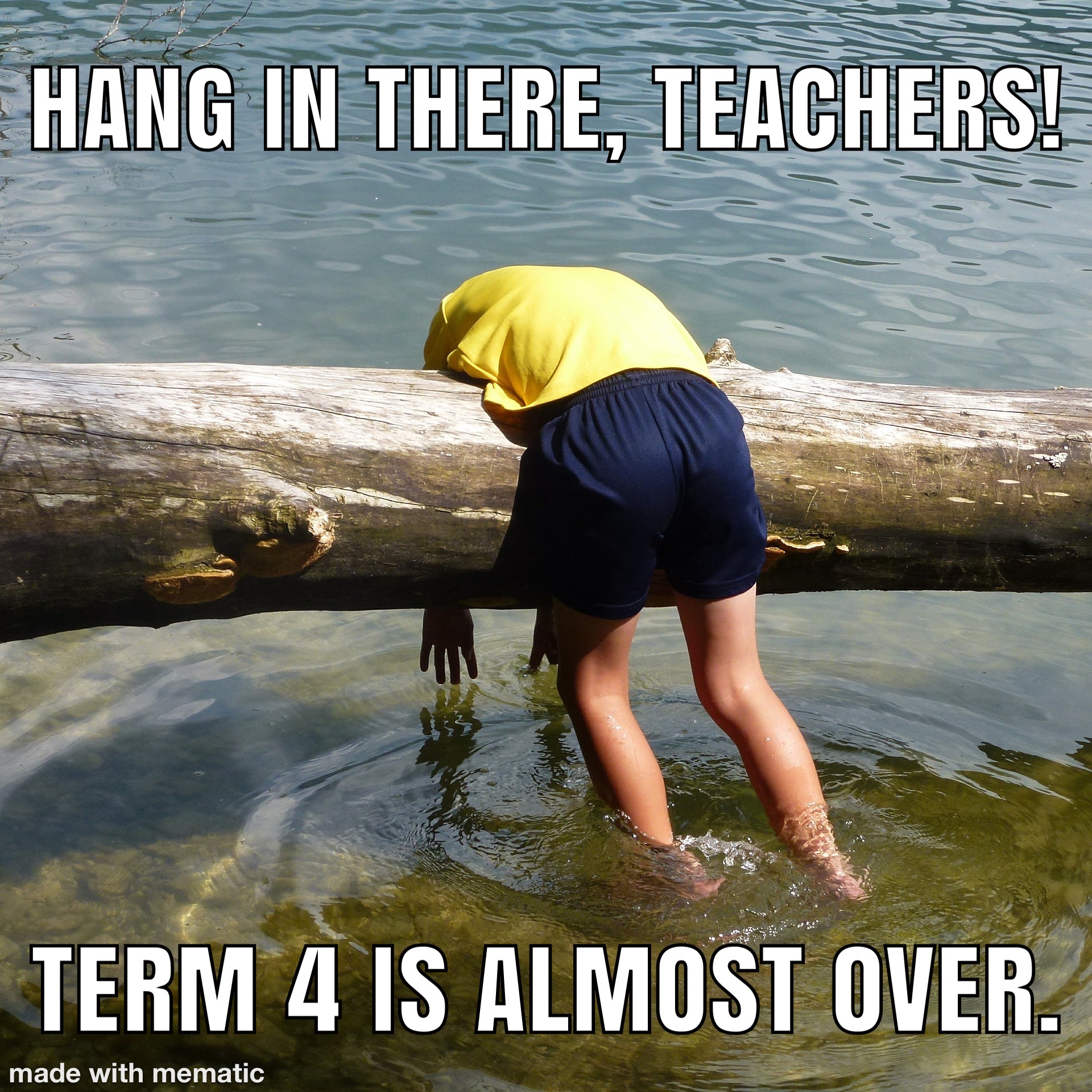
It’s almost the end of a school year that has been perpetually exhausting. Every teacher I know is beyond worn out.
I’ve used the words ‘tired’ and ‘exhausted’ so much in recent times, they have started to lose their currency. Not only are they becoming cliched, neither one really adequately describing the profundity or the long-term nature of the tiredness we’re feeling.
So, in the interests of communicating more effectively, I’d like to suggest some more expressive words to use instead.
Toilworn is a lovely word that reflects the nature of the tiredness that comes from hard work. It can also be used for something showing the effects of that kind of tiredness, or of the work that caused it.
Forswunk, as I’ve mentioned before, is one of my favourites. It’s a very old word that means exhausted by hard work.
Knackered is a term that is certainly expressive, and remarkably pleasing to say. I don’t know where else in the world people say this, but it’s certainly well understood in Australia as a term that means absolutely worn out.
If you have any other suggestions, I’d love to hear them.
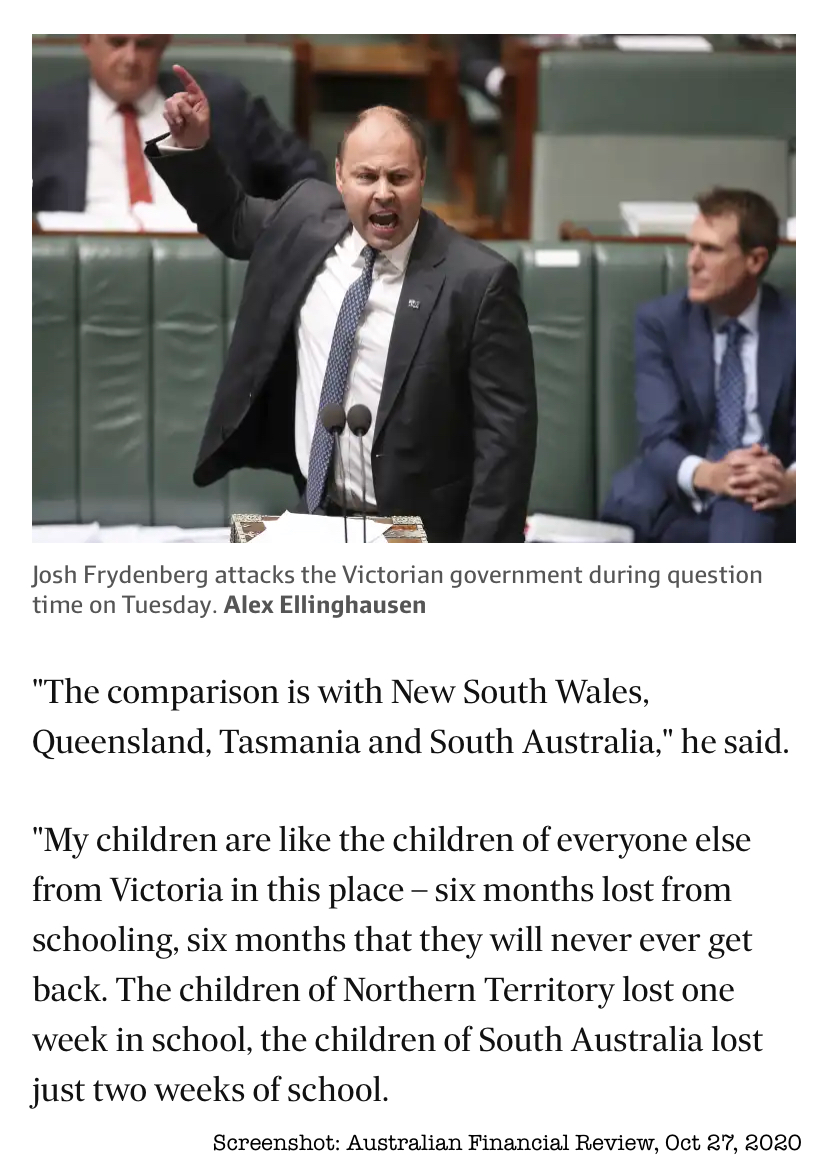
An open letter to Josh Frydenberg, Federal Treasurer and MP for Cooyong:
You have some nerve. Your outburst in Parliament yesterday was way out of line.
Yes, mistakes were made early on in Victoria’s management of COVID. And they got cleaned up. We’ve actually done a brilliant job, which you didn’t even acknowledge. But that isn’t the part of your speech to which I, and many other Victorian teachers, take particular exception.
While the rest of the House was congratulating the people of Victoria on crushing the curve and bringing the numbers back to zero, you chose to be ungrateful. That little tantrum of yours would make a two year old proud.
Your assertion that your children missed out on six months of schooling is highly offensive to every teacher in this fine state who has gone way beyond the call of professionalism and duty of care to ensure that our students did not miss a single thing that we were able to provide for them.
Were my colleagues and I merely dreaming all the extra work we put into setting up online classrooms, doing extra courses in online safety and classroom management, monitoring our students’ wellbeing and mental health, in addition to all the usual planning, preparation and teaching we have been doing all year? Did we imagine the eye fatigue and headaches from being in online classrooms all day, doing all our marking and reporting online, meeting with colleagues and conferencing with parents online?
You have been able to do your job almost completely normally all year.
We have had to completely reinvent ours, while at the same time being required to switch from face to face teaching to online classrooms, then back, and back again, sometimes at only a few days’ notice. We’ve done it without tantrums, without complaints, and without pointing fingers at people who were also trying to do their best in otherwise uncharted territory.
Victorian teachers have proven to be dedicated, resilient, and incredibly versatile this year.
And I will tell you one thing that is absolutely certain: the students at my school did not miss six months of school. They had their full timetable, every school day, complete with teachers and teachers aides, differentiated lessons, roll call, and individual help whenever they needed it.
Don’t be firing your nasty little aspersions at Victorian schools and the 100% committed teachers in them, Mr Frydenberg, even by inference.
We do not deserve that. We are exhausted, our patience has been pushed to the limit, and we are still going. We are not in the mood for your petulant tantrums.
It’s high time you gave credit where credit is due, learned some gratitude and grace, and got on with doing your job while we continue to do ours.
An Open Letter to Josh Frydenberg @JoshFrydenberg #TeacherLife #VictoriaTheHeroState #howdareyou
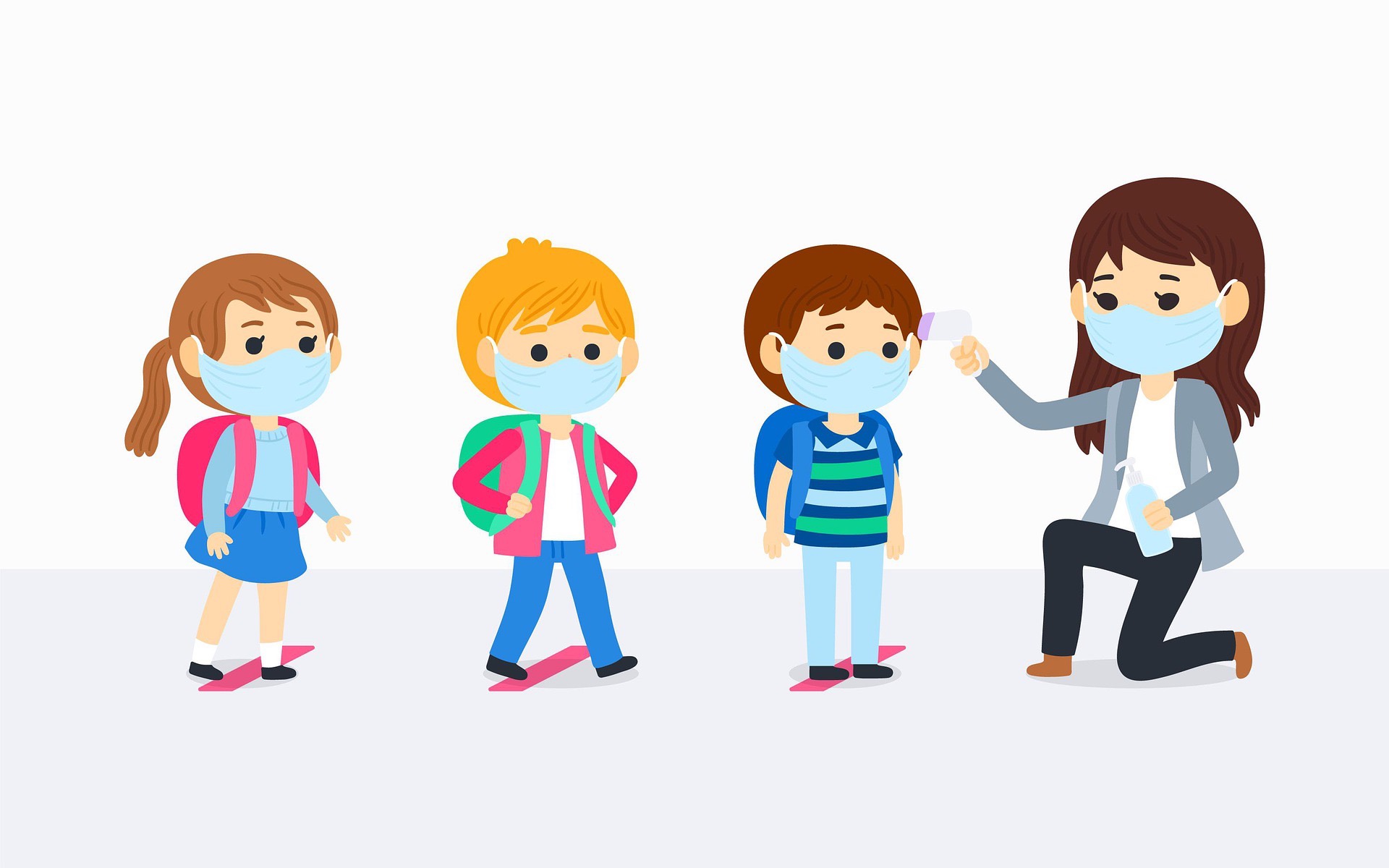
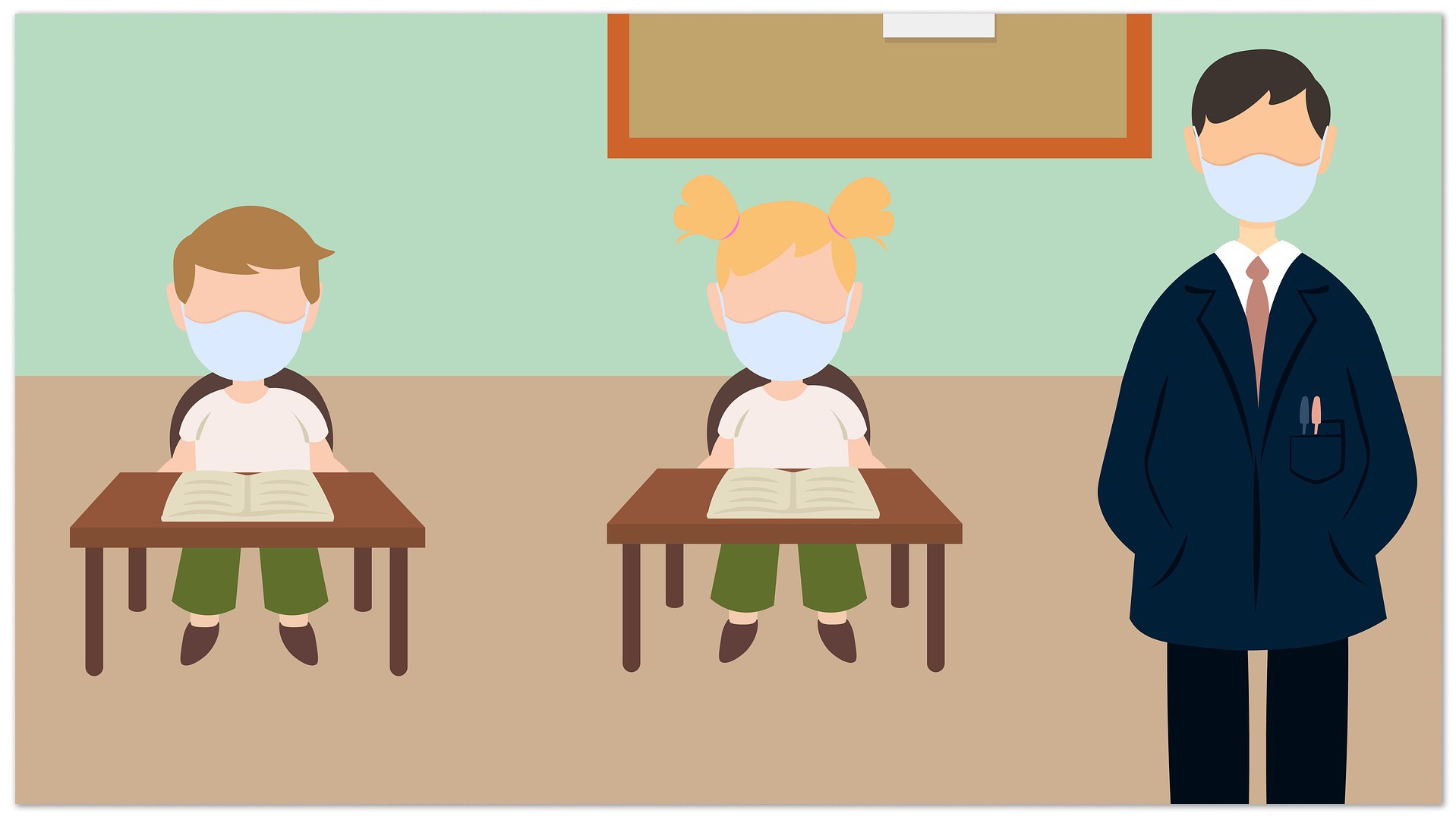
Disclaimer: I don’t kneel for my students, as that would send entirely the wrong message. Besides, they are teenagers and I’m only 5’2″. Also, I can no longer kneel. Image via Pixabay
Face to face teaching is back in full swing in Victoria, with all students over the age of 12, and all teachers, required to wear masks.
The kids generally don’t like wearing masks, and I totally get that. Still, that’s not an excuse for defiance. It’s currently a legal requirement, so whether or not we like it is a moot point.
Most of the students are quite cooperative. Some kids, though, are getting sneakier— or perhaps just less conscientious— about wearing them properly. The challenge for teachers is to find ways to remind them without being awkward or, even worse, coming across as nagging. As anyone who has tried to get a teen to do something they don’t want to will attest, that’s only ever going to create more resistance.
As I am wont to do, I have reverted to humour in addressing the problem.
When a student has their mask pulled under their nose, I tell them “don’t fly the flag at half mask”.
When someone is not wearing a mask, I say, “Oops! Your face is naked.”
When the mask is sitting under their chin, I tell them to “pull their face pants up.”
In a quiet classroom environment, or if I want to remind someone without drawing attention, I simply make eye contact, hold my hand horizontally near my chin and lift it to above my nose.
These responses engage the students by surprising the m and making them think about what I’m saying. They generally respond with a smile and then comply. The occasional student tries to argue, which invariably ends in disappointment for them.
I am always happy when it works. I was also very pleased when, while I was on yard duty, I heard one of my students tell another kid to pull his face pants up. I smiled with great satisfaction and whispered, “Good work, kid! Keep it up!” Nobody noticed, though, because I had my mask on.
Masking Awkwardness With Humour #TeacherLife #humour #blogpost
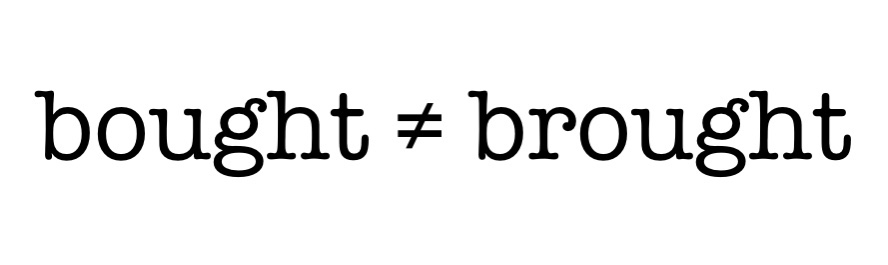
Bought and brought are words that lots of people get mixed up. They may look similar, but they are very different words.
These words are by no means interchangeable, so in the interests of both being clearly understood and preserving one’s credibility, it is beneficial to know which is which, and how to use them confidently at the right times
Bought is the past tense of buy. If you buy something, you have bought it.
Brought is the past tense of bring. If you bring something home, you have brought it home. Note: neither ‘brang’ nor ‘brung’ is standard English.
The easy way to remember which is which is that there is an r in bring and brought, but not in buy or bought. That makes pairing the correct words much easier.
Easily Confused Words: Bought vs Brought #grammar #English #explanation
The practice of leaving a preposition at the end of a sentence, often referred to as preposition stranding, has long been considered to be “against the rules”. Generations of teachers and grammarians have condemned it as a grammatical taboo.
That isolated, lonely preposition, separated from its noun, is known as a terminal preposition, and may also be described as danging, hanging or stranded.
Albeit with the best of intentions, this was drummed into me as a child, so I simply accepted it and tried to avoid doing so in whatever I wrote.
As I got older, though, I came to realise that it’s something we do very naturally in speaking. In fact, avoiding it in spoken English can make what one is saying seem very formal and stilted.
When I was in high school, one of my History teachers told us a story about one of Winston Churchill’s famous comebacks. On receiving a correction about finishing a sentence with a preposition in the draft of a speech, he responded, “This is nonsense, up with which I shall not put.”
As it turned out, it probably wasn’t Churchill who first made the joke. I don’t know if he ever did, despite numerous and varied attributions. It has also been attributed to various other people, and there are variations on the line that was said to have been delivered, so it’s hard to know who said what, and when.
Either way, the story demonstrates that the rule is actually a bit ridiculous.
So where did this rule come from? And is it something we still have to abide by?
Back in the 1600s, a grammarian named Joshua Poole developed some principles about how and where in a sentence prepositions should be used, based on Latin grammar.
A few years later, the poet John Dryden, a contemporary of John Milton, took those rules one step further when he openly criticised Ben Johnson— another great poet— for ending a sentence with a preposition. Dryden decreed that this was something that should never be done. Nobody bothered to correct or oppose Dryden, and Ben Johnson certainly couldn’t because he had been dead for years, so Dryden’s strident and public protestations popularised the principle into a rule. Over time, strict grammarians and pedants began to actively oppose the practice, and the rule became widely accepted and firmly established.
Ironically, despite all the wise and clever plays, poetry and essays written by John Dryden, it was his consistent complaint about the terminal preposition that became his most enduring legacy.
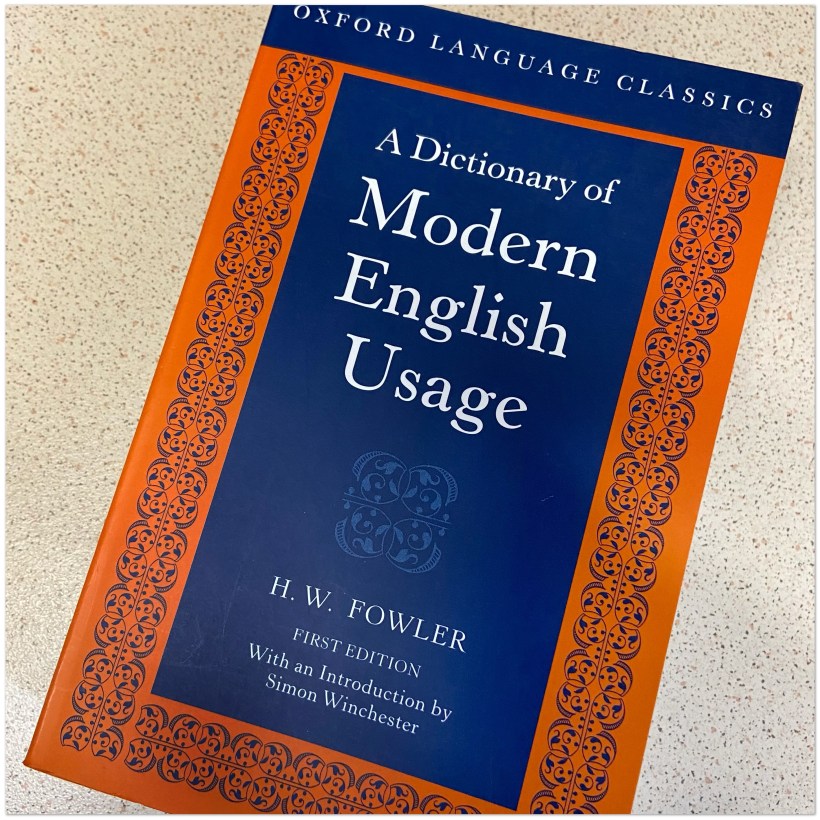
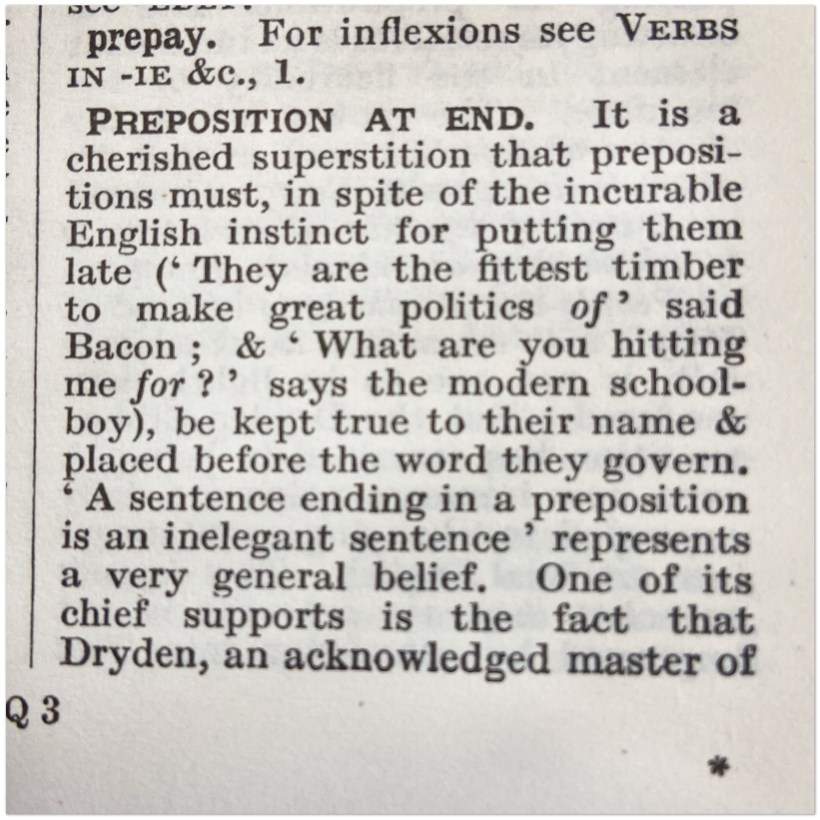
Fowler’s A Dictionary of Modern English Usage, published in 1926, calls it a “cherished superstition that prepositions must, in spite of the incurable English instinct for putting them late… be kept true to their name and placed before the word they govern.” Fowler goes on to assert that even Dryden had to go back and edit all of his work to eliminate the terminal prepositions in his own writing.
In the last century or so, people have become progressively less fussy and worried about it, but some still seem determined to cling to the rule no matter what.
I advise my students that in formal writing such as essays, speeches, official letters and submissions, it is best to avoid the terminal preposition just in case their reader is someone who might judge them for it. Any other time, in keeping with standard spoken English, they are free to use their prepositions wherever they feel most natural and make the most sense.
Nobody in the 21st century is going to naturally ask someone “On which char did you sit?” rather than “Which chair did you sit on?”, nor will they say “I wonder for whom that parcel is intended” Instead of “I wonder who that parcel is for.”
In the 21st century, that really is nonsense up with which we do not have to put.
Sources: Quote Investigator Merriam-Webster Fowler, H.W (1926) A Dictionary of Modern English Usage. Oxford Language Classics, OUP, Reprinted 2002.
Is It OK to End a Sentence with a Preposition? #grammar #English #language
After nine weeks of only seeing my students in little squares on my computer screen, a two week term break, and a final week of online classes, we resumed face to face lessons today. Things were a little bit different than they used to be, though.
The desks were distanced from one another as practically as they could be. The bottle of sanitiser at the front of the room had been joined by another and, this time around, the students didn’t need reminding to use it. Most obviously, though, we were all wearing masks.
We used to talk about “putting our teacher hat on” when we walked into the classroom, and taking it off again at the end of the day. I guess now it’s our teacher masks we have to consciously think about wearing, as this seems to be the new normal— in Victorian schools, at least— for the foreseeable future.
The wearing of masks is something disliked by many students and staff alike. Personally, I don’t mind wearing one, and I am happy to not be breathing in whatever germs are floating around the room. Most of my students seemed to manage without any difficulty, but getting some of them to wear their masks properly and not keep touching them proved to be yet another new classroom challenge.
Still, there were some good things going on.
The tone and humour in my classrooms was generally positive. One kid who doesn’t even like me much told me it was good to see me. I laughed and told him to give it time, and everyone laughed at that because we all knew it wouldn’t last.
Marking the class roll was significantly easier and quicker than online: once again, I could see at a glance who wasn’t there. Marking the roll in online classes was something I always found arduous. Today it took two seconds.
I could see right away who wasn’t doing what they should be, and I could move around behind them and see their screens. There is no more effective way to make someone work than to be able to see their screen.
At the same time, I could instantly encourage those who were working hard amd staying on task. It’s so much easier to be positive when you can be both natural and proactive about it. The added bonus is that when you praise and encourage one student for doing a good job or making a great effort, it tends to make those listening more inclined to want to do better and get some praise, too.
Those few kids who have avoided doing much at all since we returned to online schooling finally had to do some work. Those who did not engage in online lessons found themselves no longer able to just sign in and zone out or leave the room. And because I was wearing a mask, they couldn’t see my wry grin as I watched them working.
I was able to move around the room and look over the shoulders of my students. Delivering instant feedback and reminders about spelling, punctuation and paragraphs is significantly easier than trying to give that kind of advice online.
All things considered, while the day was not without a few issues and challenges, it’s fair to say that the positives outweighed the negatives. It’s hard not to be satisfied with that.
This post might come across as some kind of linguistic snobbery, and while that’s not my motivation, it is a risk I am willing to take.
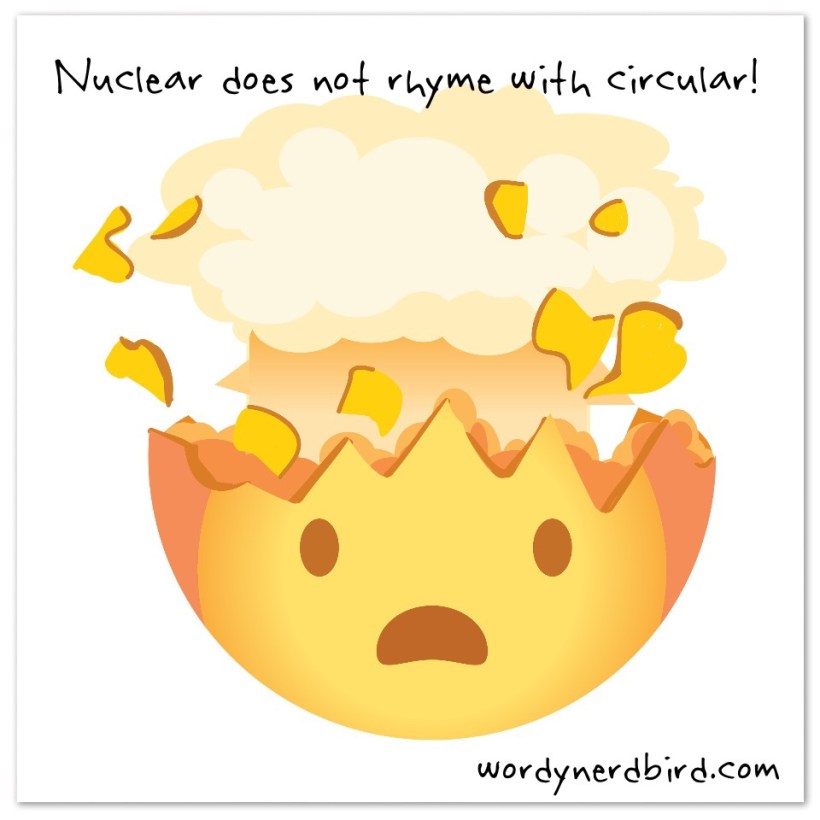
The common mispronunciation of nuclear is something that drives me absolutely nuts.
So many people pronounce it as nucular ( nyoo-kyoo-lar) but that is not how it is spelt or pronounced. I’ve even heard scientists on the radio and TV who say it that way, despite the fact that scientists of all people should know better. Did they get through however many of years study at university calling the central body of a cell the nuculus? I think not.
Nuclear is a three syllable word, pronounced nyoo-klee-ar.
If someone can say the words ‘new’ and ‘clear’ correctly, they should be able to manage ‘nuclear’ by just mashing those two words together. Think of it as linguistic nuclear fusion.
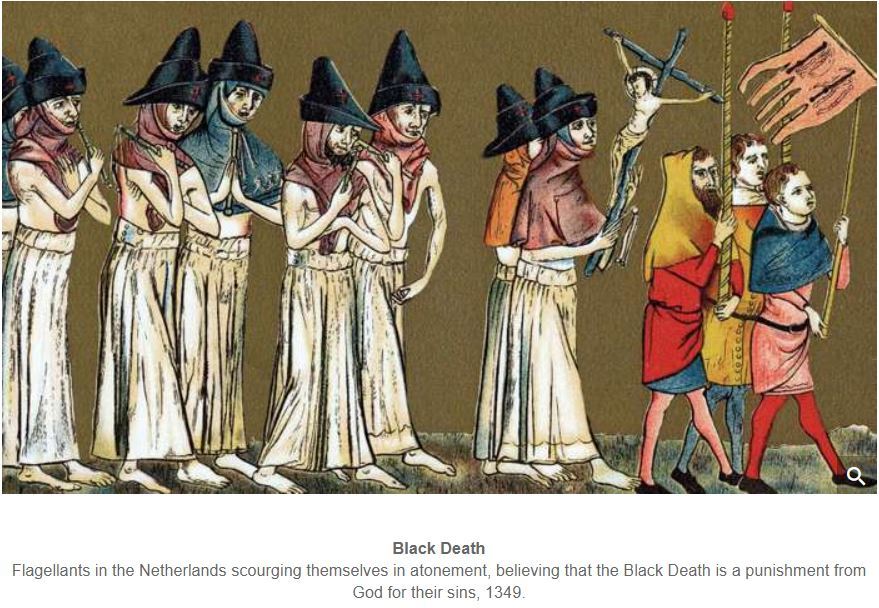
This post reminds me of the lessons I’ve been doing with my Year 8 History class about Medieval Europe and the Black Death.
My students were very interested in the plague, and surprised by the fact that this was when quarantine, social distancing, and the wearing of masks became the go-to modes of dealing with contagious disease. They were also surprised by the time it took the Europeans to understand the importance of basic hygiene, and how very long it took to develop good medical knowledge.
These lessons were highly relevant in These Times, and helped the kids to understand why we’re being reminded to wear masks, wash and sanitise our hands, and keep away from other people. It was good to be able to discuss how relevant history can be.
We all agreed we are incredibly thankful for modern medicine, science, vaccines and health care.
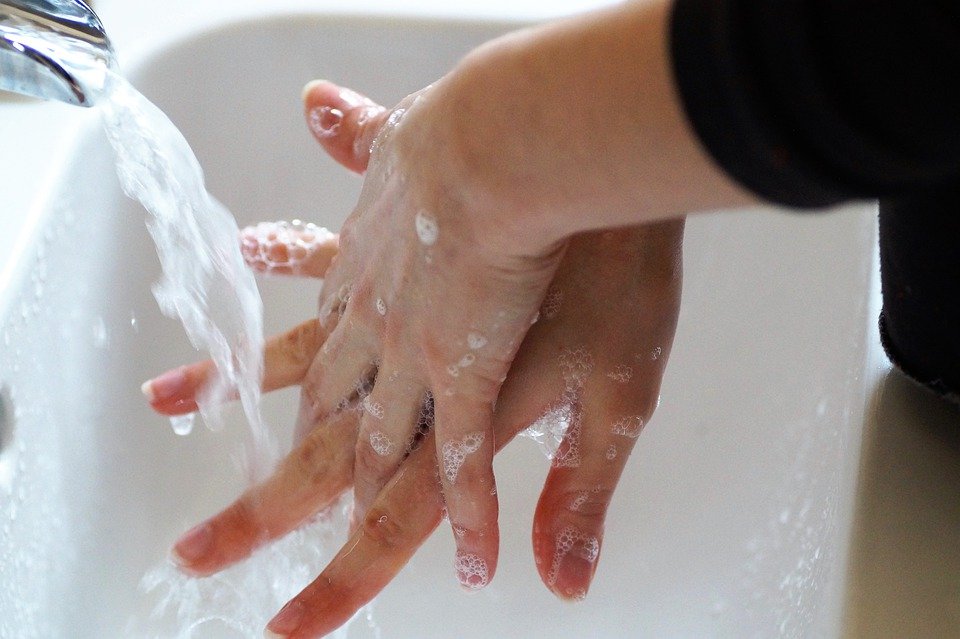
It does strike me as bizarre, however, that with all the scientific and technological advances we’ve made, we still have to remind people to wash their hands. Some things, it seems, never change.
This illustration is simply that, a suitable illustration – the Flagellants followed the first wave of the Great Pestilence and aren’t mentioned here. from https://www.britannica.com/event/Black-Death
In this time of Covid 19, when we don’t know why it seems to affect men more than women, and some ethnicities but not others, it is interesting that back in the 14th century the tsunami of the Great Pestilence of 1348 was followed by lesser waves that differed in many ways from the original. The first of these, in the England of 24 Edward III (January 1360 to January 1361) was called the secunda pestilencia and appeared to affect mostly the very young, babies and adolescents. Women were not affected in the same way.
The Chronicle of the Greyfriars of King’s Lynn notes: “…In that year [1360] began a plague among Londoners at about the feast of St Michael, where at first infants…
Last week I asked my students to do something creative.
Today, Student A wasn’t very impressed with the outcome of their efforts. “I tried, but it’s turned out a bit 2020.”
“It’s a bit what?” I asked.
“2020.”
Obviously, I was expected to understand.
“Mine’s pretty 2020 too, to be honest,” Student B admitted.
I looked at their faces on my screen. They were being serious.
“So…” I asked, “Are we using that as a swear word now?”
They’re right. It actually works.
“More meaningful than swearing, Miss,” said Student B.
The rest of the class concurred.
“And we can’t even get in trouble for saying it.” Student A grinned, clearly rather pleased with that reality.
I smiled, told them their work was way better than 2020, and moved the lesson on.
I don’t know if they just started doing that by themselves or picked it up from somewhere else, but at least they’re finding some practical use for 2020. I may just follow suit.
Today’s English class was the most fun I have had in a long time. I wanted to exercise the kids’ minds and get them thinking laterally. I also wanted them to enjoy it. A lesson with a difference seemed to me a great way to start our final week of term and inject some interest into our online classroom.
I began by presenting my students with the contention that a box of chocolates is a salad.
This was not a popular suggestion.
“No it’s not!” one student said… quite defensively, I might add. “Salad is salad. Chocolate is chocolate. You can’t ruin chocolate like that!”
But, I asked, what is a salad if it’s not simply a mixture of vegetables? Chocolate comes from beans… and if you add nuts, or fruit, or herbs like peppermint, then it’s definitely a salad.
We spent quite some time redefining food, presenting the most persuasive arguments we could think of, and debating the nature of reality.
Every time it sounded like the students might be in danger of reaching a consensus, I made another suggestion.
Ice cream, on its own, may just be ice cream – but the minute you put it in a cone, or add fruit or chocolate, it’s a salad. Coffee, like chocolate, is made from beans. It’s a salad.
“No!” was the response. “Coffee is hot – it can’t be a salad.”
So then I really twisted it up.
Is coffee soup? Is cereal soup? Or is it a salad with too much dressing? According to one student, and I quote, “Soup is not what soup is.”
Is the English language a metaphorical salad? Because it’s a mixture of a whole bunch of languages, right? The flavours are all mixed, but the parts are still recognisable if you know what you’re looking at.
Is the English language a sticky weed? Or velcro? Because you know, it takes something from every other language it swipes past. Maybe it’s double sided tape…
I am not ashamed to say that I really had fun. Despite their groans and protestations, I think they did, too.
Perhaps the most satisfying moments, though, were two comments made by different students:
“You’ve just entirely ruined the English language.”
and
“These have been the most problematic fifteen minutes of my life.”
What started out as a brain tease turned into a really interesting discussion about how we use language and define things in our own ways, and often assume that everyone else understands what we’re talking about, and that everyone else agrees with us.
It’s safe to say most of them enjoyed it… but it’s also safe to say that I enjoyed it more.






 WordyNerdBird