Grawlix.

Grawlix is an unusual word that most people haven’t heard of, although they’ve probably seen grawlixes many times before. 

A grawlix is a combination of symbols— most commonly the ones above the numbers on the keyboard— used in place of a offensive language in comics, cartoons and illustrations. It works as a visual, rather than verbal, euphemism.

The term was coined in the 60s by Mort Walker , the creator of the comic strip Beetle Bailey, although the practice had already been in use long before it was given a name.The grawlix is a clever and very effective way to express emotions like anger or frustration without actually offending anyone or causing problems with editors and censors. 

An alternative term that has been suggested is the obscenicon, which is very clever but doesn’t seem to be getting a lot of traction. Time will tell, as it always does when it comes to words and language. 

Somehow, grawlix just sounds more evocative and kind of sweary in itself.

Sources:
Lexico
Merriam-Webster
Grammarphobia
 Grawlix.
#language #words #swearing #interesting #language #blogpost

Asterisk.

The asterisk is the handy little star symbol* that we use to indicate that there is more information attached to something, to denote the existence of a footnote, to add emphasis to a word or point of notice, or to blank out letters in offensive words that we don’t want to type or write in full. 

The word asterisk means ‘little star’ and has been used as a noun since the late 14th century— well before the invention of the printing press— while the verb form “to asterisk something” was first recorded in 1733. 

Asterisk comes to use from Latin via Greek, but actually goes back to Proto-Indo-European roots, which is about as far back as any language or individual words can be traced. The PIE root *ster- is the source of the words for star in numerous languages including Hittite, Sanskrit, Greek, Latin and, thus, English. 

Therefore, the word asterisk is related to asteroid, aster daisies, disaster, constellation and starfish, among others. It is also a cousin of names such as Esther, Estelle and Stella.**  

More recently, the asterisk also inspired the name of Asterix, the hero of the classic comics by Goscinny and Uderzo. Those books are characteristically full of puns and word play, and the names of Asterix and Obelix are derived from mispronunciations of asterisk and obelisk respectively. 

* located above the 8 on a keyboard
** They are not close cousins, but more like the kind who are jealous of each other because they all want to be the most popular starlet in the family, and only make small talk with one another at family reunions. 

Source: Online Etymology Dictionary

Asterisk
#etymology #words #history #asterisk #language #typography

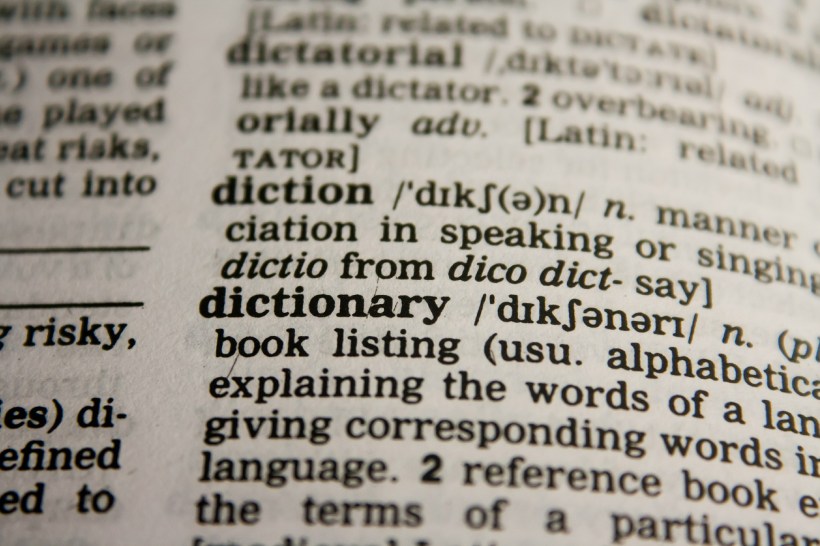
What A Dictionary Does – and Does Not – Do

A dictionary is not a rule book for the language.

Image by libelulle789 on Pixabay.

This might seem like a no-brainer, but there seems to be some misunderstanding about the function or purpose of a dictionary, particularly on social media. 

A good dictonary serves a number of functions:

  • Dictionaries record language as it is used. Words are added to a dictionary when they become frequently used by the people who speak the language. One can’t just make up a word and apply to have it included. It needs to become part of the commonly spoken language of the people first. 
  • Dictionaries give meanings of words. 
  • Dictionaries provide accepted spellings of words, and often include alternative spellings. This varies according to the country of publication, particularly when it comes to the differences between English and American spellings of words. 
  • Dictionaries often give advice as to how a word should be pronounced. This too will vary according to common usage in the country in which the dictionary is published. Some dictionaries use the regular alphabet to achieve a phonetic respelling, while others use the International Phonetic Alphabet
  • Online dictionaries do all that, and also offer voice recordings to demonstrate pronunciation. They also provide direct links to thesaurus entries and related words. 
  • Dictionaries can also settle arguments. They are helpful in adjudicating spelling games such as Scrabble, and settling arguments about how a word is spelt or what it means. 
Image by PDPics on Pixabay

There are, however, things that dictionaries neither seek nor claim to do. 

  • A dictionary is not a rule book for the language. Just because a word isn’t in the dictionary does not actually mean that it’s not a word. If people say it, and other people understand it when they do, it’s a word. 
  • An Australian dictionary is not useful for recording American English, and vice versa.
  • A dictionary generally doesn’t give the etymology of a word, although it might suggest that it’s an old, obsolete or archaic word.
    There are etymological dictionaries that do this, but they are far less popular than the regular kind of dictionary with which most people are familiar. Some etymological dictionaries are specific to a particular area of study, while the Online Etymological Dictionary is a vast resource of the history of a plethora of English words and phrases.
  • A dictionary generally won’t include words that have fallen out of use. In the large dictionary on my desk at home, words like ‘forswunk’ and ’trustful’ are no longer included, while they would have been many years ago. It doesn’t mean they are no longer words: it simply means the likelihood of someone wanting to look them up is considered far less than someone wanting to look up ‘exhausted’ or ‘melancholy’ instead. 

What’s the best dictionary to use? 

Most people will find the greatest value in a dictionary which is compiled, written and published in the country in which they live and work. Most people will want one that is up to date. 

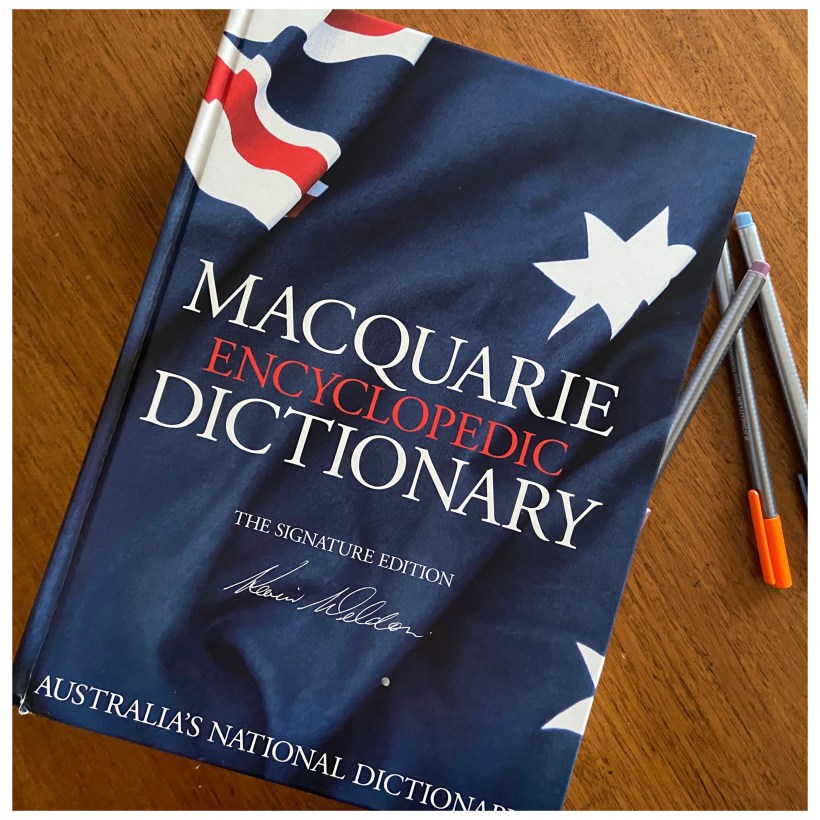
One of the two editions of the Macquarie Dictionary I own.

For Australian English, I love the Macquarie Dictionary.
For UK English, there is nothing that surpasses the Oxford English Dictionary, but the Cambridge English Dictionary is very good, too.

I have no preferred dictionary for American English, because I don’t use one. (If you can make a recommendation, please leave a comment!)

Old dictionaries hold particular appeal for scholars, teachers and lovers of language. They can be invaluable resources for authors and readers, too. 

On Tenterhooks.

Image Credit: Daniel_Nebreda

This morning I used the term “on tenterhooks” and then wondered where it came from.

It’s a term that means painful anticipation or being kept in suspense, commonly used by English speakers to describe any situation of tension or anxiety while waiting.

I imagined something being suspended or hung up, waiting for something to happen— which is exactly how I felt when I said it. I imagined the hooks to be larger and more cruel than they actually were, perhaps as some form of medieval torture or punishment, like hanging someone on a wall or in mid air using hooks to hold the body. That is an indication of several truths about me: my own feelings at the time, my love of medieval history, and my horror author’s tendency toward macabre imagination.

As it turns out, I was overthinking that part.

A little research at etymonline.org and worldwidewords.org informed me that it’s a very old word from the early 14th century that relates to the preparation of cloth, particularly woven woollen fabric, by hanging it up on a frame known as a tenter to stretch, straighten the weave, and dry. Tenter hooks were bent nails that held the fabric in place on the frame.

By the early 1500s, people spoke of being on the tenters to express being in suspense or waiting anxiously. The phrase “on tenterhooks” appeared in print for the first time in Tobias Smollett’s Roderick Random in 1748.

It is related to the word tent in that the word was used to describe the way in which hides, skins or coarse cloth were hung over a framework of poles to create a temporary dwelling, which then came to be called a tent.

Both tent and tenterhooks come to English from the Latin, tendere, meaning to stretch, via the old French word tente. They are related to the words tense, tension, intense and the phrase highly strung.

Although the ideas have come to be closely associated, tenterhooks and suspense are not related words.

Forwallowed.

Forwallowed is a very old, but very relevant, word.

image by Alexas_Fotos on Pixabay

Having successfully incorporated ‘forswunk’ into my vocabulary and introduced it to my friends and family, I am delighted to have discovered another word equally useful as a fibromyalgia sufferer. 

Forwallowed’ is an archaic word from the 15th century that means ‘weary from tossing and turning all night’. 

Not only is it perpetually relevant to my life, it sounds and feels beautiful when spoken. 

It is one of those words that evokes the sadness and tiredness of the very feeling it expresses, both physically and mentally, almost like a form of emotional onomatopoeia.  

It seems so versatile and germane that I don’t understand why it ever fell out of fashion. Forwallowed is a wonderfully expressive word that deserves to be brought back into regular use.

Mission accepted. 

Forwallowed: an old but highly relevant word that deserves to be brought back.
#words #englishvocabulary #englishtips #vocabulary #blogpost

New Words

As I often explain to my students, language adapts and evolves all the time. People invent new words, or blend old ones, to create new meanings or to explain something in a new way. 

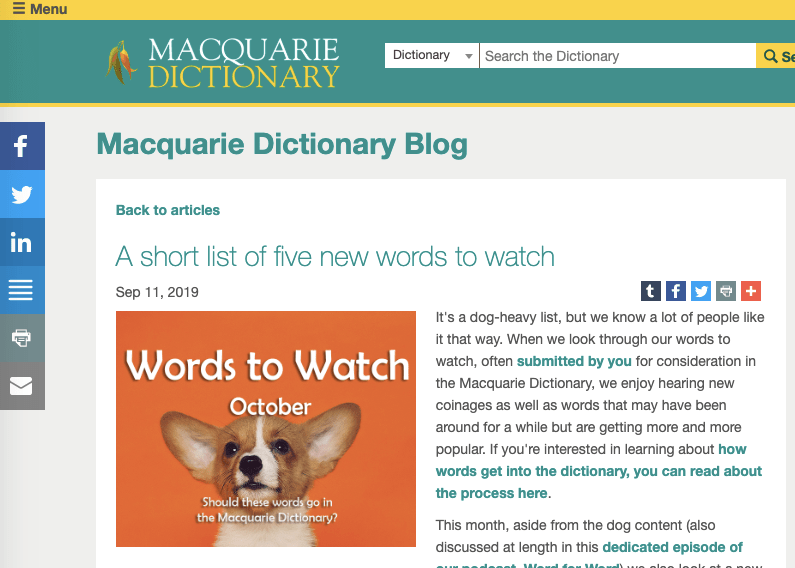
I’m always fascinated by the process, and take interest in which words are being “added to the dictionary”. Even that phrase makes me laugh, because we all know there’s more than one dictionary, and they don’t all add new words at the same time. 

The article titled Five New Words To Watch comes from the Macquarie Dictionary Blog.

The Macquarie Dictionary is my favourite for a number of reasons. Macquarie University is my alma mater, and back when the first Macquarie Dictionary was being written and compiled, I had the privilege of having two of the contributors as my lecturers and tutors in English and Linguistics. More importantly, the definitions are clear and easily understandable, Australian colloquialisms are included, and the pronunciation guide is provided in the international phonetic alphabet, which I love. 

Yeah. Nerdy, I know. 
But if you’ve been following my blog for three minutes, you’ll know I’m unapologetic about that. 

I hope you enjoy this article.
If you’d like to tell me your favourite newish words, or words you’ve invented, I’d be super happy for you to leave a comment!  

‘Definitely’ and ‘Defiantly’ Are Different Words.

I am still coming to terms with the fact that this post needed to be written. How do people not know these are different words?

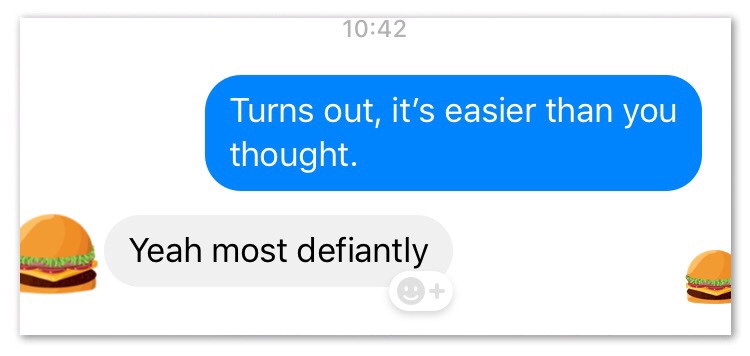
Apparently, though, it’s an all-too-common problem. Social media is littered with posts where someone has answered with “Defiantly!” when what the responder really meant to say was “Definitely!”.

It happens in my own conversations several individuals on a regular basis. In fact, it happened again just yesterday, so I took a screenshot with this blog post in mind.

Yes. I most definitely did turn my friend into a hamburger to protect their identity. 

I don’t know whether autocorrect is to blame, presumably as a result of poor typing, or if it’s just plain old-fashioned ignorance. The answer to that probably varies from one perpetrator to another, but  either way, continuing to mistake one for the other is inexcusable. 

Definitely means “for sure” or “absolutely”. 
In fact, those are excellent choices for anyone who wants to agree with something, but doesn’t actually know how to spell “definitely”. 

Here’s a hint, though.
Definitely even sounds exactly as it is spelt: def-in-it-ely.
It’s phonetically straightforward.

Therefore, anyone trying to spell it should get to the ‘a’ in ‘defiantly’ and know they’re making bad choices. 

Defiantly is a word most often used by parents or teachers describing the way in which a child refused to do as they were told. 
Examples:
The child sat in stony silence, arms crossed defiantly. 
“No!” Robin yelled defiantly, “I won’t apologise for being a grammar snob!” 

You get the idea. 

It’s definitely in your interests to get this right.

Make good choices, people… please?

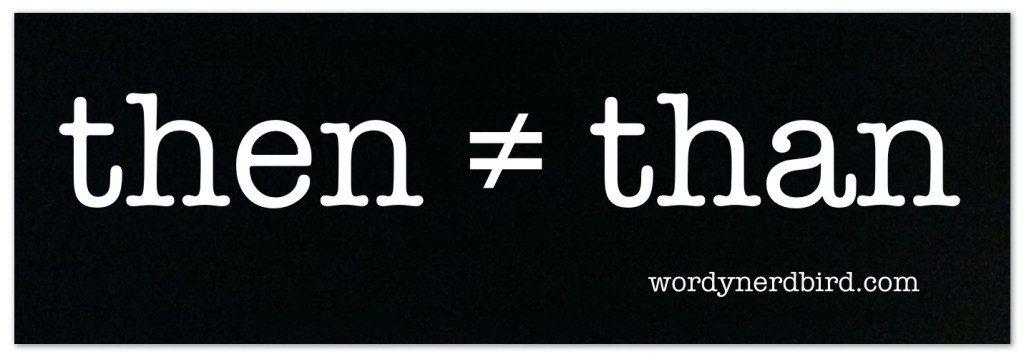
‘Then’ and ‘Than’ Are Not The Same Word.

Some word confusions are understandable, especially if they sound the same when spoken. We call those homophones, and they sound the same even if they are spelt differently.  Examples are peak/pique/peak or there/their/they’re.

The confusion between ’then’ and ’than’, however, is a completely different matter.

Sadly, this is happening more and more, especially on social media. I don’t even spend that much time on Facebook, but it feels like I see someone saying something like “Nothing is better then this!”  or “I love you more then anything!” at least twice a day. 

Yes, they are similar. 
However, they are clearly not the same.
They don’t look the same.
They don’t sound the same. 
If one doesn’t mix up ’then’ or ’than’ with ’thin’, there is no excuse for mistaking them for one another. 

I swear, it makes my eyes want to bleed.

The two words’ meanings are so vastly different that getting them wrong just makes the person writing look  either poorly educated or plain stupid, even if they are neither. 

This is one of the best and most self-evident arguments in existence for proofreading what one is writing, anywhere and every time. 

‘Then’ rhymes with ‘when”— which is an easy way to remember that it relates to time or sequence. 
Examples: 
He put on his shirt, then his jeans, and then his boots. 
She ran up the hill, then back down again. 
When you have tidied your room, then you can go to the movies. 

‘Than’ rhymes with ‘man’ and is used for making a comparison. 
Examples:
His piece of pizza is bigger than mine. 
A triangle has fewer angles than a square. 
I would rather stay home and read a book than go to work. 

Knowing which is which, and taking care to use the right words all the time, is a simple way to protect your credibility.

And for the love of Merlin’s beard, if you call yourself an author or a teacher, get it right. It’s not that hard. 

Being Conscious of One’s Conscience

Said to me today: “I don’t want that on my conscious.”
Me: “You probably don’t want it on your conscience, either.” 
Them: “Huh?”
Me: “They are different words.” 
Them: “Really?”
Me: “I promise you.”

These commonly confused words sound similar but they are not homophones. 

Conscious is an adjective. It is a descriptive word that means awake or aware. 

Examples:
I’m conscious of the confusion between words that sound similar but which are very different in meaning.
He passed out, but he is conscious again now. 

Conscience is a noun. It’s the name given to that part of our being that tells us not to do something we know we shouldn’t, and accuses us when we have done something wrong so that we feel bad about it. 

Examples:
She was good at acting innocent, but her conscience was plagued by guilt.
His conscience reminded him daily of the things he had done. 

The difference in the way these words sound is minor, but the difference in meaning is significant

Don’t Waver Over Your Waivers!

A mistake frequently made in writing is to say that someone “did not waiver” in their faith, or from a decision they had made.  What they really mean is that the person in question did not waver

Once again, it is a failure to choose between differently spelled homophones that is the problem here. 

Waiver: the renunciation or surrendering of  ownership, a right  or a claim
Example: The council decided to waive the annual fee for dog registration. The waiver resulted in more households registering  their pets. 

Waver: to hesitate or falter, or to flicker, quiver or tremble.
Examples: Her feelings for him wavered between passionate love and indifference. 
He did not waver in his support for the mayor, who was a woman of integrity. 
The flame of the candle wavered in the gentle breeze.

At least when one waves at the waves, the spelling is the same so you can’t get it wrong!