Happy Easter!

However you celebrate, whatever you believe, I wish each of you a happy and blessed Easter Sunday, safety on the roads, and the very best in chocolate eggs and bunnies.

I’m away this weekend, enjoying time with my family and getting some much needed rest and relaxation.

We’ve taken off to Port Macdonnell, a little spot on the South Australian coast, for the long weekend. Hopefully, we’ll be making the most of some beautiful mild Autumn weather and seeing some new places and scenery.

As it is Easter Sunday, I thought I would share with you one of my favourite Easter songs. I grew up listening to the music of Keith Green, an enormously popular Christian singer and songwriter of the 1970s and 80s.

For your enjoyment, this is his Easter Song.

For Those who Prefer Bookish Treats for Easter

If you’d like a bookish Easter treat for Easter,
you’re welcome to join in the

Sparkly Badgers’ Easter Egg Hunt

All you have to do is start here, find the egg hidden on each blog or website, arrange the letters, and follow the instructions to claim an ebook of your choice from the organisers.

The hunt officially begins on Good Friday.

One winner will receive a lovely Easter gift which includes chocolate and a copy of each book on offer.

For more information, see the Sparkly Badgers’ Easter Egg Hunt page on Facebook.

Poem: ‘Easter Day’ by Oscar Wilde

‘Easter Day’ is a sonnet about seeing the Pope on Easter Sunday. It is not, however, as reverent of the pontiff as it first appears. 

After describing the scene, Wilde observes that while the ceremony he observes is impressive, it actually has little to do with the reality of Jesus’ life.  It’s all about thethe Pope, far more than it is about the death and resurrection of the Messiah. 

This is a very powerful observation, and one that certainly resonates with me.  As I have said many times before, “I love Jesus. I just have significant problems with the actions of many who claim to represent Him.”

This poem, then, serves as a reminder to not put faith in man-made institutions, regardless of who or what they claim to be, but instead to focus on Christ himself, what He taught, and on one’s own faith in Him as a personal, intimate relationship. 

Easter Day

The silver trumpets rang across the Dome:
The people knelt upon the ground with awe:
And borne upon the necks of men I saw,
Like some great God, the Holy Lord of Rome.

Priest-like, he wore a robe more white than foam,
And, king-like, swathed himself in royal red,
Three crowns of gold rose high upon his head:
In splendour and in light the Pope passed home.

My heart stole back across wide wastes of years
To One who wandered by a lonely sea,
And sought in vain for any place of rest:
‘Foxes have holes, and every bird its nest,
I, only I, must wander wearily,
And bruise my feet, and drink wine salt with tears.’

Poem: ‘Loveliest of trees, the cherry now’ by A.E. Housman

This poem is perfect for sharing just a few days before Easter, being the time of the year when it is set.

A.E Housman’s ‘A Shropshire Lad’ is a relatively small volume of poetry that he self-published in 1896, containing some really lovely poetry and delightful imagery such as that we see in this poem, the second in that collection.

While the poet is young – twenty years old – and acknowledges that he probably still has fifty years ahead of him, his life expectancy is framed in terms of only fifty more opportunities in his life to see such a beautiful tree. That’s why he’s going to take every opportunity to observe the beauty around him while he can.

This brings to mind the Latin phrase made popular by the film ‘Dead Poet’s Society’: carpe diem! Sieze the day!

The poem is a great reminder to embrace the joys we find in life while we can, and to make the most of our opportunities to stop and smell the… blossoms.  

Loveliest of trees, the cherry now

Loveliest of trees, the cherry now
Is hung with bloom along the bough,
And stands about the woodland ride
Wearing white for Eastertide.

Now, of my threescore years and ten,
Twenty will not come again,
And take from seventy springs a score,
It only leaves me fifty more.

And since to look at things in bloom
Fifty springs are little room,
About the woodlands I will go
To see the cherry hung with snow.

That certainly lays to rest the popular misconception that Indie poets are somehow lesser than others, doesn’t it?

Daniel Radcliffe and Poetry

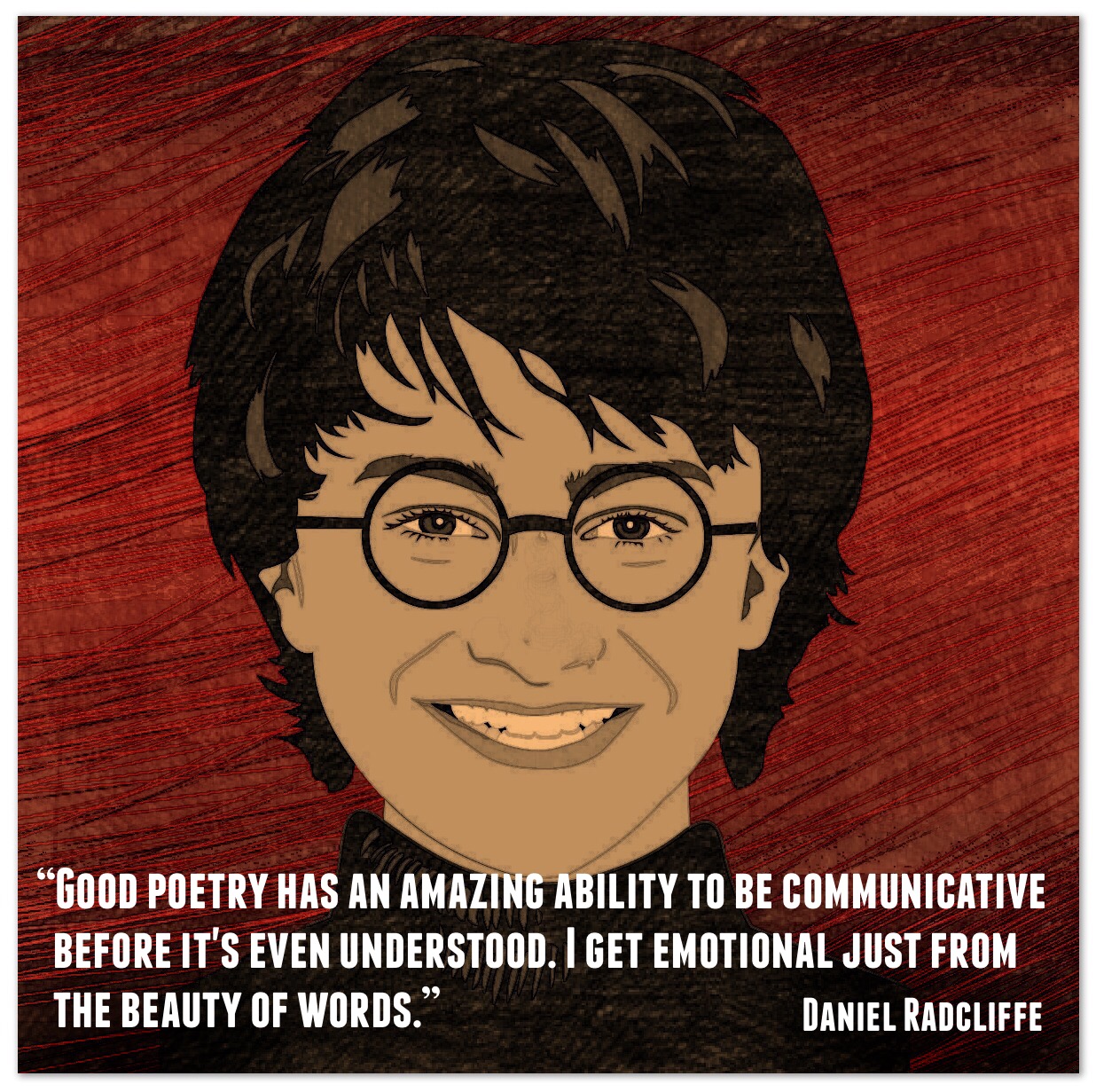
Daniel Radcliffe is a man who obviously loves good poetry. This is an indication to me that he has good taste. In fact, in my mind it’s a genre recommending a person, instead of the other way around. 

Quote by Daniel Radcliffe: Good poetry has an amazing ability to be communicative before it's even understood. I get emotional just from the beauty of words.
Read more at: https://www.brainyquote.com/search_results?q=Daniel+Radcliffe+poetry
Source: BrainyQuotes.com Image by WordyNerdBird

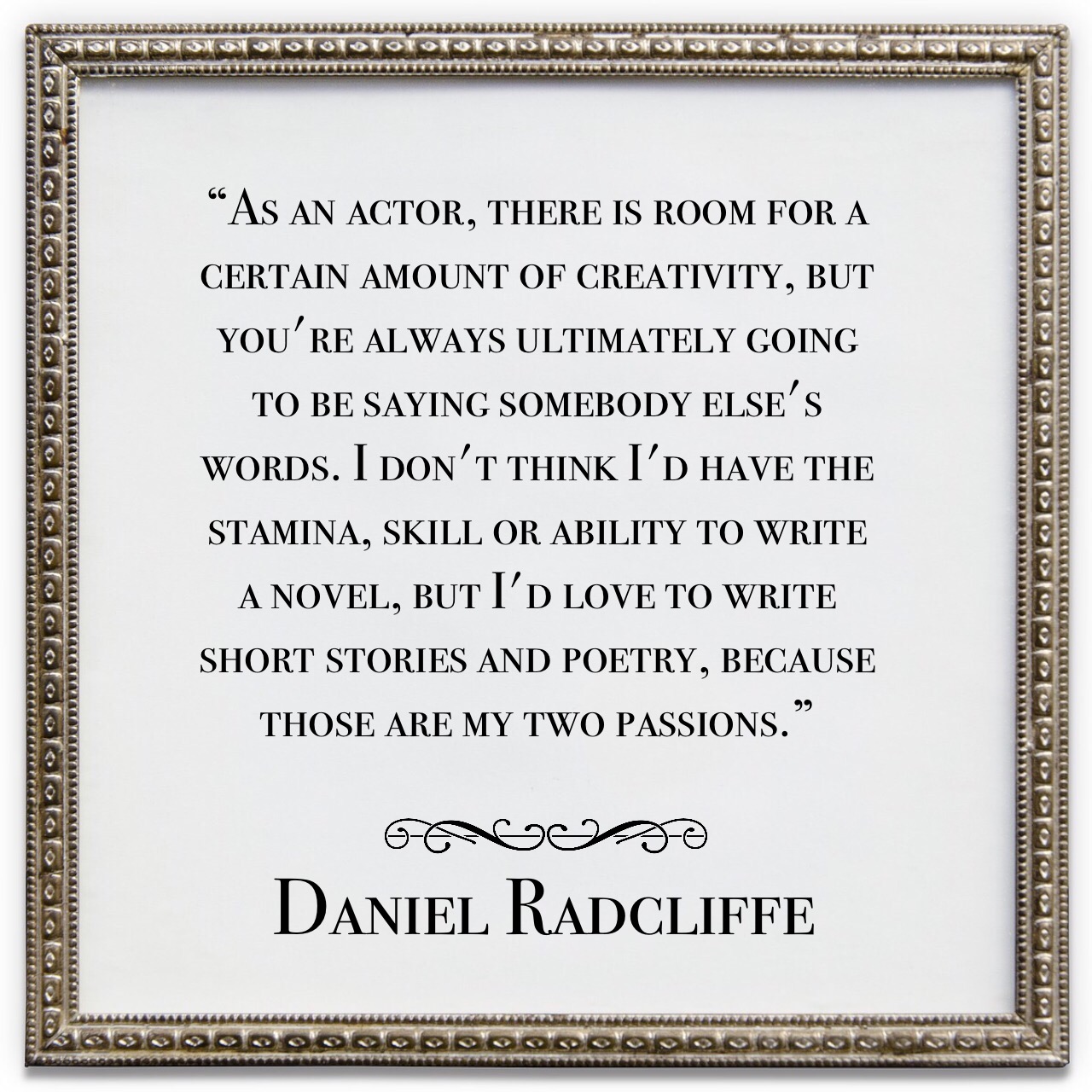
He’s mentioned his love for poetry more than once. 

Quote: "As an actor, there is room for a certain amount of creativity, but you're always ultimately going to be saying somebody else's words. I don't think I'd have the stamina, skill or ability to write a novel, but I'd love to write short stories and poetry, because those are my two passions."
Source: BrainyQuotes.com Image by WordyNerdBird

While I’m thrilled to see that short stories and poetry are his two literary passions- they are, after all, my favourite forms of writing- I do dispute that writing a novel takes more stamina, skill or ability.  In fact, it’s a different set of skills and abilities, and using them requires as much stamina as writing a novel.

He is right, though, about the ability to use one’s own words to create and communicate meaning. It’s incredibly liberating and empowering. 


Poem: Just Imagine.

Just Imagine.  

Just imagine a world 
Where more people read poetry 
Instead of giving breath 
To things that divide and cause fear.

Imagine a world
Where more people picked up a pen
Than a gun or a sword
Or even a lawyer.

Imagine a world
Where poets were the dealers
That troubled souls turned to for a hit;
Where people self-medicated with poetry 
Rather than drugs or alcohol 
To help them deal 
With their demons;
Where addiction brought life and hope, 
Mindfulness and restoration
To the broken,
The hurting,
The needy.

Imagine a world 
Where everyone knew and understood 
That they are not alone, 
That someone understands, 
That they are enough.

Just imagine. 

©2019 Joanne Van Leerdam

Poem: ‘The Owl and the Pussycat’ by Edward Lear

As a child, I always enjoyed this poem. I enjoyed the silliness of it, the musical rhythm and the sense of Fantasy. 

I
The Owl and the Pussy-cat went to sea
In a beautiful pea-green boat,
They took some honey, and plenty of money,
Wrapped up in a five-pound note.
The Owl looked up to the stars above,
And sang to a small guitar,
‘O lovely Pussy! O Pussy, my love,
What a beautiful Pussy you are,
You are,
You are!
What a beautiful Pussy you are!’

II
Pussy said to the Owl, ‘You elegant fowl!
How charmingly sweet you sing!
O let us be married! too long we have tarried:
But what shall we do for a ring?’
They sailed away, for a year and a day,
To the land where the Bong-Tree grows
And there in a wood a Piggy-wig stood
With a ring at the end of his nose,
His nose,
His nose,
With a ring at the end of his nose.  

III
‘Dear Pig, are you willing to sell for one shilling
Your ring?’ Said the Piggy, ‘I will.’
So they took it away, and were married next day
By the Turkey who lives on the hill.
They dined on mince, and slices of quince,
Which they ate with a runcible spoon;
And hand in hand, on the edge of the sand,
They danced by the light of the moon,
The moon,
The moon,
They danced by the light of the moon.


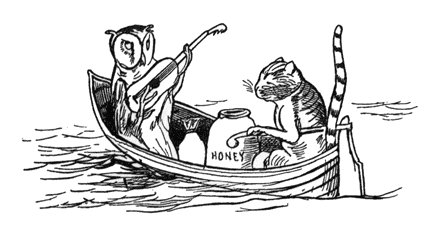
Image:Public Domain 
Edward Lear’s Own illustration of The Owl and the Pussy Cat

I must confess, though, that I hadn’t thought about this poem for many years until a friend quoted it in her newly-released paranormal romance novel. Having read and reviewed the book, it left me pondering the poem. 

In the poet’s Victorian setting it was classified as nonsense poetry, a bit of whimsy and silliness for the entertainment of children. 

I do wonder now, though, if there is a hint of rebellion against Victorian society’s moral and class standards in the unlikely union of those two mismatched creatures, and if that’s why they had to go away to be together. It could just be my 21st century sensitivities talking, but I’d like to think that maybe, back in the late 1860s, Lear was sending a subtle message to the morality police of the time that if two people were in love, they should be able to be together. 

I know people accuse English teachers of overthinking these things all the time, but just stop and think about it for a moment.

The owl and the pussycat weren’t supposed to be together, but they were quite free in expressing their feelings for one another and very happy together. Which of the two is male, and which is female? Or are they really even one of each? They do seem remarkably neutral in that regard, especially if you think of the strict gender stereotypes apparent in other Victorian literature such as that by Dickens, Thackeray, Trollope and the Brontes. 

It is just a curious thought, and I don’t want to shatter anyone’s enjoyment of a much-loved children’s poem. Maybe it is just whimsical make-believe. Maybe it’s not. We will never know. 

But it’s also a possibility that there are a whole bunch of people out there who might appreciate this poem a whole lot more on consideration of my uncommon little theory. Oh, I hope so!

Transition.

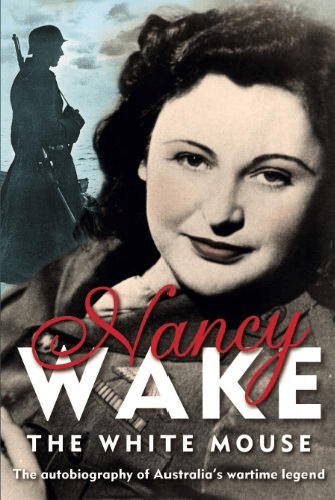
It’s the last day of March, which brings us to the end of Women’s History Month. In all honesty, I’m feeling a little sad about that.

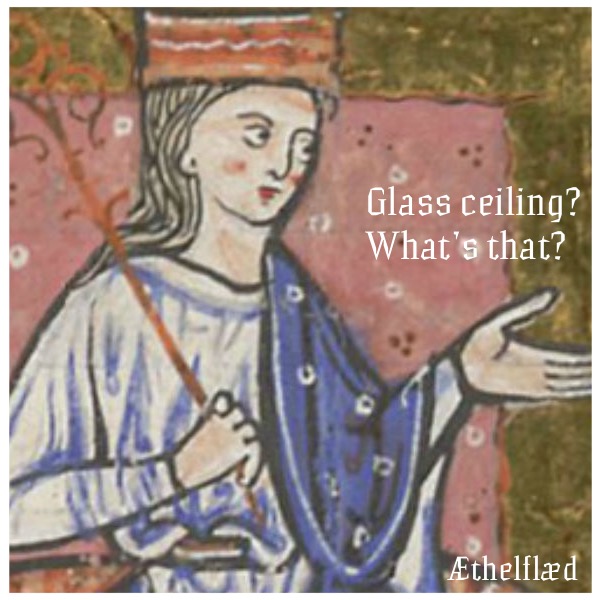
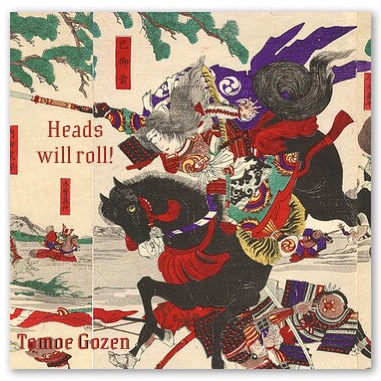
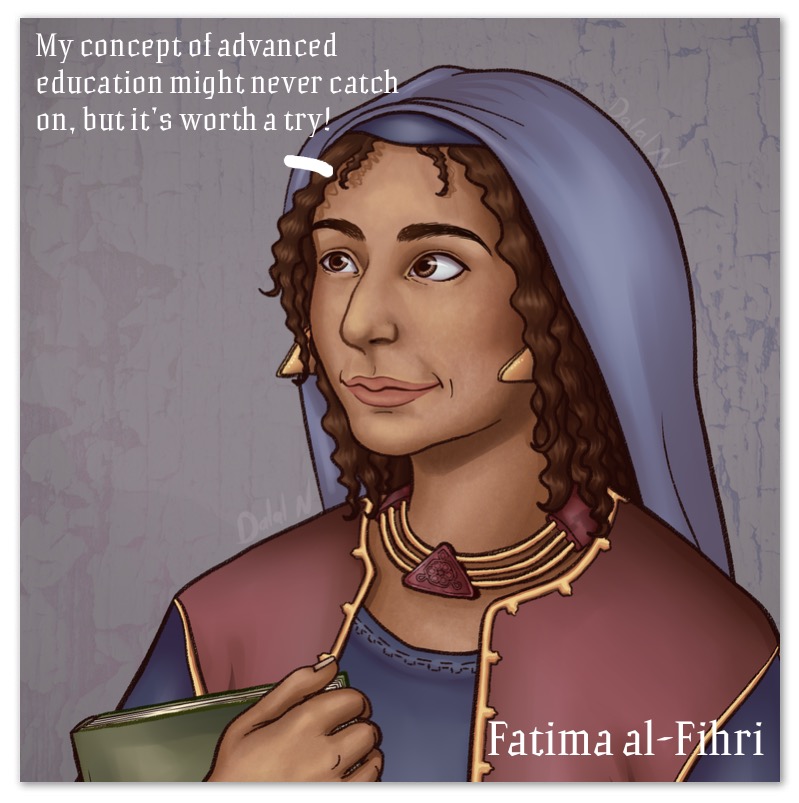
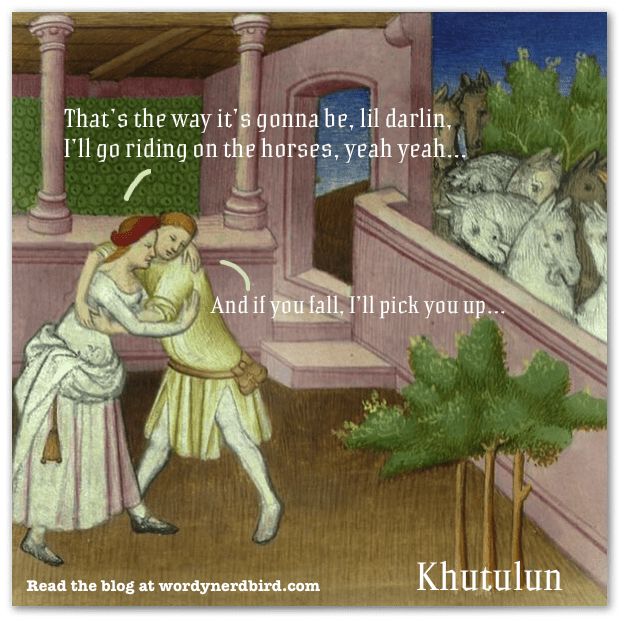
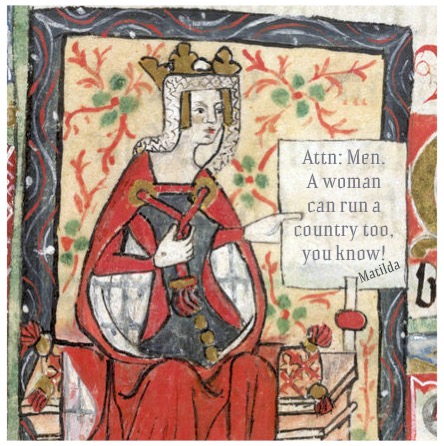
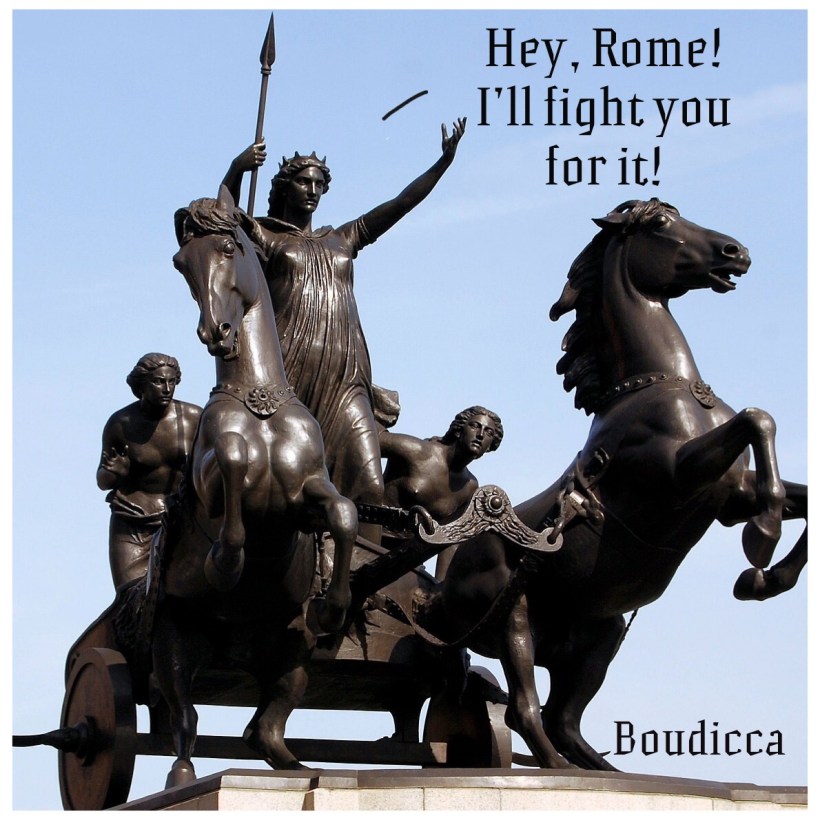
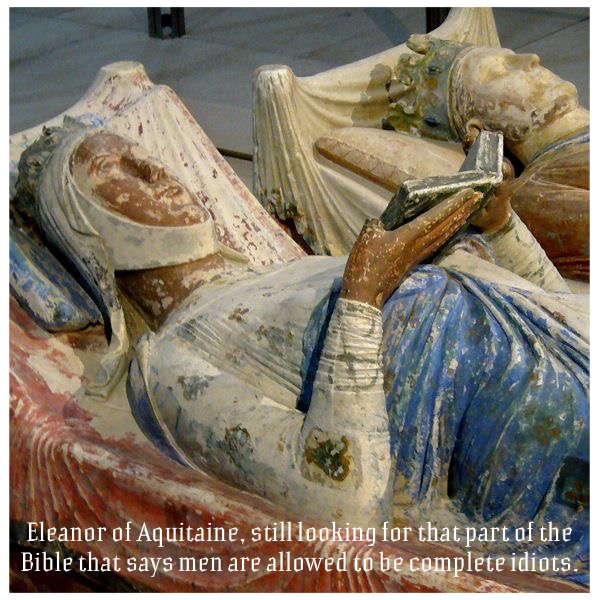
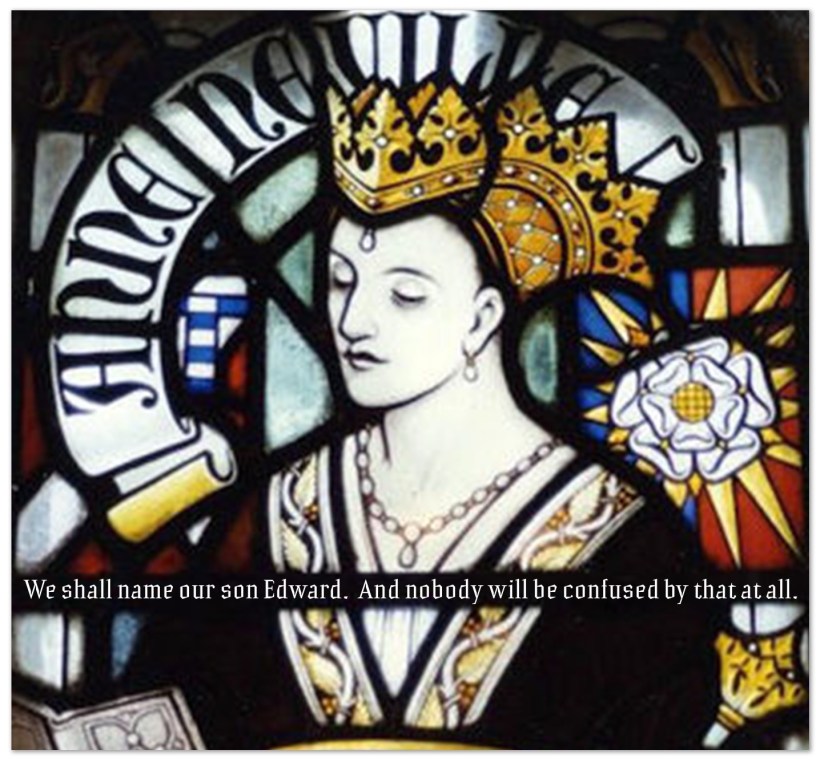
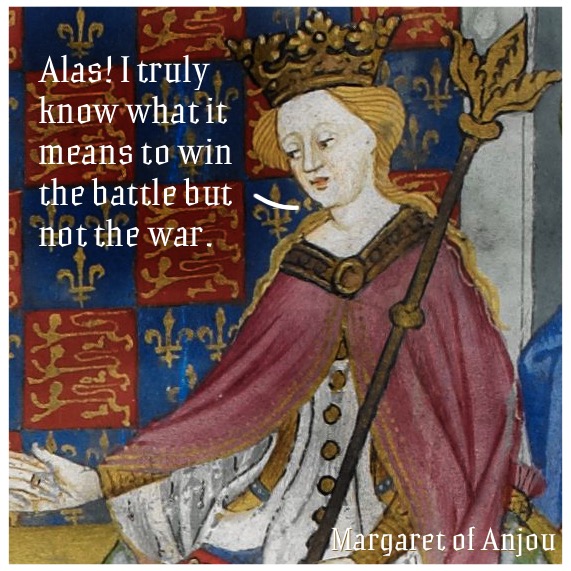
Blogging about some of the less well known  heroines of ancient and medieval history has been a most enjoyable occupation. I had fun creating some historical memes to accompany the posts and promote them on my social media, too.

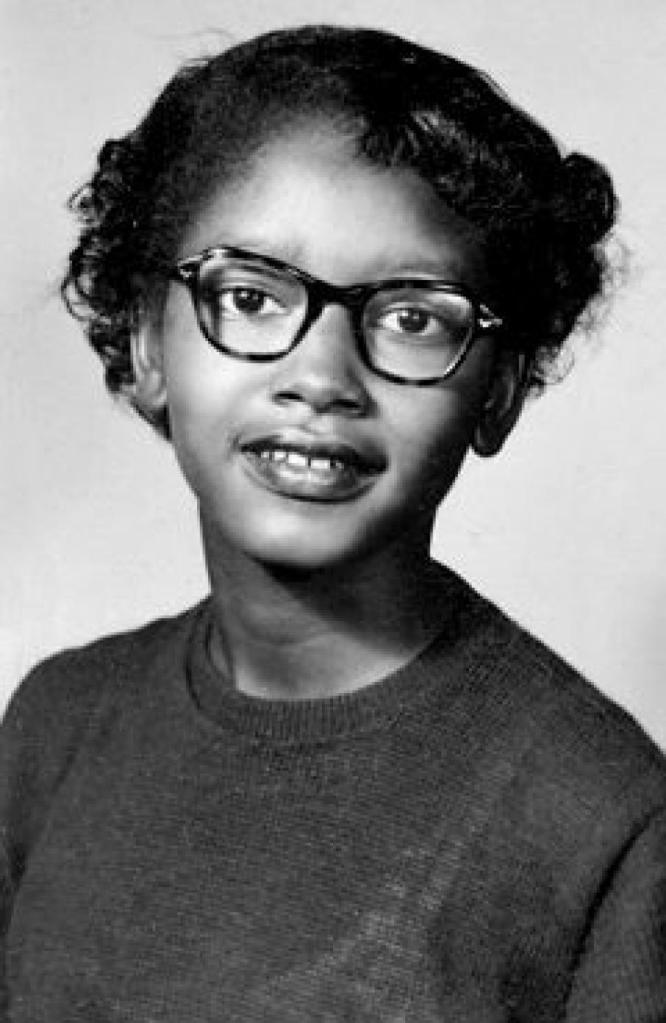
I also loved writing about some of the courageous women who willingly took on situations of conflict, oppression and segregation in the 19th and 20th centuries.


If you missed any of those posts, they are easily found by clicking on Women, Women’s History Month or Women’s History categories and tags in the sidebar. 

With those great stories told, I am feeling a little like I do when I have just finished a great book and I don’t really know what to do with myself.

Yet I know that tomorrow  I will feel differently because there are some great things happening in April: not only is it (Inter)National Poetry Month, but it’s also a month-long celebration of Indie books in the Read Self Published group on Facebook. 

The first half of the Pead Self Published month will feature a specific genre or set of genres each day, which readers are free to peruse. The second half of the month will be focused on helping each individual visual reader find what they want to read. There will also be some giveaways, which are always fun — especially for the winners! 

Everyone is welcome to join in those events, which is aimed at showing readers what they want to read without the “hard sell” that many find offputting. 

I know with all of that going on, I will have some great things to share.  I will be posting some of my favourite poems on this blog, and Book Squirrel will be sharing some great reads and book suggestions in various genres.

On a personal level, there will be continued rehearsals for the show I’m in, a very well-earned and much needed two week long term break, and a camping trip over Easter that I am really looking forward to.

So, away with my sadness. I shall welcome April with open arms and a great deal of anticipation.

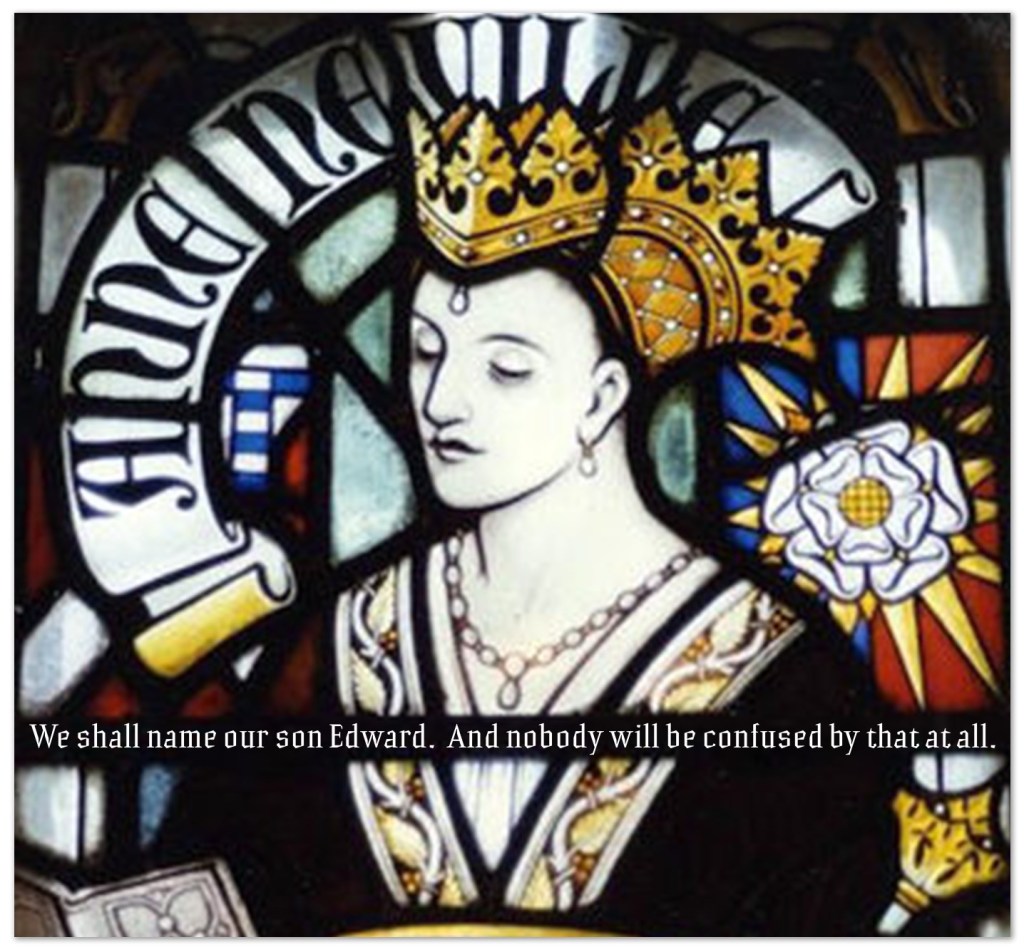
Women in History: Anne Neville

Anne Neville has to be one of the women in history most maligned by Shakespeare.

While it is true that he does portrays her as one of the many victims of Richard III, and doesn’t really say anything terribly nasty about her, it is also undeniable that her reputation is maligned by the way she is portrayed as being quite fickle and very, very gullible.

As I always remind my students, there is a vast difference between actual history and Shakespeare’s play. In fact, Shakespeare entirely misrepresents both the course of events and the relationship between Anne and Richard. 

Not only were their families well known to one another, they were quite closely related. 

Anne grew up at Middleham Castle, the daughter of the 13th Earl of Warwick and his wife, Anne Beauchamp. Anne’s great aunt was Cecily Neville, the wife of Richard, Duke of York, and mother of Richard and his brothers.

When the Duke Of York died, his youngest sons George and  Richard went to live at Middleham with Warwick’s family. Anne’s sister Isabel would later marry George, Duke of Clarence.

Warwick, known as The Kingmaker, played a crucial role in helping his cousin take and hold the throne as the King Edward IV of the House of York during the troubled times of conflict commonly referred to as either The Cousins’ War or the Wars of the Roses. For the first few years of Edward’s reign, Warwick held enormous influence over the young King. 

However, when Warwick tried to negotiate a marriage arrangement for Edward to secure an alliance with France, he discovered that Edward had secretly married Elizabeth Woodville, the widow of Sir John Grey who had been loyal to the Lancastrians. Warwick was not alone in distrusting her and her family, and was profoundly annoyed by Edward’s secret marriage to a woman whom Warwick considered entirely unsuitable. 

At the same time, and quite likely in direct response to Warwick’s contempt for his queen, Edward refused to give his blessing to a proposed union between his brother George, Duke of Clarence, and Warwick’s daughter Isabel, but the pair married anyway with Warwick’s blessing. 

This pitched Warwick and Edward against Edward, and their forces met in battle at Edgecote Moor in 1469. Edward was defeated and taken captive, although released before long, Warwick had sufficient time to reconcile his differences with Margaret of Anjou, the queen of the former Lancastrian King Henry VI. The significance of this is enormous: Warwick and Margaret absolutely hated one another.  

Even so, Warwick’s daughter Anne Neville was betrothed to Margaret’s son Edward of Westminster, the Lancastrian Prince Of Wales,  as a seal of the alliance, and Henry VI was restored to the throne of England two months before Anne and Edward were married in November of 1470. Thus,  Anne became the Princess of Wales and part of the Lancaster dynasty. 

Edward of York, however, was not so easily deposed. He defeated and killed Henry VI in the Battle of Barnet in April 1471, just as Margaret, Edward and Anne were returning to England. Margaret led an army to Tewksbury in May, where her son Edward was killed either during or just after the battle. Edward IV of York then reclaimed the throne as king of England.

Anne, a young widow, took up residence with her sister Isabel and her husband. When Richard asked for and was given consent to marry Anne, the only opposition came from his own brother, who wanted to inherit the entirety of Warwick’s wealth for himself. 

Anne was very willing to marry Richard, and harbored no resentment toward Richard for any of his deeds, perceived or real. They married in 1472 and theirr only son, Edward of Middleham, was born in 1473.

Her relationship with Richard’s mother Cecily was good and her marriage to Richard was happy, although stricken by grief when their son died at the age of ten. Anne and Richard then adopted the young orphaned son of her sister and Clarence, who was also named Edward — of course he was! and of a similar age to their own son. In yet another striking contrast to Shakespeare’s play, the newly adopted boy was named Richard’s heir. 

Anne Neville died at Westminster on 16th March 1485, from an illness that was most likely tuberculosis. She was only in her late twenties, but she had witnessed a very great deal of conflict, grief and turmoil in the kingdom in the course of her life. She was buried in Westminster Abbey, near the High Altar, although the location of her grave was never marked. 

Anne’s story is very different than that told by Shakespeare. Instead, Anne appears to have been a woman who possessed both integrity and backbone, and to have dealt with her trials with considerable resilience. As much as I love the works of the Bard, I do prefer the real story of Anne Neville, and feel sorry that for so many years, she was neither admired nor respected as she deserved to be. 

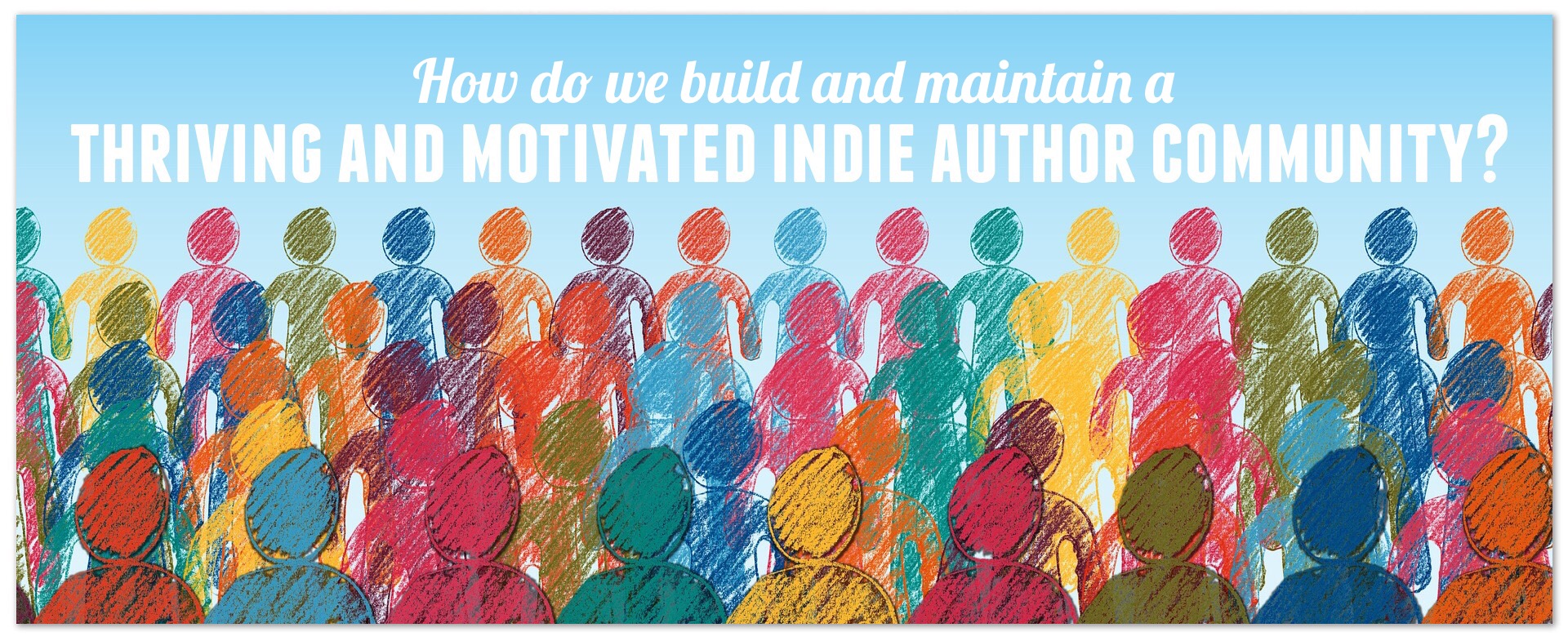
How Do We Build and Maintain a Thriving Indie Author Community?

It is easy for an Indie author to become discouraged by the challenges that come from various sources. It’s a tough gig sometimes, especially for someone who is new to the world of self-publishing. 

So how do we develop and maintain a thriving and motivated Indie author community that we all want to be part of? 

These are the key behaviours we need to adopt and make regular habits: 

  • Encourage each otherRead each other’s work
  • Give honest, constructive feedbackHelp each other achieve excellence 
  • Share each other’s work and social media posts 
  • Be professional about every phase of the writing, editing, publishing and marketing process.
  • Be free and liberal with sharing insights, experience and knowledge that will help those who are new to our community.

How do I know these things work? 

The more time you spend in the community, the clearer the divide between those who do them and those who don’t.

Those Indies who already do these things consistently demonstrate that they are are the most engaged, motivated and productive authors. They are positive and proactive. 

Most significantly, they express joy in doing these things. You can’t fake or manufacture that. 

Those who don’t support others are more likely to express jealousy and resentment in response to the success of others. They are more likely to be critical and competitive. 

And those who adopt the “success at any cost” will be far more likely to turn to less ethical avenues of advancement. It is from this small, murky pool that those willing to cheat the system will emerge. 

All in all, that doesn’t seem like much of a choice to me. I want my books to sell because they are good, not because I am pretending to be something I am not.