Pretty much anywhere you go, whoever you talk to, if they know only one thing about any play by Shakespeare, it’s the balcony scene from Romeo and Juliet. It’s possibly the most famous scene ever written.
There’s just one problem with that: there was no balcony.
That’s correct.
There. Never. Was. A. Freaking. Balcony.
In the script, the stage direction is clear: JULIET appears above at a window.
I don’t know who invented it, but it was a killer idea that I bet Shakespeare would wish he had thought of, were he still alive today.
Of course, directors can stage a play however they like, and make use of whatever structures and sets the theatre provides.
Filmmakers can do likewise, but one must keep in mind their tendency to just change whatever they want. Hollywood is notorious for that. The mayhem that comes from mass misunderstanding occurs when directors think they know better than the author, and when people watch a movie instead of reading the book.
It makes people and their assumptions about the original text wrong, and leaves them marinating in their wrongness until their wrongness is so commonly accepted that most people think it’s right.
It just goes to show that what your English teacher always said is true: there really is no substitute for reading the book.
I really appreciate the small, simple things in life that let me know I’m appreciated: a smile, a hug, an encouraging text message or a silly SnapChat. It changes my day knowing that someone cares enough about me to share those things with me.
I was reminded again by Karen Nimmo’s blog post on Nerdome how important that is. In this world where some people will sell you just as quickly as looking at you, or push you under the bus if it means they’ll achieve their goals faster, there are some people who have no positive interactions with other people all day.
My smile might be the only one they see. My words of encouragement might be the only ones they hear. My random act of kindness might be the only light in a dark day.
Because I know what dark days are like, I understand the privilege — and the responsibility — of being able to change that for someone else.
It doesn’t have to cost anything at all. It isn’t an obligation.
It does require us to take our focus off ourselves for a few seconds and give something intangible, yet priceless, to another person.
I hope that my words here, and those of Karen Nimmo, encourage you to seek to make a difference in someone else’s day today. You never know – you might just make your own at the same time.
hink of the last time someone did something nice for you.
Not something big; just a small act of kindness — bought you a coffee or a treat, did a household chore for you before you’ve asked, asked how your weekend was (and genuinely listened to the answer).
Recall for a minute how that made you feel. Good, right? It’s not so much the act that creates the warmth; it’s that they were thinking of you, that they found the time and means to appreciate you, to ease your load or make you smile.
The world can be a dog-eat-dog place; often, we find ourselves competing to get what we want and need. But trampling over others for our own agendas doesn’t make us feel good. Quite the opposite, actually.
One of the best ways to boost happiness is to do something for someone else. Their…
I am still coming to terms with the fact that this post needed to be written. How do people not know these are different words?
Apparently, though, it’s an all-too-common problem. Social media is littered with posts where someone has answered with “Defiantly!” when what the responder really meant to say was “Definitely!”.
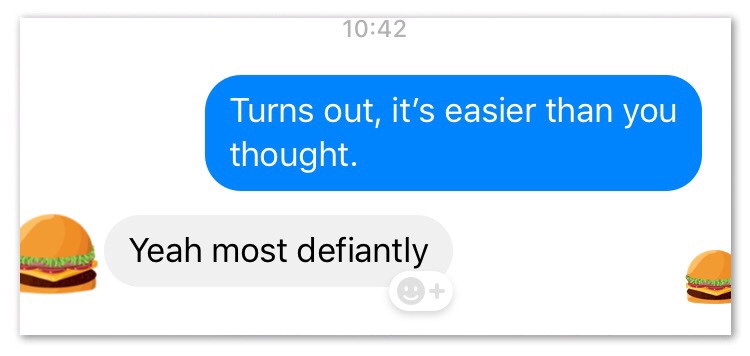
It happens in my own conversations several individuals on a regular basis. In fact, it happened again just yesterday, so I took a screenshot with this blog post in mind.
Yes. I most definitely did turn my friend into a hamburger to protect their identity.
I don’t know whether autocorrect is to blame, presumably as a result of poor typing, or if it’s just plain old-fashioned ignorance. The answer to that probably varies from one perpetrator to another, but either way, continuing to mistake one for the other is inexcusable.
Definitely means “for sure” or “absolutely”. In fact, those are excellent choices for anyone who wants to agree with something, but doesn’t actually know how to spell “definitely”.
Here’s a hint, though. Definitely even sounds exactly as it is spelt: def-in-it-ely. It’s phonetically straightforward.
Therefore, anyone trying to spell it should get to the ‘a’ in ‘defiantly’ and know they’re making bad choices.
Defiantly is a word most often used by parents or teachers describing the way in which a child refused to do as they were told. Examples: The child sat in stony silence, arms crossed defiantly. “No!” Robin yelled defiantly, “I won’t apologise for being a grammar snob!”
You get the idea.
It’s definitely in your interests to get this right.
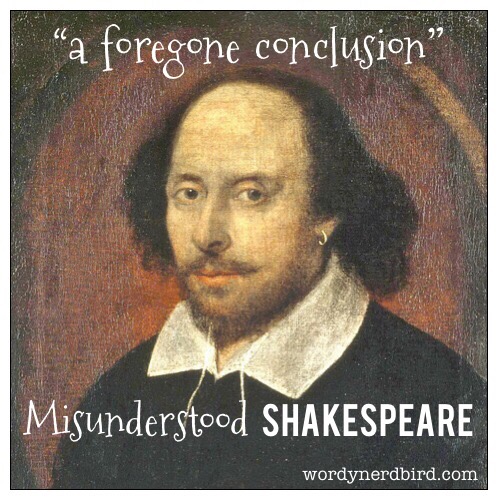
These days, when people talk about a “foregone conclusion” they mean something is a given: it is inevitable, it will happen, it may safely be assumed. As certain as it sounds, it is still a statement of conjecture about an event that is yet to occur.
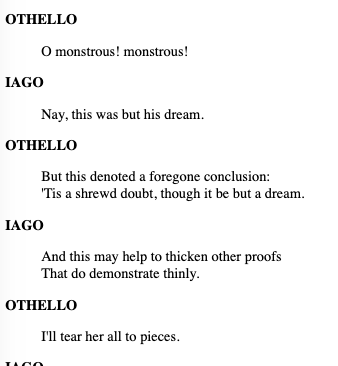
When Shakespeare had Othello speak those words in Act 3, Scene 3 of the play that bears his name, it had quite the opposite meaning. In this scene, Iago is manipulating Othello’s thoughts and making him believe that Desdemona has cheated on him.
Othello says, “But this denotes a foregone conclusion: Tis a shrewd doubt, though it be a dream.”
Here, he is speaking of the adultery between Desdemona and Cassio as something that he is certain has already happened. This gives the phrase “foregone conclusion” the opposite meaning to that which it holds today.
This, and statements such as “I’ll tear her all to pieces” and “O blood, blood, blood!” are evidence that Othello has already made up his mind about the guilt of his wife and former second-in-command.
The scene ends with Othello swearing his loyalty to Iago and thinking of ways to kill Desdemona. Charming, I know.
I was saddened to read what happened to Sharon Cathcart the other day in response to a blog post about racism. Nobody should have to put up with another person’s bad behaviour simply because they are standing up for what is right.
Sadly, there can be no doubt that racism and white supremacy are still living and active in our world.
We see their outworking on the news, on the streets, on social media, and in the actions of hateful people. It can be public or private. It can be overt or concealed.
It seems the only thing it cannot be is eradicated.
I do try, in my own sphere of influence, to teach and challenge others to embrace equality, acceptance, and empathy for what others have endured, and what is still experienced by many.
I try to make people aware of what white privilege is, and why it’s wrong to perpetuate it. Yes, I’m fully aware that I’ve been a beneficiary of it all my life. I’ve had advantages others haven’t, simply because I’m white. That doesn’t mean I am willing to sit back and allow it to perpetuate.
This is why I teach my students about the effects of European settlement of Australia on the indigenous people, then and now. It’s why I teach my students about segregation, oppression, and the Civil Rights Movement, and have them listen and respond to speeches by Martin Luther King Jr and JFK. It’s why I thave them study texts such as ‘To Kill A Mockingbird’, ‘Rabbit Proof Fence’ and ‘No Sugar’. It’s why I teach about inequality, wellbeing, and social justice. And I make sure they understand that for everything that has happened in the USA, Australia’s track record is no better.
It’s why I challenge people who tell racial jokes, or call people names, or avoid people who don’t fit their ideal.
It’s why I object to the way in which my country continues to detain people who are legitimately seeking asylum on small third-world islands nearby. It’s why I object to policies and practices that continue to discriminate against indigenous Australians.
And it’s why I write blog posts like this.
I do not ever claim to be perfect, but I detest prejudice, discrimination, and everything that goes with them. It’s not just about race: nobody should be excluded, abused or marginalised for being different in whatever way.
I, too, have had hateful messages left on a blog post or three. I know they are intended to upset me, and to deter me from posting something similar again.
Sadly for those responsible, it has the opposite effect. I always figure that if someone is vehement enough to threaten or abuse me over something I have written, I have probably touched a nerve that deserved touching. As my grandfather used to say, “If you throw a stone at a pack of dogs, the one it hits will yelp the loudest.”
He was a wise man, my grandfather. That statement was never made about actual rocks, nor about actual dogs. It was invariably made about bullies, and various other sorts of horrible people, and the way they would always lash out or blame someone else in response to any accusation or opposition directed at them.
That’s the same reason people leave nasty messages on blogs and social media. They resent the fact that someone is calling them out on their hate.
It’s okay for them to say what they want, though. They have rights, you know.
I was coming back here to write about something else, and found that I had a threatening e-mail (via my contact page) and comment (permanently deleted) from a white supremacist in reference to the link I shared about the 16th Street Baptist Church bombing. Suffice it to say that this individual now has the rare distinction of having been blocked.
This is what white supremacy looks like: threatening anyone who dares to show support for people of color, or to speak out about what happens to them.
And that is actually what I came here to write about. When my dad died, I mentioned that he had given away the bride when one of his African-American students, Joe, married a white woman. Her own family refused to attend.
Anyway, we tried very hard to find Joe in time for Daddy’s funeral. The number my mother had was disconnected, and the…
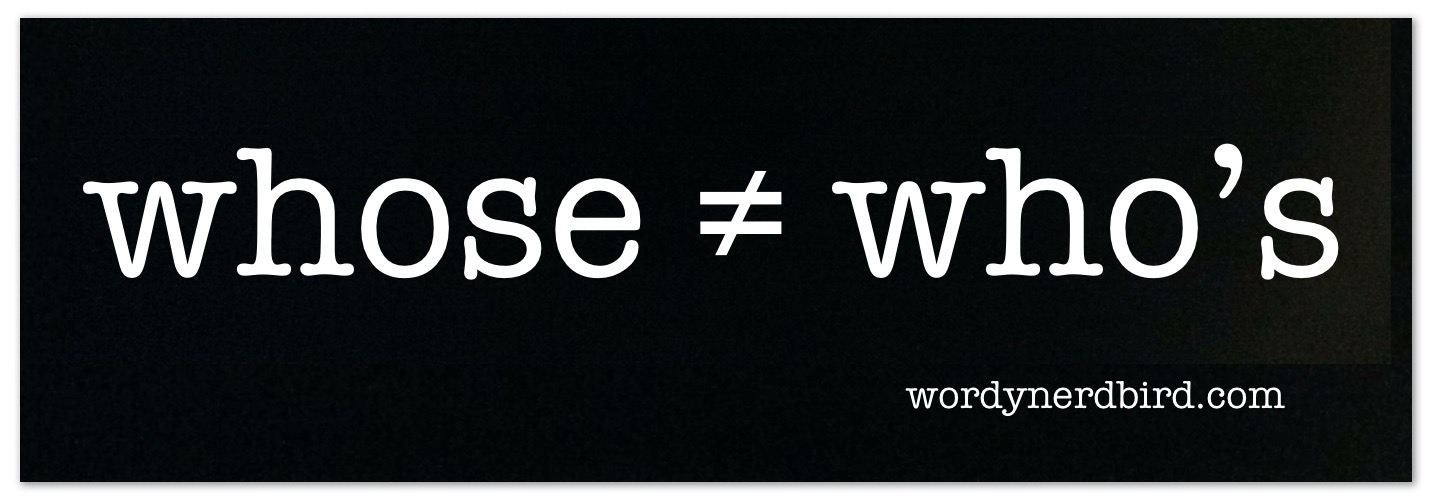
Today I received an email which included the line, “It doesn’t matter who’s responsibility it is…”
Written by a professional who should know better, it was ironic that it was me, and not them, doing a massive facepalm.
This incorrect use of the homophone “who’s” instead of “whose” is a common error, but that doesn’t make it excusable.
The apostrophe in “who’s” signals that it is a contraction— a shortening of two words into one, so that “who is” becomes “who’s”. Alternatively, it can also be a contraction of “who has”. You can tell which one it is by determining if the sentence is in past or present tense,
Examples: That’s the boy who’s a really good actor. Who’s in charge around here? Who’s been eating my porridge?
‘Whose’ is a pronoun of ownership.
Examples: This is the farmer whose cows ate all my corn. Whose car is that?
Once you know the difference, it’s fairly straightforward. That means there is absolutely no excuse for getting them wrong, even if they do sound the same when spoken.
Fun fact: “it’s” and “its” work exactly the same way.
It can also be quite cathartic.
Let’s be honest, what day can’t be improved by a good “Arrrrrgh!” or two?
If people annoy you, you can threaten to make them walk the plank, or call them lily livered landlubbers, and nobody takes offence.
I grew up enjoying books like Treasure Island and Kidnapped!, and still enjoy a good, old-fashioned pirate story, so I thought I would share Book Squirrel’s International Talk Like A Pirate Day Book Recommendations.
In honour of International Talk Like A Pirate Day, here are three great pirate tales for your reading pleasure.
‘Fallen Into Bad CompaNy’ by Kayla Jindrich
Matthew wants nothing more than to escape from his past, but that hardly seems possible with his new apprentice. While William might be Matthew’s chance at redemption, an opportunity to pay for his mistakes, William also has a reckless streak that could ruin the new life that Matthew has built for himself. Either Matthew will pull William from piracy, or William will drag Matthew back into the dangerous world that they both come from.
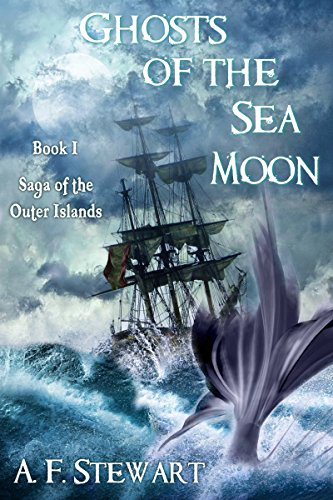
In the Outer Islands, gods and magic rule the ocean.Under the command of Captain Rafe Morrow, the crew of the Celestial Jewel ferry souls to the After World…
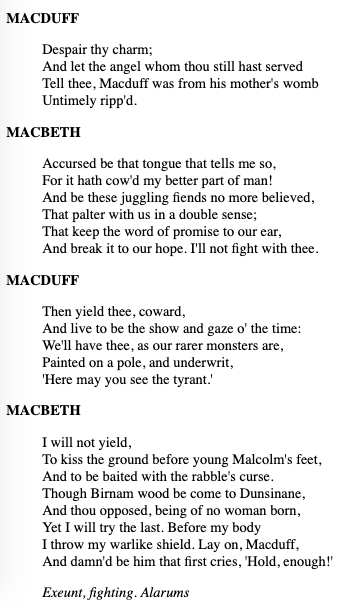
“Lead on, Macduff!” is a phrase often used to say “after you” when people are being polite and opening doors for someone, or showing that they will follow another person’s lead.
People who use this phrase think they are quoting Shakespeare’s ‘Macbeth’, but they’re not quite doing so: those are not the words Shakespeare wrote.
Both the phrase and its meaning have been changed over time.
What Shakespeare wrote was “Lay on, Macduff”, and Macbeth wasn’t opening any doors or following Macduff’s lead when he said it. Macbeth and Macduff were fighting one another, and only one of them would survive. The words “Lay on, Macduff” were Macbeth saying “come on, fight me!”
So, next time you open a door, or commit to following someone else’s lead, be careful about saying “Lead on, Macduff”. If they know their Shakespeare, they might just fight you!
Some word confusions are understandable, especially if they sound the same when spoken. We call those homophones, and they sound the same even if they are spelt differently. Examples are peak/pique/peak or there/their/they’re.
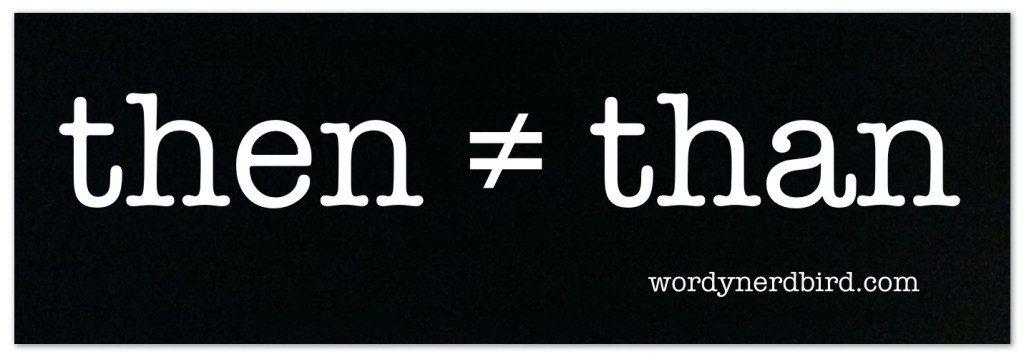
The confusion between ’then’ and ’than’, however, is a completely different matter.
Sadly, this is happening more and more, especially on social media. I don’t even spend that much time on Facebook, but it feels like I see someone saying something like “Nothing is better then this!” or “I love you more then anything!” at least twice a day.
Yes, they are similar. However, they are clearly not the same. They don’t look the same. They don’t sound the same. If one doesn’t mix up ’then’ or ’than’ with ’thin’, there is no excuse for mistaking them for one another.
I swear, it makes my eyes want to bleed.
The two words’ meanings are so vastly different that getting them wrong just makes the person writing look either poorly educated or plain stupid, even if they are neither.
This is one of the best and most self-evident arguments in existence for proofreading what one is writing, anywhere and every time.
‘Then’ rhymes with ‘when”— which is an easy way to remember that it relates to time or sequence. Examples: He put on his shirt, then his jeans, and then his boots. She ran up the hill, then back down again. When you have tidied your room, then you can go to the movies.
‘Than’ rhymes with ‘man’ and is used for making a comparison. Examples: His piece of pizza is bigger than mine. A triangle has fewer angles than a square. I would rather stay home and read a book than go to work.
Knowing which is which, and taking care to use the right words all the time, is a simple way to protect your credibility.
And for the love of Merlin’s beard, if you call yourself an author or a teacher, get it right. It’s not that hard.














 WordyNerdBird