My granddaughters and I were sitting on the floor of their pink-painted cabin at the bottom of the garden. I had evicted yet another invading spider and, while the youngest sat on my knee, her almost-five year old big sister was sprawling in the pink armchair.
The three of us had been playing. I had pushed little Imogen on her swing until she giggled with joy and had chased Hollie around the garden, swinging her up onto my shoulders and teaching her to stand on her head in a fairly unorthodox manner. Somehow, small children make you forget the aches and pains… at least until next morning when you try to move again.
By this point though, we had settled down in the playhouse and eaten a meal of chocolate-dipped worms and green slimegrobbels with custard… a menu chosen by Hollie and lovingly prepared by the…
Written in 1603 or 1604, ‘Measure for Measure’ is a play with enormous relevance to the 21st century.
As I listened to the play on the BBC’s ‘The Shakespeare Sessions’ podcast yesterday, it struck me just how timely and relevant it is.
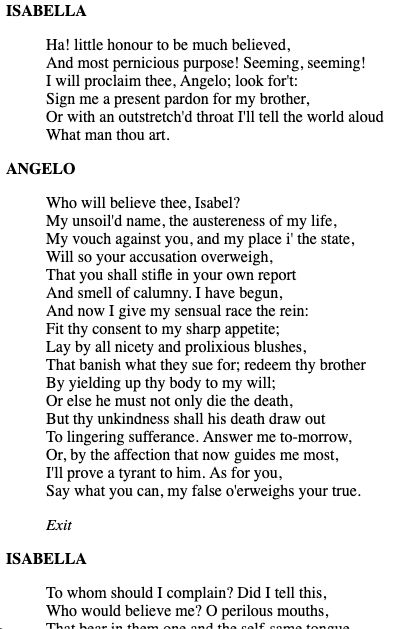
The play features a man named Angelo who, having been left in charge by the Duke, totally abuses his power in the interests of sexual gratification. He tells Isabella he will pardon her brother Claudio, who has been sentenced to death, if she has sex with him. When Isabella refuses and threatens to tell everyone what he has suggested, he simply asks, “Who will believe you?”
from ‘Measure for Measure’, Act 2, Scene 4
Angelo is clearly relying on his powerful position, and his ability to hold something over her, to get away with sexual abuse and bribery. And he dares to call it “love”, when it is anything but that. He is attempting to romanticise his proposed rape and abuse of power, as abusers so often do.
This is exactly the kind of behaviour we’ve seen exposed by the #metoo movement. Men abusing their positions of power and pressuring women to give in to them because they have the power to grant what the women need – a job, justice, whatever… and relying on their position to give them more credibility than a woman in a weaker position in society. It really does foreshadow those now infamous words spoken in 2017 by yet another reprehensible character: “And when you’re a star they let you do it. You can do anything.”
Not easily intimidated, Isabella points out that what he is suggesting is exactly the crime for which he has sentenced her brother to death. His hypocrisy is abundantly obvious to not only Isabella, but also to the audience. That she calls him out on it demonstrates her integrity and intelligence. Bravo to Isabella for not taking his crap or falling prey to his greasy manipulation.
Caught in between wanting to save her brother’s life and not wanting to have sex with Angelo, Isabella verbalises the impossibility of her situation in that very poignant and thought-provoking line: “To whom should I complain? Did I tell this, who would believe me?”
Still, even though she understands that what he says is probably true, she neither yields to him or gives up on her brother. Instead, she finds another way to solve her problems and expose the bad behaviour of Angelo.
As suggested in the title, justice is received at the end of the play in the same measure with which it is meted out at the beginning.
In this, we see a woman standing up for what is right, defending herself, refusing to give in to a man’s manipulation and sexual pressure, and winning. Angelo is punished for his corruption, and Isabella saves both herself and her brother.
This is a powerful contrast to most of the women in Shakespeare’s other plays, and indeed in the early modern times in which he lived and wrote, few of whom had any real agency or ability to stand up for themselves against the will of men.
‘Measure for Measure’ is a thought-provoking and entertaining play which demonstrates that while times have changed, the effect of power and position on human nature has not. Even so, it does remind us that evil people can, and should, be resisted, and we should never stop pursuing justice just because it’s difficult to do so.
That is truly a message pertinent to life in the 21st century.
While they’re definitely great podcasts to check out, I do have a new favourite!
I recently discovered The Hurly Burly Shakespeare Show, a fabulous podcast by Aubrey Whitlock and Jess Hamlet, AKA Whamlet. Both are vivacious and highly entertaining ‘lady academics’ – their words, not mine – who use their knowledge and expertise to make the plays accessible to new audiences and inspiring them to enjoy and appreciate Shakespeare’s works.
Both hosts are very engaging and easy to listen to, although the podcast does come with a ‘bawdy language’ warning which would be well heeded by those offended by expletives.
The podcast explores each play at a 101 level, giving the listener all the basics they need to know about that play to help them understand it better. Plot, characters, key themes and points of interest are discussed in a relaxed and relatable way.
Each episode also presents insights into the performance or staging of the plays, dramatic devices used by Shakespeare in crafting his works, and various developments in the worlds of studying or performing Shakespeare.
Some plays are revisited at a 201 level, exploring central themes and ideas at a deeper level.
In addition to exploring Shakespeare’s work, there are some really interesting episodes dedicated to the writing of Shakespeare’s contemporaries – Thomas Kidd, Christopher Marlowe, Ben Johnson, and Thomas Middleton.
The Hurly Burly Shakespeare show is both highly entertaining and informative. It has not only reinforced my knowledge, but also motivated me to read more widely and to expand my knowledge of the world in which Shakespeare lived and wrote.
If you enjoy Shakespeare, or if you’d just like to know more about his work, I recommend this excellent podcast.
The aim of this post is not to complain. My spirit is still quite positive, albeit a little weary after working hard to tick things off my “do or die” list this week. Instead, my purpose is to raise awareness of what it’s like to live with Fibromyalgia.
People cannot see my illness. It’s easy to feel sympathy for someone in a cast, a wheelchair or a hospital bed. I notice an immediate difference in people’s responses on the days I need to use my walking stick. Some are kinder, and most are more physically careful around me.
Of course, there are always some who couldn’t care less about someone with a cane, but there is no point losing time or sleep getting upset about them. Their attitude only highlights the good in others’.
My disease is invisible, although some of its effects are not. I may look tired, or upset, at times. My emotions sometimes get a bit messy, although I am a good actor so most people don’t know that.
After a busy and somewhat stressful week, my body is letting me know how unimpressed it is. My pain levels are in the “stupid” range. My legs don’t want to bend anymore. I have zero need to take my pulse because everything is throbbing. Even typing this is slow because my fingers hurt too.
To anyone else, I probably just look like someone in a recliner, covered with a quilt on a cold night, typing on her iPad. The truth is, I want to go to bed but I don’t want to move because I ache so badly.
I have medicated, but it’s not touching the pain. That’s always good.
In a further act of bodily insubordination, my very dodgy spine is giving me spasms— yet another an indication that I have probably (read: definitely) overdone it, yet again.
I don’t want sympathy. I don’t want medals or admiration, or people telling me I’m brave.
What I want is for people to understand that Fibromyalgia and other “invisible illnesses” are not imaginary. They are not something we adopt because they are “trendy”.
Fibromyalgia hurts. And it sucks. And it doesn’t go away.
And if you think I “don’t look sick”? Just remember, you can’t see my superhero cape, either.
Over the past few months I’ve been making changes to my social media usage in an effort to take better care of myself.
I have for quite some time now had a pattern of posting, responding to other people’s posts, and then looking for posts of value or interest to share. While those are all great things to do, I came to realise that I needed to put some limits on how much I did of each.
It’s so easy to get sucked into the mentality of thinking that we have to be perpetually present, always available, and never really “switched off”. That way of thinking is a lie— and a dangerous one at that. It’s a really unhealthy pattern that leads to a sense of social obligation that is really hard to break.
Sure, we all want to interact with friends, respond to their posts and see what’s interesting out there in cyberspace. We all want to share our own posts and, for those of us who are authors or other types of Indie creative, we need to promote our work.
That doesn’t mean that we have to do it constantly.
Consequently, I’ve made some changes. I have chosen to take control of my social media, instead of it controlling me.
I’ve cut down the number of times a day I check my various social media. I have found that checking in a couple of times a day is actually just as effective as checking in far more frequently.
I’ve made a deliberate effort to reduce the amount of time spent scrolling through my newsfeed. Scrolling through when things are new and there are people and posts I want to respond to is fine, but the mindless scrolling that often followed wasn’t helping me get things done. Once again, I have found that I’m interacting just as much, but wasting less time and energy in between.
If I need to post something in between as I often do, I post it, check my notifications for anything important, ignore anything that can wait until later, and leave again.
The verdict:
I feel a lot less distracted and far less pressured to “perform” on social media.
I’m using my time more constructively without losing out on contact or interaction with others.
I’m resting better. Because there’s less “white noise” in my thoughts, I can get the peace I need to relax.
Making my social media work for me is far better than me trying to fulfill its never ending demands.
I’m not saying I have total control of the circus, but at least now I am a lot closer to directing the show.
Since then, I’ve noticed one really annoying thing when I’ve been scrolling through my feed. It’s not actually the fault of Pinterest, but it is there that I am continually reminded of a matter that really needs to be corrected.
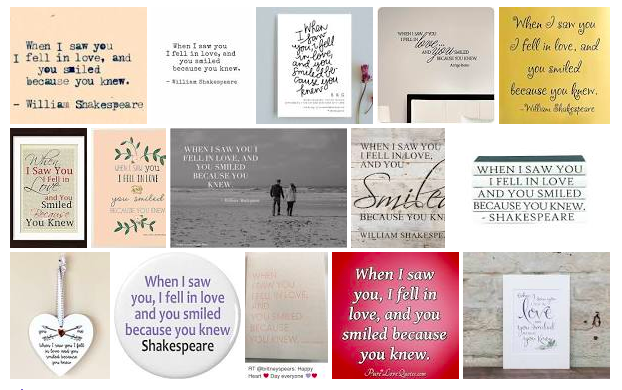
There’s a super popular quote that keeps coming up on my feed because Pinterest knows I love Shakespeare. It’s all over the internet, and it seems every second person on Pinterest is sharing it.
This quote is the darling of the Internet. But it’s not by Shakespeare.
The problem is, while it sounds like something Shakespeare might have written, those lines do not appear anywhere in the plays or poetry of the Bard… not even close, actually.
The quote is a translation from an Italian opera by Arrigo Boito titled ‘Falstaff’, based on one of Shakespeare’s plays, and which uses a number of lines from several other plays, too. Given that Boito borrowed from the Bard quite freely, it’s not really surprising that other lines from the libretto have been wrongly attributed back to Shakespeare. Some might suggest it’s karma, but it’s really just careless.
I’m more than happy for people to continue posting pretty images of the quote, but it would be great to see them attributed to the right person.
The blogpost ‘Only Way Out’ by Allison Marie Conway moved me powerfully.
This is me. This is the power writing has over me. It is my therapy. My escape.
And yet, lately, a deep, overwhelming sadness that has wrapped its weighty fingers around me, constricting my thoughts and paralysing my creativity.
“Give yourself time. Breathe. Be kind to yourself. Be patient.” I keep telling myself these things, hoping to make myself small enough and relaxed enough to slip from its grasp.
I will get through this. I will write my way out of it yet.
As a poet and author, I know full well what many do not: delivering a message of great import in one hundred words is much more difficult than writing it in one thousand. Condensing meaning, crafting and shaping ideas with an efficiency of words, is harder than it looks.
I enjoy the challenge, though, of telling a story in such a very compact form. A well-written drabble is a thing of beauty, and while I am not suggesting every one I write is excellent, some of them are.
The poem ‘Inside My Head’ was published on The Drabble blog yesterday. It is one hundred words long, yet captures the experience of being inside my own mind perfectly. It’s so relatable, so deep, so powerful – and yet, so concise. I doubt I could explain it better, so I am sharing it here for your enlightenment and enjoyment.
Memories
Reminders
Fears
Prayers
Occur in a mere
Sixty seconds
Images
Lists
Problems
Answers
Circling thoughts
Take control
Whirling
Spinning
Crashing
Linking
Hypnotic space
Easily lost
Wake up!
Eyes wide
Ears open
Life surrounds
Be still
Fully aware
Face reality
Move ahead
Be engaged
Time’s too short
To remain
Inside my head
Kelley is a wife, mom, pianist, and an elementary music teacher. She enjoys writing honest, personal stories and reflections about life. Writing helps calm her sometimes over-thinking brain.
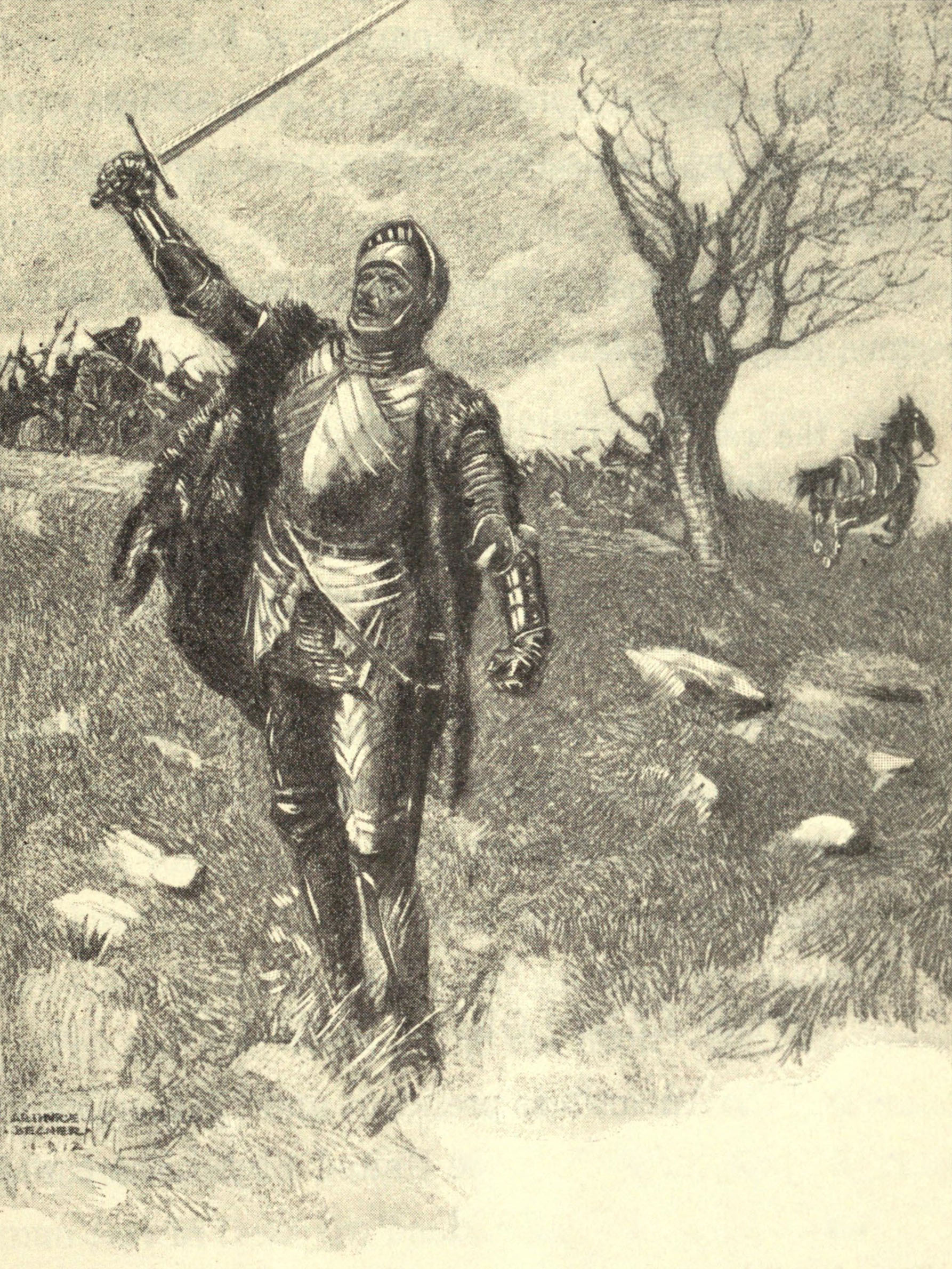
Written by Shakespeare in around 1593, these words have become immortalised as the final words of desperation spoken by King Richard III of England as he battled Henry Tudor for control of the throne of England.
These words are also possibly the most frequently misinterpreted Shakespeare quotation in history, although Prince Hal’s “The first thing we do, let’s kill all the lawyers!” from Henry Vl is right up there on the list.
Shakespeare very cleverly painted Richard III to be entirely evil and villainous, self-serving and single-minded in his pursuit of the throne at the expense of all others who stood between him and the ultimate royal goal.
As evil and villainous as Shakespeare’s Richard is, it’s crucial to remember that Richard was fighting for both his kingdom and his life. It makes absolutely no sense, therefore, that he would have been wandering around Bosworth Field offering someone his kingdom in exchange for a horse.
What this line actually means is that Richard knew he was going to lose the battle if he couldn’t get back on a horse and keep fighting. His horse had just been killed in battle, while he was still riding it. On foot, he was without means of either strategic defence or meeting the enemy in an even fight. He was an easy target that travelled much slower and far less deftly than his mounted opponent.
The line could be interpreted as meaning, “Without a horse, I’m going to lose my kingdom!” It was a cry of despair, not an attempt at last-minute marketing.
The urgency and foreboding in Richard’s words make this scene a magnificent piece of drama. If there’s anything the audience loves more than a villain getting it in the neck, it’s the villain realising that it’s coming.
When understood properly, this oft-misinterpreted quotation reveals once again the genius of the wordsmith.
If you have a line or scene of Shakespeare you’d like explained, feel free to ask a question or make a suggestion in the comments and I’ll give it a red hot shot.
Most of the time, when people protest about the way the English language is abused, it’s a case of the language continuing to evolve as it has always done.
One such example is the practice of verbing, which takes the noun form of a word and transforms it into a verb form… like ‘verb’ and ‘verbing’.
Just last week, I was talking with a friend about how annoying she finds it when people say “I’m going to action that.” I’m sure she sought me out for the conversation because I’m both a word nerd and an English teacher.
“Action is a noun! A bloody noun! How can so many otherwise intelligent people get that wrong?”
“It grates on us because it’s recent,” I said. “We’ll get used to it.”
“No, I won’t! It’s just wrong!”
“You know Shakespeare did it?”
“What?”
“Verbing. He did it all the time.”
“You and your Shakespeare. It’s like he’s the answer to everything.”
“You know he invented the word ‘friending’, right?”
She rolled her eyes and walked away. She didn’t even flinch at my use of the term “verbing”, which is exactly the same thing as “actioning” in terms of the language. After all, ‘verb’ is a noun, too.
It is the recent examples of verbing, such as “actioning” an idea, that we notice because we’re not used to hearing them yet. When Facebook was new, people complained the same way about “friending”, but these days nobody thinks twice about that. At some point in time, someone decided that it was okay to talk about bottling fruit, or shelving books, and now those terms are just everyday language.
It is also true, however, that some things people commonly say are, quite simply, wrong.
My pet peeve is when my students are talking about sport or some other kind of competition, and they say “We versed Team X”.
This is a common bastardisation of the Latin versus, which means ‘against’. It is commonly used for sporting matches and legal cases, and is generally abbreviated as v. or vs., as in Black v. White or Blue vs. Red.
My first response is always to ask whey they wrote poetry about another team. “You played them. You opposed them. You clashed with them. You competed with them. You did not write poetry about them.” Then I explain how the different words work, and what they actually mean.
The reason “versed” is wrong is because the words ‘versus’ and ‘verse’ have absolutely nothing to do with each other. Because ‘against’ is a preposition, it simply doesn’t make sense to say “We againsted them”. It is not verbing, by any stretch of the imagination.
The first time we have that conversation, they look at me with confusion. Some have a glazed look of fear, like the proverbial deer caught in the headlights. This never fails to entertain me. The second and third times, they roll their eyes.
Over time, the tedium of having the same grammar-nerdy conversation persuades them to start using the language correctly. They learn, I win, and so does the English language.








 WordyNerdBird