My granddaughters and I were sitting on the floor of their pink-painted cabin at the bottom of the garden. I had evicted yet another invading spider and, while the youngest sat on my knee, her almost-five year old big sister was sprawling in the pink armchair.
The three of us had been playing. I had pushed little Imogen on her swing until she giggled with joy and had chased Hollie around the garden, swinging her up onto my shoulders and teaching her to stand on her head in a fairly unorthodox manner. Somehow, small children make you forget the aches and pains… at least until next morning when you try to move again.
By this point though, we had settled down in the playhouse and eaten a meal of chocolate-dipped worms and green slimegrobbels with custard… a menu chosen by Hollie and lovingly prepared by the…
Most of the time, when people protest about the way the English language is abused, it’s a case of the language continuing to evolve as it has always done.
One such example is the practice of verbing, which takes the noun form of a word and transforms it into a verb form… like ‘verb’ and ‘verbing’.
Just last week, I was talking with a friend about how annoying she finds it when people say “I’m going to action that.” I’m sure she sought me out for the conversation because I’m both a word nerd and an English teacher.
“Action is a noun! A bloody noun! How can so many otherwise intelligent people get that wrong?”
“It grates on us because it’s recent,” I said. “We’ll get used to it.”
“No, I won’t! It’s just wrong!”
“You know Shakespeare did it?”
“What?”
“Verbing. He did it all the time.”
“You and your Shakespeare. It’s like he’s the answer to everything.”
“You know he invented the word ‘friending’, right?”
She rolled her eyes and walked away. She didn’t even flinch at my use of the term “verbing”, which is exactly the same thing as “actioning” in terms of the language. After all, ‘verb’ is a noun, too.
It is the recent examples of verbing, such as “actioning” an idea, that we notice because we’re not used to hearing them yet. When Facebook was new, people complained the same way about “friending”, but these days nobody thinks twice about that. At some point in time, someone decided that it was okay to talk about bottling fruit, or shelving books, and now those terms are just everyday language.
It is also true, however, that some things people commonly say are, quite simply, wrong.
My pet peeve is when my students are talking about sport or some other kind of competition, and they say “We versed Team X”.
This is a common bastardisation of the Latin versus, which means ‘against’. It is commonly used for sporting matches and legal cases, and is generally abbreviated as v. or vs., as in Black v. White or Blue vs. Red.
My first response is always to ask whey they wrote poetry about another team. “You played them. You opposed them. You clashed with them. You competed with them. You did not write poetry about them.” Then I explain how the different words work, and what they actually mean.
The reason “versed” is wrong is because the words ‘versus’ and ‘verse’ have absolutely nothing to do with each other. Because ‘against’ is a preposition, it simply doesn’t make sense to say “We againsted them”. It is not verbing, by any stretch of the imagination.
The first time we have that conversation, they look at me with confusion. Some have a glazed look of fear, like the proverbial deer caught in the headlights. This never fails to entertain me. The second and third times, they roll their eyes.
Over time, the tedium of having the same grammar-nerdy conversation persuades them to start using the language correctly. They learn, I win, and so does the English language.
I’m always a bit lost for words when people remark that history is boring. Not because I have nothing to say— far from it— but because I know they are never going to be anywhere near ready for the conversations I want to have with them.
I accept that in the past, some teachers have been guilty of making history very, very dull, but it was not the history that was boring: it was the teacher.
I’ve had some of my own students question, “Why do we need to learn about this? How am I ever going to use this in real life?” My responses vary depending on the topic at hand, but they are consistently positive and enthusiastic about how interesting and inspiring history can be.
I have recently discovered two new examples to offer to students or friends who complain about history.
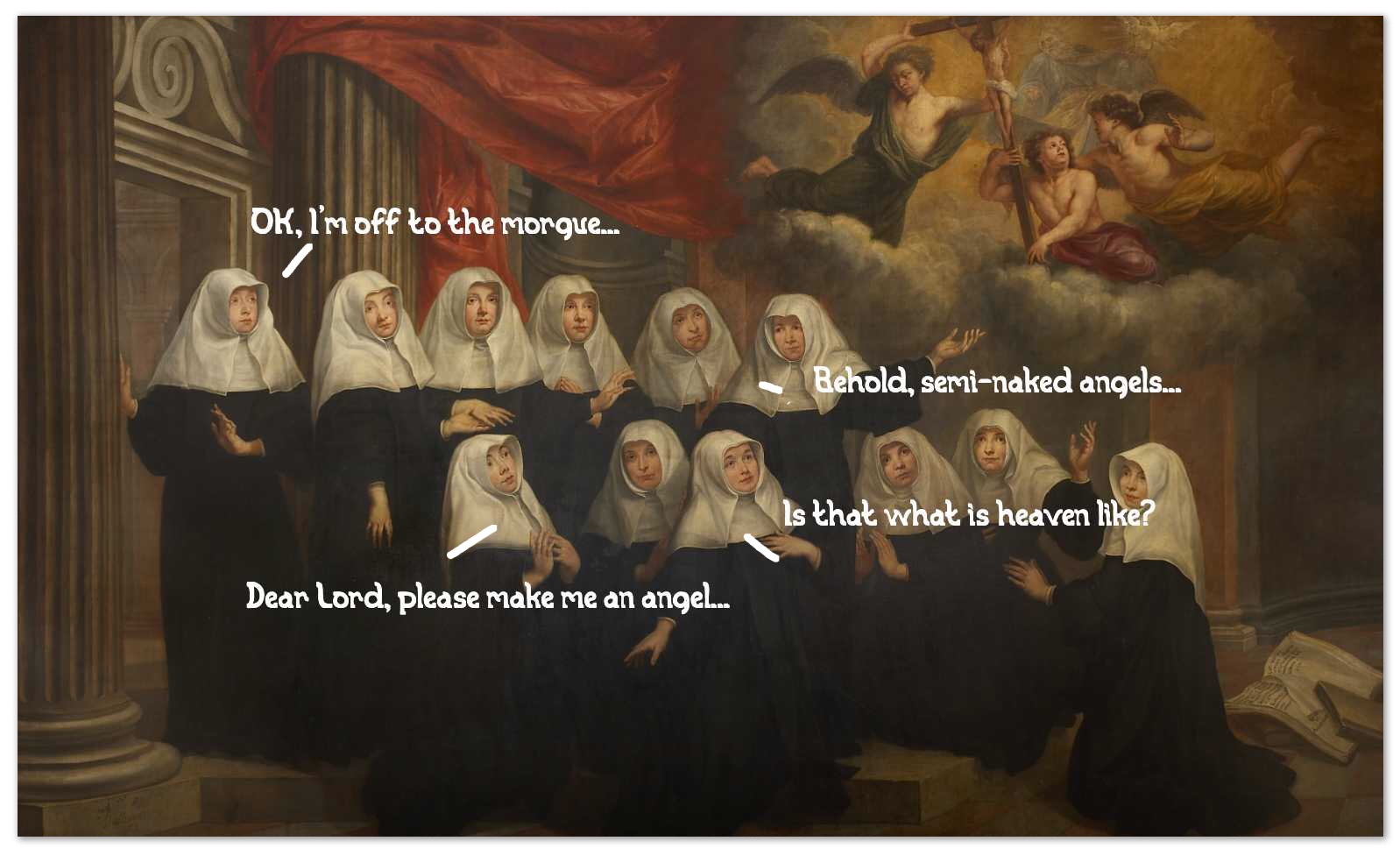
A week or so ago, I read a story of a 14th century nun named Joan who faked her own death to get out of the convent she was living in. How’s that for dedication?
Apparently, she wasn’t the only one who wanted to escape either. Having studied medieval history and knowing the lifestyle adhered to by monks and nuns of the time, I can’t say I blame any of them.
Faking your own death is definitely taking it to the next level, though, so I feel that Joan deserves a bit of recognition and applause for her commitment to the performing arts.
Original painting: Jan Van Helmont Portrait of the Sisters of the Black. Public Domain The clever edits are my own.
I now know more about this amazing creature than my friends will ever think beneficial. You can bet I’m going to tell them all about it, and I know my Year 9 boys are going to love it, too. I almost can’t wait until they complain again, so that I have a good reason to get the story out and share it.
Seriously, take a look at this beast. This picture from a medieval bestiary, or book of animals, portrays this particular bonnacon as being rather pleased with himself and his toxic poop. He’s never going to be sorry.
It is a constant source of amusement to me that barely a day goes by without someone reading a post I wrote over two years ago. As hard as I try to write posts that are interesting and engaging, and have some relevance to either readers or other authors the one post that shows up in my blog stats almost every day is ‘Top Four Shakespeare Podcasts’, posted in June 2017.
While I have had some posts that got a great response at the time, othing else I’ve published on this blog has had that kind of perpetual popularity,
The funny thing is, it’s only got three likes, but more people than that visit that post every day. Perhaps WordPress needs to make the “like” button bigger and brighter so that it’s easier to see and click.
Given that it’s the most successful blog post I’ve ever written, I thought it was worth posting again for all the followers I’ve gained since then. Enjoy.
I love podcasts, and I love Shakespeare. In these four podcasts, you’ll find the best of those two worlds combined.
#1: No Holds Bard. An informative and entertaining podcast by Dan Beaulieu and Kevin Condardo, directors of the Seven Stages Shakespeare Company in Portsmouth, New Hampshire. They discuss the plays, words that people in the 21st century might not know, different interpretations, and various performances of Shakespeare’s plays. They even have a segment where they’ll answer homework questions sent in by students.
#2: Folger Shakespeare Library: Shakespeare Unlimited. A podcast that explores the associations between Shakespeare’s writing and the world today through the words we use, ideas we discuss, and performance of the works of Shakespeare and others.
I may need to learn to turn the volume down a little when being a comic genius in public places.
We were sitting at a cafe deciding what to have when I commented on one of the options: “I’m not sure I needed to know that their chicken was marinated by a jerk.”
A lady at the next table laughed out loud, turned around and said, “I had the same thought, but wasn’t brave enough to say it.”
The waiter showed up while I was writing this post, and I shared my observations. He laughed and said, “Actually, the chef IS a jerk!”
I nodded safely. “Many of them are,” I said.
“Too true!” he said. “But that’s all just between you and me, right?”
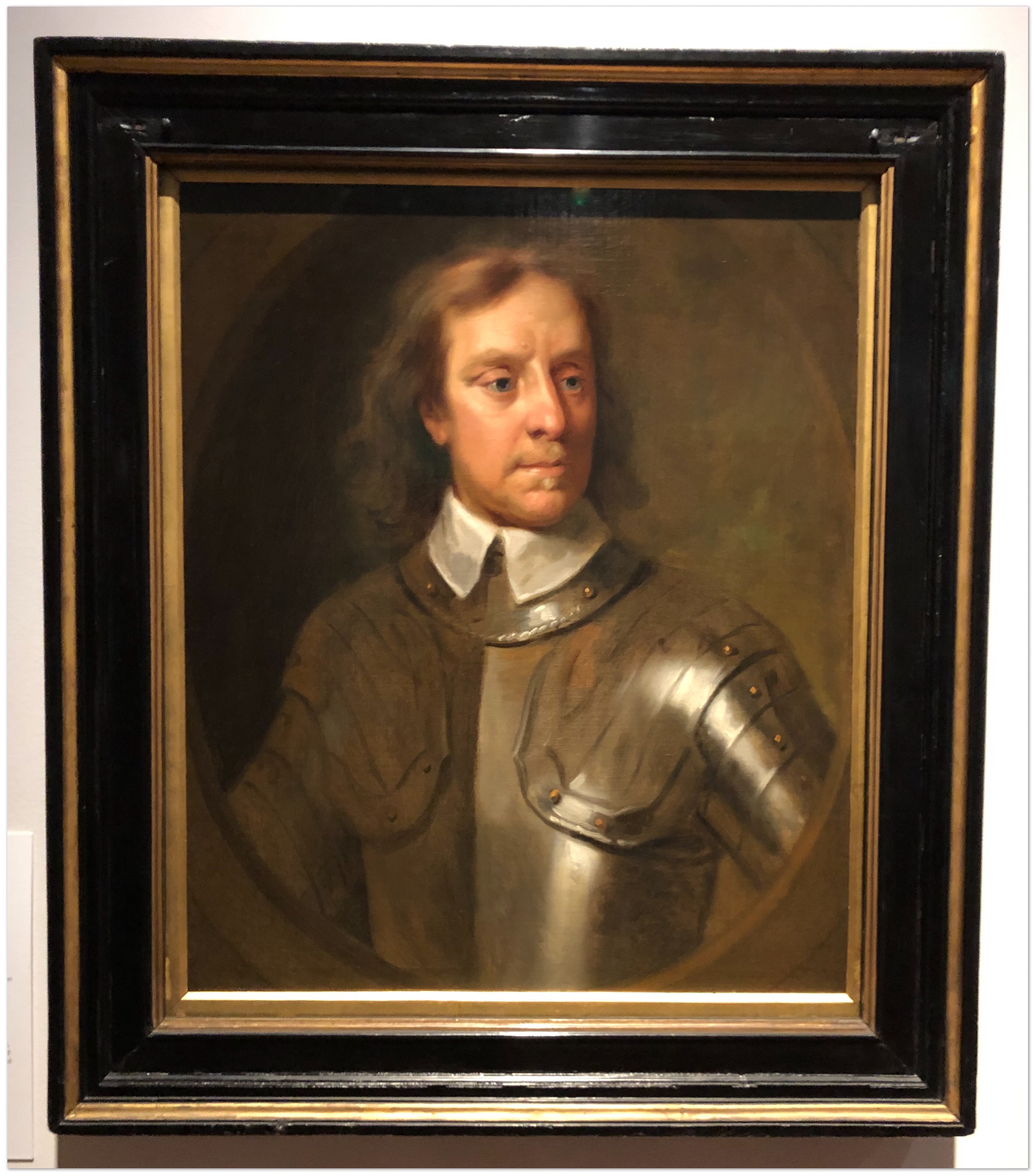
My friends and I were standing in front of a portrait of Oliver Cromwell at the Tudors to Windsors portrait exhibition at the art gallery in Bendigo. .
As I often do, I added my own commentary. In a posh English accent and lower vocal register, I quipped, “Look at me being all godly and humble and unroyal and stuff before I go and kill a bunch of people and destroy all the monasteries… you know, on God’s behalf.”
A well-dressed elderly gentleman had come to stand beside me. When I finished speaking, he added in a crisp, upper class accent: “Bastard.” He was not wrong.
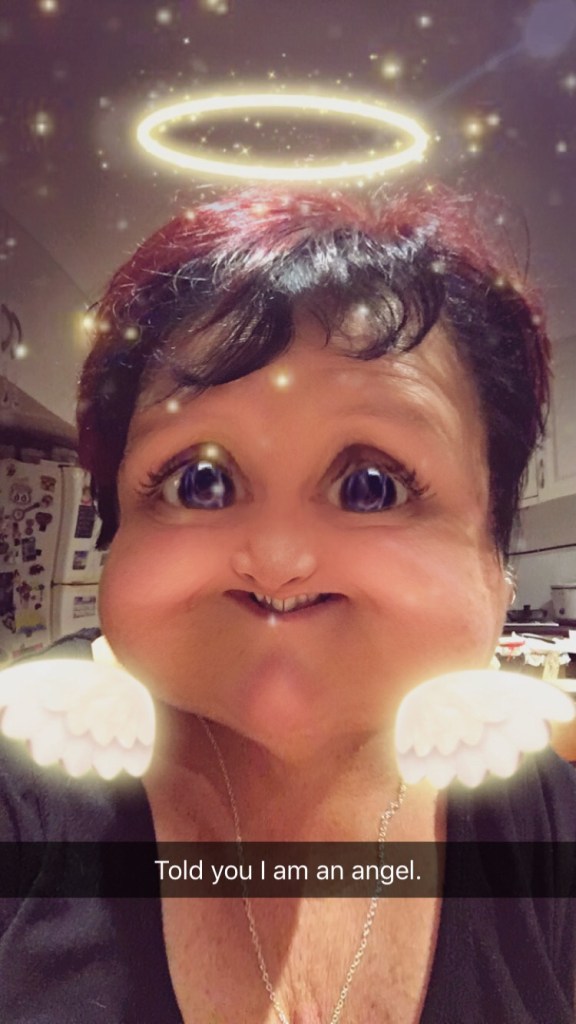
I’m proud to say that this was one of my first-ever Snapchats.
Snapchat has been the subject of much controversy in the past – mostly from people who have never used it. I know a lot of people have been vocal in their criticism of the ease with which teens could use it to send pictures of their naughty bits to one another. To be honest, they haven’t ever needed SnapChat to do that. And, in a further moment of not-so-surprising honesty, I’ve never used Snapchat for that either.
It’s like anything: you can use it sensibly, and be careful who you add to your contacts, or you can be an idiot and endanger any bit of credibility you ever had. Snapchat is definitely not alone in that regard.
Contrary to all the negative press it has had, Snapchat is actually pretty cool.
The process is simple:
Take a snap, choose who you want to send it to, and send it.
If you want everyone to be able to see it, you add it to your “story”.
If you don’t, people will only see your snap if you actually send it to them individually.
You can choose how long you want the photo or video to last. Once the time you set expires, it’s gone.
It’s important to remember that people can take a screenshot, and people can be offended, so common sense and decency are still required.
I have great fun using Snapchat for quick, easy contact with my family and friends. It’s also a great way to quickly and easily share a moment in your day in ways that are hard to otherwise express.
In that respect. It’s super duper effective.
It’s actually great for introverts because we can communicate meaningfully without actually having to make, or answer, a phone call. I have found that if you send enough Snapchats, they know you’re okay and what you’re doing, and don’t actually try to call anywhere near as often. That may sound awful, but if you ask any introvert you know, they’ll tell you it’s a fact of life: talking on the phone for any length of time is hard, especially if you’re tired or unwell.
I also use it to share my comedic genius with the world. You’ve got to take your opportunities where you can get them, after all.
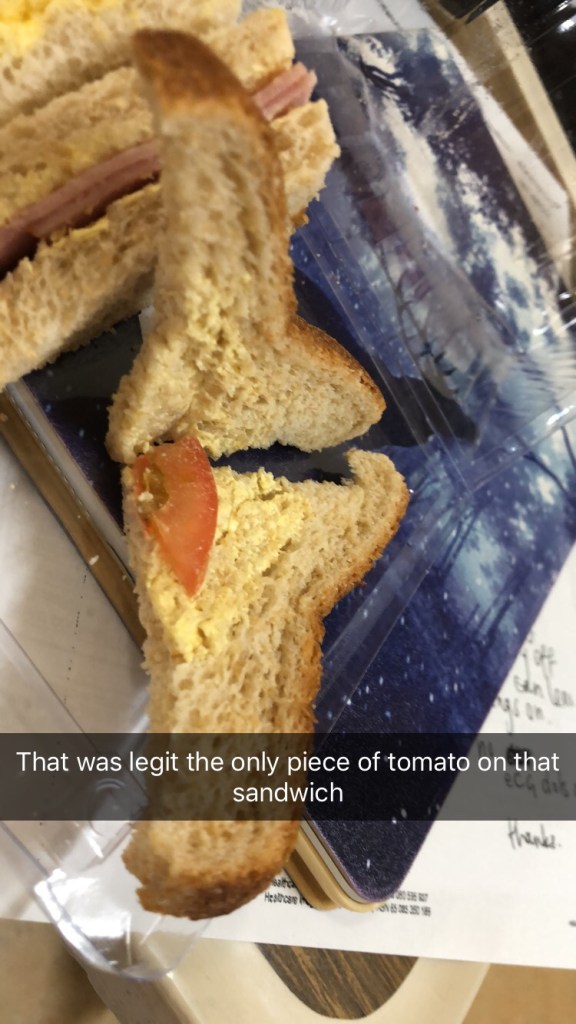
When you can’t put into words how bad your hospital food is…
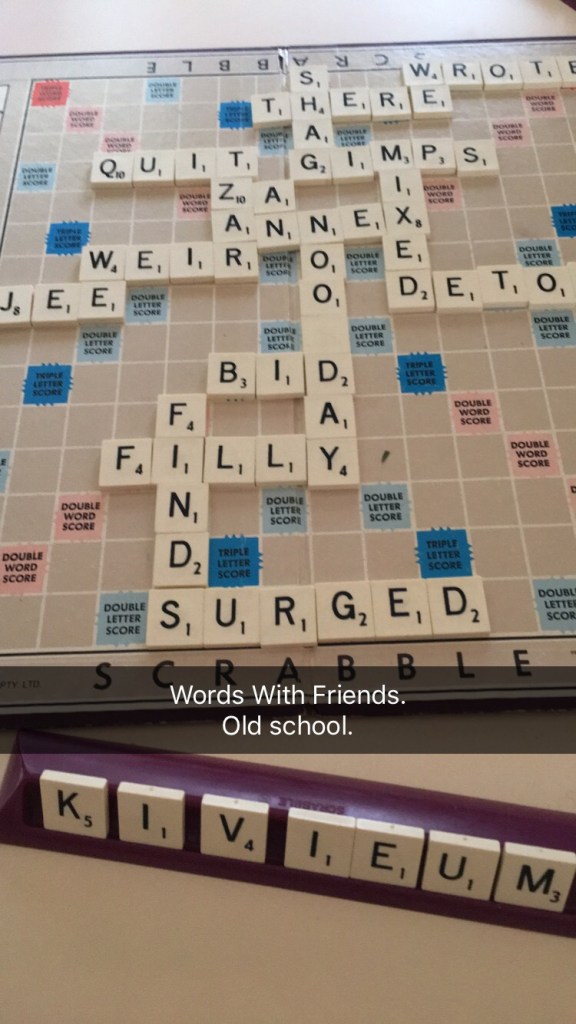
When you want to show kids these days what life without a phone was like…
My absolute favourite use of Snapchat, though, is when my family use it to send me baby spam. I’m one of those aunties who can never get enough pics of my babies so Snapchat offers a great way for them to send me pictures without all the cranky “we don’t want baby spam” whiners on Facebook and Instagram getting their noses out of joint. Snapchat makes it easy to be a lot more direct and “one on one” with your pictures.
You don’t even have to take a photo every time. You can just use the instant message function if that’s all you want to do. But then… why wouldn’t you take a photo every time when you’ve got those filters to play with?
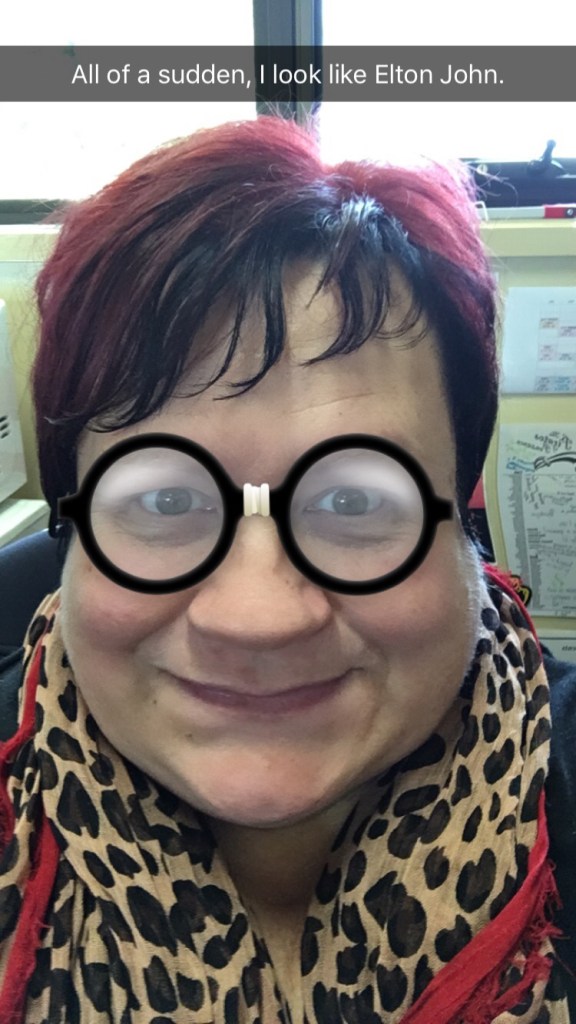
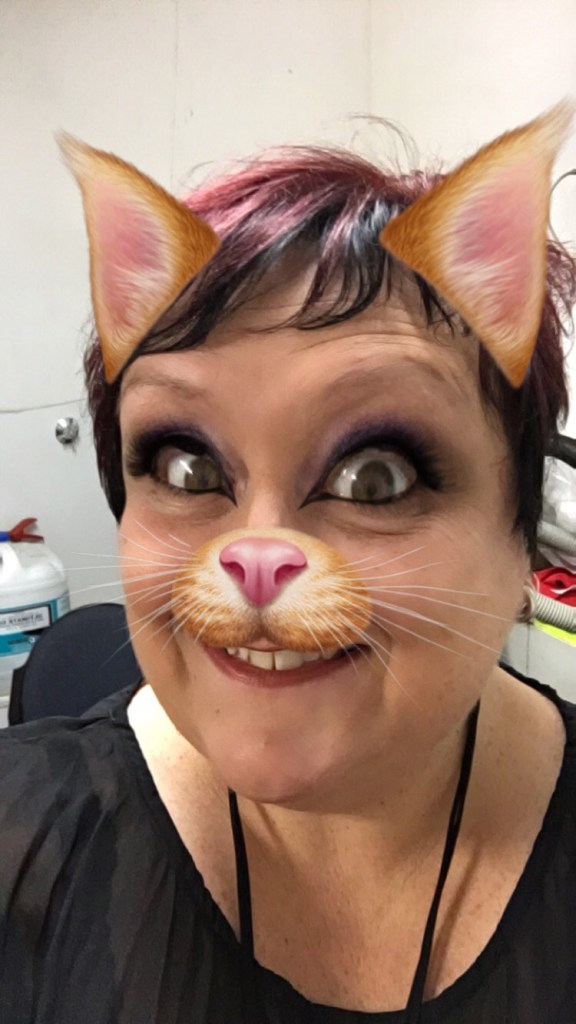
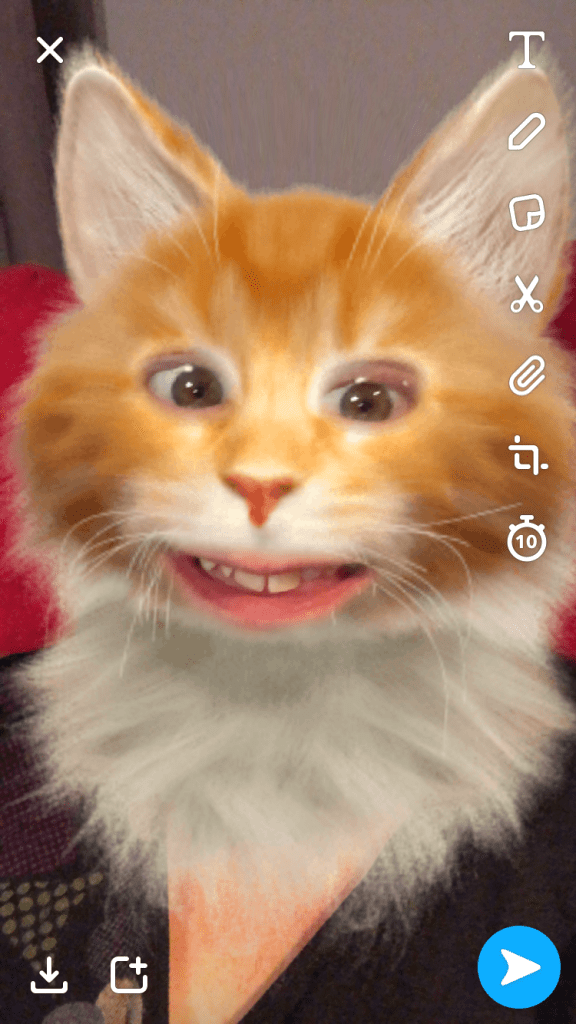
Seriously, the Snapchat filters are fantastic. One minute I’m a washed out, permanently exhausted 50-something English teacher, and the next, I’m a cat… or an emu… or a pirate… or whatever the filters of the day offer. Sometimes, I have instant makeup and smoother, younger skin. Sometimes I can add a piercing or a tattoo. Finding out what the filters are each day is as much fun as using them.
Its easy to edit a picture using the menu at the top right of whatever picture you take This allows you to:
add text, labels, and/or stickers
crop your photo
doodle or write on your picture
attach a URL or website to your image
cut out part of your picture to create a sticker
You can also easily save any picture you like to your phone’s camera roll, using the little down arrow icon at the bottom left of the image.
There isn’t really a lot that annoys me about Snapchat, but I probably should mention:
The silly, click-bait stuff they post on the “discover” page. Ugh. Once I’ve looked at my friends’ stories, I swipe away from the page.
On specific dates – Christmas, New Year, that kind of thing – the ’Snapchat Team’ send pictures or videos that you have to watch to get rid of them. Some of them are clever. Others… not so much.
Occasionally, there will be a filter that makes me look uncannily like my brother. I’m really not so keen on those, but it is kind of fun freaking out his daughters and our sisters with the pictures. And no… I’m not going to show you what I mean!
For me, the frustrations are very minor compared to the fun I have with the app. It’s a keeper.
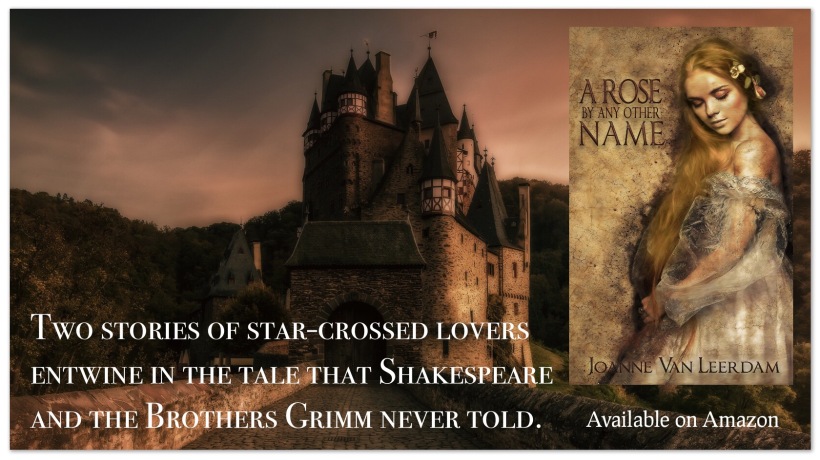
The reference to Shakespeare’s ‘Romeo and Juliet’ in the title of ‘A Rose By Any Other Name’ is blatantly obvious.
The irony is that ‘Romeo and Juliet’ is probably my least favourite play from among Shakespeare’s works. As I often explain to my students who think it’s romantic and all about love, it’s really not. It’s a tragedy that demonstrates what happens when people do stupid things on impulse and don’t stop to think about the consequences of their actions.
They’re teenagers. They met on Sunday, and by Thursday, they’re dead.
And, as Shakespeare points out in the epilogue, they end up that way because their families both prioritise their stupid feud over the happiness and the future of their children. How much more like a badly plotted teenage soap opera could it be?
It’s more of an anti-Romance, if you ask me. They’re not in love, they’re infatuated. Romeo really is quite an idiot, and as for fickle… how quickly did he forget his passion for Rosaline the moment he met Juliet? If you ask me, Rosaline dodged a bullet – or a dagger, or a vial of poison, there.
To be fair, the fault isn’t Shakespeare’s. He based his play on an old story that was very popular back in the day, which was a brilliant marketing move. The other factor that made his play such a hit was the beauty of the language with which it is written. There’s nothing at all wrong with the writing: it’s magnificent. Nothing can convince me otherwise. If anyone could give a story about two silly teenagers from equally silly families another 600 years plus in terms of longevity, he was the man for the job.
So, is it odd that I’ve used ‘Romeo and Juliet’ as one of the starting points of my story? Not really, because I wanted my story to be something of an anti-Romance, too.
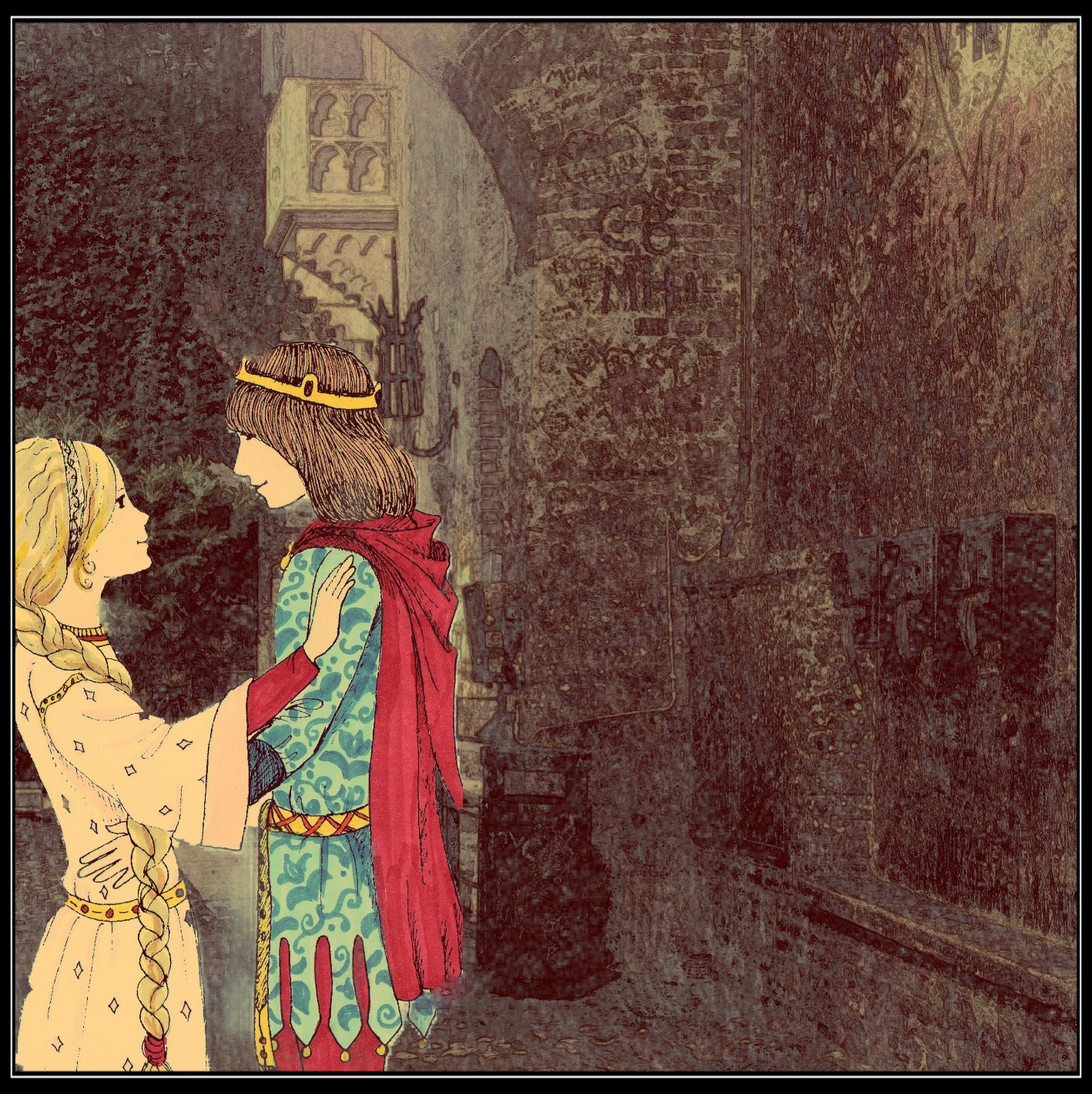
‘A Rose By Any Other Name’ draws on ‘Romeo and Juliet’, and on the Brothers Grimm fairy tale of ‘Rapunzel’ as starting points, then twists and tangles them together to create a mashup of the two stories with a very different ending. Romeo is still an idiot, it still ends in tragedy… but it’s a completely new story. It’s medieval fantasy, laced with faint traces of my subversive sense of humour.
I like to think of it as the story that Shakespeare and the Brothers Grimm never told. But I bet if they’d thought of it, they would have.
I am a person who takes others at face value. I don’t immediately classify someone as pretty or ugly, gay or straight, progressive or conservative (unless, either way, they are hateful or prejudiced – then the deal is off) , black or white or some other colour, blonde or brunette, or anything else. I don’t care if they’re plain or fancy, nor do I care if they’re pretty or not. I try to take each person as they are and let their integrity speak louder than their features. I like to get to know them before I make any decisions about them.
When it comes to fonts, however, i am nowhere near as open-minded. Don’t get me wrong – there are plenty of fonts I like, and many others that I will view with an open mind depending on context and purpose. But there ARE two or three fonts I really hate. I refuse to use them. I have handed back an assignment or two, asking for it to be reprinted in a more acceptable typeface. It’s true: I am Fontist.
I wasn’t raised that way. We didn’t really need to think about fonts back then. When I was growing up, it seemed as thought books were printed in two, maybe three different standard fonts. From memory, there was something like Times New Roman, a basic Sans Serif, and possibly another standard typewriter-style serif font. There was never a question of what typeface to submit our work in, because computers weren’t a thing and our school work was all handwritten. When I started university, assignments and essays had to be typed and double-spaced, so I used my parents’ typewriter. Of course, it only got to the typing stage when one or two hand-written drafts had been painstakingly written, proofread, edited, and revised.
Don’t get me wrong: I’m glad those days are over. I appreciate the ease of writing using my laptop as much as anyone else, and I’m happy for my students to do some – but not all – of their work on their devices. My underlying Fontism rears its ugly head, though, when someone hands in an assignment or broadcasts a presentation on the screen that screams “ridiculous font” louder than anything the student is trying to communicate. The same thing happens in meetings and seminars where the important information is obscured by the poor choice of font on the screen or handout.
You might think I’m overreacting. But consider this: I might read fifty student assignments in less than a week, or sit through twenty five student presentations in two or three days. When their font suggests I shouldn’t be taking their work seriously, that’s a complication neither they nor I need.
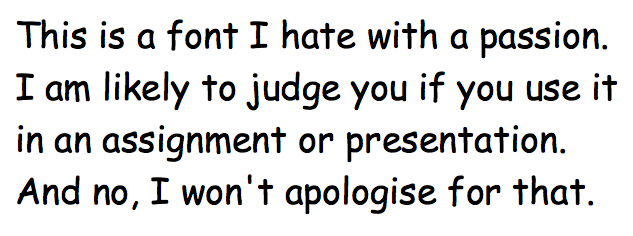
Right at the top of my hate list is Comic Sans. It looks childish, and gets increasingly ridiculous as the size increases, to the point where it is almost impossible for me to take anything printed in that font seriously. It is a font that should never be used for school work of any description by anyone older than six, nor should it be used for slide shows and presentations. Yes, it is “nice and clear for people to read”, but so are about 3000 other fonts one could choose. If your audience is not entirely in the First Grade, choose something else.
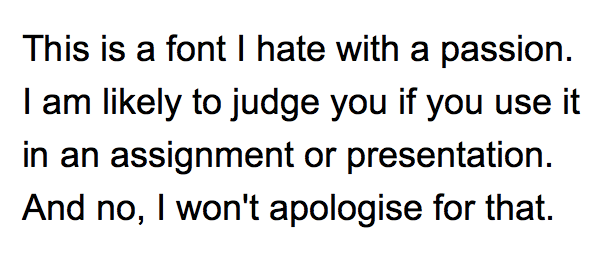
Another font I hate is Arial. Yes, it is also nice and clear for people to read. It is also entirely bland and unimaginative. Arial is the font equivalent of still having that original iPhone Marimba ring tone from 2008 on your new iPhoneX when you have 2500 different songs on your playlists. It is the font for lazy people who don’t care how their work looks. It doesn’t take much effort to switch so something equally clear but which looks a lot more polished and professional. In a word: boring.
The other fonts I really dislike fall into two groups: anything over-decorative and wrongly sized formatting.
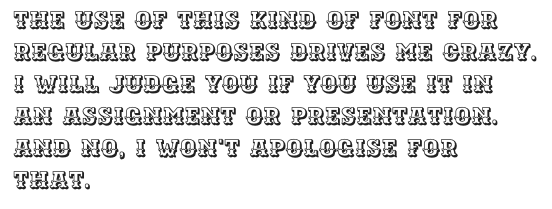
Over decorative fonts have their place, but trying to read a block of text printed in anything full of swirls and flourishes or trippy lines and shadows will make a teacher’s eyes bleed in less than three minutes. Decorative fonts can work really well for titles, or for a special capital letter or character to start a page or chapter, but they fail miserably for anything that needs to communicate information or arguments clearly and effectively.
In a similar vein, text printed too small or too large is equally frustrating. If it’s too small and condensed, it’s hard to read and… you guessed it, bleeding eyeballs. At the other end of the equation, students may think they can fool me into believing their 337words meets the 500 word minimum word count if their work is formatted in size 15 Helvetica, but my teacher brain knows better. My teacher brain has been doing this a lot longer than they have.
So, I guess this is me coming out of the classroom cupboard and acknowledging the ugliness of the deep-seated prejudice that lies deep within me. It is equally as rampant and undeniable as the grammar nerdism that I make no attempt to hide.
Call me fussy. Call me Fontist. I’m okay with that. But don’t call me to complain if I’ve asked your teen cherub to reprint an assignment so that I can read it without tears. Trust me – it’s better that way, and I’ve tried to be nice about it. Well, I’ve probably been nice..
Maybe.
Unless they are a repeat offender. In that case, there are no guarantees.






 WordyNerdBird
