I am a real sucker for posts that offer writing tips, publishing tips, and the experiences of other authors and bloggers. I’ve shared a number of them on this blog, because some people have genuinely good advice and share their experiences in a very positive and constructive way.
This response to those kind of posts is quite refreshing in its honesty and in its explanations of why those posts can actually be demotivating for some people. I can totally relate to the feeling of disappointment in myself that I haven’t adopted and implemented more of the great advice given by other Indie authors since beginning my own author journey, and to the sense of “exhaustion” at the number of “You Can Do This If You Follow My Formula” posts out there.
It’s true that those hints and tips for success aren’t “one size fits all”, and nor is success. There are many ways to measure success, and we all have individual goals that determine what our own standards or images of success might be.
It is also fair to say that there is so much advice, so many tips, so many things people tell us to do, that it’s simply not possible to try it all out, and we really do need to remain realistic about what advice we are going to take on at any given time.
I do like Daegan’s points about daily and weekly reviews of what has been done or achieved. I actually do this, and it helps me stay on track because I find achieving small goals and milestones along the way incredibly motivating.
I don’t meditate as such, but I do set time aside for quietness and reflection in my daily routine. I wear a lot of hats in my day-to-day life, so taking even just a few minutes when my brain has nothing to do is a vital means of refreshing and resetting my mind at various stages of the day. As an introvert who is often surrounded by people all day long and again at home, that quietness is also how I recharge my energy, so it’s a crucial thing for me to do.
My “takeaway” from this article is that it’s important for each of us to set our own goals, define what sort of “success” we are hoping to achieve, and find what works for us as individuals.
The one thing we should all do is keep striving to make it happen.
I have read so many articles that have a headline similar to:
“If you want to be successful, adopt these 5 habits right away!”
The problem is, the author is always telling me what I should do to be successful as if my success and their success looks exactly the same.
I get so many of these articles telling me about the habits that I should have or my life is clearly falling apart. I’ll admit, many are good and I have certainly tried them.
But what about the author? Are they using all of those tips? Do they really have all of those habits locked down when they had a post a month ago telling me 12 other success tips? I want to know the person behind the word and if it’s actually worth my time.
Maybe I’m small minded and not wired for success, but…
As I mentioned last week, my Year 9 class is studying ‘Much Ado About Nothing’ this term.
Today my students investigated the words and phrases coined by Shakespeare.
I started by giving them a list of the words and asking them to highlight which ones they knew and used. This really engaged them, and it was great to see their motivation change as they realised that Shakespeare’s language isn’t all lofty poetry and words that finish in -eth.
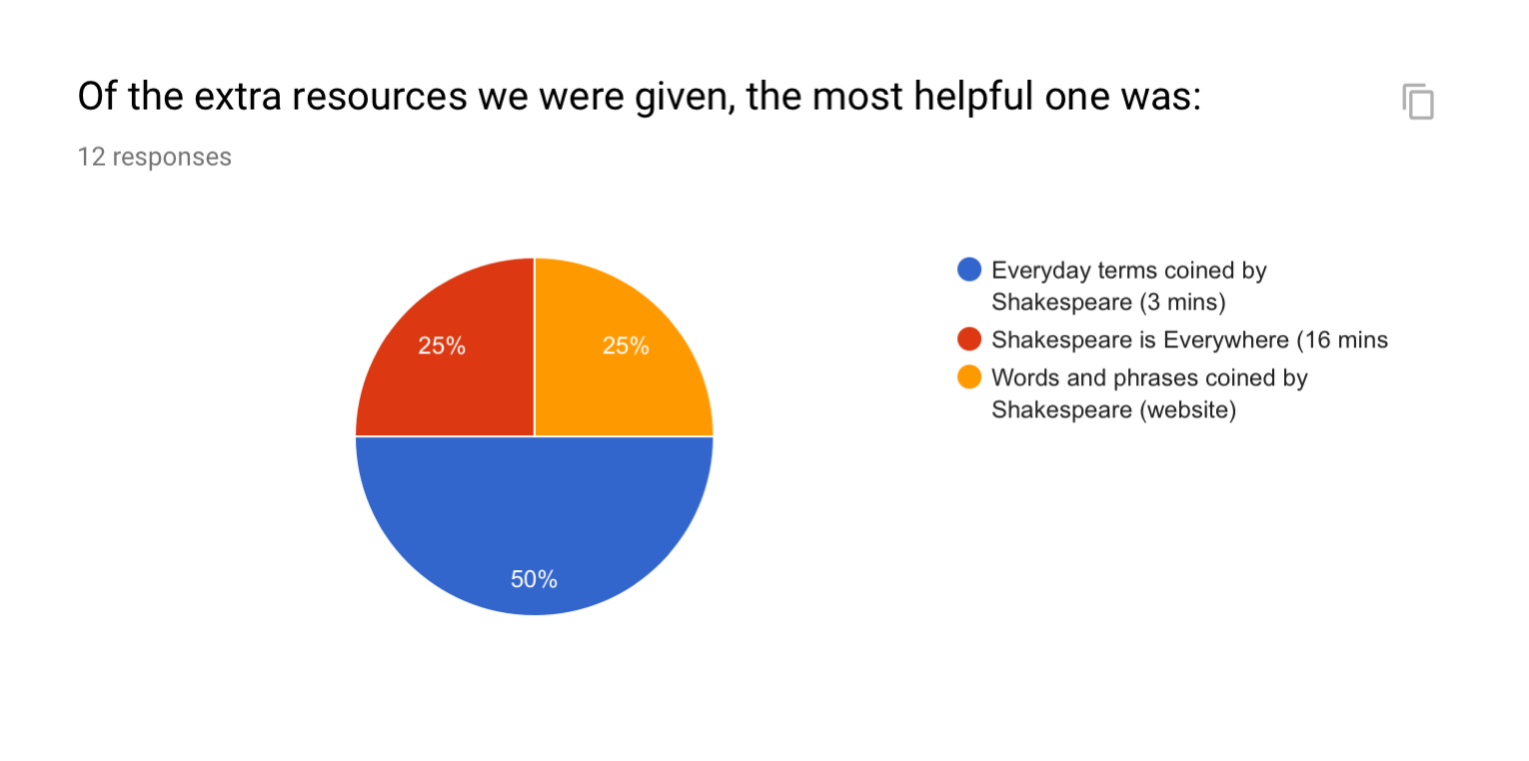
I followed that up with some great videos and a website resource to extend their knowledge and reinforce their learning.
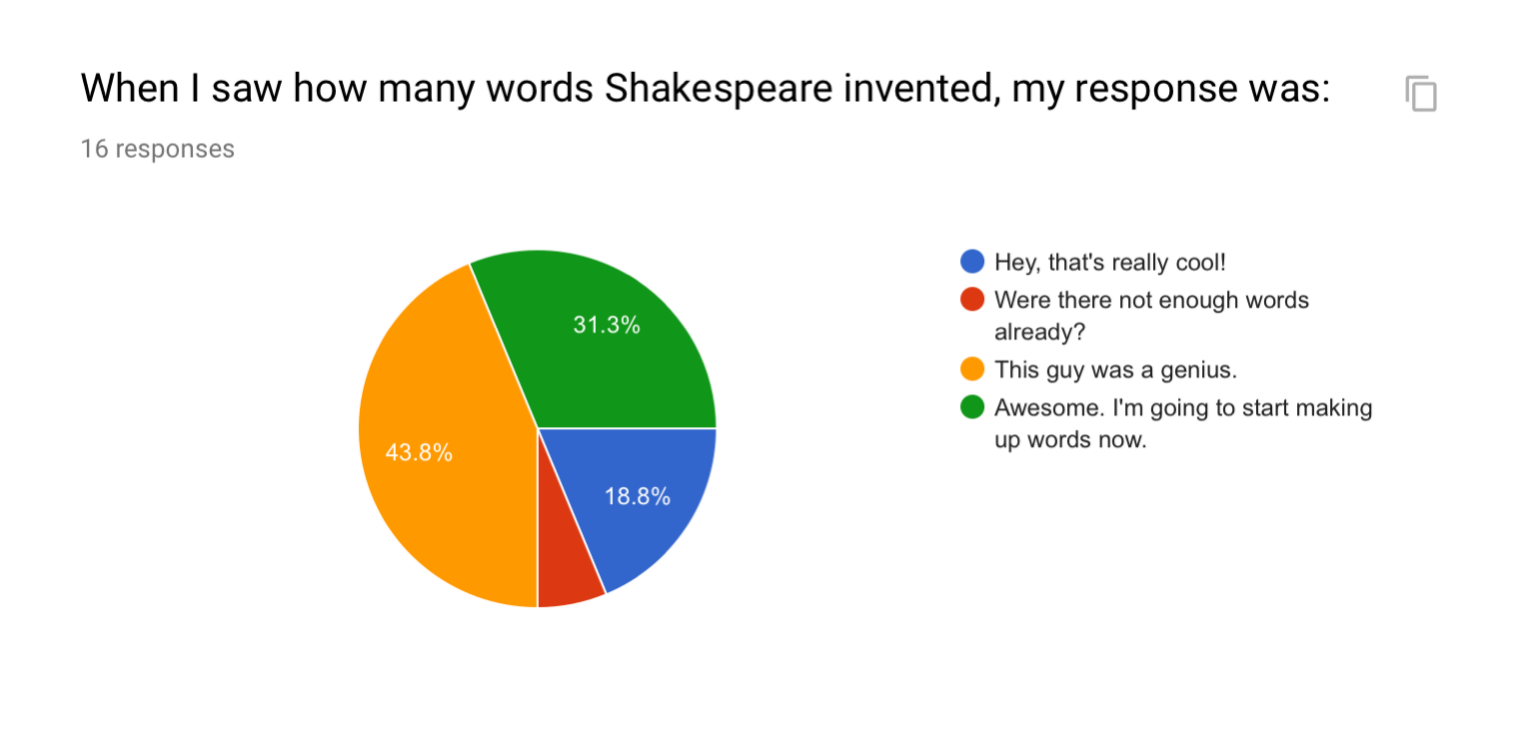
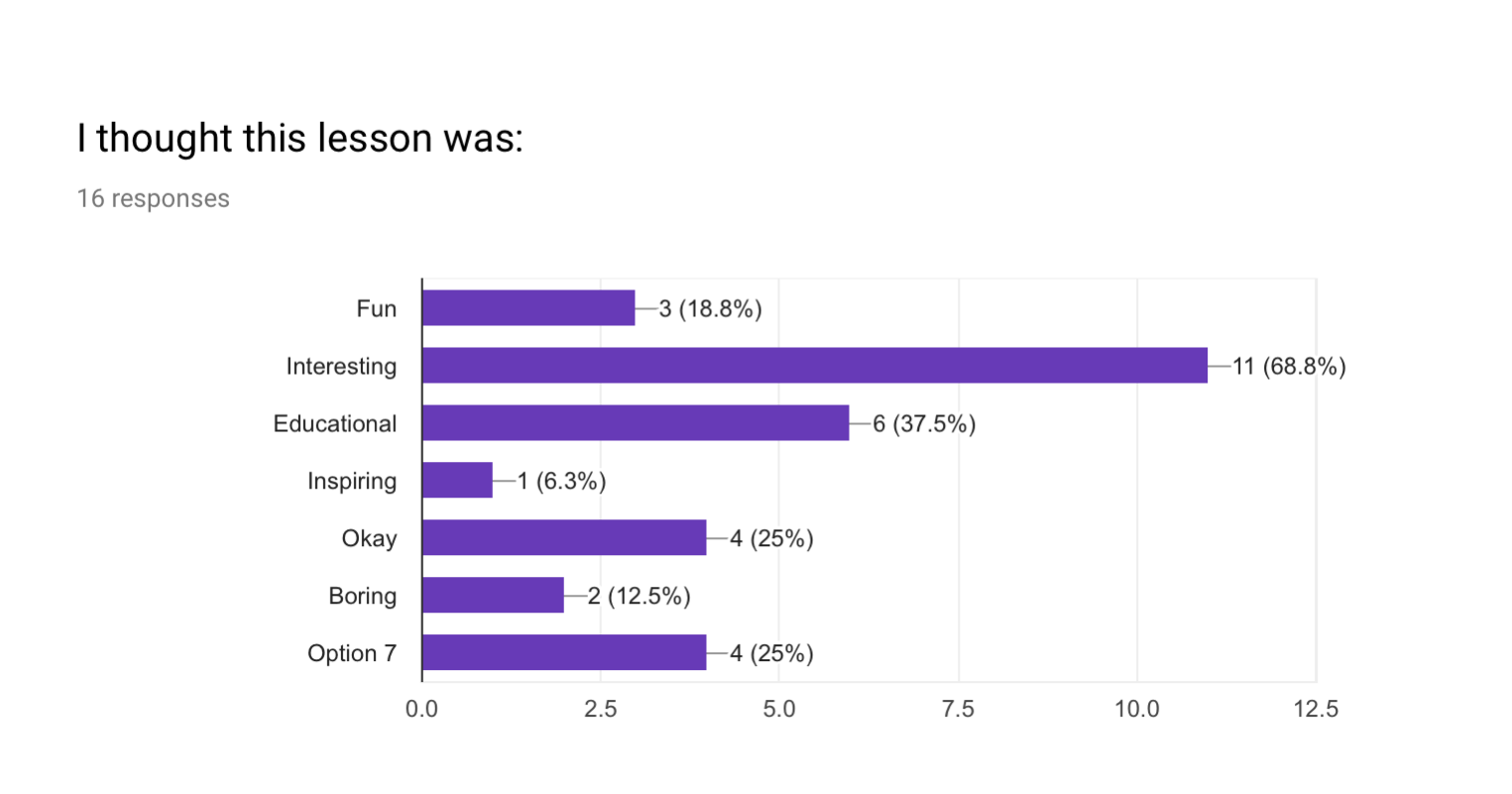
An unexpected bonus for me was the overall positive response to the exit quiz I made for the end of the lesson.
Of course, it wasn’t all enthusiastic. I’ve been teaching Year 9 English for long enough to know not all kids are going to respond positively, so I do at least try to make my quizzes fair so that they can express their feelings honestly, and kind of fun so that they actually want to do them.
They know there is no obligation to respond in a way that will make me feel good, and I know my students, so I’m confident that these responses are an accurate reflection of attitudes throughout the group.
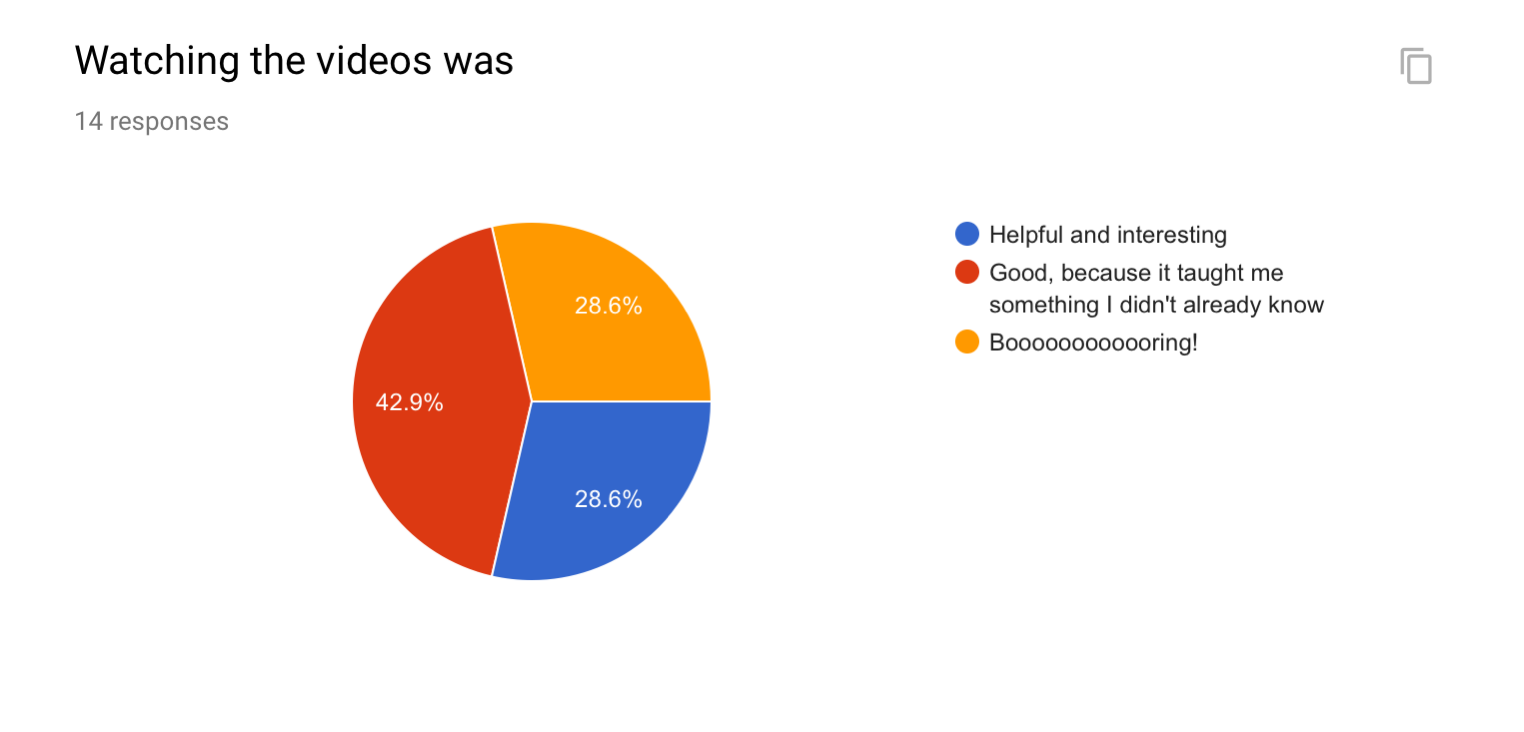
Wait, what? Boring?
Thankfully, the next set of responses explained that. The 26% who found the videos boring are probably the ones who preferred the website based resource instead. That’s a relief!
There was a surprise waiting for me, though.
The funny thing is, I didn’t even know there was an option 7. I must have accidentally hit ‘return’ while making the quiz on Google Forms. I don’t know if Option 7 was perceived to be better or worse than ‘boring’. I’m telling myself that since they could choose multiple options, Option 7 was checked by those with a good sense of humour.
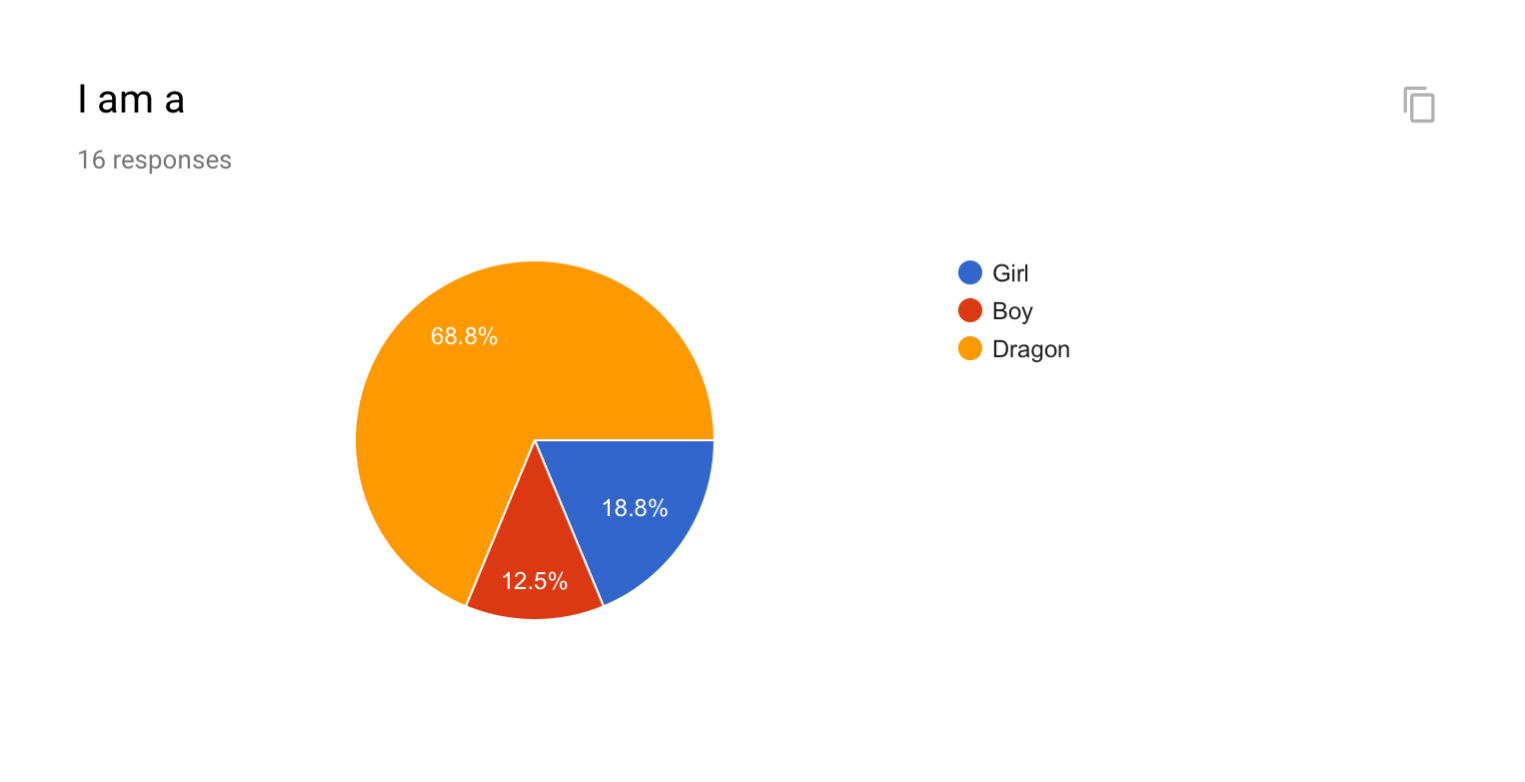
This was the closest I got to asking the students to identify themselves. If they don’t have to tell me their names, they are more likely to give honest responses. I’m not-so-secretly excited that so many of them identify as dragons.
If you’ve been following my blog for any amount of time, you’ll probably know that when I’m not blogging, reading or writing, or strutting my stuff on stage in musicals, I’m a teacher.
Teaching is demanding and tiring and stressful, but I am always up for a great booknerdy discussion with my students, who I happen to believe are some of the coolest kids on the planet. That is one of the parts of my job that I really love.
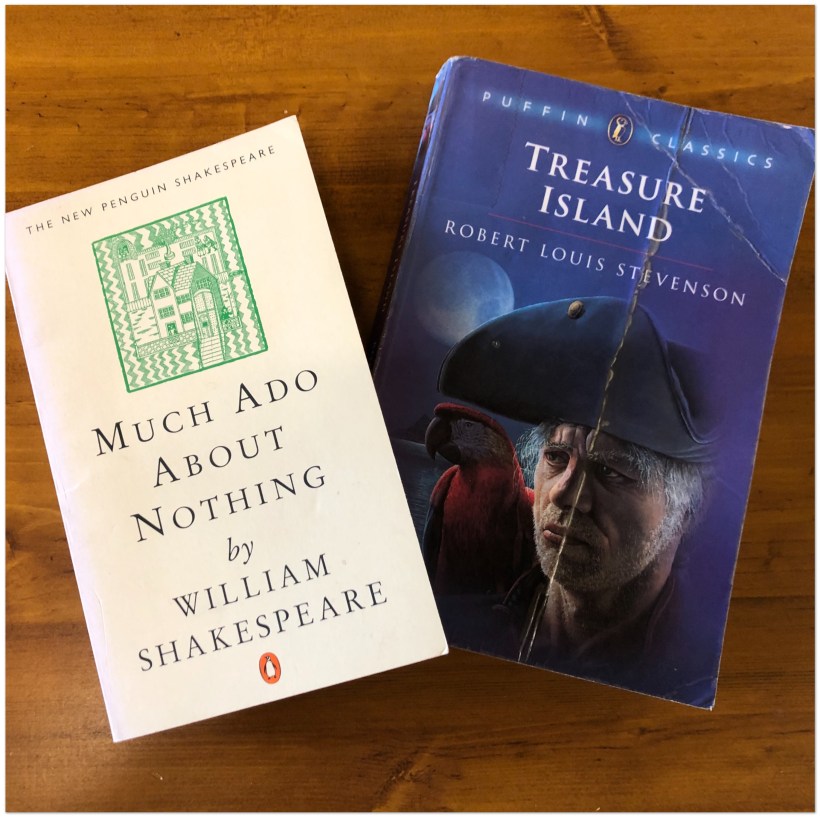
The fun continues this semester. I’m excited to be teaching four more texts I really enjoy. My Year 9 English class are going to study ‘Much Ado About Nothing’ and ‘Treasure Island’. My Year 11 English class will be studying ‘The Complete Maus’ and ‘The Book Thief’.
Teaching teenagers can be a tough gig sometimes, but it also has its perks.
If you had a teacher you liked, I’d love to know what it was about them that appealed to you or inspired you.Leave a comment and inspire me!
A million authors writing to entertain others. A million poets bleeding their souls onto the page. A million people trying to help others. A million people who are actually loyal. A million teachers going the extra mile for their kids. A million people caring for someone they love.
It might be easy to get lost in the crowd. It’s easy to feel insignificant. One tree among a million in the forest, so to speak. But I know I am one in a million.
We all write and grieve and serve and give of ourselves differently. Each of us is unique. Each of us is a distinct blend of personality, talent and substance.
Not a single one of us is worthless.
I may not stand out among the million. I may never strike it rich or become famous. I may never be someone else’s ideal. I cannot be perfect.
The truth is, I don’t have to.None of us do.
What matters is the contrast with some of the other people on this planet: the hateful, the cruel, the greedy, the selfish, the power-hungry, the narcissists. What matters is that I stand against the things they accept. What matters is that I am true to who I am, to my priorities, my values, my faith.
What matters is integrity. That’s what stands out in this world.
That, more than anything else, makes me one in a million.
Today my brother, sister-in-law and I took our elderly and increasingly frail Dad out for lunch.
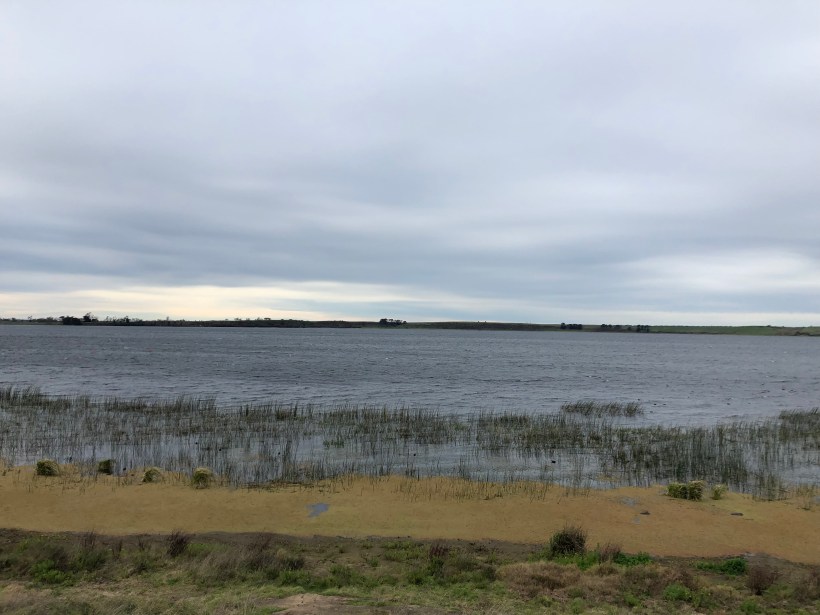
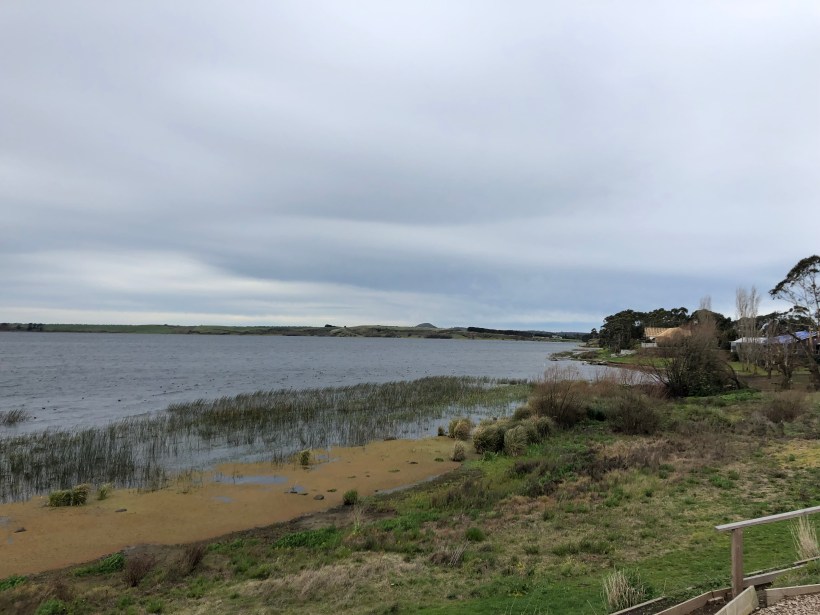
We went to one of our favourite local places: Lake Edge Cafe on the shore of Lake Purrumbete. The view is lovely in any weather, but it was nice and warm inside.
While we were waiting for our lunch, another family group came in and took the table next to ours. It looked to be a man around my own age, three boys, and the boys’ grandparents.
“Shall I tell you a bit about the menu?” the waiter asked.
“Could you wait a bit, please?” the guy responded. “My wife will be in in a moment… she’s just finishing the final few pages of a book.”
I smiled. Anyone who stays in the car to finish a book before lunch is my kind of person.
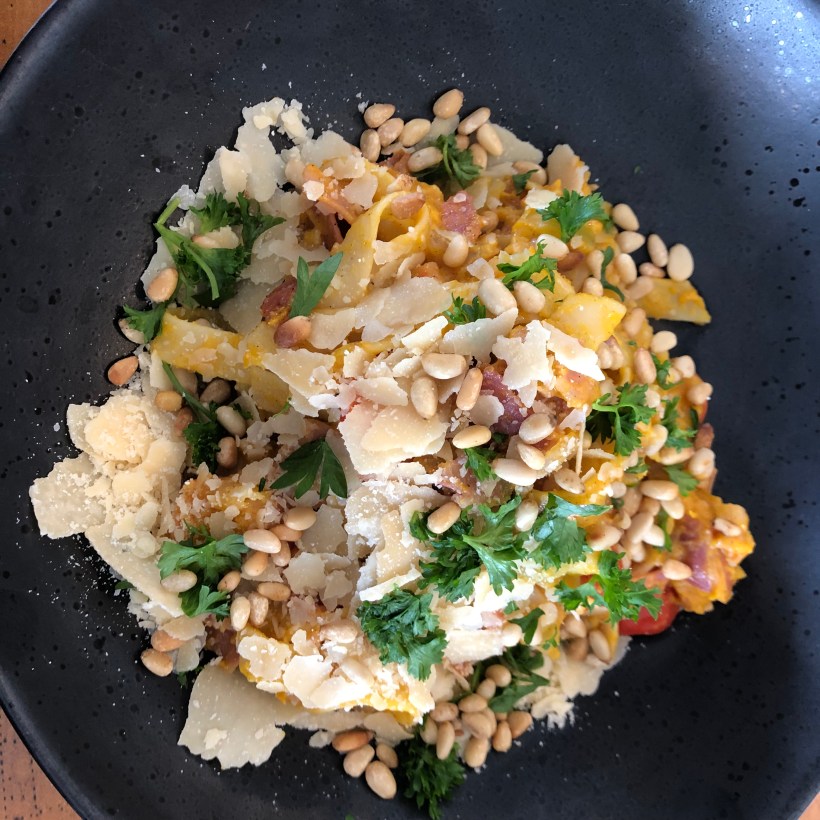
In case you were wondering, I ordered the pumpkin, prosciutto, pine nut and cherry tomato fettuccine. It was amazing.
I may need to learn to turn the volume down a little when being a comic genius in public places.
We were sitting at a cafe deciding what to have when I commented on one of the options: “I’m not sure I needed to know that their chicken was marinated by a jerk.”
A lady at the next table laughed out loud, turned around and said, “I had the same thought, but wasn’t brave enough to say it.”
The waiter showed up while I was writing this post, and I shared my observations. He laughed and said, “Actually, the chef IS a jerk!”
I nodded safely. “Many of them are,” I said.
“Too true!” he said. “But that’s all just between you and me, right?”
Lucy Mitchell’s experiences, as she describes in the article reblogged here, are not uncommon. Many writers, artists and musicians use their creativity to help process and deal with their mental health issues.
I share this author’s experience of gaining motivation, encouragement and purpose from writing and self-publishing my works.
Withdrawing my first book from its publisher and taking control of my publishing journey as an Indie author was incredibly empowering. Producing not just good writing but excellent books has been as source of both pleasure and pride for me, but it has also been fabulous therapy.
Every poem I write, whether it’s about mental health or a medieval princess saving herself and taking control of her destiny is evidence of my strength and resilience, even at those times when I am not feeling particularly strong or resilient.
The fact that I can write about my own mental health in a way that others relate to and find powerful is both liberating and encouraging. And every time I kill someone fictionally, it saves me bail money and keeps me out of jail because I haven’t actually laid hands on anyone. That’s a system that has worked extremely well for me so far, so I will stick with it.
Every book I have published is testimony to my survival. This is, perhaps, most true of A Poet’s Curse, which was written indirect response to evil behaviour and nasty people. Publishing that little volume, to which I like to refer as my “dark little book of hateful poetry” really felt like I was taking my life back from those who tried to destroy me, and I celebrated it as such.
At this point of my writing and publishing career, I can say that I am incredibly proud of what I have achieved. That in itself is positive and motivating, and encourages me to keep going. There are still a lot of ideas bubbling away, and there’s life in the old girl yet.
And where there’s life, there’s hope.
All of this is proof of how far I have come from those very dark times that almost destroyed me, and of my determination to never go back.
I hope you appreciate and enjoy the insights from Lucy Mitchell as much as I did.
Blogging consistently for 150 days in a row is no mean feat. It takes time, effort, and brain power, and a bit of self-discipline really helps, too. I’m thinking very clever things of myself today, but that’s not the only positive outcome.
When I first started blogging, I was a bit here and there with it all, which is perfectly fine. Over time, though, I noticed that the more consistent I was, the more consistently my posts were being read. When I managed a three or four day streak, I felt like I had really accomplished something constructive in terms of getting myself “out there” as a blogger,
At the beginning of this year, one of my resolutions was to blog more consistently. I can certainly put a check in that box! Now that we’ve reached the middle of the year, I have spent some time thinking about what I’ve learned from doing so.
Goals are highly motivating. When you’re on a long streak, it’s very easy to dismiss thoughts like “I’m too tired” or “not today” and get it done.
Planning is essential. Sometimes, deciding what to write about is the hardest part. Planning helps to overcome this. I have developed a list of themes, post ideas and issues to explore. That way, I’ve always got something to write about if there is nothing pressing or timely bobbing around in my head. Participating in special “months” like Women in History and “National Poetry Month” has helped me to focus my posts during those specific times. This has helped me to attract different kinds of readers to my blog, which is generally quite eclectic in the topics I cover.
I still want to improve the way I coordinate my planning. I’ve started to time my Shakespeare-related posts to coincide with #ShakespeareSunday on Twitter so that I have an audience to reach that is automatically curated for me by someone else’s design. That’s proven to be very handy, so I want to find more opportunities like that to fit with my interests and content.
Reblogging is a great way to share sand add value to someone else’s content. I often share other people’s posts via Twitter, and do so very gladly. When I discovered how to reblog someone’s work, that was a revolutionary moment for me. It enabled me to share their work in a more meaningful way than just tweeting it – which is meaningful and helpful, but it doesn’t add any value to the content.
Reblogging makes it possible to add comments or a reflection of my own on the topic. This is helpful to both them and myself: their content reaches another blogger’s audience, and my content is enriched by theirs. It is also a very good thing to be inspired by what someone else produces, and to let that fuel my own thoughts and words.
It’s also fair to say that there are times when the tank has been dangerously empty, and those bloggers whose work I have shared have literally saved my day – both by inspiring my post, but by encouraging my mind and spirit when life has been hard.
Varying the topics attracts different readers. There are blogs dedicated to just one topic. Some of those bloggers do it extremely well. I am probably never going to be one of those people.
I like to discuss different things that interest me. By mixing it up, I’ve been able to find new readers who like history, or poetry, or horror, or Shakespeare, or who are Indie authors and interested in the issues that relate to our awesome little corner of the publishing universe. These audiences often cross over, so if someone isn’t interested in what I write one day, they probably will be on the next.
Over the past 150 days, I have seen my readership grow, measurable by the increase in followers on my blog. I find this very exciting, as when I started out, I thought having ten followers was incredible. Actually, given that I had very little clue what I was doing, it probably was incredible!
Consistency increases visibility. I’ve noticed that I’m getting more post likes and engagements from people who weren’t following me previously. I can only assume that this is because my posts are gaining visibility via the WordPress reader as well as on Twitter and via my very amateur attempt at SEO. My rather thorough use of categories and tags might be helping, too. Whatever the source of the magic, I’ve enjoyed some great feedback and questions from readers that have been both helpful and stimulating.
Accuracy and accountability matter. When you say something on your blog, you need to be able to back it up. Thankfully, as a History teacher, this is something I’ve always known. So when a reader asked me recently, “What’s your source?” I was able to answer promptly and easily. I really don’t want to start providing a bibliography for every post I write, but it does matter that I can verify my content when I am called on to do so.
People want to know who you are, Even though a blog post focuses on a particular topic or idea, readers respond well when you show them something of who you are or what makes you tick. I do not suggest making it all personal or discussing all your private issues in detail, but if readers can see that you are genuine, they will respond to you in positive and encouraging ways
I am better at blogging than I used to be.
Part of that is in the development of my skills by learning as I go, and part of it is confidence that can only ever come from experience. This has, in fact, been the most motivating lesson of all. If I keep going, I’ll get even better. I don’t know if the world is ready for that, but I am.
There are, however, still things that remain a mystery to me:
How do you actually get people to click “like” before they leave? How can I get more people to leave a comment or question?
Those are questions that fall into “next level engagement”. I’ll write that into my goal-setting now.










 WordyNerdBird