Well… That Ended Badly.

I read a book this week that I was really enjoying. It kept me hooked right to the end, and then came the death blow: a sudden, out-of-nowhere, poorly executed ending. Without warning, or even the slightest hint that it was coming, the story just stopped. 

I hate that. I hate it so much that I am deferring writing my review until I’ve got over my annoyance at it. The story was so good, and the characters so interesting, that I was completely absorbed in it. And then? Suddenly, POOF! It’s all over. 

I dislike cliffhanger endings to books at the best of times. 
This one was not even the best of times.
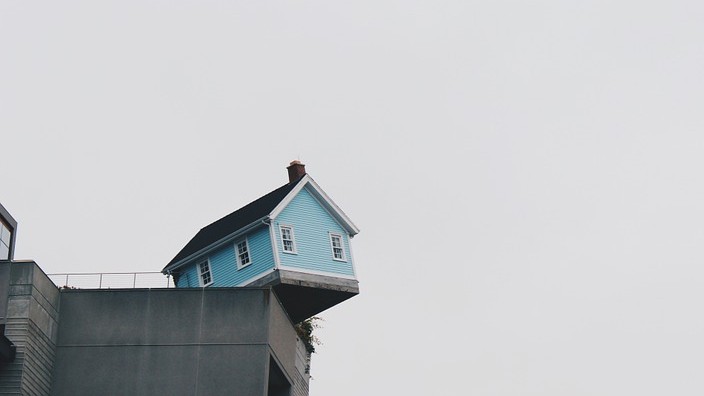
It wasn’t really a cliffhanger, either. It was more like the whole book got snatched out of my hands and thrown over the cliff, and might never be seen again. 

It was possibly the worst sudden ending to a story I’ve ever experienced. It made me think that maybe the author did not know how to properly end a story, even though they obviously knew how to write the rest of one. 

I fully understand why authors design those suspenseful endings – they want to keep readers guessing and anticipating what comes next so they’ll read the next book. 

Here’s the thing, though: if the book is good, I’m going to buy and read the next one anyway. If the writing or editing is poor, or the storyline is weak, a cliffhanger isn’t going to make me buy or read the next one. 

If there has to be a sudden ending, or a cliffhanger, there should at least be enough resolution in the final chapters to answer some of the questions raised in the book. By all means, leave questions unanswered. Just— not all of them. 

I do quite like suspense and anticipation.
I love the sensation of looking forward to the next book.
I do not enjoy an ending that leaves me wondering if the author’s computer crashed and the final chapter was irretrievably lost. 

I read a lot of books, and for me, a quality conclusion is as important as the opening paragraphs. You can win or lose readers right there, regardless of how good the rest of the book might be. 
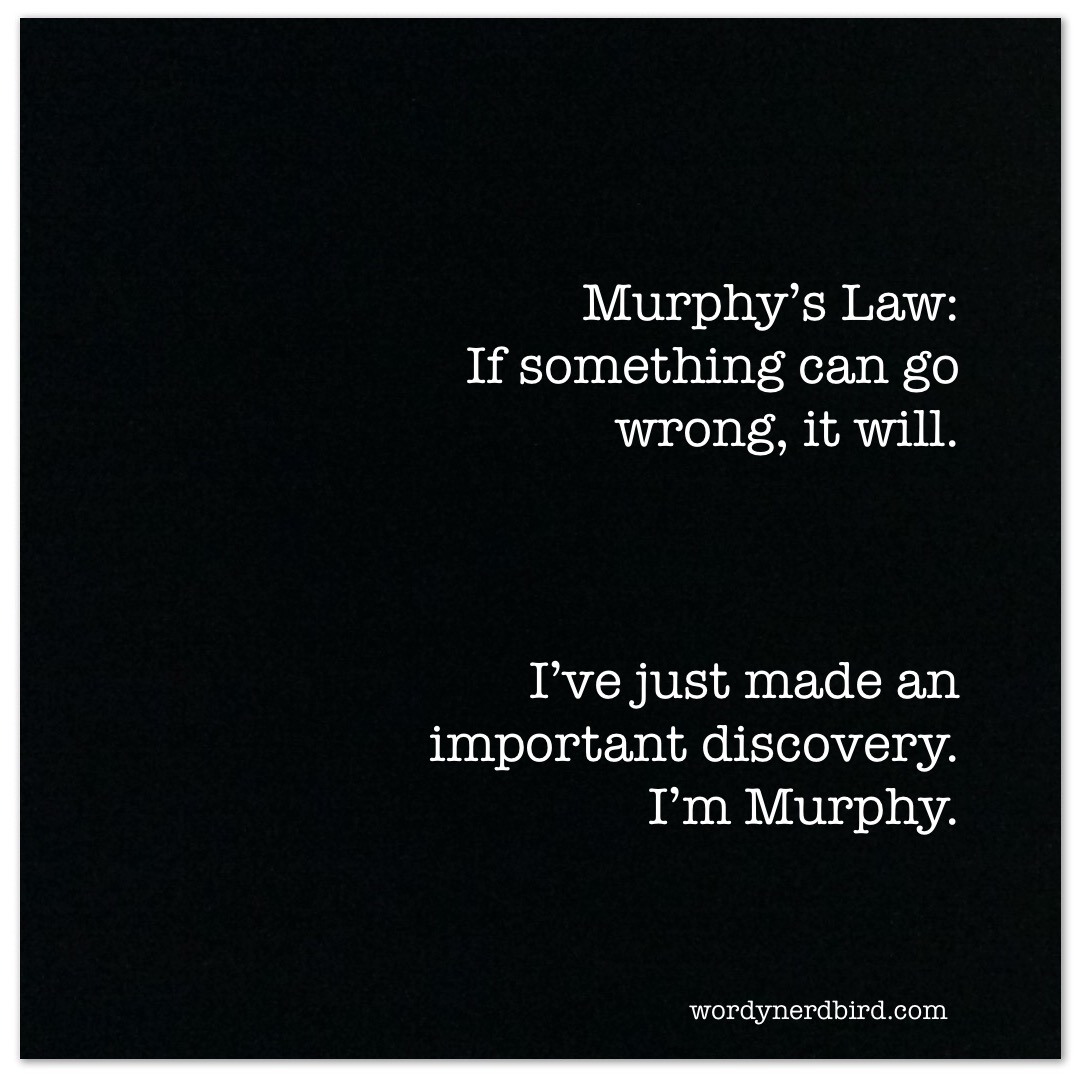
A Word of Advice for When Things Go Badly

No matter how bad things get, never, ever, comment that things can’t get much worse. 

They can, and they will. The universe seems to take that kind of talk as a dare. 

I am living, despairing proof. 

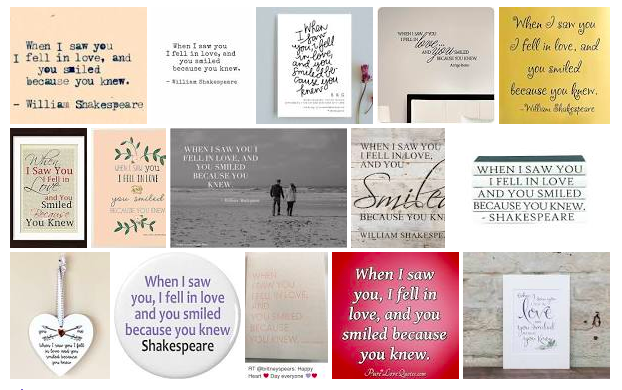
Dear Internet: That Quote You Love? It’s Not By Shakespeare.

I wrote a few weeks back about the things I enjoy , and the things I don’t enjoy so much, about Pinterest

Since then, I’ve noticed one really annoying thing when I’ve been scrolling through my feed. It’s not actually the fault of Pinterest, but it is there that I am continually reminded of a matter that really needs to be corrected.

There’s a super popular quote that keeps coming up on my feed because Pinterest knows I love Shakespeare. It’s all over the internet, and it seems every second person on Pinterest is sharing it. 

This quote is the darling of the Internet. But it’s not by Shakespeare.

The problem is, while it sounds like something Shakespeare might have written, those lines do not appear anywhere in the plays or poetry of the Bard… not even close, actually.

The quote is a translation from an Italian opera by Arrigo Boito titled ‘Falstaff’, based on one of Shakespeare’s plays, and which uses a number of lines from several other plays, too. Given that Boito borrowed from the Bard quite freely, it’s not really surprising that other lines from the libretto have been wrongly attributed back to Shakespeare. Some might suggest it’s karma, but it’s really just careless.

I’m more than happy for people to continue posting pretty images of the quote, but it would be great to see them attributed to the right person.  

Too much to hope for?
Yeah… it probably is. 

Thank God It’s Friday.

Don’t misunderstand me: I am not being flippant or casual in saying ’Thank God It’s Friday”. 

Not. 
Ever. 

And especially not tonight. 

At the end of yet another really sucky week in a succession of variously sucky weeks,  I can honestly say I am so thankful for the fact that it’s Friday night and I am free of any obligation to look or sound like I know what I’m doing, stick to a schedule, wear proper shoes, or talk to anyone that I’d rather not talk to, for two whole days. 

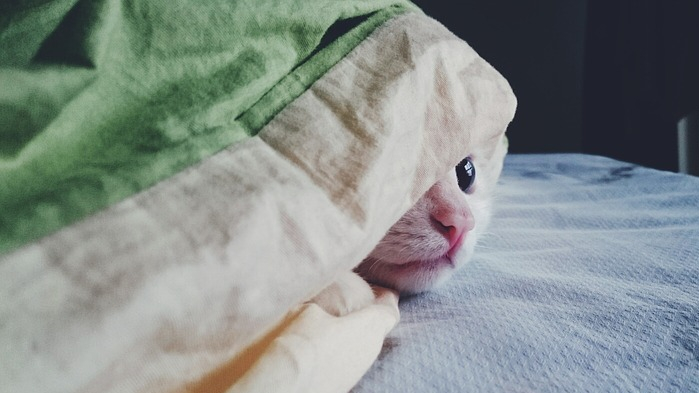
I’ve come home from work tonight, fed the dog and fed my dad, done the dishes, and consider all my obligations to have been met. I am currently hiding under a quilt in my living room so that the universe might not know where to find me. 

And if you see someone poking pins into a voodoo doll that looks like me, do me a favour and take it off them, will you please?  Gently? And maybe give it coffee and pizza. Thanks in advance. 

Dear Facebook… Yet Again.

I quote, verbatim, this afternoon’s status on my Facebook profile.

Dear Facebook,

You have been temporarily blocked from accessing some of my features.

I’m not telling you why. 
I”m not going to listen to your appeal.

But you can bet your algorithmic little hiney I’m going to have my eye on you for quite some time. Possibly forever.

Joanne Van Leerdam, June 25, 2019.

So, it seems that I’ve run afoul of the Facebook algorithm yet again.
Now they’re suggesting I’m a robot.

You read that right. A robot.

I haven’t made identical posts in forever. I vary what I post from page to page. l really don’t know what brought that on.

And let’s not overlook the irony of an algorithm calling me a robot. It’s beyond ridiculous.

They can’t still be sour about my “What I Do and Don’t Like About Facebook” post… can they?

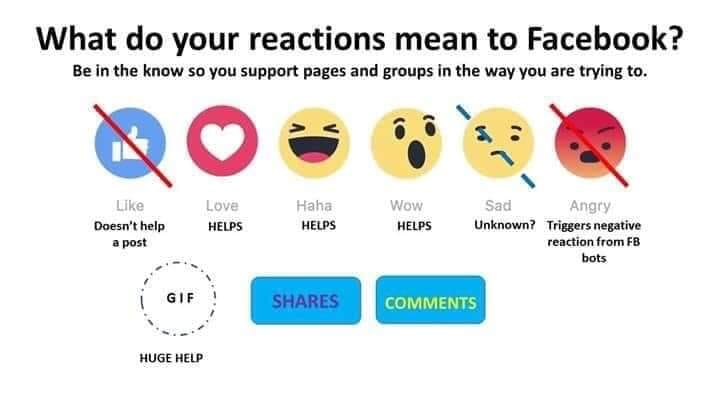
One suggestion that has been made is that when I’ve posted about things that annoy me, some well-meaning people have responded with the “angry face” reaction because they’re angry at the nonsense that a certain social media platform is throwing at people lately.

Apparently, for all its cleverness, the Facebook algorithm is unable to comprehend that it’s actually Facebook people are angry at. It interprets this reaction as those people being angry at me.

This is good to know.

Because who could be angry at Facebook or its ever-changing algorithm?

It’s fair to say that Facebook is not doing a single thing to recommend itself to me right now.

Facebook’s Delicate Community Standards

Facebook’s “community standards” did not enter my thoughts last night when I was posting about what I love and hate about Facebook. Had I been writing that post today, it would have been a very different story. 

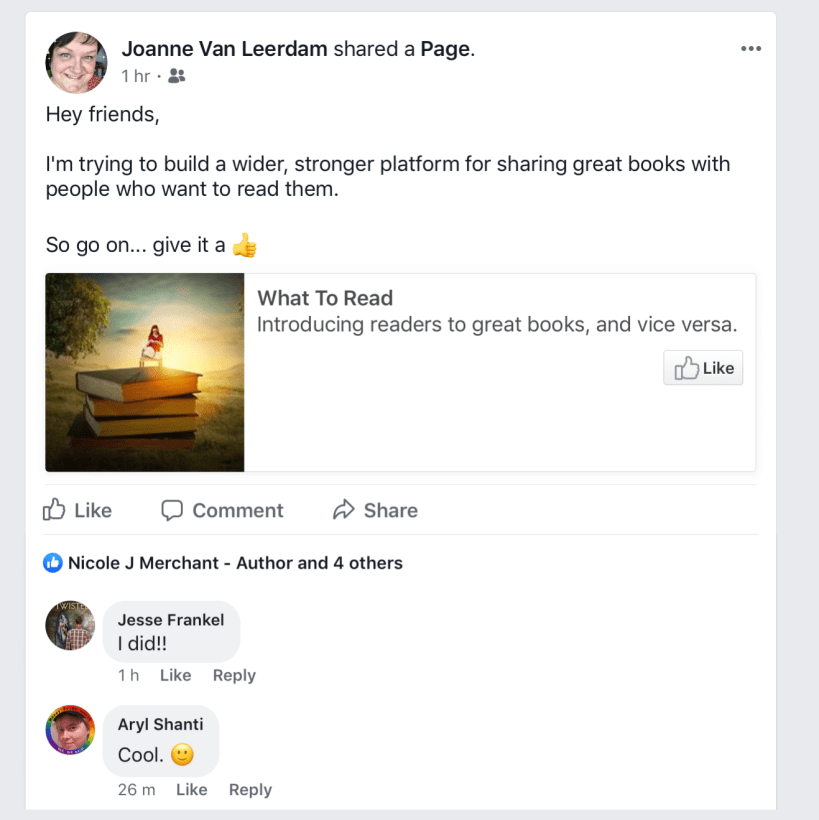
This afternoon, I set up a new page on Facebook with the aim of extending my reach to new readers by using a popular bookish hashtag phrase, What To Read, as the title. 

As soon as I had set up the page, Facebook started coaching me to complete certain steps to make my page more visible. 

Profile photo: check.
Cover photo: check. 
First post: check. 

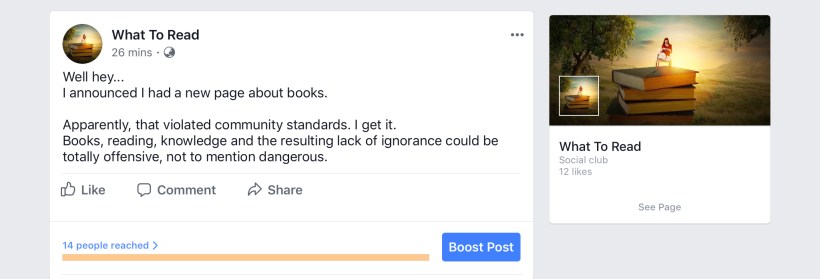
Oops! My first post violated Facebook’s delicate community standards. 
Want to know what it said? 

So… people can freely incite hate, vilify and shame others, put up pictures of them humiliating themselves… but I can’t suggest that my friends might like a page about books? 

Wow. 
Maybe I should have said something dumb instead. 

May the fates be in my favour when I actually start encouraging people to read. 

***

Update: it took me three attempts to share this blogpost on Facebook.
If they don’t want me to be snarky, they’re going the wrong way about it.

Attention: Facebook

Due to recent trends, my algorithm has been realigned.

You may notice that your invitations to boost my posts or create advertisements will receive zero attention. Some may be marked as spam due to lower perceived relevance to the audience. 

If you won’t show my posts to the people who do follow me, I most certainly will not be paying you to show them to people who don’t. 

Because, as you say so often yourself, “it’s all about engagement”. 

Fortunately for the rest of us, there are other places to “engage”, too. 
Are you aware that Twitter neither suppress nor hides anything I post? As soon as it’s sent, BAM, it’s out there for the whole Twitverse to see.

We’re you aware that WordPress allows me to use tags, categories and SEO to make my posts available beyond those who already follow my blog? And they do it free of charge. Ingenious, no?  

I’ll still give you a little attention, Facey. But not as much as you want. And not to help you make money. From what I have heard on the news, you’ve already got quite enough out of people like me. 

Lesson from ‘Othello’: How not to be a husband. 

My students have obviously learned something from studying Shakespeare’s ‘Othello’. 

A student wrote the following assessments in this week’s essay: 

“Desdemona is Othello’s wife; the least he could do is talk to her, but apparently that’s too much to ask of our protagonist.”

“Othello is a dirtbag husband that took advantage of Desdemona’s love for him.”

Spot on, I say.