Two nights of almost zero sleep had left me way beyond forswunk and very near completely useless by Thursday afternoon.
A frequent flier on Air Insomnia, I have been through this before. I’ve always been a lousy sleeper, and ever since chronic back pain and fibromyalgia became part of my life, they have always been quick to join the party and keep me awake long after I wish to be unconscious.
So, as I have done so many times before, I just kept going. I taught my classes with the same degree of professionalism and confidence that I demonstrate every other day, with the help of only marginally more caffeine than usual.
Once classes were done and my work for the day was finished, my recliner was my refuge. I put on a podcast and closed my eyes… and still didn’t sleep. Discouraged but comfortable, I just stayed there and rested… like I had a choice.
A very early night was definitely in order, and I made sure I got one. Still awake at 11pm, I tried not to think about the state I would be in after another sleepless night. That kind of thinking doesn’t help anyone fall asleep, ever. So, I closed my eyes, listened to my regular radio program, and tried to slow my breathing and my thoughts.
I drifted off at some point after midnight. Seven glorious hours later, I woke up when my alarm went off.
Such relief! I feel so much more able to do what the day demands and meet any challenges that might come along.
There is a reason they use sleep deprivation as torture, after all. It can be physically painful and psychologically overwhelming. I’m so thankful for the sleep I got last night, and I certainly hope that particular cycle of insomnia is finished.
And now, I go once more unto the breach, dear friends. Online classes, lesson planning and my email inbox await me, and I must imitate the action of the tiger.
As a teacher, I know there is no substitute for being in the classroom, engaging with the students and supervising their work, making suggestions or guiding their thinking. When you create a constructive, productive learning environment, students thrive.
Over the past few weeks, my school has worked really hard to reproduce that in an online learning environment. My colleagues and I have put a great deal of thought and preparation into making our students’ experiences of learning from home in online classes as interesting and beneficial as they can possibly be. From where I stand, we’ve done a great job of preparing for teaching and learning from home, and I really hope that our students and their parents feel the same way.
Today was our first day of teaching and learning remotely. My students were well behaved and cooperative. Most seem to have coped with the challenges of doing school at home, some of them sharing an environment with their siblings who were also doing their lessons at home, quite well. We got through everything I had planned for those initial lessons. Judging from the work they handed in today, the kids generally worked as well as they usually do in a classroom environment.
I don’t know how they all felt at the end of the school day, but by the time 3.30pm rolled around, I was exhausted.
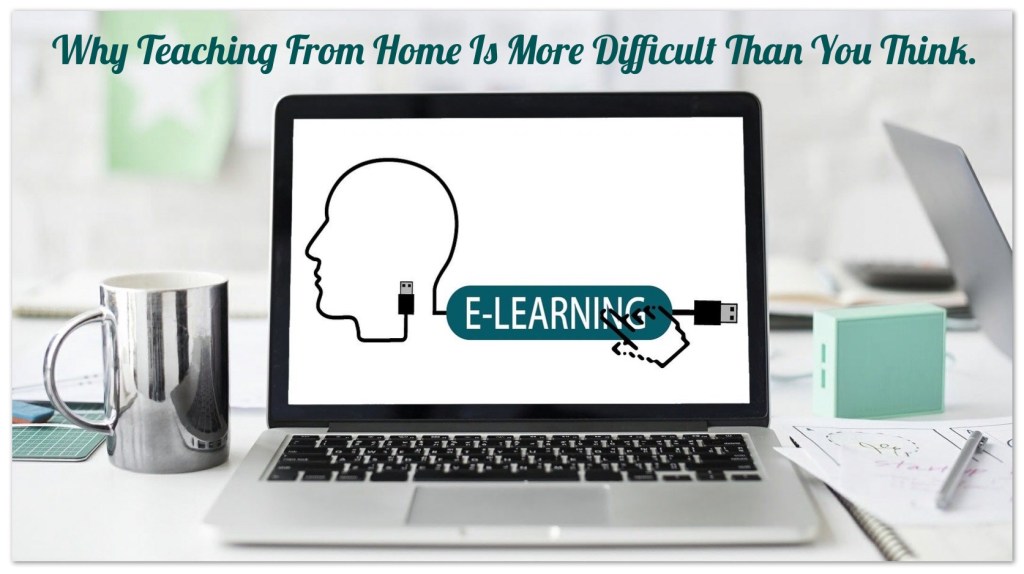
Make no mistake: online teaching is really hard. It’s mentally demanding in ways that physical presence in the classroom is not. It’s harder to hear students when they speak, and it’s harder to be sure that everyone understands what you say or what you want them to do. Even marking the roll poses new challenges when you can’t simply identify empty spaces in the classroom. Things that have become instinctive for teachers are now impossible, and we find ourselves reinventing pedagogy, teaching, communication, and the delivery of lessons and lesson materials.
You can no longer maintain classroom management by circulating around the room or standing in strategic places so you can see what kids have on their screens. You can’t just look over a kid’s shoulder and remind them of a principle or fact that they need to consider. You can’t make a teaching point of quickly correcting an error or oversight.
To an extent, one has to just accept that and move on. If a student is easily distracted or willing to be inattentive, that is understandable: there’s a lot going on, they’re at school without being at school, they’re in their own environment, and some of them are genuinely anxious about the dangers and the restrictions that Covid-19 has brought about. Really, the best you can hope for is to find a way to gently bring their attention back to the task and try to re-focus them.
It’s a tricky set of circumstances for the kids as it is, and adding learning at home to the strangeness of social isolation and distancing is a situation that some kids — and some teachers — will undoubtedly find awkward at best.
Still, it’s good for all of us, kids and teachers alike, to have a routine and a variety other things to think about. It is healthy and constructive use of the abundant time we would otherwise have on our hands at this point in time.
As tired as I was, they day did end particularly well. After spending 90 minutes with one of my classes this afternoon, I was pleasantly surprised when three of my students thanked me for the lesson. In the past, wishing each other a good afternoon or a pleasant evening was not unusual, but having students actually thanking me for double English after lunch on Tuesday is totally new.
I spent the rest of my regular school day responding to the work they submitted, and giving my students some feedback on their ideas and responses. It was nice to be able to
At 4.15pm, I made myself a cup of coffee and almost cried into it with gratitude for my good but mentally exhausting day, and for the caffeine upon which I would rely for the next couple of hours while I cooked dinner and did everything else I needed to do.
When dinner was done, I looked at my husband and asked if it was too early to go to bed. “It’s 6.15pm,” he said. “So probably, then?” I asked. “Yeah. Probably.”
Maybe I’ll just spend the time between now and bedtime thinking about what gift I’m going to buy myself for Teacher Appreciation Week. Whatever it is, I will have earned it.
One teacher’s thoughts on the first day of teaching and learning while #StayingHome #teachingfromhome #TeachFromHome #TeachingOnline #teachertwitter
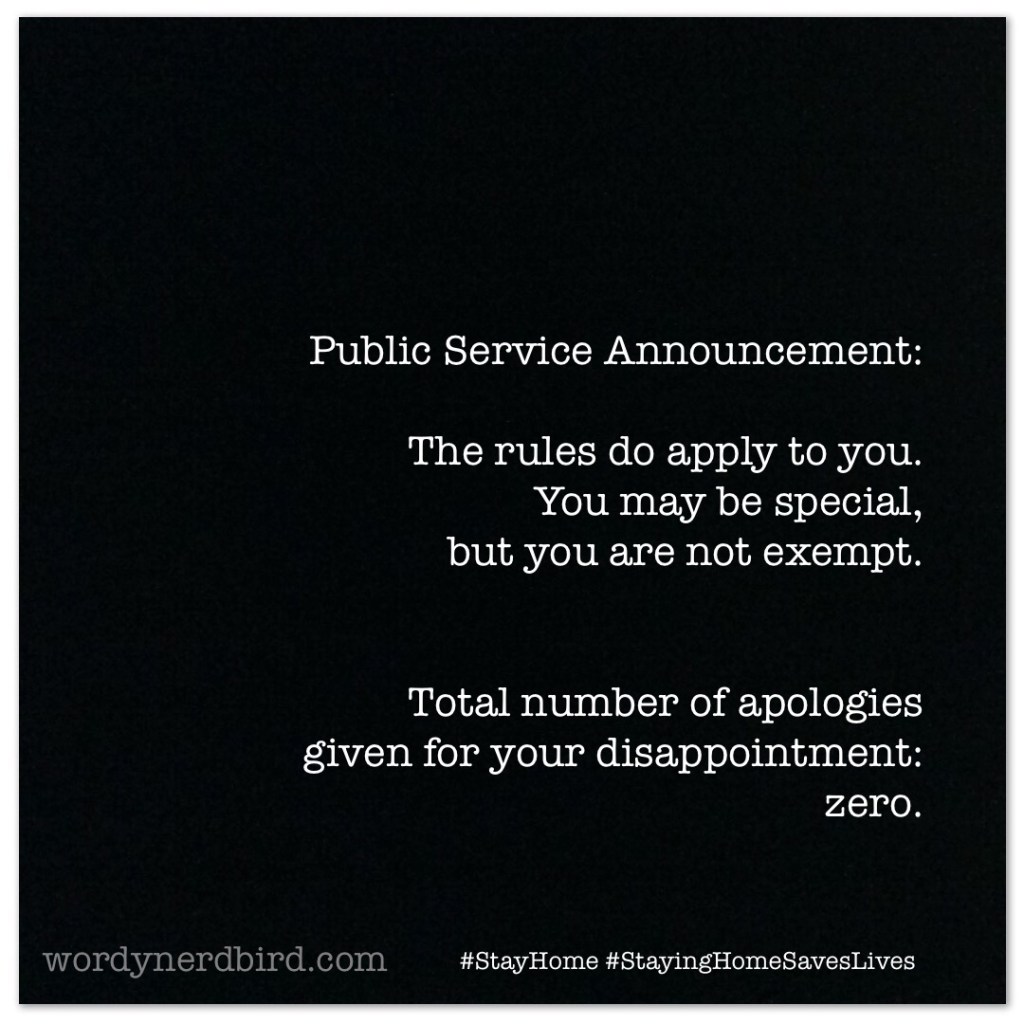
Here’s a Public Service Announcement for everyone thinking of breaking out of isolation and going somewhere else for the Easter weekend, especially those Australians who seem to think that the rules apply to everyone but them.
Just. Stay. Home.
And the places you’re thinking of going? They don’t want you there at this point in time.
Sure, spending the long weekend at home with the same people might be boring, but aren’t they the people you’re thinking of going away with for the weekend? Maybe it’s home itself that is boring. Consider, though, that it’s also safe, because it’s keeping you out of the way of that nasty corona virus and any other germs that might be doing the rounds.
Yes, it’s inconvenient. But it’s no more inconvenient or uncomfortable for you than it is for anyone else.
People selfishly ignoring the rules, going out and potentially spreading germs all over the place is why we have such strict isolation rules now.
And, you know, it’s an investment in everyone’s future.
Some of us have elderly family members that we’re trying to keep alive long enough to be able to see and hug their children and grandkids at Christmas, if this is all over by then. Some of us have family members whose immunity is compromised by illness, or chemotherapy, or their own unique biology. We’d like to keep them alive, too. Some of us have chronic illnesses that make us susceptible to every bug that floats past our noses. Given that we already battle significant health issues every day of our lives, we’d prefer to not add Covid-19 to that list.
So when selfish, ignorant people insist on travelling places where they don’t live — whether it’s to deplete our shops of the essentials that are in short supply everywhere (thanks for that by the way, we didn’t need toilet paper this past fortnight) or hang out on the beaches or lake shores or in the parks — and so disrespect the boundaries that the government has established to keep everyone healthy and safe, we get more than a little annoyed.
Because the rest of us are staying home, too. And we would like to be able to eventually see and hug our families and friends. We’d like to be able to go to a cafe or restaurant, or meet with friends at the pub. We’d like to be able to browse a real bookstore with real books in it, or go shopping for things like clothes or shoes without worrying about whose health we might be endangering.
And let’s face it – most people who have lost their jobs because of this pandemic would like them back, sooner rather than later. Essential workers would like to be able to go to work and come home not worrying about what they’re exposed to every day.
The more selfish prats who insist on going to the beach or driving some tourist route instead of just staying home, the longer and harder the lockdown is going to be.
So please, for the love of everything good in this world, stay home.
If home is “boring”, that says a lot more about your imagination than you realise. If you decide something will be boring, guess what? It will be.
Making changes or finding and introducing new opportunities for entertaining yourselves at home is entirely within your control. So if you’re bored, you’ve got nobody to blame but yourself.
Consider this long weekend your opportunity to change your attitude and your environment, not your location.
Please: #StayHome this #EasterWeekend #EasterWeekendlockdownchallenge #StayHomeAustralia #StayingHomeStaySafe
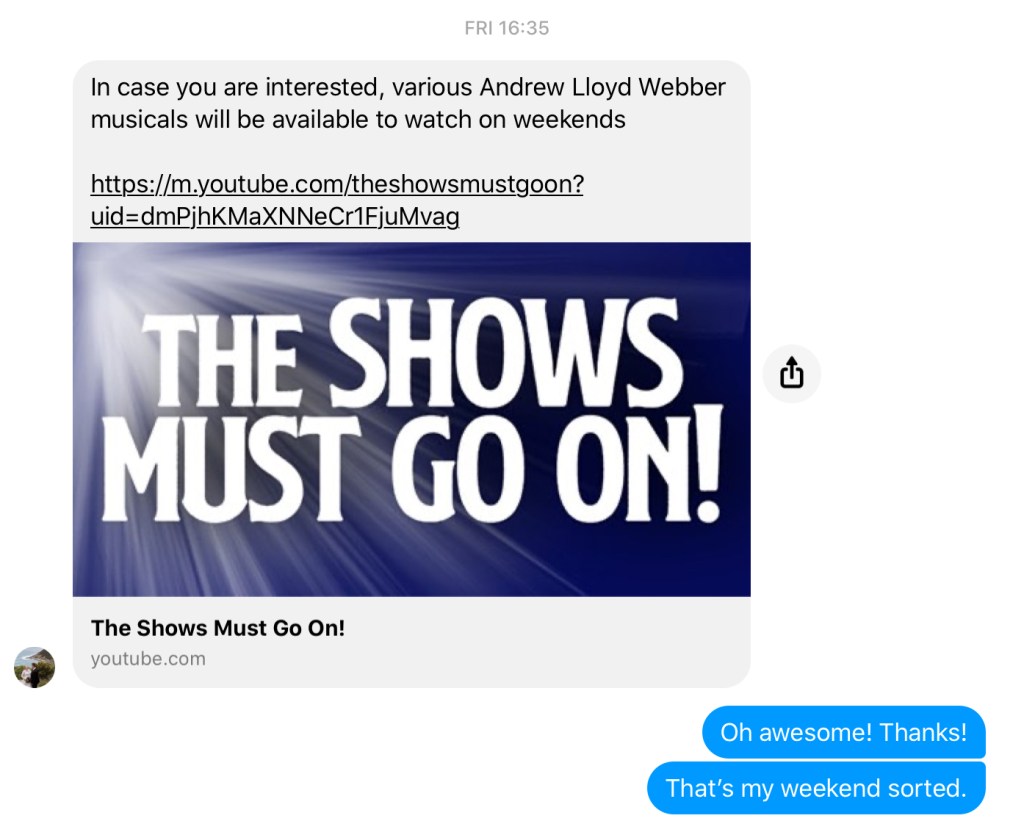
My family are definitely looking out for me while we’re all staying home. Just this week, two of my nieces sent me messages about opportunities for free entertainment while we’re all staying home and staying safe. I’m super grateful to them both for thinking of me and passing on the details of things they knew I would love.
In factt, those opportunities are so good, they deserve sharing with you, too.
The Globe Theatre is streaming a free Shakespeare play each fortnight, starting with Hamlet on April 6th. What a fabulous opportunity to watch great productions by some of the best in the world! And for any Shakespeare lovers who, like me, live somewhere that means they’ll never get to see as many of the plays as they wish to in live theatre, this is a fabulous chance to see more of the canon in near-to-live performance.
The Shows Must Go On! features productions of various Andrew Lloyd Webber musicals, free of charge, on YouTube. The first show available is Joseph and the Amazing Technicolor TM Dreamcoat. Given that I directed that show last year, anyone who knows me will tell you there is absolutely zero chance of me not singing along with every word.
(Edit: already watching… already singing. Strange as it seems… )
I know it’s not the same as actually going to the theatre, but such fabulous, free entertainment is most welcome, especially while we’re all maintaining social isolation and trying to maintain our wellbeing.
Fabulous, free entertainment opportunities for #StayingHome #StayHome #entertainment #WhatToDoDuringQuarantine #WhatToWatch
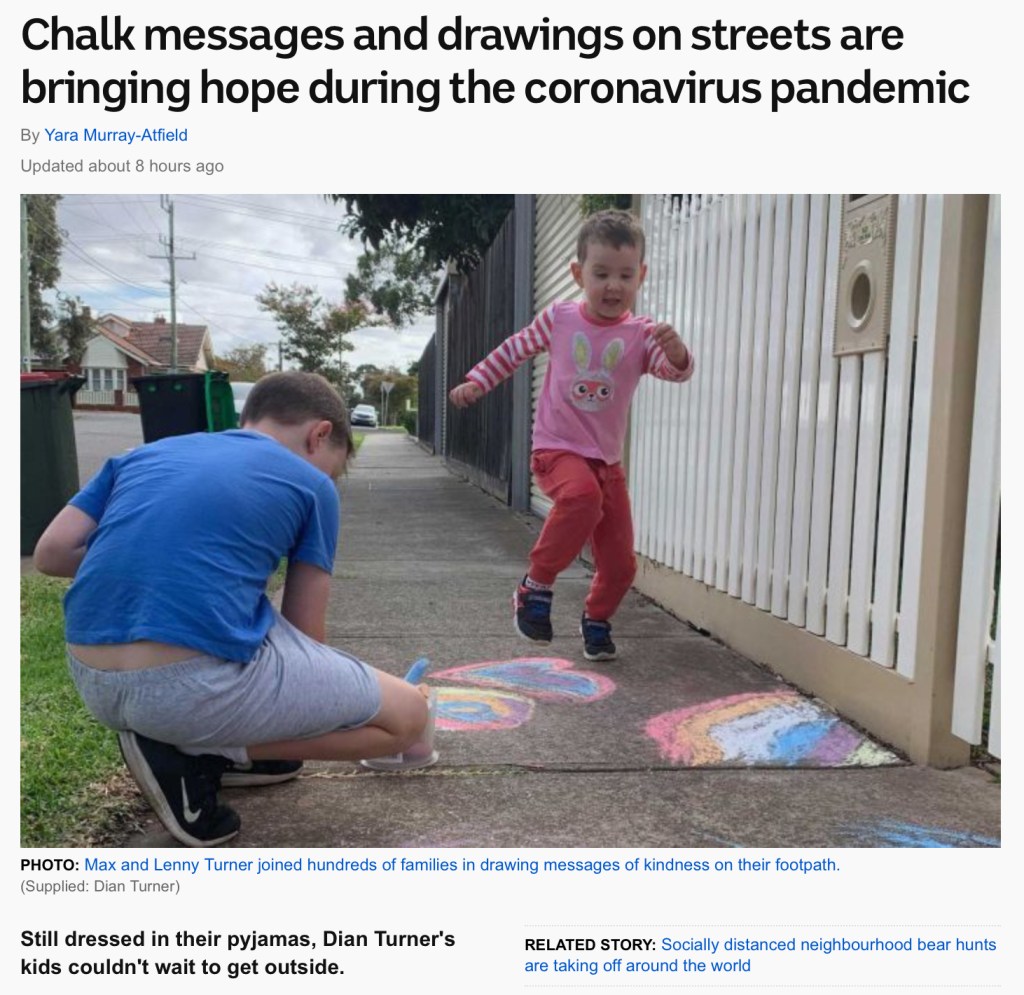
It’s cheerful, and simple, and sincere, and it’s just so beautiful.
In the midst of these bleak and socially-distanced times, these messages are a delightful trend that is bringing heartfelt encouragement to communities.
In this time of social distancing and staying home, some people are feeling very restricted and isolated. It’s easy for people to give into negativity and resentment, particularly if they are used to being out and about and interacting with people. It’s crucial that we don’t fall into that trap, especially as it is, in all likelihood, only early days yet.
I have one single thought to share with you today which has the power to completely change a person’s perspective and re-focus their thoughts in much healthier directions.
Don’t think about what you can’t do. Think about what you cando.
This is going to be my response to every expression of negativity about staying home.
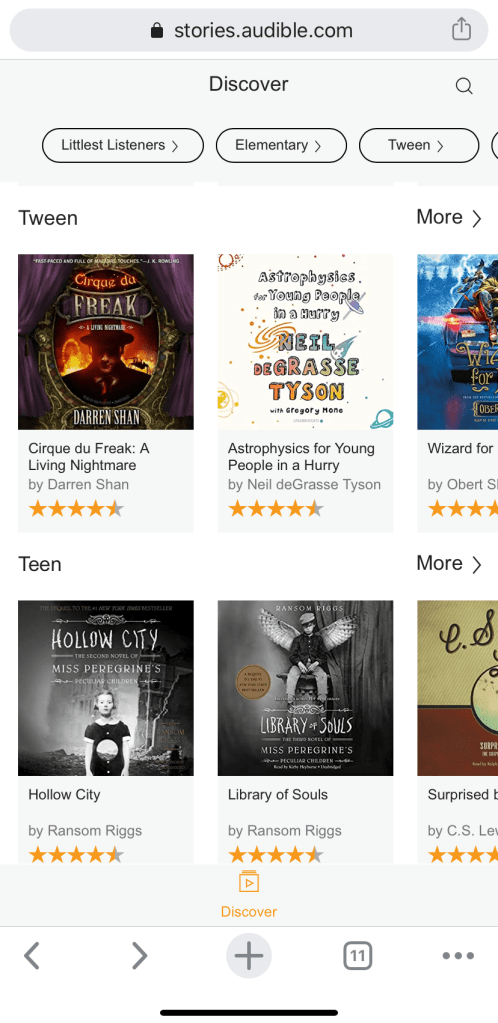
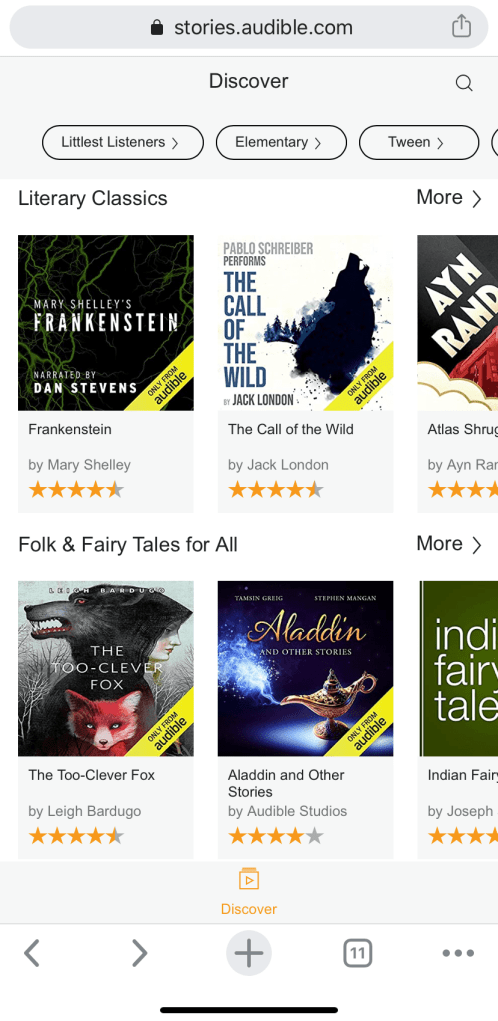
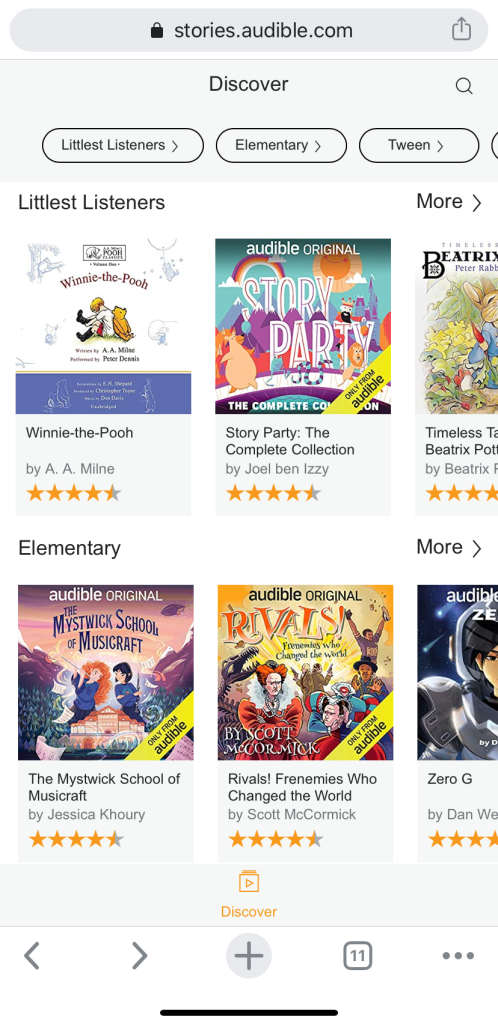
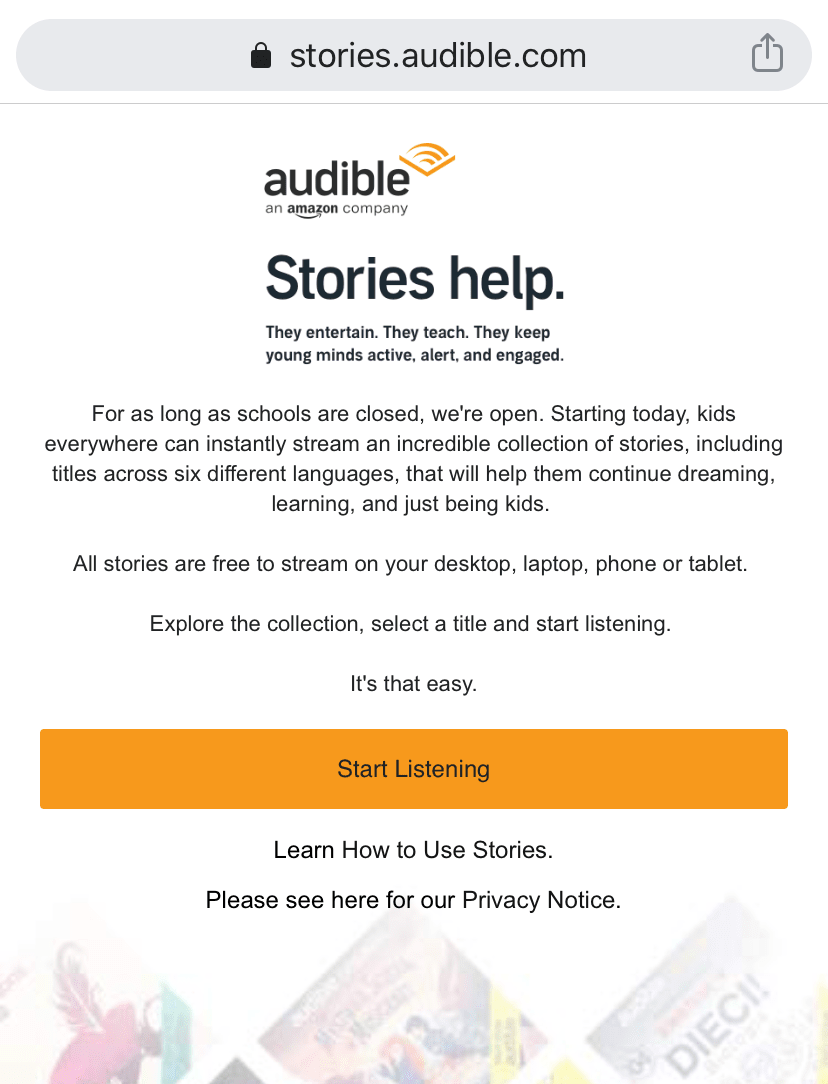
Audible has released a whole bunch of audiobooks for kids and families absolutely free, called Stories.
There’s an extensive range of books for kids of all ages, from ‘Littlest Listeners’ to teens, and some excellent literary classics, too!
What a fantastic opportunity for beating the lockdown blues! It’s great to see one of the big companies taking the initiative to offer something to help us all out by feeding our imaginations and entertaining our families.
An Audible membership is not required, so anyone can use it. As it is browser based, no credit card or personal information is needed to listen. It works on phone, laptop and tablet.
Completely free #audiobooks for kids and families to #ListenTo while #stayinghome – fantastic! Thanks, @Audible!
I get it. We’re at home, our kids are home, we can’t go anywhere, so let’s stay in our pyjamas all day! Right?
Wrong.
When everything else in the world is in limbo and the rules are changing on a weekly — or daily — basis, it’s really important for our health to keep some kind of routine and not let the basics fall by the wayside.
Yesterday, I mentioned that taking care of ourselves is one of the positive things we should all be doing. While everyone’s situation is unique, there are some commonsense strategies for taking care of ourselves which are particularly relevant during the disruption to our regular routines by the corona virus lockdown.
Nutrition matters. It’s tempting to live on pizza, chocolate and peanut butter sandwiches, but being sure we eat well and nourish our bodies properly is crucial to maintaining good health. The healthier we are, the more resistant we are to germs of any kind, and the recovery from any bug we might pick up will be quicker. Not only that, but we’re going to have to go back to work sooner or later, and it would be good if those business suits or uniforms still fit when that time comes.
Hydration is also crucial to keeping the body healthy, but most of us don’t drink as much water as we should. It was only when I started keeping track of how much I was drinking in a day that I realised how far short I had fallen from what my body actually needed on a daily basis. Remember, too, that alcohol is a diuretic, so for every beer or glass of wine, we need to drink more water. For a great discussion on how much water we need to drink, listen to this interview from ABC Australia.
Exercise is similarly important, and for more reasons than just not bulking out while we’re hibernating. Exercise is good for the brain and the emotions as well as the body, so even when we can’t leave home, it’s important to walk, or get on the treadmill, toss a ball with the dog, follow a cardio or dance video tutorial, or get into stretching and yoga. Even cleaning out a cupboard or doing some gardening qualifies. There are lots of options for people to pursue at home, and your exercise can be as gentle or vigorous as you want it to be so there’s no excuse for staying in bed or living on the couch for the foreseeable future.
While it has been widely publicised that sunlight will kill the corona virus doesn’t like the sunlight, that is not actually true. Even so, it dos kill other germs and bacteria. Stepping outside the house and into the fresh air and sunshine is highly beneficial for wellbeing. You don’t have to go far – just into the yard will do if you can’t or don’t want to go any further. While people who live outside the city are at a definite advantage here, most neighbourhoods have parks, gardens or reserves where you can go and walk without being in close proximity to anyone else or even touching anything. Letting light into your house is important, too. it helps you maintain a natural circadian rhythm, and therefore promotes better sleep hygiene.
Personal hygiene may seem mundane, and there are probably people out there who are treating it as optional, but showering every day, wearing deodorant, and taking care with presentation is an important part of taking on each day with a positive attitude. It’s psychologically proactive and It makes a difference to our physical health and wellbeing. Just as importantly, it makes you much more pleasant to be around. You might just be at home with your family, but they are actually the most significant people in your life. If you couldn’t be bothered doing it for yourself, do it for them.
Maintaining a routine is also a very positive psychological strategy. If you normally work from 8.30 til midday then break for lunch, try to do that at home, too. You might have some interruptions, or you might be sharing a workspace, but it’s a powerful way to model to other people, especially kids, that keeping going in times of adversity is both possible and beneficial. It also keeps the brain trained for returning to work when the time comes, and gives you a great sense of satisfaction of achieving something each day.
Similarly, keeping your home spaces clean and tidy promotes health by not giving the germs a foothold. Do the laundry, wash the dishes, and clean the surfaces regularly. That way, things are easily maintained without turning into hard labour.
Relaxation should be part of every day. Whether it’s reading, crafting, meditation, writing, doing a puzzle or listening to music or a podcast, spend some time each day in quietness and peace. If your kids aren’t good at quietness and peace — and many are not — now is a better time than any to model positive mindfulness and teach them some strategies they can use. They should also be learning to respect your need for some downtime, too. They may be getting frustrated, but it’s actually not all about them.
In keeping with all of this, my own personal strategies include are:
Maintaining my regular morning routine: get up at a reasonable hour, shower, dress, have breakfast, and then get into the things I need to do each day.
Creating an achievable “to-do” list for each day. It helps me organise myself, and ticking things off the list is incredibly satisfying.
Sticking to my usual school timetable as much as possible when I’m working from home. I’m a teacher, so there’s always plenty I can do. I have to take care not to let work consume the entirety of each and every day. A routine helps me to manage that more effectively, and keeps me on task this week as I’m working to get done what I need for the beginning of Term 2.
During the scheduled term break of two weeks leading up to Easter, I need to ensure I have the break I have earned. There will be some school work to do — there always is — but I will not be working the whole time.
Spending time outdoors every day. I can choose to work in our courtyard, spend time in the yard with the dog and talking to the sheep over the fence, or spend time in one of the parks in town. Mixing it up from day to day is how I roll.
Eating properly. The temptation to snack all day is huge, and having dropped a few dress sizes since August, that’s not a habit I want to get back into. I’m shopping strategically – I go only when I need to, and when my resolve is strongly in favour of buying apples rather than chocolate.
Punctuating between activities by drinking a glass of water.
Maintain my regular habit of reading for at least an hour a day.
Self Care At Home During the #CoronavirusLockdown #mentalhealth #HealthandWellbeing #selfcare #Priorities #stayinghome
During any crisis, be it war, fire, flood, famine or pestilence, it’s important to stay up to date with important information, but it’s also really easy to be overloaded by non-stop discussion and bombardment by both media and social channels.
In recent weeks, it seems that every time one turns the radio on or watches anything on commercial television, the only thing anyone talks about is corona virus related. It’s relentless. Government officials, scientists, medical authorities, celebrities, talk shows, podcasts, and current affairs specials are all contributing to the conversations, with varying degrees of accuracy and relevance. Every news bulletin tells us how many people have been diagnosed and how many have died.
It would be quite possible to consume media about global developments, self isolation, quarantine, and empty supermarket shelves all day, every day— and there are probably people doing that.
That’s not healthy.
It very quickly becomes emotionally and mentally overwhelming , and can blow out into quite disproportionate fear and paranoia.
We are all as susceptible to that as anyone else, so it is important to strike a balance between keeping abreast of what we need to know and limiting the amount of constant discussion about the virus that we allow into each day.
My strategies and decisions for achieving this include:
Being very selective about where I get my news and information. Each day, I inform myself via reputable and balanced news services. Then I turn my focus to other things.
Choosing to deliberately reject “fear language” and negativity, because that doesn’t help anyone.
Being discerning about the content of social media feeds, and how much time is spent reading them. Keep in mind that social media is very rarely one of those reputable and balanced news services. There’s a lot of misinformation out there. The “mute” functionality is very useful in those circumstances.
Adopting an “only positive” approach to sharing and promoting other people’s content. If it’s encouraging, entertaining and constructive, share away. Spread that stuff around like a five year old sprinkles glitter.
Occupying our thoughts with productive and proactive things. Whether that is work, recreational, or creating positive content for our own social media depends on the needs and demands of each day.
Balancing the amount of screen time in each day with screen-free time. Especially in these times of social distancing, it’s vital to ensure that healthy habits are maintained. Go for a walk, enjoy some sunshine or look at the night sky, prepare and enjoy good food, talk with family and friends, dance to a favourite tune or two, read a book, play with the dog, clean out a cupboard or pull some weeds in the garden… the possibilities are myriad.
Keeping things in perspective. Yes, there is a global health crisis making many people sick and curtailing personal and social freedoms. People are losing jobs and businesses as a result. The economy is wallowing. It is a very serious situation. At the same time, most of us are simply being asked to stay home and find ways to entertain ourselves. It might be inconvenient, and we might have to abandon or change plans, but it is still a much better option than what some people are facing.
Supporting local community. When you do need to buy things, try to invest in local and small businesses so that they can survive the crisis, too. This can help you to develop a sense of connection and belonging that is as encouraging for you as it is for the folk you support. An additional benefit is that many small businesses are currently offering contactless shopping and delivery options at no extra expense, and the quality of the goods and services they offer often far surpasses their bigger competitors.
We can’t control the virus, but we can control our own responses to the disruption and social climate it has created. By being proactive about keeping informed and staying positive, we can avoid being overwhelmed by the volume of discussion and the fear and negativity that can so easily take hold as a result.
Staying informed without getting overwhelmed during the #Coronavirus #pandemic #perspective #mentalwellbeing #blogpost
As Australia has begun the process of going into partial lockdown in response to the corona virus pandemic, it is becoming astoundingly clear who the country cannot do without.
Here’s the thing: it’s not the billionaires, the movie stars or rock singers, the football players or the fashion models.
Don’t get me wrong. They’re important people. But who are the ones we rely on to keep doing what they do so that the majority of the population can actually isolate or socially distance themselves in comfort and safety? Who is actually unable to stop working and stay home in the interests of self-preservation?
It’s the doctors and nurses, police officers, firefighters, and paramedics, the people who stack supermarket shelves and work the checkouts, and the teachers. It’s the people who work the service stations and fast-food and takeaway restaurants, the cleaners, the truck drivers, the retail workers… and the list goes on.
They are the people who are still going to work every day, regardless of their potential exposure to germs – and not just Covid-19, either — and to the frustrations, anxieties and hostility of the general public.
Most of them can’t work from home. And, with the possible exception of the doctors, most are paid nowhere near what they are worth.
Teachers could, of course, deliver their lessons online as my own school is planning to do if we are ordered to close the college. That’s not as easy as it sounds, either, especially with younger students. It’s a lot more planning and preparation every day, as the curriculum will still need to be delivered as fully as possible. There won’t be any less marking, either.
Of course, whether or not schools will be closed is still a matter of debate in Australia. The government doesn’t want to close the schools, because that would mean the people in medical jobs would have to stay home to look after their kids. Who would look after the sick people then?
So when you are out shopping for groceries and annoyed that the shelves are half empty, don’t take your frustrations out on the store workers: they can’t stack shelves with what has not been supplied. Save the blame for the people hoarding basic goods out of selfishness and greed. They’re the real reason you can’t buy the basics at the moment. And let’s be honest: when those people are at home self-isolating and eating ten people’s worth of pasta and rice, and the loo gets blocked up with all that hoarded toilet paper… they’ll still want the plumber to come out and fix it.
When you have to wait in a longer-than-usual line to collect takeaway food, don’t give the servers attitude for the delay. They are doing their best under extremely demanding circumstances. And remember, they are saving you the effort of cooking for yourself, so there’s that to be thankful for.
When you see a medical worker or first responder getting coffee or taking a break, don’t kvetch about them having some downtime. Instead, thank them for the tough job they’re doing, especially if it’s a job you wouldn’t want to be doing during a global health crisis.
When you hear about nursing homes, hospitals and schools closing their doors and not allowing visitors in, don’t complain about inconvenience or behave like its an overreaction. Thank them for being proactive in taking extra measures to protect the people for whom they have a duty of care.
When you hear people complain about the inconvenience of social distancing and working from home, remind them that some people don’t have the ability to do so.
They are the workers on the front line, keeping the country going while everyone else stays home. They should not be on the receiving end of anyone’s bad behaviour.




 WordyNerdBird