This post might come across as some kind of linguistic snobbery, and while that’s not my motivation, it is a risk I am willing to take.
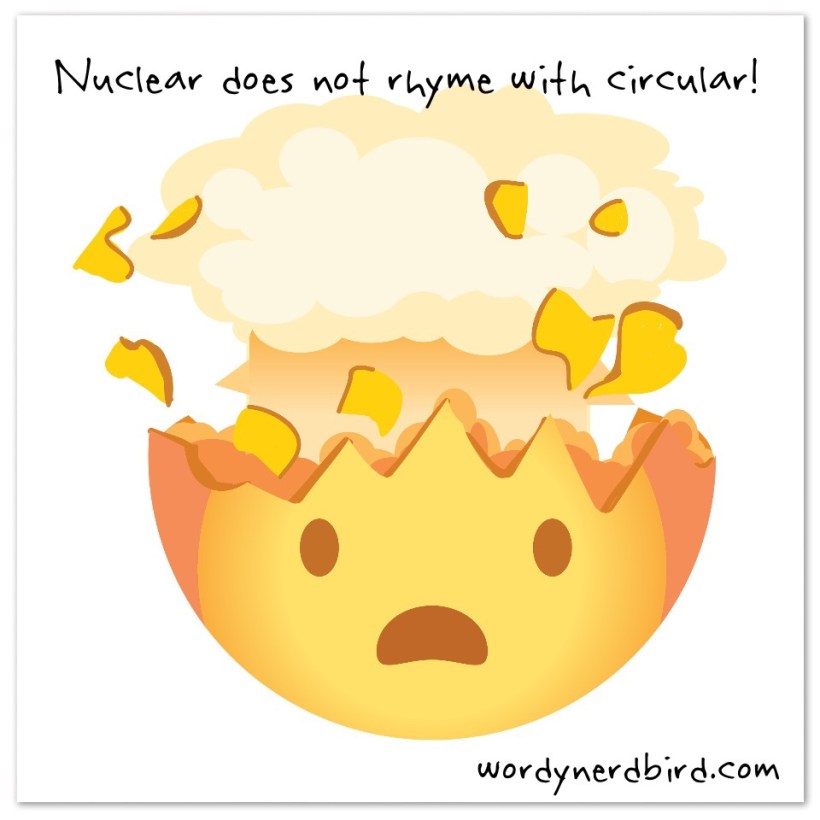
The common mispronunciation of nuclear is something that drives me absolutely nuts.
So many people pronounce it as nucular ( nyoo-kyoo-lar) but that is not how it is spelt or pronounced. I’ve even heard scientists on the radio and TV who say it that way, despite the fact that scientists of all people should know better. Did they get through however many of years study at university calling the central body of a cell the nuculus? I think not.
Nuclear is a three syllable word, pronounced nyoo-klee-ar.
If someone can say the words ‘new’ and ‘clear’ correctly, they should be able to manage ‘nuclear’ by just mashing those two words together. Think of it as linguistic nuclear fusion.
Irony occurs when one thing is expected, but the opposite thing happens or turns out to be true.
When the audience knows or understands something that the characters in a story or on stage or screen do not, that is called dramatic irony.
It should be noted, too, that an event or outcome being ironic for one person or group does not preclude it being predictable for other people
Both irony and dramatic irony are much-loved devices for writers, but they do not only exist in literature and film.
In fact, one could argue that the reason writers use these techniques is because they know that these things happen in everyday life, and that people love it when they do. The profundity of natural irony, dramatic or otherwise, is like crack for writers, who are often keen observers of human nature and behaviour.
Irony is a powerful thing. It can evoke all sorts of responses, ranging from pity to laughter to judgement, depending on the perspective of each onlooker. It can bring about self-pity, humility or significant changes in attitude and behaviour for those who experience it.
When well executed by an author, irony creates plot twists and complications that add depth and complexity to a story, but which also make the experiences of the characters relatable and intriguing for readers.
When expertly executed by the universe, though, irony can blow one’s mind.
Likewise, Trump denied the existence or threat of the virus and casually dismissed the illness and death of thousands of his own people. He refused to wear a mask or observe social distancing, he insisted on holding social events and campaign rallies against all medical advice. That he has tested positive and ended up in hospital with the virus is loaded with both types of irony.
There is little doubt that 45’s illness is a plot twist that he didn’t see coming.
One would hope that his treatment with highly experimental drugs that others with the illness haven’t had access to doesn’t end up doing more harm than good. That would also be ironic.
Personally, I find it impossible to feel sorry for him.
My empathy lies with all those Americans who suffered the disease and who lost loved ones to it while he proclaimed it as fake, and with all those who cannot afford the instant access to hospital care and fancy drugs that he can.
Irony, Dramatic Irony, and the Plot Twists of 2020 #irony #PlotTwist #TrumpCovid #BorisJohnson #JustSaying #blogpost
This post reminds me of the lessons I’ve been doing with my Year 8 History class about Medieval Europe and the Black Death.
My students were very interested in the plague, and surprised by the fact that this was when quarantine, social distancing, and the wearing of masks became the go-to modes of dealing with contagious disease. They were also surprised by the time it took the Europeans to understand the importance of basic hygiene, and how very long it took to develop good medical knowledge.
These lessons were highly relevant in These Times, and helped the kids to understand why we’re being reminded to wear masks, wash and sanitise our hands, and keep away from other people. It was good to be able to discuss how relevant history can be.
We all agreed we are incredibly thankful for modern medicine, science, vaccines and health care.
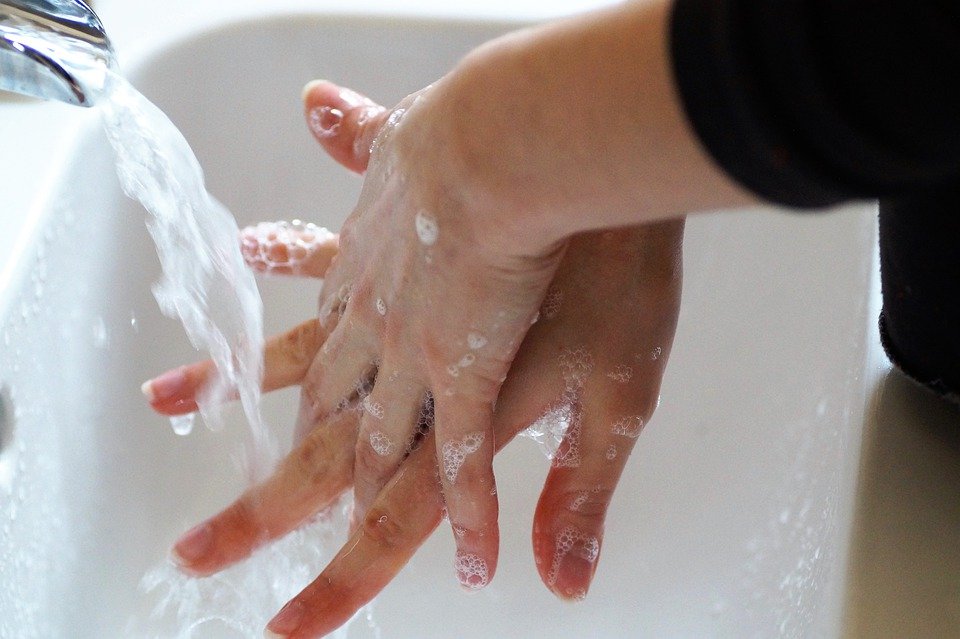
It does strike me as bizarre, however, that with all the scientific and technological advances we’ve made, we still have to remind people to wash their hands. Some things, it seems, never change.
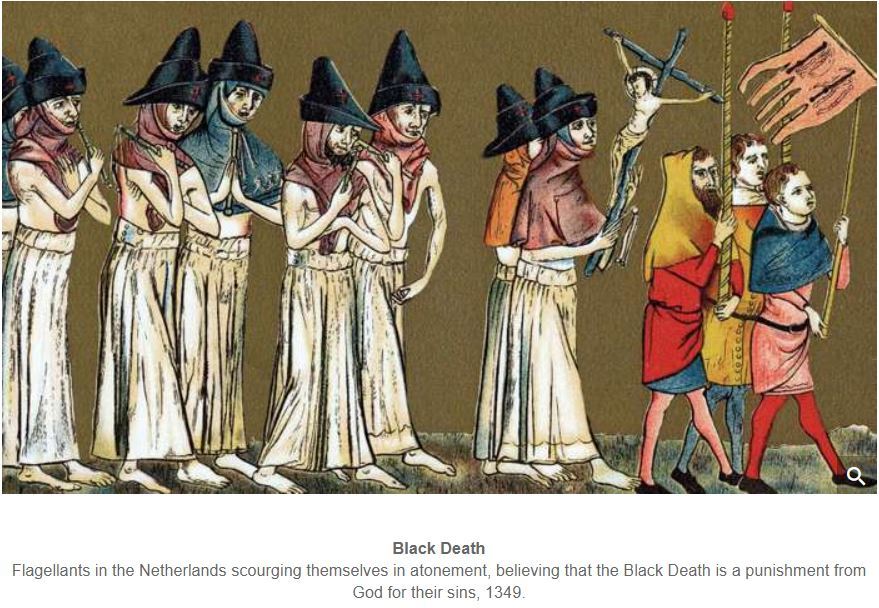
This illustration is simply that, a suitable illustration – the Flagellants followed the first wave of the Great Pestilence and aren’t mentioned here. from https://www.britannica.com/event/Black-Death
In this time of Covid 19, when we don’t know why it seems to affect men more than women, and some ethnicities but not others, it is interesting that back in the 14th century the tsunami of the Great Pestilence of 1348 was followed by lesser waves that differed in many ways from the original. The first of these, in the England of 24 Edward III (January 1360 to January 1361) was called the secunda pestilencia and appeared to affect mostly the very young, babies and adolescents. Women were not affected in the same way.
The Chronicle of the Greyfriars of King’s Lynn notes: “…In that year [1360] began a plague among Londoners at about the feast of St Michael, where at first infants…
One thing I have noticed with the wearing of a mask every time I go out is how dry my lips get!
I don’t know if it’s the mask that does that, or the fact I’m not wearing lipstick as much as I used to.
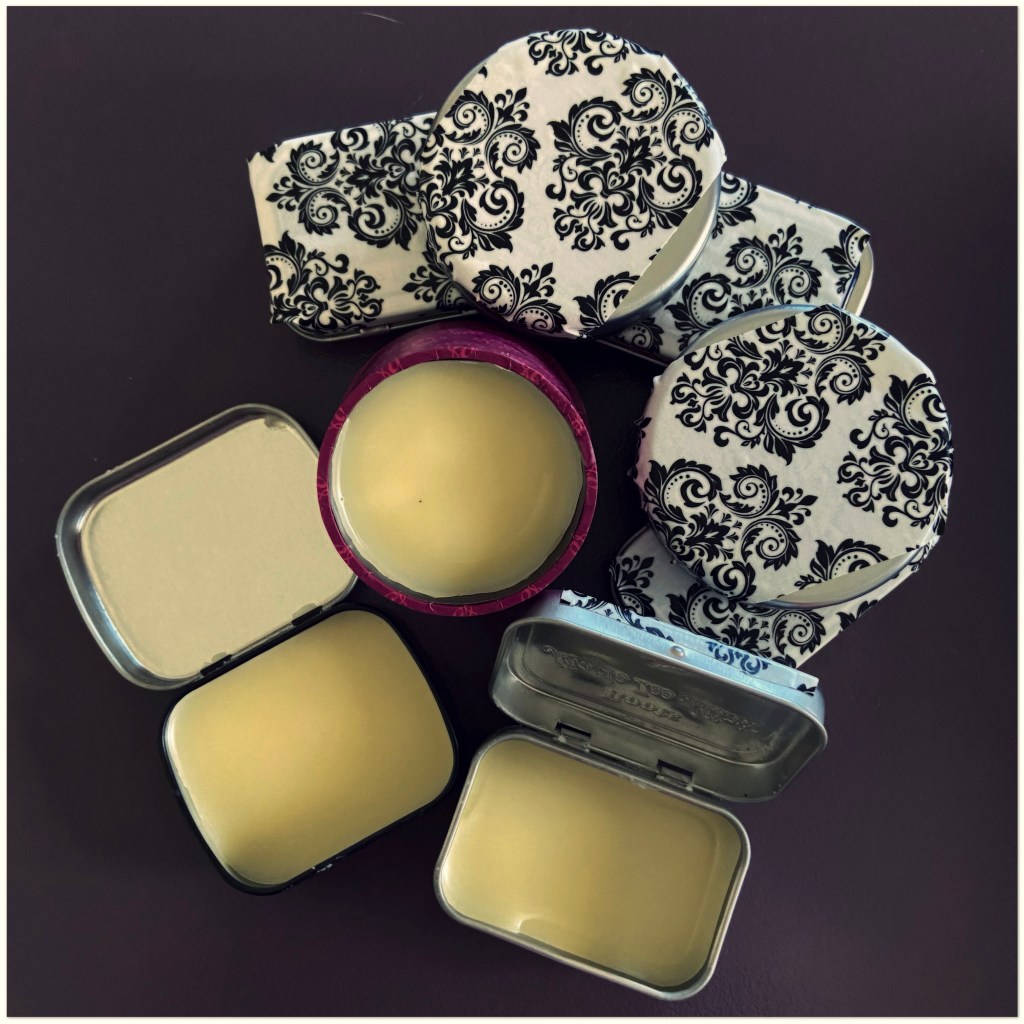
So, I decided that the term break was the perfect time to try something new: making my own lip balm! I’m going to brand it ‘Kiss My Mask’ because saying that makes me smile.
This all-natural lip balm recipe is easy and quick, and the end product is quite lovely. It absorbs quickly, is not greasy, and there’s no colour to mess up my masks.
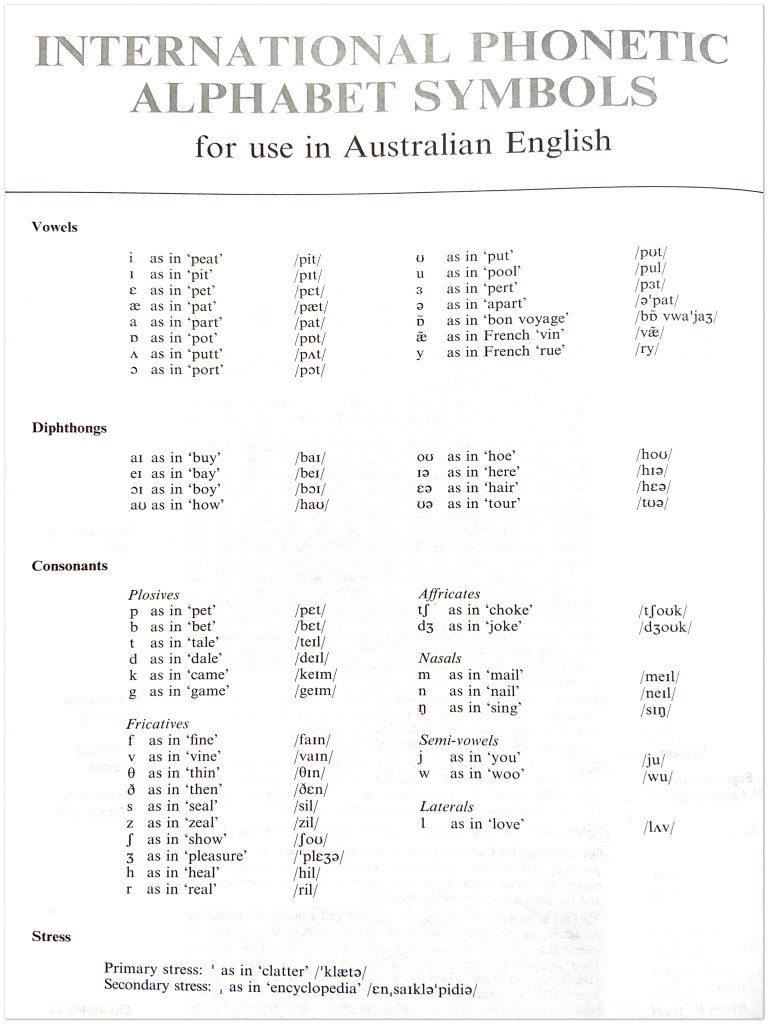
The International Phonetic Alphabet is a system of symbols that denote all the different units of sound — called phonemes — that make up words in any language. It was first developed in the late 19th century, and has been developed and updated ever since.
Photo: Joanne Van Leerdam. The IPA page in my copy of The Macquarie Encylopedic Dictionary, 2011 Signature Edition.
I learned the IPA in my first year at Macquarie University in 1985. and found it to be an incredibly useful extension of my literacy and learning. It is knowledge and fluency that I have actively maintained ever since.
While it has more symbols to learn, it is more straightforward than the English alphabet, where letters can have more than one sound, and a sound can have multiple letters and letter combinations assigned to them. In the IPA. there is one symbol for one sound. There are no silent letters, and there is clear differentiation between words such as ‘foot’ and ‘boot’ that look as though they should rhyme, but do not. It also avoids situations such as that created by the letter a having six different pronunciations from which the reader must choose correctly if they are to understand what has been written. Syllables in words are marked, so that the pronunciation of the word is clearly and accurately transcribed.
Hypothetically, one could write any word of any language as it was heard, and anyone fluent in IPA could read it regardless of which other languages they could or could not speak or read fluently.
That came in very handy when lecturers and tutors in other courses used words or names I didn’t know: I used the IPA to write them down, so that I could research and identify them later. When I wanted to keep something confidential, I used the IPA to make notes or records, confident in the knowledge that my friends and family would have absolutely zero clue what was written. That probably wasn’t always entirely necessary, but it did give me a sense of security at the time. The IPA also helped me learn and perfect key phrases to use when family from overseas came to visit, and again later on when I was visiting other countries.
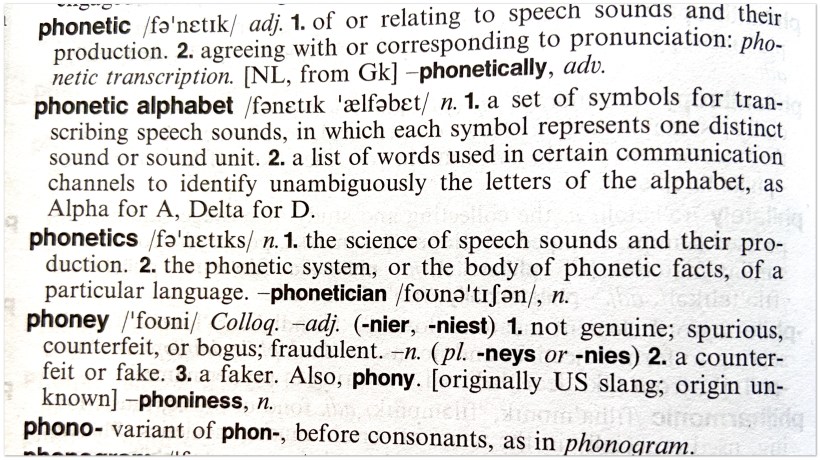
Photo: Joanne Van Leerdam. from The Macquarie Encylopedic Dictionary, 2011 Signature Edition.
A number of dictionaries, both online and hard copy, provide the pronunciation of every word in IPA, giving clear guidance to how unknown words should be spoken. As a fan of the IPA, this is something I consider essential in a dictionary for my own use.
Because it is an international system of transcribing language, the IPA does include symbols that are not often used in standard UK or Australian English. They may, however, be very useful in transcribing the spoken English of migrant communities. It also has some symbols that are only used in English, and some that are used predominantly in American English.
All of this makes the IPA a versatile tool for all sorts of contexts: work, travel, study, clear communication, and general word nerdery.
The first thing I discovered when I started researching how to prepare my memorial puzzle for framing was the amount of conflicting, and sometimes terrible, advice the internet had to offer.
Why did it all have to be so hard to find? Why couldn’t there just be one post with clear, straightforward instructions? Who even knows? I resolved then and there to write that post once I worked out what I was doing.
So, I drilled down, made notes on the approaches that seemed reasonable, and sought out some experts to guide me on the process.
On their advice, and a fair degree of holding my breath and hoping things worked as I had been told they would, this is the process I followed.
Materials:
A good solid board to mount the puzzle on. I used 2mm strawboard which I bought for about $5 at my favourite office and art supply shop. It is strong and flexible, but won’t sag or warp. It is also slightly textured, which makes it less likely that things will slide around on it.
A rolling pin.
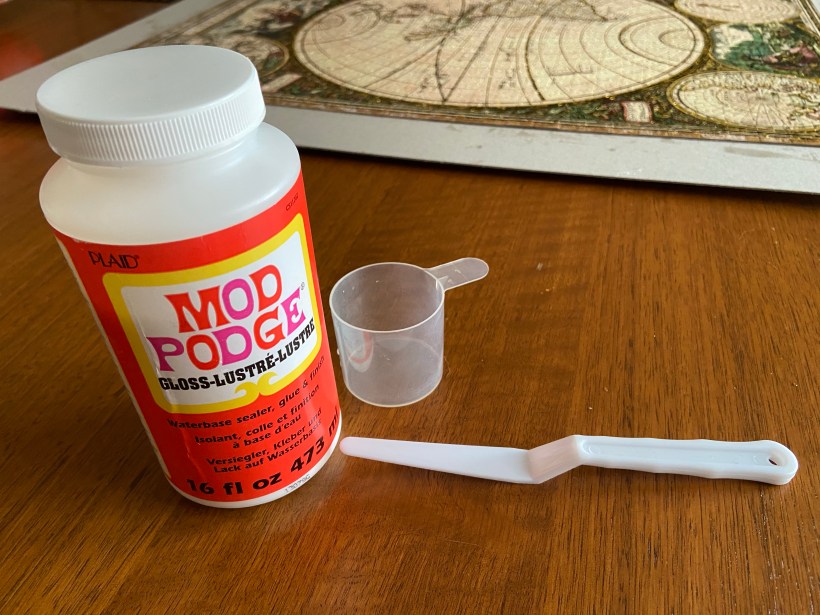
Mod Podge sealant glue. I didn’t know how much I would need, and I knew my puzzle was big, so I bought the 16oz bottle. It turned out that I only used about 2 oz of that. It’s handy stuff, so that’s okay.
A small cup to pour your glue from. This allows you to have more control over how much and where you are pouring. I used an old measure from laundry detergent.
A plastic spatula with a straight edge for spreading the glue. Some people use a credit or ATM card, but the handle on the spatula moves your hand back from the action and allows you to see right away what you’re doing.
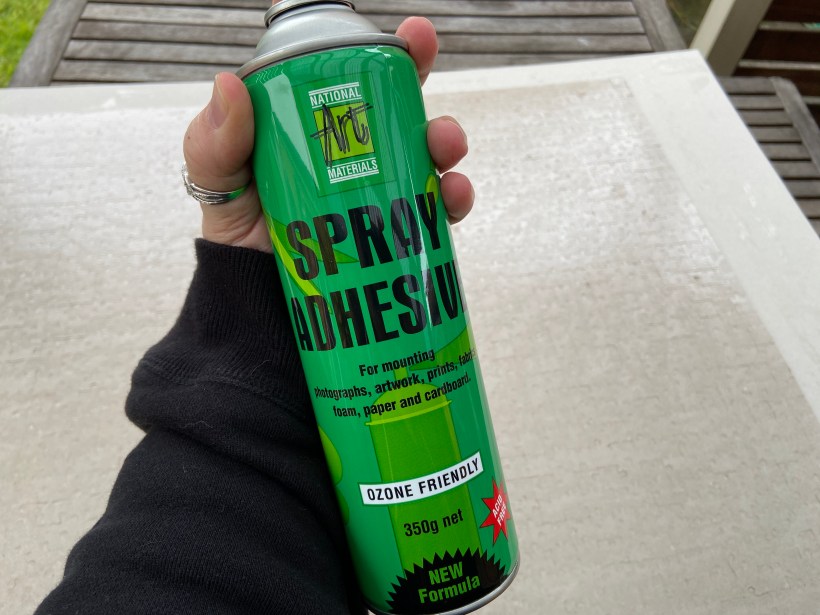
Strong spray adhesive.
Practice Makes Perfect.
Before you go anywhere near the puzzle you want to frame with your glue, practice an old puzzle so that you develop your skills and your confidence.
A friend who runs a puzzle exchange gave me an old one that nobody was interested in. Goodwill and charity shops often have loads of them for a dollar or two each. I didn’t even make the whole puzzle. I simply completed a couple of sections to practice on.
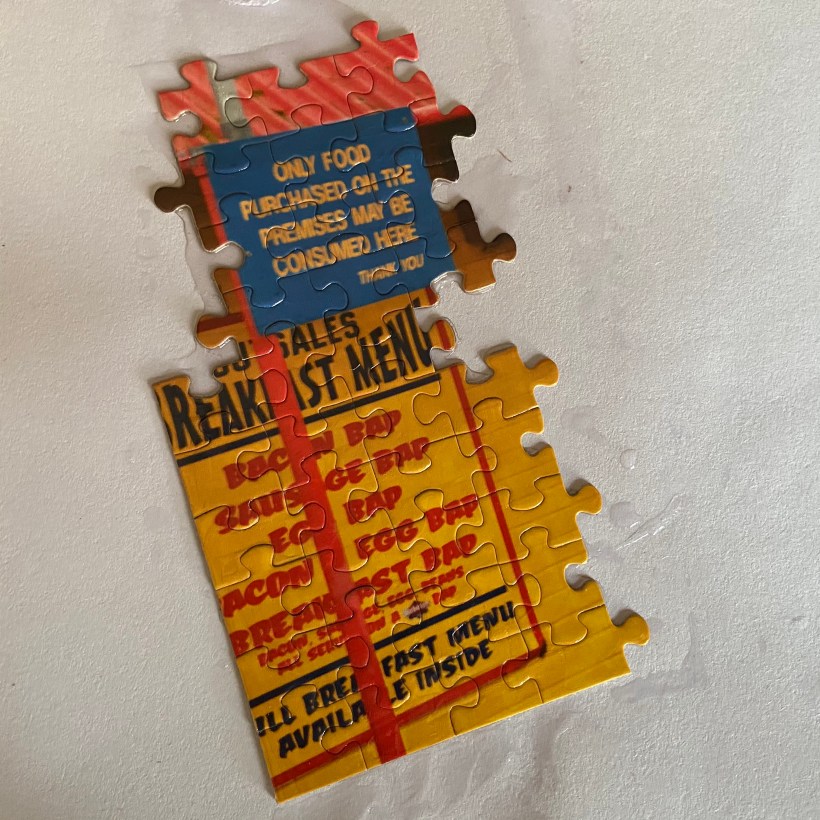
My first attempt was not bad, but I quickly discovered how easy it was to use too much glue. It spread easily, but pooled around the edges. This gave me a better idea of how much to pour on in the first instance, and how to spread it evenly. So, the edges were messy with glue, but the effect on the puzzle was good.
The first attempt involved too much glue.
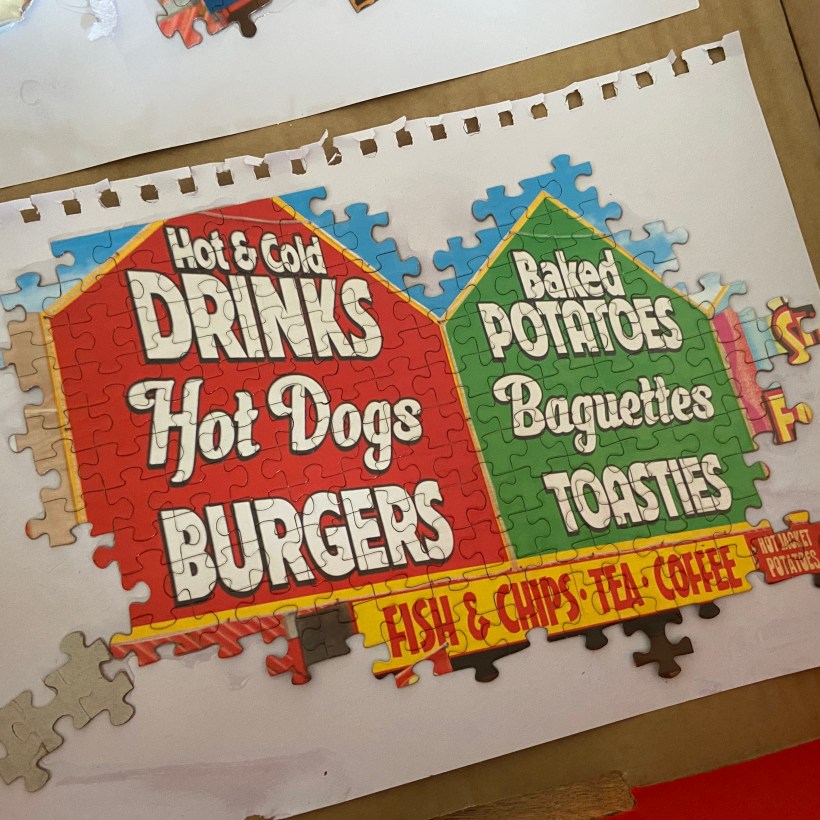
The second attempt was much better.
My second attempt was much more even. It came up really well.
I braced myself, got my gear ready, and turned to my beautiful puzzle. It was time.
Gluing The Puzzle
Use your rolling pin to ensure the puzzle is completely flat and the pieces are evenly joined.
Pour some glue from the big bottle into the small cup. You can always add more if you need it.
Don’t panic that the glue is white. It WILL dry clear and glossy.
Pour the glue in a thin, even S shape line over your puzzle. Spread it thinly and evenly over the surface with the spatula.
Make sure all the joins between the pieces are filled with glue. Make sure you don’t have globs or spots of glue anywhere. The aim is to achieve an even coating over the surface.
Mine was a very large puzzle, so I did it in three sections. When one section was done, I poured more glue and kept going.
Allow it to dry for several hours. It will feel dry to touch after about 20 minutes, but it’s important to allow the glue in the joins between the pieces to cure and dry completely before you go any further.
Turn your puzzle over very gently. It may have been glued, but it’s important to be as careful as you can with it at every step of all times, as it is still fragile.
Repeat the gluing process on the back of your puzzle. This will both strengthen the bond between the pieces and seal the surface.
Wait at least 12 hours to ensure that everything is completely dry.
Cover the back of your puzzle evenly with spray adhesive, then cover the surface of your mounting board.
Wait a few minutes for the surface to become tacky to touch. then flip your puzzle very carefully onto the board.
Do this outside or in a well-ventilated area, and wear a mask. Remember, you don’t want spray adhesive all over your furniture OR in your lungs!
Use a rolling pin to ensure the entire surface of your puzzle is pressed onto the board.
Leave it alone to set and dry. Your puzzle will be ready for framing tomorrow.
The Result:
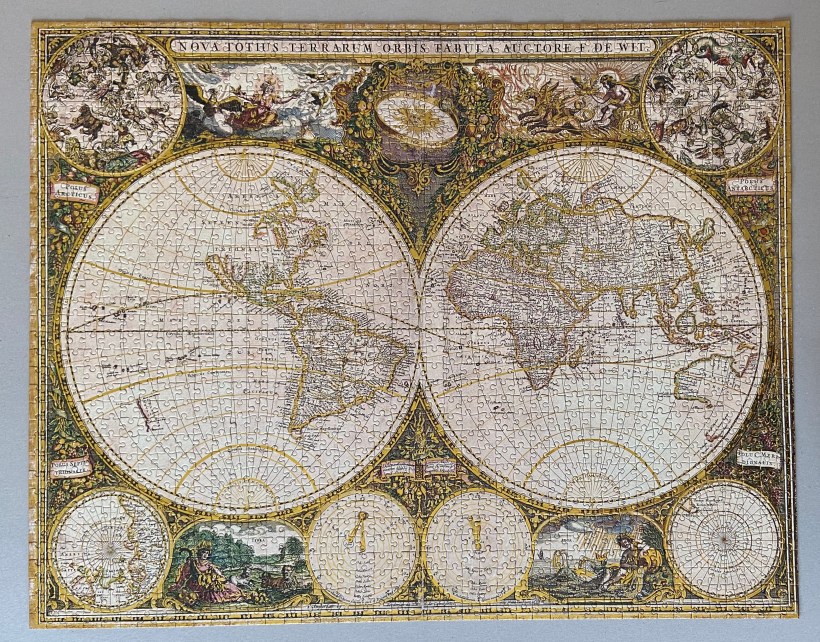
I’m really pleased with how my puzzle turned out. The finish is beautiful, and the gloss of the glue really highlights the gold highlights and subtle colours in the puzzle.
Because my puzzle is a very special one, and because it is too big for any of the commercially available frames I have seen, I’m going to take it to a professional picture framer.
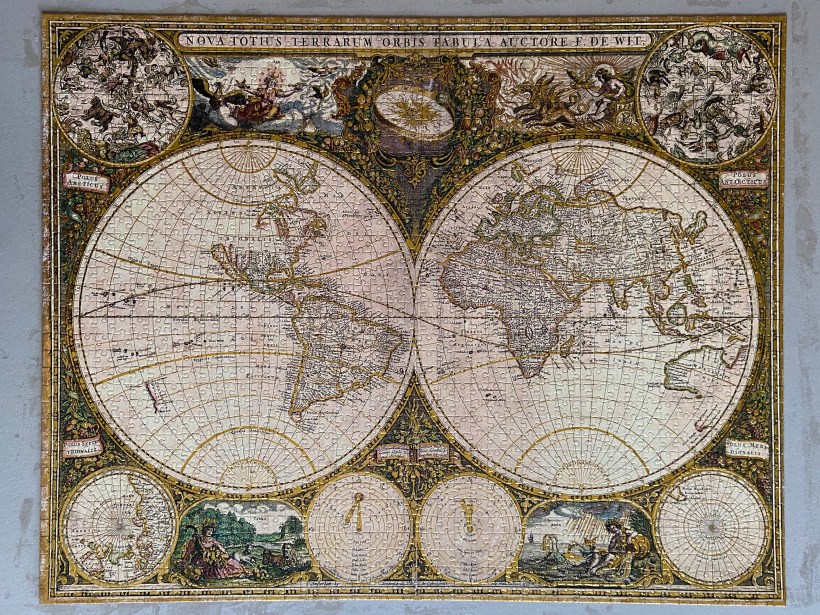
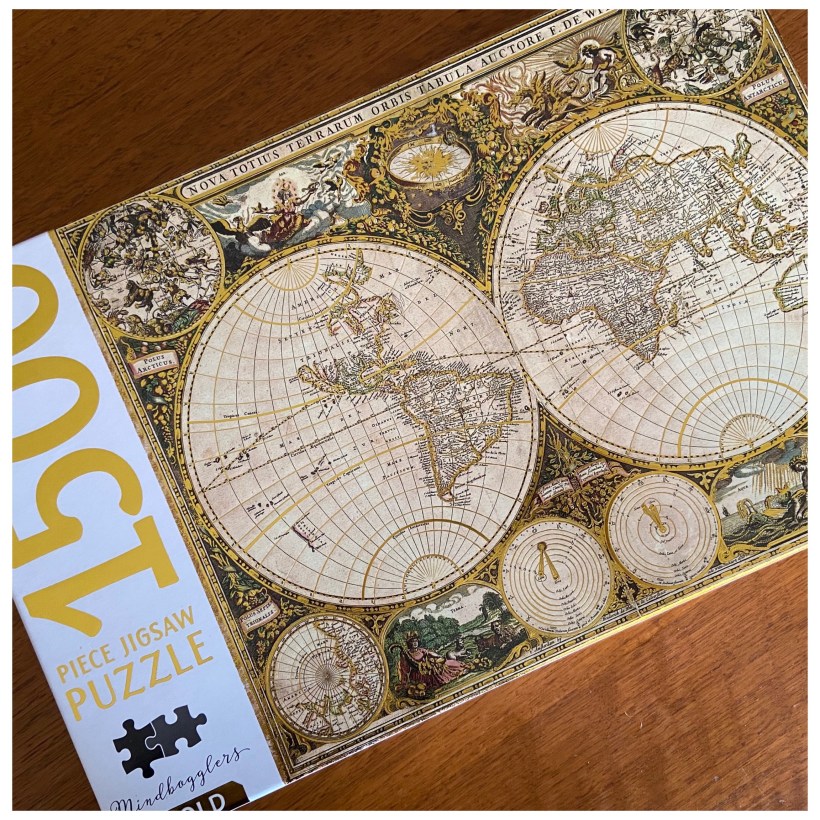
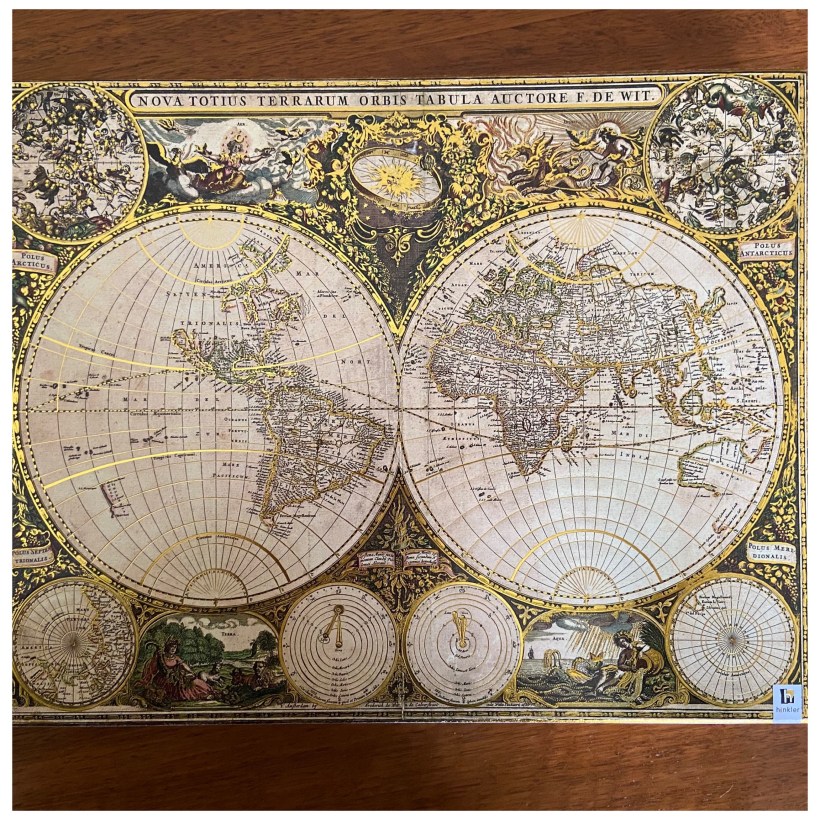
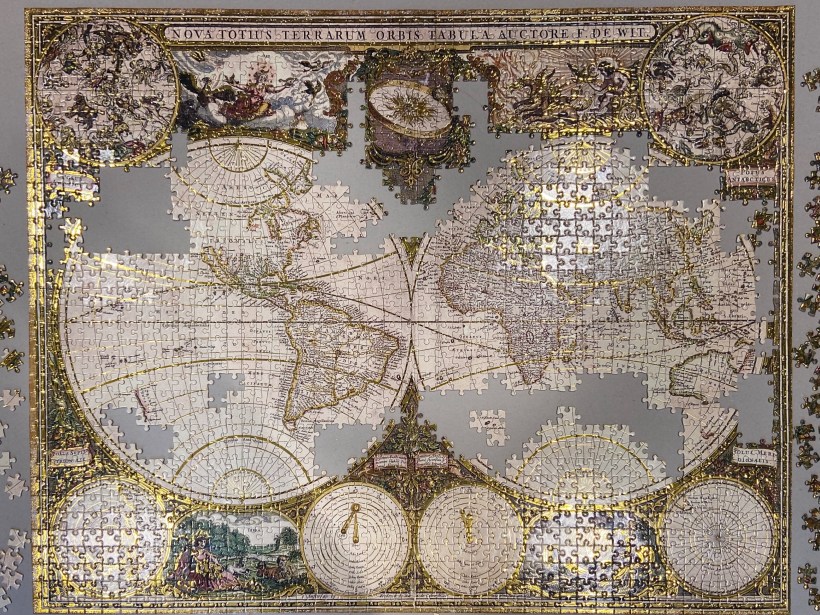
I’ve been working on a beautiful jigsaw puzzle over the past month. I chose it in honour of Helen, because she and I often did puzzles together. In fact, this was the first jigsaw puzzle I’ve done without Helen in probably twenty years. I also chose it for my dad, who would have loved both the map and the fact it was created by a Dutchman.
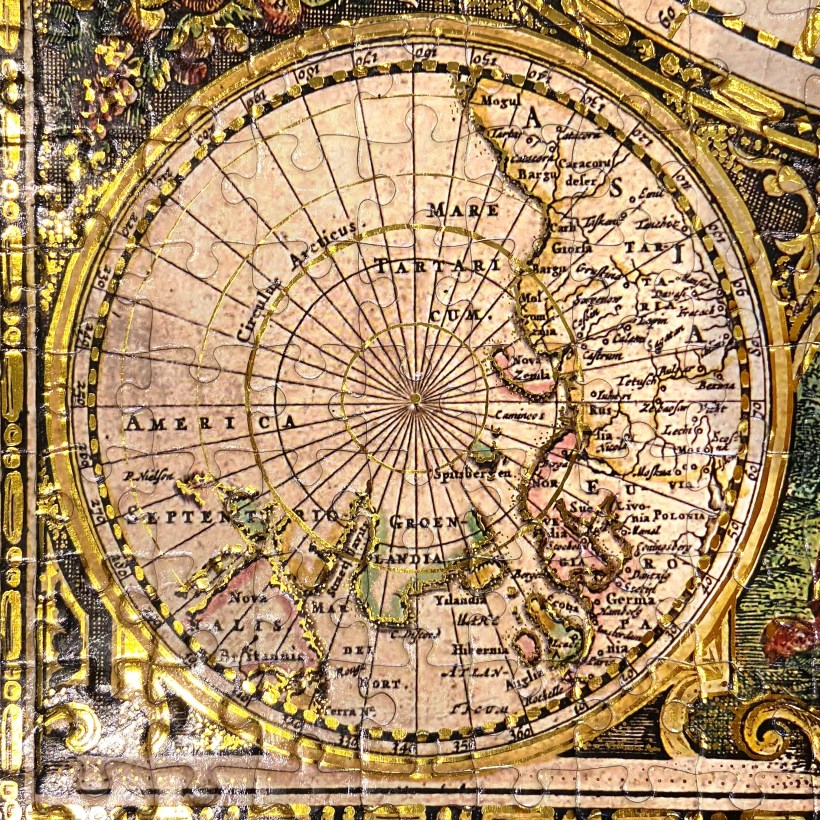
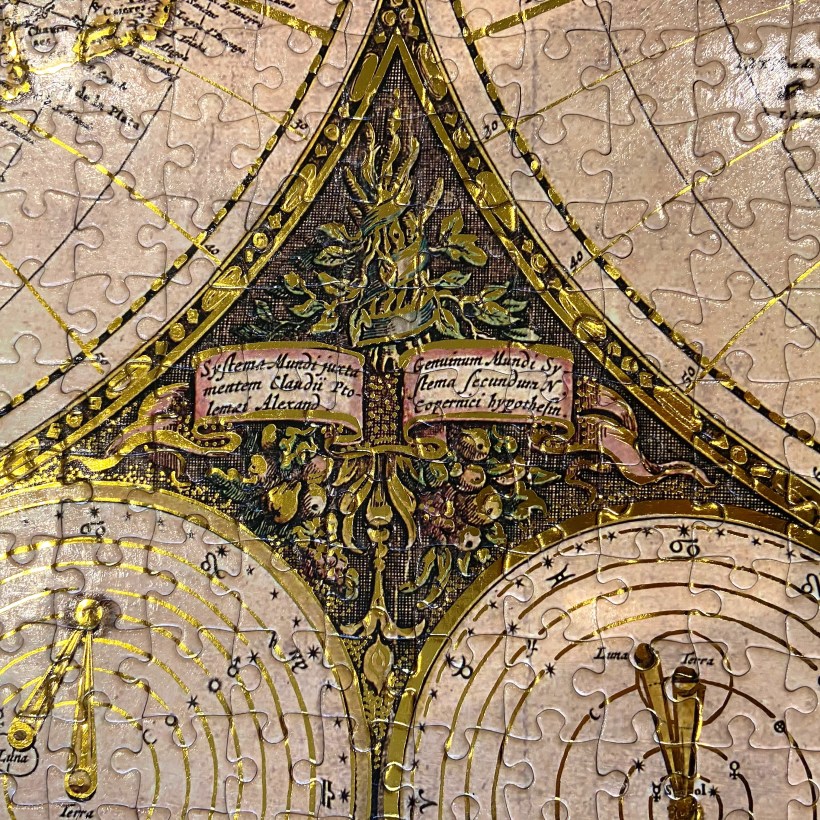
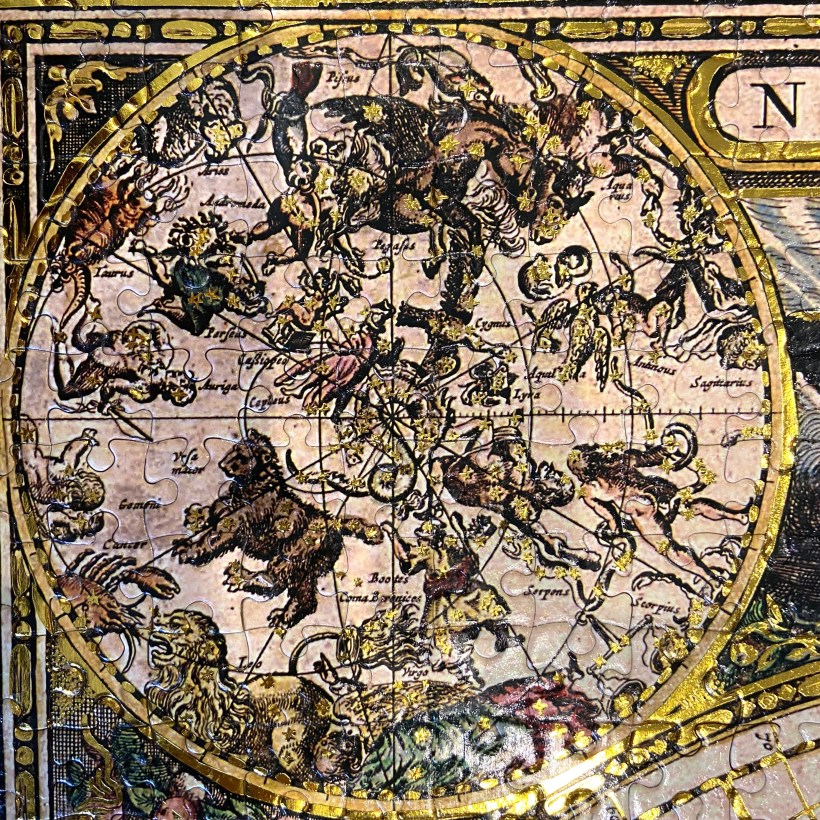
The image is an antique map of the known world, complete with solar systems and representations of the four elements; highlighted with gold embellishments. It was created by F. De Wit in Amsterdam in 1663, and the puzzle was produced by Hinkler Mindbogglers. Boy oh boy, did they get that branding right!
It really was a mind boggling challenge. Intricate lines, many pieces that still looked almost the same, and corner and edge pieces that were almost identical to one another made putting this puzzle together quite the labour of love.
Mind boggling, to say the least!
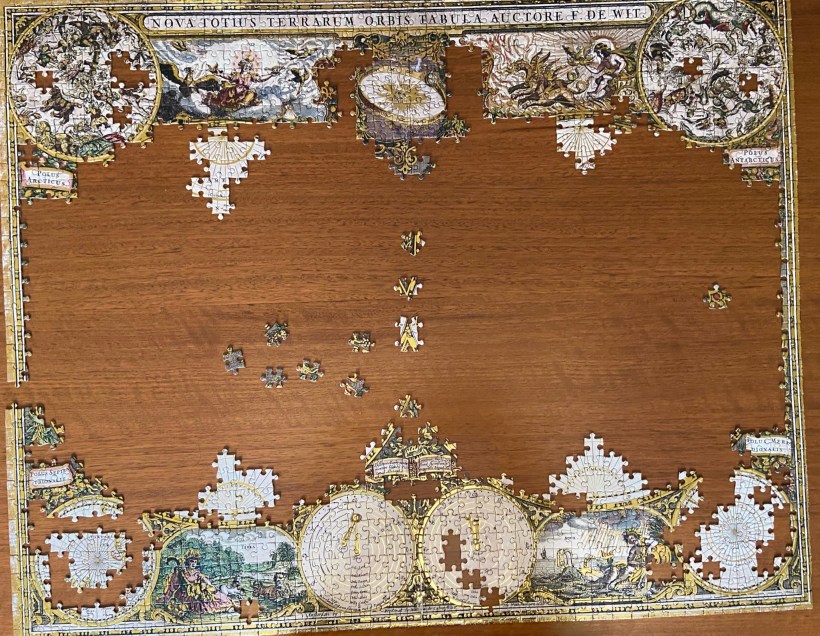
Piece by piece, though, it started to happen. It is no understatement to say that I felt a profound sense of achievement when I finished a section and could anticipate how beautiful the whole thing was going to look.
Piece by piece, it started to come together…
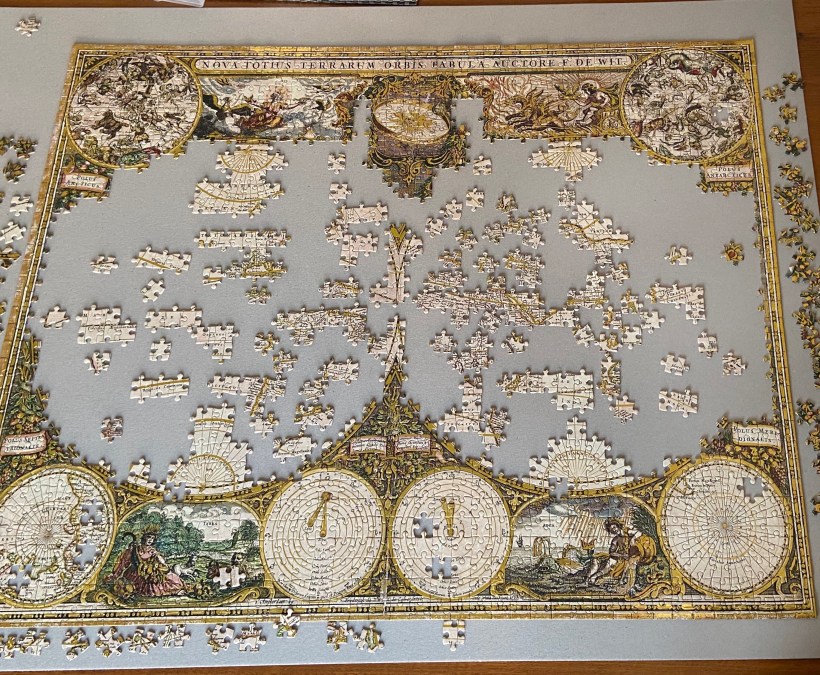
Doing the puzzle in honour of Helen and my father gave me purpose, but the concentration it required and the distraction from other things in life gave me a sense of mindfulness and peace that really helped me in my day to day life.
Almost there! But those last couple of hundred pieces were the hardest!
Dealing with my grief and managing tasks related to Dad’s estate were somewhat complicated by the challenges of teaching online again during Victoria’s second major Covid-19 lockdown, but working from home also gave me the space I needed to do those things and start to heal.
In many ways, that puzzle became an allegory for my own life. I was putting those pieces together too, seeing how things fit and getting an idea of how things would look. I too have intricate lines and a complex design that needs to be observed carefully in order to achieve the desired outcome. My life is full of pieces that fit together neatly, and it’s up to me to make sure I get that right.
So, while the puzzle on the table is complete, the puzzle that is me is still a work in progress.
A beautiful picture indeed!
Today marks thirteen weeks since my dad graduated to heaven. Thursday marks the same interval for Helen.
Three months seemed like an appropriate goal for completing the puzzle, and I feel a deep sense of satisfaction at having done so.
This week, I will make arrangements to have it framed.
When it is hanging on my wall, it will be a daily reminder that doing life well is a process, not an event. It will remind me that every piece matters. And it will remind me of my love for Dad and for Helen, of their love for me.
I am so blessed to have known and loved them both, and to have been loved by them. The pieces they contributed to the puzzle of my life have helped to make it a thing of beauty. For that, I am very, very thankful.
I know that as the pieces of life continue falling into place and fitting back together, my grief will remain present, but it will change. It will transform to become a part of the bigger picture, while keeping its own shape and character. In time, it will be differently painful, but the picture of my life would be incomplete with out it. In its place, fitting in with the pieces that represent joy, achievement, love, and hope, it adds its own detail, texture and embellishment to the canvas.
Last week I asked my students to do something creative.
Today, Student A wasn’t very impressed with the outcome of their efforts. “I tried, but it’s turned out a bit 2020.”
“It’s a bit what?” I asked.
“2020.”
Obviously, I was expected to understand.
“Mine’s pretty 2020 too, to be honest,” Student B admitted.
I looked at their faces on my screen. They were being serious.
“So…” I asked, “Are we using that as a swear word now?”
They’re right. It actually works.
“More meaningful than swearing, Miss,” said Student B.
The rest of the class concurred.
“And we can’t even get in trouble for saying it.” Student A grinned, clearly rather pleased with that reality.
I smiled, told them their work was way better than 2020, and moved the lesson on.
I don’t know if they just started doing that by themselves or picked it up from somewhere else, but at least they’re finding some practical use for 2020. I may just follow suit.
Today’s English class was the most fun I have had in a long time. I wanted to exercise the kids’ minds and get them thinking laterally. I also wanted them to enjoy it. A lesson with a difference seemed to me a great way to start our final week of term and inject some interest into our online classroom.
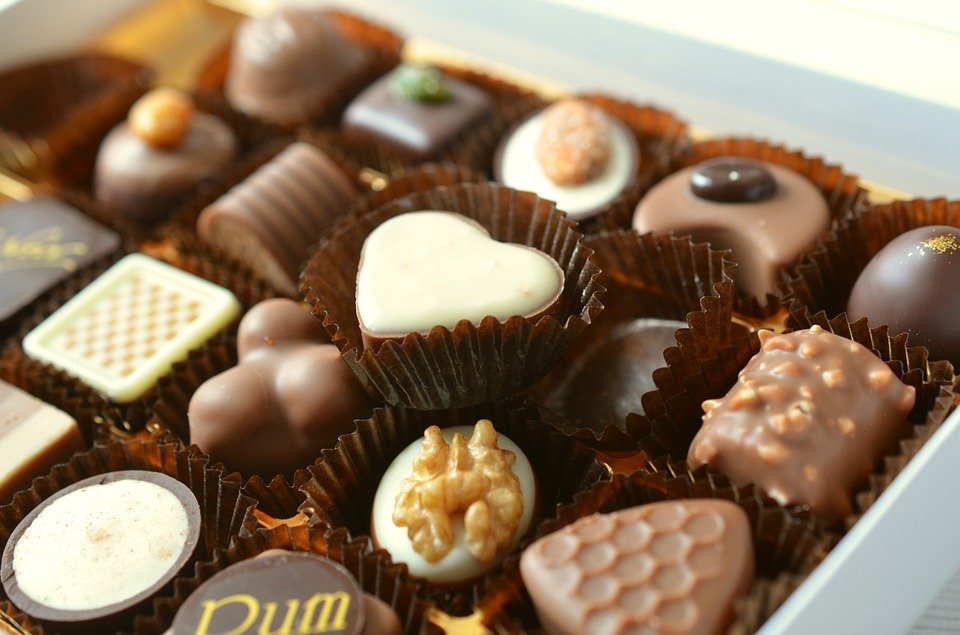
I began by presenting my students with the contention that a box of chocolates is a salad.
This was not a popular suggestion.
“No it’s not!” one student said… quite defensively, I might add. “Salad is salad. Chocolate is chocolate. You can’t ruin chocolate like that!”
But, I asked, what is a salad if it’s not simply a mixture of vegetables? Chocolate comes from beans… and if you add nuts, or fruit, or herbs like peppermint, then it’s definitely a salad.
We spent quite some time redefining food, presenting the most persuasive arguments we could think of, and debating the nature of reality.
Every time it sounded like the students might be in danger of reaching a consensus, I made another suggestion.
Ice cream, on its own, may just be ice cream – but the minute you put it in a cone, or add fruit or chocolate, it’s a salad. Coffee, like chocolate, is made from beans. It’s a salad.
“No!” was the response. “Coffee is hot – it can’t be a salad.”
So then I really twisted it up.
Is coffee soup? Is cereal soup? Or is it a salad with too much dressing? According to one student, and I quote, “Soup is not what soup is.”
Is the English language a metaphorical salad? Because it’s a mixture of a whole bunch of languages, right? The flavours are all mixed, but the parts are still recognisable if you know what you’re looking at.
Is the English language a sticky weed? Or velcro? Because you know, it takes something from every other language it swipes past. Maybe it’s double sided tape…
I am not ashamed to say that I really had fun. Despite their groans and protestations, I think they did, too.
Perhaps the most satisfying moments, though, were two comments made by different students:
“You’ve just entirely ruined the English language.”
and
“These have been the most problematic fifteen minutes of my life.”
What started out as a brain tease turned into a really interesting discussion about how we use language and define things in our own ways, and often assume that everyone else understands what we’re talking about, and that everyone else agrees with us.
It’s safe to say most of them enjoyed it… but it’s also safe to say that I enjoyed it more.
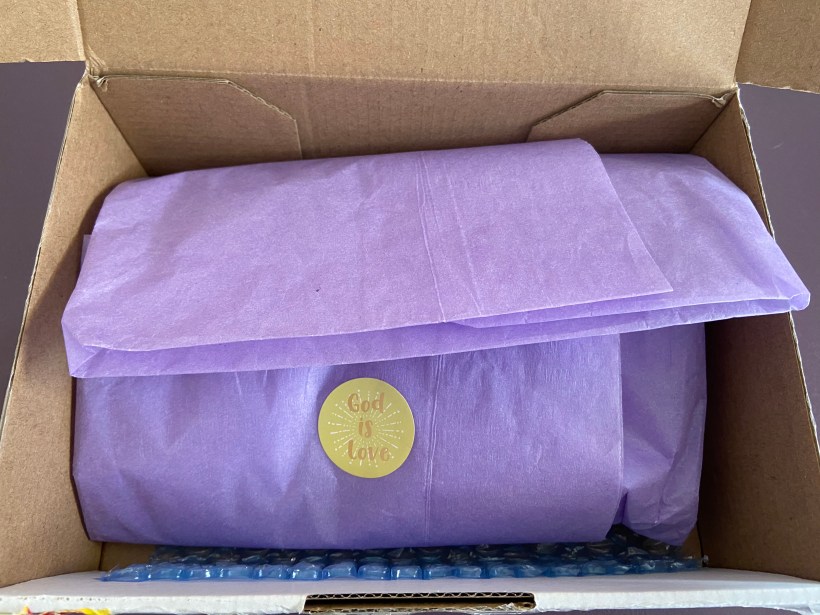
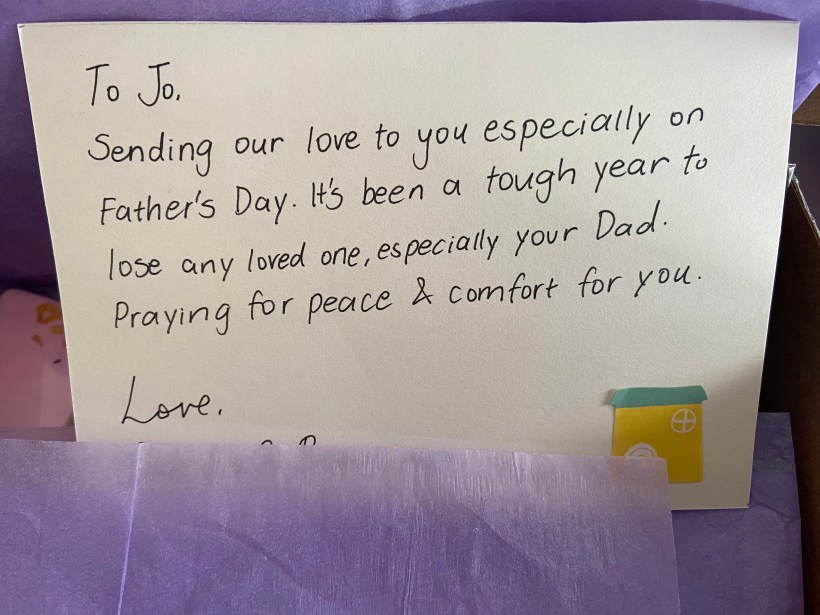
In that moment, I felt so cared for. I felt valued and understood.
What a blessing to receive such kindness. What an honour to know that a former student likes and respects me enough to do something so sweet and generous.
Highly recommended.
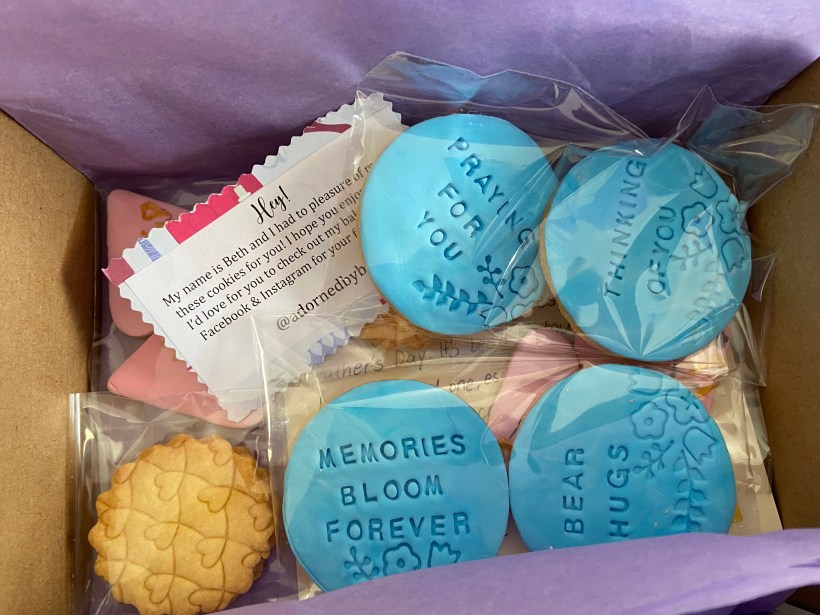
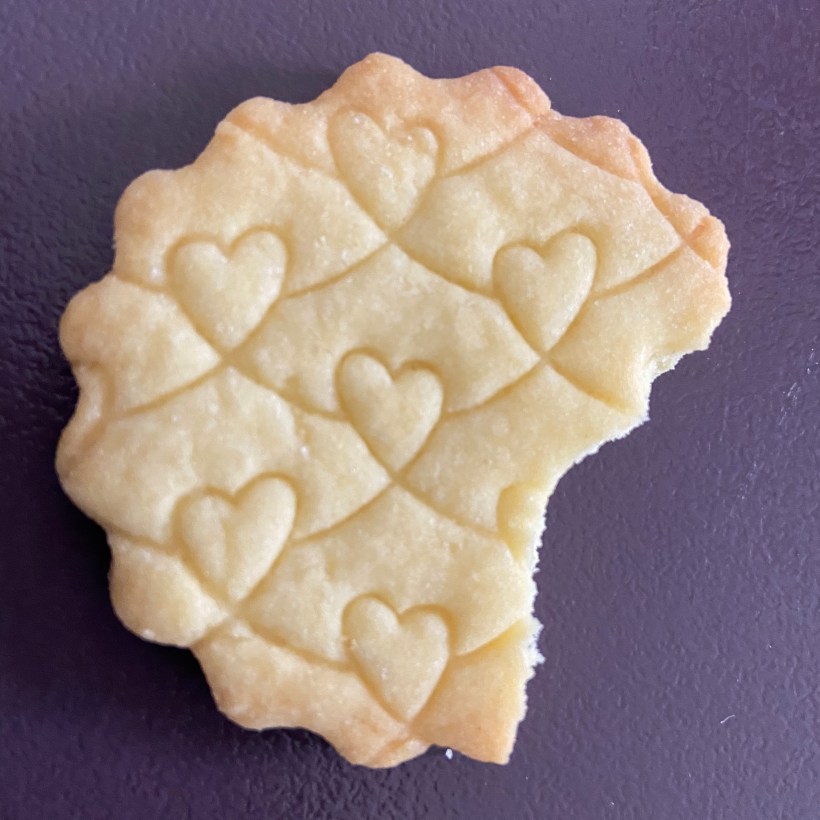
Finally, those cookies! They’re sensational – and almost too pretty to eat.


 WordyNerdBird