I mentioned in a post last week that I was anticipating the release of a new book, about which I am very excited.
The book is a medieval fantasy story called ‘A Rose By Any Other Name’ which draws on both ‘Romeo and Juliet’ and ‘Rapunzel’ as the starting points for this story before taking those narratives in a very different direction.
And so, without any further delay, let me reveal the beautiful cover, created for me by Renee Gauthier of RM Designs in Toronto, Canada.
The back cover is gorgeous, too.
It’s fair to say I am thrilled by the beauty of this cover art, and incredibly thankful to Renee for her fabulous work.
This story grew out of the inspiration from my author posse, the Indie Fabs. When one of them suggested that we write a fairy tale retelling anthology as a group, I was very nervous at first. I had never written anything like that. I didn’t know where to start, or how I might ever achieve that goal. I honestly thought I was going to let them down. Then one of them said, “Write what you know.” Well, I knew all the old fairy tales that I had grown up with. And I knew and loved Shakespeare. And in that moment, this story concept was born.
‘A Rose By Any Other Name’ took its place in that anthology, titled ‘Once Upon A Fabulous Time’ and published in 2017. It truly is an anthology unlike any other – far more than just a collection of our reinvented and often significantly transformed fairy tale stories, those stories were linked with one another by another separate, magical story that wove them all into one continuous narrative. Because it is such a very special book, it is still available in paperback, but no longer as an ebook. As a result, my story is back in my hands and free to be released as an individual title.
I am a person who takes others at face value. I don’t immediately classify someone as pretty or ugly, gay or straight, progressive or conservative (unless, either way, they are hateful or prejudiced – then the deal is off) , black or white or some other colour, blonde or brunette, or anything else. I don’t care if they’re plain or fancy, nor do I care if they’re pretty or not. I try to take each person as they are and let their integrity speak louder than their features. I like to get to know them before I make any decisions about them.
When it comes to fonts, however, i am nowhere near as open-minded. Don’t get me wrong – there are plenty of fonts I like, and many others that I will view with an open mind depending on context and purpose. But there ARE two or three fonts I really hate. I refuse to use them. I have handed back an assignment or two, asking for it to be reprinted in a more acceptable typeface. It’s true: I am Fontist.
I wasn’t raised that way. We didn’t really need to think about fonts back then. When I was growing up, it seemed as thought books were printed in two, maybe three different standard fonts. From memory, there was something like Times New Roman, a basic Sans Serif, and possibly another standard typewriter-style serif font. There was never a question of what typeface to submit our work in, because computers weren’t a thing and our school work was all handwritten. When I started university, assignments and essays had to be typed and double-spaced, so I used my parents’ typewriter. Of course, it only got to the typing stage when one or two hand-written drafts had been painstakingly written, proofread, edited, and revised.
Don’t get me wrong: I’m glad those days are over. I appreciate the ease of writing using my laptop as much as anyone else, and I’m happy for my students to do some – but not all – of their work on their devices. My underlying Fontism rears its ugly head, though, when someone hands in an assignment or broadcasts a presentation on the screen that screams “ridiculous font” louder than anything the student is trying to communicate. The same thing happens in meetings and seminars where the important information is obscured by the poor choice of font on the screen or handout.
You might think I’m overreacting. But consider this: I might read fifty student assignments in less than a week, or sit through twenty five student presentations in two or three days. When their font suggests I shouldn’t be taking their work seriously, that’s a complication neither they nor I need.
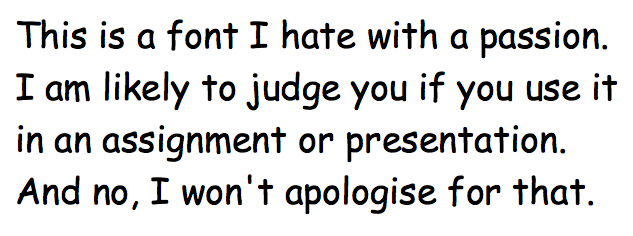
Right at the top of my hate list is Comic Sans. It looks childish, and gets increasingly ridiculous as the size increases, to the point where it is almost impossible for me to take anything printed in that font seriously. It is a font that should never be used for school work of any description by anyone older than six, nor should it be used for slide shows and presentations. Yes, it is “nice and clear for people to read”, but so are about 3000 other fonts one could choose. If your audience is not entirely in the First Grade, choose something else.
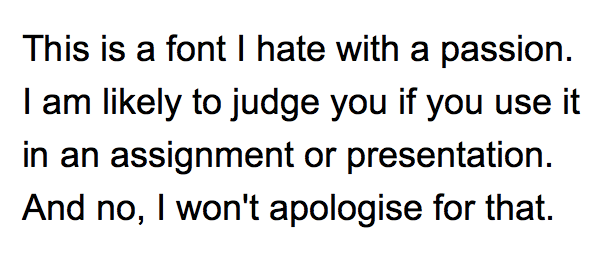
Another font I hate is Arial. Yes, it is also nice and clear for people to read. It is also entirely bland and unimaginative. Arial is the font equivalent of still having that original iPhone Marimba ring tone from 2008 on your new iPhoneX when you have 2500 different songs on your playlists. It is the font for lazy people who don’t care how their work looks. It doesn’t take much effort to switch so something equally clear but which looks a lot more polished and professional. In a word: boring.
The other fonts I really dislike fall into two groups: anything over-decorative and wrongly sized formatting.
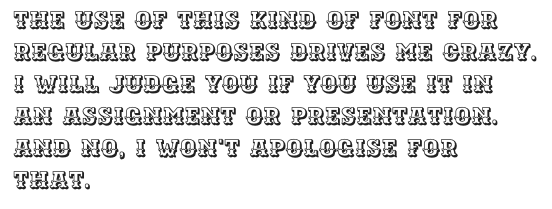
Over decorative fonts have their place, but trying to read a block of text printed in anything full of swirls and flourishes or trippy lines and shadows will make a teacher’s eyes bleed in less than three minutes. Decorative fonts can work really well for titles, or for a special capital letter or character to start a page or chapter, but they fail miserably for anything that needs to communicate information or arguments clearly and effectively.
In a similar vein, text printed too small or too large is equally frustrating. If it’s too small and condensed, it’s hard to read and… you guessed it, bleeding eyeballs. At the other end of the equation, students may think they can fool me into believing their 337words meets the 500 word minimum word count if their work is formatted in size 15 Helvetica, but my teacher brain knows better. My teacher brain has been doing this a lot longer than they have.
So, I guess this is me coming out of the classroom cupboard and acknowledging the ugliness of the deep-seated prejudice that lies deep within me. It is equally as rampant and undeniable as the grammar nerdism that I make no attempt to hide.
Call me fussy. Call me Fontist. I’m okay with that. But don’t call me to complain if I’ve asked your teen cherub to reprint an assignment so that I can read it without tears. Trust me – it’s better that way, and I’ve tried to be nice about it. Well, I’ve probably been nice..
Maybe.
Unless they are a repeat offender. In that case, there are no guarantees.
I have achieved a 118 day blogging streak. How’s that for a consistent effort?
I just wanted to say thank you for the encouragement to everyone who has motivated me by reading, responding, liking or commenting on my blog posts.
They seem like such small things to do, but they really are significant in the life of a blogger.
They help me know I’m not just typing into a void. They help me know I’m not alone in this big old bloggerverse. And it’s fair to say that they remind you of the same things.
Thank you for sharing the ride with me so far.
Stay tuned, folks. For my next trick, I plan to see how far I can make the streak last!
They say time seems to go by faster as you get older. Today, I have two questions in response to that premise:
Exactly how ancient am I?
How is it already June?
I don’t actually think it’s age that does it. I blame deadlines and responsibilities. They’re the things that put us under pressure, that make us work more than we play, and that stop us being all lackadaisy and carefree about how we spend our time like we were when we were kids.
Pressure put on us by employers. Pressure put on us by kids and families. Pressure put on us by ourselves. Pressure put on us by society to be perfect, to be leaders, to be models, to be lots and lots of things we feel we can’t be. We struggle to do it all, and the vortex of expectations and time pressure that is created by those pressures drags us into a cycle of racing against time and waking up every morning surprised that it’s already Wednesday, already June, already 2019.
Sure, I want to be a responsible adult. But I also want to be able to relax without feeling guilt. I want to be able to slow down sometimes, and drink my coffee without actually thinking about all the things the caffeine is going to help me to achieve within a given time frame. I want to be able to fill my day doing things I enjoy doing without having to rationalise or justify how I spend my time.
Those dratted deadlines and responsibilities keep me from doing those things. These days, you can’t even be deathly ill and stay in bed for two days without doing paperwork and announcing your impending demise on social media to account for your whereabouts.
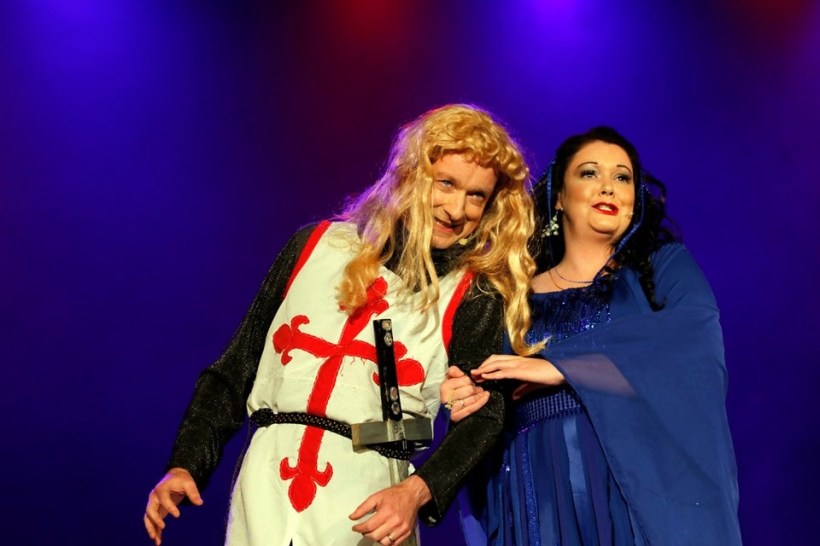
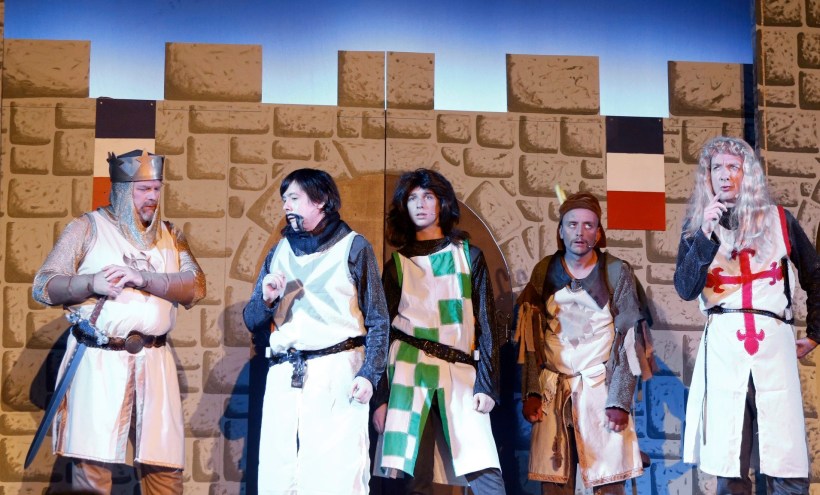
That was one of the many things I loved about being in Spamalot! last month. It was a responsibility and a demand on my time, for sure, but it was loads of fun, and being in rehearsal or on stage meant that I could say, “Sorry, not available” to everyone and everything else that wanted a slice of my time. Even better, I took on a role and left myself and those darned responsibilities behind for a few hours at a time. It was wonderful.
Another thing I loved doing in May was blogging about my favourite classic books. Yes, it was another commitment to doing something every day, but it gave me a daily opportunity for a few minutes where I could justify picking up a favourite book, leafing through it to reacquaint myself with it, spend some time reading, taking a photo of said book, and enjoying my not-so-secret life as an unapologetic book nerd. That, too, was wonderful.
June promises to be a busy month with auditions and casting for the school musical, grading exams and assessments, writing reports, and meeting a bunch of work deadlines that are looming. I shall put my plans together today for possible blog topics so that I can keep up my momentum here, and for images and ideas for Instagram posts, because I really enjoy those aspects of my author/blogger life.
June will also see the release of a new fantasy novella, which I am very excited about. Titled ‘A Rose By Any Other Name’, it was one of my stories included in the fairytale retelling anthology titled ‘Once Upon A Fabulous Time’, and which is now back in my hands for individual release, as that collection is now only available in paperback. I’m in the process of having a new cover designed for the story, and when that’s ready, it will be good to go! That’s the advantage of having a manuscript that is already thoroughly edited!
So, a busy but hopefully enjoyable month looms ahead, and no doubt it will fly past as fast as the months before it have done. All I can do is hang on and do my best… and maybe hope for a little downtime, too.
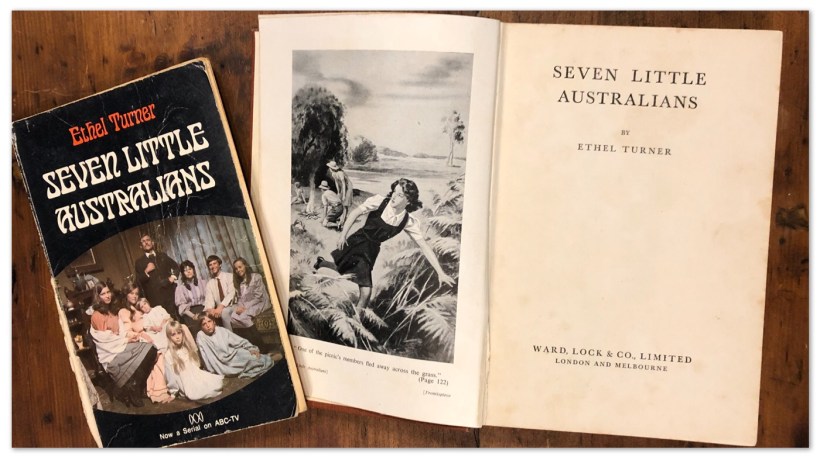
My copy of ‘Seven Little Australians’ is rather tattered and the worse for wear, a result of having been read many, many times.
This is an Australian classic that tells he story of the Woolcot family, and is set near Sydney in the late 19th century. The father was a gruff army captain, and his young wife was a sweet and kind stepmother to the children, most of whom were spirited and often mischievous.
The story is a lot of fun, but it also has some tragic moments. I remember reading the book for the first time when I was perhaps nine or ten. When my favourite character met a most untimely end, I put the book down and refused to read on. I couldn’t believe that an author would do such a thing!
It was only when I talked about it with my great Aunt Judy, who had given me the book, that I resumed reading. She sympathised with me, of course, but told me I really needed to finish the book to understand that the author had a message and a purpose in making that happen.
If Auntie Judy had told me to read it standing on my head, I probably would have done. I adored her. As the sister of my grandmother, whom I had never bet because she died before I was born, Judy was much older than me, but we had always had a close bond. We were great friends and she would always call me “her little girl”. We enjoyed each other’s company enormously, and we both loved books, She and her sister, my Auntie Enid, used to visit us regularly, and in school holidays or weekends, Mum and Dad would take us to visit them. Auntie Enid always brought me a pretty handkerchief as a gift, and Auntie Judy always gave me a book. On her next visit, we’d talk about the book and what we liked about it.
The funny thing was, until the day I told her I couldn’t finish reading this book, I didn’t know that she had been similarly affected for a while. I also discovered that her name wasn’t really Judy. Her given name was Anne, and my mother had been named for her, but she chose to start calling herself Judy because the character of that name had been her favourite in this book, and she had also adopted that name for herself— her real name was Helen.
So, this delightful book holds a lot of personally powerful memories and associations for me. Entirely apart from those, it’s a really good story that anyone who enjoyed Anne of Green Gables or The Adventures of Tom Sawyer would appreciate. It has a similar sense of fun and evokes an indulgent love for a naughty kid that is hard to resist. It also has a similarly sentimental tone about it, without being soppy at all.
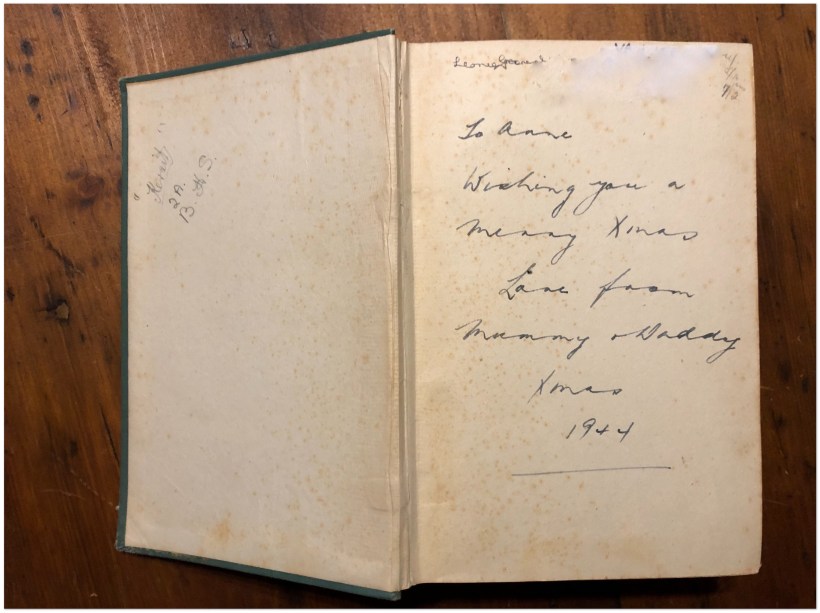
While my Auntie Judy is long gone, along with the rest of that generation of my family. I am very pleased that I still have this book and my memories. I also have my mother’s copy of two others in the series, given to her by her parents as gifts for her birthday and Christmas in 1944. I love looking at her handwriting inside the front cover, and feeling connected once again by our love of the same stories.
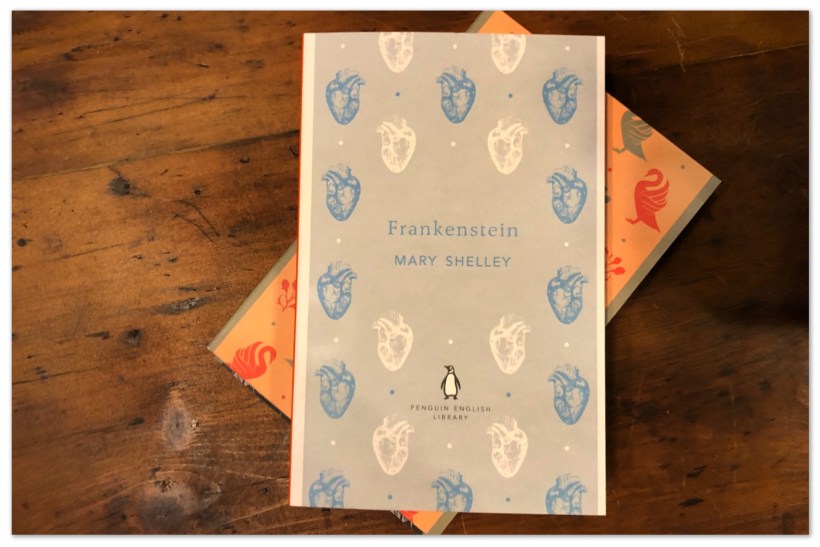
I should also confess that I have laughed at myself heartily while writing about the memories of my outrage at an author killing off a character because, now that I’m an author, I knock people off all the time. My readers don’t tend to be children, though, and in all fairness, the people who die in my horror stories generally deserve what’s coming to them. Given that Auntie Judy also gave me a copy of both Frankenstein and Dracula, and loved those stories, I am fairly sure she’d have enjoyed mine, too. My mother? Not so much.
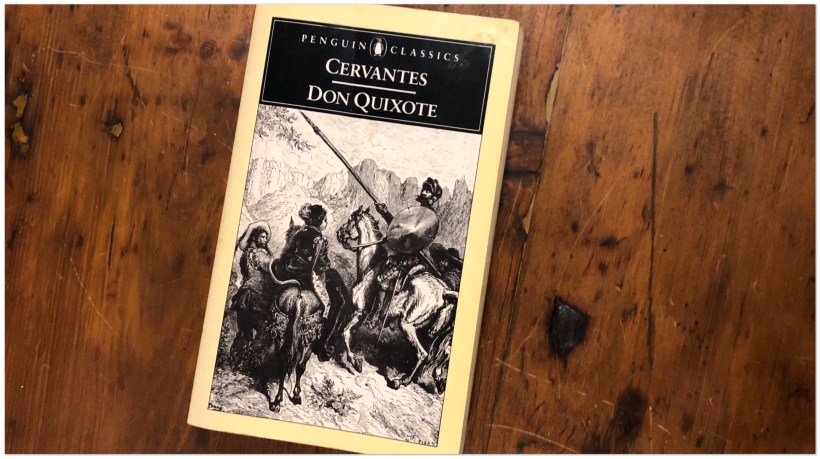
While Shakespeare was writing plays and fancy sonnets that made him incredibly famous, Miguel de Cervantes was sitting in a jail cell for getting his accounts wrong while working for the Spanish tax department, writing this work of comic genius that would bring him, too, worldwide fame.
As always, the comedic examines important issues and ideas in ways that no other form feels free to do. Think of medieval court jesters and today’s stand-up comedians – they make their mark on the world by saying things nobody else feels free to say and making people laugh at the same time. That’s exactly what Don Quixote does.
Don Quixote is a story about a man who is so obsessed with stories of chivalry, romance and adventure that he loses his mind and sets off on his own missions of derring-do and knightly behaviour. He is a man who cannot separate the imaginary from the real world, so in his version of reality, he rescues damsels, fights giants, and seeks to solve the problems and wrongs that beset the people he meets. Everyone else, including his own faithful sidekick Sancho Panza, thinks he’s nuts.
It’s a story that could be sad and pathetic, but it’s written with a strong sense of comedy and powerful wit that enable the reader to empathise with Don Quixote, who is a man living his dream in every sense of the word. There are some “Groundhog Day” elements, with some scenes being relived and reinvented long after the fact, which emphasises both the delusion and the intelligence of Don Quixote as the creator of his own reality.
As the story progresses, it poses an interesting dilemma: if you can’t actually do what you’d most like to do, and if your imagination can take you there and allow you to do it- is it crazy to pursue your dream, or madness to forego the pleasure?
It’s a fascinating and fun read that, like Shakespeare’s works, has inspired musicals, ballets, films, and countless other stories and novels in the 400+ years since its publication.
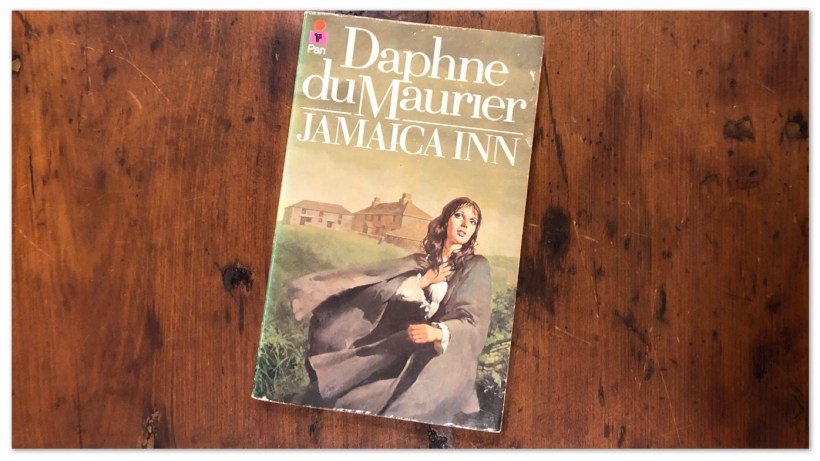
My copy of ‘Jamaica Inn’ was given to me by my sister-in-law for my 16th birthday. I don’t know if she remembers giving it to me, but I certainly do. I hadn’t read any of du Maurier’s books before, and I read it in a day. Given the tendency of many other favourite books to migrate from my shelves to those of other people, it is something of a miracle that the very same copy is still on my bookshelf.
Jamaica Inn is set in and around a Cornwall coaching inn in the early 1800s. It is a a dramatic and exciting story, full of mystery, intrigue, skullduggery and danger.
Having come to live at Jamaica Inn with her relatives, Mary Yellan, the heroine of the story, learns the hard way that she can’t trust anyone she thought she should be able to, and that life on the moors can be as bleak and coldhearted as the weather.
It is reminiscent of Bronte’s Withering Heights in both the setting, even though the location is vastly different, and the characters who populate it, giving the book a strong sense of the kind of Gothic literature that was written a century earlier. It’s sinister and rather creepy, laced with vivid detail and evocative writing that brings the characters and especially the settings to life.
While it is classified as Romantic Literature, this book should not be mistaken for a romance – the two are very different things. In fact, it’s more of an anti-romance, showing men to be ignorant and selfish, some violent and others just rather stupid. It’s not about female vanity, but rather about the vulnerability of women living at a time when they were entirely dependent on their men to provide for and protect them. The contrasts between integrity and deceit, and between love and selfishness, are powerful, adding depth and drama to the compelling storyline.
The thing I love most, though, is the writing: du Maurier’s craftsmanship is magnificent. That in itself makes her books well worth reading.
P.S. I am excited that I actually got to use the word ‘skullduggery’ in a post, as it’s one of the most delightful words, yet one so rarely gets a chance to use it well. I really am a word nerd.
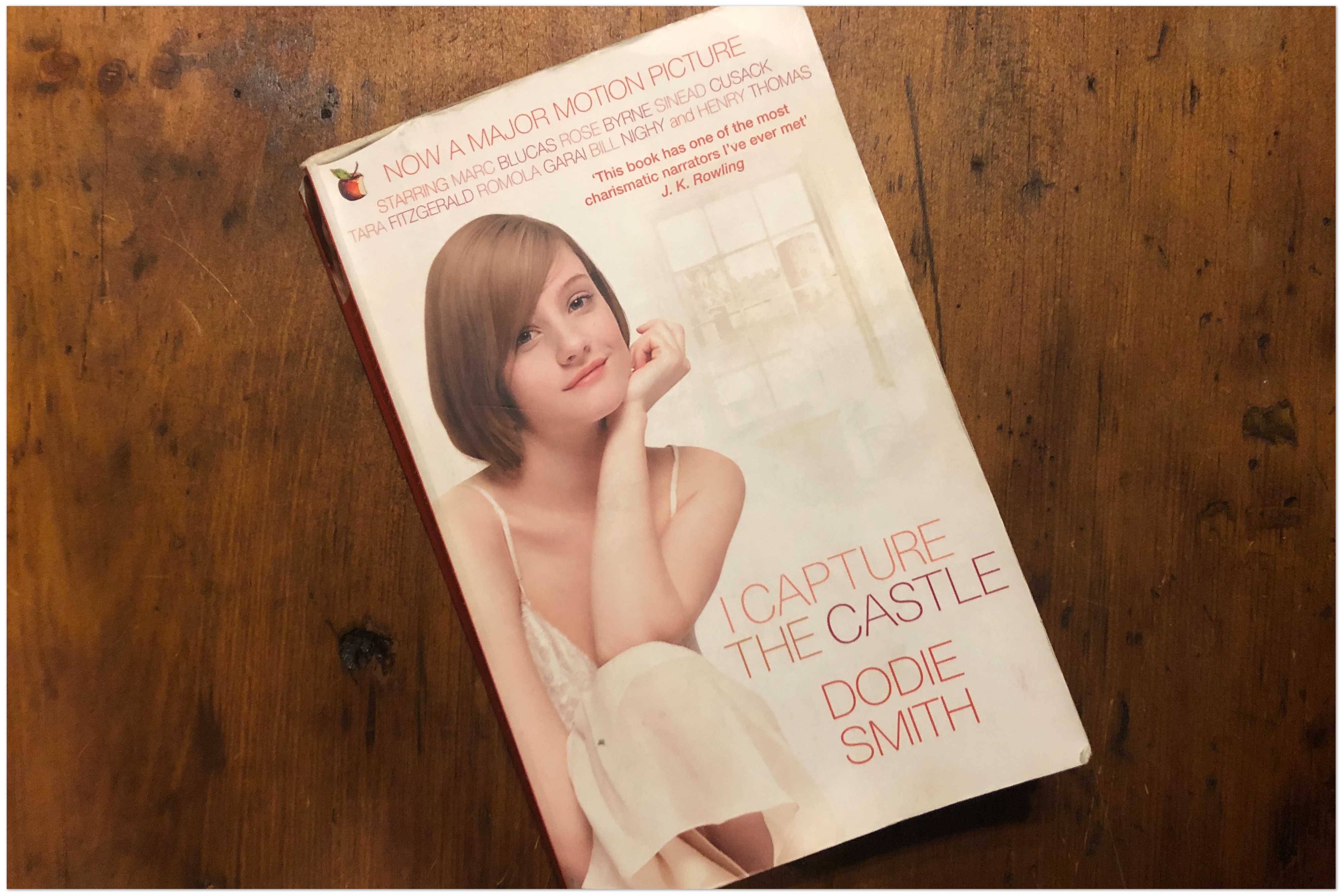
Dodie Smith is best known as the author of ‘101Dalmatians’, but I much prefer this beautifully sentimental and highly engaging book.
Set in 1930s England, the story of the Mortmain family is told by Cassandra, who begins her narrative with one of my most-favourite-ever opening lines:
“I write this sitting in the kitchen sink. That is, my feet are in it. The rest of me is on the draining board, which I have padded with our dog’s blanket and the tea-cosy.”
Another feature of this book that I really enjoy is Cassandra’s frequent references to books and plays she has read and enjoyed. In that sense, she is the literary forerunner of Rory Gilmore, the booknerdy lead character in the TV show Gilmore Girls. Other characters, too, make scattered literary references throughout the book.
It does frustrate me that the only copy I have on my shelf is one with a movie-based cover image— I generally avoid those, but this is my last remaining copy, which I picked up in my favourite book rescue shelter upon discovering that my other copies had disapeared. It was their last copy, too. Like The Scarlet Pimpernel, this is a book that has migrated from my shelf to those of family and friends on multiple occasions.
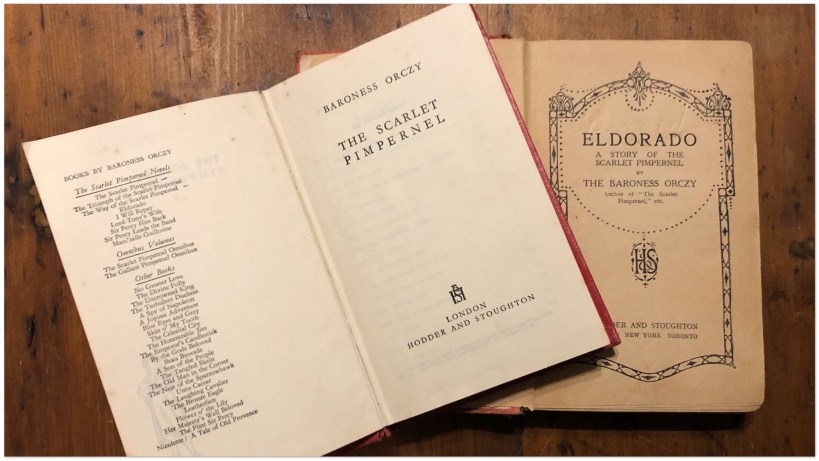
I looked for my paperback copy of ‘The Scarlet Pimpernel’ last night in order to include it in the image for this post. It wasn’t there. Again.
So, I slipped in my vintage copy of Eldorado, another book in the same series, because it does have a really beautiful title page.
I can’t tell you how many times I have bought ‘The Scarlet Pimpernel’ in paperback. It just keeps disappearing— which means a good number of my friends and family members probably have it on their shelves. I hope they’ve read it, because if they haven’t, they’re missing out.
It’s a mystery adventure story about an unidentified Englishman who helps French aristocrats escape France, and therefore the guillotine, during the ‘Reign Of Terror’ after the French Revolution. Of course, there’s only one thing the French want more than to chop off the heads off the rich and powerful, and that’s to chop off the Scarlet Pimpernel’s Head, so maintaining the mystery of his identity is definitely in his interests.
It’s a great read for lovers of Historical Fiction, but there’s also enough mystery, romance and adventure for readers of those genres to enjoy, too.
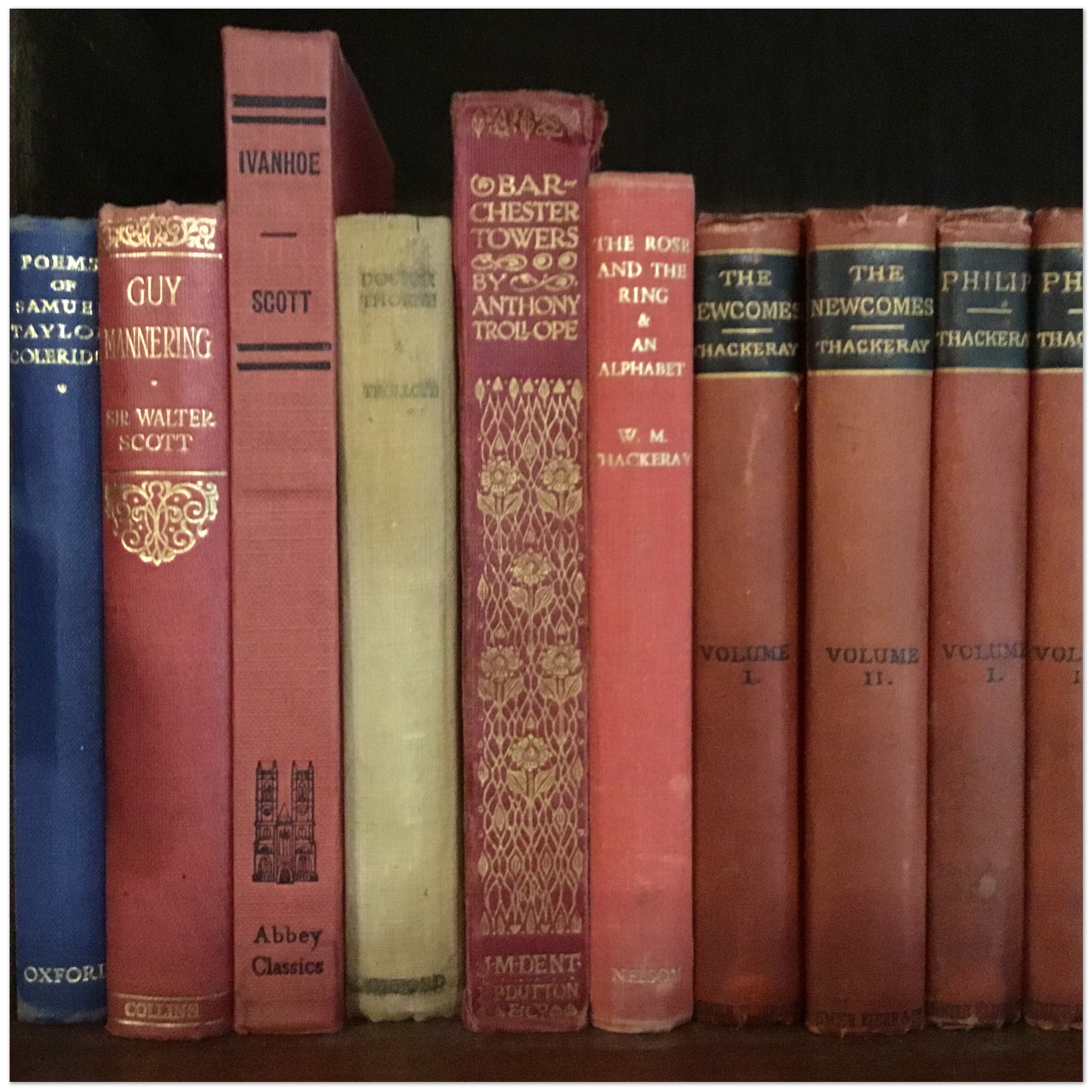
Anthony Trollope has quite a few novels to his name, of which I have enjoyed most, but ‘Barchester Towers’ is the pick of the bunch. If you are only ever going to read one of his works, choose this one.
While Dickens was writing novels that exposed the social issues and injustices of his time, Trollope was doing the same thing in a slightly different way. Trollope’s ‘Chronicles of Barsetshire’ turned the readers’ attention to the structures and conventions of the church hierarchy in Victorian England, framing clerical life in a comedic way that highlighted the hypocrisy and manipulation that plagued the upper ranks of the church. His Palliser Novels series focuses on political life and the machinations of Parliament and government, once again with a good degree of satire and cynicism.
Trollope’s characterisation is every bit as clever and masterful as Dickens’, and the humour with which he wrote is just as engaging. I find it most disappointing that Trollope is not as widely read or renowned as Dickens. The reason for that lies in the fact that Dickens’ books made him the champion of the lower classes, giving him very widespread appeal and ensuring a loyal readership, while Trollope tended to write more about the challenges faced by the middle and upper classes as society changed. Those issues were just as real, but far less relatable and interesting to the masses.
‘Barchester Towers’ is a gem of a book. It’s quite easy to read, and very entertaining. While The Guardian listed it as one of the ‘1000 Novels Everyone Must Read’, it is much higher on my own list, hence its inclusion among the novels featured on this blog as one of my top 25 classic novels.







 WordyNerdBird