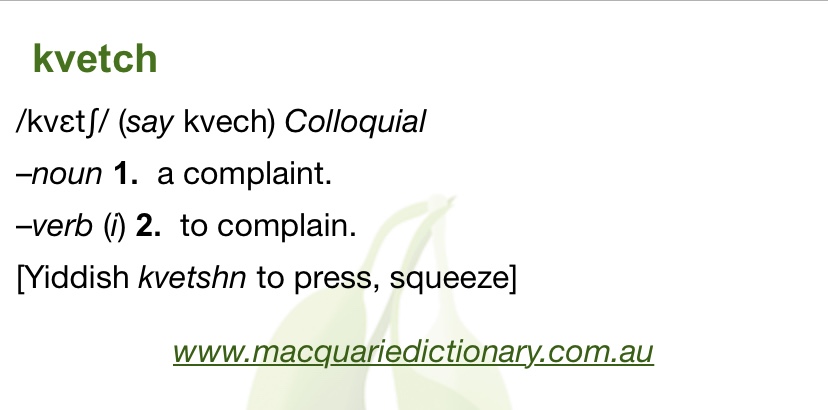
As Victoria enters a five day lockdown designed to halt the spread of that dratted virus after its recent escape from a quarantine hotel, there’s a lot of kvetching going on.
Yes, it’s our third lockdown. Yes, we all saw this coming when the Australian Open was allowed to go ahead. Naturally, we’d all rather not. We’d all like to be able to do whatever we want to do. I know it’s inconvenient. I had to cancel my plans, too.
Still, there is nothing to be achieved by blaming anyone. Contrary to what some people like to say, our state government is not a dictatorship. They’re doing their best to manage a pandemic, balancing the health of the community with what millions of individuals perceive as their rights and needs.
The fact is, this virus is highly contagious, airborne and invisible. The pandemic is not yet over, and these things are going to happen from time to time. It may actually be a fact of life for the foreseeable future, even when we are careful about wearing masks, social distancing and sanitising everything. One of the fundamental truths of a pandemic disease is that it is not easily controlled: that’s how it became a pandemic in the first place. At best, it can be well managed.
At least it’s only five days this time, not months like the last one.
Even so, I have lost count of how many times I have felt the need to tell people to stop kvetching about it in the last 24 hours.
Kvetch is a wonderful word, donated to English from Yiddish in the mid-20th century. It is as satisfying to say as ‘bitch’ with far less possibility of offending anyone, and it is so much more expressive than other synonyms such as ‘whine’, ‘complain’ or ‘moan’.
Perhaps the only synonym that is as expressive is the one that my grandfather used when we were kids: “Stop your bellyaching,” I haven’t thought about that expression in decades, and it has just come back to me riding on a wave of memory and emotion. I think I’ll have to start saying that now, too.
Because the weekend was difficult, I stayed home from work on Monday, which was the third day after the procedure. I returned to school on Tuesday, and after spending most of the day on my feet, I was absolutely exhausted by the end of it. An early dinner and spending the evening lying down was a good strategy, as it gave relief to both my lower back and everything else that was hurting.
The injection site was progressively less tender as the week wore on, so was able to lie down and sleep on my back. As the steroids started to do their thing, I began to experience a lot less sciatic pain. I continued to have the consistent pain related to my fibromyalgia, but at least my butt and legs were no longer on fire.
That I began to see improvement on Monday and Tuesday was right on schedule for the time frame the doctor gave me – the injections would start working in 2-3 days and build up effect over the next couple of weeks. So far so good. Now, we wait to see how long that lasts.
The ESI hasn’t made any difference to my lower back pain – that’s not what the treatment was meant to do – but having the sciatic pain diminished makes a huge difference. I know how to manage my lower back and fibromyalgia pain. I can lie down comfortably for rest and sleep – and what a blessing that is!
The one-week verdict is positive. Despite the initial pain and discomfort, the procedure appears to have done what it was intended to do. If the sciatic pain returns, I’ll definitely have the treatment again.
Epidural Spinal Injection: One Week Later #spinalhealth #BackPain
I wrote yesterday about waiting to receive a CT guided epidural spinal injection to treat the constant lower lumbar and sciatic pain I have been suffering due to further degeneration of the disks on my spine.
Actually, I do try really hard not to walk like that …
I am sincerely touched and thankful for every message of support and encouragement that I have received since publishing that post.
In the light of the fact that there are some good medical sites available but relatively few “this is what it was like for me” posts to be found, this post is intended to address that imbalance.
When I got to the treatment room, I was provided a hospital gown and asked to change. I was able to leave my underwear on, so I wasn’t completely exposed.
I was then invited to lie face down/on my stomach on the Ct scanner table. The nurse and radiologist helped me to get as comfortable as I could, reminding me that I wouldn’t be able to move during the scans and injections.
Once I was settled, they did some test scans to give the doctor initial images to work with.
When the doctor came in and introductions were done, he proceeded to wash my lower back with iodine and prepare the injection site.
That was all completely fine until we got to the initial local anaesthetics. Knowing I couldn’t move, I gritted my teeth and made some indiscriminate grungy noises that communicated more than “ouch”.
Then came the insertion, at a precise location in my lower back, of the needle and cannula for the delivery of the rest of the injections.
“Just a scratch now,” said the doctor.
In response, I laid very still but made more ugly noises.
“How is that?” he asked me.
Showing significant restraint, I responded with “I’m not sure what scratches you, but it’s very different than anything that usually scratches me.”
He didn’t say anything, but the nurse and radiologist laughed at that, which I found rather satisfying: I may be lying prone and vulnerable while a very clever person with a tendency toward understatement sticks sharp, pointy things into my spine, but I’m still hilarious.
The radiologist scanned my back again to make sure the needle and cannula were in the right place, and the doctor proceeded to administer the prescribed anaesthetic and steroids.
In the course of the procedure, counting anaesthetics and steroids, the doctor made multiple injections . It wasn’t unbearable but it definitely wasn’t painless. I wouldn’t have wanted it to happen without the local anaesthetics, but I could still feel the injections.
After the procedure, I had to lie down with my upper body elevated for about 90 minutes before being declared able to go home.
The advice given to me before being allowed to leave was as follows:
Do not lie flat for 12 hours as nobody wants the anaesthetic heading north instead of south, which could cause significant complications.
When the local anaesthetics wear off, I would probably not feel both my original pain and some pain around the injection site. .
The injection usually takes 2-3 days to start taking effect. Full effect is generally reached after 10 days to 2weeks.
Rest for a couple of days to give things the best chance of healing.
The injection deals with the symptoms, not the actual degeneration in my back. I will still have the same limitations as before, but hopefully with a lot less pain.
I came home feeling quite tender and a bit jelly-legs, which I am told is normal.
I spent the afternoon and evening in my recliner with my feet up, changing the angle of the chair every now and then. I made sure I drank plenty of water, and that I got up regularly for necessary short walks.
I have experienced an increase in my fibromyalgia pain — which is a different kind of pain altogether from my back and sciatic pain, so it is easily distinguishable. Such pain flares are totally standard whenever my body experience stress or trauma. It’s fair to say that’s not helpful in the sleep department m, either.
Twelve hours later, the injection site is fairly painful , so lying on my back and trying to sleep isn’t much of an option right now. Some bruising is coming out, but I haven’t had any bleeding from the injection site. There is no significant swelling, redness or heat in the area, so I am assuming this is just par for the course and not anything I need to follow up.
It was a great relief to get into bed and lie down, albeit with an extra pillow, but even with my usual pain medication, sleep seems unlikely at this point. Not only am I a rubbish sleeper at the best of times, I have to lie on my back to sleep — I can’t ever sleep on my side or stomach because it’s just too uncomfortable for my back. So, 2.43am seemed like an opportune time to write an update post.
I am really hoping that I do see some improvement over the next couple of days, and that some consistent relief from pain is imminent,
I am writing this while waiting for today’s instalment of treatment on my problematic lower back and spine.
An accurate representation of my life.
I’ve been having increasingly constant and aggressive pain in my back and sciatic pain in both my legs over recent months. I cannot sit, stand, or lie down without pain, which is both affecting everything I do and depriving me of sleep.
My neurosurgeon has prescribed an epidural injection of steroids into my back, done under CT scan guidance.
I know it is a treatment a lot of people have, but that doesn’t stop me feeling anxious about it. I am looking forward to the respite from constant pain, but it’s not a process I am looking forward to.
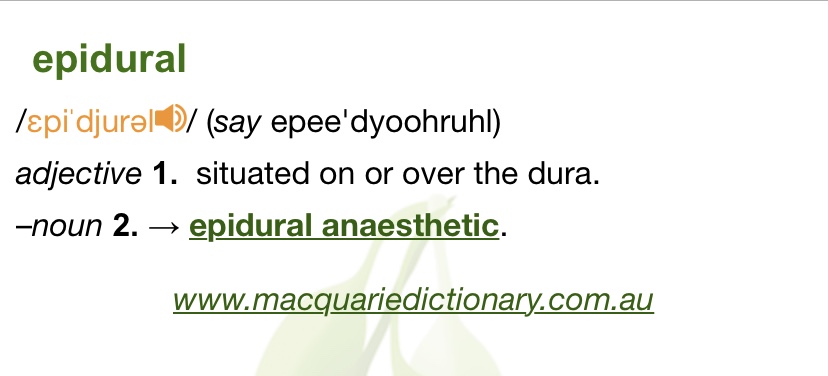
So, I am filling in the time by wondering about the meaning and origin of the word ‘epidural’. It’s a frequently used word in relation to one of the kinds of anaesthetic used during childbirth, and people generally understand that is blocks pain from the waist down, but that is not my circumstance. I’m definitely not giving birth today!
The Macquarie Dictionary definition, while accurate, was not entirely helpful.
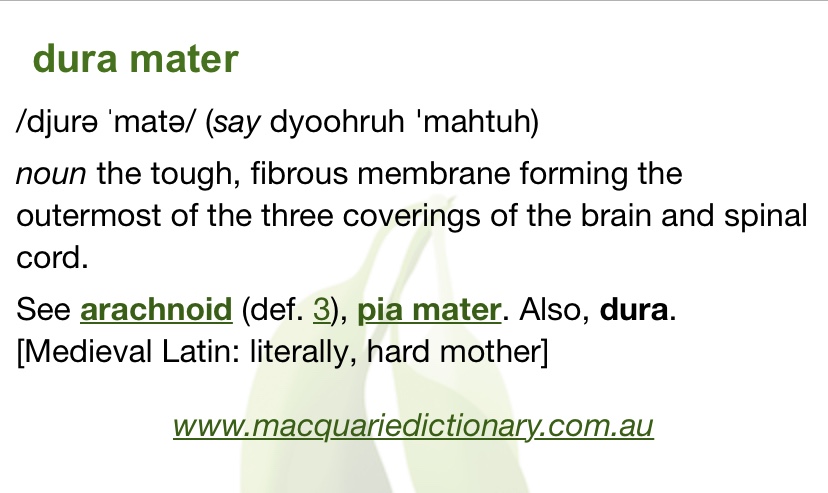
Having looked up ’epidural’, I then had to look up ‘dura’. Just like that, I’m already learning things I didn’t know.
So, I can deduce that I am having an injection through the tough outer lining of my spinal cord.
To be honest, this research isn’t really reassuring me about the procedure at all.
According to Etymonline, the prefix epi- means on or above, and came into English from Greek. The term dura mater dates back to about 1400 AD, coming from the Medieval Latin ‘dura mater cerebri’ which translates to “hard mother of the brain,” a term which was borrowed from the Arabic ‘umm al-dimagh as-safiqa’, which means “thick mother of the brain.”
And so I wait, informed and still apprehensive of what is to come.
All I can say is I really, really hope this works.
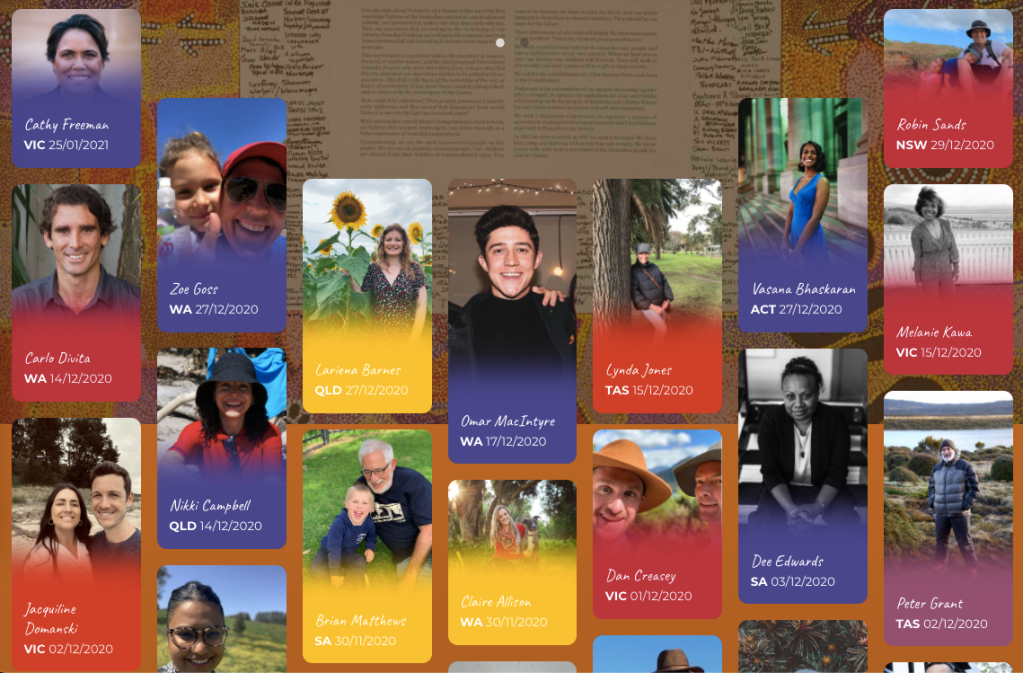
I make this public declaration in addition to signing my name on the signature wall:
I stand with the First Nations people of Australia as an ally and an advocate for voice, for Treaty, and for truth.
I will continue to teach Australian history with honesty and with empathy for the experiences of the Indigenous people. I will encourage others to listen and understand .
I will continue to seek an end to racism, division and inequality.
I will continue to work for reconciliation, friendship, and harmony. I will continue to speak for increased representation and constitutional recognition.
There’s a lot of controversy about celebrating Australia Day on January 26, and with good reason.
Some Aussies — in all honesty, mostly white ones – argue that there is nothing wrong with celebrating our country on that day as we do.
They would most likely be quite surprised to know that Australia Day wasn’t celebrated nationally until 1935: it’s not something we’ve been doing since 1788. Even more surprising would be the fact that it’s only been a public holiday since 1994 – not even thirty years.
A growing number of Aussies feel conflicted about the date. They are coming to understand that, as it is, it is a celebration that causes grief and hurt to the Indigenous and Torres Strait Islander people of Australia. For them, it is ‘Invasion Day’ or ‘Day of Mourning’, which is a very fair call.
January 26 marks the anniversary of the date in 1788 when the First Fleet sailed into Sydney Harbour, set up camp, and began the first British colony in Australia. It is impossible to condense the history of the nation since then into just one sentence, but it’s fair to say that the story is characterised by dispossession, racism, violence, massacre and oppression toward the Indigenous people of the country. That is why celebrating that date is so offensive to them. Anyone who doesn’t understand that is either a. extremely white privileged, b. not trying hard enough or c. both.
It is common understanding that if one is doing something that hurt someone else, and if it is in that person’s power to stop, I should stop doing it. Even if there is an apology, the only way to prove the apology means anything at all is to refrain from doing it again. The only way to heal a damaged relationship is to change one’s ways. This is as true on a national level as it is for an individual.
There is no reason why we can’t change the date for celebrating our nation. There’s a lot to celebrate, but we can also do much better than we have in the past.
Some people suggest that we should celebrate Australia Day on January 1st – the anniversary of Federation. It’s a good idea, despite the complaints that people will be hung over from New Year’s Eve parties the night before. That’s a choice for each individual to make – but wouldn’t less drunkenness be a good thing anyway?
Alternatively, I suggest that the Australian government should commit to and sign a Treaty with the Indigenous people, as they have been pleading for the government to do for years. This Treaty, made in collaboration with Indigenous people, would acknowledge the past, shape the future, and enable us to move on together in a spirit of reconciliation and healing.
The date on which that Treaty was established and signed should be the new date for Australia Day. We could even call it Treaty Day, or Australian Treaty Day, to put the focus on the relationship instead of the painful memories of the past.
I’m not Indigenous, and I do not pretend to share their experiences or speak for anyone else.
I am, however, a History teacher who seeks to teach Australian history with empathy and awareness of the experiences of Australia’s First Nations people, and to encourage my students to understand that our nation’s story began long before 1788. I am an Australian who loves my country, but also one who is deeply sorry for the suffering of the Indigenous people, past and present.
As such, I cannot help but think that either one of those two ideas would have to be better than what we have now.
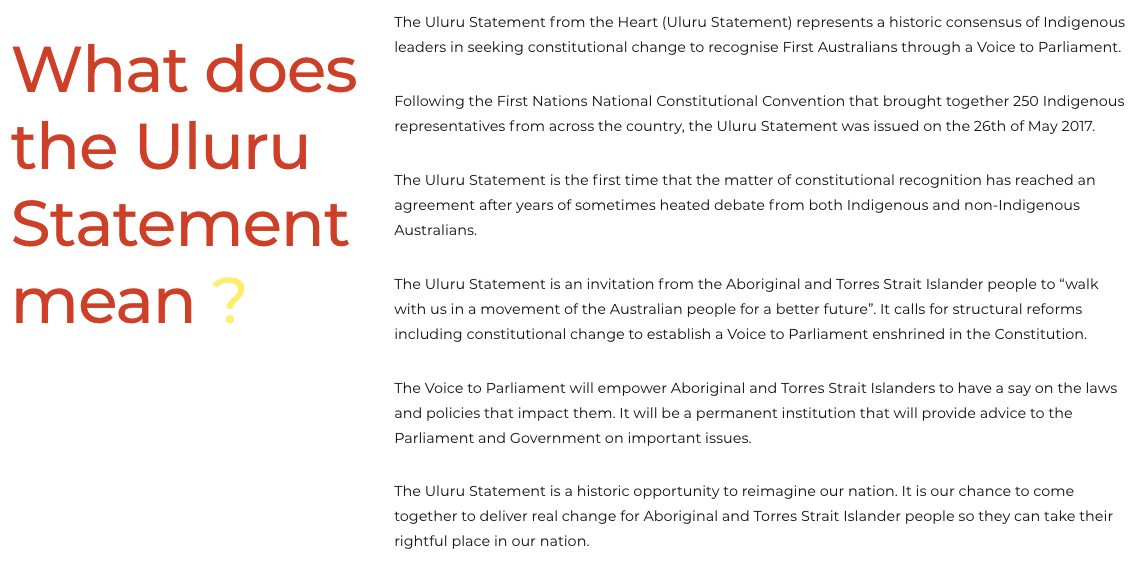
I will not be attending or watching any Australia Day celebrations tomorrow. Instead, I intend to mark the day by signing the Uluru Statement From The Heart, which is a call to Australians to rally together to achieve constitutional recognition for our First Nations peoples and to establish an Indigenous voice to Parliament.
Today, for reasons of my own that do not need to be shared publicly, this song is playing in my head.
Screenshot: The Chicks — Not Ready To Make Nice
Don’t get me wrong: I firmly believe in forgiveness. Even if the other person never knows I have forgiven them, it’s important for myself spiritually and emotionally to move on from carrying that burden.
That does not always mean I can trust them again.
Contrary to what the platitudes say, time does not heal all wounds and forgiveness does not erase the memory.
It is also important, both spiritually and emotionally, that I protect myself and those I love from harm. If that means not giving someone the means to damage me or my family again, then that is what I must do.
I can be civil without letting a toxic person into my life or my home. Those barriers are not coming down.
I can let others have a friendship or relationship with that person if they are determined to do so, but if I see that they are in danger of experiencing significant harm, I will speak up or stand between them if I must.
I know that many of my Christian friends and family would say that my forgiveness is incomplete. They might suggest I am not showing love.
I would argue that sometimes the kindest and forgiving thing you can do for a person is to stay right away from them. I would also argue that neither God nor the nature of forgiveness itself demands that one must become a doormat or a willing receptor of someone else’s malignity.
There are a handful of people about whom I have made that decision over the course of my life, and I am confident that in each situation, slamming that door firmly and permanently shut is the best thing I could have chosen to do about it.
Sometimes, you just have to leave certain people behind and move on.
Not Ready To Make Nice #forgiveness #selfcare #Boundaries
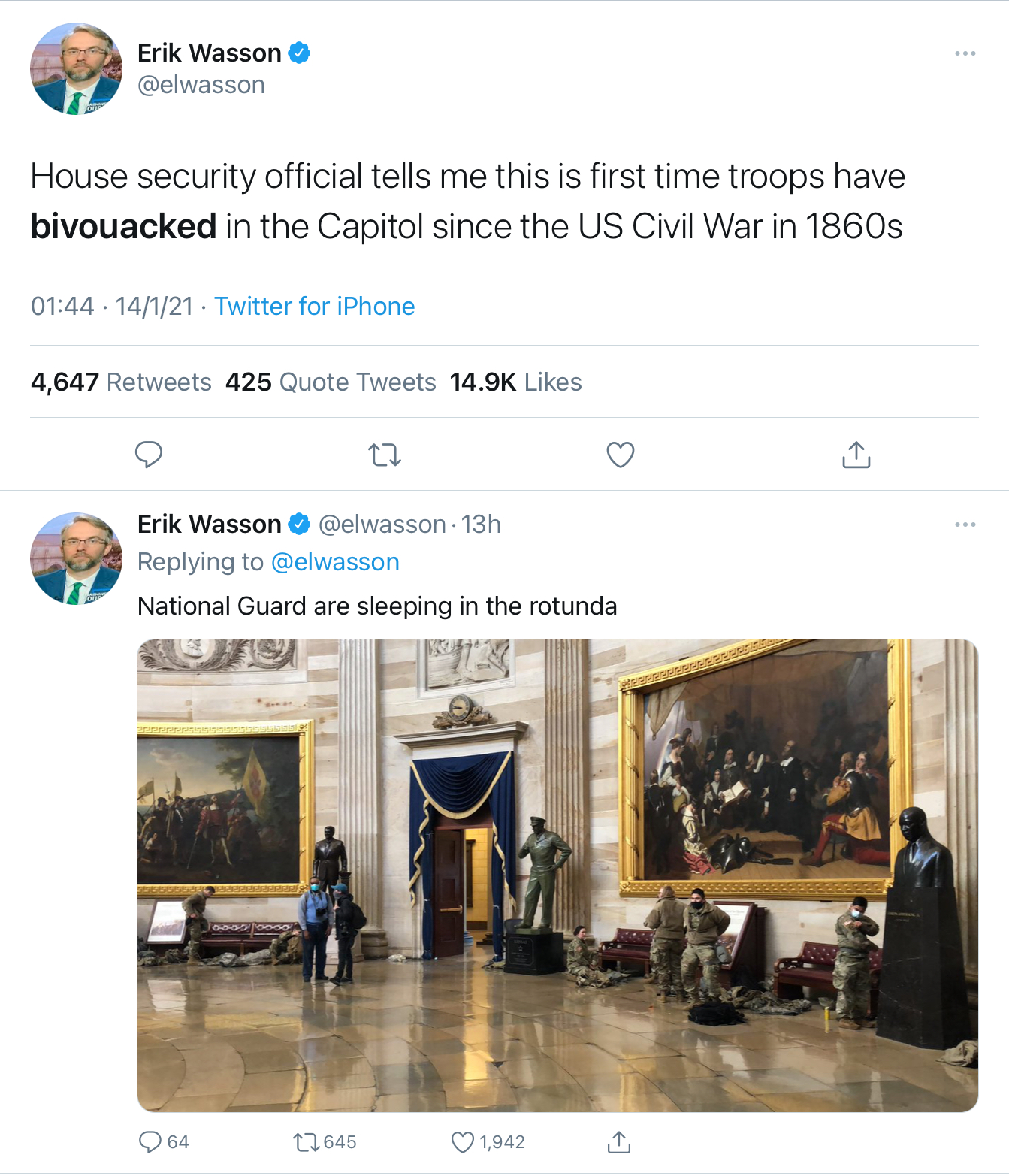
The word that got my attention was ‘bivouacked’. Despite the fact that I am a passionate reader and a scholar and teacher of History, I had no idea what this word meant. Obviously, I wasn’t the only one: plenty of people responded that they had to look the word up.
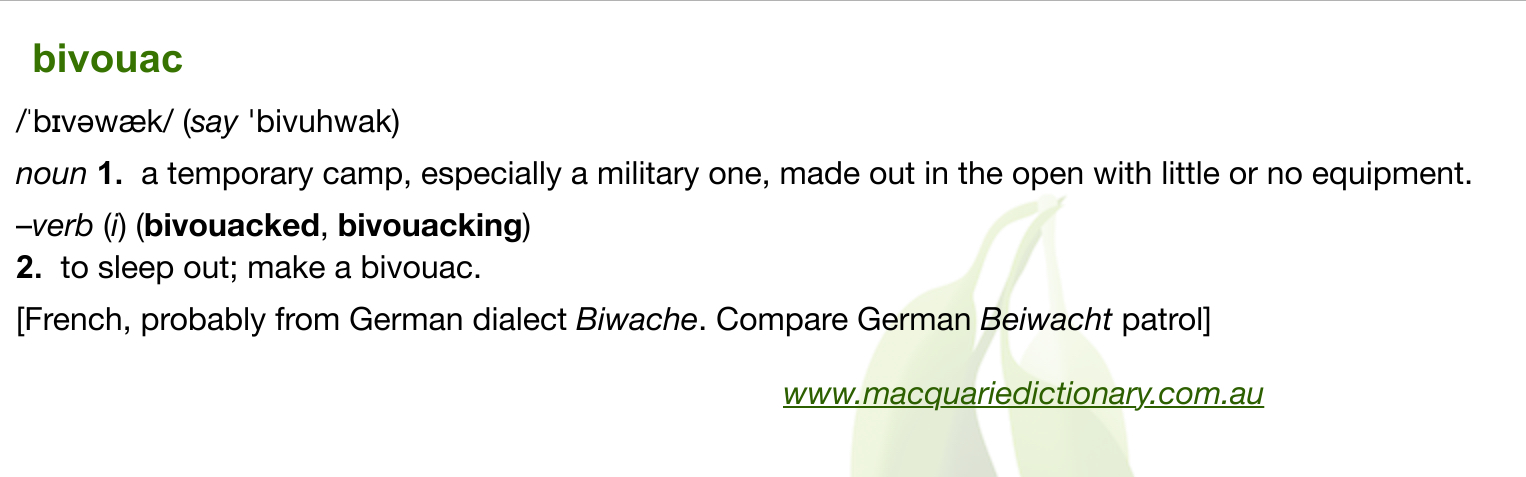
My trusty Macquarie Dictionary gave me the definition.
Etymonline explains that the use of bivouac in English dates back to 1702, meaning an “encampment of soldiers that stays up on night watch in the open air, dressed and armed.”
It is an image of readiness to defend and protect, which was exactly the context of the tweet. These images of bivouacked soldiers in the Capitol building, Washington DC, are confronting and comforting at the same time. That it is even necessary is heartbreaking, yet in the current political climate, I am thankful they are there.
The word came from French, and before that from the 17th century Swiss/Alsatian word ‘biwacht’ which meant “night guard”.
By 1853, bivouac was also used as a noun to mean an outdoor or open-air camp.
The use of the verb ‘to bivouac’, meaning to post troops in the night dates to 1809, and meaning to camp or sleep out-of-doors without tents dates to 1814. It should be no surprise that the noun became a verb in the context of the Napoleonic Wars and the War of 1812, during both of which the practice would have been common.
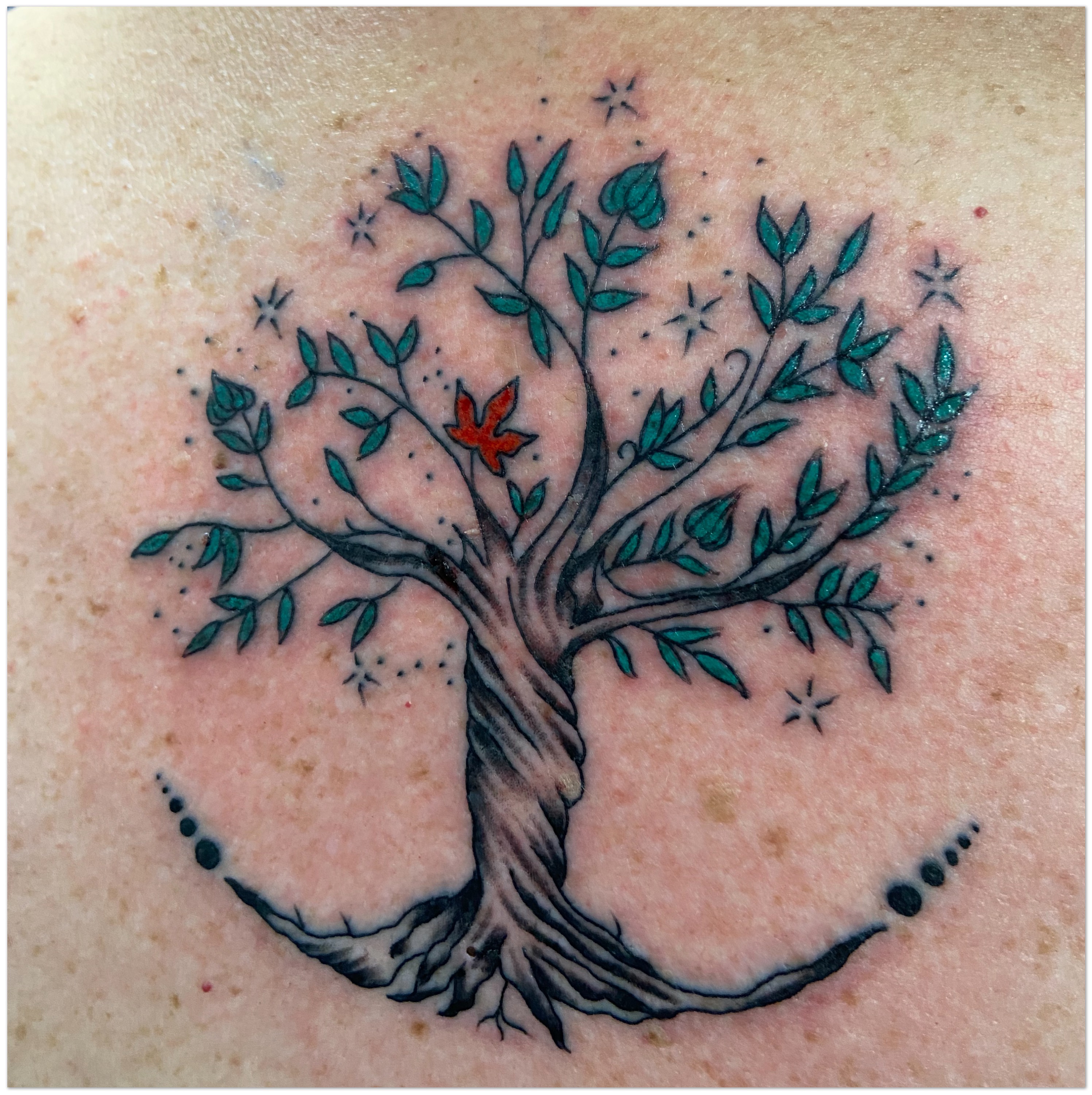
This tattoo honours my late father, my family, and my unique identity within it. My family’s surname is Dutch: Groenenboom, which translates to ‘green tree’.
I am thankful to be starting the new year by doing something to deeply meaningful. It is a positive way of acknowledging those who have passed, including my dad and my beloved cousin six months ago, those who remain and are still flourishing, and my connection to them all.
I spent months choosing the tree design, as there are myriad options available and many are gorgeous. I chose this one because it symbolises strength, beauty and grace. The maple leaf represents me, obviously— unique among the other leaves, but strongly connected and coming from the same source.
I am so proud that this symbol is now part of me.
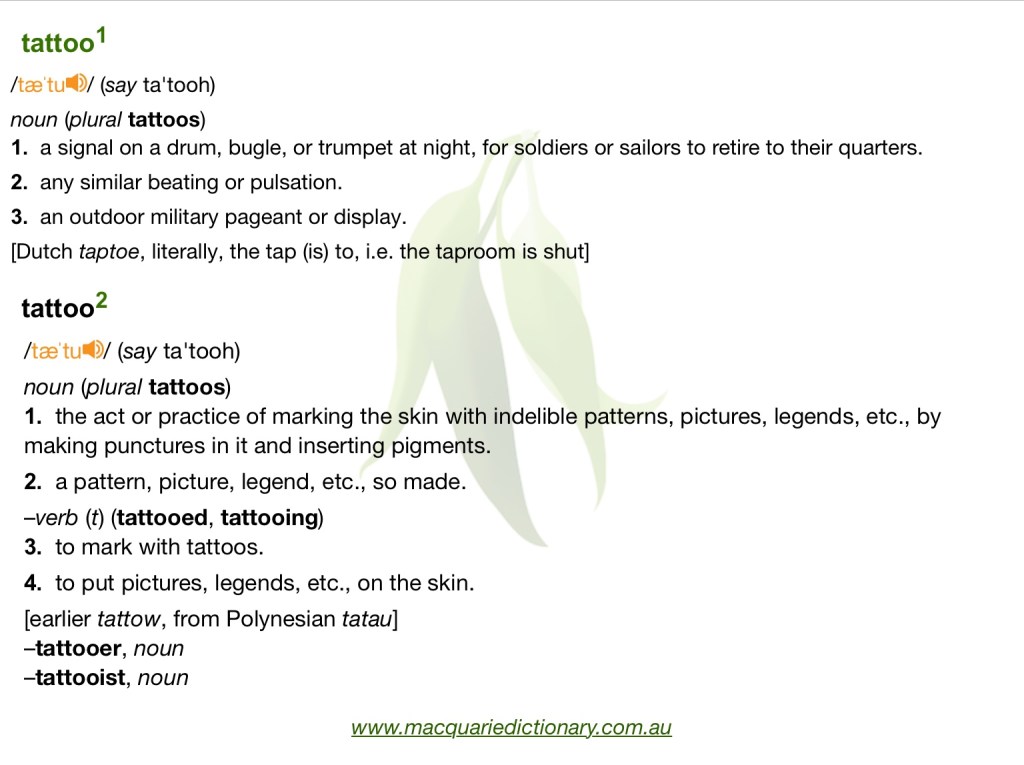
The word tattoo is interesting because the one word has two completely different sets of meanings that have come from entirely distinct sources.
That makes it a homophone, a homograph, and a homonym all at the same time: as it is pronounced and spelt identically for each of its various meanings.
Traditionally sung on New Year’s Eve, ‘Auld Lang Syne‘ is a song about remembering the friends and loved ones we have known in the past.
For the first time in my lifetime of knowing this song, it brought tears to my eyes: not only was 2020 brutal in numerous ways, I knew I was not the only one who was painfully aware of missing a beloved someone. I was blown away by the realisation that this song is as much about grief as it is about wistfulness, friendships of the past, and happy memories.
“Should auld acquaintance be forgot And never brought to min’? Should auld acquaintance be forgot And auld lang syne?”
Robert Burns, 1796
The song we sing now is part of a longer song written by the Scottish poet Robert Burns in the late 18th century. Sadly, though, many people sing it without really knowing what it means.
Auld Lang Syne is a sweet little Scots phrase that means ‘for old time’s sake’. It translates literally to “old long since”. This song was a reinvention of an older song. Burns wrote about his song in separate letters to different people:
“It is the song of the olden times, which has never been in print… I took it down from an old man’s singing.” “Light be on the turf of the heaven-inspired poet who composed this glorious fragment.”
Robert Burns
Just as the original song was much older than Burns’ version, the words themselves are very old. Auld and lang both come from the Old English of the Anglo-Saxons, while syne dates to the 1300s.
It is a beautiful phrase to say: it feels nice in the mouth, and it sounds just lovely, especially when spoken with a Scottish accent.
From now on, when I hear ‘Auld Lang Syne’, I shall think of the wonderful people I have known and loved in my life, and of the happier times of the past, but I will also think of the beautiful words that have been passed down to use from auld lang syne, too.
I’d like to take this opportunity to wish all my readers a happier, more hopeful new year. Lang may yer lum reek.











 WordyNerdBird