Poet, writer, teacher.
Good humoured. Cynical and sarcastic. More than slightly subversive.
I love language and words, and the power that they can hold when used well.
One thing I have noticed with the wearing of a mask every time I go out is how dry my lips get!
I don’t know if it’s the mask that does that, or the fact I’m not wearing lipstick as much as I used to.
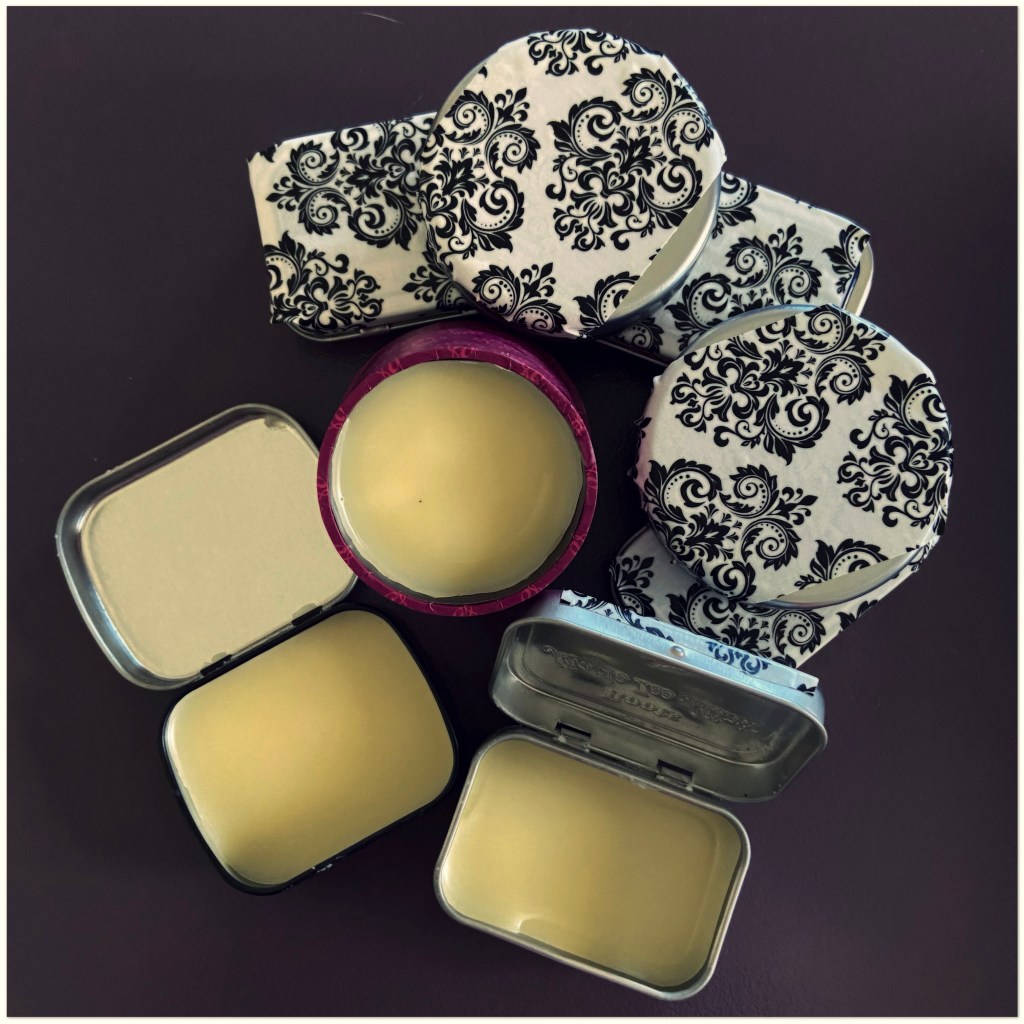
So, I decided that the term break was the perfect time to try something new: making my own lip balm! I’m going to brand it ‘Kiss My Mask’ because saying that makes me smile.
This all-natural lip balm recipe is easy and quick, and the end product is quite lovely. It absorbs quickly, is not greasy, and there’s no colour to mess up my masks.
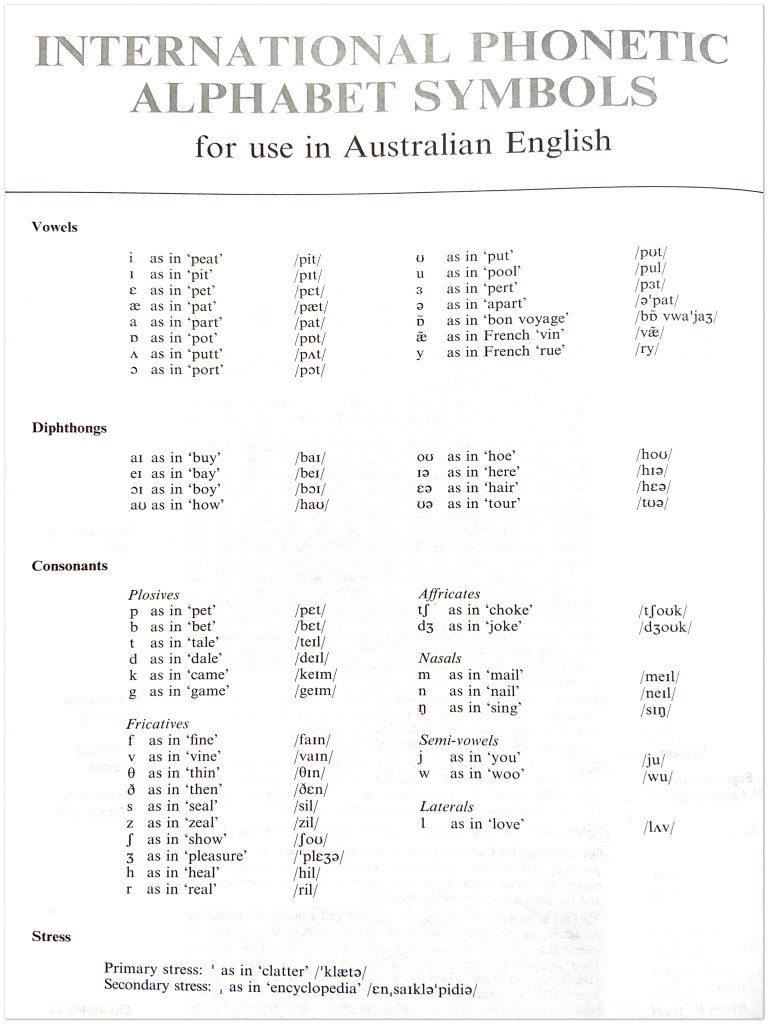
The International Phonetic Alphabet is a system of symbols that denote all the different units of sound — called phonemes — that make up words in any language. It was first developed in the late 19th century, and has been developed and updated ever since.
Photo: Joanne Van Leerdam. The IPA page in my copy of The Macquarie Encylopedic Dictionary, 2011 Signature Edition.
I learned the IPA in my first year at Macquarie University in 1985. and found it to be an incredibly useful extension of my literacy and learning. It is knowledge and fluency that I have actively maintained ever since.
While it has more symbols to learn, it is more straightforward than the English alphabet, where letters can have more than one sound, and a sound can have multiple letters and letter combinations assigned to them. In the IPA. there is one symbol for one sound. There are no silent letters, and there is clear differentiation between words such as ‘foot’ and ‘boot’ that look as though they should rhyme, but do not. It also avoids situations such as that created by the letter a having six different pronunciations from which the reader must choose correctly if they are to understand what has been written. Syllables in words are marked, so that the pronunciation of the word is clearly and accurately transcribed.
Hypothetically, one could write any word of any language as it was heard, and anyone fluent in IPA could read it regardless of which other languages they could or could not speak or read fluently.
That came in very handy when lecturers and tutors in other courses used words or names I didn’t know: I used the IPA to write them down, so that I could research and identify them later. When I wanted to keep something confidential, I used the IPA to make notes or records, confident in the knowledge that my friends and family would have absolutely zero clue what was written. That probably wasn’t always entirely necessary, but it did give me a sense of security at the time. The IPA also helped me learn and perfect key phrases to use when family from overseas came to visit, and again later on when I was visiting other countries.
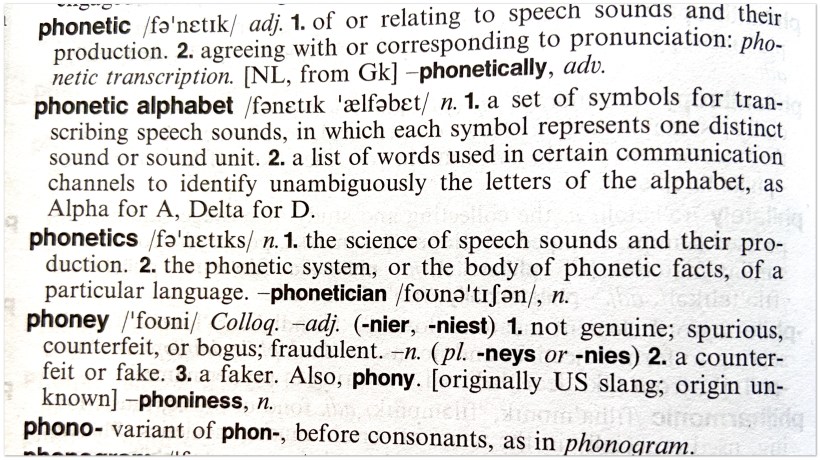
Photo: Joanne Van Leerdam. from The Macquarie Encylopedic Dictionary, 2011 Signature Edition.
A number of dictionaries, both online and hard copy, provide the pronunciation of every word in IPA, giving clear guidance to how unknown words should be spoken. As a fan of the IPA, this is something I consider essential in a dictionary for my own use.
Because it is an international system of transcribing language, the IPA does include symbols that are not often used in standard UK or Australian English. They may, however, be very useful in transcribing the spoken English of migrant communities. It also has some symbols that are only used in English, and some that are used predominantly in American English.
All of this makes the IPA a versatile tool for all sorts of contexts: work, travel, study, clear communication, and general word nerdery.
There are many ways people have found to refer to this era of Covid-19 and all its baggage: widespread testing and temperature checking, social distancing, hand washing and sanitising, and the wearing of masks.
One of the most common is ‘these times’ and variations on that — these strange times, these difficult times, these awful times, and so on. There are myriad adjectives one could choose, although some are more socially acceptable than others.
Recently, I’ve observed that people have started to capitalise the term as These Times in blogs and social media posts.
This interests me, because of the way in which the language is being ever so slightly adjusted to add weight and significance to the term. Those capital letters are acting as an intensifier.
Intensifiers are those parts of language that add strength to what we’re saying or writing. Words like ‘absolutely’, ‘completely’, ‘terribly’, the commonplace ‘very’ and even the humble little ‘so’ are all intensifiers. Some people use expletives to do the same job, especially in spoken English. The meaning of the sentence doesn’t change if they are removed, but the sense of degree or importance in the words around them isn’t necessarily communicated if those intensifiers are not present.
By capitalising those Ts, writers are communicating their assumption that their readers will know exactly what they’re talking about. And, in These Times, there is little doubt that they will.
This highly relatable post by C.J. Langer about being bamboozled got me thinking about the etymology of the word.
Bamboozle is a verb: It means to trick, defraud, confuse, perplex or frustrate someone.
One can bamboozle another person, or be bamboozled by them.
The noun is bamboozler.
For a word that is so much fun to say, it has to have an interesting history… right?
Image by JoeBreuer on Pixabay.
The entry at etymonline.com dates its first use in print to 1703, but its origins are unknown. There are, however, some interesting theories offered:
It could be Scottish: from bombaze or bumbaze, which mean to confound or perplex
It could be related to bombast – using big words and fancy language to impress people without saying much
It could be derived from the French word “embabouiner “ which means to quite literally to make a ‘baboon’of someone.
It could come from Italian words such as bambolo, bamboccio, bambocciolo which refer to a young baby, but have come to be applied to people who are silly or gullible.
The Scottish “bombaze” seems to me to be the closest and most likely, particularly given that the Scottish Stuarts had been on the English throne for a century: it makes historical sense that this would have given Scottish terms an entry into vernacular English before being written down as they became more commonly spoken. Ultimately, though, we’ll probably never know.
There are some words in the English language that strike me – sometimes funny, sometimes just as damned strange. Bamboozle is one of those words. I looked up the definition – to fool or cheat – just to be sure I understood it and sure enough I knew and it fit exactly how I’ve felt for the past few days.
It’s hard not to be offended when you finally figure out you’ve been duped yet again by the same people who have done it in the past. It’s hard not to be hurt, angry. It’s hard to forgive, again…
I love the whole ‘forgive and forget’ concept. It’s something I try to live by. I really do but what the great quote writers don’t tell you is that chances are you’re going to have to forgive the same people over and over again. For little things, little hurts.
The first thing I discovered when I started researching how to prepare my memorial puzzle for framing was the amount of conflicting, and sometimes terrible, advice the internet had to offer.
Why did it all have to be so hard to find? Why couldn’t there just be one post with clear, straightforward instructions? Who even knows? I resolved then and there to write that post once I worked out what I was doing.
So, I drilled down, made notes on the approaches that seemed reasonable, and sought out some experts to guide me on the process.
On their advice, and a fair degree of holding my breath and hoping things worked as I had been told they would, this is the process I followed.
Materials:
A good solid board to mount the puzzle on. I used 2mm strawboard which I bought for about $5 at my favourite office and art supply shop. It is strong and flexible, but won’t sag or warp. It is also slightly textured, which makes it less likely that things will slide around on it.
A rolling pin.
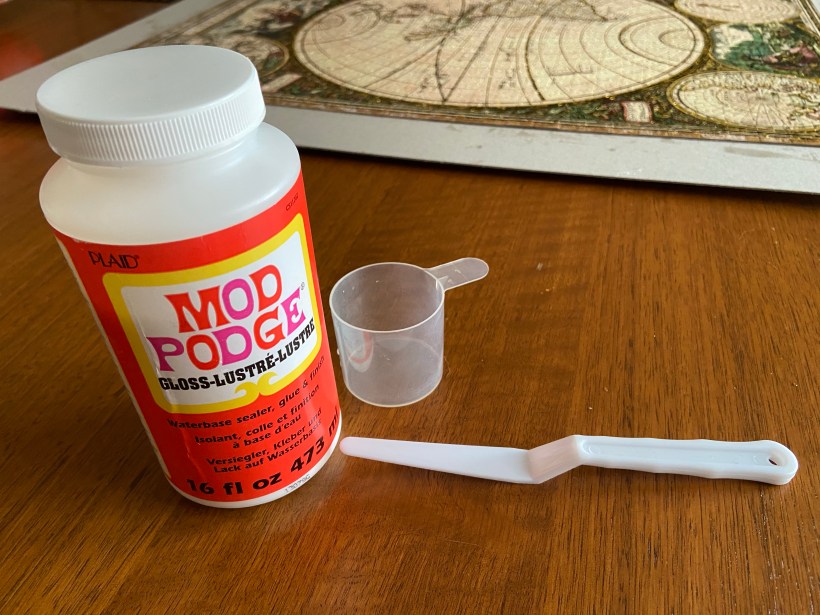
Mod Podge sealant glue. I didn’t know how much I would need, and I knew my puzzle was big, so I bought the 16oz bottle. It turned out that I only used about 2 oz of that. It’s handy stuff, so that’s okay.
A small cup to pour your glue from. This allows you to have more control over how much and where you are pouring. I used an old measure from laundry detergent.
A plastic spatula with a straight edge for spreading the glue. Some people use a credit or ATM card, but the handle on the spatula moves your hand back from the action and allows you to see right away what you’re doing.
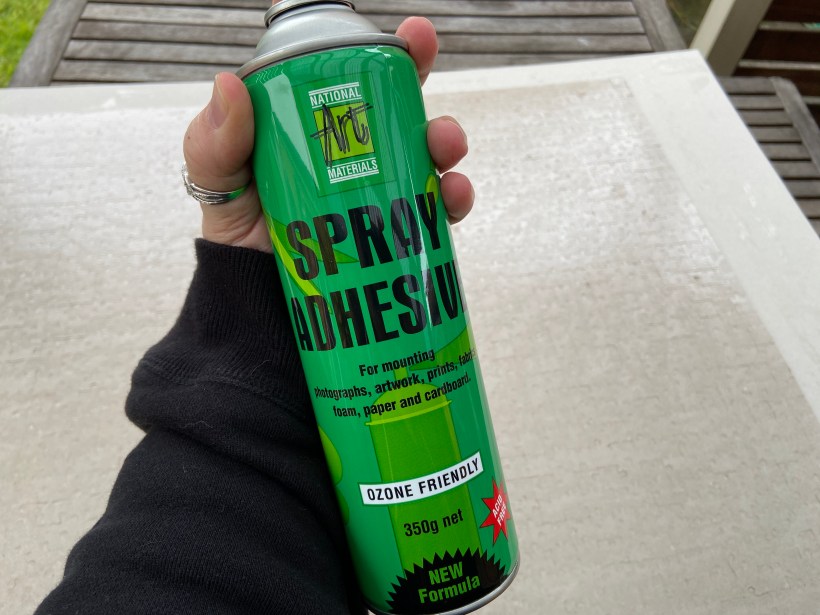
Strong spray adhesive.
Practice Makes Perfect.
Before you go anywhere near the puzzle you want to frame with your glue, practice an old puzzle so that you develop your skills and your confidence.
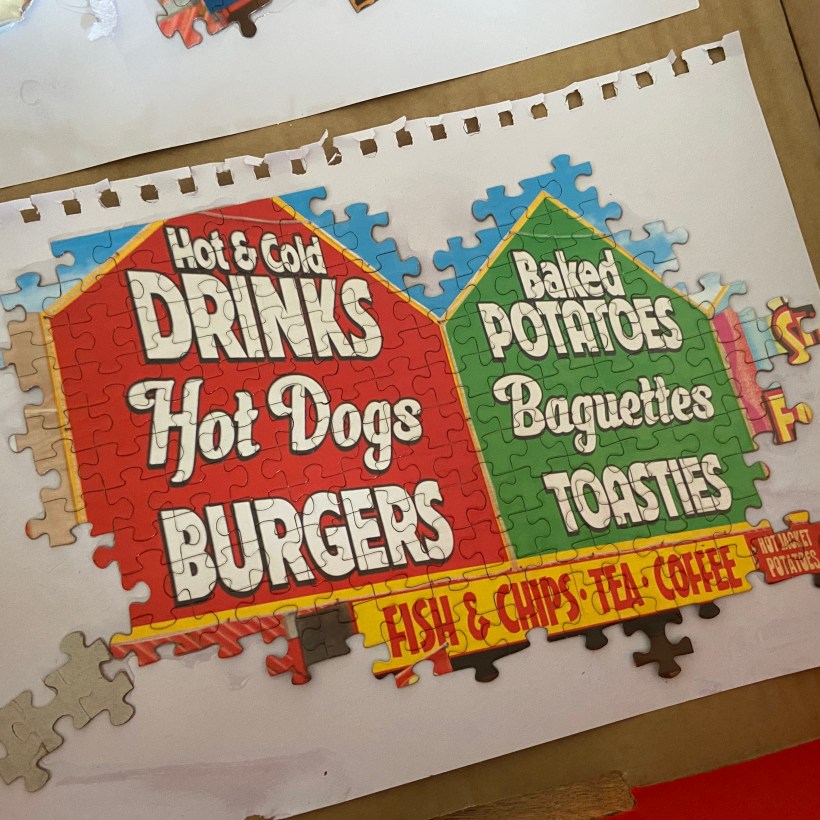
A friend who runs a puzzle exchange gave me an old one that nobody was interested in. Goodwill and charity shops often have loads of them for a dollar or two each. I didn’t even make the whole puzzle. I simply completed a couple of sections to practice on.
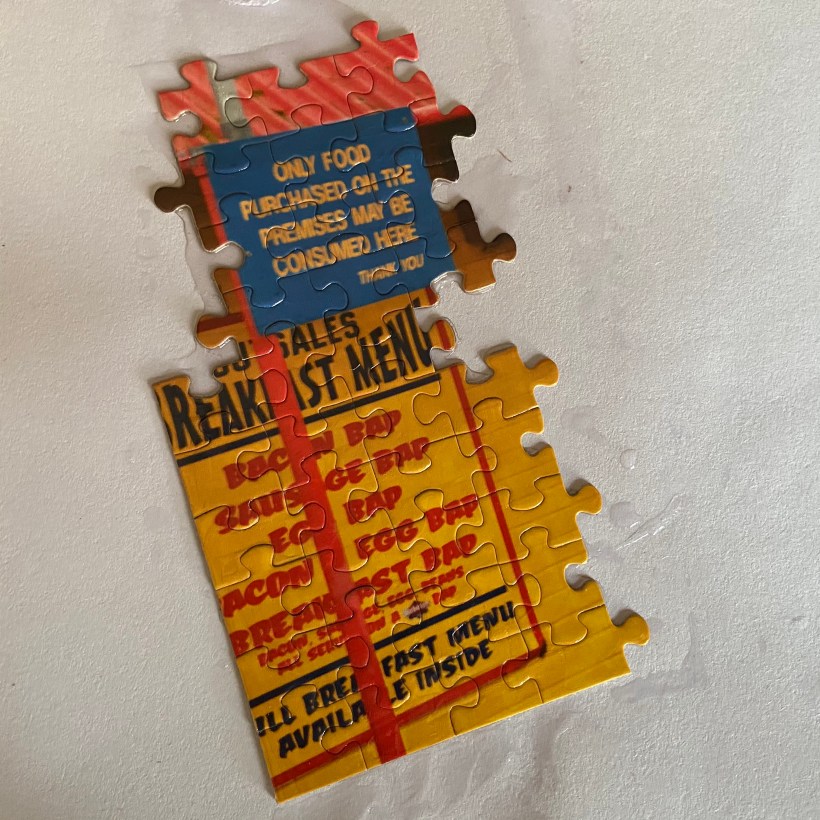
My first attempt was not bad, but I quickly discovered how easy it was to use too much glue. It spread easily, but pooled around the edges. This gave me a better idea of how much to pour on in the first instance, and how to spread it evenly. So, the edges were messy with glue, but the effect on the puzzle was good.
The first attempt involved too much glue.
The second attempt was much better.
My second attempt was much more even. It came up really well.
I braced myself, got my gear ready, and turned to my beautiful puzzle. It was time.
Gluing The Puzzle
Use your rolling pin to ensure the puzzle is completely flat and the pieces are evenly joined.
Pour some glue from the big bottle into the small cup. You can always add more if you need it.
Don’t panic that the glue is white. It WILL dry clear and glossy.
Pour the glue in a thin, even S shape line over your puzzle. Spread it thinly and evenly over the surface with the spatula.
Make sure all the joins between the pieces are filled with glue. Make sure you don’t have globs or spots of glue anywhere. The aim is to achieve an even coating over the surface.
Mine was a very large puzzle, so I did it in three sections. When one section was done, I poured more glue and kept going.
Allow it to dry for several hours. It will feel dry to touch after about 20 minutes, but it’s important to allow the glue in the joins between the pieces to cure and dry completely before you go any further.
Turn your puzzle over very gently. It may have been glued, but it’s important to be as careful as you can with it at every step of all times, as it is still fragile.
Repeat the gluing process on the back of your puzzle. This will both strengthen the bond between the pieces and seal the surface.
Wait at least 12 hours to ensure that everything is completely dry.
Cover the back of your puzzle evenly with spray adhesive, then cover the surface of your mounting board.
Wait a few minutes for the surface to become tacky to touch. then flip your puzzle very carefully onto the board.
Do this outside or in a well-ventilated area, and wear a mask. Remember, you don’t want spray adhesive all over your furniture OR in your lungs!
Use a rolling pin to ensure the entire surface of your puzzle is pressed onto the board.
Leave it alone to set and dry. Your puzzle will be ready for framing tomorrow.
The Result:
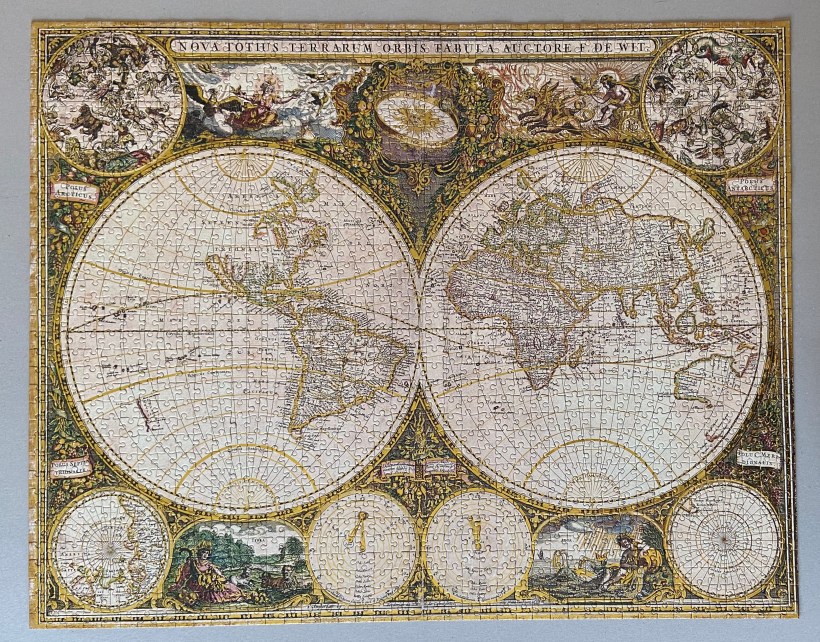
I’m really pleased with how my puzzle turned out. The finish is beautiful, and the gloss of the glue really highlights the gold highlights and subtle colours in the puzzle.
Because my puzzle is a very special one, and because it is too big for any of the commercially available frames I have seen, I’m going to take it to a professional picture framer.
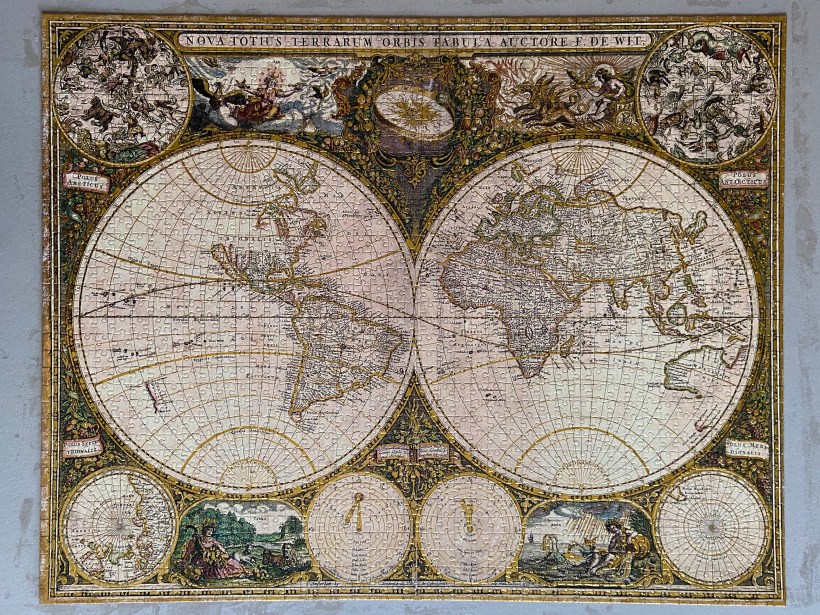
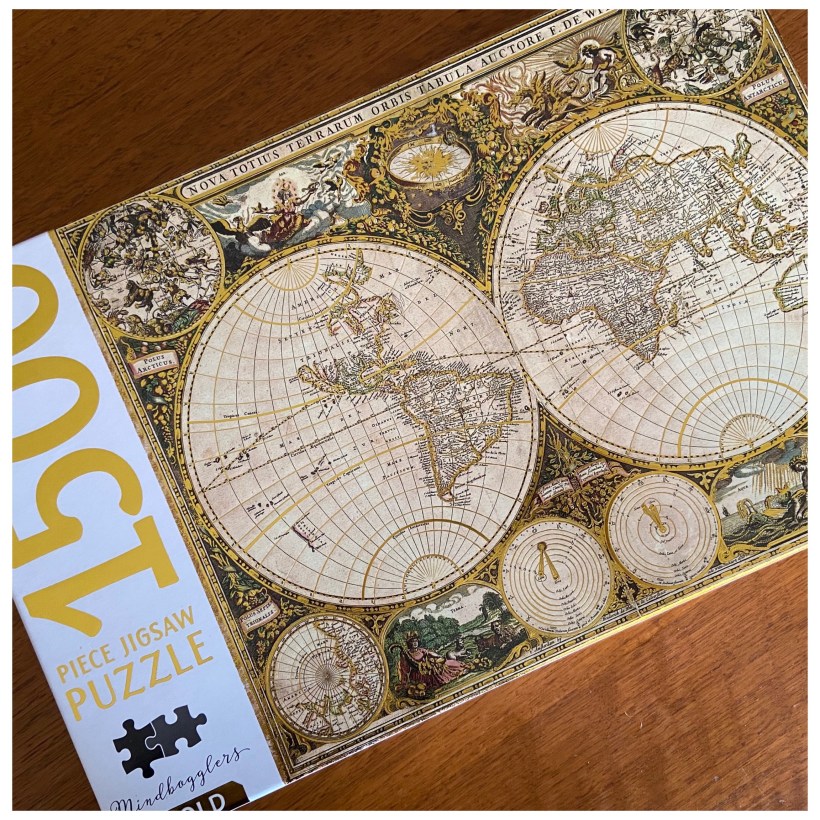
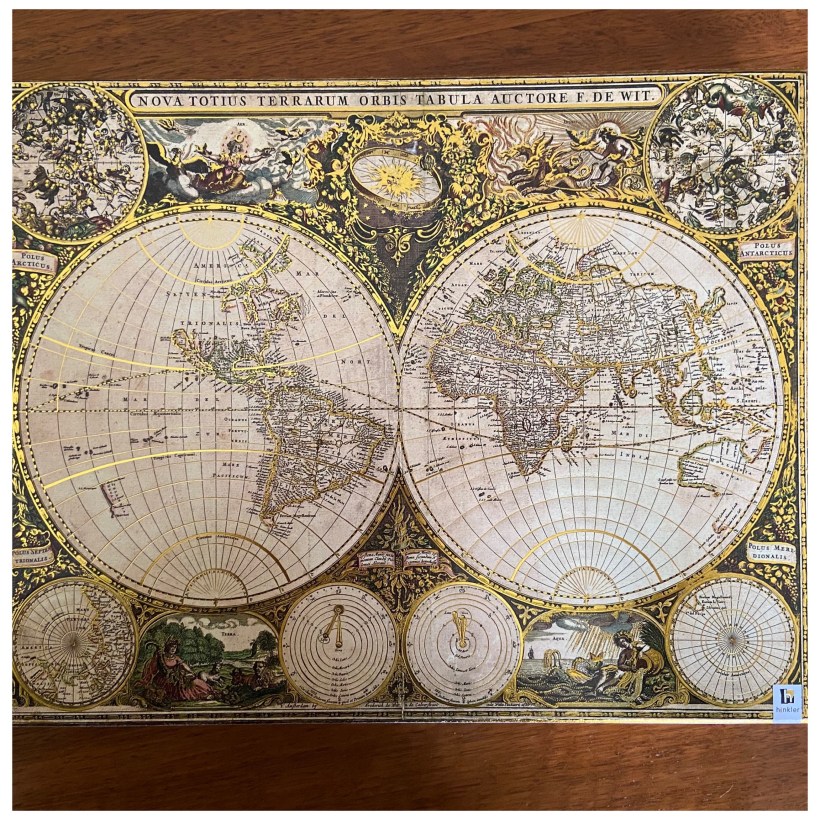
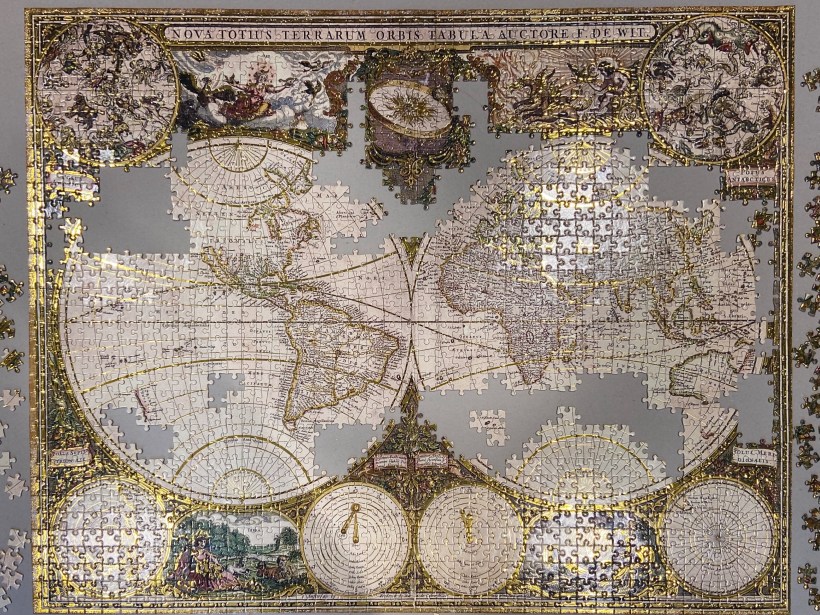
I’ve been working on a beautiful jigsaw puzzle over the past month. I chose it in honour of Helen, because she and I often did puzzles together. In fact, this was the first jigsaw puzzle I’ve done without Helen in probably twenty years. I also chose it for my dad, who would have loved both the map and the fact it was created by a Dutchman.
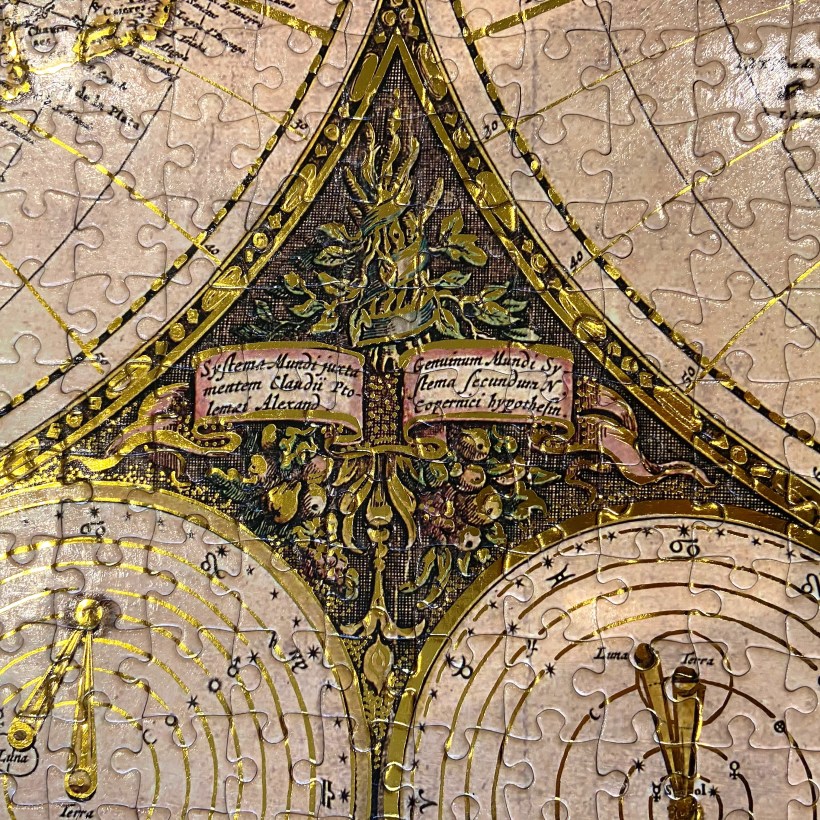
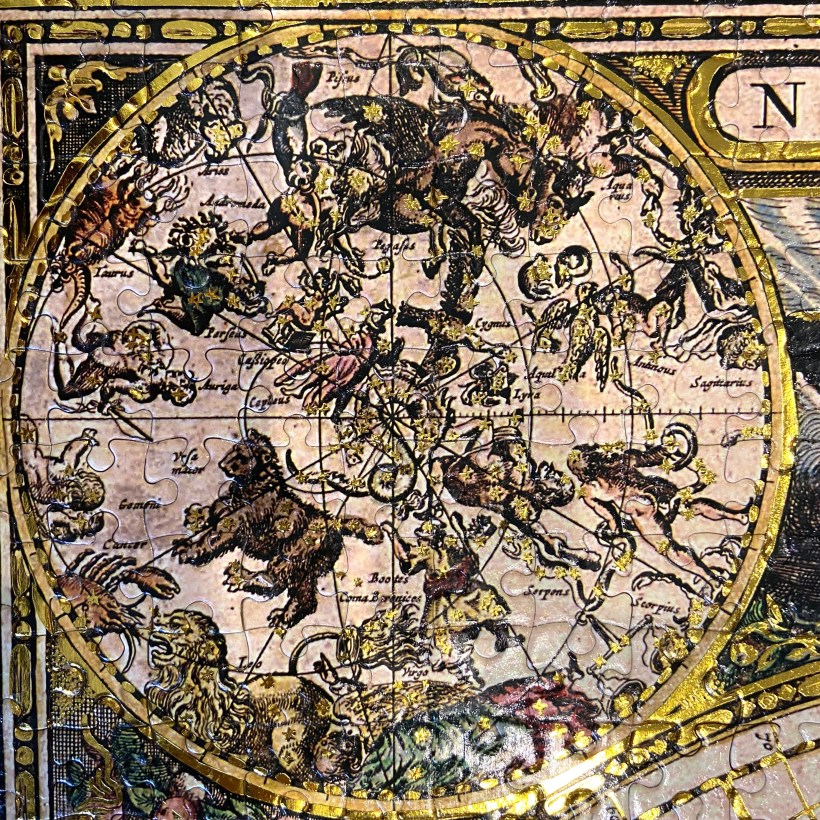
The image is an antique map of the known world, complete with solar systems and representations of the four elements; highlighted with gold embellishments. It was created by F. De Wit in Amsterdam in 1663, and the puzzle was produced by Hinkler Mindbogglers. Boy oh boy, did they get that branding right!
It really was a mind boggling challenge. Intricate lines, many pieces that still looked almost the same, and corner and edge pieces that were almost identical to one another made putting this puzzle together quite the labour of love.
Mind boggling, to say the least!
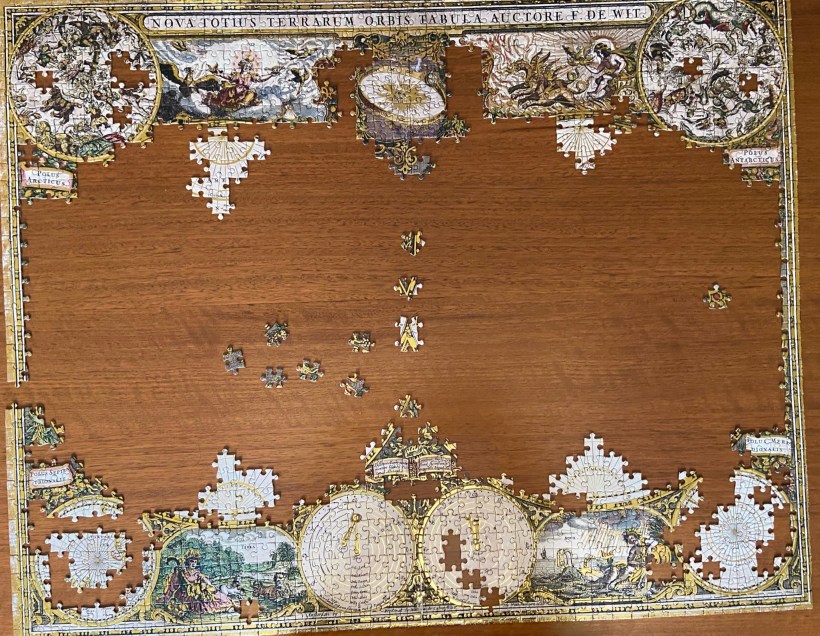
Piece by piece, though, it started to happen. It is no understatement to say that I felt a profound sense of achievement when I finished a section and could anticipate how beautiful the whole thing was going to look.
Piece by piece, it started to come together…
Doing the puzzle in honour of Helen and my father gave me purpose, but the concentration it required and the distraction from other things in life gave me a sense of mindfulness and peace that really helped me in my day to day life.
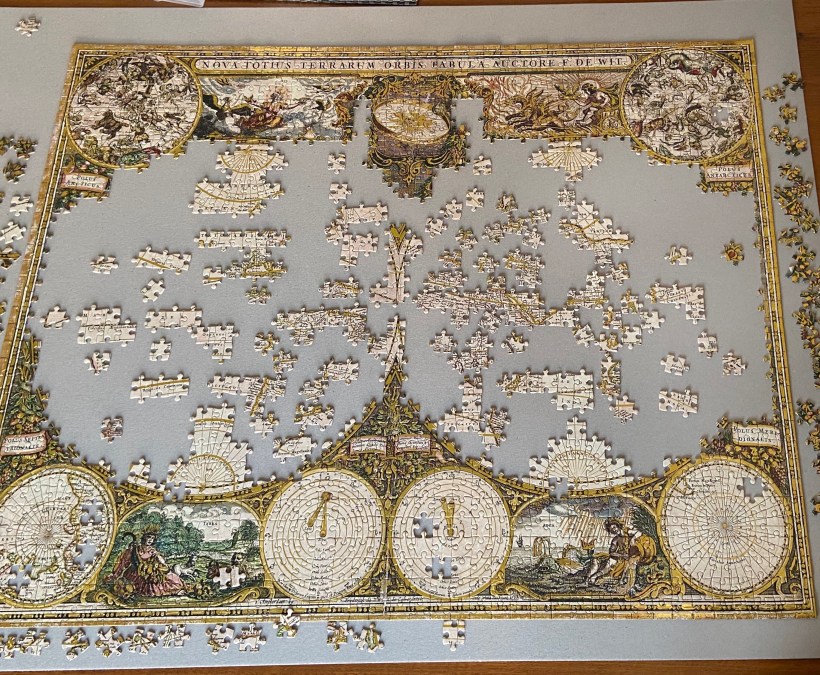
Almost there! But those last couple of hundred pieces were the hardest!
Dealing with my grief and managing tasks related to Dad’s estate were somewhat complicated by the challenges of teaching online again during Victoria’s second major Covid-19 lockdown, but working from home also gave me the space I needed to do those things and start to heal.
In many ways, that puzzle became an allegory for my own life. I was putting those pieces together too, seeing how things fit and getting an idea of how things would look. I too have intricate lines and a complex design that needs to be observed carefully in order to achieve the desired outcome. My life is full of pieces that fit together neatly, and it’s up to me to make sure I get that right.
So, while the puzzle on the table is complete, the puzzle that is me is still a work in progress.
A beautiful picture indeed!
Today marks thirteen weeks since my dad graduated to heaven. Thursday marks the same interval for Helen.
Three months seemed like an appropriate goal for completing the puzzle, and I feel a deep sense of satisfaction at having done so.
This week, I will make arrangements to have it framed.
When it is hanging on my wall, it will be a daily reminder that doing life well is a process, not an event. It will remind me that every piece matters. And it will remind me of my love for Dad and for Helen, of their love for me.
I am so blessed to have known and loved them both, and to have been loved by them. The pieces they contributed to the puzzle of my life have helped to make it a thing of beauty. For that, I am very, very thankful.
I know that as the pieces of life continue falling into place and fitting back together, my grief will remain present, but it will change. It will transform to become a part of the bigger picture, while keeping its own shape and character. In time, it will be differently painful, but the picture of my life would be incomplete with out it. In its place, fitting in with the pieces that represent joy, achievement, love, and hope, it adds its own detail, texture and embellishment to the canvas.
Last week I asked my students to do something creative.
Today, Student A wasn’t very impressed with the outcome of their efforts. “I tried, but it’s turned out a bit 2020.”
“It’s a bit what?” I asked.
“2020.”
Obviously, I was expected to understand.
“Mine’s pretty 2020 too, to be honest,” Student B admitted.
I looked at their faces on my screen. They were being serious.
“So…” I asked, “Are we using that as a swear word now?”
They’re right. It actually works.
“More meaningful than swearing, Miss,” said Student B.
The rest of the class concurred.
“And we can’t even get in trouble for saying it.” Student A grinned, clearly rather pleased with that reality.
I smiled, told them their work was way better than 2020, and moved the lesson on.
I don’t know if they just started doing that by themselves or picked it up from somewhere else, but at least they’re finding some practical use for 2020. I may just follow suit.
Today’s English class was the most fun I have had in a long time. I wanted to exercise the kids’ minds and get them thinking laterally. I also wanted them to enjoy it. A lesson with a difference seemed to me a great way to start our final week of term and inject some interest into our online classroom.
I began by presenting my students with the contention that a box of chocolates is a salad.
This was not a popular suggestion.
“No it’s not!” one student said… quite defensively, I might add. “Salad is salad. Chocolate is chocolate. You can’t ruin chocolate like that!”
But, I asked, what is a salad if it’s not simply a mixture of vegetables? Chocolate comes from beans… and if you add nuts, or fruit, or herbs like peppermint, then it’s definitely a salad.
We spent quite some time redefining food, presenting the most persuasive arguments we could think of, and debating the nature of reality.
Every time it sounded like the students might be in danger of reaching a consensus, I made another suggestion.
Ice cream, on its own, may just be ice cream – but the minute you put it in a cone, or add fruit or chocolate, it’s a salad. Coffee, like chocolate, is made from beans. It’s a salad.
“No!” was the response. “Coffee is hot – it can’t be a salad.”
So then I really twisted it up.
Is coffee soup? Is cereal soup? Or is it a salad with too much dressing? According to one student, and I quote, “Soup is not what soup is.”
Is the English language a metaphorical salad? Because it’s a mixture of a whole bunch of languages, right? The flavours are all mixed, but the parts are still recognisable if you know what you’re looking at.
Is the English language a sticky weed? Or velcro? Because you know, it takes something from every other language it swipes past. Maybe it’s double sided tape…
I am not ashamed to say that I really had fun. Despite their groans and protestations, I think they did, too.
Perhaps the most satisfying moments, though, were two comments made by different students:
“You’ve just entirely ruined the English language.”
and
“These have been the most problematic fifteen minutes of my life.”
What started out as a brain tease turned into a really interesting discussion about how we use language and define things in our own ways, and often assume that everyone else understands what we’re talking about, and that everyone else agrees with us.
It’s safe to say most of them enjoyed it… but it’s also safe to say that I enjoyed it more.
I have a really handy social media skill. It may actually prove to be a talent: time will tell.
It’s super for my mental health, and has amazing benefits in maintaining positive content on my social media feed.
It is, quite simply, deleting rubbish content on social media and snoozing the people who post it.
Obviously, “rubbish content” is a highly subjective term. But since it’s my hobby, and since it’s my social media feed, I get to decide what’s rubbish and what’s not. I don’t dictate to anyone else what they post, or what they read, or what they want to see. But I do get to decide on what I allow to speak into my life.
Things that get an instant veto are racism, intolerance, and hatred. The chances of them changing my mind on those issues range at the lower end of remote to zero. Also high on the veto list are conspiracy theories, politics, and ignorance. I’m not limiting their right to free speech, nor am I insisting that they think or believe. I am simply choosing not to engage with them. All I am limiting is their ability to speak into my space and my mental health.
To that end, I have deleted comments. Obviously, people can see if their comments have been deleted. If that bothered me more than the comments do, I wouldn’t delete them.
I have also muted conversations in messenger. The person on the other end of the conversation won’t know I’ve muted them, because I don’t often respond to general content in messenger anyway. Forwarded messages, videos, chain letters, those virus-laden ‘OMG I can’t believe this!’ messages and spam only ever come to my inbox to die, friendless, unacknowledged and alone. If it’s a personal message, that’s a different thing entirely.
I have snoozed or unfollowed people on Facebook. The advantage is that you can do both without those people knowing and getting all offended and being weird with you when you see them at the next family gathering or in the supermarket.
Furthermore, I have zero shame about doing any of it.
I have chosen to not engage in debates because I don’t have the energy, nor do I have any inclination to enter into conflict. My social media feed is not the place for a bunfight about whose lives matter or whether or not something is real. And if I post something and someone disagrees, they’re completely free to do so without starting an existential debate on my thread. They can do what I do, and simply walk away.
As someone said to me last week, it’s a bit like peeing in a wetsuit: it gives you a warm feeling, but nobody else notices. That’s absolutely true, but that doesn’t matter one bit, because I’m not doing it for anyone else. I’m doing it for me.
Here’s the how-to:
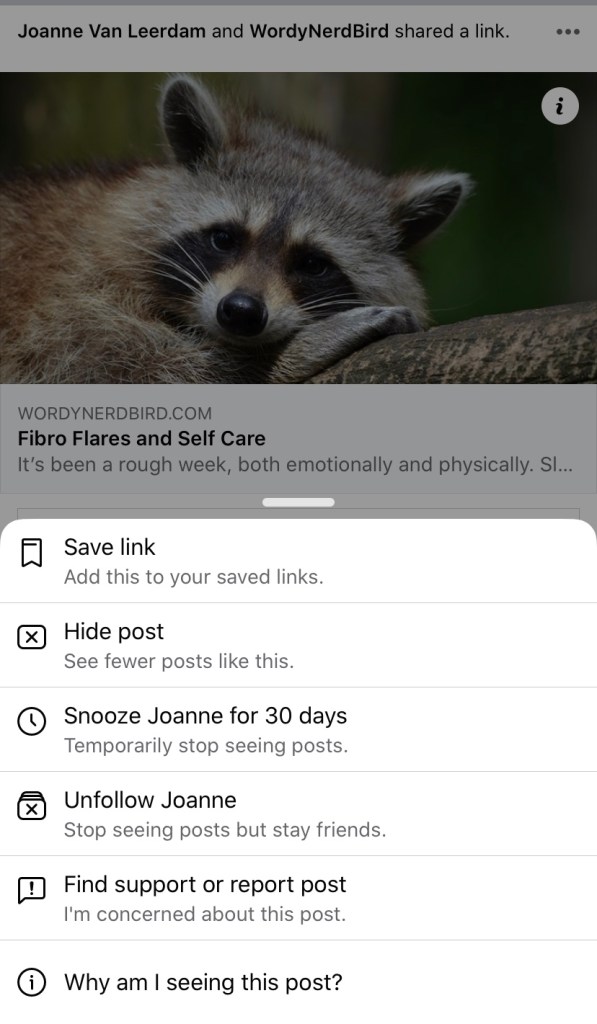
At the top right of a Facebook post are three dots, like an ellipsis. Click on those.
From the drop-down menu, you can choose to snooze the person who made the most for 30 days OR to unfollow them entirely. This means you won’t see anything they post unless you go to their profile.
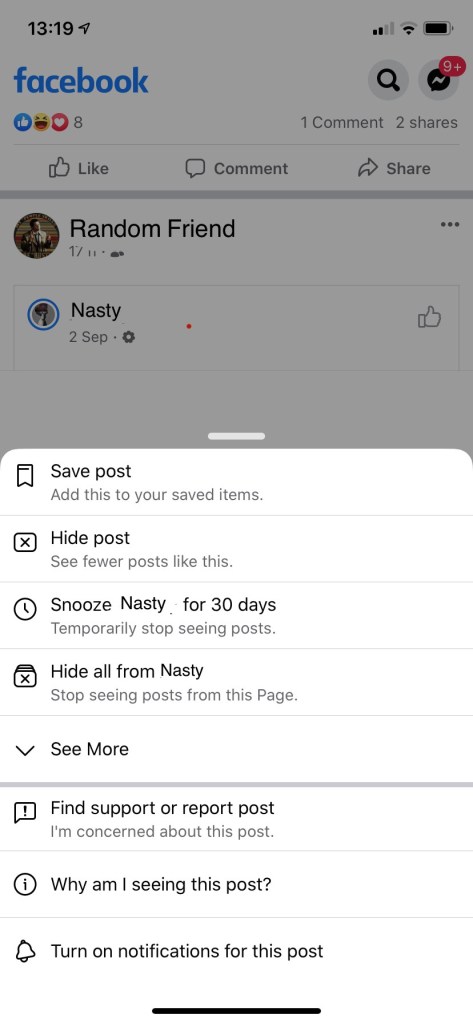
If that person is sharing someone else’s post, you have another option.
I changed the names on this post so that there is no inferred suggestion certain pages should be hidden or unfollowed. I made this name up. Any resemblance to existing pages is entirely coincidental.
You can hide all content from the creator of the original post without affecting your friend’s usual posts. This is usually my first choice, and I don’t snooze or unfollow my friends until they have deliberately and repeatedly shared what I consider to be rubbish on multiple occasions: that’s when I understand that I am better off just not seeing their posts.
Finally, if people think something I post is rubbish or disagreeable, they’re welcome to ignore it or snooze/unfollow me, too. Fair’s fair, and I’m really not that easily offended.
It’s been a rough week, both emotionally and physically. Sleep has been patchy, which isn’t unusual for me, and my back pain has been relentless.
Naturally, my fibromyalgia decided to join the pain party with some extra bass beats and neon flares of its own.
Yesterday I chose to work through it. I’m a teacher working from home and my students are depending on me. It’s not that easy for substitute teachers to step into a remote learning classroom and make things happen the way I want them to. And, you know, I didn’t have to drive to school, which helps when you wake up in crushing pain. My classes were great, and spending ninety minutes with Genghis Khan in my Year 8 History class was a good distraction.
When my classes finished, I had to go to town to pick up my much needed new glasses, I’ve been struggling with eye fatigue while doing so much remote teaching, and it’s fair to say that the curriculum planning and lesson preparation don’t stop just because we’re working off campus. It was a 45 minute drive, but I just went there, got my glasses, and came home. I am not interested in shopping or spending any more time around people than I need to right now.
When I got home, I rested. Dinner was easy – the soup was already made, and just waiting for us to enjoy it with a spinach and feta bread twist.
I really hoped the evening of rest would be enough to make the pain flare back off.
Nope.
So, by necessity, this weekend has to be a quiet one.
My new glasses are great, but I’m not going to be spending much time on screen. I’d love to read a book, but my hands hurt too much to hold one for long.
So, I will do what needs doing, and that’s it. I have a couple of new podcasts to road test, and then I’m going to indulge in an audiobook. I’ve got my recliner, my quilt, my cat, and the sound of rain falling outside.
Choosing my content is important for my mental and emotional wellbeing. I’m taking care to exclude anything negative, so I’m avoiding the news and social media. Throughout the whole Covid-19 pandemic and working from home experience, I have found that to be a good strategy for keeping my mental and physical spaces positive and healthy.
I’ve also got my pain medications handy in the drawer just beside me, because those things are my friends. It’s all well and good to be idealistic about managing pain and not relying on drugs, but on flare-up days, there is absolutely zero chance of that happening. A girl has to do what a girl has to do.







 WordyNerdBird