Pedant vs. Teacher

Most people use the term ‘pedant’ in a derogatory way, usually in reference to someone they perceive as being too fussy or too strict about rules. 
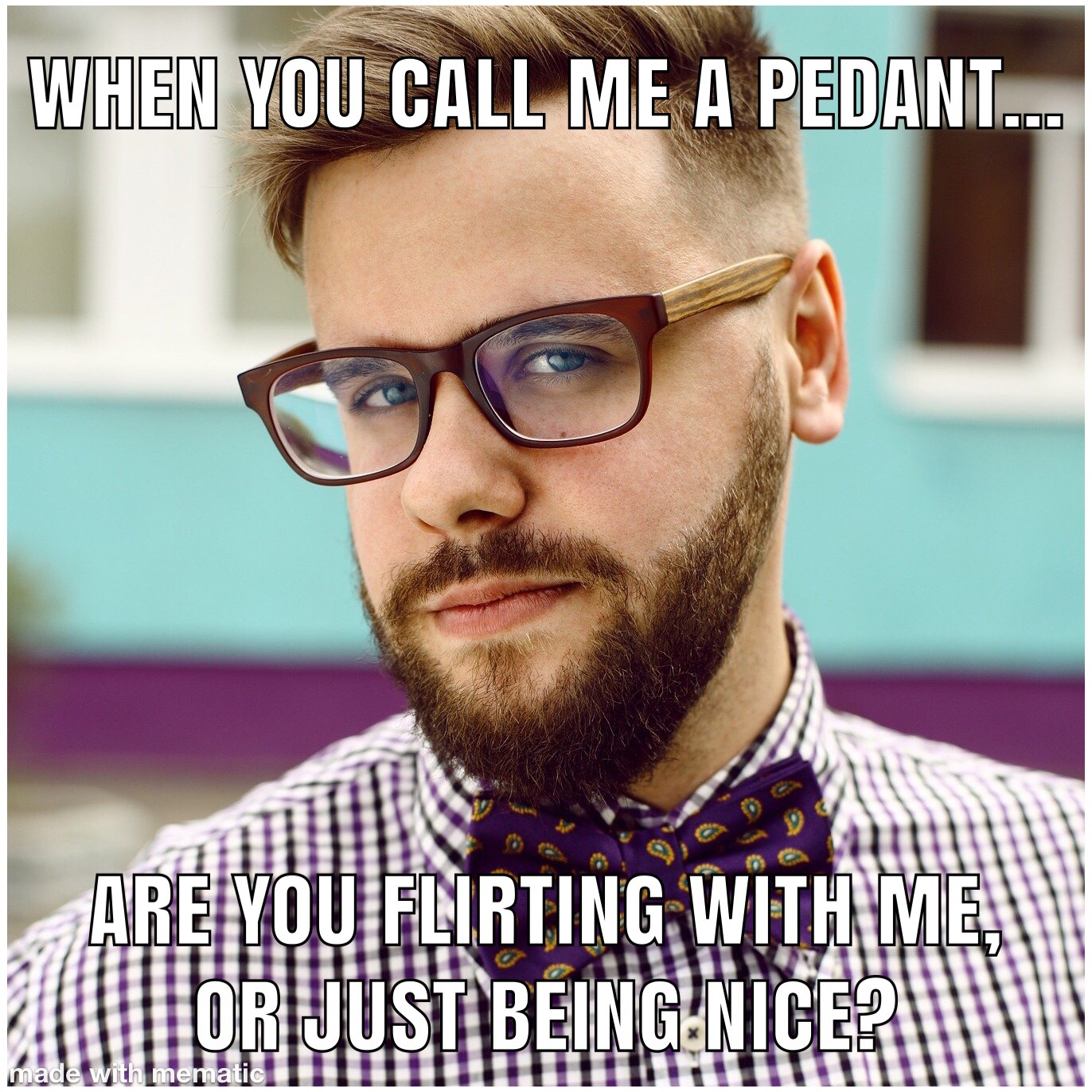
On the occasions when I have been called a “grammar pedant”, I have generally responded as though someone is paying me a huge compliment. I invariably say something like “Oh stop it, you flatterer!” or “One day you’ll say that like it’s a bad thing!”

As a lover of the English language and words in general, there are things to we should be paying careful attention. There is value in pointing out where a student needs an apostrophe or a comma in their writing, or where they can express an idea or key point of information more clearly. That is part of being a teacher. It’s my job.

However, I try to restrain myself from correcting people’s grammar on social media, though, for two reasons:

  1. I don’t have time. I have a life to live, and I need sleep to function.
  2. They tend not to like it much.

What many people don’t know is that the word pedant was actually derived from the world of teaching and education. It came to English from either the  Italian word ‘pedante’ or from its descendant, the later Middle French word pédant, both of which referred to a schoolmaster or teacher.  It may be one of those words that came into English from more than one source. The Italian word is derived from the Latin word paedagogantem, which is the origin of the words pedagogue and pedagogy, which are also related to teaching and education. 

By the late 16th century, though, the English were using the term in a negative rather than a neutral way.  ‘Pedant’ had already come to be used for one who placed undue emphasis on the minor details of learning, or someone who focused on details or technicalities  instead of looking at overall issues or taking a wider view of general learning and practice. 

In that sense, correcting someone’s grammar on social media when it is clearly not appreciated is being unnecessarily pedantic. Perhaps that is the distinction that really needs to be made.

Alternatively, it might be a somewhat uncomfortable yet valuable opportunity to improve both one’s learning and professional credibility in an age where prospective employers and customers look at social media profiles before deciding to give a job or order to a particular person. This is particularly true for anyone who should be reasonably expected to have a sound grasp on the language, such as teachers, writers, bloggers and professionals who rely on clear communication in their work. 

Let’s face it. I may not care if someone misspells an uncommon word, or one they’ve only heard and not read, but if they don’t bother to differentiate between ‘your’ and ‘you’re’ on social media, I’m neither going to buy their book, nor hire them to write my copy or teach my kids. 

Fussy? Yes. 
Pedantic? Probably. 
Apologetic? Not one bit. 

Reference: Online Etymology Dictionary

Pedant vs. Teacher
#grammar #English #language #words
Chasing Waterfalls.

In wilful defiance of TLC’s advice, we spent today chasing waterfalls. Thankfully, though, we were visiting real waterfalls rather than metaphorical ones. 

It was great to get out in the sunshine and fresh air, and to enjoy a change of scenery after months of social restrictions and another term of teaching from home. 

I visited both Nigretta Falls and Wannon Falls near Hamilton, Victoria, with my bestie in July, but my husband hadn’t been there before, so it was nice to be able to visit with him. 

Western Victoria has had a lot of rain the past couple of weeks, so the falls were both far more spectacular than they were in July. The volume of water at Nigretta Falls actually made it look completely different than it did just a few months ago. Wannon Falls had more water, but still looked much the same. 

While watching the water cascading over Wannon Falls and flowing away, I spotted one resilient little tree growing in the river. It is barely visible in the bottom corner of the image above, but it’s there.

I thought about how the river just washes around it and keeps going, but rather than being washed away, that little tree stands its ground. The rocks around it may give it some protection and reduce the drag of the water, but even so, it must have very good roots. 

It occurred to me that I am a bit like that tree. 

This year has been a powerful and relentless river, and the last four months in particular have swollen that river with a lot of extra rain.  I’ve learned to stand my ground and, to purposefully allow many of the pressures of life to just pass me by. I’ve had to. My priority has been to just hang on and try to not get completely overwhelmed and washed away.

Chances are, without the rocks around me, I might have been broken or got washed away. I am so thankful for those people who have supported and protected me. I’m thankful for the powerful roots and protective rocks of faith, family and friends who have held me and sheltered me, each one of them helping to deflect the water in their own way.  

Hopefully, the floodwaters will recede soon and both that little tree and I can start to grow and flourish rather than merely surviving.

Chasing Waterfalls.
#LifeLessons #thoughts #grief #resilience

Grawlix.

Grawlix is an unusual word that most people haven’t heard of, although they’ve probably seen grawlixes many times before. 

A grawlix is a combination of symbols— most commonly the ones above the numbers on the keyboard— used in place of a offensive language in comics, cartoons and illustrations. It works as a visual, rather than verbal, euphemism.

The term was coined in the 60s by Mort Walker , the creator of the comic strip Beetle Bailey, although the practice had already been in use long before it was given a name.The grawlix is a clever and very effective way to express emotions like anger or frustration without actually offending anyone or causing problems with editors and censors. 

An alternative term that has been suggested is the obscenicon, which is very clever but doesn’t seem to be getting a lot of traction. Time will tell, as it always does when it comes to words and language. 

Somehow, grawlix just sounds more evocative and kind of sweary in itself.

Sources:
Lexico
Merriam-Webster
Grammarphobia

 Grawlix.
#language #words #swearing #interesting #language #blogpost

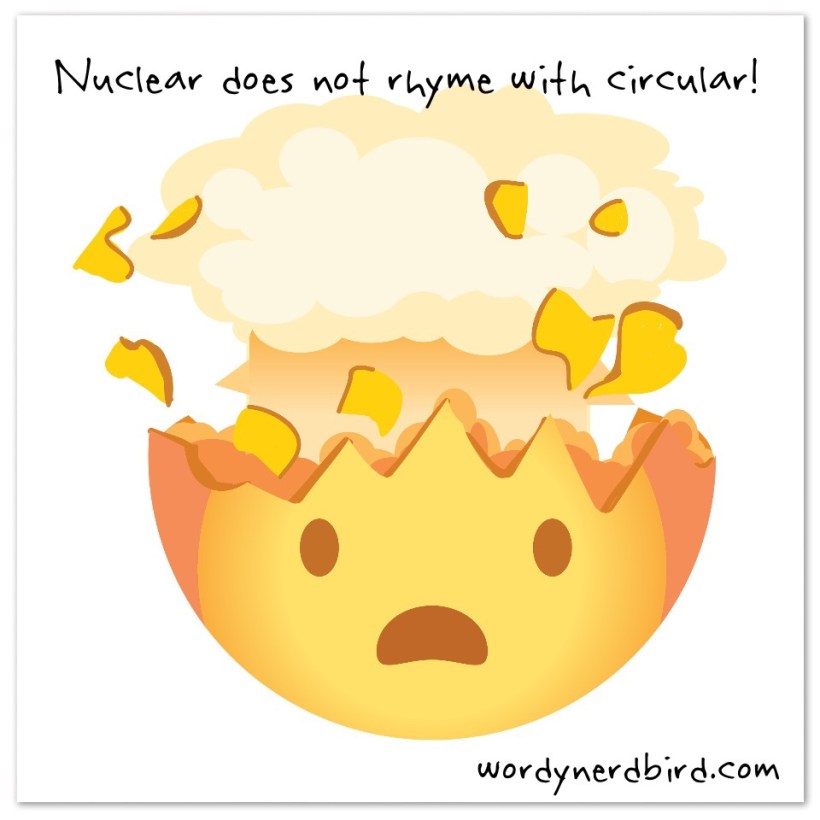
Nuclear Does Not Rhyme With Circular

This post might come across as some kind of linguistic snobbery, and while that’s not my motivation, it is a risk I am willing to take. 

The common mispronunciation of nuclear is something that drives me absolutely nuts. 

So many people pronounce it as nucular ( nyoo-kyoo-lar) but that is not how it is spelt or pronounced. I’ve even heard scientists on the radio and TV who say it that way, despite the fact that scientists of all people should know better. Did they get through however many of years study at university calling the central body of a cell the nuculus? I think not.

Nuclear is a three syllable word, pronounced nyoo-klee-ar.

If someone can say the words ‘new’ and ‘clear’ correctly, they should be able to manage ‘nuclear’ by just mashing those two words together. Think of it as linguistic nuclear fusion. 

It really isn’t rocket science. 

The Appeal of Poetic Justice

Why is it so satisfying to see horrible people get what’s coming to them?

Image by pixel2013 on Pixabay.

Poetic justice is the idea that someone will get, or has got, what they deserve as a consequence of their behaviour. It can be either a reward or a punishment, and these are sometimes thought of as two sides of the same coin: a perpetrator will suffer while their victim has the satisfaction of seeing that justice has been served. 

It is similar to the concept of karma, by which one’s intent and actions have a direct effect on their future and wellbeing. 

Another related idea is divine retribution: a divine being or the universe itself punishing someone for their actions. 

Of course, these concepts are highly subjective. What someone deserves or not depends on one’s perspective. If person A has suffered as the result of Person B’s actions, then A is able to interpret B’s bad fortune as poetic justice or karma, while B might well consider that they are a victim and have reason to hope for their own vindication. Realistically, those two people may never join the same dots. 

So why is the idea of poetic justice so appealing?

It can make someone going through a bad situation, or wearing the scars of previous suffering, feel that they are less alone. It can give them hope that and that someone or something somewhere might notice their situation and act in their favour. Ultimately, we would probably all want God or the universe or the supernatural or the powers that be to be on our side and rule in our favour. 

The thought of someone having to pay or suffer for what they’ve done to us or to others we care about is powerful. It’s also relatable: as much as we decry revenge and know that it doesn’t solve anything, it’s still an attractive prospect— particularly if we haven’t had to actually do anything to make it happen.

Hoping for poetic justice, or karma, or divine retribution, can also function as a passive way of taking back some control from those who have hurt us. How many of us can honestly say that we haven’t thought “Well, he had THAT coming!” when something bad that has happened to a horrible person?

They are natural thoughts and feelings, and they need to be acknowledged and worked through. 

Still, as understandable as those feelings may be, we cannot afford to unpack and live there, no matter how much some of us may want to. It’s not a healthy place to stay. We have to move on and find a way to prevent our feelings about someone else from controlling our behaviour and attitudes.  

Perhaps that’s why seeing poetic justice delivered to fictional characters— or, indeed, to public figures who behave badly—  is so satisfying. It may not be happening to our own nemesis, but at least it’s happening to someone else’s. 

The Appeal of Poetic Justice
#PoeticJustice #Karma #Retribution #satisfaction #observation #blogpost

Several of my books explore themes of poetic justice and seeing people who behave horribly punished for their actions in one way or another.
They are available via jvlpoet.com/books and in all digital stores. Paperbacks are also widely available via Amazon and Book Depository.

Irony, Dramatic Irony, and the Plot Twists of 2020

Image by sapphoris on Pixabay

Irony occurs when one thing is expected, but the opposite thing happens or turns out to be true. 

When the audience knows or understands something that the characters in a story or on stage or screen do not, that is called dramatic irony. 

It should be noted, too, that an event or outcome being ironic for one person or group does not preclude it being predictable for other people

Both irony and dramatic irony are much-loved devices for writers, but they do not only exist in literature and film. 

In fact, one could argue that the reason writers use these techniques is because they know that these things happen in everyday life, and that people love it when they do. The profundity of natural irony, dramatic or otherwise, is like crack for writers, who are often keen observers of human nature and behaviour.

Irony is a powerful thing. It can evoke all sorts of responses, ranging from pity to laughter to judgement, depending on the perspective of each onlooker. It can bring about self-pity, humility or significant changes in attitude and behaviour for those who experience it. 

When well executed by an author, irony creates plot twists and complications that add depth and complexity to a story, but which also make the experiences of the characters relatable and intriguing for readers. 

When expertly executed by the universe, though, irony can blow one’s mind. 

Without being political, it was ironic that Boris Johnson dismissed the potential threat of COVID-19, counted on the population developing herd immunity, and then got so sick with the virus that he ended up crediting the medical team who cared for him with saving his life.  

Likewise, Trump denied the existence or threat of the virus and casually dismissed the illness and death of thousands of his own people. He refused to wear a mask or observe social distancing, he insisted on holding social events and campaign rallies against all medical advice. That he has tested positive and ended up in hospital with the virus is loaded with both types of irony. 

Trump’s mockery of Hilary Clinton when she suffered pneumonia during her campaign in 2016 was not only a dreadful thing to do, it has also proven now to be deeply ironic. 

There is little doubt that 45’s illness is a plot twist that he didn’t see coming. 

One would hope that his treatment with highly experimental drugs that others with the illness haven’t had access to doesn’t end up doing more harm than good. That would also be ironic. 

Personally, I find it impossible to feel sorry for him. 

My empathy lies with all those Americans who suffered the disease and who lost loved ones to it while he proclaimed it as fake, and with all those who cannot afford the instant access to hospital care and fancy drugs that he can. 

Irony, Dramatic Irony, and the Plot Twists of 2020
#irony #PlotTwist #TrumpCovid #BorisJohnson #JustSaying #blogpost

Covid 19 and the Great Pestilence: How Much Have We Really Learned?

Image by ivabalk on Pixabay.

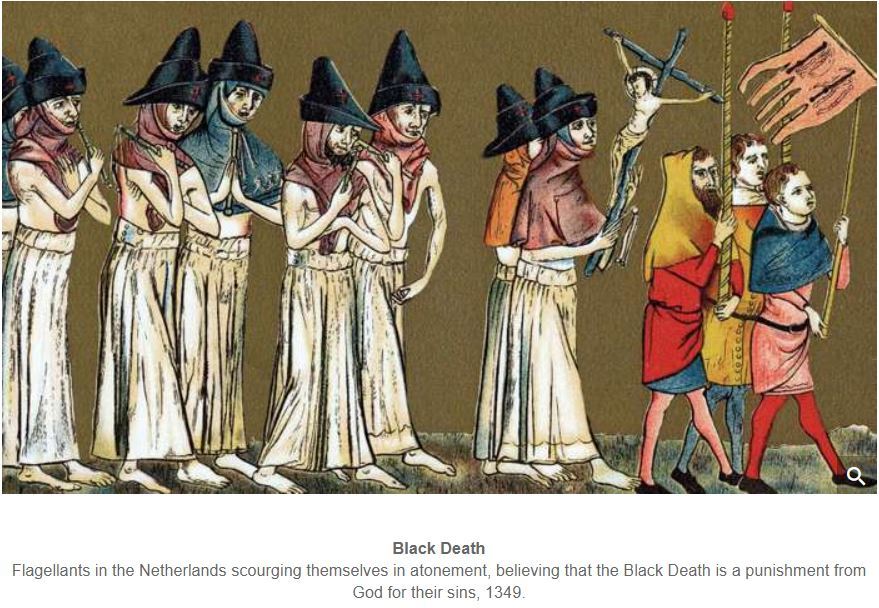
This post reminds me of the lessons I’ve been doing with my Year 8 History class about Medieval Europe and the Black Death.

My students were very interested in the plague, and surprised by the fact that this was when quarantine, social distancing, and the wearing of masks became the go-to modes of dealing with contagious disease. They were also surprised by the time it took the Europeans to understand the importance of basic hygiene, and how very long it took to develop good medical knowledge.

These lessons were highly relevant in These Times, and helped the kids to understand why we’re being reminded to wear masks, wash and sanitise our hands, and keep away from other people. It was good to be able to discuss how relevant history can be. 

We all agreed we are incredibly thankful for modern medicine, science, vaccines and health care. 

It does strike me as bizarre, however, that with all the scientific and technological advances we’ve made, we still have to remind people to wash their hands. Some things, it seems, never change. 

viscountessw's avatarmurreyandblue

This illustration is simply that, a suitable illustration – the Flagellants followed the first wave of the Great Pestilence and aren’t mentioned here.
from https://www.britannica.com/event/Black-Death

In this time of Covid 19, when we don’t know why it seems to affect men more than women, and some ethnicities but not others, it is interesting that back in the 14th century the tsunami of the Great Pestilence of 1348 was followed by lesser waves that differed in many ways from the original. The first of these, in the England of 24 Edward III (January 1360 to January 1361) was called the secunda pestilencia and appeared to affect mostly the very young, babies and adolescents. Women were not affected in the same way.

The Chronicle of the Greyfriars of King’s Lynn notes: “…In that year [1360] began a plague among Londoners at about the feast of St Michael, where at first infants…

View original post 471 more words

The Intensity of These Times

Image by ractapopulous on Pixabay

There are many ways people have found to refer to this era of Covid-19 and all its baggage: widespread testing and temperature checking, social distancing, hand washing and sanitising, and the wearing of masks. 

One of the most common is ‘these times’ and variations on that — these strange times, these difficult times, these awful times, and so on. There are myriad adjectives one could choose, although some are more socially acceptable than others. 

Recently, I’ve observed that people have started to capitalise the term as These Times in blogs and social media posts. 

This interests me, because of the way in which the language is being ever so slightly adjusted to add weight and significance to the term. Those capital letters are acting as an intensifier.

Intensifiers are those parts of language that add strength to what we’re saying or writing. Words like ‘absolutely’, ‘completely’, ‘terribly’, the commonplace ‘very’ and even the humble little ‘so’ are all intensifiers. Some people use expletives to do the same job, especially in spoken English. The meaning of the sentence doesn’t change if they are removed, but the sense of degree or importance in the words around them isn’t necessarily communicated if those intensifiers are not present. 

By capitalising those Ts, writers are communicating their assumption that their readers will know exactly what they’re talking about. And, in These Times, there is little doubt that they will. 

The Latest, Perhaps Greatest, Swear Word

Last week I asked my students to do something creative. 

 Today, Student A  wasn’t very impressed with the outcome of their efforts. “I tried, but it’s turned out a bit 2020.” 

“It’s a bit what?” I asked. 

“2020.” 

Obviously, I was expected to understand. 

“Mine’s pretty 2020 too, to be honest,”  Student B admitted. 

I looked at their faces on my screen. They were being serious. 

“So…” I asked, “Are we using that as a swear word now?” 

They’re right. It actually works.

“More meaningful than swearing, Miss,” said Student B.

The rest of the class concurred. 

“And we can’t even get in trouble for saying it.” Student A grinned, clearly rather pleased with that reality. 

I smiled, told them their work was way better than 2020, and moved the lesson on. 

I don’t know if they just started doing that by themselves or picked it up from somewhere else, but at least they’re finding some practical use for 2020. I may just follow suit. 

A Handy-Dandy Social Media Skill

I have a really handy social media skill. It may actually prove to be a talent: time will tell. 

It’s super for my mental health, and has amazing benefits in maintaining positive content on my social media feed. 

It is, quite simply, deleting rubbish content on social media and snoozing the people who post it. 

Obviously, “rubbish content” is a highly subjective term. But since it’s my hobby, and since it’s my social media feed, I get to decide what’s rubbish and what’s not. I don’t dictate to anyone else what they post, or what they read, or what they want to see. But I do get to decide on what I allow to speak into my life. 

Things that get an instant veto are racism, intolerance, and hatred. The chances of them changing my mind on those issues range at the lower end of remote to zero. Also high on the veto list are conspiracy theories, politics, and ignorance. I’m not limiting their right to free speech, nor am I insisting that they think or believe. I am simply choosing not to engage with them. All I am limiting is their ability to speak into my space and my mental health. 

To that end, I have deleted comments. Obviously, people can see if their comments have been deleted. If that bothered me more than  the comments do, I wouldn’t delete them.

I have also muted conversations in messenger. The person on the other end of the conversation won’t know I’ve muted them, because I don’t often respond to general content in messenger anyway. Forwarded messages, videos, chain letters, those virus-laden ‘OMG I can’t believe this!’ messages and spam only ever come to my inbox to die, friendless, unacknowledged and alone. If it’s a personal message, that’s a different thing entirely. 

I have snoozed or unfollowed people on Facebook. The advantage is that you can do both without those people knowing and getting all offended and being weird with you when you see them at the next family gathering or in the supermarket. 

Furthermore, I have zero shame about doing any of it. 

I have chosen to not engage in debates because I don’t have the energy, nor do I have any inclination to enter into conflict. My social media feed is not the place for a bunfight about whose lives matter or whether or not something is real. And if I post something and someone disagrees, they’re completely free to do so without starting an existential debate on my thread. They can do what I do, and simply walk away. 

As someone said to me last week, it’s a bit like peeing in a wetsuit: it gives you a warm feeling, but nobody else notices. That’s absolutely true, but that doesn’t matter one bit, because I’m not doing it for anyone else. I’m doing it for me.

Here’s the how-to:

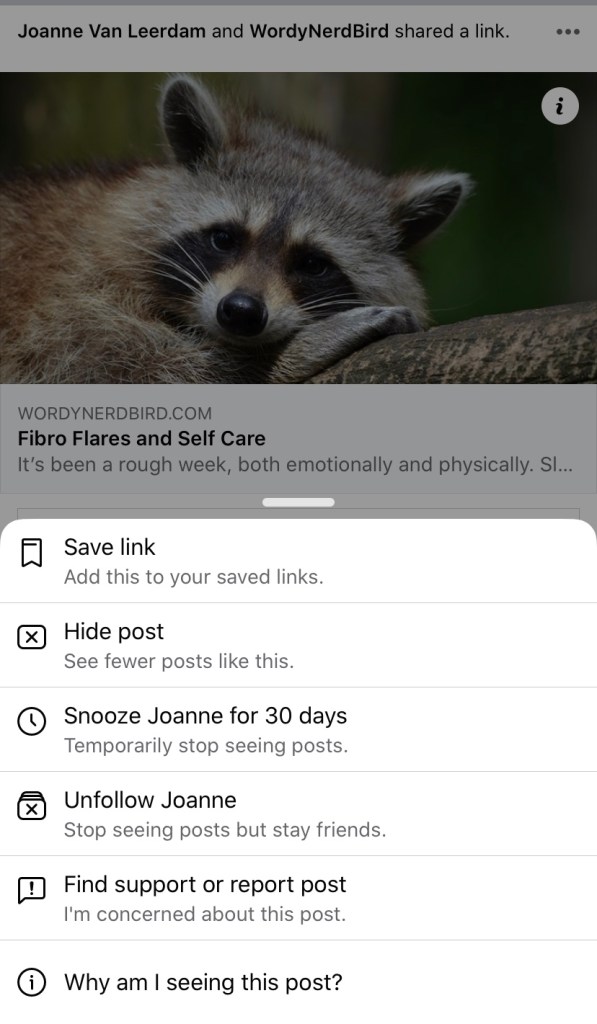
At the top right of a Facebook post are three dots, like an ellipsis. Click on those. 

From the drop-down menu, you can choose to snooze the person who made the most for 30 days OR to unfollow them entirely. This means you won’t see anything they post unless you go to their profile. 

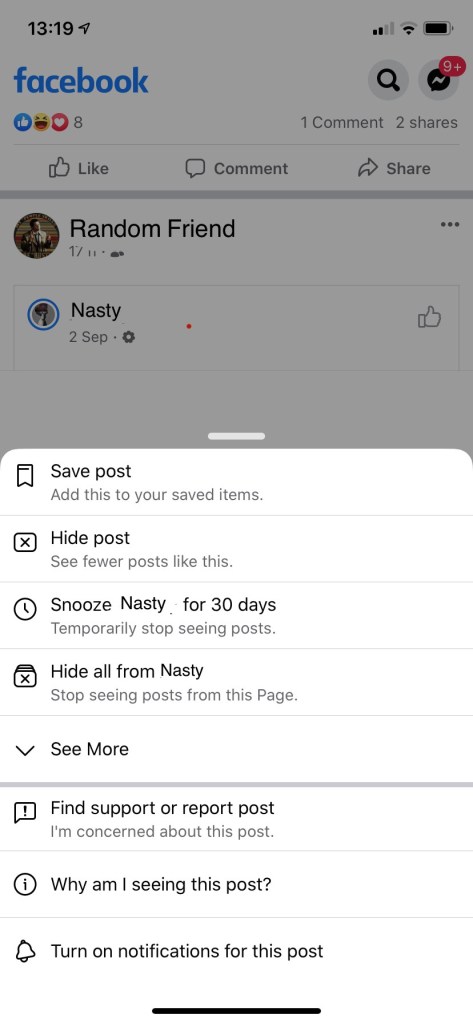
If that person is sharing someone else’s post, you have another option. 

I changed the names on this post so that there is no inferred suggestion certain pages should be hidden or unfollowed. I made this name up. Any resemblance to existing pages is entirely coincidental.

You can hide all content from the creator of the original post without affecting your friend’s usual posts. This is usually my first choice, and I don’t snooze or unfollow my friends until they have deliberately and repeatedly shared what I consider to be rubbish on multiple occasions: that’s when I understand that I am better off just not seeing their posts. 

Finally, if people think something I post is rubbish or disagreeable, they’re welcome to ignore it or snooze/unfollow me, too. Fair’s fair, and I’m really not that easily offended.