Dear Facebook… Yet Again.

I quote, verbatim, this afternoon’s status on my Facebook profile.

Dear Facebook,

You have been temporarily blocked from accessing some of my features.

I’m not telling you why. 
I”m not going to listen to your appeal.

But you can bet your algorithmic little hiney I’m going to have my eye on you for quite some time. Possibly forever.

Joanne Van Leerdam, June 25, 2019.

So, it seems that I’ve run afoul of the Facebook algorithm yet again.
Now they’re suggesting I’m a robot.

You read that right. A robot.

I haven’t made identical posts in forever. I vary what I post from page to page. l really don’t know what brought that on.

And let’s not overlook the irony of an algorithm calling me a robot. It’s beyond ridiculous.

They can’t still be sour about my “What I Do and Don’t Like About Facebook” post… can they?

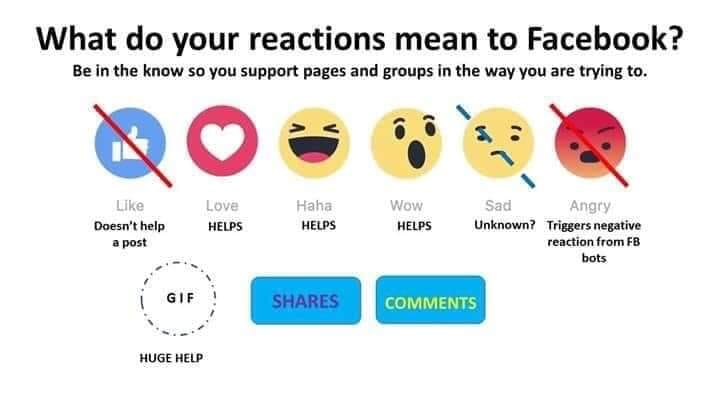
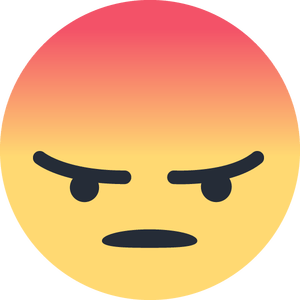
One suggestion that has been made is that when I’ve posted about things that annoy me, some well-meaning people have responded with the “angry face” reaction because they’re angry at the nonsense that a certain social media platform is throwing at people lately.

Apparently, for all its cleverness, the Facebook algorithm is unable to comprehend that it’s actually Facebook people are angry at. It interprets this reaction as those people being angry at me.

This is good to know.

Because who could be angry at Facebook or its ever-changing algorithm?

It’s fair to say that Facebook is not doing a single thing to recommend itself to me right now.

Why I Might Never Send Out Another Author Newsletter

They say having an email list is crucial for an author. It’s the one sure-fire way to reach your readers.

I am clearly the exception to that rule. 

Either I really suck at creating newsletters, or my subscribers signed up for the wrong list. 
It’s why I am very reluctant to  send out  newsletters now. 

When I send emails with other people’s books in them, my subscribers click through to those books. 
Do they click through to mine? Nope. 
And sadly, I get as many clicks to unsubscribe as I do on the links in my newsletter. 
It really is quite depressing. 

Yet I don’t do anything different than any of the dozens of authors whose newsletters I receive. Well, that part isn’t strictly true:

I don’t spam my books repeatedly.
I don’t email every week, let alone every day or two, like some do.
I don’t use high pressure sales pitches. 
I don’t beg, and I don’t whine. 
I don’t even include only my own content. I always share other books and bookish events that readers might be interested in. 

I have observed all those things happening in various different authors’ newsletters at different times, and have always tried to avoid doing anything I have found off-putting.

Honestly? I don’t know what I’m doing wrong, but I appear to be doing it consistently. 

I do suspect that maybe newsletter writing is not for me. I’ve given it a fair crack and it hasn’t been at all well received.

For now, I think I’ll stick to blogging. 

Facebook’s Delicate Community Standards

Facebook’s “community standards” did not enter my thoughts last night when I was posting about what I love and hate about Facebook. Had I been writing that post today, it would have been a very different story. 

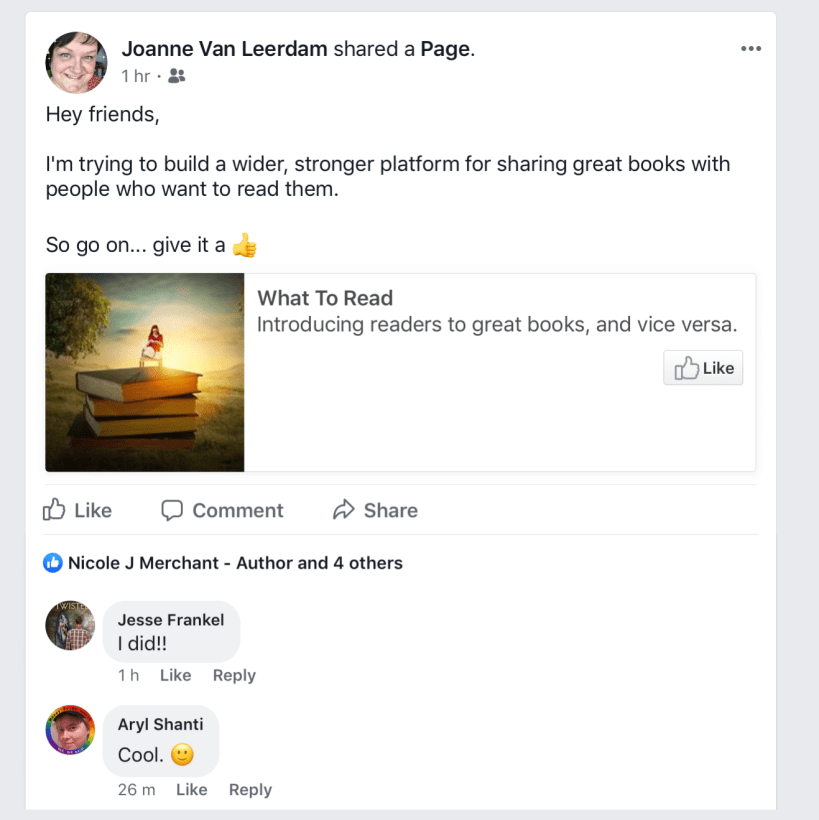
This afternoon, I set up a new page on Facebook with the aim of extending my reach to new readers by using a popular bookish hashtag phrase, What To Read, as the title. 

As soon as I had set up the page, Facebook started coaching me to complete certain steps to make my page more visible. 

Profile photo: check.
Cover photo: check. 
First post: check. 

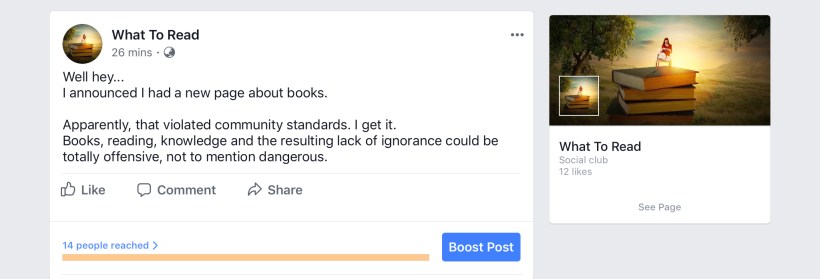
Oops! My first post violated Facebook’s delicate community standards. 
Want to know what it said? 

So… people can freely incite hate, vilify and shame others, put up pictures of them humiliating themselves… but I can’t suggest that my friends might like a page about books? 

Wow. 
Maybe I should have said something dumb instead. 

May the fates be in my favour when I actually start encouraging people to read. 

***

Update: it took me three attempts to share this blogpost on Facebook.
If they don’t want me to be snarky, they’re going the wrong way about it.

What I Love… and What I Don’t… about Facebook.

There’s no doubt about it: Facebook is one of the most popular social media platforms on the planet.

Like anything, it can be fantastic if it’s used the right way, and it can downright dangerous if used for sinister purposes. 

There are some aspects of Facebook I really enjoy:

  • Being able to connect with my family and friends all over the world in real time. What a blessing! When I’m homesick for someone I love – there they are! When I’m lonely – my friends are right there! I can see their pictures and videos, and respond to them right away. I can chat with them, talk with them, and send them stupid memes to cheer them up when they are down or unwell. 

  • Being able to connect with like-minded people all over the world. As part of the Indie author community, I have received so much help, encouragement, knowledge, advice and good direction from people in Facebook groups.

    It has also been a very great pleasure for me to be able to pass some of that knowledge and advice on to others, and to encourage them in their journeys.

    Similarly, I’ve made some wonderful lifelong friends in a particular grammar-nerd group, and have met two of them on one of my trips overseas.  I can’t imagine not knowing them or being able to talk with them.

  • Being able to find things I’m interested in via the pages people create. I’ve discovered some wonderful blogs to follow, some great information on specific topics, and I can’t tell you how many excellent Indie books I’ve found to read. That number has to be in the hundreds. 

  • Being able to permanently hide things from my timeline that I don’t want to see. This is generally anything racist, hateful, or politically zealous. 

  • Being able to permanently hide things from my timeline that I don’t want to see. This is generally anything racist, hateful, or politically zealous. 
  • Memes, jokes, and videos that make me laugh. Some of that stuff is pure gold.  
  • The block function. It’s really good. 

Of course, with the good comes the not-so-good. 

There are things I really hate about Facebook. 

  • The fact that they don’t show me everything my friends post. If my friends think it’s worth posting, I probably want to see it. But no… Facebook gets all choosy about showing me their posts, and when showing mine to them.

    Of course, they’ll tell you that boosting your post will get it shown to your friends. For $13, your post can reach… er, how about no? I’m not giving them money to show my posts to my own friends. They should do that for nothing. 

  • That dratted algorithm. It seems any moron can make a stupid post that will go viral because people “like” and  respond to it, but you can’t post a link for a product, or a blog post, or an event, or a website outside of Facebook without them suppressing it so that maybe 3% of the people who follow you or your page will actually see it.

    And every time you get clever about how to communicate your product/event/website to your audience, they change the algorithm so you are actually  no further ahead, yet again. 

    I know: it’s a business. But if they showed my stuff to the people I know, I’d probably be more interested in giving them a bit of cash to show it to folks I don’t know. 

  • The perceived freedom some people feel they have to deride, belittle, criticise, mock and bully others.  In a not-so-surprising coincidence, this correlates very closely with one of the things I hate most about people in general.  Just because they’re hiding behind a profile picture or an avatar, they think they can say what they want to and have no consequences. 

    Not in my world, Julie.
    Block, block, block.
    Fixed. 

The verdict: As much as I hate it, I love it.
I’m definitely keeping it.

But if I ever meet that algorithm in person… it may just walk away with a black eye. 

Being Fontist.

I am a person who takes others at face value. I don’t immediately classify someone as pretty or ugly, gay or straight, progressive or conservative (unless, either way, they are hateful or prejudiced – then the deal is off) , black or white or some other colour, blonde or brunette, or anything else. I don’t care if they’re plain or fancy, nor do I care if they’re pretty or not. I try to take each person as they are and let their integrity speak louder than their features. I like to get to know them before I make any decisions about them.

When it comes to fonts, however, i am nowhere near as open-minded. Don’t get me wrong – there are plenty of fonts I like, and many others that I will view with an open mind depending on context and purpose. 
But there ARE two or three fonts I really hate. I refuse to use them. I have handed back an assignment or two, asking for it to be reprinted in a more acceptable typeface. It’s true: I am Fontist. 

I wasn’t raised that way.  We didn’t really need to think about fonts back then. When I was growing up, it seemed as thought books were printed in two, maybe three different standard fonts. From memory, there was something like Times New Roman,  a basic Sans Serif, and possibly another standard typewriter-style serif font. There was never a question of what typeface to submit our work in, because computers weren’t a thing and our school work was all handwritten. When I started university, assignments and essays had to be typed and double-spaced, so I used my parents’ typewriter. Of course, it only got to the typing stage when one or two hand-written drafts had been painstakingly written, proofread, edited, and revised. 

Don’t get me wrong: I’m glad those days are over. I appreciate the ease of writing using my laptop as much as anyone else, and I’m happy for my students to do some – but not all – of their work on their devices. 
My underlying Fontism rears its ugly head, though, when someone hands in an assignment or broadcasts a presentation on the screen that screams “ridiculous font” louder than anything the student is trying to communicate. The same thing happens in meetings and seminars where the important information is obscured by the poor choice of font on the screen or handout. 

You might think I’m overreacting. But consider this: I might read fifty student assignments in less than a week, or sit through twenty five student presentations in two or three days. When their font suggests I shouldn’t be taking their work seriously, that’s a complication neither they nor I need. 

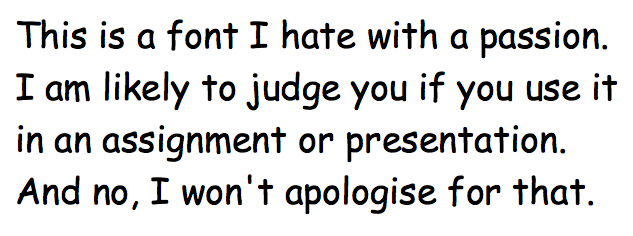
Right at the top of my hate list is Comic Sans. It looks childish, and gets increasingly ridiculous as the size increases, to the point where it is almost impossible for me to take anything printed in that font seriously. It is a font that should never be used for school work of any description by anyone older than six, nor should it be used for slide shows and presentations.  Yes, it is “nice and clear for people to read”, but so are about 3000 other fonts one could choose. If your audience is not entirely in the First Grade, choose something else. 

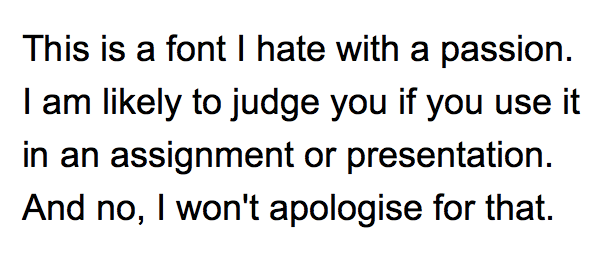
Another font I hate is Arial. Yes, it is also nice and clear for people to read. It is also entirely bland and unimaginative. Arial is the font equivalent of still having that original iPhone Marimba ring tone from 2008 on your new iPhoneX when you have 2500 different songs on your playlists.  It is the font for lazy people who don’t care how their work looks. It doesn’t take much effort to switch so something equally clear but which looks a lot more polished and professional. In a word: boring. 

The other fonts I really dislike fall into two groups: anything over-decorative and wrongly sized formatting

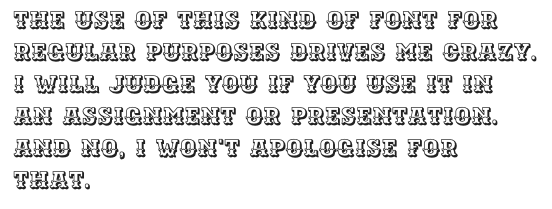
Over decorative fonts have their place, but trying to read a block of text printed in anything full of swirls and flourishes or trippy lines and shadows will make a teacher’s eyes bleed in less than three minutes. Decorative fonts can work really well for titles, or for a special capital letter or character to start a page or chapter, but they fail miserably for anything that needs to communicate information or arguments clearly and effectively. 

In a similar vein, text printed too small or too large is equally frustrating. If it’s too small and condensed, it’s hard to read and… you guessed it, bleeding eyeballs. At the other end of the equation, students may think they can fool me into believing their 337words meets the 500 word minimum word count if their work is formatted in size 15 Helvetica, but my teacher brain knows better. My teacher brain has been doing this a lot longer than they have. 

So, I guess this is me coming out of the classroom cupboard and acknowledging the ugliness of the deep-seated prejudice that lies deep within me. It is equally as rampant and undeniable as the grammar nerdism that I make no attempt to hide.

Call me fussy. Call me Fontist. I’m okay with that. But don’t call me to complain if I’ve asked your teen cherub to reprint an assignment so that I can read it without tears. Trust me – it’s better that way, and I’ve tried to be nice about it. Well, I’ve probably been nice.. 

Maybe. 

Unless they are a repeat offender. In that case, there are no guarantees. 

Fibromyalgia And Me

I could have spent most of Fibromyalgia Awareness Month writing about my experience of this condition. I could spend a year writing what people don’t know or understand about it.

However, I plan for this to be my only post on that topic during this Fibromyalgia Awareness Month, because I don’t like to complain and I don’t want to sound like I am hiding behind my disease or making excuses. 

Fibromyalgia is a diagnosed medical condition— now. It wasn’t always. It has a wide variety of symptoms, although they basically all contribute to chronic pain and overwhelming fatigue. 

Because of Fibromyalgia, I have pain all the time. Think about that. 

Pain.
 All.
The.
Time. 

It doesn’t ever completely go away. The best I can hope for is that it will ease off a bit, and that I’ll have more good days than awful ones. 

When people present to the Emergency Department or paramedics with pain, the standard procedure is to ask them to rank it between 1 and 10, assuming that 10 is the worst pain they have experienced. I wake up most days to a starting level of about 4 or 5 for me. With medication, I can generally keep it down to about a 3. 

That’s why I have structured my working week so that I start a bit later in the mornings. It’s not because I don’t want to get out of bed: it’s because when I do, I am stiff and sore and it’s really hard to get moving. 
As the day wears on, my pain levels start to increase. My legs feel heavy and hard to lift when I walk. My feet  begin to ache, and that often turns into a throbbing pain that starts to work its way up my legs. It can take hours for the aching to subside enough to let me sleep, especially if I have been on my feet a lot. A similar thing happens with my hands and arms if I am using them a lot, and especially if it involves holding or carrying anything with a bit of weight in it. It’s not unusual to end each day feeling like I’ve been either beaten up or body slammed by someone or something a lot larger than me. 

Anytime I get stressed or anxious, or when my depression is messing with me, my pain levels flare. Overtiredness also increases my pain. Sometimes, I reach that level of tiredness by lunchtime and still have two classes to teach and a 40 minute drive home before I can rest. Add in a work deadline or two and things can get pretty horrid. 

All of this is completely separate from my back pain, which is a different thing and a different type of pain altogether, and which I am able to manage fairly effective for the most part.  

The problem with pain is that people can’t see it like they can if you have cuts and bruises or a cast. You can hide a lot behind makeup and a smile. 

When they call this an invisible illness, they’re not kidding. If I had a dollar for every time someone said to me “But you don’t look sick,” I could quit work and live very nicely on the interest. It’s such a shame I can’t bill people for their insensitivity or ignorance. 

I know it’s not a death sentence like some other diseases are. It is, however, a life sentence. As things stand, there’s no cure in sight. All I can do is keep up my painkillers and anti-inflammatories and hope for the best. 

None of this makes me, or anyone else with Fibromyalgia, weak. 

It takes strength and courage to get through each day, and sometimes that’s on a moment-by-moment basis. It takes resolve to blink away the tears and keep showing up for work or social or family occasions. It takes guts to say, “Actually, I’m not doing so well” when people ask, or to write a post like this one. In a world that prioritises health and beauty, brokenness is often an unpopular confession. 

I have Fibromyalgia. I don’t want sympathy or pity. I don’t want people to tell me I am strong or brave. You bet I am! 

What I really want is more awareness, better understanding, and more effective pain relief. And a cape. They can’t see my pain or my superpowers, but they’d be sure to know I have something if I were wearing a cape. 

Shakespeare’s Birthday

Every year on April 23rd, my family celebrates Shakespeare’s birthday with cake. I always do some reading from a play or sonnet, but my husband isn’t so fond of that as he is of the cake, so it’s usually either a solitary activity or one I share with my dog. It’s a well-established fact that Abbey the Labby loves the Bard… and cake.

This year, though, my homage will take the form of several hours of rehearsal for a different comedy – Monty Python’s Spamalot – before I am able to indulge in birthday cake. It does seem fitting that the show is a little bawdy, somewhat irreverent, and absolutely hilarious. 

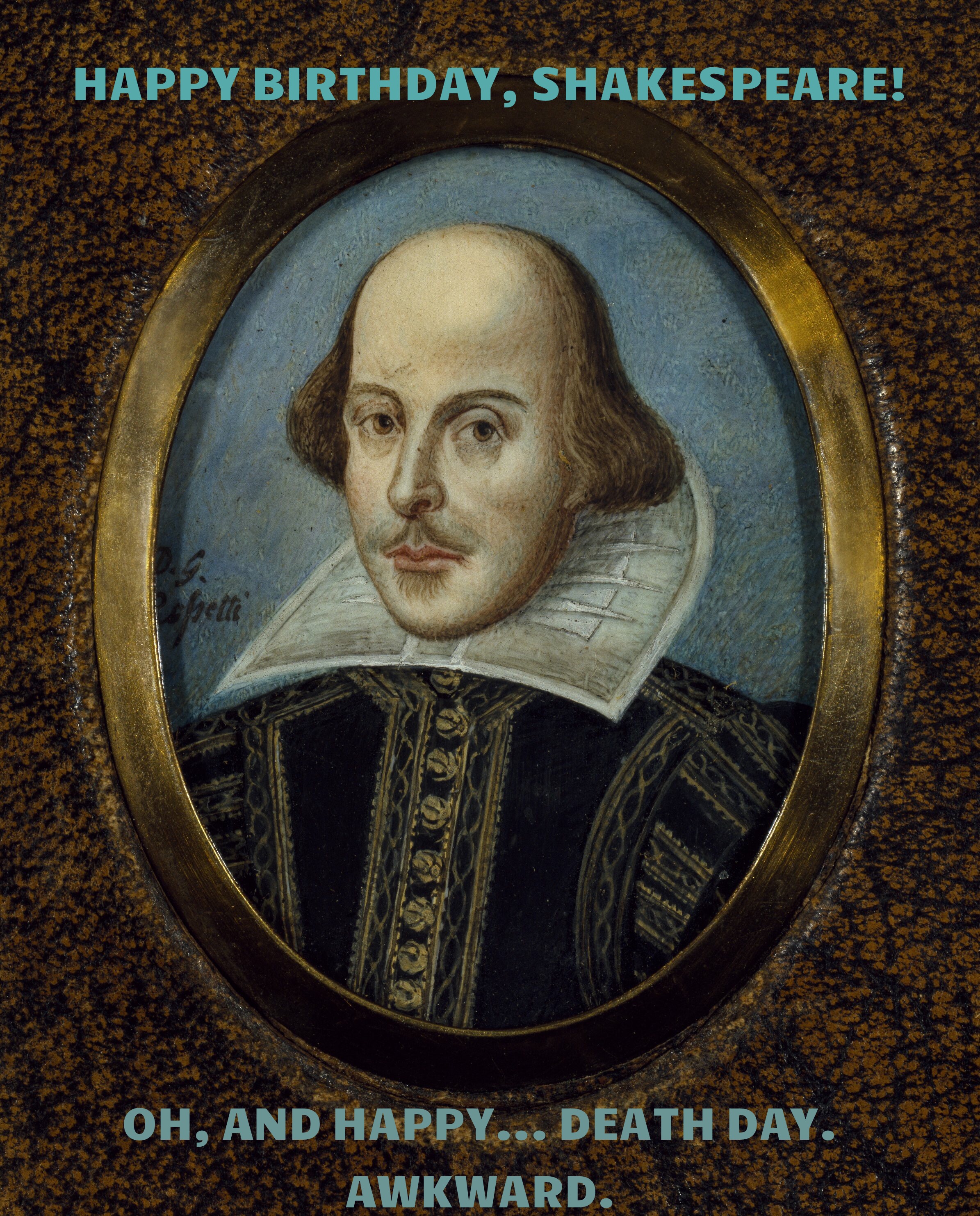
While the precise date of Shakespeare’s birth was not recorded, the date of his baptism was registered as April 26th, 1564. Because it was traditional for babies to be christened three days after they were born, it is generally accepted that William Shakespeare was born on April 23rd. 

In an ironic twist, Shakespeare died on the same date in 1616. Some people think that is awkward, but I think it’s a pretty cool achievement. I’m not sure how common it is for people to die on their birthday, but one of my grandfathers  did, so it’s a feat that has always been a point of interest for me. 

So, here’s to The Bard, his works, and his legacy.

Women in History: Anne Neville

Anne Neville has to be one of the women in history most maligned by Shakespeare.

While it is true that he does portrays her as one of the many victims of Richard III, and doesn’t really say anything terribly nasty about her, it is also undeniable that her reputation is maligned by the way she is portrayed as being quite fickle and very, very gullible.

As I always remind my students, there is a vast difference between actual history and Shakespeare’s play. In fact, Shakespeare entirely misrepresents both the course of events and the relationship between Anne and Richard. 

Not only were their families well known to one another, they were quite closely related. 

Anne grew up at Middleham Castle, the daughter of the 13th Earl of Warwick and his wife, Anne Beauchamp. Anne’s great aunt was Cecily Neville, the wife of Richard, Duke of York, and mother of Richard and his brothers.

When the Duke Of York died, his youngest sons George and  Richard went to live at Middleham with Warwick’s family. Anne’s sister Isabel would later marry George, Duke of Clarence.

Warwick, known as The Kingmaker, played a crucial role in helping his cousin take and hold the throne as the King Edward IV of the House of York during the troubled times of conflict commonly referred to as either The Cousins’ War or the Wars of the Roses. For the first few years of Edward’s reign, Warwick held enormous influence over the young King. 

However, when Warwick tried to negotiate a marriage arrangement for Edward to secure an alliance with France, he discovered that Edward had secretly married Elizabeth Woodville, the widow of Sir John Grey who had been loyal to the Lancastrians. Warwick was not alone in distrusting her and her family, and was profoundly annoyed by Edward’s secret marriage to a woman whom Warwick considered entirely unsuitable. 

At the same time, and quite likely in direct response to Warwick’s contempt for his queen, Edward refused to give his blessing to a proposed union between his brother George, Duke of Clarence, and Warwick’s daughter Isabel, but the pair married anyway with Warwick’s blessing. 

This pitched Warwick and Edward against Edward, and their forces met in battle at Edgecote Moor in 1469. Edward was defeated and taken captive, although released before long, Warwick had sufficient time to reconcile his differences with Margaret of Anjou, the queen of the former Lancastrian King Henry VI. The significance of this is enormous: Warwick and Margaret absolutely hated one another.  

Even so, Warwick’s daughter Anne Neville was betrothed to Margaret’s son Edward of Westminster, the Lancastrian Prince Of Wales,  as a seal of the alliance, and Henry VI was restored to the throne of England two months before Anne and Edward were married in November of 1470. Thus,  Anne became the Princess of Wales and part of the Lancaster dynasty. 

Edward of York, however, was not so easily deposed. He defeated and killed Henry VI in the Battle of Barnet in April 1471, just as Margaret, Edward and Anne were returning to England. Margaret led an army to Tewksbury in May, where her son Edward was killed either during or just after the battle. Edward IV of York then reclaimed the throne as king of England.

Anne, a young widow, took up residence with her sister Isabel and her husband. When Richard asked for and was given consent to marry Anne, the only opposition came from his own brother, who wanted to inherit the entirety of Warwick’s wealth for himself. 

Anne was very willing to marry Richard, and harbored no resentment toward Richard for any of his deeds, perceived or real. They married in 1472 and theirr only son, Edward of Middleham, was born in 1473.

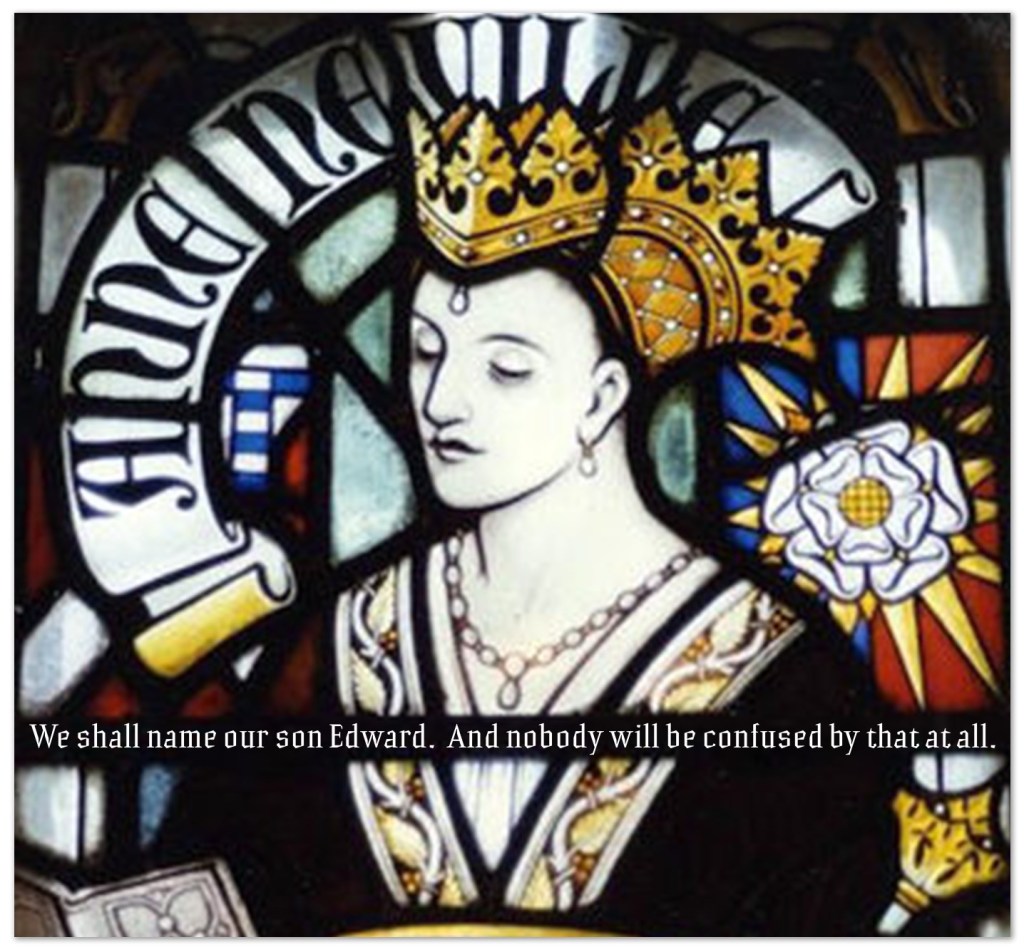
Her relationship with Richard’s mother Cecily was good and her marriage to Richard was happy, although stricken by grief when their son died at the age of ten. Anne and Richard then adopted the young orphaned son of her sister and Clarence, who was also named Edward — of course he was! and of a similar age to their own son. In yet another striking contrast to Shakespeare’s play, the newly adopted boy was named Richard’s heir. 

Anne Neville died at Westminster on 16th March 1485, from an illness that was most likely tuberculosis. She was only in her late twenties, but she had witnessed a very great deal of conflict, grief and turmoil in the kingdom in the course of her life. She was buried in Westminster Abbey, near the High Altar, although the location of her grave was never marked. 

Anne’s story is very different than that told by Shakespeare. Instead, Anne appears to have been a woman who possessed both integrity and backbone, and to have dealt with her trials with considerable resilience. As much as I love the works of the Bard, I do prefer the real story of Anne Neville, and feel sorry that for so many years, she was neither admired nor respected as she deserved to be. 
The Facebook and Instagram Outage Crisis of March 13th, 2019

Despite the crisis that had unfolded overnight as I slept, I woke this morning to find that the sun had risen, gravity still worked, and the earth continued to turn on its axis. 

I had breakfast, got ready for work, and headed into a very busy day. Surprisingly, I found that the work deadlines and professional requirements that were in place yesterday still existed today. 

My students, however, were despondent. 

Them: Facebook is gone! Instagram doesn’t work! 
Me: Imagine how much work you might get done in the meantime!
Them: You’re not very sympathetic. 
Me: And that surprises you because…?
Them: Rolled eyes and sighs. Some lovely moments of dramatic pathos that I shall try to draw on in drama class. 

This left me wondering: what on earth does the world do without Facebook and Instagram? 
It seems the general response is to complain. 

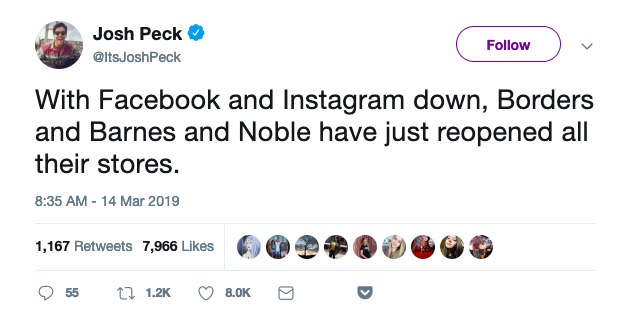
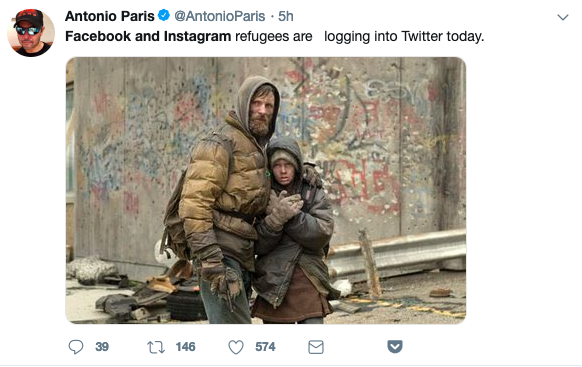
Many of the real social media junkies responded by rushing over to Twitter to complain and commiserate with their followers and the social media world in general. 

In all honesty, some of the responses are pretty funny. 

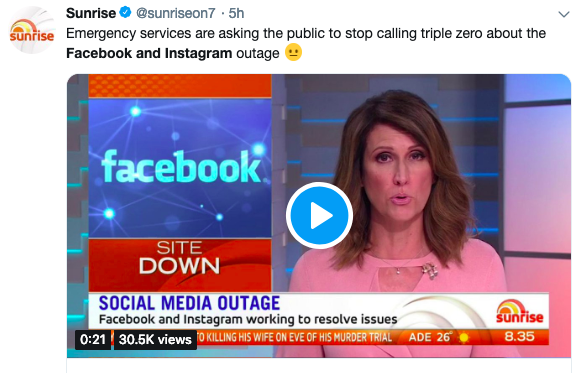
Others demonstrate that many people are much worse at dealing with this kind of thing than they should be.  
I mean, really, Australia?
Emergency services?
That’s… pathetic.

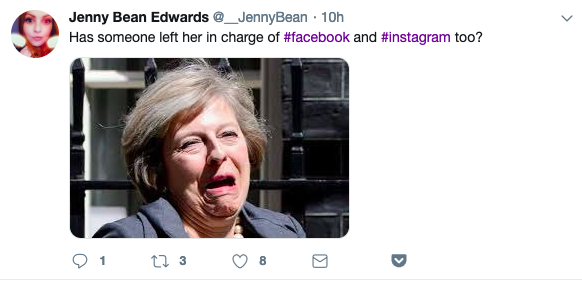
This one has to be my favourite. It cuts through the whining and combines the sublime and the ridiculous with glorious snark.
Jenny Bean Edwards gets an A+ for World Studies.

Cheer up, folks.
I’m sure Facebook and Instagram and their enormously profitable algorithms will be back soon.

Until then? You may actually be forced to either read a book or have face-to-face conversations with real people.

Alternatively, you can head to twitter and follow me!

No More Tiptoeing Through The Tulips.

I love tulips. They are lovely and graceful, and so colourful!  

My goodness, though, they’re delicate. It doesn’t take much to make a tulip wilt and bend its head to the ground. One might be tempted to think that a flower that needs to have its bulb frozen during winter in order to bloom might be a little more resilient… but apparently not.

I’ve come to the conclusion that a lot of the people in my circles— not all, but a hefty percentage of them— are like tulips. As long as the environment suits them, they are fine, but when they are unhappy for some reason, they just don’t cope. It doesn’t take much to upset the balance: just do something they find confronting. The more brave and nonconformist the act, the stronger the effect.

Don’t get me wrong: I do like most of the people in my circles. 

What I don’t like is having to kowtow to their apparent discomfort about certain things that matter to me, when they demonstrate zero tolerance to who and what I am. 

I am weary of having to live with the perpetual awareness that many people I know don’t mind me being an author as long as I never mention it. Some wouldn’t mind my multiple ear piercings either if I grew my hair longer to cover them. Others don’t mind my tattoos as long as my clothes hide them. They feign politeness when I talk about the theatre company I’m in or the musicals I direct at school, but very few of them have ever bought a ticket and come to see a show. And let’s not even start on how they feel about my political views. 

And yes. Those very different things get exactly the same reaction from a lot of people.

It’s ridiculous, and I’m over it. 

I am not less than them. 
I do not matter less than they do. 
My feelings, thoughts, passions and pursuits matter just as much as theirs do. 
I am as worthy of their interest and respect as they are of mine.

And I am very proud of my poetry and my stories… and of my shows. I’m rather fond of my tattoos and piercings too, for that matter. 

What I write happens to be pretty darned good: all those reviews my books receive from strangers are proof of that. Why should I hide my work under a cloak of secrecy when they can freely discuss being a builder, a butcher, a baker or a candlestick maker?

Nobody looks at them with thinly veiled suspicion. Nobody questions if what they build or make is any good. Nobody asks how much money they make per job. Nobody asks if their kids are real, or if they are any good. 
They are all quite free and welcome to talk about their kids in front of me even though I don’t have any, and I certainly don’t respond as though they are trying to sell me a child.

So, no more tiptoeing around. I won’t be shoving a book in their face at every opportunity — that’s not me — but I’m not going to allow others to pretend they don’t exist, either. They don’t have to read my work, but they will know that I expect their respect and acknowledgment.

I will not allow other people to treat me as less than I am.

I will not allow them to suppress my thoughts and feelings. 
I will call people out on double standards. 
I will refuse to be made to feel small.
I will be as diplomatic and gentle as I can, but I will assert myself.

And if they insist, I will know they are not really my people, and were never really in my circle.