Anyone who knows me well enough to be in my front yard knows how much I love my maple trees that I have carefully and lovingly grown as reminders of my beloved Canada. I can’t get there anywhere near as often as I want to, so the least I can do is have a bit of Canada in my own garden. It’s not too much to ask.
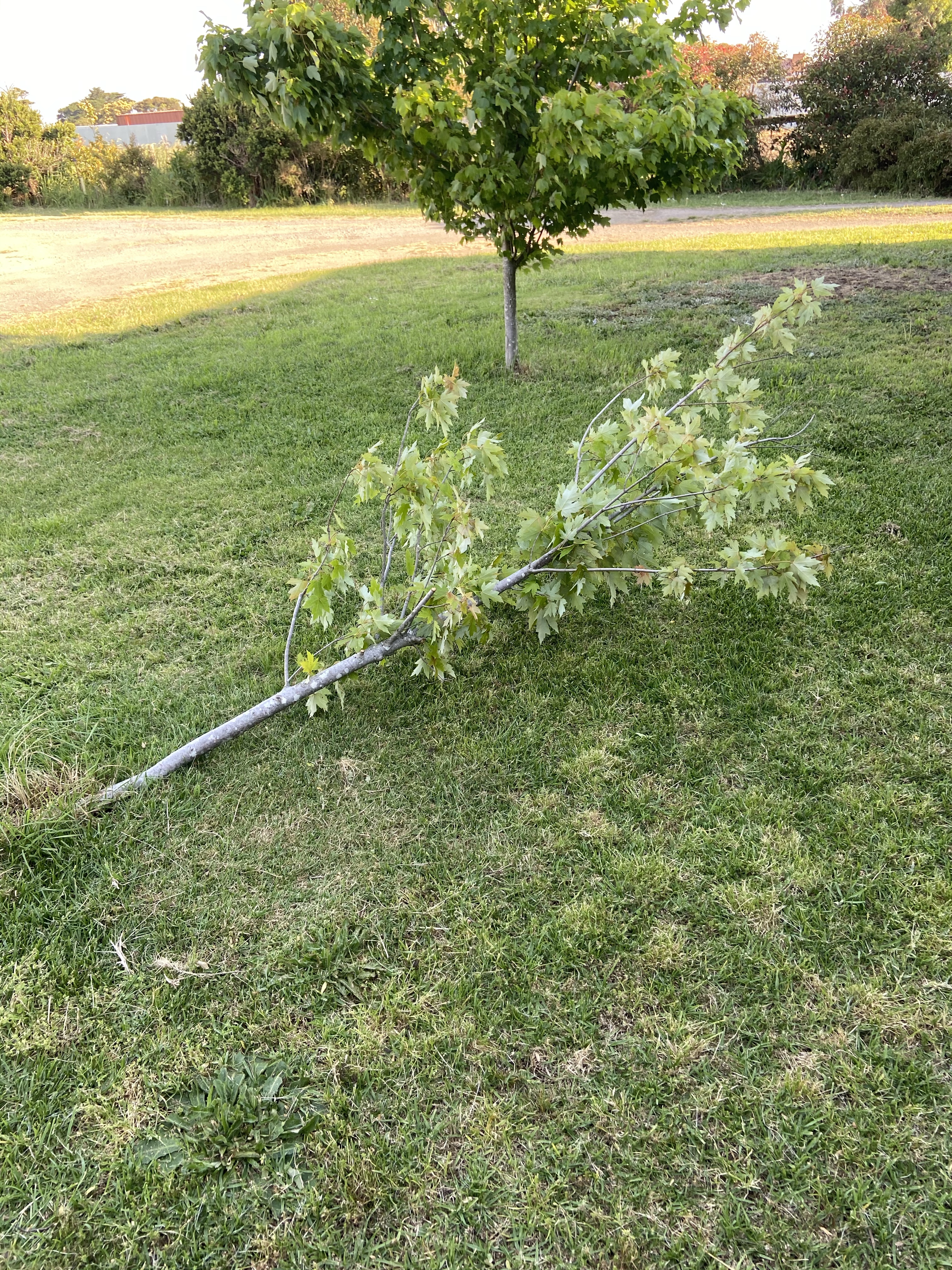
Today, though, someone who was in my front yard — unbeknown to anyone who lives here, of course, heartlessly ran down one of my maples.
The victim.
Yes, it was a fairly small tree. That is irrelevant, because it was on its way to being big. Big maples cost lots more than smaller maples in Australia, and small ones cost more than enough. More importantly, it was my tree.
The only notification they left of the destruction of my tree was the tree itself, now horizontal rather than vertical. No note. No phone call or text. No apology. No identification of the culprit.
I am so sad. I’m sad for the loss of a tree that actually meant something to me.
I’m also sad that whoever is responsible felt it was okay to not be honest with me.
If I knocked over someone’s tree or broke something that belonged to someone else, I would be guilt-ridden and desperate to replace it.
Apparently, not everyone I know is quite so principled.
Fortunately for them, I have absolutely zero clues as to who is responsible.
Unfortunately for me, that means that my already cynical INFJ mind will not just go “oh well…” and let it go. Self-destructive as it may be, a little voice in my head will wonder ‘Was it you?’ every time I see people I should be able to trust. The question will probably never come out of my mouth, but it will be there, nevertheless.
The group of people in whom I have absolute trust was already a very small group indeed. And people wonder why.
Doomscrolling is the act of continually updating and reading one’s social media feed for the latest news on a significant event. It is closely related to doomsurfing, which is scouring the Internet for the same kind of information.
The term has been around for a few years, but found new popularity as a hashtag earlier this year, predominantly in response to Covid-19. It is surging again on Twitter today as people try to stay updated on the results of the US election.
It may be a relatively recently coined term, but it’s fair to say the activity to which it refers has probably existed for as long as easy access to the Internet, especially via platforms such as Twitter and Facebook, has been available.
It’s an understandable behaviour – we want to stay informed, after all. These things matter. We want to know. However, it can also be a very effective self-torture device, as it compels us to focus on what is actually causing our anxiety and distress. It seems that the worse the news is, the more people tend to keep on watching or reading. Some people even become fixated on that event, to the exclusion of other things, no matter how sad or angry it makes them.
The term also hints at the subjectivity of the behaviour: what one interprets as ‘doom’ is likely to be the exact inverse of what another person interprets it to be. It all depends on what outcome one is hoping for whether the course of events is classified as doom or a reprieve.
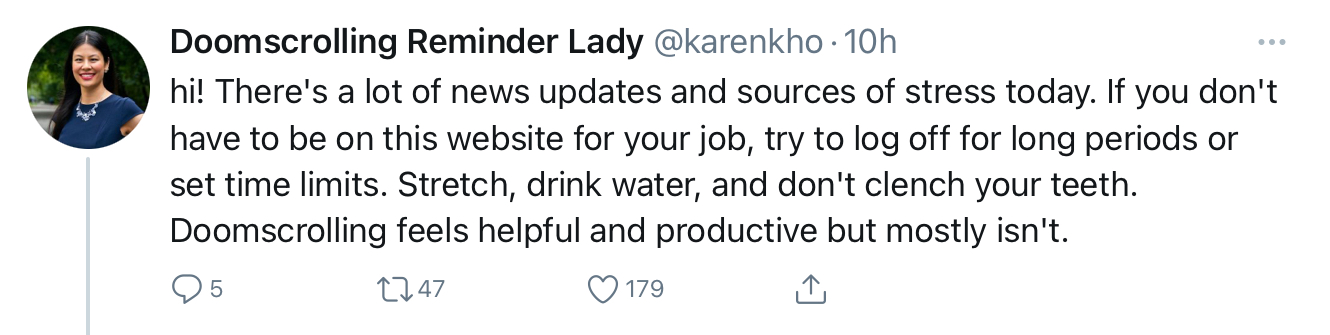
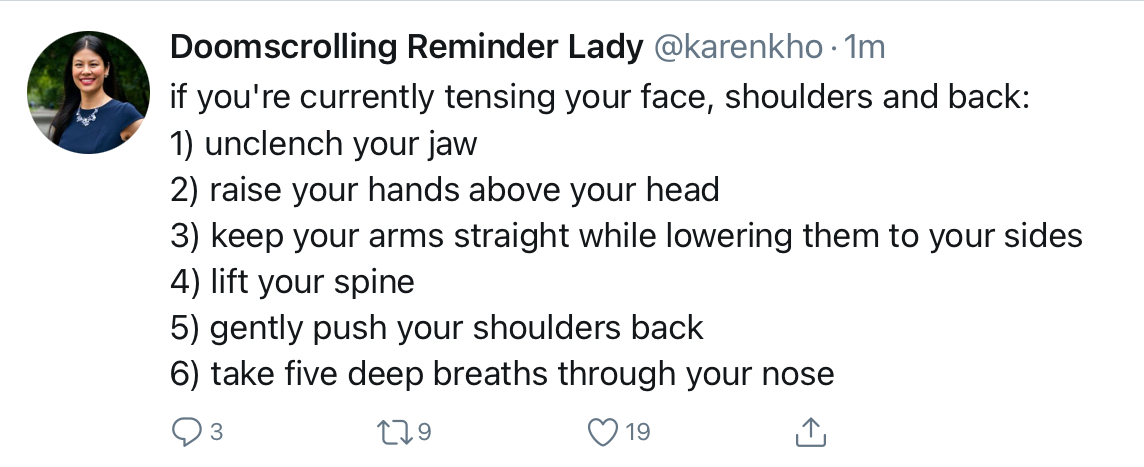
A highly relevant and helpful Twitter account is Doomscrolling Reminder Lady, who repeatedly tells people to get off the internet and take care of themselves instead.
Elections in Australia, New Zealand, Britain and Canada are more straightforward than those conducted in the USA. Here, the winner of the popular vote in each electorate wins the seat. The leader of the winning party becomes the Prime Minister.
American elections, on the other hand, are more complex and remain somewhat baffling to many of us.
I found this page to be full of clear, concise explanations for all those who, like me, are still wondering exactly how American elections work.
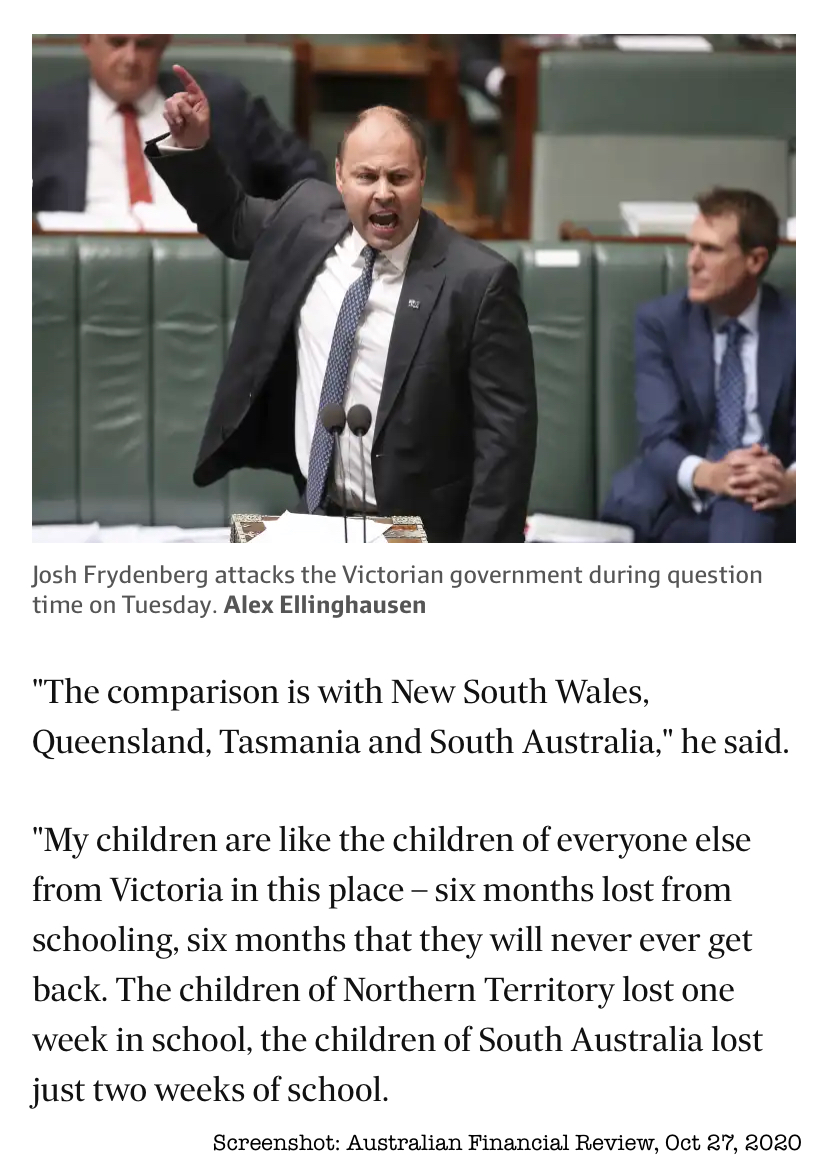
An open letter to Josh Frydenberg, Federal Treasurer and MP for Cooyong:
You have some nerve. Your outburst in Parliament yesterday was way out of line.
Yes, mistakes were made early on in Victoria’s management of COVID. And they got cleaned up. We’ve actually done a brilliant job, which you didn’t even acknowledge. But that isn’t the part of your speech to which I, and many other Victorian teachers, take particular exception.
While the rest of the House was congratulating the people of Victoria on crushing the curve and bringing the numbers back to zero, you chose to be ungrateful. That little tantrum of yours would make a two year old proud.
Your assertion that your children missed out on six months of schooling is highly offensive to every teacher in this fine state who has gone way beyond the call of professionalism and duty of care to ensure that our students did not miss a single thing that we were able to provide for them.
Were my colleagues and I merely dreaming all the extra work we put into setting up online classrooms, doing extra courses in online safety and classroom management, monitoring our students’ wellbeing and mental health, in addition to all the usual planning, preparation and teaching we have been doing all year? Did we imagine the eye fatigue and headaches from being in online classrooms all day, doing all our marking and reporting online, meeting with colleagues and conferencing with parents online?
You have been able to do your job almost completely normally all year.
We have had to completely reinvent ours, while at the same time being required to switch from face to face teaching to online classrooms, then back, and back again, sometimes at only a few days’ notice. We’ve done it without tantrums, without complaints, and without pointing fingers at people who were also trying to do their best in otherwise uncharted territory.
Victorian teachers have proven to be dedicated, resilient, and incredibly versatile this year.
And I will tell you one thing that is absolutely certain: the students at my school did not miss six months of school. They had their full timetable, every school day, complete with teachers and teachers aides, differentiated lessons, roll call, and individual help whenever they needed it.
Don’t be firing your nasty little aspersions at Victorian schools and the 100% committed teachers in them, Mr Frydenberg, even by inference.
We do not deserve that. We are exhausted, our patience has been pushed to the limit, and we are still going. We are not in the mood for your petulant tantrums.
It’s high time you gave credit where credit is due, learned some gratitude and grace, and got on with doing your job while we continue to do ours.
An Open Letter to Josh Frydenberg @JoshFrydenberg #TeacherLife #VictoriaTheHeroState #howdareyou
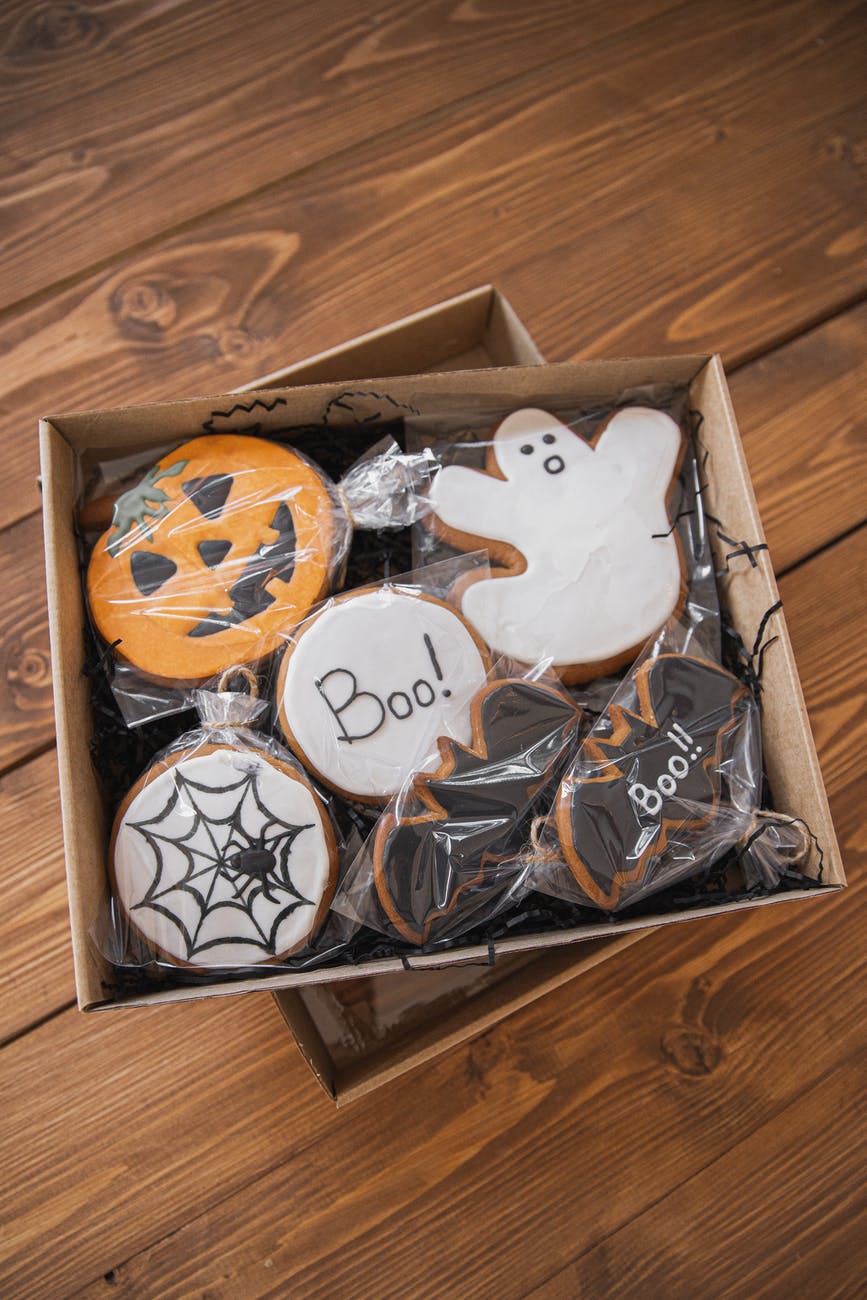
It’s one week today until Halloween. The shops are full of costumes, accessories, and big bags of treats to hand out.
Australians are once again protesting about it being an American thing (it’s not) while they gladly binge-watch American TV series on Foxtel and Netflix, listen to predominantly American music on commercial radio, and argue about whether Coke or Pepsi is better. (It’s definitely Coke.)
Despite the protestations of those Aussie nay-sayers, it’s a week that I quite enjoy. It reminds me of my first Halloween season in Canada, where I learned more about the background of the holiday and started to appreciate it in a different way. I like seeing kids and families out together, dressed up in costumes and walking around my small town, spending time together and having fun that doesn’t involve a screen.
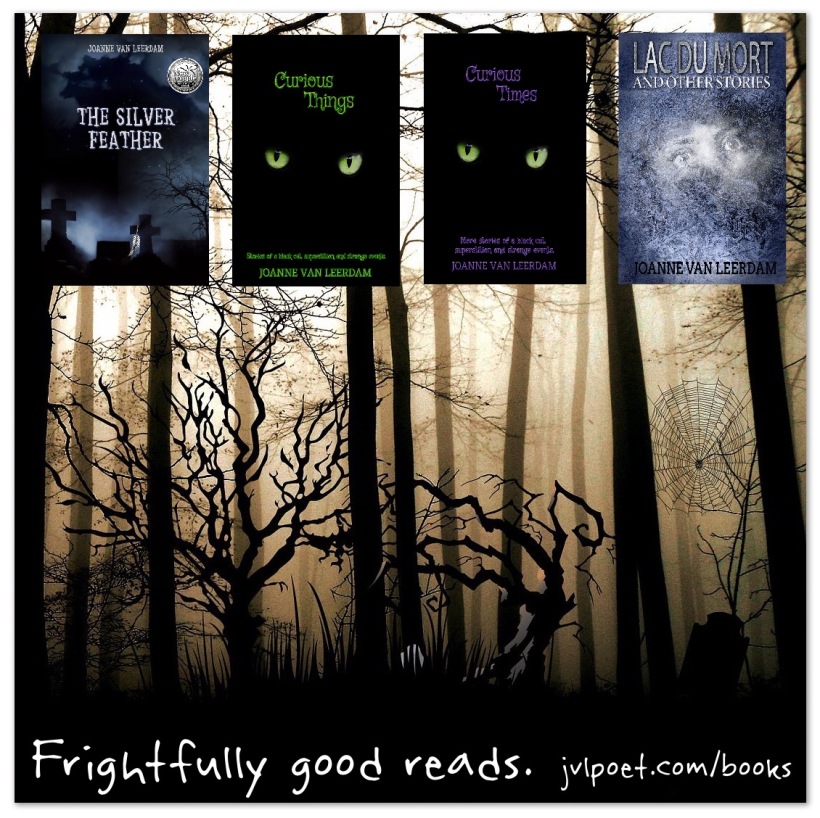
It’s also a time when, like many other horror authors, I’m hoping to put my books in front of people and maybe get a sale or three.
I write spooky short stories, among other things. I work hard to build the right atmosphere, to lure the reader in, and then shock them with a macabre turn of events. I try to appeal to different senses so that they hold their breath while their skin crawls. It’s not splatter for splatter’s sake, and the monsters generally don’t hide under the beds or in the wardrobes of little kids. The monsters I write about are, more often than not, people who seem ordinary in most ways— until they prove they are not.
So, why not try a creepy story? You might enjoy it more than you think!
Ultracrepidarian is an old word that can be used as either a noun or an adjective to describe someone who is critical and judgemental, or who gives advice or opinions, about matters in which they have little or no knowledge, experience or expertise.
Although somewhat different to a malapert, it is entirely possible for a person to be both.
The earliest record of the word ultracrepidarian comes from the early 1800s, when it was derived from the Latin phrase ultrā crepidam which means “above the sole”. This was a reference to a story relayed by Pliny the Elder about a Greek painter named Apelles, who when criticised by a cobbler, said something to the effect of “nē suprā crepidam sūtor jūdicāre” or“let the cobbler not judge above the sandal”.
People generally don’t welcome advice or critique that they have not sought. If advice must be given, it’s probably wise to stick to one’s actual area of knowledge and expertise. Even more importantly, it’s essential to be kind and gentle about it, and to try to be humble. That’s how to avoid being ultracrepidarian.
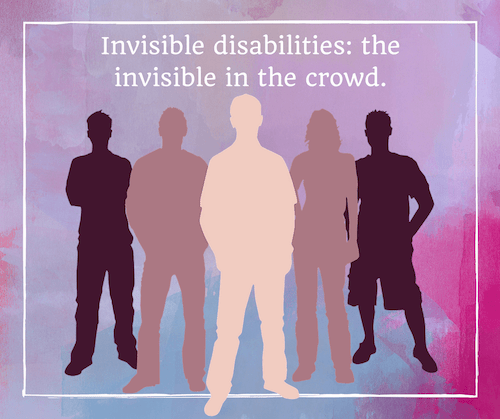
I, too, suffer from chronic, invisible illnesses.
I have fibromyalgia. I have a permanent back injury. I have depression and anxiety, and I work hard to keep those under control. I strive to take good care of myself, and to manage my conditions. I avoid aggravating them. I also make every possible effort to stay positive and to do the things in life that I enjoy doing.
The fact is, though, no matter what good care I take care of myself or how positive and proactive I am, I cannot heal or cast off my invisible disabilities.
The debilitation is real.
The exhaustion is real.
The misconceptions are real.
And the judgement? Many people would not be willing to believe how real, and how consistent, and how very, very toxic that is.
The critics are only right about one thing: I don’t look sick.
That’s because I’ve been faking being well for years.
A malapert is a person who acts like they know everything and is confident that they are always right.
These days, we might call them a know-it-all. We could also call them a wise guy, a smart aleck, or an expert on everything. There are a number of less polite terms available to those willing to use them, too.
The difference between a pedant and a malapert is that a pedant knows they are right about something in particular, while a malapert thinks they are right about everything.
Malapert is a word that dates back to the 14th century, coming into English from the Old French words mal meaning bad or badly, and apert meaning skilful or clever. By the mid1400s, it was being used to describe a type of person rather than just a behaviour or attitude. Given that Shakespeare uses the word three times in his plays, each time without any explanation, one can assume that the word was commonly used and understood throughout the medieval and early modern periods.
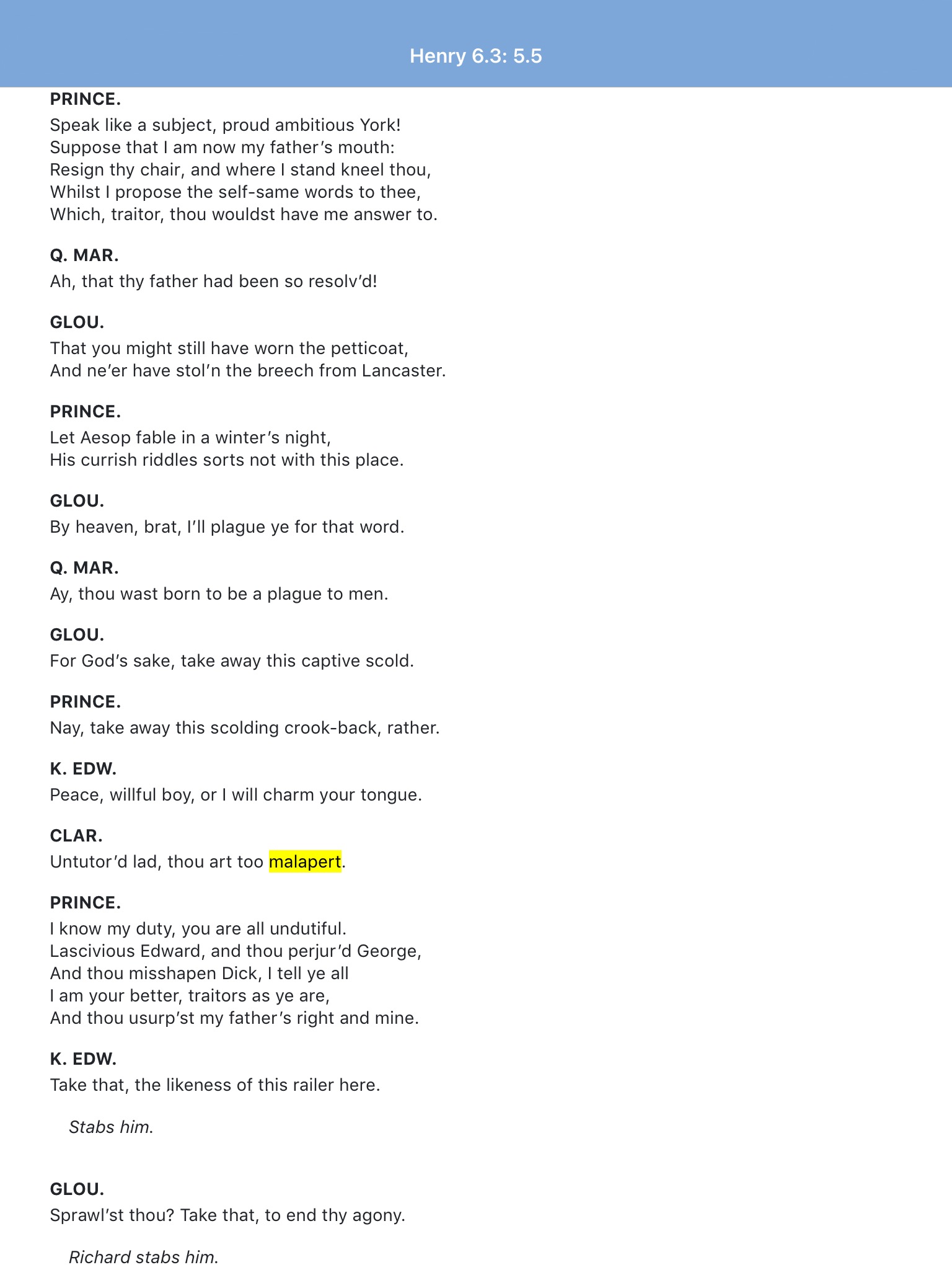
In Henry 6, Queen Margaret and her son, the young Lancaster Prince Edward, engage in a contest of insults with their captors: Clarence and Gloucester. As sons of Richard, Duke of York these two are the Lancastrian King Henry’s enemies, as the two houses are rivals for the English throne. Clarence calls the young prince malapert, highlighting his youthful confidence by calling him an “untutor’d lad”.
Almost as proof of Clarence’s assessment, the prince responds by insulting them again. Despite the clevernesand bravery of his words, this proved to be a bad move, as “perjur’d George” and “misshapen Dick” respond by stabbing him to death. End of argument.
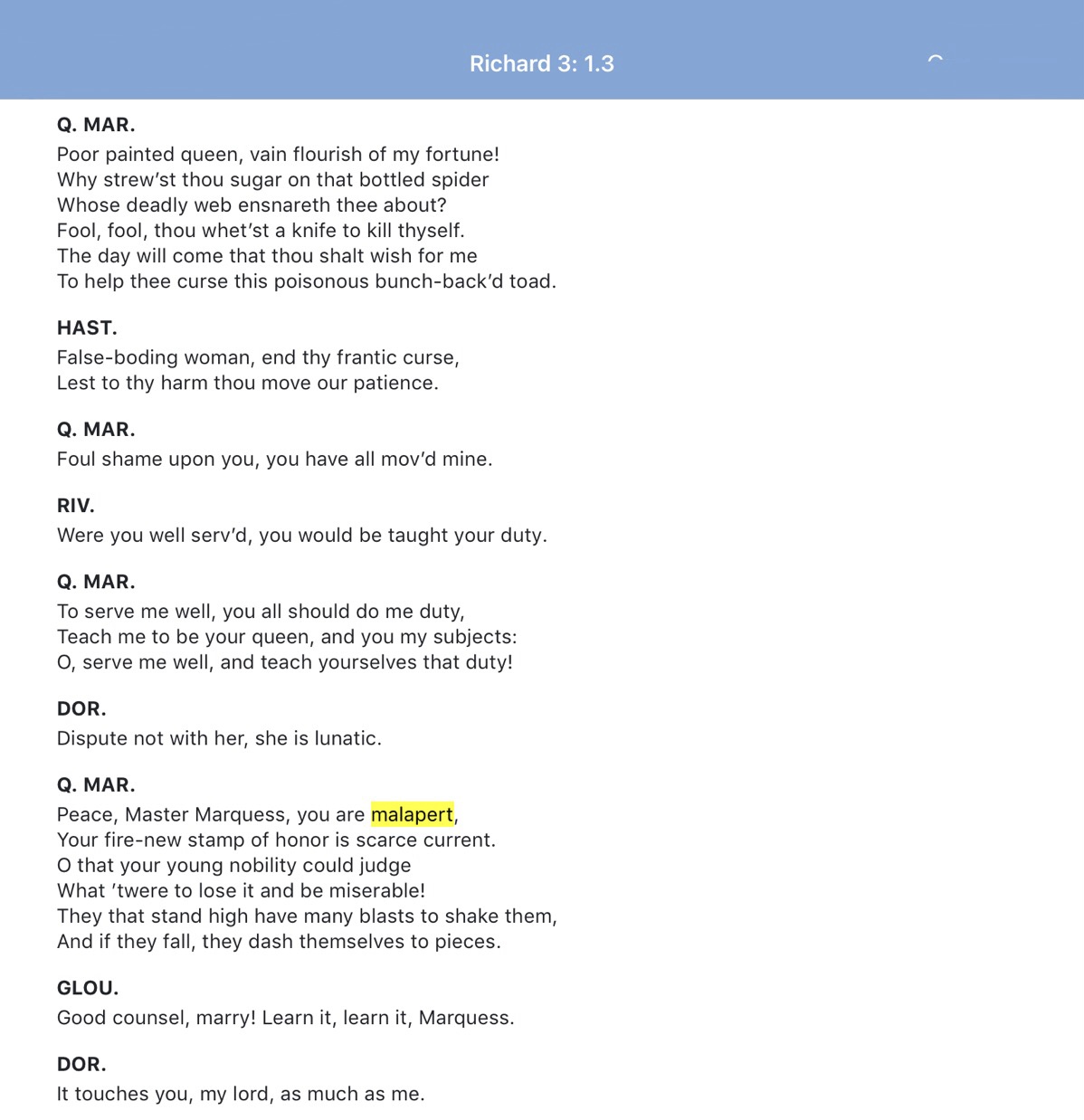
In Richard III, the same Queen Margaret tells the Marquess of Dorset that he is malapert and warns him that his newly found nobility won’t protect him from being destroyed by the Yorks, particularly Richard (Gloucester) whom she describes as a “bottled spider” and a “poisonous bunch-back’d toad”. Richard turns the insult back on Margaret, and Dorset promptly turns it right back on him.
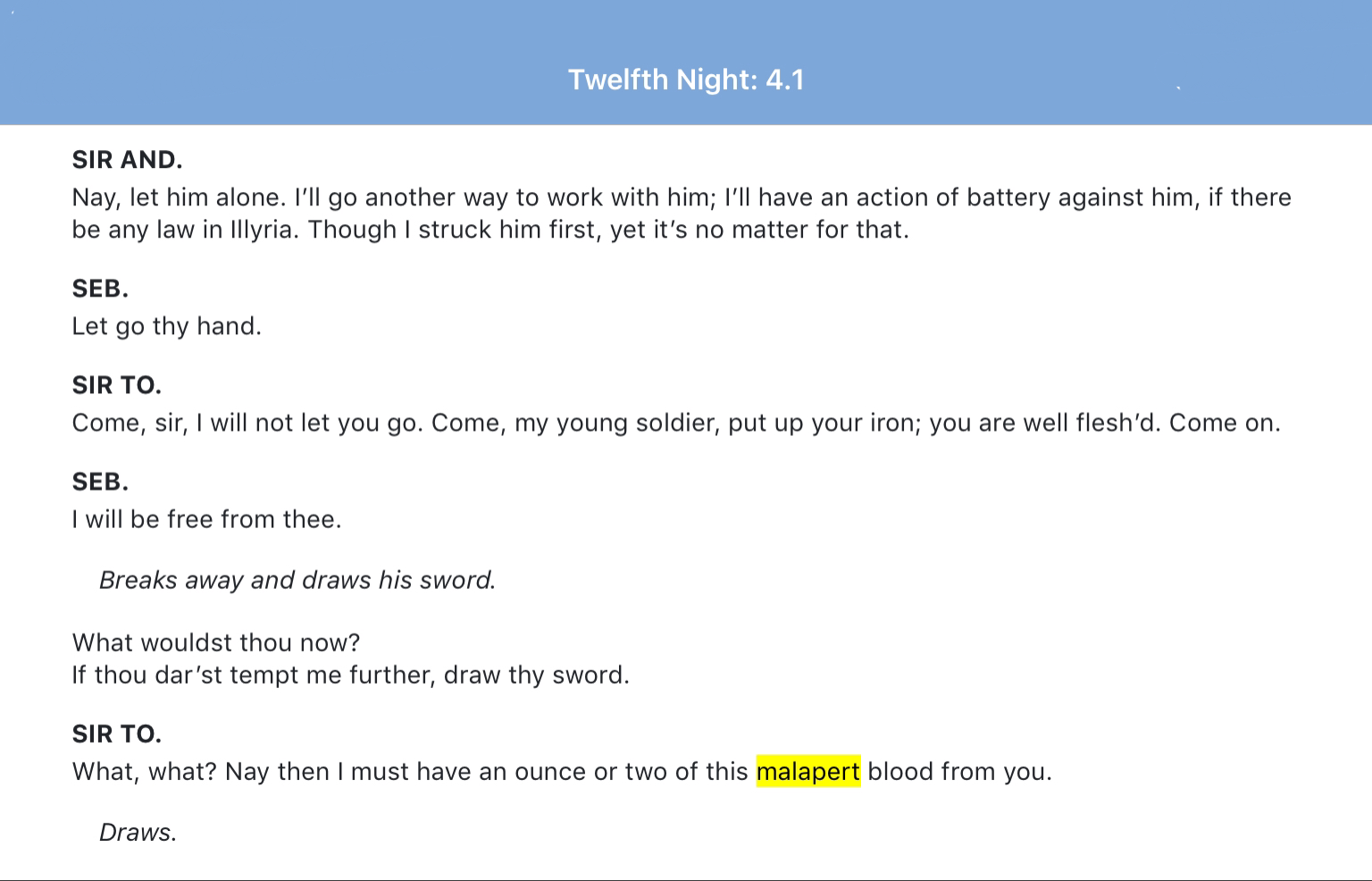
In the comedy Twelfth Night, Sir Toby Belch and Sebastian are engaged in an argument when Sir Toby insists that he “must have an ounce or two of this malapert blood” from his rival.
This is a word I have long been aware of, yet I have definitely not made as good use of it as I could have done. This, however, is likely to change in the near future.
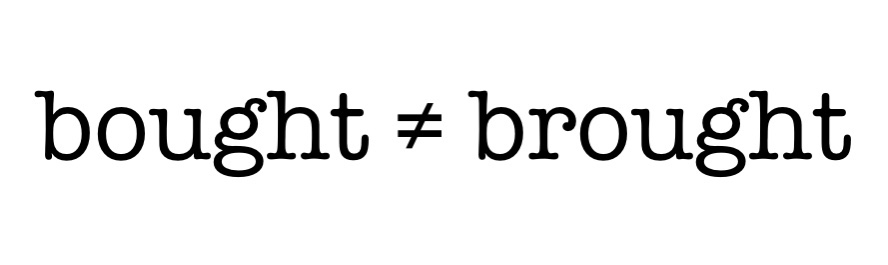
Bought and brought are words that lots of people get mixed up. They may look similar, but they are very different words.
These words are by no means interchangeable, so in the interests of both being clearly understood and preserving one’s credibility, it is beneficial to know which is which, and how to use them confidently at the right times
Bought is the past tense of buy. If you buy something, you have bought it.
Brought is the past tense of bring. If you bring something home, you have brought it home. Note: neither ‘brang’ nor ‘brung’ is standard English.
The easy way to remember which is which is that there is an r in bring and brought, but not in buy or bought. That makes pairing the correct words much easier.
Easily Confused Words: Bought vs Brought #grammar #English #explanation
The practice of leaving a preposition at the end of a sentence, often referred to as preposition stranding, has long been considered to be “against the rules”. Generations of teachers and grammarians have condemned it as a grammatical taboo.
That isolated, lonely preposition, separated from its noun, is known as a terminal preposition, and may also be described as danging, hanging or stranded.
Albeit with the best of intentions, this was drummed into me as a child, so I simply accepted it and tried to avoid doing so in whatever I wrote.
As I got older, though, I came to realise that it’s something we do very naturally in speaking. In fact, avoiding it in spoken English can make what one is saying seem very formal and stilted.
When I was in high school, one of my History teachers told us a story about one of Winston Churchill’s famous comebacks. On receiving a correction about finishing a sentence with a preposition in the draft of a speech, he responded, “This is nonsense, up with which I shall not put.”
As it turned out, it probably wasn’t Churchill who first made the joke. I don’t know if he ever did, despite numerous and varied attributions. It has also been attributed to various other people, and there are variations on the line that was said to have been delivered, so it’s hard to know who said what, and when.
Either way, the story demonstrates that the rule is actually a bit ridiculous.
So where did this rule come from? And is it something we still have to abide by?
Back in the 1600s, a grammarian named Joshua Poole developed some principles about how and where in a sentence prepositions should be used, based on Latin grammar.
A few years later, the poet John Dryden, a contemporary of John Milton, took those rules one step further when he openly criticised Ben Johnson— another great poet— for ending a sentence with a preposition. Dryden decreed that this was something that should never be done. Nobody bothered to correct or oppose Dryden, and Ben Johnson certainly couldn’t because he had been dead for years, so Dryden’s strident and public protestations popularised the principle into a rule. Over time, strict grammarians and pedants began to actively oppose the practice, and the rule became widely accepted and firmly established.
Ironically, despite all the wise and clever plays, poetry and essays written by John Dryden, it was his consistent complaint about the terminal preposition that became his most enduring legacy.
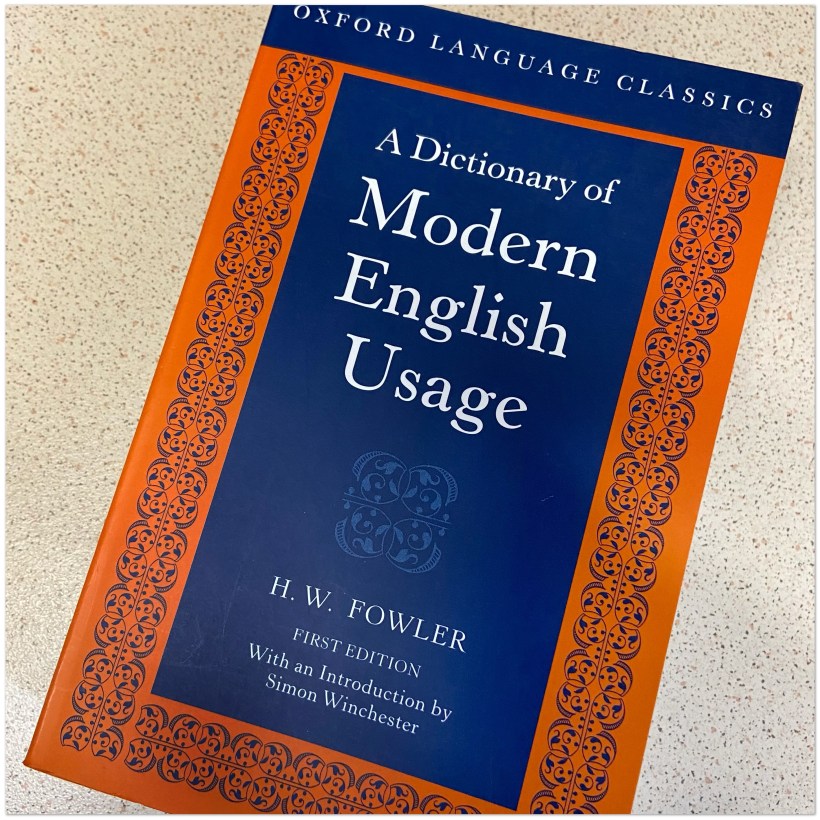
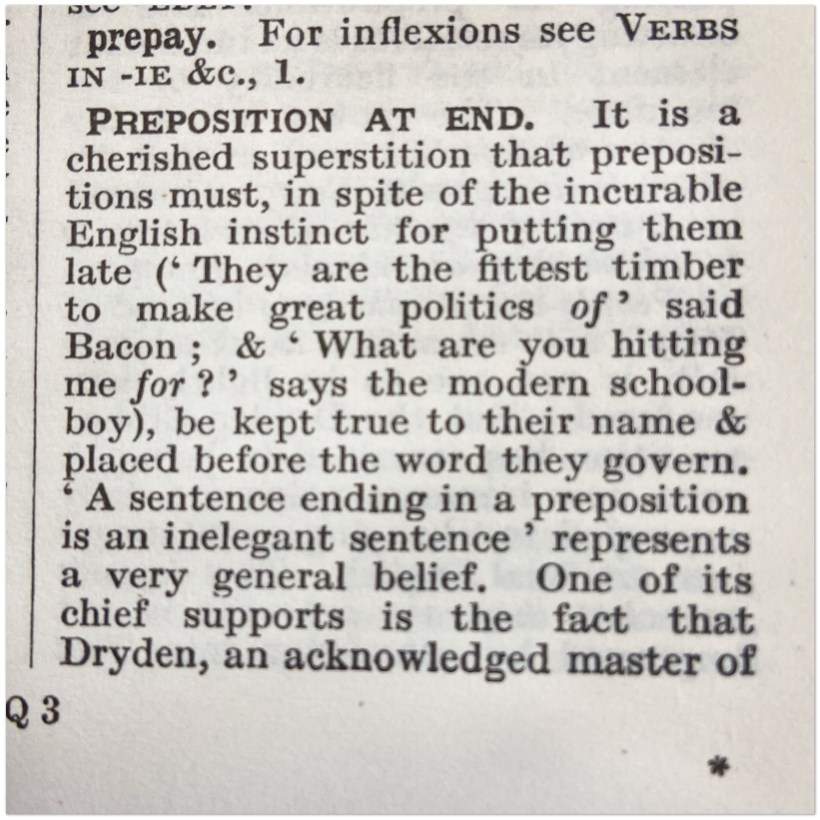
Fowler’s A Dictionary of Modern English Usage, published in 1926, calls it a “cherished superstition that prepositions must, in spite of the incurable English instinct for putting them late… be kept true to their name and placed before the word they govern.” Fowler goes on to assert that even Dryden had to go back and edit all of his work to eliminate the terminal prepositions in his own writing.
In the last century or so, people have become progressively less fussy and worried about it, but some still seem determined to cling to the rule no matter what.
I advise my students that in formal writing such as essays, speeches, official letters and submissions, it is best to avoid the terminal preposition just in case their reader is someone who might judge them for it. Any other time, in keeping with standard spoken English, they are free to use their prepositions wherever they feel most natural and make the most sense.
Nobody in the 21st century is going to naturally ask someone “On which char did you sit?” rather than “Which chair did you sit on?”, nor will they say “I wonder for whom that parcel is intended” Instead of “I wonder who that parcel is for.”
In the 21st century, that really is nonsense up with which we do not have to put.
Sources: Quote Investigator Merriam-Webster Fowler, H.W (1926) A Dictionary of Modern English Usage. Oxford Language Classics, OUP, Reprinted 2002.
Is It OK to End a Sentence with a Preposition? #grammar #English #language




 WordyNerdBird
