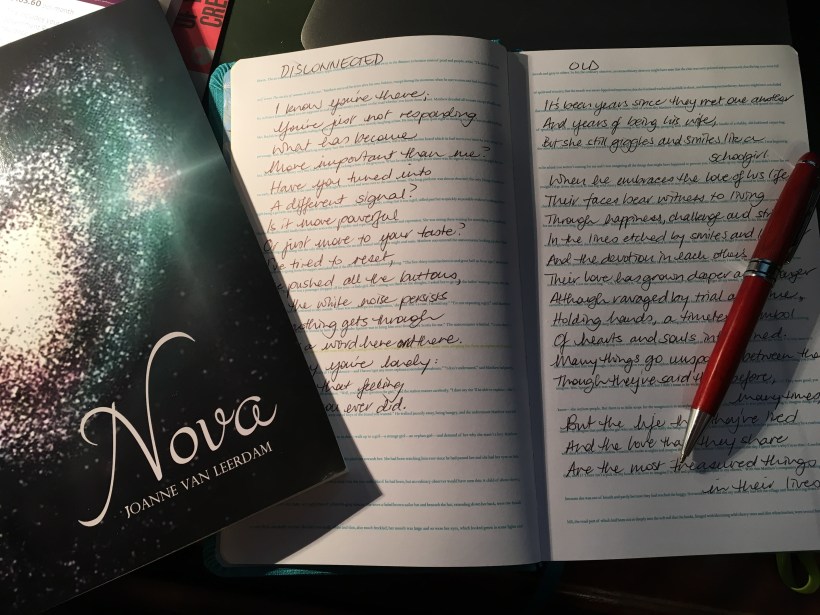
Six 21st Century Poets You Should Be Reading.

Six 21st Century Poets and Why You Should Be Reading Them.

I’m the first to admit that I’m fussy about the poetry I read. I want to experience something moving and powerful in a unique style. I want imagery, colour and movement. I want depth, and I want to be able to feel and hear the poet’s soul. It may be considered “old-school” by some, but I still want to find the music of rhythm and rhyme among the various techniques that a poet uses to deliver their ideas.

So, when I tell you that these are the poets you should be reading, please understand that this is not just a nod to people I like or who have pretty book covers. These people don’t just write poetry— they are poets, and they take their craft seriously. These poets can really take a reader beyond themselves, open a reader’s mind, and influence them so that they see things in a completely new way.

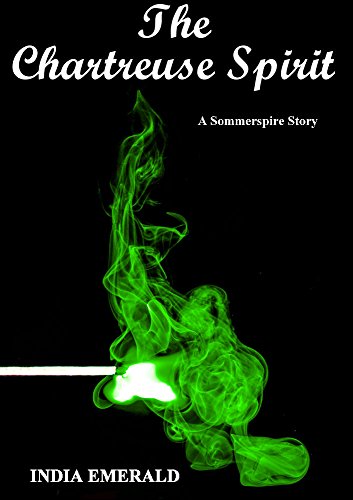
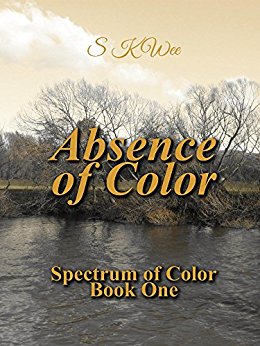
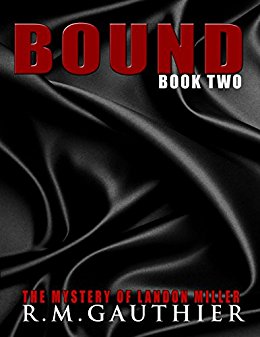
These Six 21st Century Poets You Should Be Reading are not listed in any order of preference. If you want to explore their work further, simply click on the cover of each book.

Lyra Shanti

Author of ‘Sediments’.

Lyra Shanti Sediments

Shanti’s poetry is rich and sensory, full of imagery that draws the reader into the emotion and wellsprings of the poet’s mind.
Drawing on mythological themes and elements of Biblical allegory, although it is by no means religious poetry, Shanti explores her place in time, relationships, and the universe through themes of belonging, human vulnerability, equality, and home. She is a master of contrast and balance, weighing sensitivity against images of those things that overwhelm, and confidence in belonging despite her humility, framed within a very real sense of awareness of the immeasurable breadth and depth of the universe.


Patrick Williams
Author of ‘Lethal As Love’.
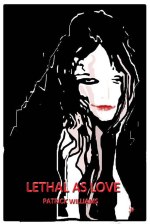
Patrick Williams Lethal As Love
Patrick Williams’ poems are beautiful in the simplicity and honesty of the feelings they convey, even though the feelings they communicate are at times complex and conflicted. There is no pretence or affectation in Williams’ writing, nor is there any strict observance of rhythm, rhyme or other particular poetic techniques. Instead, he uses language and form to evoke a strong sense of love and longing that is almost tangible as he leads the reader on a journey through the highs and lows of the love he so powerfully communicates in these poems.
Some of this poetry is quite erotic, so it’s definitely only for an adult audience, but there’s nothing gratuitous or tawdry about it. One could learn quite a lot about how to love deeply and sensuously from reading ‘Lethal as Love’, but there is also a more sombre lesson to be heeded: nothing lasts forever.  It is clear from ‘Lethal as Love’, though, that the pleasure and passion were definitely worth the pain.


Sarah Northwood
Author of ‘The Truths We Tell’.
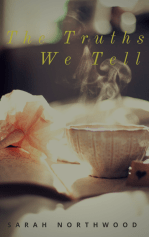
Sarah Northwood The Truths We Tell
Sarah Northwood gives voice to thoughts and feelings commonly experienced, but often not so thoughtfully expressed, by people in all walks of life.
Northwood explores the ways in which we respond to the situations and feelings that challenge us and those things that fill and complete us. The reality of being haunted by regret and the “what ifs” of life is contrasted with the whimsy of fleeting happiness and the irresistible, transforming power of love.
Through all of this is the reminder that life is what it is: “Feeling the breeze on her cheek she knew, the wind can never be the sun.” (Unique)


Joseph Ferguson
Author of ‘Reflections of a Scurvy Bastard’

Joseph Ferguson Reflections of a Scurvy Bastard
Ferguson writes with a very strong sense of realism and a degree of world-weariness in his profound poems that work like snapshots of different events and memories. He has a gift for creating vivid images that transport the reader to another time and place, and making it seem absolutely real.
When Joseph Ferguson’s poetry is recognised as ‘classic’ and he is regaled world-wide as a master poet, it shall come as no surprise to me.


Shelby Leigh
Author of ‘It Starts Like This’
Shelby Leigh It Starts Like This

Leigh’s poetry is thoughtful and often intense in its exploration of love, loss, anger,   loneliness and grief, and is highly relatable for anyone who has experienced the breakdown of a relationship or been let down by someone they trusted.
Her poetry and expression are accessible and easily understood, and Leigh’s imagery is often quite stark and raw, but that is where her strengths as a poet lie.


Joanne Van Leerdam 
Author of ‘Leaf’, ‘Nova’, ‘Stained Glass’ and ‘The Passing Of The Night’. 


Yes, that’s me, and those are my own books. Obviously, I write the type of poetry I want to read. Don’t take my word for it, though – I have compiled this description with quotations from different Amazon reviewers. 

“Joanne Van Leerdam is a master poet who combines an old-worldly feel to her poetry with a modern flavor.”
“Joanne Van Leerdam’s poems are about the emotional fragility of human existence, about the brittleness of love and about living with love lost. She expresses both the sense of frailty and the strength of resilience in her reflections, as if a lonely survivor on a faraway island.”
“Many of her poems are conventional in structure, with a regular rhyme scheme, traditional yet so sensitive and vulnerable that they emerge as special, standing out like novae in the vast night sky.
Her poems don’t crash through the door, flourishing their creative uniqueness, but in a quiet voice Van Leerdam almost whispers to us to let her poems come in as she both exposes the emotional pains of life and provides comfort for them.”
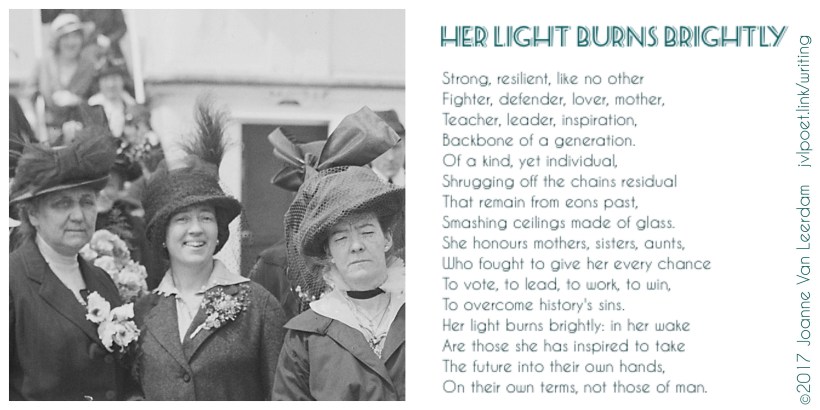
I’d love to know if you are encouraged to try any of these poets’ works, and if you do, what you think of them. You’re always welcome to leave a comment on this, or any other, post. 

International Women’s Day, 2018

Why We Should Celebrate International Women’s Day.

As I was driving to work this morning, a caller to my favourite radio station was critical of the fact that the station was observing International Women’s Day as part of the day’s programming.

“What’s it going to achieve? Do you think you’re going to change everything in one day?” He spoke politely, but went on to dismiss the value of this, and every other, “touchy-feely day”.

While my initial instinct was to dismiss him as a sexist pig, his cynicism challenged me to consider that there might be many folks out there, and possibly not just men, who doubt the benefit or validity of such an observance.

This is what I would like to say to those with that mindset:

Observing International Women’s Day is definitely not going to change everything on one day. That’s not what anyone is expecting.

It is a chance to celebrate the changes that have been made, and to remember those who worked so hard to introduce them. It’s not even exclusively about gender equality – so many women have made significant advances, even when it was still almost entirely a “man’s world”. Think of Marie Curie or Ruby Payne-Scott making significant scientific and mathematical discoveries that have had a huge impact in many other areas of society. Think of Rosa Parkes and her courage that inspired so many. Think of the countless women who have worked for freedom, or justice, or civil rights for all people, not just women.

It is a day to remember that the rights and freedoms I have as an Australian woman were fought for by many – not just the suffragettes. Nurses at the battlefields of major conflicts, teachers, doctors and medical researchers, writers, women who raised their sons to respect them and therefore other women, lawyers, filmmakers, journalists— they and countless others have contributed to the privileges I enjoy in the 21st century.

It is a day to remember my own mother, grandmothers and aunts who worked hard to provide and care for me, but also to teach me and demonstrate for me what it means to be a woman of strength, confidence and integrity. It’s also a day to think of my sisters, cousins and friends who encourage and stand beside me when life is hard, because they model those same qualities for me time and time again. They remind me of not just what I am, but who I am.

It is a day to consider what legacy I pass on to my nieces, my students, and my readers. What do I want them to learn from my example? I want them to know they are enough. Strong enough, good enough, beautiful enough, deserving enough, talented enough, smart enough, and worthy enough. They do not have to take any else’s bullying or abuse. They do not have to accept other people’s bad behaviour. They are under no obligation to “measure up” to the yardstick of anyone else, male or female. They can make of their lives anything that they decide upon and set their mind to. They can face challenges with courage, and they can overcome whatever would seek to undo or defeat them.

These are the women I write of in my poems, blog posts and stories about women of strength and beauty.

That, my friend, is what this day helps me to achieve, because it sharpens my focus on those things for a time.

So, happy International Women’s Day 2018.

I hope that you will think of it in terms of gratitude and humility. I also hope that every woman will use it to both be inspired and be inspirational.

Books, Authors, Double Standards and Snobbery.

There remains a commonly held view that all Indie books are somehow sub-standard. This perception could not be more wrong.

angry-2191104_960_720

I am perpetually frustrated by the disdain that many have for Indie authors. Indie artists, musicians, and filmmakers are applauded for daring to step out, break the mould and do their own thing in defiance of the industries that are perceived to have grown too big, too powerful, too rich.

Nobody hesitates to go to a doctor or lawyer who owns their own practice. People don’t think twice about having their car serviced by a mechanic who runs a local garage. They’re independent practitioners within their industry, too. Let’s face it, there are some shonky ones out there – in any industry – but they are the vast minority, and their behaviour should never be used as the yardstick by which all others are measured.

So why is the double standard against Indie authors still not only acceptable, but so widely endorsed?

woman with bookI won’t deny that I’ve picked up two or three books that I just couldn’t finish because they were either poorly written, poorly edited, or just not very good at all. But two or three out of more than 150 is a very small percentage, where the others have consistently ranged between very good and excellent quality in terms of both writing and production.
Having been an avid reader all my life, it’s also true that I’ve read – or rejected – a number of books that weren’t so great in the traditionally published world, too. Some I just couldn’t get into – even among the most famous and widely commended are certain ‘literary greats’ whose writing I just don’t appreciate. There are also traditionally published books that remain popular among less discerning readers and sell quite well, despite the fact that the writing and/or story lines really are… well… rubbish.

I’ve read almost exclusively Indie books for more than a year. I am continually impressed by the originality of the stories, the high standard of writing, and the depth of creative talent. I’ve posted countless book reviews for these books, and have shared my appreciation of both books and authors far and wide, because those books deserve to be read and appreciated.

Having been an avid reader all my life, I’ve read – or rejected – a number of books that weren’t so great in the traditionally published world, too. Some I just couldn’t get into – even among the most famous and widely commended are certain ‘literary greats’ whose writing I just don’t appreciate. There are also traditionally published books that remain popular among less discerning readers and sell quite well, despite the fact that the writing and/or storylines really are rubbish.

Indie authors are, more often than not, Indie by choice. For many, the first foray into traditional publishing has ended up being a very negative and traumatic experience. For some, their publishers have closed down, leaving the author without their rights, unpaid and unable to sell or market their work. Other companies have published books and then done nothing, leaving them to languish in obscurity unless the author does their own marketing.

Sure, that hasn’t happened to J.K. Rowling or George R. R. Martin. People need to understand, though, that they are the exceptions, not the rule. That kind of success doesn’t just happen for everyone who writes a fantastic book or series, and it’s well-established fact that it almost didn’t happen for Rowling either.

Last week, I saw someone comment on social media platform in a most derisive tone that “traditional publishers won’t touch anything that’s been self-published”. My response was that it’s their loss. And when it comes to my own work, they’re not welcome to.

Like many others, I choose to be Indie because I control my own intellectual property, I retain my legal rights to my work, and I earn the royalties for my books. My hard work is not lining the pockets of some faceless company that pays a small fraction of the earnings of a book to the author and gets fat on the rest, without actually doing much in the way of marketing or promotion. Marketing and promotion is really hard work, there’s no doubt about it. But if I have to do the schlepp work anyway, why would I let someone else have control of my work? And I can take pride in the fact that I have earned every review, every award, and every cent, on my own.

In the end, I choose to be Indie because there is nobody in this world as committed to my books or my career as an author than I am.

It’s time we got rid of the double standard that celebrates Indie music and art, and which takes pride in supporting local and artisan businesses, but considers Indie books and authors to be something less than their traditional counterparts.

Indie authors are doing their part by writing and producing excellent books.

Readers are doing themselves a gross disservice by accepting the kind of intellectual snobbery at the heart of this double standard. I’m confident they will be more than pleasantly surprised when they finally choose to set prejudice aside and find out what they’ve been missing out on.

Promo Indie And Proud


How to Achieve A Visually Attractive Twitter Feed.

Just because you can use 280 characters, doesn’t mean you should.

Over the past few weeks, I’ve noticed a lot of people commenting on how they love the new 280 character limit for Twitter. I’ve also noticed a lot of people writing long tweets with no line breaks, and barely any space in them to take a breath.

My message here may be unpopular with those folks, but it must be said: just because you can use 280 characters, doesn’t mean you should.

Remember, people are basically lazy. They don’t want to have to work to figure out what you’re saying, and they don’t want to wade through thirteen hashtags to do so, either.

When it comes to writing tweets, I’ve always assumed that the rule of “less is more” applies. I want my message to be short, easily understood and digested, and easily acted upon.

ScreenHunter_439 Feb. 20 21.34

I’ve always tried to keep my tweets to well under the 140 characters, as short as 100 characters if possible. A short, effective message is more attractive to people than a slab of text.

As an author, I’ve heard more people than I care to try to count tell me that they don’t like reading. (I know, right? I don’t understand it either.) However, it’s something that I’ve taken to heart when writing anything promotional. Any ad, tweet, or invitation is completely ineffective if it puts people off before they even really look at it.

I always leave a line of space between my main message and my hashtags. It breaks up the tweet so it looks more accessible. I also think that it makes the hashtags a bit more obvious, given that some people might take notice of those before the actual message.

When it comes to hashtags, I wrote a few months back about ‘How To Avoid Hashtag Hell’ in social media. I advised then to use two well-chosen hashtags, and no more. Given the increased word limit, I’m about to start experimenting with using three to increase the discoverability of my tweets, but that would be my upper limit. This isn’t a rule, as such, but simply my desire to keep my tweets looking simple and attractive. I’m no expert in advertising or design, but I go by what I experience myself: when a message is easy on the eye, it’s going to get more attention.

On that same assumption, I always include an image. People are very visually oriented and will, more often than not, look at the picture before the text. I try to make the image relevant to the post, and will often superimpose text and web addresses on the image in a way that won’t detract from the visual effect I hope it will achieve. Where appropriate, I use logos that will build familiarity with my work. Otherwise, I use my own images or stock images that are copyright and royalty free, so that I’m not infringing on copyright, either. There are lots of places that offer them, but I find pexels.com and pixabay.com to be excellent sources of quality images that are free for reuse for any purpose.

ScreenHunter_437 Feb. 20 21.33I use a link shortening service so that half the tweet isn’t taken up by an enormous web address or link. Bit.ly is free, so are many others. I use Buffer to schedule my tweets, and it shortens links automatically, so that’s a double win!
A further advantage of using Buffer is that it enables me to recycle my tweets so that I don’t have to spend hours each week coming up with new content. I regularly change the hashtags and messages on a reused tweet so that I’m not just giving people the same old thing time after time.

When it’s done a few rounds, I’ll rest a great tweet for a while, and pick it up again down the track if it’s still relevant. I save them in files in Evernote, so all I have to do when I come back is copy and paste it into a new message, attach the image, and off I go.

ScreenHunter_439 Feb. 20 21.33

Some of my tweets don’t have links. This is a deliberate decision on my part – sometimes I just want to offer a thought, a joke, or a compliment to my audience without asking them to do anything in return. That’s not a rule either – it’s just how I like to do things.

Finally, mix it up. If all you tweet is ads for your book or service, or quotations from your work in progress, it can get a little humdrum. I keep things varied by tweeting about great books, free reads, short reads, book reviews, magazines, great blog articles, and interesting tidbits of history, science and general interest far more than I tweet ads for my own books. My books are worthy of advertising and attention, and I would love to find more readers, but I don’t believe in shoving them in people’s faces at every opportunity, either.

I know all that seems like a lot of work, but being active on social media does take effort and thoughtfulness if you’re going to have something meaningful to offer.

Since I have been following these guidelines, I have had new followers every day. I started 2017 with just over 300, and now I have 3000 more than that. It’s slow growth, but it’s organic growth – my audience actually wants to be my audience! And that is worth far, far more than being able to fit a bunch of stuff in one tweet.

WordyNerdBird’s “One Click” Authors.

There are many authors whose work I love reading. My to-be-read list is populated with dozens of books by fine writers, many of them Indies who write every bit as well as traditionally published authors.

Some, though, are on a special list. These are the writers whose book I will buy with the “Buy with 1 click” button on Amazon without needing to read a blurb, check out the cover, or read reviews to see what others have to say. 

Without an exception, these authors are brilliant writers who deliver original, interesting and entertaining books every single time. I love the way they use words and the ways in which they stretch and stimulate my mind.

These are my “One Click” authors – in no particular order of preference. They’re all at the top of the list.

J.B Richards – historical fiction
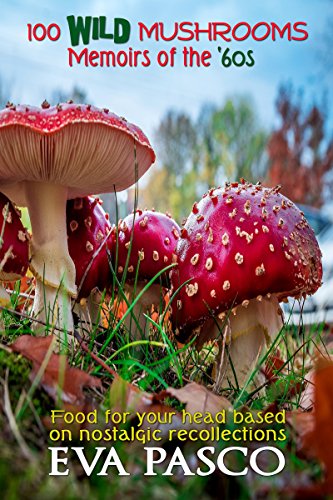
Eva Pasco – contemporary fiction
R.M. Gauthier – mystery/thriller, romance
Aliya DalRae – paranormal mystery/romance
Lyra Shanti – sci-fi/space opera, poetry
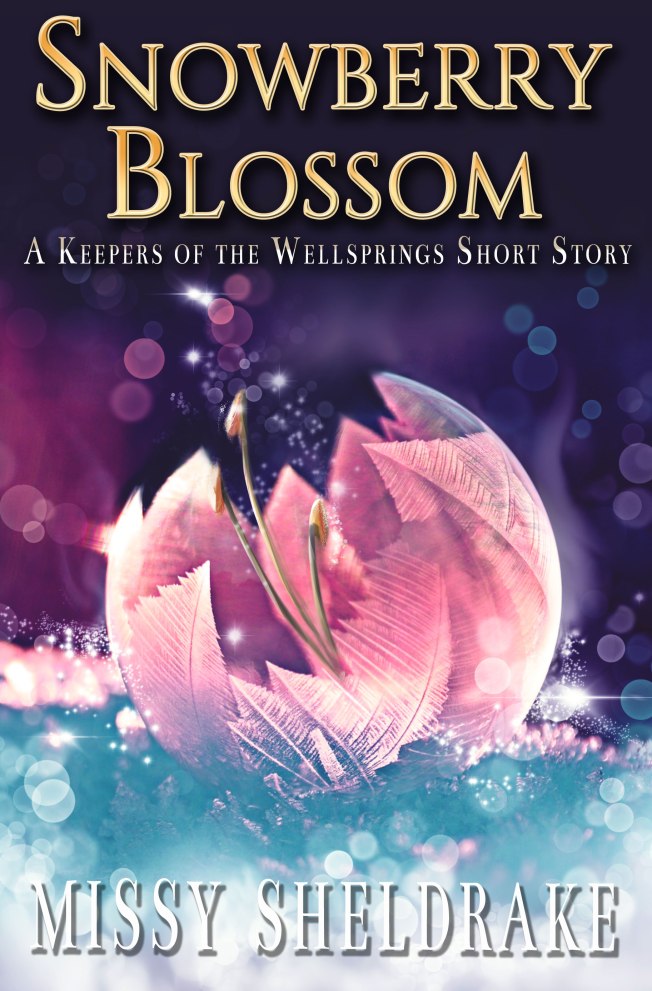
Missy Sheldrake – fantasy
S.K Wee – fantasy
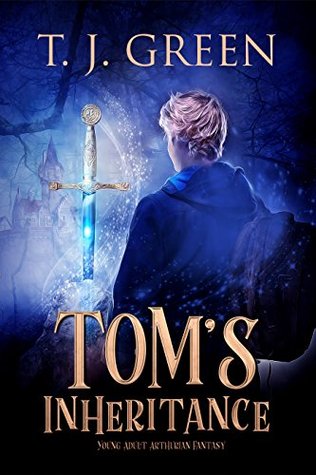
T.J. Green – fantasy
D.J. Doyle – horror
Nikki Landis – romance, mystery, horror
Eric Tanafon – fantasy with a paranormal element
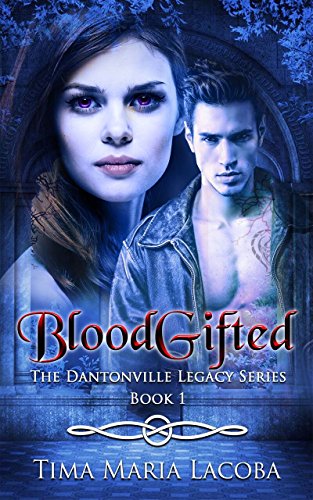
Tima Maria Lacoba – paranormal
Miranda Brock – contemporary fantasy
India Emerald – magical realism, contemporary fiction
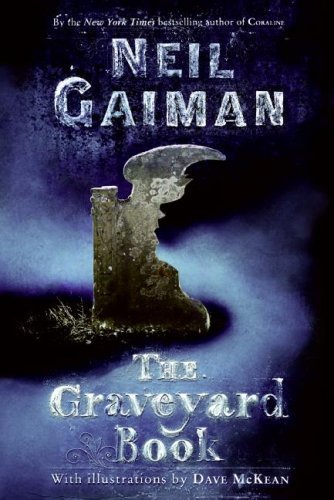
Neil Gaiman – fantasy, macabre
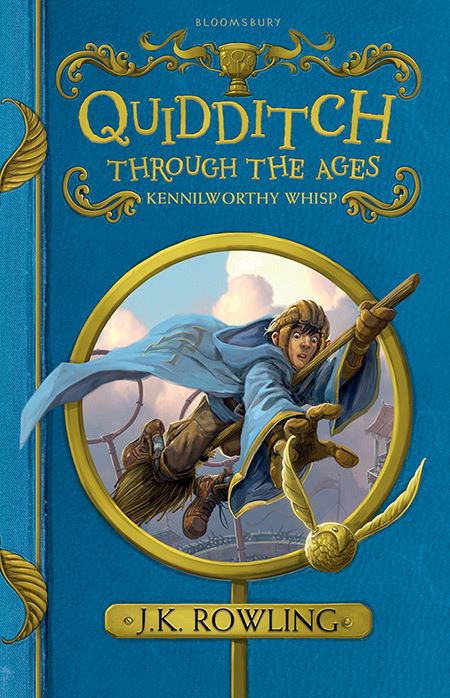
J.K. Rowling – magical realism, fantasy

WordyNerdBird’s Top Three Podcasts of 2017

In the past, I’ve nominated my favourite podcasts in various genres.

Today, I give you my top three podcasts of 2017.

Promo Top Five English Podcasts PlainOver the course of a few weeks earlier this year, I nominated my favourite podcasts about history (to which I added two more later on),  Shakespeare,  and the English language.
Now that the year is almost over, I’m willing to narrow it down to my favourite three podcasts of 2017.

My criteria for these choices are simple: they’re enjoyable, entertaining and interesting.  I never scroll past them to see what else is on offer in the 20+ various podcasts I subscribe to. Truth be told, I probably should unsubscribe from some of them – perhaps that’s an idea for a New Year’s Eve cleansing ritual or something.

So, without further ado, here are my top three podcasts of 2017:
Rex Factor Podcast1. Rex Factor In this absolutely brilliant podcast, the kings and queens of England followed by the kings and queens of Scotland are reviewed, ranked, and rated according to the qualities an ideal ruler should have. It’s both historical and hysterical. Don’t try to listen to this in the hope that it will lull you to sleep. It won’t. https://rexfactor.podbean.com/p/about/


Lingthusiasm Podcast2. Lingthusiasm   This podcast explores different aspects of the English language in just over 30 minutes for each episode. It’s interesting, word-nerdy, and fun.
twitter: @lingthusiasm
http://lingthusiasm.com/


british-history-podcast.png3. The British History Podcast A chronological history of Britain with a focus on the people and how they lived and died. It’s well told by a knowledgeable host with a very nice voice. Hey… it all helps.
https://www.thebritishhistorypodcast.com/


If you have a podcast you really enjoy, I’d love to hear about it in the comments.


Top Four English Language Podcasts

If you’re someone who takes knowing the difference between “your” and “you’re” seriously, if you experience a secret thrill when someone uses a semi-colon or an Oxford comma properly, or if you just want to know more, these podcasts could be for you. 

Promo Top Five English Podcasts Plain

Pleasantly surprised by how popular last week’s post on my top five history podcasts proved to be, I decided to share a little more of my podcast-loving joy with you this week.

It’s common knowledge that I’m pretty nerdy about words.

I love them. I love the way they work. I love knowing where different words and phrases came from. I love using them to write and communicate ideas in interesting ways. I love knowing which words are related to each other, even when they don’t actually sound much like each other anymore, like long-lost cousins who bump into each other when they leave home to go to university, and discover their common history that the family has been hiding in the dust and cobwebs behind the skeleton in the closet.

So, it should come as no surprise that I enjoy listening to podcasts about the English language, its roots and evolution, and how it works.

If you’re someone who takes knowing the difference between “your” and “you’re” seriously, if you experience a secret thrill when someone uses a semi-colon or an Oxford comma properly, or if you just want to know more, these podcasts could be for you.

So, without further ado, here are my four favourite word-nerdy podcasts.

#1. The History of English.  This podcast gets into the down and dirty of where the English language and many of the words and phrases we use came from. If you suspect that Mr Webster didn’t just go out into a cabbage patch and find a newborn lexicon crying for its mother, give this podcast a try.
twitter: @englishhistpod
http://historyofenglishpodcast.com/

#2. Lingthusiasm. This podcast explores different aspects of the English language in just over 30 minutes for each episode. It’s interesting, word-nerdy, and fun.
twitter: @lingthusiasm
http://lingthusiasm.com/

#3. The Allusionist. This podcast focuses more on lexicon and how we use words to craft and deliver meaning in particular ways. The episodes are a bit shorter than the first two placegetters, staying under 20 minutes a shot.
twitter: @AllusionistShow
www.theallusionist.org

#4. The English We Speak. This podcast from the BBC World Service explores those words and phrases we use every day in episodes that last about three minutes each. This might be a good place “to cut your teeth” if you don’t want to “go the whole hog”.  You’re catching on. Cool.
http://www.bbc.co.uk/learningenglish/english/features/the-english-we-speak


I’d really appreciate it if you would leave a comment.
And click “like”.
And if you shared my post, that would be almost like Christmas.

Almost.

WordyNerdBird’s Top Five History Podcasts.

Who doesn’t love a good history podcast?
Today, I give you my top five, along with some honourable mentions.

Promo History Podcast Top 5


Who doesn’t love a good history podcast?
Today, I give you my top five, along with some honourable mentions.


#1 Rex Factor.
In this absolutely brilliant podcast, the kings and queens of England followed by the kings and queens of Scotland are reviewed, ranked, and rated according to the qualities an ideal ruler should have. It’s both historical and hysterical. Don’t try to listen to this in the hope that it will lull you to sleep. It won’t. https://rexfactor.podbean.com/p/about/

#2 British History Podcast. A chronological history of Britain with a focus on the people and how they lived and died. It’s well told by a knowledgeable host with a very nice voice. Hey… it all helps.

https://www.thebritishhistorypodcast.com/

#3 History of England Podcast Another chronological history of Britain, yet quite different to the BHP – David Crowther delivers the history in a bit more of an “English” style, whatever that is.
https://thehistoryofengland.co.uk/

#4 Rum, Rebels and Ratbags Presented by David Hunt, author of ‘Girt’ and ‘True Girt’, and Dom Knight, this podcast explores the early years of European settlement in Australia. It’s insightful, irreverent, and irrepressibly Australian.
https://soundcloud.com/rum-rebels-ratbags

#5 History of Byzantium Podcast by Robin Pearson. This podcast picks up where the History of Rome podcast left off and explores the story of the Byzantine empire, based in Constantinople, from 476 to 1453 AD.
www.historyofbyzantium.com 


Honourable mentions: 

  • History of the Crusades by Sharon Easthaugh
  • Myths and Legends by Jason Weiser.
  • In Our Time by Melvyn Bragg
  • Russian Rulers History Podcast

Ten Ways We Can Start To Change the World For Our Kids. 

When I was 20, I pledged to never buy another women’s magazine.

Even then I was frustrated by the unrealistic body image they consistently communicated to women.  It wasn’t long before that extended to the “cool” publications like Cleo and Cosmo, which I had convinced myself were different because they provided helpful articles on makeup, health and other issues relevant to younger women.
 mirror-1417264_960_720
Okay, so I was deluded about that, but it didn’t last long once I observed that these magazines also projected false and unrealistic body images that neither I, nor most of the young women I knew, could ever hope to meet.
 For longer than anyone can remember, our western society has had  an unhealthy fixation on looks. We’ve been getting it wrong since long before Henry VIII married Anne of Cleves based entirely on her portrait and promptly divorced her the minute he met her in person, citing as his reason the fact that she looked like a horse.
And it’s only getting worse. Chlidren as young as five or six are no strangers to the words “cute”, “handsome” and even “sexy”. Pre-teen kids have body image issues and the eating disorders that go with them. Peer pressure and bullying are daily realities in every school and friendship group that our kids belong to. Marketing is aimed at wearing the right clothes, having the right look, and doing what everyone else does. Social media can take those problems right into kids’ own homes. And it happens to boys every bit as much as it happens to girls.
 child-856132_960_720
When does a kid ever get a chance to be themselves?
 
All of this leads to one challenging question: How do we swim against the stream when the current is so strong?
My answer is that we need to invest differently in people.  We need to model much more healthy and constructive behaviour, and encourage others to do the same.
Let me say straight up that I don’t have kids of my own. I have, however, been very active in helping a lot of friends and family raise theirs. Our house has, quite literally, been a second home for more than a handful of teenagers over the years. I’ve also been a teacher, youth leader and mentor for almost thirty years. It’s this accumulated experience upon which I base these comments.


I don’t have all the answers. Nobody does.
But I do have a few ideas about how we can start.


This is my starter list:

10 Ways We Can Change The World For Our Kids

  1. Don’t put kids or other people down. Ever. I can’t stress this enough. Never tell kids, or anyone else, they are stupid, useless or worthless. Criticise a behaviour if you need to, but do not make it about the whole person.
  2. Stop buying into what the media tell us is ideal. Choosing not to surround yourself and your kids with unattainable ideals helps to take your focus off how far short we fall. This decision had a significant effect in my own life, so I am speaking from experience here.
  3. Stop commenting on how people look. Whether someone looks beautiful, tired, or exhausted, don’t say so. Don’t comment on whether someone has lost or gained weight – in this case especially, you can safely assume that they already know. Just don’t comment on anything external. Chances are, the less you comment on it, the less you will think about it. And the more you think and talk about those things, so will your kids.
  4. Instead, comment on things that have intrinsic value. Statements such as “I love it when you smile like that!” or “You did such a good job of that! Well done” can make such a difference to someone because they emphasise one’s value rather than looks. Saying “I really appreciate your kindness” (or any other value) reinforces that behaviour as well as encouraging the person who hears it.
  5. Discuss celebrities differently. Instead of saying “I wish I looked like that!”, discuss the positive qualities of a person or the character they portray. There will doubtless also be opportunities to discuss negative behaviours and messages. Be honest about the consequences those behaviours carry for real people, even if they’re made to look funny’ popular or “cool”.
  6. Don’t comment on your kids’ or your own health, weight or fitness. Make an effort to do something about it instead of commenting on it. Model behaviours for your kids that help to establish habits that will help you as well as them – provide better food, go for a walk, go to the gym together or take up a hobby together. It doesn’t have to cost more to be better for you.
  7. Discuss feelings and values in a positive and purposeful way. Not every feeling or experience shared will be positive, but honest discussion lets kids and young adults know it’s okay to not always feel great about things and teaches them ways to handle different emotions and experiences. This encourages self-awareness, but more importantly, it builds honest communication and relationship that both they and you will value enormously.
  8. Make an investment of time, more than money, in people, especially in your kids. It won’t matter to kids what they have if they feel unloved or undervalued. Take an active interest in each one and find out what matters to them.  Building a strong, loving relationship with your child is the best gift you can ever give them. It will bear fruit in every other relationship they have.
  9. Celebrate worthwhile achievements. “You did it!” should be more valuable than “You’re so pretty!”
  10. Be realistic and constructive about disappointments and failure. Make sure they know you care about their disappointment and hurt. Don’t tell them it doesn’t matter, because it does matter to them – at least for now. In time, they will be ready for you to help them see the bigger picture and refocus their efforts and priorities.
We can’t expect to change the whole world. However, we can influence the way they see themselves, and we can influence the way our own kids see, experience and respond to the world they live in.  

And there’s no better time to start than today.

On Being A Writer.

Tonight, an author friend posed this question in a discussion group: Is being a writer just a pipe dream?

She asked this in response to a controversial tweet by Diana Gabaldon, author of the Outlander series, last week:
‘English Major = Want Fries With That? Pick something that will give you enough money to write what you want.’ (Follow the link to the full article.)

It’s a thought-provoking question. Can I legitimately call myself a writer or a poet if that’s not my main source of income? Without a doubt, yes!

Authors throughout history have held other jobs to survive while they pursued their writing.  I’m just one in a very long list.

In this world, being “just” a writer is the domain of very few.

However, being a writer AND having another job doesn’t mean one is not a writer.
I don’t make enough out of writing to quit my job… far from it… but writing is both my passion and my therapy, so if I can cover my expenses… in my mind, that’s a good outcome.

If my writing helps someone feel that they’re less alone, or less weird, or can better understand someone else’s situation… that’s far more like what I want to achieve, particularly with my poetry.

I’d like to sell more books, sure. But not doing so isn’t going to stop me writing. And it won’t make me any less a writer.

You just wait til I’m dead. (Hopefully not any time soon.)
My poetry will go off the charts then.

Maybe you should buy a signed copy from me while you can.

2017-03-16 22.32.17