Saying No: Something Many People Struggle To Do

I often wonder why “Just Say No” became a catchphrase among those trying to teach kids and teens to resist poor examples, negative influences and bad habits. It’s not always that easy or so straightforward. Peer pressure, family expectations, social engineering and a desire for job security have all taught us to take the path of least resistance — which can actually be a really unhealthy thing. 

Among all the different people in this world, there are two groups who invariably find each other: those who have trouble saying no, and those who take advantage of them. 

You know it. I know it. And we all know which of the two groups certain friends and family members fall into. 

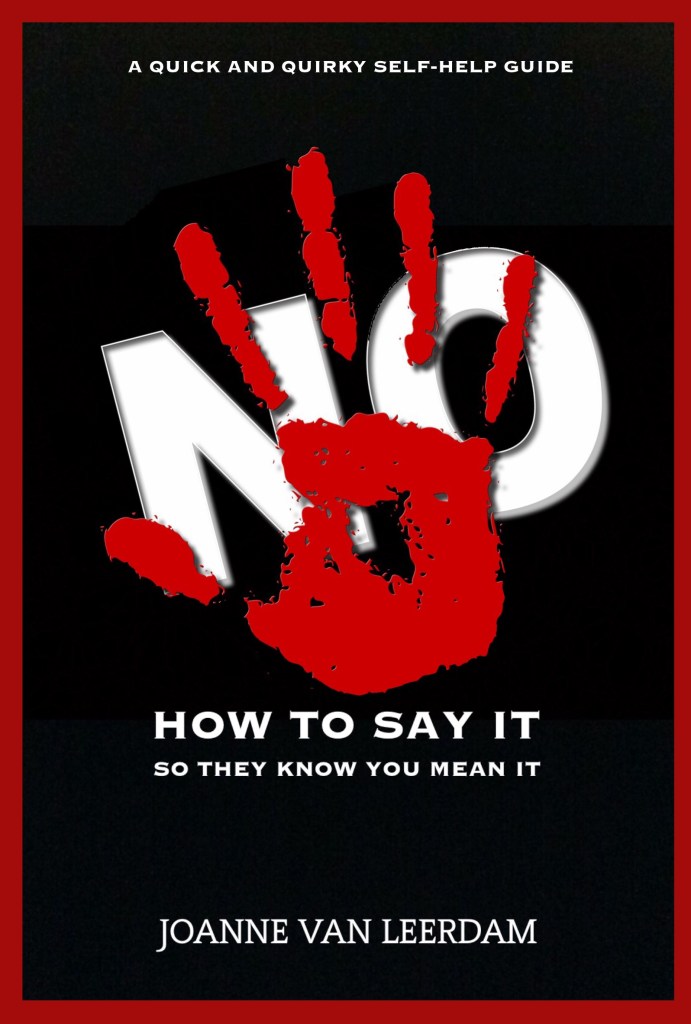
This quick and quirky self-help guide to saying no more effectively provides insights and tips on how to say “no” so that others know you mean it, and thereby reclaim your freedom from those who would readily exploit your generosity.  

If you find it hard to say no to people, but really want to… this is the book you need. 

Available for preorder. Out on Tuesday 10th.

The Pun.

The pun is often quite an under-appreciated  form of humour. Also known as paronomasia, its a device of word play that relies on the multiple meanings of words, or the alternate meanings of homophones, to make a joke or draw attention to an idea. 

All my life, puns have been a much-loved form of humour in my family. Sometimes deliberate, other times incidental, my mother always took great enjoyment in teaching us to play with words and meanings, and to take great satisfaction in a well-executed pun.      

Birds, flowers, food, animals, jobs… you name it, we punned about it. 

One of my personal favourites occurred the first time we played Trivial Pursuit as a family.  My brother-in-law asked me a Science & Nature question: “Which is bigger, the Moon or Uranus?” “Hold on and I’ll check!” I quipped, then bent right  over and stuck my head between my knees.  The combination of sight gag and pun had everyone roaring with laughter. Since then, the story has been passed on numerous times to friends, extended family, and the next generation. 

Admittedly, some can be fairly lame, but when wielded by a person with great vocabulary and word power, a pun can be a thing of beauty. 
Shakespeare himself loved a good pun, incorporating many of them into his plays. Shakespeare often engaged in paronomasia in both humorous and more serious contexts as a way of exploring or developing key ideas.. 

Mercutio’s joke as he is dying, “Ask for me tomorrow and you shall find me a grave man” is a prime example, and a master stroke of dark comedy genius secreted within a play that actually has very little to laugh about.

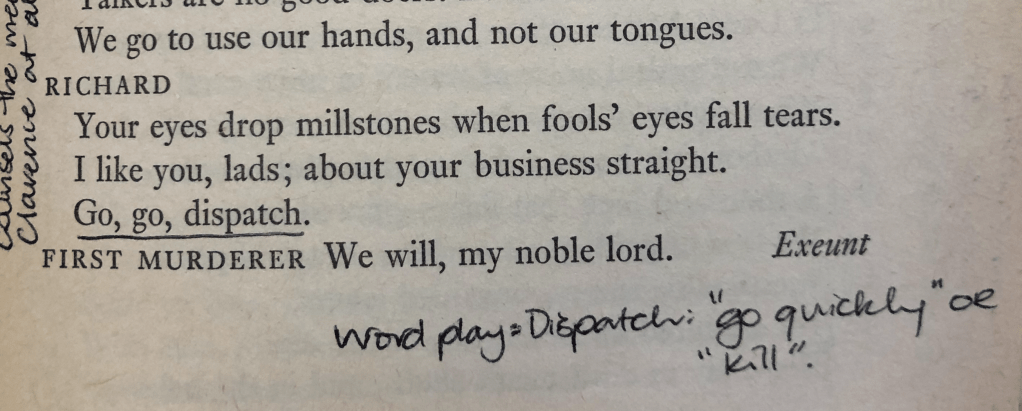
The ability of characters such as Iago and Richard III to twist words using puns demonstrates just how easily they are able to manipulate both meaning and situations to their advantage, and provide powerful insights into each one’s evil genius.

It’s nice to think that Shakespeare and I are of the same mind when it comes to puns. They are fun; they are clever; they engage the intellect; they bring ideas into sharp focus. And the fact that there are a plethora of ways to use them means a lot. 

Of course, some people just don’t appreciate that particular brand of humour. There’s no point, for example, trying to explain puns to kleptomaniacs because they can’t help taking things literally.
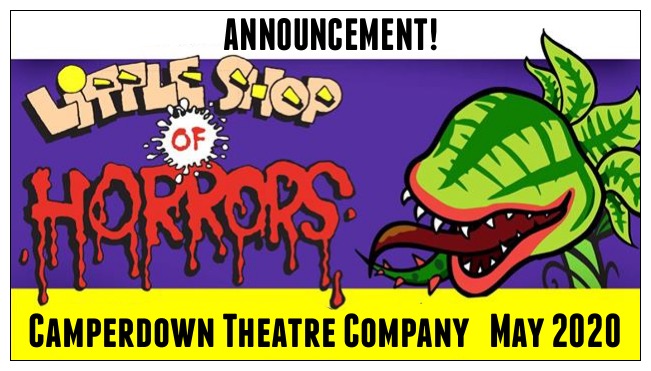
Coming in May 2020: Little Shop of Horrors

For several weeks now, I have been almost bursting with excitement and anticipation, and with the pressure of keeping this news secret until now!

I am finally at liberty to announce that I am going to be the director of ‘Little Shop of Horrors’  in May 2020 with Camperdown Theatre Company. 

I’m thrilled to be working with a wonderful friend as CoDirector alongside a brilliant team of incredibly talented people. I’m really looking forward to bringing this show to life with them, and building our friendships and experience at the same time. 

And this show! I can’t put into words how much I want to do this show. 

This is another “musical theatre bucket list” show for me, and I’m incredibly thankful to Camperdown Theatre Company for having faith in me as a director, but also for giving me the opportunity to do yet another amazing show with them. 

This is so freaking awesome, I can’t even begin to express how I feel. 

Auditions will be in November, and rehearsals will start early in the new year. There are lots of plans and decisions to be made before then, and I can’t wait to get started. 

First things first, though. My school production of ‘Joseph and the Amazing TechnicolorTM Dreamcoat’ hits the stage next week, and that’s going to be my focus until it’s done and dusted. 

Oh my gosh. Hold on tight, kids: the next seven months are going to be an incredible ride!

Don’t Waver Over Your Waivers!

A mistake frequently made in writing is to say that someone “did not waiver” in their faith, or from a decision they had made.  What they really mean is that the person in question did not waver

Once again, it is a failure to choose between differently spelled homophones that is the problem here. 

Waiver: the renunciation or surrendering of  ownership, a right  or a claim
Example: The council decided to waive the annual fee for dog registration. The waiver resulted in more households registering  their pets. 

Waver: to hesitate or falter, or to flicker, quiver or tremble.
Examples: Her feelings for him wavered between passionate love and indifference. 
He did not waver in his support for the mayor, who was a woman of integrity. 
The flame of the candle wavered in the gentle breeze.

At least when one waves at the waves, the spelling is the same so you can’t get it wrong!

Hal-arious.

We were watching Antiques Roadshow this evening. The host was enthusing over a large wooden table that he identified as a genuine piece of Tudor furniture. 

“Look at those gorgeous Tudor legs and lovely drawers!” he said. 

“Henry VIII had gorgeous Tudor legs and lovely drawers!” I quipped. 

“That thing’s bloody huge!” my husband observed. 

It’s not often I get such a perfect opportunity. There was only one thing left for me to say: “So was Henry by the end of it.”

I know, right? Comic genius. 

Shakespeare Nerd.

In an attempt to organise all my Shakespeare-related posts so they might actually reach the readers they were written for, I have a new Facebook page called Shakespeare Nerd

It’s easy to find those posts on WordPress because you can search, or simply click on a category like Shakespeare or a tag like Shakespeare Nerd and they will magically appear.

Finding specific posts on Facebook is not that straightforward, and so my new page was born. 

It’s already full of all sorts of hey nonny nonny and hurly burly, and waiting to be discovered by my fellow Shakespeare lovers.

If you are on Facebook, love Shakespeare, and want to make my day, please give it a like. 

If you’re not, or you don’t, or don’t want to, there is absolutely no obligation. You won’t miss a thing, because you’re already here, right at the front of the line waiting for me to serve up the wordy nerdy goods.

Thank you for being a supporter and reading my posts, by the way. It’s very much appreciated.

Podcast Review: ‘Fry’s English Delight’

As soon as I discovered the existence of this podcast I knew it was going to be good. 

Steven Fry, actor, comedian, TV host, really needs no introduction. He has a nice voice, charming style and ease of delivery that really suit these enjoyable and varied excursions into different aspects of the English language.

The fact that the title is a play on Fry’s Turkish Delight is an indication of the defining qualities of the show: clever, witty, rather English, and most enjoyable. 

The podcast is very easy listening, presented in language anyone can understand. Each episode runs for just under half an hour, so it fits well into the time people might spend commuting, exercising or having lunch. It’s obviously a show designed to be interesting and entertaining for everyone, not just for academics or linguists, although as an English teacher of more years that I care to admit, I certainly don’t feel as though it over-simplifies or talks down to people, either. 

Apart from being great entertainment, the value of a podcast like this is that it not only teaches or reminds us about elements of the English language that we use every day without thinking, it also helps us to appreciate the beauty and intricacy of language and the ways it can be used to create and shape meaning so that our communications are more thoughtful and effective. 

The podcast is available via Audible, and is free of charge for members. 

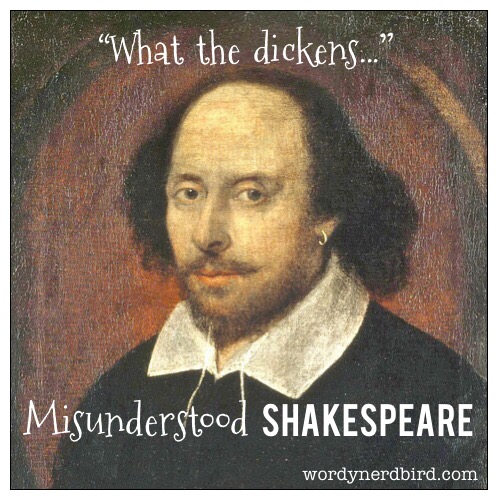
Misunderstood Shakespeare: “What The Dickens”

Many people assume that “What the dickens?” is a reference to the author Charles Dickens. 

Considering that Shakespeare wrote this expression in ‘The Merry Wives of Windsor’ in 1600 and Charles Dickens was born in 1812, that is entirely impossible. 

Instead, ‘dickens’ is a euphemism for ‘devil’, as is ‘deuce’. When Mrs Page says “I cannot tell what the dickens his name is…” she really means ‘what the devil”.

It’s a more polite way of expressing strength of an idea or emphasising their intent, in this case, that she has no idea of the identity of the person she is being asked about. It’s exactly the same as people saying ‘heck’ instead of hell, ‘gosh’ instead of ‘God’ and ‘jeez’ instead of ‘Jesus’, and is probably  done for the same reason: superstitious avoidance of using religious terms, or “using in vain” the names of religious entities. 

There’s also a chance that, for some folks, old-fashioned good manners may enter into it, too. 

In short, this is a euphemism: an inoffensive word or phrase used to replace an impolite or offensive one. We use euphemism when we talk about “powdering my nose” or “going to see a man about a dog” instead of “going to the bathroom”, or “bathroom” instead of “toilet”.

Like many of Shakespeare’s words and phrases, “what the dickens” has stood the test of time and is still used as a euphemism today.

A Fit of Pique.

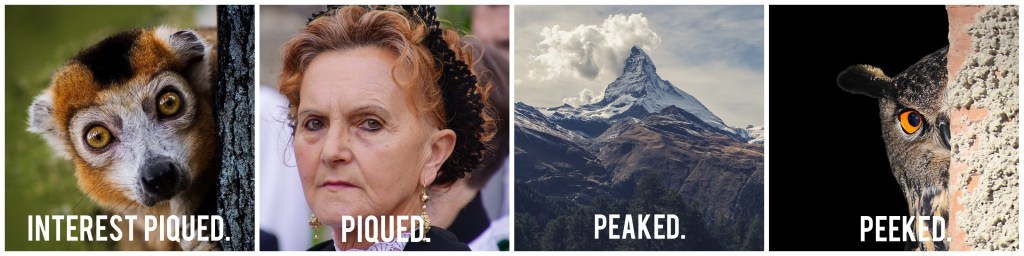
I get really annoyed when I see people writing about peaking someone’s interest. 

A mountain is peaked. A cap can be peaked. 
People can even look peaked: in this sense, it means they are pale. 
A career can peak. 
In fact, someone’s interest in something can peak, right before it declines again. 

While they sound the same, the correct term for having caused intense interest or curiosity, is piqued

To pique someone’s interest is to heighten or arouse it. In other words, it is to stimulate their curiosity or attention. 

A fit of pique is an episode of annoyance or irritation – such as might happen, for example, if someone’s negative emotions are piqued. 

A related word is piquant, which means provocative, tantalising, spicy or tangy. Food that excites the taste buds or a story that excites the imagination can both be described as piquant. 

The other homophone is peeked. This is the past tense of peek: to take a quick look, or a sneaky one. 

So… now that I’ve piqued your interest with my fit of pique, and you’ve peeked at my post… I’m sure your interest has long since peaked. 

See? Homophones can be fun!

Classy Humour.

I love the fact that my students have great senses of humour. They’re quirky and fun, and they know they have the freedom to express that in my classes.

Last week, one of my students told me a funny story about what he did in Biology class. To his delight, I appreciated the humour a lot more than his classmates or the Biology teacher had done.

He was more than willing to give me permission to write his story creatively. I decided a Drabble would be perfect for creating a snapshot of that moment in the classroom.

I hope you enjoy his very classy humour as much as I did.

And thank you, James, for making me laugh on a regular basis. You’re a legend.

wordynerdbird's avatar

The teacher stood at the front of the room, textbook in hand, as the students settled down to business. 

“Please open your text book to page four hundred and four, and… yes, James?”

The teacher looked with anticipation at the young man sitting in the second row, hand raised and an awkward smile on his face. 

“That page cannot he found.” 

His classmates looked confusedly at James, and then at the specified page in their own books.

The teacher frowned. “Are you sure? There must be some kind of mistake.”

James’ smile became a triumphant grin. “It’s an error 404.”

***

Credit for this story must be given to my student, James, who actually did this in one of his classes, and gave me permission to write it as a drabble.

View original post