Having discussed the meaning of “not mincing one’s words” n my previous post, it seemed logical to explore the practice of using minced oaths.
You might never have heard of a minced oath, but most of us use them all the time.
A minced oath is a term we use instead of a swear word. Just as minced words are diplomatic so as to not cause offence, minced oaths are likewise designed to express surprise or to emphasise reactions or feelings without causing offence through swearing or blasphemy.
Therefore, it’s a kind of euphemism: a word we use instead of a less polite or more uncomfortable term. We use them all the time, and there are probably thousands of them in common use in English. For example, we call the toilet “the bathroom”, we call dying “passing away” and the dead our “dearly departed”, and we refer to swearing as “colourful language”.
A minced oath can also work as an intensifier: it can give emphasis and power to a statement, just as effectively as a swearword or any other adjective or adverb. To say “that dratted virus” or “that freaking thing!” enables the speaker to inject more force and emotion into their statement without actually offending anyone.
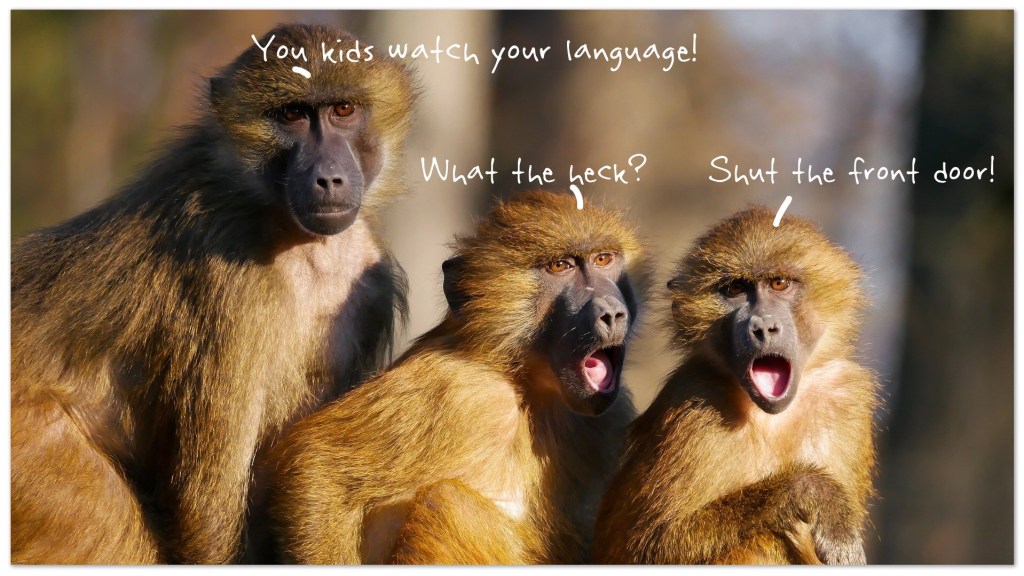
21st century English is full of minced oaths. Darn. Dang. Dagnabbit. Gosh. Golly. Jiminy. Jeepers Creepers. OMG. Geeze Louise. Heck. Holy Moly. Shut the front door. If we tried to list them all, we’d be here all day.
Some are closer to actual swearing than others — in fact, some come painfully close — but most are used without causing any real offence to most people.
When I was a kid, my parents never allowed me to say anything that approximated ‘God’ or ‘Jesus’ because they believed it was just as bad as using those names as blasphemy. My friends and I used to joke that “heck is where you go if you don’t believe in gosh or jeez’, but we still wouldn’t use those terms around our parents. In contrast, kids now are shocked to discover that those are the origins of their common expressions.
It’s all part of the way in which language evolves and adapts to suit different purposes and situations.
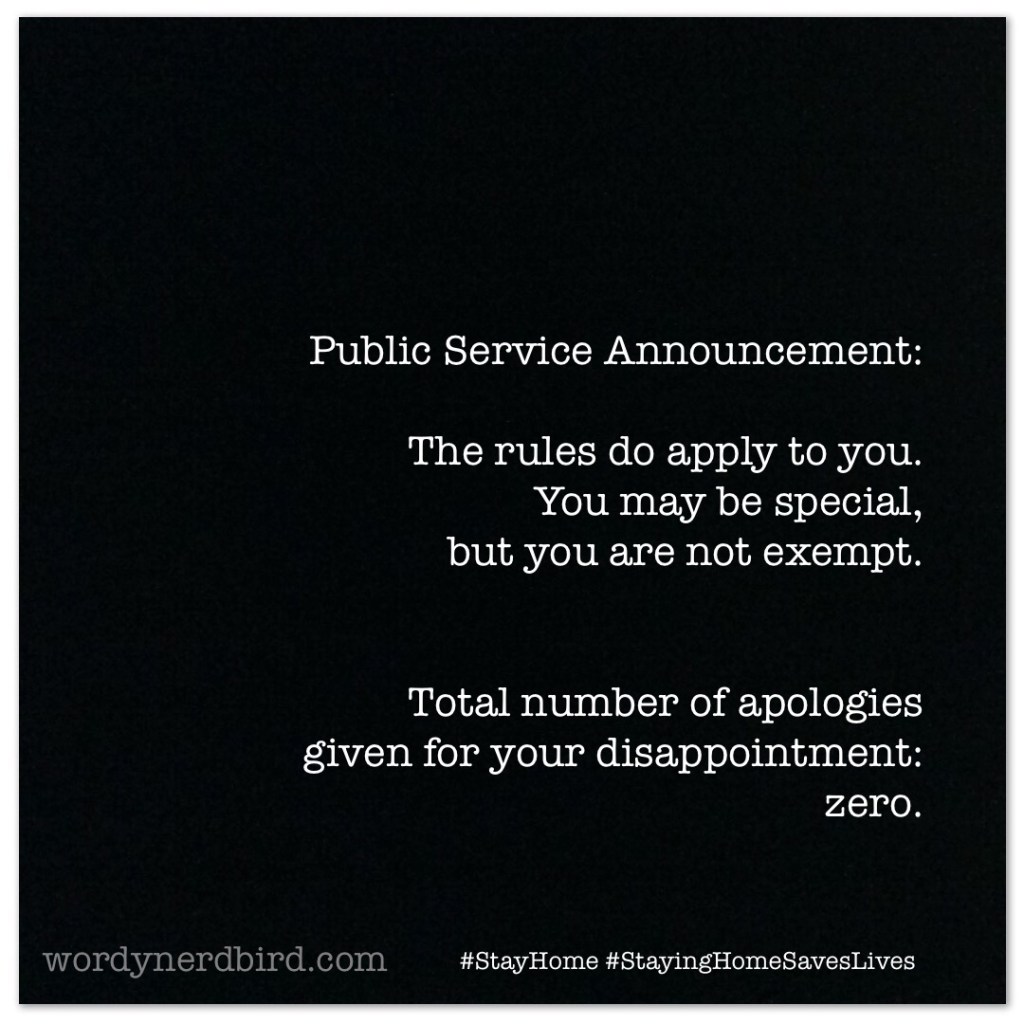
Here’s a Public Service Announcement for everyone thinking of breaking out of isolation and going somewhere else for the Easter weekend, especially those Australians who seem to think that the rules apply to everyone but them.
Just. Stay. Home.
And the places you’re thinking of going? They don’t want you there at this point in time.
Sure, spending the long weekend at home with the same people might be boring, but aren’t they the people you’re thinking of going away with for the weekend? Maybe it’s home itself that is boring. Consider, though, that it’s also safe, because it’s keeping you out of the way of that nasty corona virus and any other germs that might be doing the rounds.
Yes, it’s inconvenient. But it’s no more inconvenient or uncomfortable for you than it is for anyone else.
People selfishly ignoring the rules, going out and potentially spreading germs all over the place is why we have such strict isolation rules now.
And, you know, it’s an investment in everyone’s future.
Some of us have elderly family members that we’re trying to keep alive long enough to be able to see and hug their children and grandkids at Christmas, if this is all over by then. Some of us have family members whose immunity is compromised by illness, or chemotherapy, or their own unique biology. We’d like to keep them alive, too. Some of us have chronic illnesses that make us susceptible to every bug that floats past our noses. Given that we already battle significant health issues every day of our lives, we’d prefer to not add Covid-19 to that list.
So when selfish, ignorant people insist on travelling places where they don’t live — whether it’s to deplete our shops of the essentials that are in short supply everywhere (thanks for that by the way, we didn’t need toilet paper this past fortnight) or hang out on the beaches or lake shores or in the parks — and so disrespect the boundaries that the government has established to keep everyone healthy and safe, we get more than a little annoyed.
Because the rest of us are staying home, too. And we would like to be able to eventually see and hug our families and friends. We’d like to be able to go to a cafe or restaurant, or meet with friends at the pub. We’d like to be able to browse a real bookstore with real books in it, or go shopping for things like clothes or shoes without worrying about whose health we might be endangering.
And let’s face it – most people who have lost their jobs because of this pandemic would like them back, sooner rather than later. Essential workers would like to be able to go to work and come home not worrying about what they’re exposed to every day.
The more selfish prats who insist on going to the beach or driving some tourist route instead of just staying home, the longer and harder the lockdown is going to be.
So please, for the love of everything good in this world, stay home.
If home is “boring”, that says a lot more about your imagination than you realise. If you decide something will be boring, guess what? It will be.
Making changes or finding and introducing new opportunities for entertaining yourselves at home is entirely within your control. So if you’re bored, you’ve got nobody to blame but yourself.
Consider this long weekend your opportunity to change your attitude and your environment, not your location.
Please: #StayHome this #EasterWeekend #EasterWeekendlockdownchallenge #StayHomeAustralia #StayingHomeStaySafe
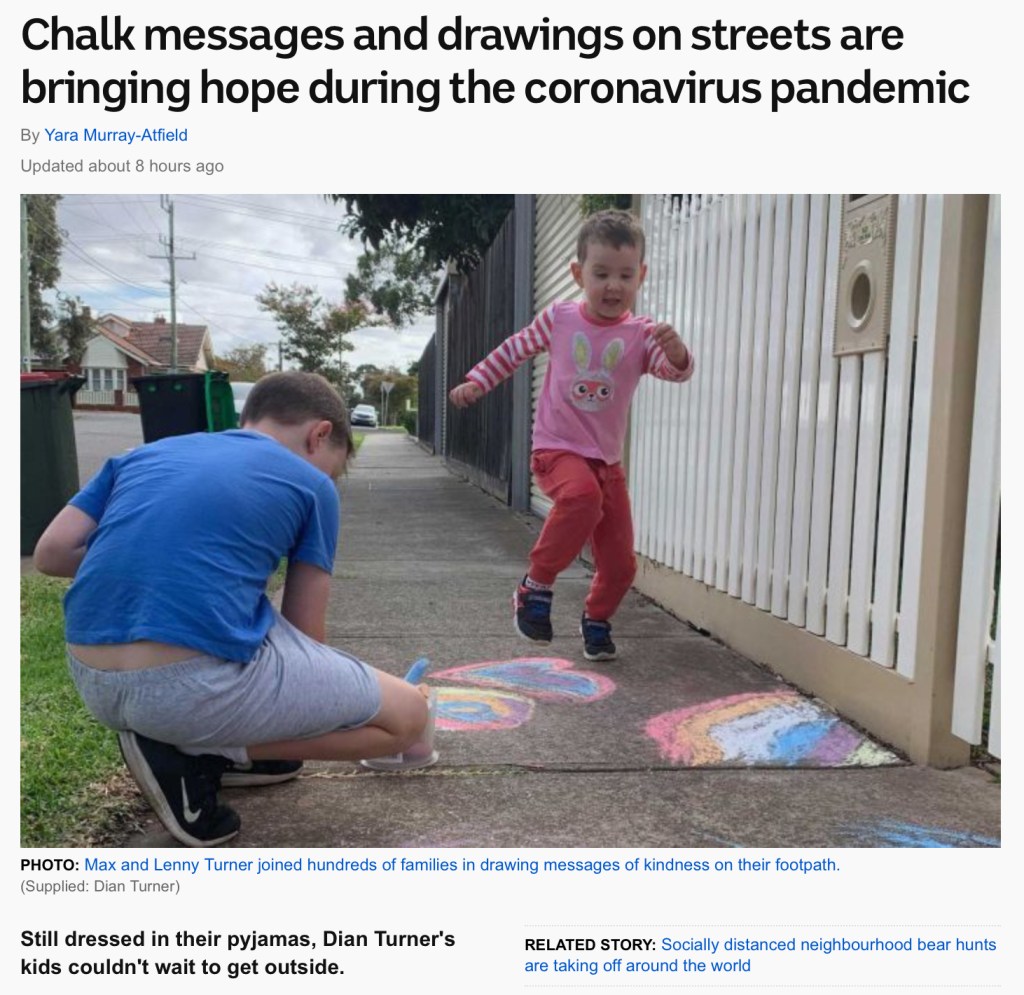
It’s cheerful, and simple, and sincere, and it’s just so beautiful.
In the midst of these bleak and socially-distanced times, these messages are a delightful trend that is bringing heartfelt encouragement to communities.
I get it. We’re at home, our kids are home, we can’t go anywhere, so let’s stay in our pyjamas all day! Right?
Wrong.
When everything else in the world is in limbo and the rules are changing on a weekly — or daily — basis, it’s really important for our health to keep some kind of routine and not let the basics fall by the wayside.
Yesterday, I mentioned that taking care of ourselves is one of the positive things we should all be doing. While everyone’s situation is unique, there are some commonsense strategies for taking care of ourselves which are particularly relevant during the disruption to our regular routines by the corona virus lockdown.
Nutrition matters. It’s tempting to live on pizza, chocolate and peanut butter sandwiches, but being sure we eat well and nourish our bodies properly is crucial to maintaining good health. The healthier we are, the more resistant we are to germs of any kind, and the recovery from any bug we might pick up will be quicker. Not only that, but we’re going to have to go back to work sooner or later, and it would be good if those business suits or uniforms still fit when that time comes.
Hydration is also crucial to keeping the body healthy, but most of us don’t drink as much water as we should. It was only when I started keeping track of how much I was drinking in a day that I realised how far short I had fallen from what my body actually needed on a daily basis. Remember, too, that alcohol is a diuretic, so for every beer or glass of wine, we need to drink more water. For a great discussion on how much water we need to drink, listen to this interview from ABC Australia.
Exercise is similarly important, and for more reasons than just not bulking out while we’re hibernating. Exercise is good for the brain and the emotions as well as the body, so even when we can’t leave home, it’s important to walk, or get on the treadmill, toss a ball with the dog, follow a cardio or dance video tutorial, or get into stretching and yoga. Even cleaning out a cupboard or doing some gardening qualifies. There are lots of options for people to pursue at home, and your exercise can be as gentle or vigorous as you want it to be so there’s no excuse for staying in bed or living on the couch for the foreseeable future.
While it has been widely publicised that sunlight will kill the corona virus doesn’t like the sunlight, that is not actually true. Even so, it dos kill other germs and bacteria. Stepping outside the house and into the fresh air and sunshine is highly beneficial for wellbeing. You don’t have to go far – just into the yard will do if you can’t or don’t want to go any further. While people who live outside the city are at a definite advantage here, most neighbourhoods have parks, gardens or reserves where you can go and walk without being in close proximity to anyone else or even touching anything. Letting light into your house is important, too. it helps you maintain a natural circadian rhythm, and therefore promotes better sleep hygiene.
Personal hygiene may seem mundane, and there are probably people out there who are treating it as optional, but showering every day, wearing deodorant, and taking care with presentation is an important part of taking on each day with a positive attitude. It’s psychologically proactive and It makes a difference to our physical health and wellbeing. Just as importantly, it makes you much more pleasant to be around. You might just be at home with your family, but they are actually the most significant people in your life. If you couldn’t be bothered doing it for yourself, do it for them.
Maintaining a routine is also a very positive psychological strategy. If you normally work from 8.30 til midday then break for lunch, try to do that at home, too. You might have some interruptions, or you might be sharing a workspace, but it’s a powerful way to model to other people, especially kids, that keeping going in times of adversity is both possible and beneficial. It also keeps the brain trained for returning to work when the time comes, and gives you a great sense of satisfaction of achieving something each day.
Similarly, keeping your home spaces clean and tidy promotes health by not giving the germs a foothold. Do the laundry, wash the dishes, and clean the surfaces regularly. That way, things are easily maintained without turning into hard labour.
Relaxation should be part of every day. Whether it’s reading, crafting, meditation, writing, doing a puzzle or listening to music or a podcast, spend some time each day in quietness and peace. If your kids aren’t good at quietness and peace — and many are not — now is a better time than any to model positive mindfulness and teach them some strategies they can use. They should also be learning to respect your need for some downtime, too. They may be getting frustrated, but it’s actually not all about them.
In keeping with all of this, my own personal strategies include are:
Maintaining my regular morning routine: get up at a reasonable hour, shower, dress, have breakfast, and then get into the things I need to do each day.
Creating an achievable “to-do” list for each day. It helps me organise myself, and ticking things off the list is incredibly satisfying.
Sticking to my usual school timetable as much as possible when I’m working from home. I’m a teacher, so there’s always plenty I can do. I have to take care not to let work consume the entirety of each and every day. A routine helps me to manage that more effectively, and keeps me on task this week as I’m working to get done what I need for the beginning of Term 2.
During the scheduled term break of two weeks leading up to Easter, I need to ensure I have the break I have earned. There will be some school work to do — there always is — but I will not be working the whole time.
Spending time outdoors every day. I can choose to work in our courtyard, spend time in the yard with the dog and talking to the sheep over the fence, or spend time in one of the parks in town. Mixing it up from day to day is how I roll.
Eating properly. The temptation to snack all day is huge, and having dropped a few dress sizes since August, that’s not a habit I want to get back into. I’m shopping strategically – I go only when I need to, and when my resolve is strongly in favour of buying apples rather than chocolate.
Punctuating between activities by drinking a glass of water.
Maintain my regular habit of reading for at least an hour a day.
Self Care At Home During the #CoronavirusLockdown #mentalhealth #HealthandWellbeing #selfcare #Priorities #stayinghome
I’ve mentioned here before that I enjoy a good pun. Today, to my delight, one of my students came up with a pretty good one, so I responded in kind.
It happened in history, where my students were mapping the three arenas of WWII.
Student A: Syria. Sy-ri-a. *grins* Are you…syyyyyyrias? Me: Hey, I was just dam-ask in’… Student B: That’s SO bad.
Well, we laughed hard. And then student A explained it to the rest of the class, and they laughed too.
Poor Student B, though. As Student A explained, he put his head on the table and moaned, “It’s like having my dad in the room… twice!”
Still, it it wasn’t enough to stop him from piping up a little later.
Student B: Did you know that it wasn’t just Darwin, Broome got bombed too? Me: Yes, the Japanese swept right across north-west Australia… Student A: Haha! That’s genius! Student B: No. NO. That’s awful! Me: I didn’t expect you to bristle like that. Student B: I’m leaving. *walks out of the room* Student C: Where’s B? Me: *just as B is walking back in* I made a joke and he flew off the handle. Student B: No. *walks out again*
It was a fun moment which we all enjoyed, but it also made the facts the students were working with more memorable. Once we’d had a laugh, they all just kept on working.
Opportunities like that don’t happen all the time, but when they do, they are welcome.
Humour is such good medicine, and it makes excellent social glue. It was wonderful to be able to laugh together during a week when the world seems far more uncertain and a lot less enjoyable than it did a couple of weeks ago.
I’m thankful that my students have the confidence to express themselves in my classroom, and that they do it in ways that are clever and fun. It really is a huge blessing to be able to have such great rapport with my students, and these kids make it easy to keep going to work every day.
These anecdotes were retold here with the permission of the students involved.
There are four main sets of skills that English teachers work to develop in their students: reading, writing, speaking and listening.
Over the past few years of my teaching career, I have observed that my students find listening much more difficult than the others.
I’m not talking about them showing respect or being quiet when I’m talking – most of them are pretty good at that, thankfully.
It’s the art of deliberate, intentional listening, focusing on what is heard and processing that kind of information, that people seem to struggle with.
I have offered my students audiobooks to help them with reading their set texts. Most of them aren’t interested in that— not even the struggling readers, who would really benefit from that kind of assistance in getting through a book. I have also offered them podcast episodes related to the books they are studying, and I don’t recall anyone taking up the offer.
Give them a YouTube clip, though, and they’re on it like flies at a barbecue.
Don’t get me wrong – those YouTube clips and TED Talks can be super helpful. My issue is that people – and it’s not just kids, I’m sure – are so oriented to screens and visuals and hooked on sensory overload that they’re losing the art of listening.
People these days frequently have music playing while they do other things – work, run, work out, eat, walk, shop, drive, clean the house, you name it. There’s absolutely nothing wrong with that. But do they ever really just stop everything else and just listen to something?
It is really healthy to turn off the “noise” of the world and the demands of a busy life and close your eyes to focus on what you can hear. You don’t even have to listen to anything in particular – it can be fascinating to see what you can hear when devices, TVs, and appliances are turned off and things are quiet, especially if you go outside.
In terms of listening material, there is so much available that is good to listen to beyond music or commercial radio. Audiobooks are fantastic, as I’ve observed in a previous post. There are podcasts on every imaginable subject, free of charge, just begging to be listened to. Listening to talkback radio is both informative and entertaining, if you can find a station or a show you really like.
Listening is such a valuable skill. It enriches life in so many ways. It builds relationships, enhances learning, develops understanding of the world and the different people in it, provides entertainment, aids relaxation and soothes the soul.
If we would all just turn off the screens, close our eyes, and open our ears more, we’d be a lot better off.
It can also be quite cathartic.
Let’s be honest, what day can’t be improved by a good “Arrrrrgh!” or two?
If people annoy you, you can threaten to make them walk the plank, or call them lily livered landlubbers, and nobody takes offence.
I grew up enjoying books like Treasure Island and Kidnapped!, and still enjoy a good, old-fashioned pirate story, so I thought I would share Book Squirrel’s International Talk Like A Pirate Day Book Recommendations.
In honour of International Talk Like A Pirate Day, here are three great pirate tales for your reading pleasure.
‘Fallen Into Bad CompaNy’ by Kayla Jindrich
Matthew wants nothing more than to escape from his past, but that hardly seems possible with his new apprentice. While William might be Matthew’s chance at redemption, an opportunity to pay for his mistakes, William also has a reckless streak that could ruin the new life that Matthew has built for himself. Either Matthew will pull William from piracy, or William will drag Matthew back into the dangerous world that they both come from.
In the Outer Islands, gods and magic rule the ocean.Under the command of Captain Rafe Morrow, the crew of the Celestial Jewel ferry souls to the After World…
Today is RU OK Day, also known as World Suicide Prevention day.
This is an awareness very close to my heart.
I’m not going to expand on why, because I want the focus of this post to be positive and encouraging.
The message is important not just for today because it’s a special awareness day. This message is permanently, crucially important.
We need to take care of each other. Each of us is uniquely placed to offer support and encouragement to the people we know – friends, families, colleagues, students, whoever we cross paths with in our lives. That doesn’t mean we have to be their only support, although sometimes we might be just that.
If you think someone is down, if they look tired or unwell, or notice they’re not taking care of themselves as well as they usually do, ask them if they are okay. Don’t just ask as a throwaway question. Be willing to have a quality conversation that includes questions like:
What’s going on?
What do you need?
How can I help?
Is there someone I can contact for you?
Taking the time to check in with someone deliberately and thoughtfully is a powerful communication of care and concern.
It’s important to realise that you or I might be the one positive thing that happens in someone’s day. We might be the only source of encouragement and light that they encounter.
We also need to consider the power of our words. A curt dismissal or snide remark in response to a comment that might actually be a true confession of desperation, depression or anxiety can be incredibly destructive. We should never, ever be making a joke of that. Yes, sometimes it is attention-seeking or needless drama— but sometimes it’s not.
A kind word or message of encouragement could be the difference between someone actually deciding that now is the time to end their life, or not.
I know. It’s a huge responsibility.
But imagine a world where each of us gives someone that kind of support, and someone else gives it to us when we need it.
And if you’re thinking you’ll never need it, stop right now and be very, very thankful for the blessings in your life and the comfort of good, stable mental health. It’s not possible to emphasise enough just how lucky you are.
If you’re one of those who is struggling, or feeling like you’re drowning, or tired of treading water… please, please, talk to someone. Seek help. Look for reasons — any reason — to stay. Please stay.
I wrote this poem after one of the darkest seasons of my life thus far. I hope that you will gain both perspective and insight from reading it.
Before you read this poem, there is somethingI would likeyou to know.
This poem is absolutely, 100% true. It is personal, it is painfully honest, and it tells of my own experience, not anyone else’s. And you may find it quite confronting.
Despite its darkness, it is written to be positive, not negative.
It was not written to win sympathy or make anyone feel guilt: it was written so that people might understand what’s in my head, and what I’ve been feeling, and why I’ve made the choices I have.
To answer your concerns: I have chosen to stay here and to defy all impulses that tempt me otherwise. I don’t always feel okay, I’m not always okay, but I will be okay.
For anyone in a similar position: hold on. Stay here. You matter more than you know.
STILL HERE.
For a moment- One fleeting, isolated point in time-
I often wonder why “Just Say No” became a catchphrase among those trying to teach kids and teens to resist poor examples, negative influences and bad habits. It’s not always that easy or so straightforward. Peer pressure, family expectations, social engineering and a desire for job security have all taught us to take the path of least resistance — which can actually be a really unhealthy thing.
Among all the different people in this world, there are two groups who invariably find each other: those who have trouble saying no, and those who take advantage of them.
You know it. I know it. And we all know which of the two groups certain friends and family members fall into.
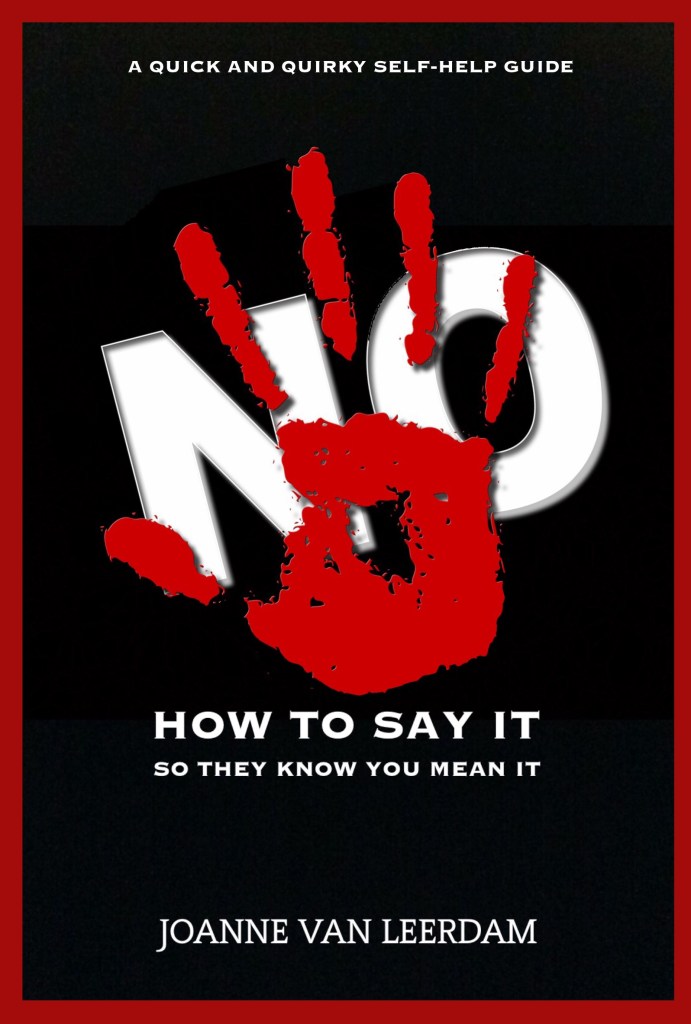
This quick and quirky self-help guide to saying no more effectively provides insights and tips on how to say “no” so that others know you mean it, and thereby reclaim your freedom from those who would readily exploit your generosity.
If you find it hard to say no to people, but really want to… this is the book you need.









 WordyNerdBird