Easily Confused Words: Bought vs. Brought

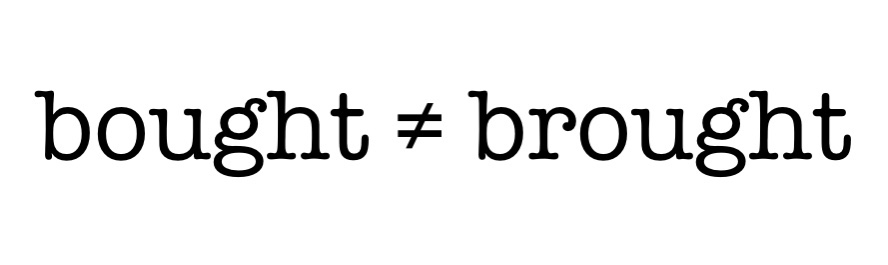
Bought and brought are words that lots of people get mixed up. They may look similar, but they are very different words.

These words are by no means interchangeable, so in the interests of both being clearly understood and preserving one’s credibility, it is beneficial to know which is which, and how to use them confidently at the right times

Bought is the past tense of buy. If you buy something, you have bought it. 

Brought is the past tense of bring.  If you bring something home, you have brought it home. 
Note: neither ‘brang’ nor ‘brung’ is standard English. 

The easy way to remember which is which is that there is an r in bring and brought, but not in buy or bought. That makes pairing the correct words much easier. 

Easily Confused Words: Bought vs Brought
#grammar #English #explanation

Uhtcare

Uhtcare— pronounced oot-care — is a lovely Old English word that dates back to the Anglo-Saxon poem ‘The Wife’s Lament’, and was probably used throughout medieval times.

I heard it for the first time today in the Something Rhymes With Purple podcast by Susie Dent and Gyles Brandreth.

Image by pasja1000 on Pixabay

Uhtcare translates to ‘dawn care’ and relates to the anxiety of lying in bed worrying about the coming day before it has even really started. It comes from the OE words uht meaning before dawn and cearu/caru meaning anxiety.

It wasn’t just the beauty of the word that struck me, but also the timeliness of hearing it today. Completely forwallowed after a night of very little sleep courtesy of painsomnia, I could totally relate to that feeling! I was lying in bed before dawn this morning wondering if it were at all possible for me to actually make it to work today. I thought about the lessons I wanted to teach, and how much effort it always takes to ensure that a substitute teacher has everything they need to deliver my lessons effectively.I also felt incredibly guilty about the fact that we have only just returned to face to face teaching, and there I was thinking about staying home.

Still, I knew I wouldn’t be a safe driver today, and I also knew there was very little likelihood of me teaching anything effectively at all.

So, I got up at 5.45 am and made sure all my lessons, material and extra notes for my replacement for the day were loaded in the school’s system and ready to go.

Image by MichaelGaida on Pixabay

Given that we don’t really have an adequate alternative for such a useful and expressive word in today’s English, It is a shame that this word has fallen out of use. Maybe it’s time to bring it back.

Uhtcare: lying awake before dawn, worrying about the day.
Anglo-Saxon/Old English
#English #words #blogpost

Sources:
Something Rhymes With Purple podcast: Vedettes 15/9/2020

Ten Rare But Useful Words Everyone Should Know

Anglish Wordbook

Pedant vs. Teacher

Most people use the term ‘pedant’ in a derogatory way, usually in reference to someone they perceive as being too fussy or too strict about rules. 

On the occasions when I have been called a “grammar pedant”, I have generally responded as though someone is paying me a huge compliment. I invariably say something like “Oh stop it, you flatterer!” or “One day you’ll say that like it’s a bad thing!”

As a lover of the English language and words in general, there are things to we should be paying careful attention. There is value in pointing out where a student needs an apostrophe or a comma in their writing, or where they can express an idea or key point of information more clearly. That is part of being a teacher. It’s my job.

However, I try to restrain myself from correcting people’s grammar on social media, though, for two reasons:

  1. I don’t have time. I have a life to live, and I need sleep to function.
  2. They tend not to like it much.

What many people don’t know is that the word pedant was actually derived from the world of teaching and education. It came to English from either the  Italian word ‘pedante’ or from its descendant, the later Middle French word pédant, both of which referred to a schoolmaster or teacher.  It may be one of those words that came into English from more than one source. The Italian word is derived from the Latin word paedagogantem, which is the origin of the words pedagogue and pedagogy, which are also related to teaching and education. 

By the late 16th century, though, the English were using the term in a negative rather than a neutral way.  ‘Pedant’ had already come to be used for one who placed undue emphasis on the minor details of learning, or someone who focused on details or technicalities  instead of looking at overall issues or taking a wider view of general learning and practice. 

In that sense, correcting someone’s grammar on social media when it is clearly not appreciated is being unnecessarily pedantic. Perhaps that is the distinction that really needs to be made.

Alternatively, it might be a somewhat uncomfortable yet valuable opportunity to improve both one’s learning and professional credibility in an age where prospective employers and customers look at social media profiles before deciding to give a job or order to a particular person. This is particularly true for anyone who should be reasonably expected to have a sound grasp on the language, such as teachers, writers, bloggers and professionals who rely on clear communication in their work. 

Let’s face it. I may not care if someone misspells an uncommon word, or one they’ve only heard and not read, but if they don’t bother to differentiate between ‘your’ and ‘you’re’ on social media, I’m neither going to buy their book, nor hire them to write my copy or teach my kids. 

Fussy? Yes. 
Pedantic? Probably. 
Apologetic? Not one bit. 

Reference: Online Etymology Dictionary

Pedant vs. Teacher
#grammar #English #language #words

Asterisk.

The asterisk is the handy little star symbol* that we use to indicate that there is more information attached to something, to denote the existence of a footnote, to add emphasis to a word or point of notice, or to blank out letters in offensive words that we don’t want to type or write in full. 

The word asterisk means ‘little star’ and has been used as a noun since the late 14th century— well before the invention of the printing press— while the verb form “to asterisk something” was first recorded in 1733. 

Asterisk comes to use from Latin via Greek, but actually goes back to Proto-Indo-European roots, which is about as far back as any language or individual words can be traced. The PIE root *ster- is the source of the words for star in numerous languages including Hittite, Sanskrit, Greek, Latin and, thus, English. 

Therefore, the word asterisk is related to asteroid, aster daisies, disaster, constellation and starfish, among others. It is also a cousin of names such as Esther, Estelle and Stella.**  

More recently, the asterisk also inspired the name of Asterix, the hero of the classic comics by Goscinny and Uderzo. Those books are characteristically full of puns and word play, and the names of Asterix and Obelix are derived from mispronunciations of asterisk and obelisk respectively. 

* located above the 8 on a keyboard
** They are not close cousins, but more like the kind who are jealous of each other because they all want to be the most popular starlet in the family, and only make small talk with one another at family reunions. 

Source: Online Etymology Dictionary

Asterisk
#etymology #words #history #asterisk #language #typography

Tmesis: Abso-flaming-lutely!

Tmesis— pronounced teh-MEE-sis—  is an unusual word that many people will never have heard of, even though it’s the name for something we do frequently and quite naturally.

Tmesis is the name given to that linguistic behaviour by which we divide a word and insert another word into the middle. In the 21st century, the inserted word is often a swear word, but it doesn’t have to be. 

Image by hpgruesen on Pixabay

We do it to add emphasis and increase the strength of what we’re saying. 

The Ancient Greek word temnein meant ‘to cut’, and from that came the word tmesis, which meant ‘cutting’. It refers to the cutting or division of the first word in order to insert the second. 

The practice is centuries old. There are examples of it in Old Irish and Scandinavian poetry, although the earliest written examples of it being used in English only date back to the 1500s. 

Shakespeare used tmesis in a number of his plays:

  • “This is not Romeo, he’s some other where.” — Romeo and Juliet
  • “How heinous ever it be” — Richard II
  • “That man – how dearly ever parted.” — Troilus and Cressida

Tmesis also exists in the poetry of John Donne:


“In what torn ship soever I embark,
That ship shall be my emblem,
What seas soever swallow me, that flood
Shall be to me an emblem of thy blood.” — Hymn to Christ

From these examples, it is clear that the device has always been used to strengthen the idea or emotion being communicated, which is exactly how it’s still used today. 

In Australia, where we seem to love a good swear word and the power it gives our expressions, tmesis is so common that it seems to me to be part of our linguistic identity. Inserting a term such as ‘flaming” or ‘flipping’, or one’s preferred swear word, into words and phrases is a standard part of our speech. From “abso-flaming-lutely’ to “no freaking way!”, Australians have made tmesis their own without ever knowing that it was a literary device or that it has a name. 

Tmesis: Abso-flaming-lutely!
#language #English #grammar #speaking #englishvocabulary #wordynerdbird #blogpost 

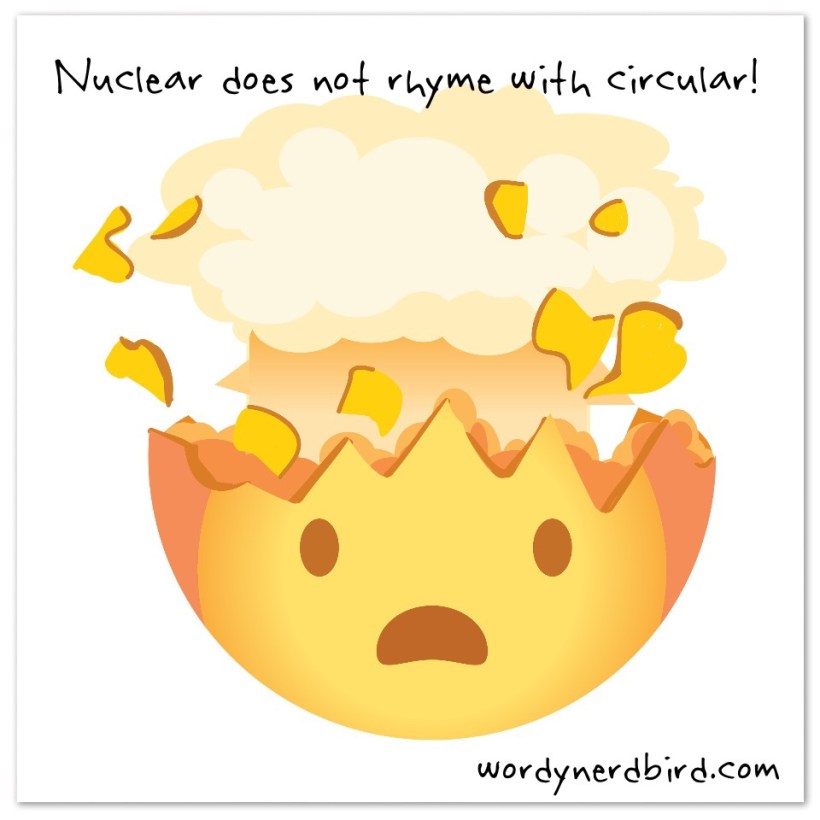
Nuclear Does Not Rhyme With Circular

This post might come across as some kind of linguistic snobbery, and while that’s not my motivation, it is a risk I am willing to take. 

The common mispronunciation of nuclear is something that drives me absolutely nuts. 

So many people pronounce it as nucular ( nyoo-kyoo-lar) but that is not how it is spelt or pronounced. I’ve even heard scientists on the radio and TV who say it that way, despite the fact that scientists of all people should know better. Did they get through however many of years study at university calling the central body of a cell the nuculus? I think not.

Nuclear is a three syllable word, pronounced nyoo-klee-ar.

If someone can say the words ‘new’ and ‘clear’ correctly, they should be able to manage ‘nuclear’ by just mashing those two words together. Think of it as linguistic nuclear fusion. 

It really isn’t rocket science. 

The Intensity of These Times

Image by ractapopulous on Pixabay

There are many ways people have found to refer to this era of Covid-19 and all its baggage: widespread testing and temperature checking, social distancing, hand washing and sanitising, and the wearing of masks. 

One of the most common is ‘these times’ and variations on that — these strange times, these difficult times, these awful times, and so on. There are myriad adjectives one could choose, although some are more socially acceptable than others. 

Recently, I’ve observed that people have started to capitalise the term as These Times in blogs and social media posts. 

This interests me, because of the way in which the language is being ever so slightly adjusted to add weight and significance to the term. Those capital letters are acting as an intensifier.

Intensifiers are those parts of language that add strength to what we’re saying or writing. Words like ‘absolutely’, ‘completely’, ‘terribly’, the commonplace ‘very’ and even the humble little ‘so’ are all intensifiers. Some people use expletives to do the same job, especially in spoken English. The meaning of the sentence doesn’t change if they are removed, but the sense of degree or importance in the words around them isn’t necessarily communicated if those intensifiers are not present. 

By capitalising those Ts, writers are communicating their assumption that their readers will know exactly what they’re talking about. And, in These Times, there is little doubt that they will. 

Is English A Salad?

Today’s English class was the most fun I have had in a long time. I wanted to exercise the kids’ minds and get them thinking laterally. I also wanted them to enjoy it. A lesson with a difference seemed to me a great way to start our final week of term and inject some interest into our online classroom.

I began by presenting my students with the contention that a box of chocolates is a salad.

This was not a popular suggestion. 

“No it’s not!” one student said… quite defensively, I might add. “Salad is salad. Chocolate is chocolate. You can’t ruin chocolate like that!”

But, I asked, what is a salad if it’s not simply a mixture of vegetables? Chocolate comes from beans… and if you add nuts, or fruit, or herbs like peppermint, then it’s definitely a salad.

We spent quite some time redefining food, presenting the most persuasive arguments we could think of, and debating the nature of reality. 

Every time it sounded like the students might be in danger of reaching a consensus, I made another suggestion. 

Ice cream, on its own, may just be ice cream – but the minute you put it in a cone, or add fruit or chocolate, it’s a salad. 
Coffee, like chocolate, is made from beans. It’s a salad.

“No!” was the response. “Coffee is hot – it can’t be a salad.”

So then I really twisted it up.

Is coffee soup?
Is cereal soup? Or is it a salad with too much dressing?
According to one student, and I quote, “Soup is not what soup is.”

Is the English language a metaphorical salad? Because it’s a mixture of a whole bunch of languages, right? The flavours are all mixed, but the parts are still recognisable if you know what you’re looking at.

Is the English language a sticky weed? Or velcro? Because you know, it takes something from every other language it swipes past. Maybe it’s double sided tape… 

I am not ashamed to say that I really had fun. Despite their groans and protestations, I think they did, too. 

Perhaps the most satisfying moments, though, were two comments made by different students: 

“You’ve just entirely ruined the English language.”

and

“These have been the most problematic fifteen minutes of my life.”

What started out as a brain tease turned into a really interesting discussion about how we use language and define things in our own ways, and often assume that everyone else understands what we’re talking about, and that everyone else agrees with us.

It’s safe to say most of them enjoyed it… but it’s also safe to say that I enjoyed it more. 
Tristful.

Image by huskyherz on Pixabay.

Tristful is an archaic word that means to be melancholy or full of sadness. Like forswunk and forwallowed, it is a word which is said to be obsolete now, but it is so beautiful that I want to bring it back. 

It came into the English language, as many words did, courtesy of the Normans and the Plantagenets, in medieval times.  The Latin word tristis gave French the word triste, which gave English trist meaning sad or gloomy, and thus tristful. 

I discovered this word today while looking for words to describe my feelings and state of mind at this point in my grief journey. Over the past few days, I have been feeling as though everything is too hard, and I just want to withdraw into my cocoon and wallow. I’m not angry, nor am I ungrateful, but I am definitely not numb. My emotions are very close to the surface, and at times I am unable to hold back the tears. 

I know all of that is completely natural, and I know I need to accept it and work through it. I know it won’t last forever.

But I also needed the words to understand and express my emotions. 

I have been using the term ‘melancholy’ a lot, and it describes my condition perfectly. However, I know that while one cannot actually wear a word out, it is entirely possible to cheapen it with overuse. Melancholy is a word that I love because it is so expressive, and because it’s beautiful to say and to hear, so I would hate to be guilty of turning it into a cliche. 

Sad isn’t deep enough. Miserable would be appropriate, but it feels more temporary and somehow more minor than what I am experiencing. 

I very quickly rejected morose and in a funk because both suggest sullenness or a bad mood, which is not reflective of my feelings or state of mind. Moody was no better.

When I saw tristful listed in my thesaurus under the entry for melancholy, I had an immediate sense of having discovered a gem that most people had laid aside and forgotten about. As I researched its meaning and etymology, I knew I had discovered the perfect alternative. 

Tristful: to be melancholy or full of sadness. #words #emotions #etymology #English #blogpost

Holy Moly, It’s a Minced Oath!

Oh gosh! I do this all the freaking time!

Having discussed the meaning of “not mincing one’s words” n my previous post, it seemed logical to explore the practice of using minced oaths. 

You might never have heard of a minced oath, but most of us use them all the time. 

A minced oath is a term we use instead of a swear word. Just as minced words are diplomatic so as to not cause offence, minced oaths are likewise designed to express surprise or to emphasise reactions or feelings without causing offence through swearing or blasphemy. 

Therefore, it’s a kind of euphemism: a word we use instead of a less polite or more uncomfortable term. We use them all the time, and there are probably thousands of them in common use in English. For example, we call the toilet “the bathroom”, we call dying “passing away” and the dead our “dearly departed”, and we refer to swearing as “colourful language”.

A minced oath can also work as an intensifier: it can give emphasis and power to a statement, just as effectively as a swearword or any other adjective or adverb. To say “that dratted virus” or “that freaking thing!” enables the speaker to inject more force and emotion into their statement without actually offending anyone.

21st century English is full of minced oaths.
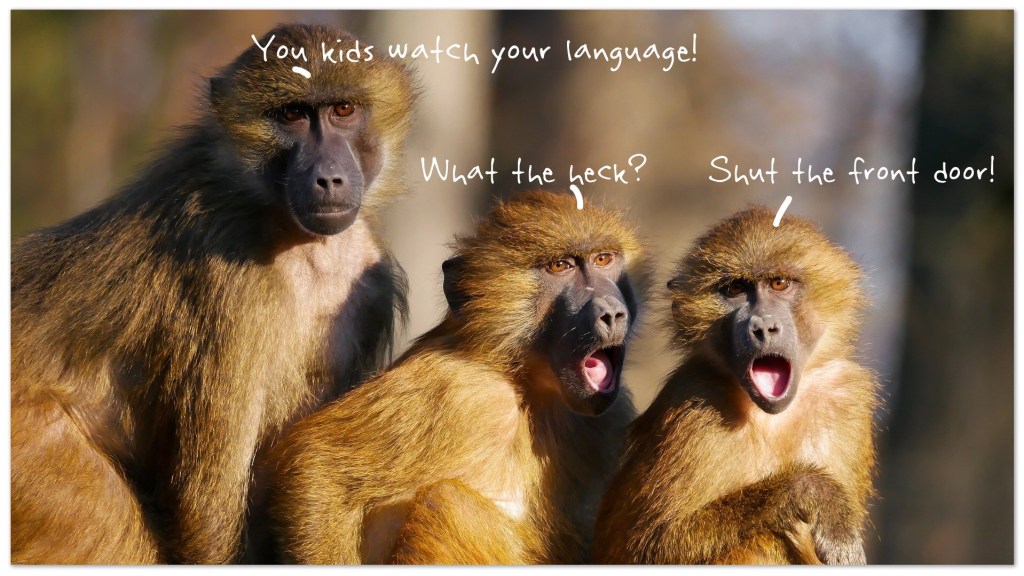
Darn. Dang. Dagnabbit. Gosh. Golly. Jiminy. Jeepers Creepers. OMG. Geeze Louise. Heck. Holy Moly. Shut the front door. 
If we tried to list them all, we’d be here all day.

Some are closer to actual swearing than others — in fact, some come painfully close — but most are used without causing any real offence to most people. 

When I was a kid, my parents never allowed me to say anything that approximated ‘God’ or ‘Jesus’ because they believed it was just as bad as using those names as blasphemy. My friends and I used to joke that “heck is where you go if you don’t believe in gosh or jeez’, but we still wouldn’t use those terms around our parents. In contrast, kids now are shocked to discover that those are the origins of their common expressions. 

It’s all part of the way in which language evolves and adapts to suit different purposes and situations. 

Holy Moly, It’s A Minced Oath!
#Language #EnglishLanguage #vocabulary #grammar #words