What I Like … and What I Don’t… About Instagram

I really like Instagram. 

It’s easy. A nice picture, a few well-chosen hashtags, and you’re done.  Scrolling through your feed and liking posts is easy too. 

Of course, there are ways you can make things more sophisticated. Adding your post to your story is relatively straightforward. You can add posts to highlights that show up in nicely organised groups on your profile. You can save posts into collections. You can follow favourite hashtags as well as individuals. 

There’s no obligation to do any of those things, so you can really keep it as simple or make it as fancy as you like. 

I really enjoy looking at other people’s creativity in pictures, so I’m right at home on Insta. I’m happy to look at their books, their cats or dogs, their holiday snaps, whatever. I love baby pictures. I enjoy memes. Some people want to post about their books all the time. Some people hardly ever post about their books. Either way, I’m cool with that. I like the fact that we all have freedom to post as we please, and we’re all able to get on and play nicely in the Insta playground. 

I like the simplicity of responding to other people’s posts. Liking is easy. Commenting is easy. 
I do occasionally think it would be nice if there were a choice of reactions like there is on Facebook. Other days, though, I consider it in terms of “a heart is a heart is a heart” and am grateful that there isn’t more value given to one response over another. 

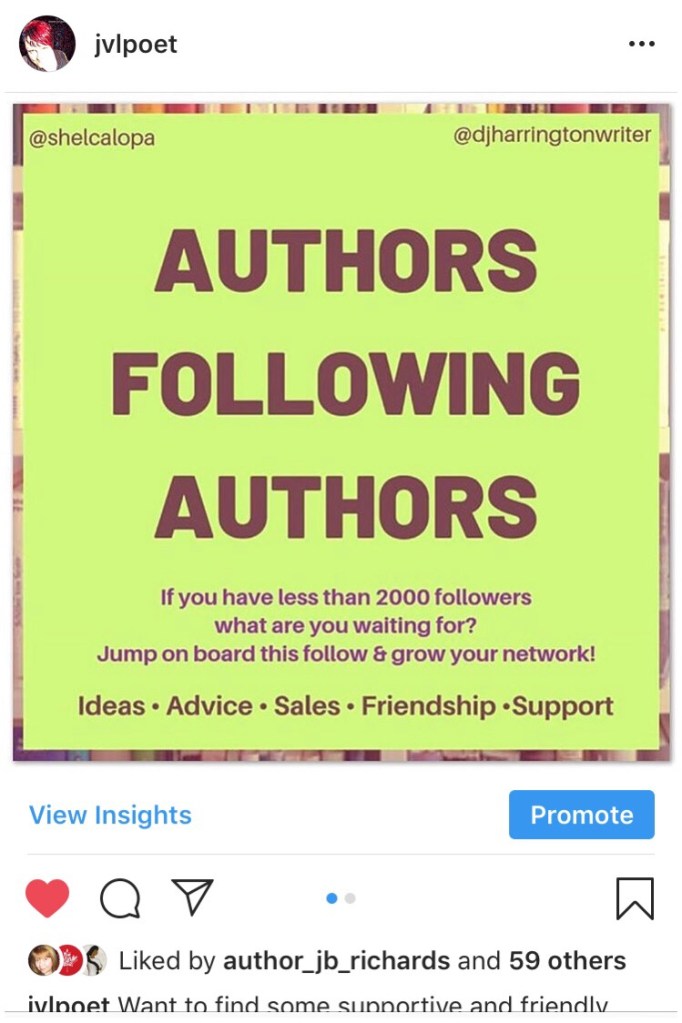
It has been really encouraging and motivating to connect with other people with similar interests through the use of particular hashtags and “follow loops”, which are basically posts where authors or other people with common interests respond and then follow one another. I’ve found so much inspiration, and received so much encouragement and feedback, from other authors and Indie creatives on Instagram. It’s a great way to become part of a very positive and proactive creative community. 
The challenge of developing my own creative identity on Instagram has been beneficial in terms of incorporating my own style and branding so that my Instagram profile is consistently “me”. I want people to be able to look at my profile and understand something of my personality and commitment to what I do. There’s a lot more to that than “buy my book” posts. It’s been a bit of a learning curve, but well worth it in terms of consistency and style, and as a means of establishing some credibility.  
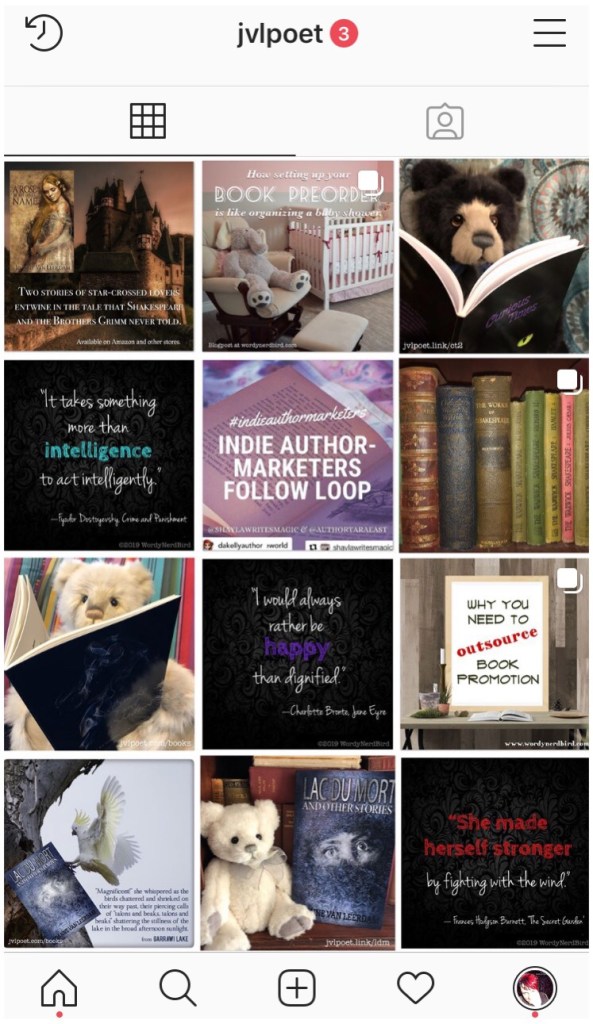
And, of course, there are things that frustrate me.
These fall into two groups: less pleasant aspects of the app itself, and my own personal peeves. 

First up: the less “user friendly” elements.  

  • Using the wrong hashtags – or more correctly, hashtags that have been abused by others, can cause your posts using those tags to be shadow banned. That’s a nerdy way of saying fewer people will see them. Don’t panic, though – there are ways to find out which tags are  thus afflicted, and so avoid using them. 
  • Scammers that look like legitimate shopfronts frequent Instagram. They’re as capable of using a pretty picture as anyone else, it seems. It pays to check out any business or site before clicking through from an Insta ad – and that’s the voice of experience talking. I got caught out once, and learned my lesson very promptly. 
  • The challenge of gaining visibility for posts. It seems that no matter how many followers I have, there’s a natural cap on how many “likes” or views my posts seem to get.  Just like Facebook – which owns Instagram – there’s an algorithm running that appears to how many of my followers see my posts. The more likes a post gets, the more visible it is to more people.  Of course, they’re quite happy to encourage me to boost my posts and pay for them to show my posts to more people. Forgive my cynicism about that, won’t you?


Secondly, my “pet peeves”:

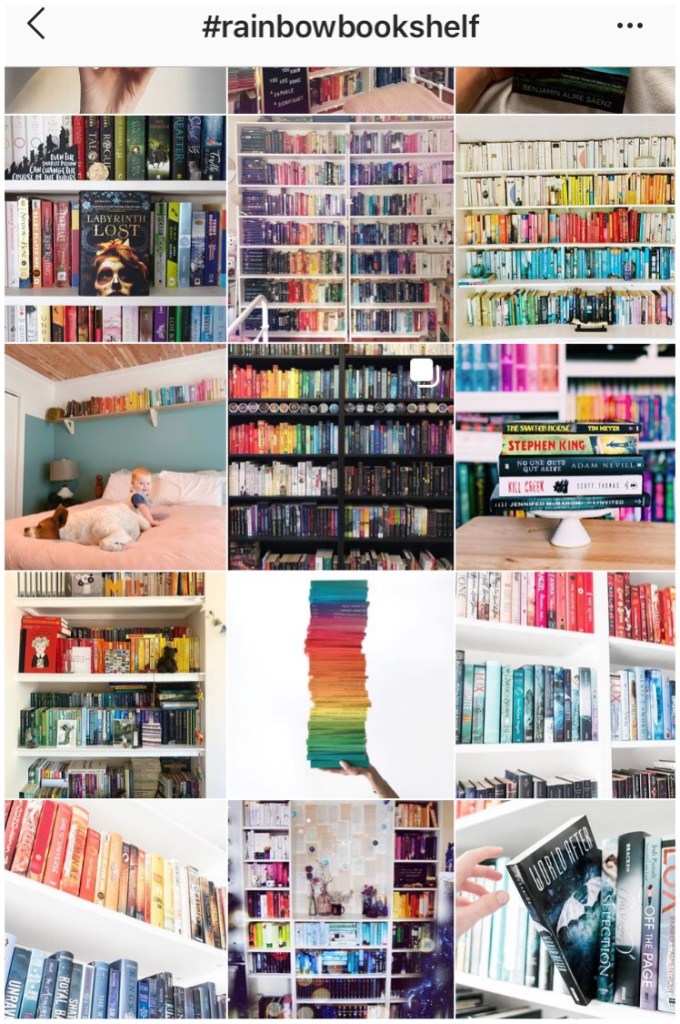
  • Bookshelves arranged into rainbows.  I just don’t understand. I get that it’s pretty, and I like rainbows as much as anyone… but it really gives the book nerd in me enormous anxiety. Wouldn’t that mean a series of books is separated on the shelves? And how does one find anything if different genres and categories are all mixed up on the basis of the colour of their covers?  This is clearly a hard no from me. 
  • People who appear to be commenting in response to something I post, but they’re really spamming me with their own content. Ugh. That’s just rude.
  • People who follow in the hope that you’ll follow them back, and then unfollow you. Especially those who don’t just do it once. There are a couple of accounts with a really distinctive  and instantly recognisable handle that keeps on following me, then unfollowing and following again a couple of weeks later. Frankly, I wonder why they bother, but it is amusing. Do they think people aren’t going to notice that? 
The verdict: Instagram is generally a very positive and enjoyable place for me. The things I don’t like are opportunities for me to practise being a grown up and just keep scrolling past them.
It’s an Insta-heart from me. 

Ten Great Reasons To Preorder That Book!

Authors making their books available for preorder is becoming more and more popular these days. It’s natural. They’re excited about that upcoming New Release, and they want you to be a part of it. 

Apart from the obvious value of supporting authors and encouraging their creativity, there are some very good reasons why you will benefit from preordering a pending book release. 

Why You Should Preorder That Book 

  1. You will have it as soon as it releases. 
  2. It satisfies that “I want it now” feeling that we all have upon seeing a beautiful cover and reading an intriguing blurb.
  3. It’s convenient: you don’t have to remember to go back and order it later. 
  4. You get to share in the excitement of a pending arrival. Consider it a baby shower gift for someone who has worked hard for months to make that book a reality.
  5. Anticipation is a positive and highly motivating emotion. 
  6. For less than the price of a coffee, you can make someone’s day AND get a great read at the same time. 
  7. Books have zero calories, so it’s a guilt-free way of treating yourself to something wonderful. 
  8. It’s like giving yourself a gift. You order it, and a short time later, a wonderful surprise appears in your eReader. 
  9. You will have the satisfaction of knowing your supported someone’s creativity and talent. 
  10. Positive Karma.

What’s not “feel good” about that list?
If you have any more great reasons, feel free to add them in a comment!

The Importance of PreOrders: An Author’s Perspective

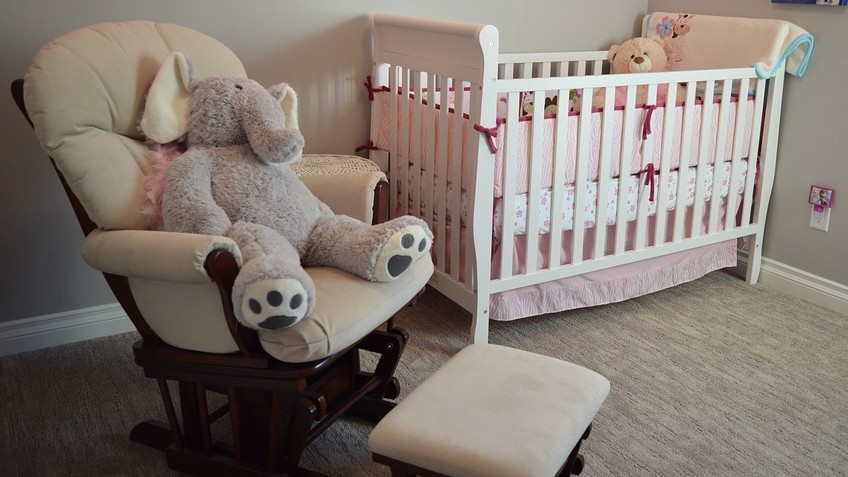
Picture this scene: a baby is due soon.
The mother has spent months anticipating the birth, making sure everything is okay, getting the nursery ready, and making sure she’s booked into the birthing suite at the hospital of her choice at the right time. 

Wouldn’t it be a little…well, weird if she didn’t tell anyone at all it was happening? 
Wouldn’t it be far more likely that she’d be sharing snapshots of the baby’s room and first teddy bear? And her friends would probably be liking those pictures, commenting on the anticipated arrival, and buying gifts for the baby shower. 

Setting up a preorder for a new book is, for an author, akin to getting the nursery ready and inviting one’s friends to the baby shower. Every preorder sale is like a baby shower gift that shows love for the author and excitement for the new arrival. 

To some, the analogy might seem far-fetched. As an author, I can assure you that it’s really not. 

***

Preorders really can make a huge difference to a new book’s start of life. 

Once you’ve got the writing, editing, formatting and publication organised, you can give your book a boost by making it available for preorder and getting some advance sales. 

Without going into a whole lot of technical details, there are some really good reasons to do so:

  • It’s convenient. When someone preorders a book, it is delivered straight to them upon release. They don’t have to think about saving links, bookmarking sites, or following up later. 
  • It allows you to tap into the “I want it now” mentality that is so strong these days. Enabling people to order your book right away and satisfy their impatience is a clever marketing strategy. 
  • Having your book available on preorder enables you to build excitement and anticipation for your release. It’s one thing to be able to say “this is being released on Friday”, but another entirely to be able to say “Reserve your copy now! Be the first to get it as soon as it’s released! You won’t have to wait!” Remembering that tone is everything, it can’t hurt to have some excitement injected into your pre-release social media chatter. 
  • Those advance sales push your book further up the rankings, so that vendors show it to more people, enabling it to get even more sales. If you can achieve a spot in the “top new bestsellers” list for a day or even a week, that’s going to mean a lot more potential customers seeing your book without you having to go out and find them. If you’re lucky enough to win a “Number 1 New Release” ribbon on Amazon or Barnes & Noble, that gives you more marketing momentum and appeal.
  • Strong sales in the first week help to get your book noticed by other readers. It will show up in the “customers also bought” or “based on your browsing/purchase history” lists for more readers, and again, get new eyes on your book that you don’t have to go and find on your own. 

In my experience, making my books available for preorder has definitely been a good strategy.

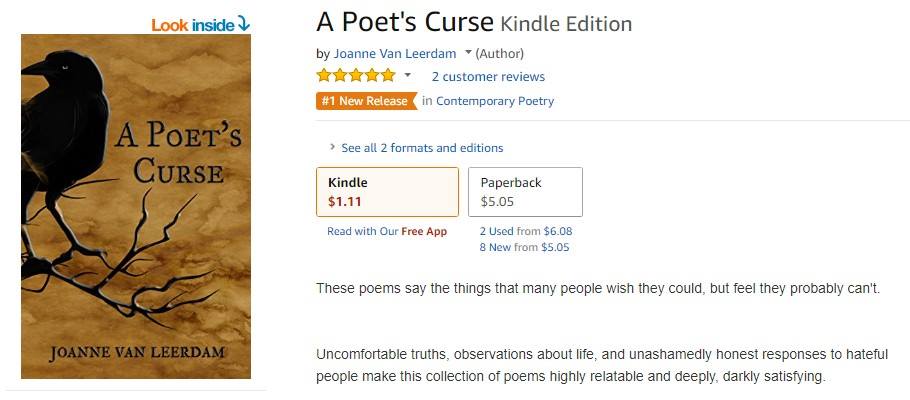
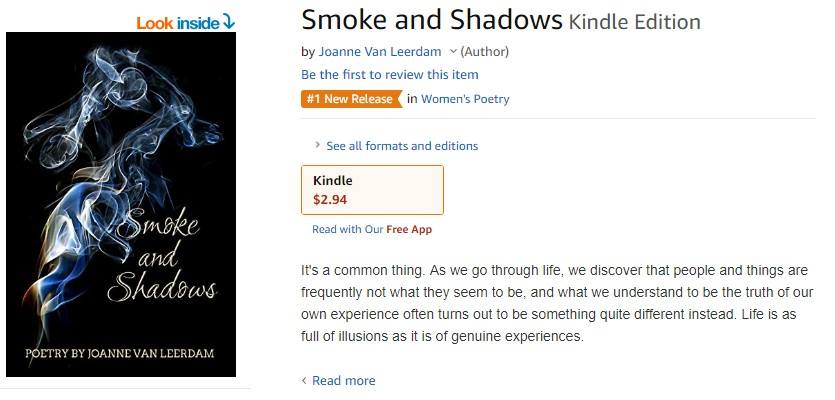
I’ve been lucky enough to gain the “#1 New Release” ribbon for poetry twice, and obviously I’d love to do that with ‘A Rose By Any Other Name’ when it releases on Friday. Although it is in the much more competitive categories of Fantasy and Fairy Tales, which is a much greater challenge, but it’s not impossible. It’s also in the category of ‘Mashup Fiction’ so it has a good chance there. 

Whether my book makes a big splash or simply becomes a drop in the ocean, I will have given it my best shot. And that knowledge and confidence is something that you can’t put a price on. 

***

If you’d like to join in my “baby shower”, you can preorder ‘A Rose By Any Other Name’ at
Amazon or your other preferred digital store.

Why I Love Shakespeare

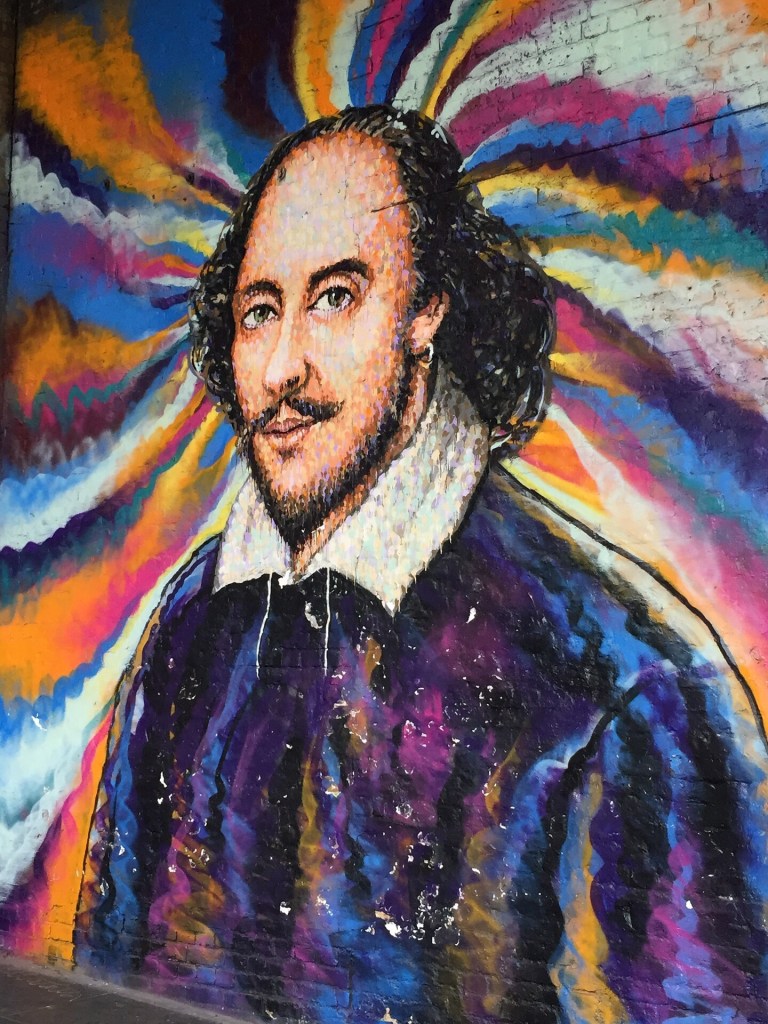
I’m currently reading a great book titled ‘Blood and Ink’ by DK Marley. It is a really well written historical fiction novel that explores, in part, one of the theories about the identity of the man we know of as William Shakespeare.

Rumours and theories that Shakespeare’s works were written by someone else have abounded for a long time. Various people have been proposed as the actual author. 

That’s all very interesting, of course, but the fact is, I really don’t care whether his name was actually Filchin McFarkle. 

My love for Shakespeare isn’t about the person: it’s about the language, the writing, and the craftsmanship that combine to be the genius of the writer. What his name was doesn’t matter one bit. 

The power of Shakespeare’s plays and poetry is that they take something ordinary and transform it into something extraordinary.

Themes of love, passion, ambition, revenge, hatred, despair, desire, and family dysfunction make his work interesting and relatable to just about everyone. And while there are at least a dozen ways to write any story, the way Shakespeare tells each story is absolute magic. 

Shakespeare used rhythm and poetic devices like imagery, allegory and highly emotive language to heighten the feelings and drama of the situations his characters find themselves in. He enmeshes them in a complex web of conflicting emotions and ambitions and then exposes their innermost  thoughts in the most profound ways. He really is the master of intrigue and dramatic irony, able to hold the audience spellbound, even though they probably already know what’s going to happen and what the various characters are thinking.

To be honest, some of the storylines are pretty rubbish. There are very convenient coincidences, leaps of logic, and plot holes galore, particularly in the comedies. The history plays are at times more fiction than history. Despite all that, Shakespeare dramatises the stories and scenes in such a compelling way, and so deeply engages the audience in the dilemmas and conflicts experienced by the characters, that any issue of credibility actually doesn’t matter.  

I will still pick up a play and read it, or watch a performance, or read the sonnets and be as entranced as ever. Even when interpretations change, the magic with which the words are crafted and woven never gets old. 

Facebook’s Delicate Community Standards

Facebook’s “community standards” did not enter my thoughts last night when I was posting about what I love and hate about Facebook. Had I been writing that post today, it would have been a very different story. 

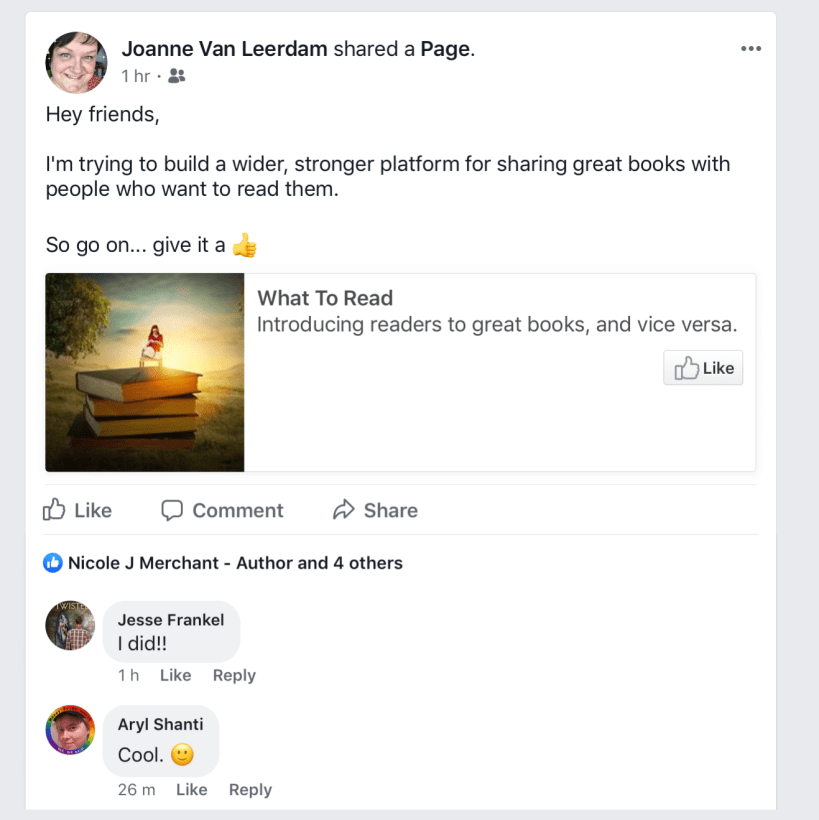
This afternoon, I set up a new page on Facebook with the aim of extending my reach to new readers by using a popular bookish hashtag phrase, What To Read, as the title. 

As soon as I had set up the page, Facebook started coaching me to complete certain steps to make my page more visible. 

Profile photo: check.
Cover photo: check. 
First post: check. 

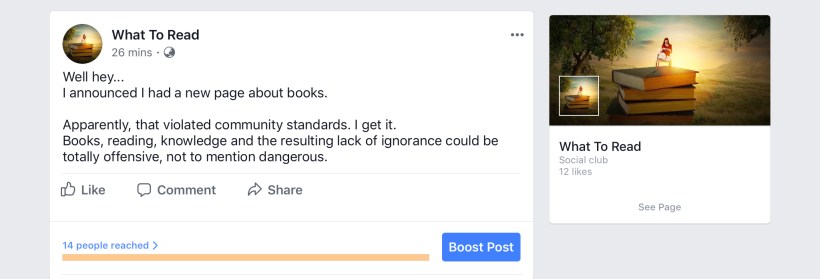
Oops! My first post violated Facebook’s delicate community standards. 
Want to know what it said? 

So… people can freely incite hate, vilify and shame others, put up pictures of them humiliating themselves… but I can’t suggest that my friends might like a page about books? 

Wow. 
Maybe I should have said something dumb instead. 

May the fates be in my favour when I actually start encouraging people to read. 

***

Update: it took me three attempts to share this blogpost on Facebook.
If they don’t want me to be snarky, they’re going the wrong way about it.

What I Love… and What I Don’t… about Facebook.

There’s no doubt about it: Facebook is one of the most popular social media platforms on the planet.

Like anything, it can be fantastic if it’s used the right way, and it can downright dangerous if used for sinister purposes. 

There are some aspects of Facebook I really enjoy:

  • Being able to connect with my family and friends all over the world in real time. What a blessing! When I’m homesick for someone I love – there they are! When I’m lonely – my friends are right there! I can see their pictures and videos, and respond to them right away. I can chat with them, talk with them, and send them stupid memes to cheer them up when they are down or unwell. 

  • Being able to connect with like-minded people all over the world. As part of the Indie author community, I have received so much help, encouragement, knowledge, advice and good direction from people in Facebook groups.

    It has also been a very great pleasure for me to be able to pass some of that knowledge and advice on to others, and to encourage them in their journeys.

    Similarly, I’ve made some wonderful lifelong friends in a particular grammar-nerd group, and have met two of them on one of my trips overseas.  I can’t imagine not knowing them or being able to talk with them.

  • Being able to find things I’m interested in via the pages people create. I’ve discovered some wonderful blogs to follow, some great information on specific topics, and I can’t tell you how many excellent Indie books I’ve found to read. That number has to be in the hundreds. 

  • Being able to permanently hide things from my timeline that I don’t want to see. This is generally anything racist, hateful, or politically zealous. 

  • Being able to permanently hide things from my timeline that I don’t want to see. This is generally anything racist, hateful, or politically zealous. 
  • Memes, jokes, and videos that make me laugh. Some of that stuff is pure gold.  
  • The block function. It’s really good. 

Of course, with the good comes the not-so-good. 

There are things I really hate about Facebook. 

  • The fact that they don’t show me everything my friends post. If my friends think it’s worth posting, I probably want to see it. But no… Facebook gets all choosy about showing me their posts, and when showing mine to them.

    Of course, they’ll tell you that boosting your post will get it shown to your friends. For $13, your post can reach… er, how about no? I’m not giving them money to show my posts to my own friends. They should do that for nothing. 

  • That dratted algorithm. It seems any moron can make a stupid post that will go viral because people “like” and  respond to it, but you can’t post a link for a product, or a blog post, or an event, or a website outside of Facebook without them suppressing it so that maybe 3% of the people who follow you or your page will actually see it.

    And every time you get clever about how to communicate your product/event/website to your audience, they change the algorithm so you are actually  no further ahead, yet again. 

    I know: it’s a business. But if they showed my stuff to the people I know, I’d probably be more interested in giving them a bit of cash to show it to folks I don’t know. 

  • The perceived freedom some people feel they have to deride, belittle, criticise, mock and bully others.  In a not-so-surprising coincidence, this correlates very closely with one of the things I hate most about people in general.  Just because they’re hiding behind a profile picture or an avatar, they think they can say what they want to and have no consequences. 

    Not in my world, Julie.
    Block, block, block.
    Fixed. 

The verdict: As much as I hate it, I love it.
I’m definitely keeping it.

But if I ever meet that algorithm in person… it may just walk away with a black eye. 

My Least Favourite Shakespeare Play

The reference to Shakespeare’s ‘Romeo and Juliet’ in the title of ‘A Rose By Any Other Name’ is blatantly obvious. 

The irony is that ‘Romeo and Juliet’ is probably my least favourite play from among Shakespeare’s works. As I often explain to my students who think it’s romantic and all about love, it’s really not. It’s a tragedy that demonstrates what happens when people do stupid things on impulse and don’t stop to think about the consequences of their actions.

They’re teenagers. They met on Sunday, and by Thursday, they’re dead.

And, as Shakespeare points out in the epilogue, they end up that way because their families both prioritise their stupid feud over the happiness and the future of their children.  How much more like a badly plotted teenage soap opera could it be?

It’s more of an anti-Romance, if you ask me. They’re not in love, they’re infatuated. Romeo really is quite an idiot, and as for fickle… how quickly did he forget his passion for Rosaline the moment he met Juliet? If you ask me, Rosaline dodged a bullet – or a dagger, or a vial of poison, there. 

To be fair, the fault isn’t Shakespeare’s. He based his play on an old story that was very popular back in the day, which was a brilliant marketing move. The other factor that made his play such a hit was the beauty of the language with which it is written. There’s nothing at all wrong with the writing: it’s magnificent. Nothing can convince me otherwise.  If anyone could give a story about two silly teenagers from equally silly families another 600 years plus in terms of longevity, he was the man for the job.

So, is it odd that I’ve used ‘Romeo and Juliet’ as one of the starting points of my story? Not really, because I wanted my story to be something of an anti-Romance, too. 

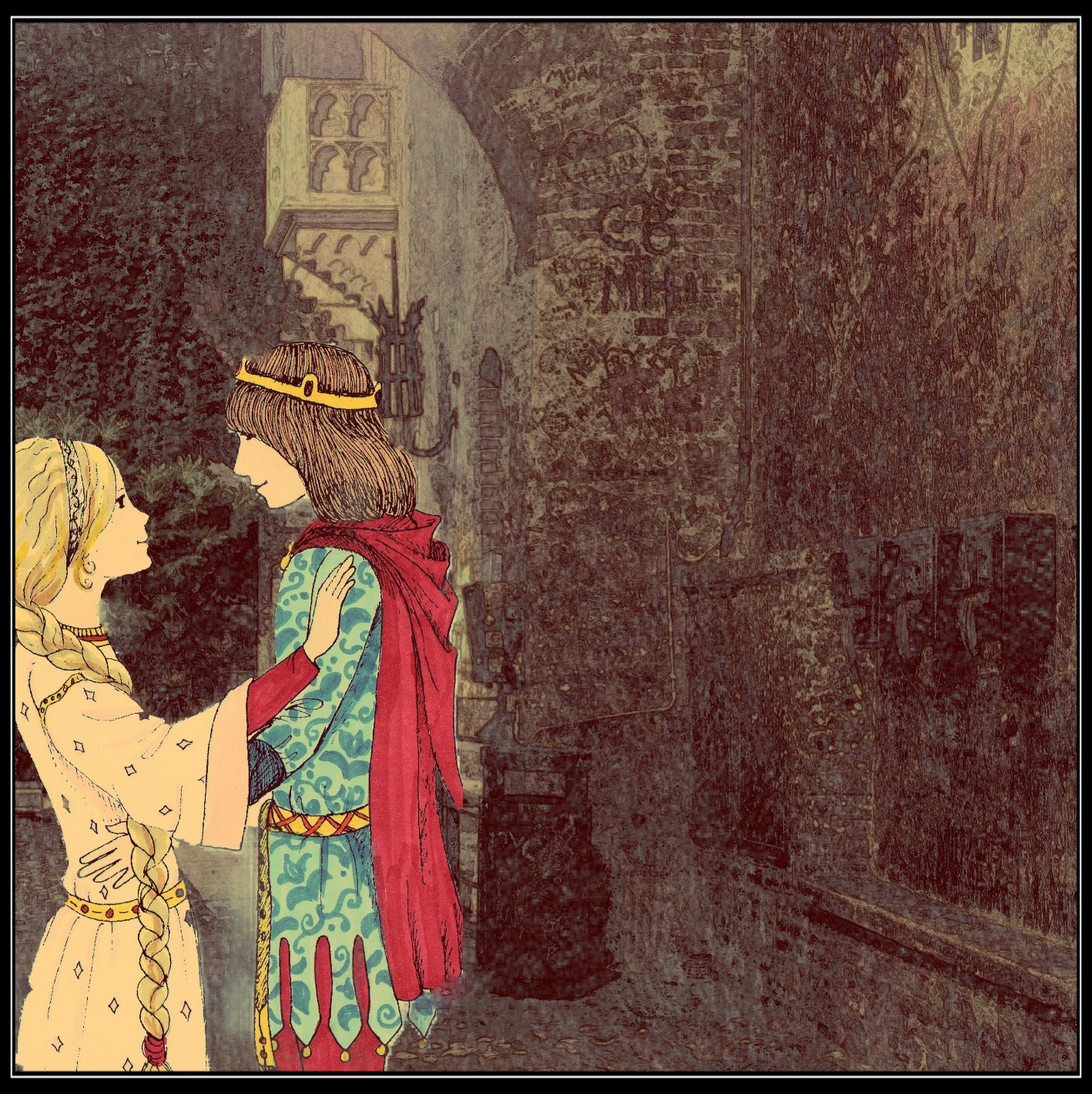
‘A Rose By Any Other Name’ draws on ‘Romeo and Juliet’, and on the Brothers Grimm fairy tale of ‘Rapunzel’ as starting points, then twists and tangles them together to create a mashup of the two stories with a very different ending. Romeo is still an idiot, it still ends in tragedy… but it’s a completely new story. It’s medieval fantasy, laced with faint traces of my subversive sense of humour. 

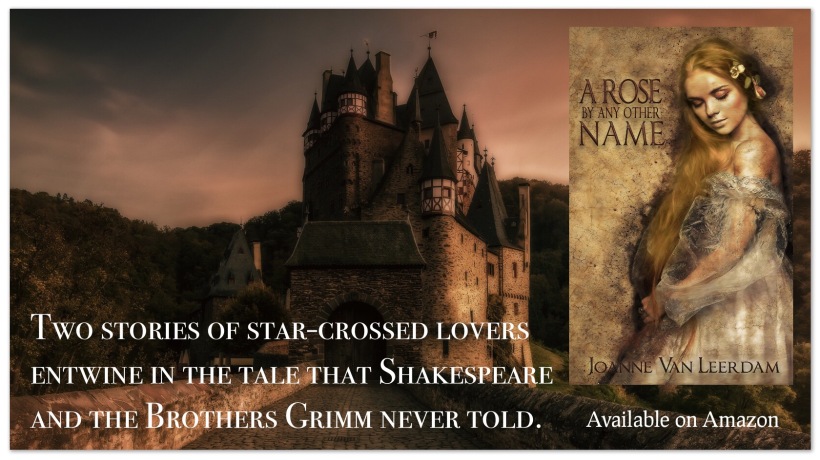
I like to think of it as the story that Shakespeare and the Brothers Grimm never told. 
But I bet if they’d thought of it, they would have. 

***

A Rose By Any Other Name is available for preorder.

Cover Reveal: A Rose By Any Other Name

I mentioned in a post last week that I was anticipating the release of a new book, about which I am very excited.

The book is a medieval fantasy story called ‘A Rose By Any Other Name’ which draws on both ‘Romeo and Juliet’ and ‘Rapunzel’ as the starting points for this story before taking those narratives in a very different direction. 

And so, without any further delay, let me reveal the beautiful cover, created for me by Renee Gauthier of RM Designs in Toronto, Canada. 

The back cover is gorgeous, too.

It’s fair to say I am thrilled by the beauty of this cover art, and incredibly thankful to Renee for her fabulous work. 

This story grew out of the inspiration from my author posse, the Indie Fabs. When one of them suggested that we write a fairy tale retelling anthology as a group, I was very nervous at first. I had never written anything like that. I didn’t know where to start, or how I might ever achieve that goal. I honestly thought I was going to let them down. 
Then one of them said, “Write what you know.”  Well, I knew all the old fairy tales that I had grown up with. And I knew and loved Shakespeare. 
And in that moment, this story concept was born. 

‘A Rose By Any Other Name’ took its place in that anthology, titled ‘Once Upon A Fabulous Time’ and published in 2017. It truly is an anthology unlike any other – far more than just a collection of our reinvented and often significantly transformed fairy tale stories, those stories were linked with one another by another separate, magical story that wove them all into one continuous narrative. Because it is such a very special book, it is still available in paperback, but no longer as an ebook. As a result, my story is back in my hands and free to be released as an individual title.

It is available for preorder, and will be released at 12.01am EST on June 14. 

Make sure you’re following me on Twitter or Facebook so that you are able to reserve your copy. 

Being Fontist.

I am a person who takes others at face value. I don’t immediately classify someone as pretty or ugly, gay or straight, progressive or conservative (unless, either way, they are hateful or prejudiced – then the deal is off) , black or white or some other colour, blonde or brunette, or anything else. I don’t care if they’re plain or fancy, nor do I care if they’re pretty or not. I try to take each person as they are and let their integrity speak louder than their features. I like to get to know them before I make any decisions about them.

When it comes to fonts, however, i am nowhere near as open-minded. Don’t get me wrong – there are plenty of fonts I like, and many others that I will view with an open mind depending on context and purpose. 
But there ARE two or three fonts I really hate. I refuse to use them. I have handed back an assignment or two, asking for it to be reprinted in a more acceptable typeface. It’s true: I am Fontist. 

I wasn’t raised that way.  We didn’t really need to think about fonts back then. When I was growing up, it seemed as thought books were printed in two, maybe three different standard fonts. From memory, there was something like Times New Roman,  a basic Sans Serif, and possibly another standard typewriter-style serif font. There was never a question of what typeface to submit our work in, because computers weren’t a thing and our school work was all handwritten. When I started university, assignments and essays had to be typed and double-spaced, so I used my parents’ typewriter. Of course, it only got to the typing stage when one or two hand-written drafts had been painstakingly written, proofread, edited, and revised. 

Don’t get me wrong: I’m glad those days are over. I appreciate the ease of writing using my laptop as much as anyone else, and I’m happy for my students to do some – but not all – of their work on their devices. 
My underlying Fontism rears its ugly head, though, when someone hands in an assignment or broadcasts a presentation on the screen that screams “ridiculous font” louder than anything the student is trying to communicate. The same thing happens in meetings and seminars where the important information is obscured by the poor choice of font on the screen or handout. 

You might think I’m overreacting. But consider this: I might read fifty student assignments in less than a week, or sit through twenty five student presentations in two or three days. When their font suggests I shouldn’t be taking their work seriously, that’s a complication neither they nor I need. 

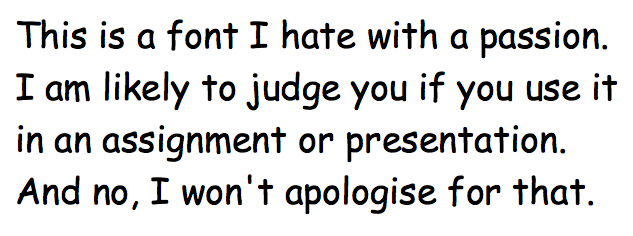
Right at the top of my hate list is Comic Sans. It looks childish, and gets increasingly ridiculous as the size increases, to the point where it is almost impossible for me to take anything printed in that font seriously. It is a font that should never be used for school work of any description by anyone older than six, nor should it be used for slide shows and presentations.  Yes, it is “nice and clear for people to read”, but so are about 3000 other fonts one could choose. If your audience is not entirely in the First Grade, choose something else. 

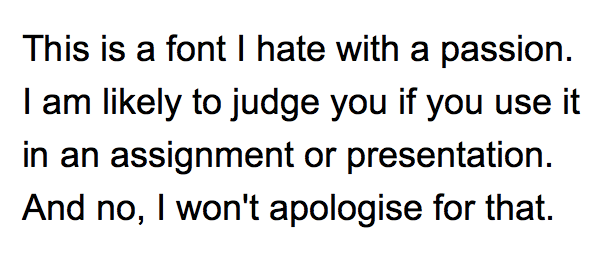
Another font I hate is Arial. Yes, it is also nice and clear for people to read. It is also entirely bland and unimaginative. Arial is the font equivalent of still having that original iPhone Marimba ring tone from 2008 on your new iPhoneX when you have 2500 different songs on your playlists.  It is the font for lazy people who don’t care how their work looks. It doesn’t take much effort to switch so something equally clear but which looks a lot more polished and professional. In a word: boring. 

The other fonts I really dislike fall into two groups: anything over-decorative and wrongly sized formatting

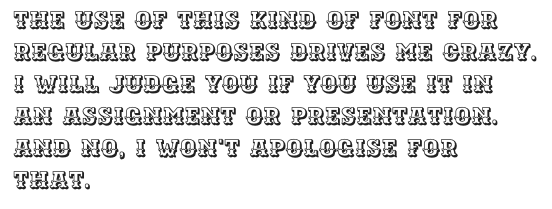
Over decorative fonts have their place, but trying to read a block of text printed in anything full of swirls and flourishes or trippy lines and shadows will make a teacher’s eyes bleed in less than three minutes. Decorative fonts can work really well for titles, or for a special capital letter or character to start a page or chapter, but they fail miserably for anything that needs to communicate information or arguments clearly and effectively. 

In a similar vein, text printed too small or too large is equally frustrating. If it’s too small and condensed, it’s hard to read and… you guessed it, bleeding eyeballs. At the other end of the equation, students may think they can fool me into believing their 337words meets the 500 word minimum word count if their work is formatted in size 15 Helvetica, but my teacher brain knows better. My teacher brain has been doing this a lot longer than they have. 

So, I guess this is me coming out of the classroom cupboard and acknowledging the ugliness of the deep-seated prejudice that lies deep within me. It is equally as rampant and undeniable as the grammar nerdism that I make no attempt to hide.

Call me fussy. Call me Fontist. I’m okay with that. But don’t call me to complain if I’ve asked your teen cherub to reprint an assignment so that I can read it without tears. Trust me – it’s better that way, and I’ve tried to be nice about it. Well, I’ve probably been nice.. 

Maybe. 

Unless they are a repeat offender. In that case, there are no guarantees. 

118 Days.

Holy Toledo!

I have achieved a 118 day blogging streak. How’s that for a consistent effort?

I just wanted to say thank you for the encouragement to everyone who has motivated me by reading, responding, liking or commenting on my blog posts.

They seem like such small things to do, but they really are significant in the life of a blogger.

They help me know I’m not just typing into a void.
They help me know I’m not alone in this big old bloggerverse.
And it’s fair to say that they remind you of the same things.

Thank you for sharing the ride with me so far.

Stay tuned, folks. For my next trick, I plan to see how far I can make the streak last!