Faking It.

Image by Joanne Van Leerdam.

Today I feel completely hungover. 

I haven’t had any alcohol at all in weeks.
I didn’t eat the bread or the fries that came with last night’s burger. 
I’m hydrated. 

This is just my fibromyalgia being a complete jerk. 

By the time I get to work, I will have drawn on every acting skill I have— and that’s quite a few— to present as ‘normal’. 
I will do my job with absolute professionalism: my students will never know how dreadful My body feels. 

After work, I will complete the errands on my to-do list. Those things don’t go away because I feel rotten. 

Only when I come home again can I give in to the pain, the sluggishness, and the desire to just go to bed and moan a bit. 

But they’re right. 
I don’t “look sick”.
That’s because I am 100% accomplished at making it look like I’m not.

Faking It.
#fibromyalgia #FibromyaliaAwareness

Zarf.

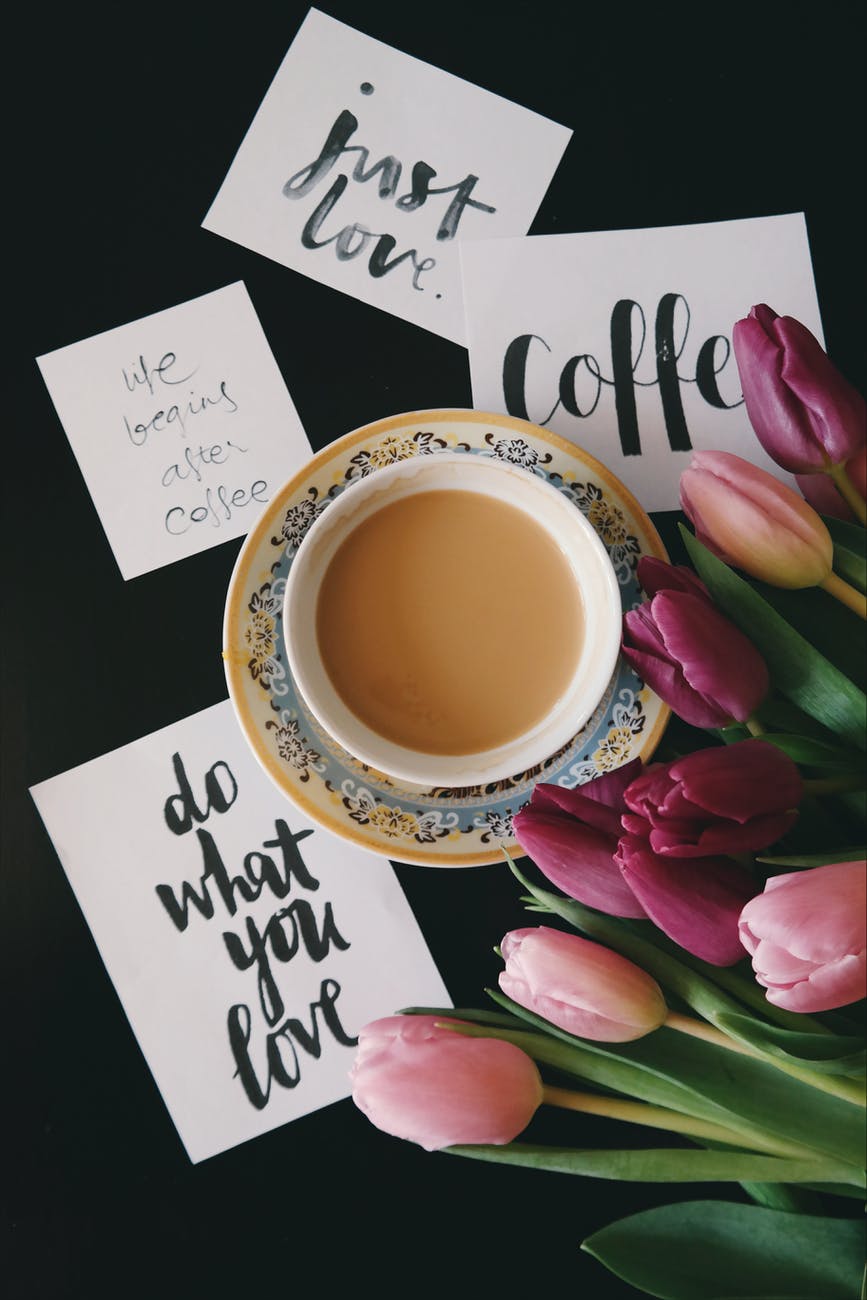
Zarf is a word you might never have heard or used, but it relates to something with which most of us are quite familiar.

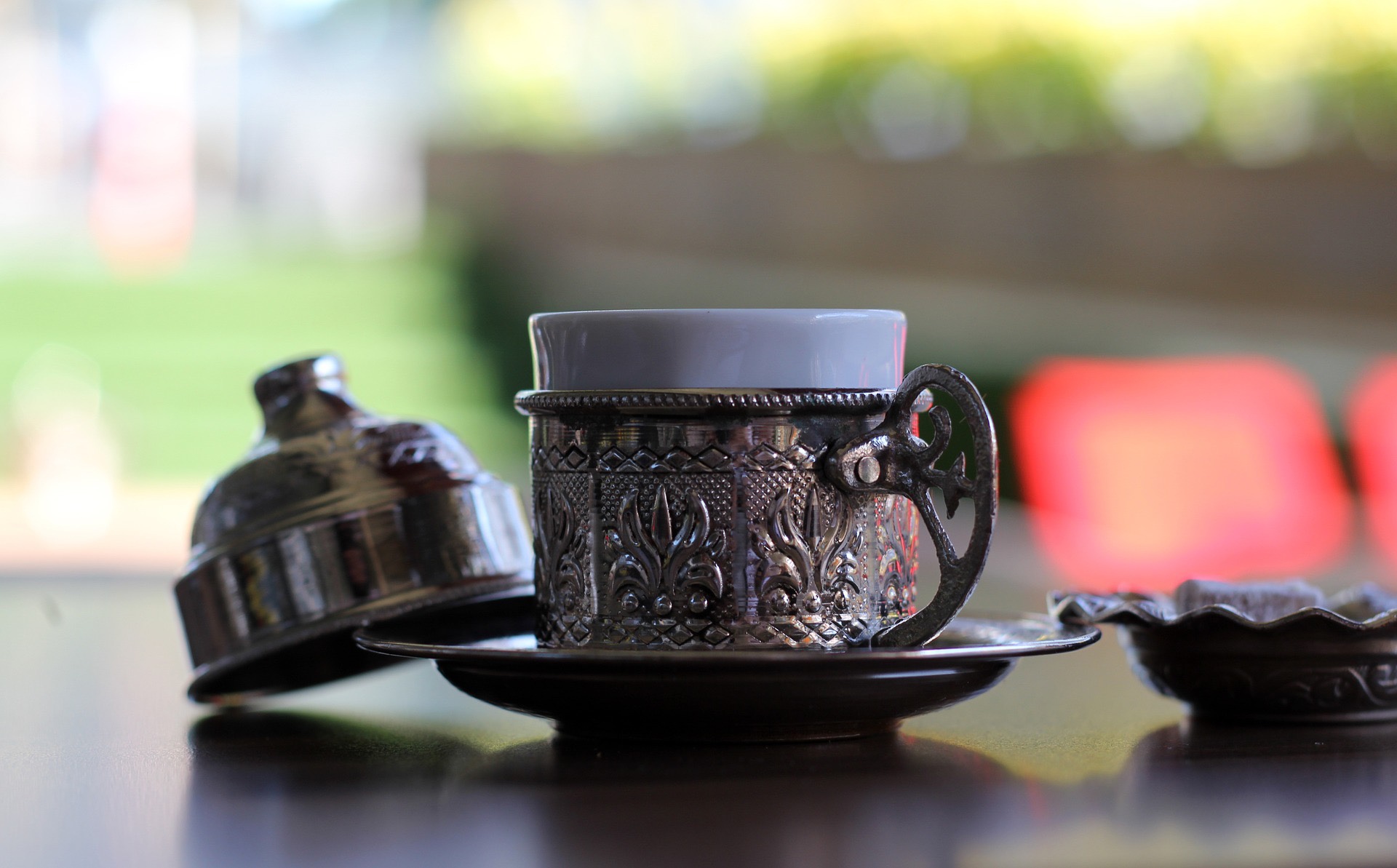
These days, the word zarf refers to that cardboard or silicone band on a portable coffee cup that insulates it and stops your fingers getting too hot while holding your drink. Some call it a cup sleeve or a cup holder: zarf is a far more evocative and interesting word.

The word zarf comes from Arabic via Turkish, and simply means ‘envelope’. Thus, its adoption for a cardboard sleeve to go around a disposable coffee cup is logical, and it soon came to be applied to anything that went around or held a cup to make it more comfortable to hold.

Many people assume that the zarf was a late 20th century invention that came about with the advent of the disposable, followed by the the reusable, takeaway coffee cup. Those people are wrong.

The zarf began as a holder for a hot coffee cup in Turkey and across the Middle East as early as the 1600s.

Image credit: nokta_cizgi on Pixabay.

When the Ottoman Empire banned alcohol in the 16th century, coffee became the premier drink of the people. Within one hundred years, coffee houses became such important centres of gathering, culture and political discussion that the Empire banned coffee, too.

As any coffee lover could predict, that didn’t work. The people responded so profoundly that the Empire decided not to stand between the people and their caffeine ever again, but added a significant tax on coffee instead, in keeping with the age-old governmental proverb: if you can’t beat them, tax them. 

image credit: Activedia on Pixabay

As the traditional coffee cups had no handles, the zarf evolved as a functional holder, but soon became elaborately decorative. These are still used today.

Traditionally, the  more ornate and beautiful the zarf, the higher the esteem in which the drinker is held. An ornate zarf can indicate status or affection and respect, which means that a lover, a close friend or a family member might serve coffee in a zarf as beautiful as that served to a sultan or emir.

The zarf and the coffee served in it are just two of the many wonderful things we have inherited from Eastern history and culture. Coffee houses are still cultural and social hubs in the Middle East, a legacy reflected in the popularity of coffee shops and cafes worldwide.

Anyone inclined toward prejudice against Eastern and Muslim cultures should remember that when sipping their morning cup of joe: it would be impossible to live as we do without their contributions and influence.

Sources:
Macquarie Dictionary
The Story of the Zarf
What is a zarf? The bizarre story behind this everyday object.

Zarf.
#words #coffee #coffeelovers

Zucked.

I do the love the Macquarie Dictionary.

It is the dictionary of Australian English, expressive of all classes and of our multicultural society. Regular readers of this blog will be familiar with it because of my frequent reference to it in my word-nerdy posts.

Today, though, the editors excelled themselves.

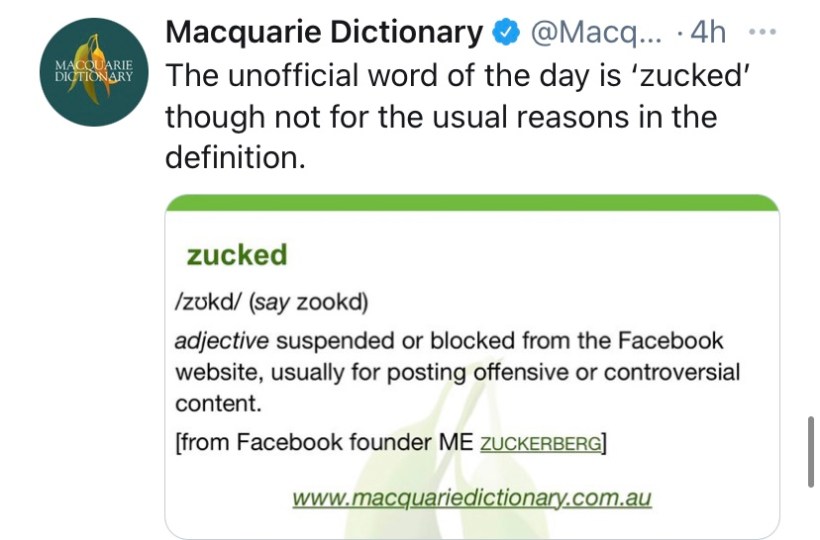
On the day when Facebook cut off access to all Australian news channels— sadly including sources of information relied upon by particular social groups such as  Indigenous communities, domestic violence support groups for women and families, and local information networks— as a result of a disagreement with the Australian government over market share and finances, the Macquarie tweeted that Australians have been zucked.

An obvious play on the F-bomb and Zuckerberg, it’s a clever new portmanteau word.

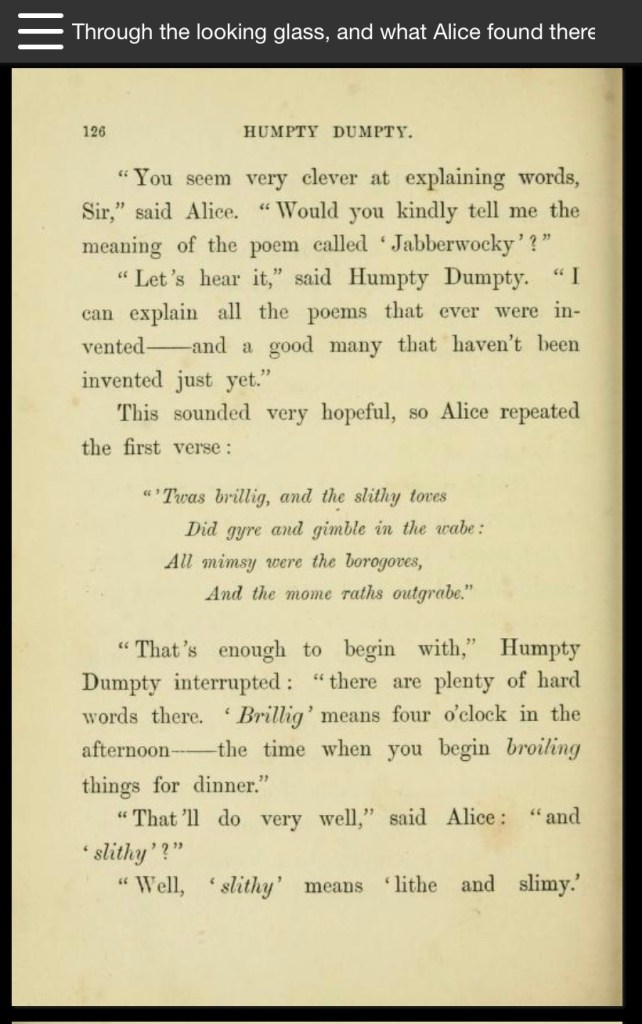
A portmanteau word is one created by blending two existing words or parts of words to create a new word. The name comes from a portmanteau, which is a type of suitcase that opens into two halves. This  dates back to Lewis Carroll’s ‘Through the Looking Glass’:

from ‘Through the Looking Glass’ by Lewis Carroll, courtesy of archive.org

We use portmanteau words every day, without many of us realising how they were created:

  • Botox —  botulism toxin
  • Brexit — British exit from the European Union
  • Bollywood — Bombay and Hollywood
  • Email — electronic mail
  • Fortnight — fourteen nights, so two weeks
  • Sitcom — situation comedy
  • Webinar — web seminar

English is actually full of these words, as it’s a form of wordplay that has been around for hundreds of years.

Sources:
Britannica
Etymonline
Macquarie Dictionary

Zucked.
#words #language #facebooknewsban

Thank You… I Think

It hurts when someone who we think should love and/or appreciate us does not.
It’s also a fact of life that not everyone is going to like, appreciate or love us.  After all, we don’t like, appreciate or love absolutely everyone else, do we?

This poem expresses the truth of that, but also adds a positive spin: when we accept that and grow through it, we become stronger. When we are true to ourselves, we find the people who do love and appreciate us, and they become our tribe.

Family isn’t just who you are born to, or the people connected to that group in one way or another. Sometimes, the best family is the one you find while being the person you are meant to be.

wordynerdbird's avatar

Photo by Francesca Zama on Pexels.com

How ironic
That you don’t like it
When I stand up for myself:
You’re the one
Whose weapon words
Gave me real-time training
In the art of self defence.
Had I not learned
To deflect your contempt
And resist your hateful words,
I would not be here today.

You prompted my resistance,
Inspired my defiance,
And forced my indifference
To anything else you have to say.

So thank you, I think,
For helping me become someone others like
Infinitely more than you do.

ⓒ2020 Joanne Van Leerdam

Thank You… I Think
#poem #Poetuit

View original post

Writing Tips: Avoiding Sentence Fragments.

We all know the basic elements of writing a sentence  in English: starting with a capital letter and finishing with some kind of ending punctuation appropriate to the form of the sentence, be it a statement, a question or an exclamation.

Photo by Brigitte Tohm on Pexels.com

Most people have mastered the fact that each sentence should communicate one key idea, and that they can use punctuation and conjunctions to extend that idea.

However, the use of sentence fragments is a problem I notice frequently, both as a teacher and as an avid reader. They are not the sole domain of people still learning to write: a novel I read over the weekend was littered with them, which frustrated me so much I was sorely tempted not to finish it.

A sentence fragment is a little bit of a sentences that don’t make sense on its own, and really needs either additional information or to be attached to the previous or following sentence in order to make sense.

It’s one thing to speak or send a quick text message using sentence fragments. We do it all the time without thinking twice. When writing for someone else to read our work, though, it’s important to express complete thoughts and to make sense on the first reading.

Example: I have been busy today. Writing this essay. It’s hard going.

This example sentence  fragment can be corrected it in any one of the following ways:

  • I have been busy today, writing this essay. It’s hard going.
  • I have been busy today. Writing this essay is hard going.
  • I have been busy today: writing this essay is hard going.

While it’s true that some writers use sentence fragments for stylistic effect, and may do so very effectively, it’s also true that they need to be proficient in constructing sentences and paragraphs so that they are able to make that technique work for them.  They are useful in writing conversations, communicating a train of thought, tacking on afterthoughts, or reflecting a nervous, excited or angry character.

Most people who write sentence fragments are, alas, painfully unaware that they are even doing it. Their sentence fragments don’t work for them, because they don’t communicate ideas clearly and effectively: in fact, it tends to have the opposite effect.

As writers, we should avoid anything that frustrates or confuses their readers, particularly if they hope to develop a broad and loyal readership.

This highlights the importance of careful proofreading and editing in the writing process.

One of the most effective strategies for finding sentence fragments is to read your work aloud. Your voice and ears will alert you when things don’t sound right, much faster than your eyes will discern it. This is because your brain already knows what you intended to say, and tends to make written errors almost invisible to the eye when reading silently.  

Avoiding Sentence Fragments.
#writingtips #writingadvice

Kvetch.

As Victoria enters a five day lockdown designed to halt the spread of that dratted virus after its recent escape from a quarantine hotel, there’s a lot of kvetching going on.

Photo by Andrea Piacquadio on Pexels.com

Yes, it’s our third lockdown. Yes, we all saw this coming when the Australian Open was allowed to go ahead. Naturally, we’d all rather not. We’d all like to be able to do whatever we want to do. I know it’s inconvenient. I had to cancel my plans, too. 

Still, there is nothing to be achieved by blaming anyone. Contrary to what some people like to say, our state government is not a dictatorship. They’re doing their best to manage a pandemic, balancing the health of the community with what millions of individuals perceive as their rights and needs.

The fact is, this virus is highly contagious, airborne and invisible. The pandemic is not yet over, and these things are going to happen from time to time. It may actually be a fact of life for the foreseeable future, even when we are careful about wearing masks, social distancing and sanitising everything. One of the fundamental truths of a pandemic disease is that it is not easily controlled: that’s how it became a pandemic in the first place. At best, it can be well managed.

At least it’s only five days this time, not months like the last one.

Even so, I have lost count of how many times I have felt the need to tell people to stop kvetching about it in the last 24 hours.

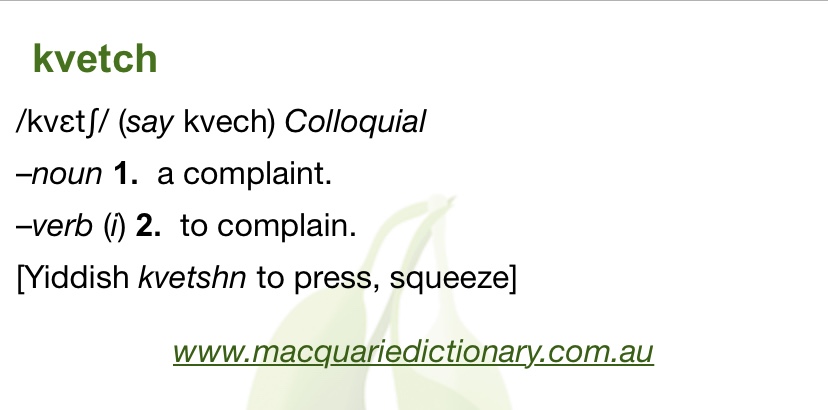
Kvetch is a wonderful word, donated to English from Yiddish in the mid-20th century. It is as satisfying to say as ‘bitch’ with far less possibility of offending anyone, and it is so much more expressive than other synonyms such as ‘whine’, ‘complain’ or ‘moan’.

Perhaps the only synonym that is as expressive is the one that my grandfather used when we were kids: “Stop your bellyaching,” I haven’t thought about that expression in decades, and it has just come back to me riding on a wave of memory and emotion. I think I’ll have to start saying that now, too.

Kvetch.
#wordsofwisdom #pandemic

Epidural Spinal Injection: One Week Progress Report

Photo by Kris Lucas on Pexels.com

A week ago I had an epidural spinal injection into my lower back to treat constant sciatic pain.

One week later, I have good things to report.
After a rough couple of days following the injection, things started to improve. I’m very happy to report that I’m doing much better now.

Because the weekend was difficult, I stayed home from work on Monday, which was the third day after the procedure. I returned to school on Tuesday, and after spending most of the day on my feet, I was absolutely exhausted by the end of it. An early dinner and spending the evening lying down was a good strategy, as it gave relief to both my lower back and everything else that was hurting.

The injection site was progressively less tender as the week wore on, so was able to lie down and sleep on my back. As the steroids started to do their thing, I began to experience a lot less sciatic pain. I continued to have the consistent pain related to my fibromyalgia, but at least my butt and legs were no longer on fire.

That I began to see improvement on Monday and Tuesday was right on schedule for the time frame the doctor gave me – the injections would start working in 2-3 days and build up effect over the next couple of weeks. So far so good. Now, we wait to see how long that lasts.

The ESI hasn’t made any difference to my lower back pain – that’s not what the treatment was meant to do – but having the sciatic pain diminished makes a huge difference. I know how to manage my lower back and fibromyalgia pain. I can lie down comfortably for rest and sleep – and what a blessing that is!

The one-week verdict is positive. Despite the initial pain and discomfort, the procedure appears to have done what it was intended to do. If the sciatic pain returns, I’ll definitely have the treatment again.

Epidural Spinal Injection: One Week Later
#spinalhealth #BackPain

Free Short Reads

Photo by Amina Filkins on Pexels.com

It’s Valentines Day on the weekend, and while I don’t pay a lot of attention to the day, I do think it’s a good opportunity to offer something to my readers. Think of it as a small token of my appreciation, if you will.

Among the numerous short reads over  at wordynerdbirdwrites , you’ll find the romantic poem Beloved, a romantic short story titled Montpelier, and a macabre little tale called A Curious Valentine’s Day

There are lots of other poems and stories there too, and it is all free to read. I would like to think there’s something there for every taste.

However you celebrate, or don’t celebrate, Valentine’s Day,  I hope you’ll take some time this week or over the weekend to read something that makes you smile.
I’d be super pleased if that happened to be something I wrote.

Free Short Reads
#WhatToRead #FreeReading #readAwrite

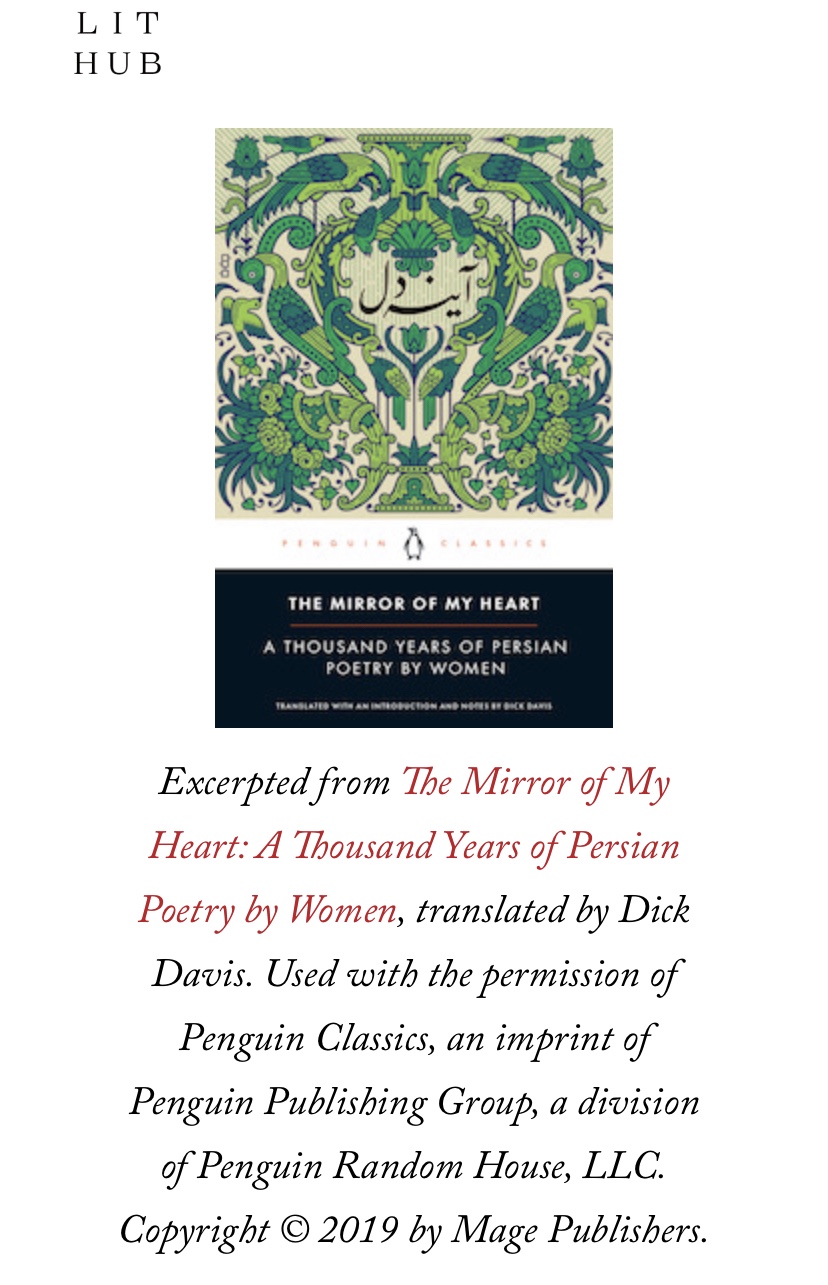
The Imagery of Persian Poetry

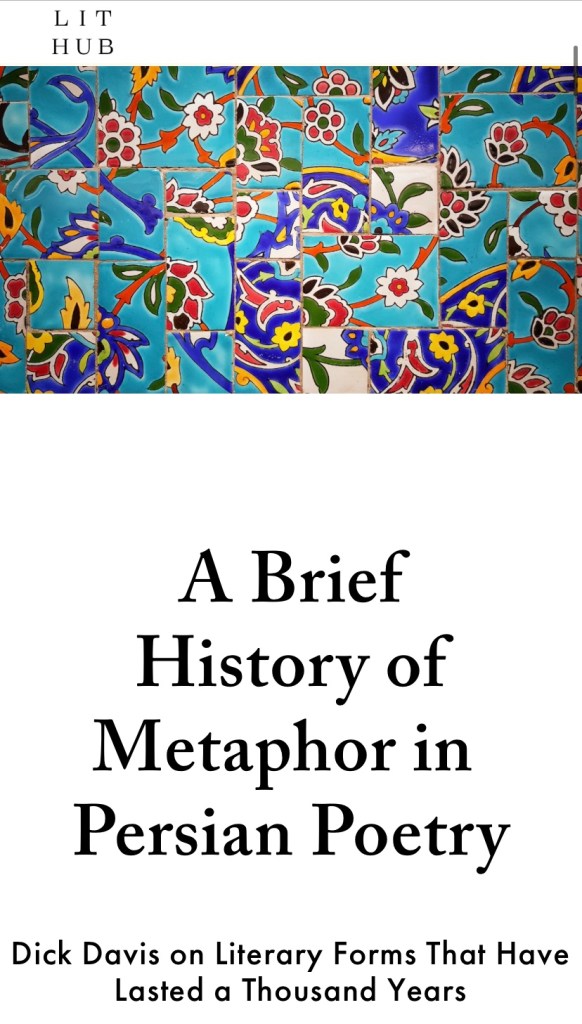
This fascinating article appeared on my Twitter feed this morning.

It’s healthy to be reminded that the things we do with language to make it vivid and powerful are not just the domain of the English language: indeed, to imagine so would be both insular and ignorant. Given that English is such a mutt of a language, it should be no surprise that other cultures were doing powerfully creative things with language long before we were.

When reading even just the translated excerpts in this article, the abundance of metaphor, simile, and other types of imagery in these Persian poems is evident. The language is beautiful and the poems expressive.

I’m adding some Persian poetry to my reading list. I’m keen to read more of the poets listed in the article, and to experience the beauty of the language in the work of the poets.

Consider my poetic horizons broadened!

The Imagery of Persian Poetry
#images #Persian #poetry

Word Nerdy Book Recommendations

If there’s something word nerds love, it’s word-nerdy books.

Personally, I love a great dictionary or thesaurus. I also enjoy books that explore different aspects of the English language and how we use it.

These three books are books I have particularly enjoyed over recent months.

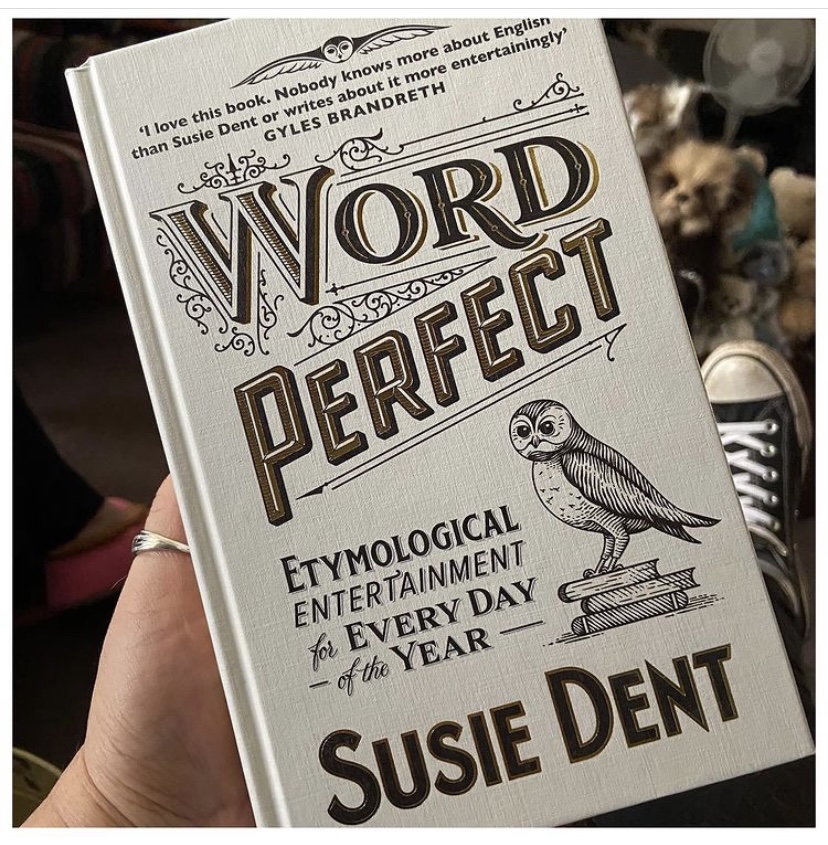
Word Perfect by Susie Dent

This is a wonderful compilation that will please any word lover or etymology enthusiast.

Dent writes with clarity and good humour. The word for each day, and Dent’s definition and etymology of each, are interesting and quirky.

The challenge is to only read each day’s offering instead of running ahead an consuming it more quickly.

Grab a copy, keep it by your favourite chair, and enjoy a wordy treat each day. You won’t be sorry.

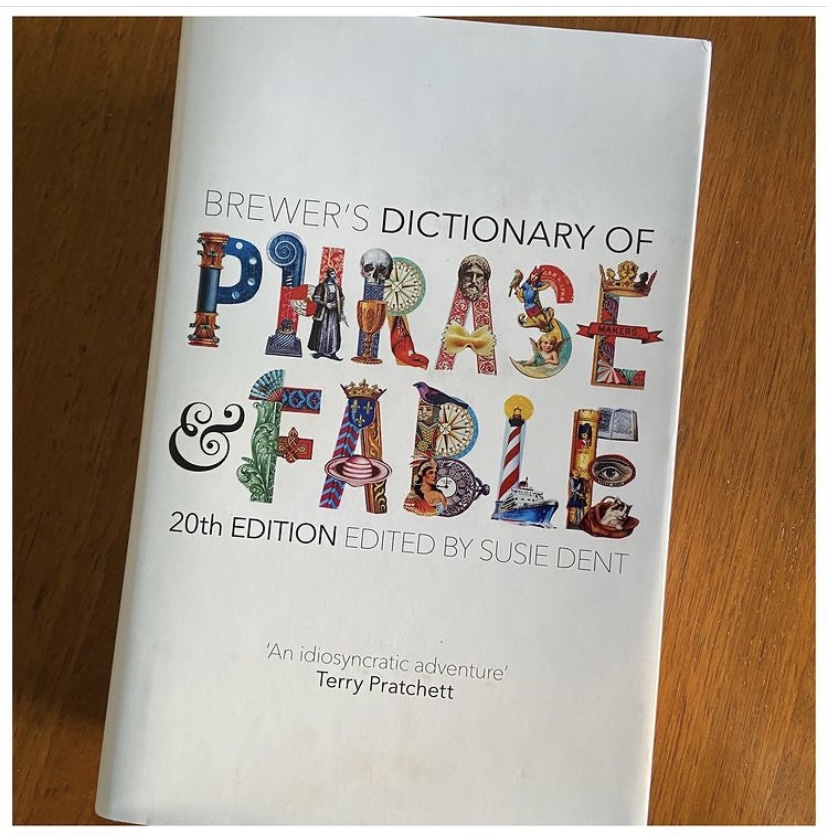
Brewer’s Dictionary of Phrase and Fable

This is a most interesting and entertaining book that traces the histories of words and phrases used in English.

It is a collection of most diverting rabbit holes in print: a world of fascinating information that draws you deeper in each time. Not once have I managed to look up the word or phrase I wanted to reference without discovering another entry nearby that was just as captivating as the first… or second… or third entry I had read.

It really is a treasure trove of words, etymology and history that will delight any lover of the English language.

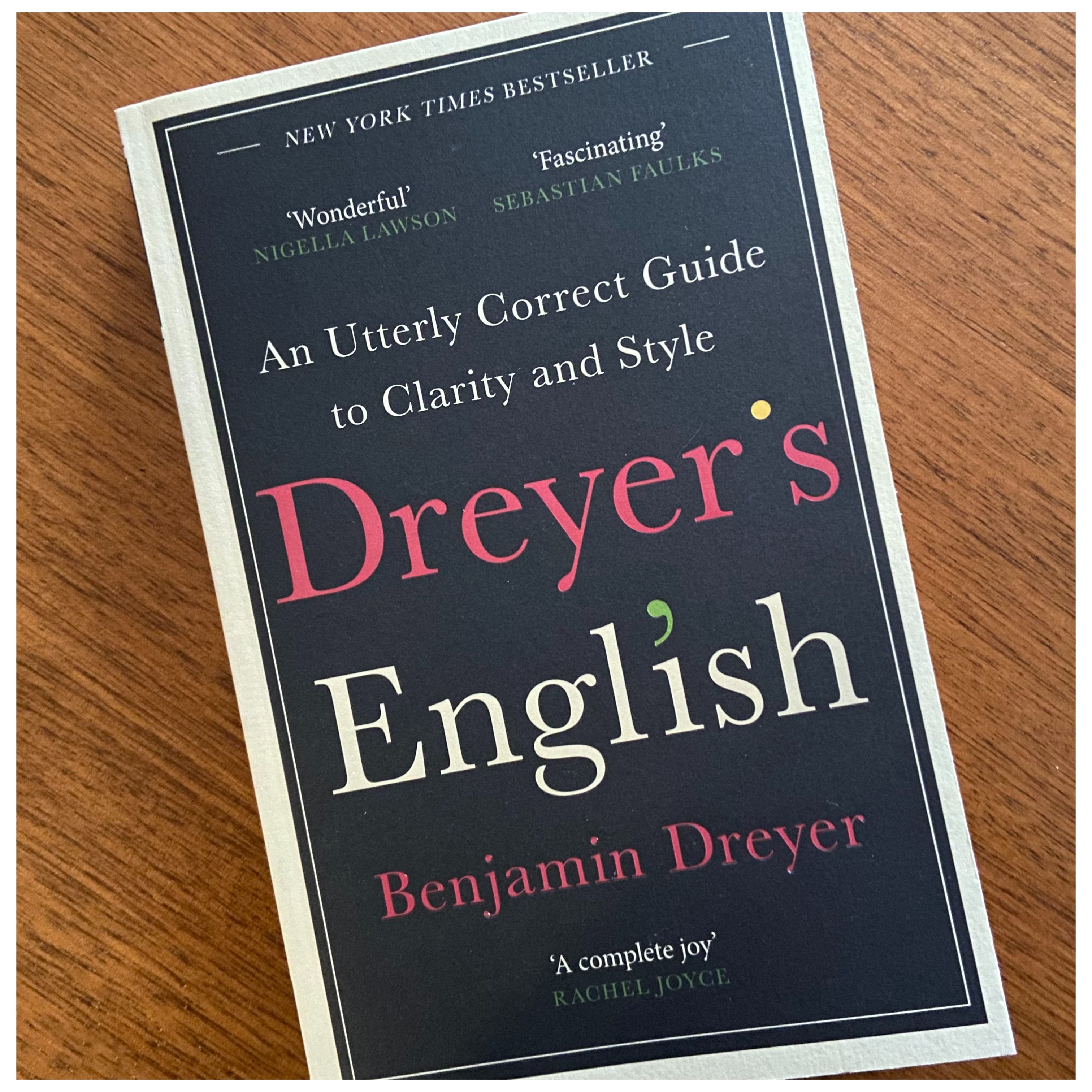
Dreyer’s English: An Utterly Correct Guide to Usage and Style by Benjamin Dreyer

This book is a delight. With the aim of helping writers achieve greater clarity and better style, Dreyer examines the “rules” of English as we know them, and provides a clear and understandable guide to using the English language most effectively.

The book is written with humour and a relaxed tone, and delivers content that is far more accessible for the everyday reader and writer than my beloved and very worn copy of Fowler’s Modern English Usage, which is now far less modern than it was when I first obtained the book.

Dreyer’s English is an ideal reference for today’s writers, regardless of their preferred form or the purpose for which they write. It’s also entertaining enough to pick up and read on a Saturday afternoon, without feeling at all like it’s time you’ll never get back.

Highly recommended.

Word Nerdy #BookRecommendations
#words #language