Everything David Gittlin has written in this post sounds remarkably familiar to me, as my own experiences are very similar.
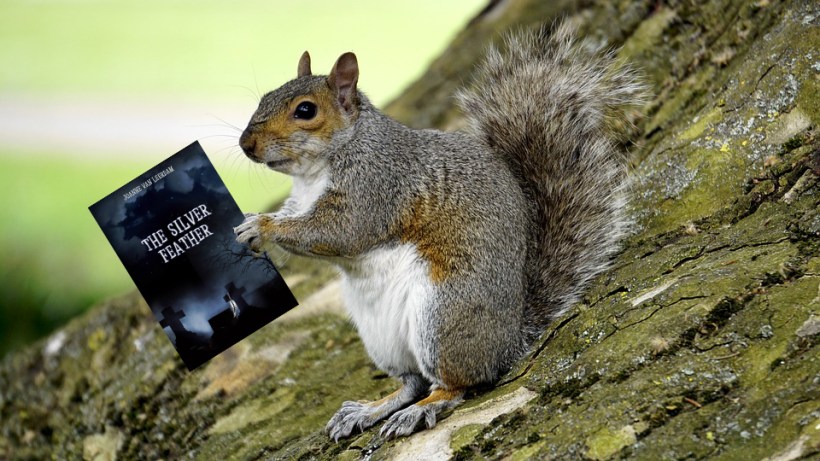
This is precisely one of the reasons that I developed some budget-friendly book promotion options for Indie authors via Book Squirrel – it costs a lot less per month to get your book seen by people than it cost me, or David Gittlin, or countless others for that matter, for the months of promotion paid for with very low return.
Of course, I don’t pretend that Book Squirrel is the entire solution. No one package ever is. But his options for book promotion definitely offer a few affordable opportunities, and provide some valuable parts of a good overall promotion plan.
The other thing to keep in mind that promotion will not always directly result in sales. It’s also about building familiarity with your book and brand, getting your name out there, developing some credibility and presenting opportunities for people to think about your book as well as to buy it. Realistically, very few people will immediately buy a book by someone they haven’t heard of: in fact, very few people immediately buy a book by someone they have heard of. Those readers who have a “one click” response to books and authors are worth their weight in gold.
Comparatively speaking, writing a novel is the fun, easy, first step of the self-publishing process. The second step, creating an attention-getting book cover, offers its own unique set of challenges. However, the most intimidating and difficult undertaking, to most authors, is the third step—marketing. The word strikes terror in many authors’ sensitive little hearts because they want as little to do with the outside world as possible.
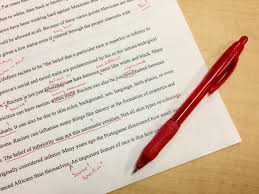
Reading aloud when proofreading and editing is excellent practice because far fewer errors escape our notice.
I teach my students to do it. I recommend other authors and bloggers do it. And even though I have been teaching English for 30 years, I know I am not infallible, so I still do it, too.
Lisa Shambrook hits the nail on the head repeatedly in this great blogpost about the life of an Indie creator.
It is so hard to achieve and maintain visibility, and it takes time and effort that authors and artists would really rather invest into writing or creating. Marketing your work sometimes feels like selling yourself. It’s a really tough gig.
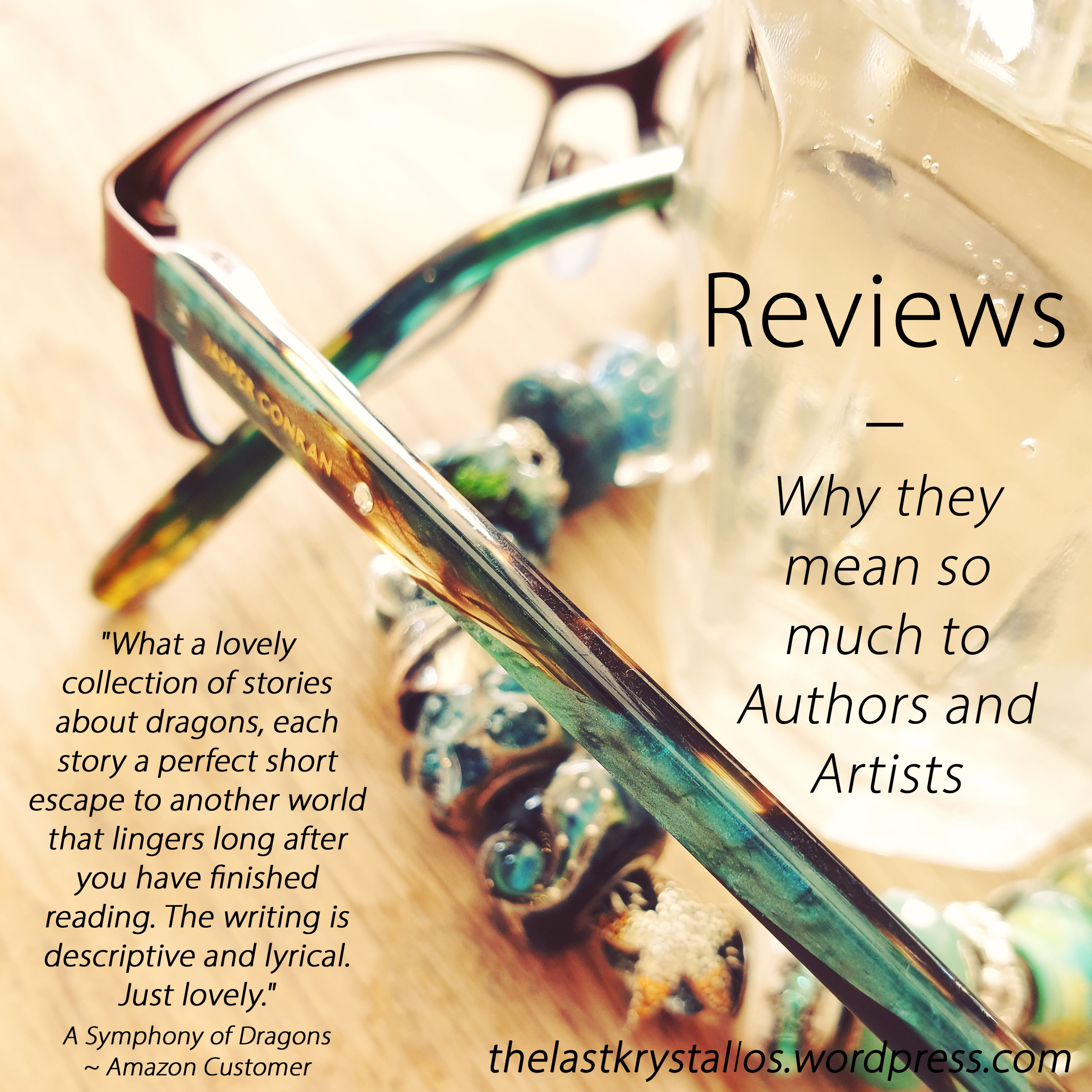
A review helps to gain visibility. Attention, it seems, attracts attention, It encourages others to take a chance on a book, or a CD, or a hand-crafted item that has been created with heart and soul, time and energy, that readers, listeners and admirers may never fully understand.
So, take a look at Lisa Shambrook’s article and, whenever you get the chance, leave a review for someone who needs it— an author, a artist, a crafter, a local small business, or your favourite coffee shop. Sharing the love is easy once you get the hang of it.
Review: to think again. It’s about considering, assessing, and to offer an opinion, and how many of us love offering an opinion? Social media is all about reviews… we’re posting about our lives, reviewing what we’ve done, where we’ve been, and sharing our thoughts about it. These days, reviewing is just another part of our life.
So, since we’re doing it all the time, how about taking a few minutes – the time to write a status update – to offer a review to those who need them?
It’s my birthday week this week and when I’m asked “What would you like?” – right now, I’d just love a review.
Not a review of me, I think I’m open enough for everyone to know who I am, and I don’t need a rate! I’d love a book review or an Amaranth Alchemy Etsy review.
There are four main sets of skills that English teachers work to develop in their students: reading, writing, speaking and listening.
Over the past few years of my teaching career, I have observed that my students find listening much more difficult than the others.
I’m not talking about them showing respect or being quiet when I’m talking – most of them are pretty good at that, thankfully.
It’s the art of deliberate, intentional listening, focusing on what is heard and processing that kind of information, that people seem to struggle with.
I have offered my students audiobooks to help them with reading their set texts. Most of them aren’t interested in that— not even the struggling readers, who would really benefit from that kind of assistance in getting through a book. I have also offered them podcast episodes related to the books they are studying, and I don’t recall anyone taking up the offer.
Give them a YouTube clip, though, and they’re on it like flies at a barbecue.
Don’t get me wrong – those YouTube clips and TED Talks can be super helpful. My issue is that people – and it’s not just kids, I’m sure – are so oriented to screens and visuals and hooked on sensory overload that they’re losing the art of listening.
People these days frequently have music playing while they do other things – work, run, work out, eat, walk, shop, drive, clean the house, you name it. There’s absolutely nothing wrong with that. But do they ever really just stop everything else and just listen to something?
It is really healthy to turn off the “noise” of the world and the demands of a busy life and close your eyes to focus on what you can hear. You don’t even have to listen to anything in particular – it can be fascinating to see what you can hear when devices, TVs, and appliances are turned off and things are quiet, especially if you go outside.
In terms of listening material, there is so much available that is good to listen to beyond music or commercial radio. Audiobooks are fantastic, as I’ve observed in a previous post. There are podcasts on every imaginable subject, free of charge, just begging to be listened to. Listening to talkback radio is both informative and entertaining, if you can find a station or a show you really like.
Listening is such a valuable skill. It enriches life in so many ways. It builds relationships, enhances learning, develops understanding of the world and the different people in it, provides entertainment, aids relaxation and soothes the soul.
If we would all just turn off the screens, close our eyes, and open our ears more, we’d be a lot better off.
This article resonates deeply with me on so many levels. My mother used to quote things like this all the time, with her favourite being “Stop it! Stop it! Someone will get hurt in a minute!” My beloved mum is long gone, but this still gets quoted among our family in our best “Mum” voice on a regular basis.
The author of this post makes some really good points about how people treat one another, especially on social media where some seem to think that everything is acceptable because they are hiding behind a screen and a keyboard.
Cruelty is never okay. A joke among friends is one thing: mocking someone, making fun of them, calling names or deriding their character is a different beast altogether.
It really isn’t so hard to be kind. It really isn’t so hard to put yourself in someone else’s shoes and think about how they might feel.
It’s pretty basic, really, to “do to others as you would have them do to you”, but so few people seem to manage it.
In the immortal words of Maxwell Smart, “if only they used their [social media] for goodness instead of rottenness.”
Make good choices, people. Choose the positive. Choose kindness.
Remember that gem? I’m sure my parents rolled that one out a time or two when I was finally doing something active. I’ve always been risk adverse. Better safe than sorry has been my life’s mission statement.
Yeah, sometimes I think I was born old…
But I want to change this saying to fit our wonderful social media age. I think it should be ‘it’s all fun and games until we need the people we’re making fun of’.
Because as much as I like to think I don’t need people sometimes life is much easier with people. Most of the time they were people I had just met. People who were capable of empathy, capable of being decent, friendly human beings, capable of showing someone respect just because and without judgement.
I really appreciate the small, simple things in life that let me know I’m appreciated: a smile, a hug, an encouraging text message or a silly SnapChat. It changes my day knowing that someone cares enough about me to share those things with me.
I was reminded again by Karen Nimmo’s blog post on Nerdome how important that is. In this world where some people will sell you just as quickly as looking at you, or push you under the bus if it means they’ll achieve their goals faster, there are some people who have no positive interactions with other people all day.
My smile might be the only one they see. My words of encouragement might be the only ones they hear. My random act of kindness might be the only light in a dark day.
Because I know what dark days are like, I understand the privilege — and the responsibility — of being able to change that for someone else.
It doesn’t have to cost anything at all. It isn’t an obligation.
It does require us to take our focus off ourselves for a few seconds and give something intangible, yet priceless, to another person.
I hope that my words here, and those of Karen Nimmo, encourage you to seek to make a difference in someone else’s day today. You never know – you might just make your own at the same time.
hink of the last time someone did something nice for you.
Not something big; just a small act of kindness — bought you a coffee or a treat, did a household chore for you before you’ve asked, asked how your weekend was (and genuinely listened to the answer).
Recall for a minute how that made you feel. Good, right? It’s not so much the act that creates the warmth; it’s that they were thinking of you, that they found the time and means to appreciate you, to ease your load or make you smile.
The world can be a dog-eat-dog place; often, we find ourselves competing to get what we want and need. But trampling over others for our own agendas doesn’t make us feel good. Quite the opposite, actually.
One of the best ways to boost happiness is to do something for someone else. Their…
I am still coming to terms with the fact that this post needed to be written. How do people not know these are different words?
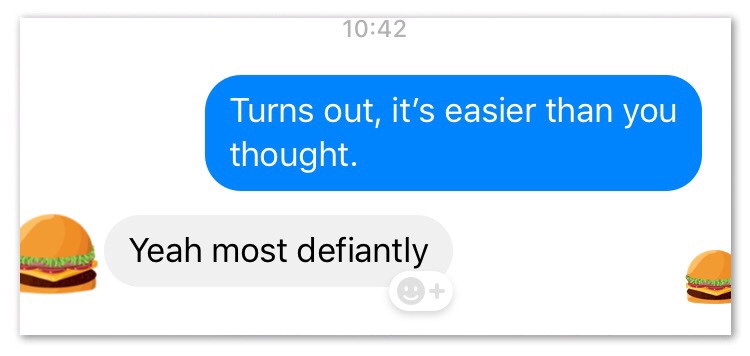
Apparently, though, it’s an all-too-common problem. Social media is littered with posts where someone has answered with “Defiantly!” when what the responder really meant to say was “Definitely!”.
It happens in my own conversations several individuals on a regular basis. In fact, it happened again just yesterday, so I took a screenshot with this blog post in mind.
Yes. I most definitely did turn my friend into a hamburger to protect their identity.
I don’t know whether autocorrect is to blame, presumably as a result of poor typing, or if it’s just plain old-fashioned ignorance. The answer to that probably varies from one perpetrator to another, but either way, continuing to mistake one for the other is inexcusable.
Definitely means “for sure” or “absolutely”. In fact, those are excellent choices for anyone who wants to agree with something, but doesn’t actually know how to spell “definitely”.
Here’s a hint, though. Definitely even sounds exactly as it is spelt: def-in-it-ely. It’s phonetically straightforward.
Therefore, anyone trying to spell it should get to the ‘a’ in ‘defiantly’ and know they’re making bad choices.
Defiantly is a word most often used by parents or teachers describing the way in which a child refused to do as they were told. Examples: The child sat in stony silence, arms crossed defiantly. “No!” Robin yelled defiantly, “I won’t apologise for being a grammar snob!”
You get the idea.
It’s definitely in your interests to get this right.
Today I received an email which included the line, “It doesn’t matter who’s responsibility it is…”
Written by a professional who should know better, it was ironic that it was me, and not them, doing a massive facepalm.
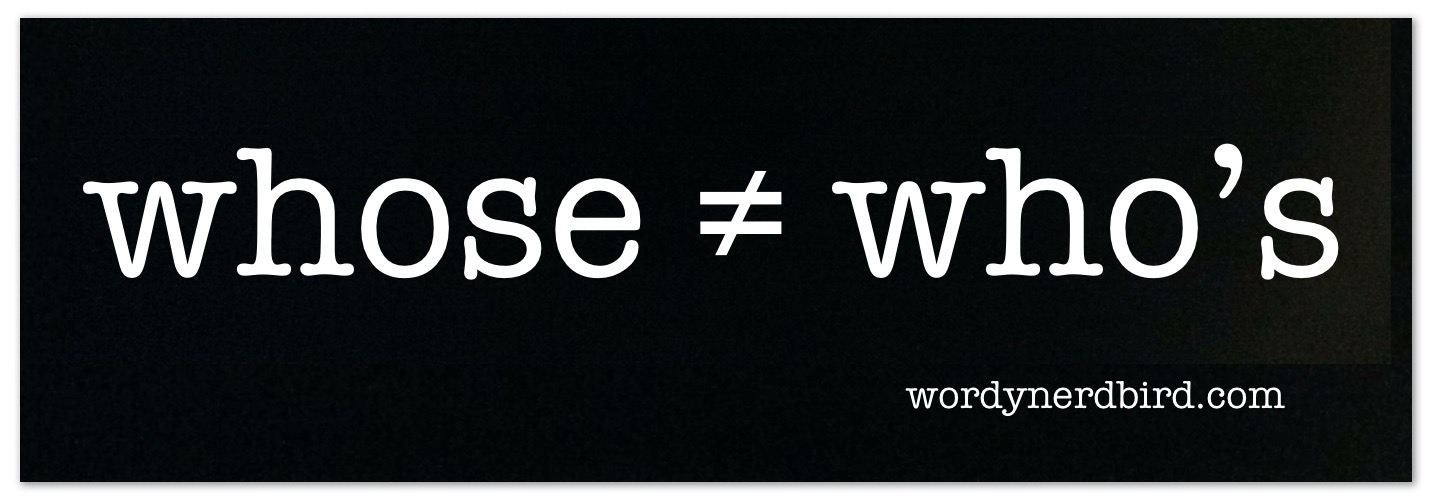
This incorrect use of the homophone “who’s” instead of “whose” is a common error, but that doesn’t make it excusable.
The apostrophe in “who’s” signals that it is a contraction— a shortening of two words into one, so that “who is” becomes “who’s”. Alternatively, it can also be a contraction of “who has”. You can tell which one it is by determining if the sentence is in past or present tense,
Examples: That’s the boy who’s a really good actor. Who’s in charge around here? Who’s been eating my porridge?
‘Whose’ is a pronoun of ownership.
Examples: This is the farmer whose cows ate all my corn. Whose car is that?
Once you know the difference, it’s fairly straightforward. That means there is absolutely no excuse for getting them wrong, even if they do sound the same when spoken.
Fun fact: “it’s” and “its” work exactly the same way.
Today is RU OK Day, also known as World Suicide Prevention day.
This is an awareness very close to my heart.
I’m not going to expand on why, because I want the focus of this post to be positive and encouraging.
The message is important not just for today because it’s a special awareness day. This message is permanently, crucially important.
We need to take care of each other. Each of us is uniquely placed to offer support and encouragement to the people we know – friends, families, colleagues, students, whoever we cross paths with in our lives. That doesn’t mean we have to be their only support, although sometimes we might be just that.
If you think someone is down, if they look tired or unwell, or notice they’re not taking care of themselves as well as they usually do, ask them if they are okay. Don’t just ask as a throwaway question. Be willing to have a quality conversation that includes questions like:
What’s going on?
What do you need?
How can I help?
Is there someone I can contact for you?
Taking the time to check in with someone deliberately and thoughtfully is a powerful communication of care and concern.
It’s important to realise that you or I might be the one positive thing that happens in someone’s day. We might be the only source of encouragement and light that they encounter.
We also need to consider the power of our words. A curt dismissal or snide remark in response to a comment that might actually be a true confession of desperation, depression or anxiety can be incredibly destructive. We should never, ever be making a joke of that. Yes, sometimes it is attention-seeking or needless drama— but sometimes it’s not.
A kind word or message of encouragement could be the difference between someone actually deciding that now is the time to end their life, or not.
I know. It’s a huge responsibility.
But imagine a world where each of us gives someone that kind of support, and someone else gives it to us when we need it.
And if you’re thinking you’ll never need it, stop right now and be very, very thankful for the blessings in your life and the comfort of good, stable mental health. It’s not possible to emphasise enough just how lucky you are.
If you’re one of those who is struggling, or feeling like you’re drowning, or tired of treading water… please, please, talk to someone. Seek help. Look for reasons — any reason — to stay. Please stay.
I wrote this poem after one of the darkest seasons of my life thus far. I hope that you will gain both perspective and insight from reading it.
Before you read this poem, there is somethingI would likeyou to know.
This poem is absolutely, 100% true. It is personal, it is painfully honest, and it tells of my own experience, not anyone else’s. And you may find it quite confronting.
Despite its darkness, it is written to be positive, not negative.
It was not written to win sympathy or make anyone feel guilt: it was written so that people might understand what’s in my head, and what I’ve been feeling, and why I’ve made the choices I have.
To answer your concerns: I have chosen to stay here and to defy all impulses that tempt me otherwise. I don’t always feel okay, I’m not always okay, but I will be okay.
For anyone in a similar position: hold on. Stay here. You matter more than you know.
STILL HERE.
For a moment- One fleeting, isolated point in time-
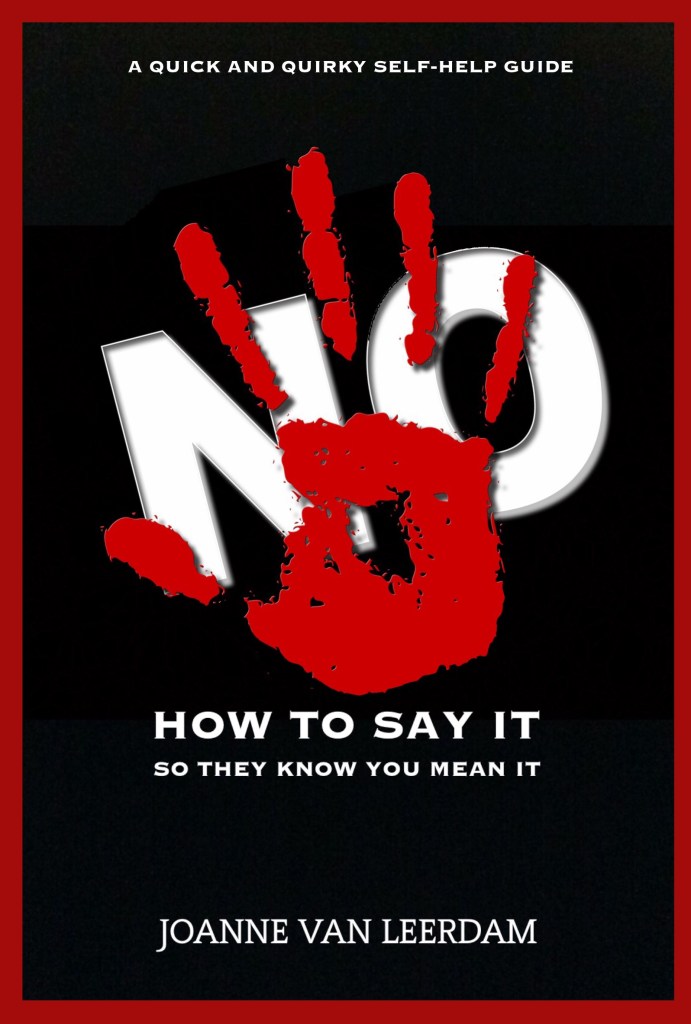
I often wonder why “Just Say No” became a catchphrase among those trying to teach kids and teens to resist poor examples, negative influences and bad habits. It’s not always that easy or so straightforward. Peer pressure, family expectations, social engineering and a desire for job security have all taught us to take the path of least resistance — which can actually be a really unhealthy thing.
Among all the different people in this world, there are two groups who invariably find each other: those who have trouble saying no, and those who take advantage of them.
You know it. I know it. And we all know which of the two groups certain friends and family members fall into.
This quick and quirky self-help guide to saying no more effectively provides insights and tips on how to say “no” so that others know you mean it, and thereby reclaim your freedom from those who would readily exploit your generosity.
If you find it hard to say no to people, but really want to… this is the book you need.







 …until somebody loses an eye.



 WordyNerdBird