Back in the Classroom: Putting My Teacher Mask On

Thoughts on the first day of face to face teaching after months of lockdown and teaching online.

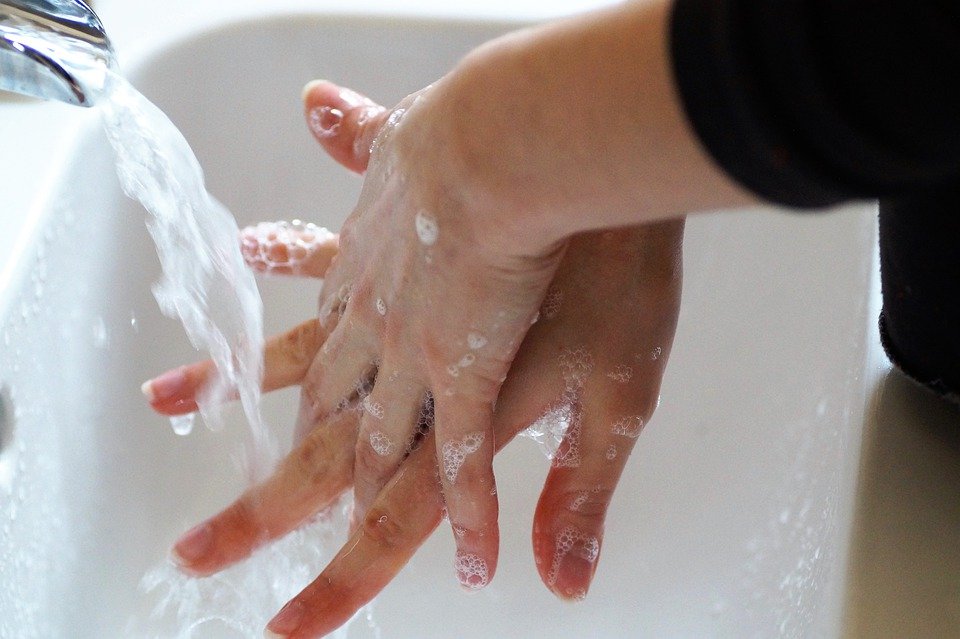
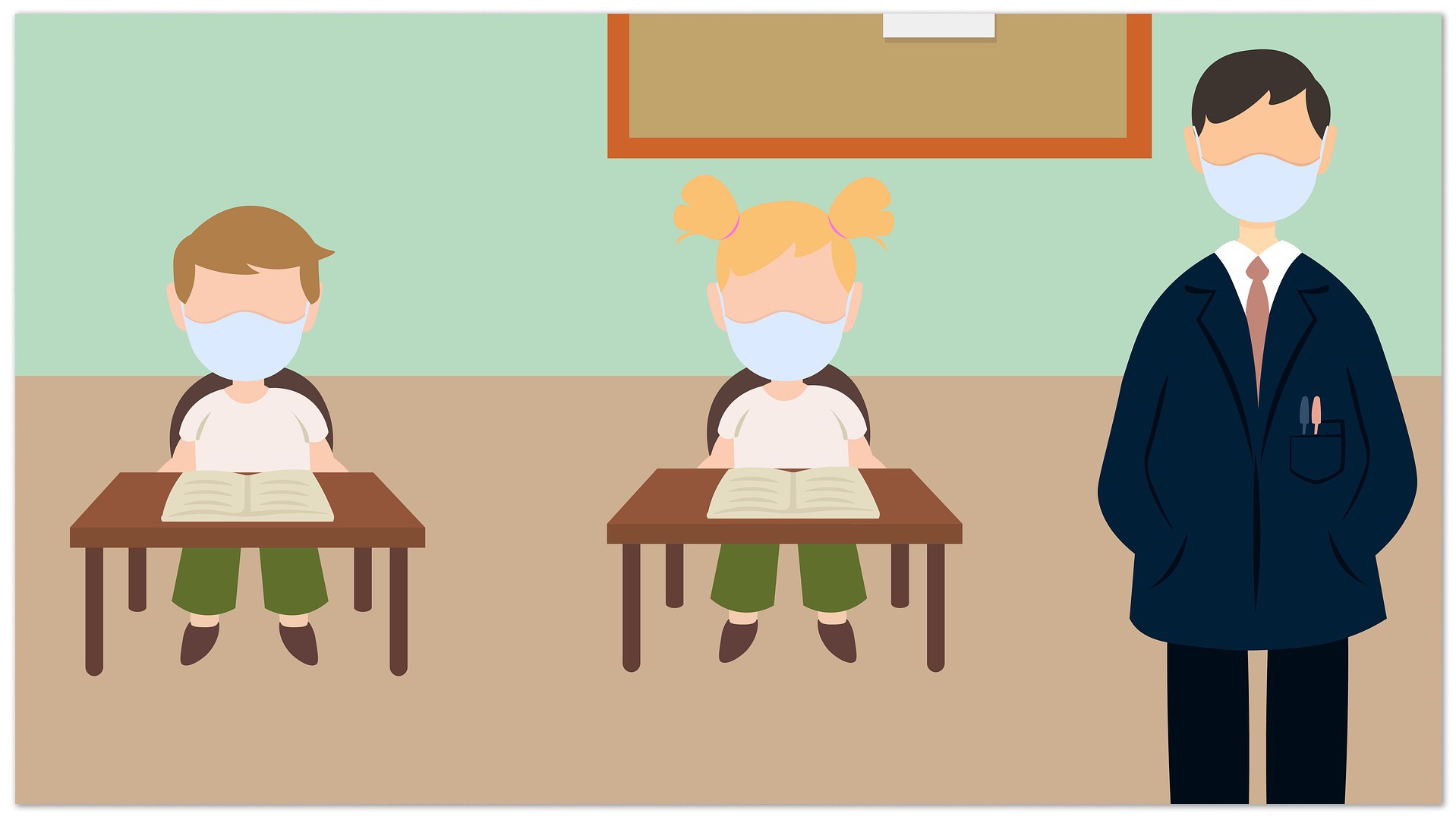
Image by HaticeEROL on Pixabay

After nine weeks of only seeing my students in little squares on my computer screen, a two week term break, and a final week of online classes, we resumed face to face lessons today. Things were a little bit different than they used to be, though. 

The desks were distanced from one another as practically as they could be. The bottle of sanitiser at the front of the room had been joined by another and, this time around, the students didn’t need reminding to use it. Most obviously, though, we were all wearing masks. 

We used to talk about “putting our teacher hat on” when we walked into the classroom, and taking it off again at the end of the day. I guess now it’s our teacher masks we have to consciously think about wearing, as this seems to be the new normal— in Victorian schools, at least— for the foreseeable future. 

The wearing of masks is something disliked by many students and staff alike. Personally, I don’t mind wearing one, and I am happy to not be breathing in whatever germs are floating around the room. Most of my students seemed to manage without any difficulty, but getting some of them to wear their masks properly and not keep touching them proved to be yet another new classroom challenge.

Still, there were some good things going on. 

The tone and humour in my classrooms was generally positive. One kid who doesn’t even like me much told me it was good to see me. I laughed and told him to give it time, and everyone laughed at that because we all knew it wouldn’t last.

Marking the class roll was significantly easier and quicker than online: once again, I could see at a glance who wasn’t there. Marking the roll in online classes was something I always found arduous. Today it took two seconds. 

I could see right away who wasn’t doing what they should be, and I could move around behind them and see their screens. There is no more effective way to make someone work than to be able to see their screen. 

At the same time, I could instantly encourage those who were working hard amd staying on task. It’s so much easier to be positive when you can be both natural and proactive about it. The added bonus is that when you praise and encourage one student for doing a good job or making a great effort, it tends to make those listening more inclined to want to do better and get some praise, too. 

Those few kids who have avoided doing much at all since we returned to online schooling finally had to do some work. Those who did not engage in online lessons found themselves no longer able to just sign in and zone out or leave the room. And because I was wearing a mask, they couldn’t see my wry grin as I watched them working. 

I was able to move around the room and look over the shoulders of my students. Delivering instant feedback and reminders about spelling, punctuation and paragraphs is significantly easier than trying to give that kind of advice online.

All things considered, while the day was not without a few issues and challenges, it’s fair to say that the positives outweighed the negatives. It’s hard not to be satisfied with that. 
Covid 19 and the Great Pestilence: How Much Have We Really Learned?

Image by ivabalk on Pixabay.

This post reminds me of the lessons I’ve been doing with my Year 8 History class about Medieval Europe and the Black Death.

My students were very interested in the plague, and surprised by the fact that this was when quarantine, social distancing, and the wearing of masks became the go-to modes of dealing with contagious disease. They were also surprised by the time it took the Europeans to understand the importance of basic hygiene, and how very long it took to develop good medical knowledge.

These lessons were highly relevant in These Times, and helped the kids to understand why we’re being reminded to wear masks, wash and sanitise our hands, and keep away from other people. It was good to be able to discuss how relevant history can be. 

We all agreed we are incredibly thankful for modern medicine, science, vaccines and health care. 

It does strike me as bizarre, however, that with all the scientific and technological advances we’ve made, we still have to remind people to wash their hands. Some things, it seems, never change. 

viscountessw's avatarmurreyandblue

This illustration is simply that, a suitable illustration – the Flagellants followed the first wave of the Great Pestilence and aren’t mentioned here.
from https://www.britannica.com/event/Black-Death

In this time of Covid 19, when we don’t know why it seems to affect men more than women, and some ethnicities but not others, it is interesting that back in the 14th century the tsunami of the Great Pestilence of 1348 was followed by lesser waves that differed in many ways from the original. The first of these, in the England of 24 Edward III (January 1360 to January 1361) was called the secunda pestilencia and appeared to affect mostly the very young, babies and adolescents. Women were not affected in the same way.

The Chronicle of the Greyfriars of King’s Lynn notes: “…In that year [1360] began a plague among Londoners at about the feast of St Michael, where at first infants…

View original post 471 more words

Why Word Nerds Love The International Phonetic Alphabet

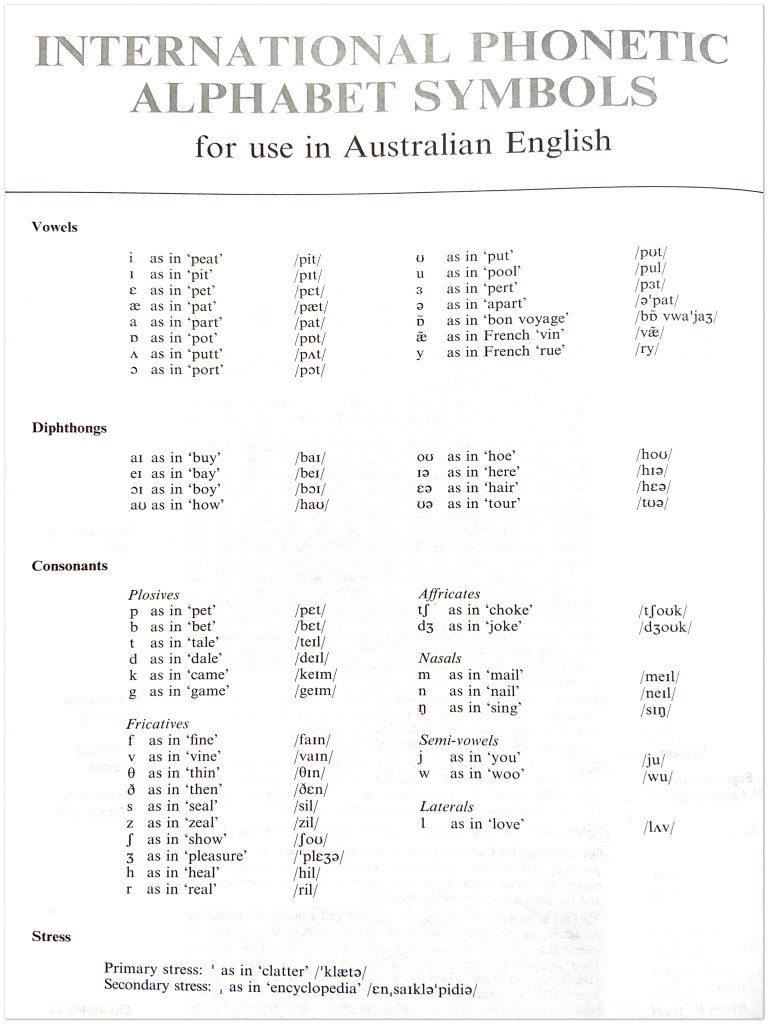
The International Phonetic Alphabet is a system of symbols that denote all the different units of sound — called phonemes — that make up words in any language. It was first developed in the late 19th century, and has been developed and updated ever since. 

Photo: Joanne Van Leerdam. The IPA page in my copy of The Macquarie Encylopedic Dictionary, 2011 Signature Edition.

I learned the IPA in my first year at Macquarie University in 1985. and found it to be an incredibly useful extension of my literacy and learning.  It is knowledge and fluency that I have actively maintained ever since. 

While it has more symbols to learn, it is more straightforward than the English alphabet, where letters can have more than one sound, and a sound can have multiple letters and letter combinations assigned to them. In the IPA. there is one symbol for one sound. There are no silent letters, and there is clear differentiation between words such as ‘foot’ and ‘boot’ that look as though they should rhyme, but do not. It also avoids situations such as that created by the letter a having six different pronunciations from which the reader must choose correctly if they are to understand what has been written. Syllables in words are marked, so that the pronunciation of the word is clearly and accurately transcribed. 

Hypothetically, one could write any word of any language as it was heard, and anyone fluent in IPA could read it regardless of which other languages they could or could not speak or read fluently. 

That came in very handy when lecturers and tutors in other courses used words or names I didn’t know: I used the IPA to write them down, so that I could research and identify them later. When I wanted to keep something confidential, I used the IPA to make notes or records, confident in the knowledge that my friends and family would have absolutely zero clue what was written. That probably wasn’t always entirely necessary, but it did give me a sense of security at the time. The IPA also helped me learn and perfect key phrases to use when family from overseas came to visit, and again later on when I was visiting other countries.

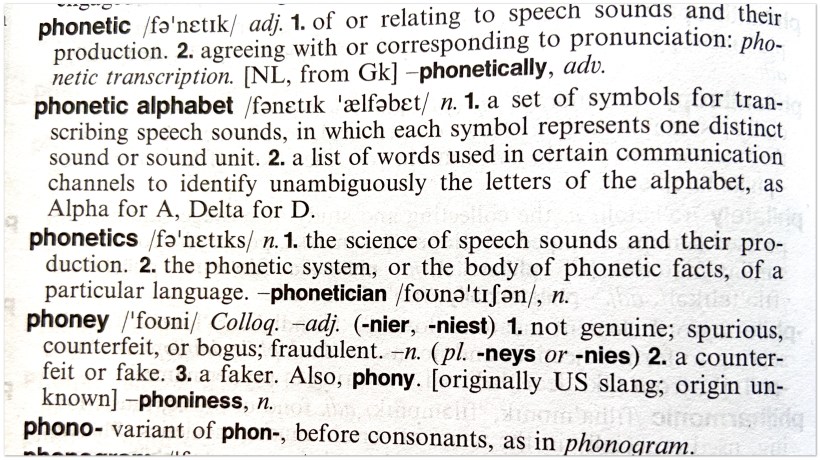
Photo: Joanne Van Leerdam. from The Macquarie Encylopedic Dictionary, 2011 Signature Edition.

A number of dictionaries, both online and hard copy, provide the pronunciation of every word in IPA, giving clear guidance to how unknown words should be spoken. As a fan of the IPA, this is something I consider essential in a dictionary for my own use. 

Because it is an international system of transcribing language, the IPA does include symbols that are not often used in standard UK or Australian English. They may, however, be very useful in transcribing the spoken English of migrant communities. It also has some symbols that are only used in English, and some that are used predominantly in American English.

All of this makes the IPA a versatile tool for all sorts of contexts: work, travel, study, clear communication, and general word nerdery. 

Resources: 

The Latest, Perhaps Greatest, Swear Word

Last week I asked my students to do something creative. 

 Today, Student A  wasn’t very impressed with the outcome of their efforts. “I tried, but it’s turned out a bit 2020.” 

“It’s a bit what?” I asked. 

“2020.” 

Obviously, I was expected to understand. 

“Mine’s pretty 2020 too, to be honest,”  Student B admitted. 

I looked at their faces on my screen. They were being serious. 

“So…” I asked, “Are we using that as a swear word now?” 

They’re right. It actually works.

“More meaningful than swearing, Miss,” said Student B.

The rest of the class concurred. 

“And we can’t even get in trouble for saying it.” Student A grinned, clearly rather pleased with that reality. 

I smiled, told them their work was way better than 2020, and moved the lesson on. 

I don’t know if they just started doing that by themselves or picked it up from somewhere else, but at least they’re finding some practical use for 2020. I may just follow suit. 

Is English A Salad?

Today’s English class was the most fun I have had in a long time. I wanted to exercise the kids’ minds and get them thinking laterally. I also wanted them to enjoy it. A lesson with a difference seemed to me a great way to start our final week of term and inject some interest into our online classroom.

I began by presenting my students with the contention that a box of chocolates is a salad.

This was not a popular suggestion. 

“No it’s not!” one student said… quite defensively, I might add. “Salad is salad. Chocolate is chocolate. You can’t ruin chocolate like that!”

But, I asked, what is a salad if it’s not simply a mixture of vegetables? Chocolate comes from beans… and if you add nuts, or fruit, or herbs like peppermint, then it’s definitely a salad.

We spent quite some time redefining food, presenting the most persuasive arguments we could think of, and debating the nature of reality. 

Every time it sounded like the students might be in danger of reaching a consensus, I made another suggestion. 

Ice cream, on its own, may just be ice cream – but the minute you put it in a cone, or add fruit or chocolate, it’s a salad. 
Coffee, like chocolate, is made from beans. It’s a salad.

“No!” was the response. “Coffee is hot – it can’t be a salad.”

So then I really twisted it up.

Is coffee soup?
Is cereal soup? Or is it a salad with too much dressing?
According to one student, and I quote, “Soup is not what soup is.”

Is the English language a metaphorical salad? Because it’s a mixture of a whole bunch of languages, right? The flavours are all mixed, but the parts are still recognisable if you know what you’re looking at.

Is the English language a sticky weed? Or velcro? Because you know, it takes something from every other language it swipes past. Maybe it’s double sided tape… 

I am not ashamed to say that I really had fun. Despite their groans and protestations, I think they did, too. 

Perhaps the most satisfying moments, though, were two comments made by different students: 

“You’ve just entirely ruined the English language.”

and

“These have been the most problematic fifteen minutes of my life.”

What started out as a brain tease turned into a really interesting discussion about how we use language and define things in our own ways, and often assume that everyone else understands what we’re talking about, and that everyone else agrees with us.

It’s safe to say most of them enjoyed it… but it’s also safe to say that I enjoyed it more. 

Stress Management Tips For Workaholics.

At a time when my state is still in lockdown, we’re back to teaching online and trying to tick all the boxes that go with that while at the same time dealing with all the other demands of life.

It’s very easy to become consumed by the job. It’s very easy to rationalise going those extra steps to create whizz-bang lessons that will engage and interest the students and hopefully keep both them and myself motivated despite the malaise that I have dubbed ‘online learning fatigue”.

I have learned over recent months how important it is to set limits for myself. I have consciously tried to avoid overburdening my students with work, and sought to develop learning activities that they can complete offline. I’ve tried to remind them to get up and walk around, to drink water, to get sunshine on their face and on their back.

Ironically, I’m not always so great at managing my own stress. In the midst of trying to be Super Teacher or Little Miss Motivator, I still have to remind myself to do those same things.

This post from Nerdome appeared in my feed at an opportune moment. It’s a good read, providing some quick tips and good insights about managing stress.

I hope you enjoy it as much as I did.

GigaWorld's avatarNerdome

Those who spend more time with their works tend to suffer from stress more than the other. The mental and emotional burden that is often attributed to the demands of work can affect our productivity and efficiency with our task that would often lead us to troubles than not. This is one reason why it is very important for workaholics to undertake stress management to avoid compromising their career.

You don’t have to be in a special place to apply stress management. In fact, you can do it anytime and anywhere if you feel like it. You can do it while at your work desk, in the comfort room, or even out in the lobby. The idea here is to control your mind to relax so that you can continue fresh with your task — emotionally, physically, and mentally. Here are some tips that will surely help you out.

Tip…

View original post 412 more words

Balancing Positive and Negative Emotions

Today’s professional development day at school focused on Positive Education and how we can help our students and our communities to flourish. 

One of the aspects I found most thought-provoking was the discussion about positive or comfortable emotions and negative or uncomfortable emotions. It was particularly relevant to many of the things I have been experiencing and observing about life in recent weeks, and I want to share my observations and reflections on those things with you here.

Before I go any further, though, I want to make it absolutely clear that I am not a medical or psychological expert or professional. I am, however, a high school teacher of 30 years’ experience, so I have had time and opportunity to make some observations about the things that happen in life and how we deal with them.

More personally, as someone who experiences chronic physical issues and mental health challenges, and who has experienced many conflicting emotions recently due to profound personal loss, I’m confident I know at least a little bit about dealing with adversity, and I’ve learned a few things about the importance of balancing negative emotions with positive ones. 

Both positive and negative emotions can be powerfully motivating.  Fear of failure or embarrassment is as strong, or stronger, in some people as desire for success is in others. 

Negative or uncomfortable emotions can motivate and fuel positive outcomes such as creativity, empathy, and relationship building.

Positive and negative emotions can actually be highly effectivecompanion emotions‘.  I don’t expect that this is a scientific term at all, but it seems to me a useful term that describes how contrasting emotions experienced at the same time can provide some healthy balance and perspective. 

I can testify from the past few weeks that gratitude can moderate grief, and enjoying a few quiet moments in the beauty of nature can transform abject misery into much gentler sadness.  

In different contexts, fear can be a healthy addition to awe or wonder – think of a child at the zoo, for example, for whom interest and desire to engage with the animals should always be balanced with both respect and a little fear or mistrust, so that the child and the animals all remain safe. In yet another situation, a little anxiety or nervousness can actually heighten deliberate preparation and performance if it is paired with intentional and thoughtful preparation, because it can stop one from making rushed or careless errors, or from taking success for granted. 

Life is not about always avoiding the feelings that make us uncomfortable or sad. Hoping to do so isn’t realistic at all, given that there are many situations that we can neither actually control or entirely avoid. 

Instead, it’s crucial that each of us learns to manage those negative or uncomfortable feelings and use the situations in which we encounter them to develop and consolidate our personal strengths and resilience.  Learning to look for the positives in life and choosing to find a balance for the negative experiences or emotions we encounter is how we grow and move forward in life. 

“Whether dealing with a major lifeshattering event or a small bump in the road, we can use gratitude to help boost our happiness and change our outlook. While gratitude won’t change our circumstances, experts say gratitude can change how we feel about them.”

Paula Felps in ‘Your Brain on Gratitude’ by Paula Felps 

That’s certainly what I’m seeking to do while working through my grief. It’s okay to take the time to mourn my losses, but I can’t afford to unpack and live there. Finding a constructive way through my pain will enable me to heal, and come out stronger at the other end. 

In being honest about how I feel and what I’m thinking in my posts on this blog, my hope is that my words will help and encourage someone else get through their personal challenges, whatever they are, and to deal with both their circumstances and their feelings.

I have no doubt that knowing we are not the only ones going through grief or pain or whatever trial it is that is burdening us actually helps us to start to heal. That’s why empathy and compassion are so powerful. That’s why the support and love of family and friends is what we yearn for and seek out when things are hard.  

Tonight, as I reflected on these ideas and considered the fact that I had no evidence for my inexpert assertions, I did find a number of articles that show my conclusions are consistent with current science and research surrounding emotional and mental health. 

Of those articles, some were quite wordy and far too academic to be accessible, but I did find two easily readable and very interesting pieces that discuss the ways in which positive emotions such as gratitude and self-compassion can help individuals deal with adverse situations more constructively.  They are:
‘Your Brain on Gratitude’ by Paula Felps via livehappy.com
’The Reason You Make Unhealthy Choices’ by Mandy Oaklander via time.com

“Being kind to yourself, as opposed to tearing yourself down, leads to fewer bad feelings and, in turn, healthier actions.”

Dr Fuschia Sirois, quoted in ’The Reason You Make Unhealthy
Choices’ by Mandy Oaklander
, via time.com September 25, 2014

Balancing Positive and Negative Emotions
#emotions #feelings #psychology #thoughts #reflection #personal #blogpost

Having Dropped — And Temporarily Lost — The Ball

I’ve been absent.

It seems that I haven’t just dropped the proverbial ball when it comes to blogging regularly, I’ve gone and lost the jolly thing.
I last saw it a couple of weeks ago, when it bounced a couple of times before rolling away through some very prickly bushes and falling into a seemingly bottomless hole.

The thing is, life since that drafted virus unleashed itself on the world has been tumultuous.

I could tell you I haven’t written anything, but that’s not true. I have written some really great lessons and three entire new units because what I had planned (and written) previously wasn’t going to work in an online learning environment.

I could tell you I didn’t have a quarantine project, but that isn’t true either. I’ve had two, both of which happened by necessity rather than design.

Project One: reinventing my career
Initial Observations: Teaching from home is a whole lot more work than it sounds. All that extra time online is very tiring.
Final Observations: Challenging and exhausting, but enormously satisfying. Most students engaged really well. More positives than negatives.
Verdict: Aced it.

Project Two: supporting my father as he spent a couple of weeks in hospital before transitioning into residential aged care.
Initial observations: Lots of phone calls. Mountains of paperwork. Huge emotional adjustments.
Further Observations: Decisions are hard, even when you actually have no choice. Emotions are hard. Being on one mental and emotional roller coaster while your dad is on a completely different one can only be dealt with by hanging on for dear life and completely faking any appearance of knowing what you are doing.
Verdict: Aced it. Especially the part where I looked like I knew what I was doing.

It should also be mentioned that these two significant challenges occurred simultaneously. I didn’t have time to scratch myself, much less spend any more personal time online than I did.

So really, I’ve achieved far more since mid-March than is apparent from my nonexistent output of either blog posts or fiction.

I admit that I have seriously contemplated walking away from writing and/or blogging. Even while considering that, I knew that was the stuff of emotional and mental exhaustion, because I still have ideas and plans bubbling away in the back of my mind. I am not ready to quit, and I would be letting myself down if I did.

I will get my mojo back, even if I’m not sure when that might happen.

Stay tuned, folks. I’m not dead yet.

A Reflection on Teaching From Home: Week 1

While online classes may not be ideal, things could definitely be worse.

I wrote in Tuesday night’’s post that the first day of teaching my classes remotely/online was challenging. 

I thought it would be good to follow that up at the end of the school week with my insights after a few more days’ experience.

Things definitely got better as the school week progressed. 

All of my students seemed to relax and interact more normally as the week progressed. I think some of them found it really awkward and a bit artificial at first, and many others— myself included— just didn’t know what to expect. 

I had to make my expectations for behaviour and interactions super clear via email to a couple of kids. 
I actually made an explicit list of what I expected and what they were not welcome to do.  This helped to set boundaries for them, and they changed their attitude accordingly. Things were a lot better after that. 

My students have done some great work this week, and I have been able to give positive and constructive feedback to encourage them. 
This also encourages me: I can do this. The kids appreciate my effort and input. My classes are benefiting from the structure, the lessons and the encouragement I have given them. It doesn’t matter if I feel it’s not the same or not enough, or as though I am treading water. 
I am good enough. My teaching is valuable. I can do this. 

I am so thankful for  my school and its  consistent, uniform approach to the delivery of lessons and learning material. I’m also super glad we have followed the same routines and timetables. 

In times of turmoil and change, schools, teachers and students all have the greatest chance of success when everyone is on the same page and things are kept as consistent and stable as possible

In my discussions with friends and family who teach elsewhere, I have learned that this isn’t happening elsewhere. Timetables and class sizes have changed for some, some have new classes they’ve never had before, and others have no streamlined or consistent method of delivery or assessment. One poor soul is trying to deal with all of those complications and more. 
I am trying to be as supportive of that particular friend as I can be, and have suggested that if the school has left it completely up to him to manage, he might follow the practices my own school has implemented so that his students have some structure and consistency with his classes at least. He’s going to do that, and suggest those same things to his colleagues. 

Teachers worldwide are struggling with the same anxieties, challenges and logistics that I am. 
I am note alone. 
Nor are my students. 

We should not be discouraged if we don’t get through the regular program, or if things don’t always work the way we’d like them to.

Our online classrooms provide valuable connection and communication for the kids. It helps them to feel less isolated and cut off, and gives them regular opportunities to think and talk about life beyond corona. 

Ultimately, my students are safe and healthy at home, and learning every day. Those are blessings that should not ever be taken for granted in this strange coronaverse of 2020. 

I can honestly say I am looking forward to another week of positive, encouraging lessons and interactions after a well-earned rest this weekend. 

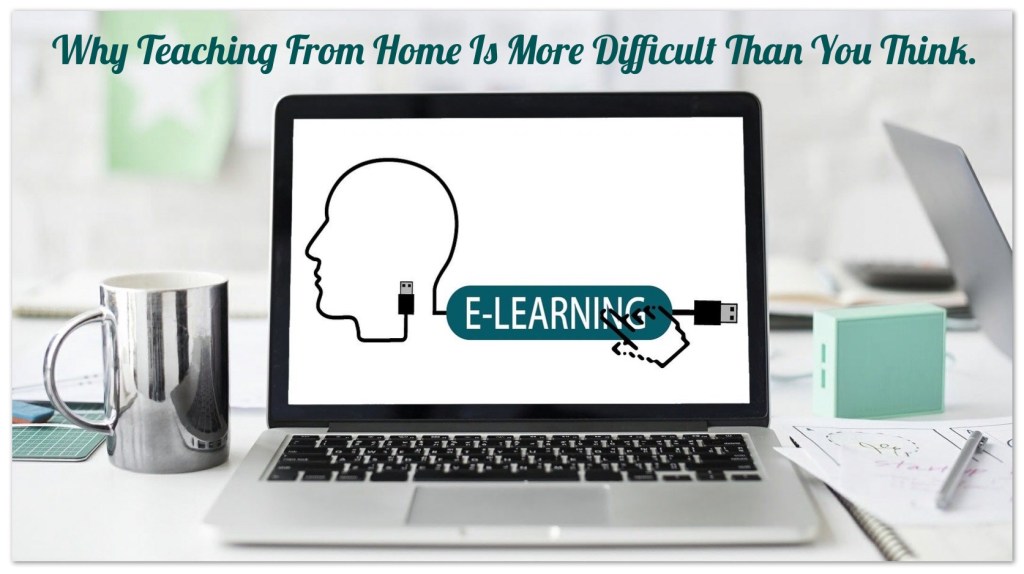
Why Teaching From Home Is More Difficult Than You Think

One teacher’s thoughts on the first day of teaching and learning while #StayingHome

As a teacher, I know there is no substitute for being in the classroom, engaging with the students and supervising their work, making suggestions or guiding their thinking. When you create a constructive, productive learning environment, students thrive. 

Over the past few weeks, my school has worked really hard to reproduce that in an online learning environment. My colleagues and I have put a great deal of thought and preparation into making our students’ experiences of learning from home in online classes as interesting and beneficial as they can possibly be. From where I stand, we’ve done a great job of preparing for teaching and learning from home, and I really hope that our students and their parents feel the same way. 

Today was our first day of teaching and learning remotely. My students were well behaved and cooperative. Most seem to have coped with the challenges of doing school at home, some of them sharing an environment with their siblings who were also doing their lessons at home, quite well. We got through everything I had planned for those initial lessons. Judging from the work they handed in today, the kids generally worked as well as they usually do in a classroom environment. 

I don’t know how they all felt at the end of the school day, but by the time 3.30pm rolled around, I was exhausted. 

Make no mistake: online teaching is really hard. It’s mentally demanding in ways that physical presence in the classroom is not. It’s harder to hear students when they speak, and it’s harder to be sure that everyone understands what you say or what you want them to do.  Even marking the roll poses new challenges when you can’t simply identify empty spaces in the classroom. Things that have become instinctive for teachers are now impossible, and we find ourselves reinventing pedagogy, teaching, communication, and the delivery of lessons and lesson materials. 

You can no longer maintain classroom management by circulating around the room or standing in strategic places so you can see what kids have on their screens. You can’t just look over a kid’s shoulder and remind them of a principle or fact that they need to consider. You can’t make a teaching point of quickly correcting an error or oversight. 

To an extent, one has to just accept that and move on. If a student is easily distracted or willing to be inattentive, that is understandable: there’s a lot going on,  they’re at school without being at school, they’re in their own environment, and some of them are genuinely anxious about the dangers and the restrictions that Covid-19 has brought about. Really, the best you can hope for is to find a way to gently bring their attention back to the task and try to re-focus them. 

It’s a tricky set of circumstances for the kids as it is, and adding learning at home to the strangeness of social isolation and distancing is a situation that some kids — and some teachers — will undoubtedly find awkward at best. 

Still, it’s good for all of us, kids and teachers alike, to have a routine and a variety other things to think about. It is healthy and constructive use of the abundant time we would otherwise have on our hands at this point in time. 

As tired as I was, they day did end particularly well. After spending 90 minutes with one of my classes this afternoon, I was pleasantly surprised when three of my students thanked me for the lesson. In the past, wishing each other a good afternoon or a pleasant evening was not unusual, but having students actually thanking me for double English after lunch on Tuesday is totally new. 

I spent the rest of my regular school day responding to the work they submitted, and giving my students some feedback on their ideas and responses. It was nice to be able to 

At 4.15pm, I made myself a cup of coffee and almost cried into it with gratitude for my good but mentally exhausting day, and for the caffeine upon which I would rely for the next couple of hours while I cooked dinner and did everything else I needed to do. 

When dinner was done, I looked at my husband and asked if it was too early to go to bed. 
“It’s 6.15pm,” he said. 
“So probably, then?” I asked. 
“Yeah. Probably.” 

Maybe I’ll just spend the time between now and bedtime thinking about what gift I’m going to buy myself for Teacher Appreciation Week. 
Whatever it is, I will have earned it.

One teacher’s thoughts on the first day of teaching and learning while #StayingHome
#teachingfromhome #TeachFromHome #TeachingOnline #teachertwitter

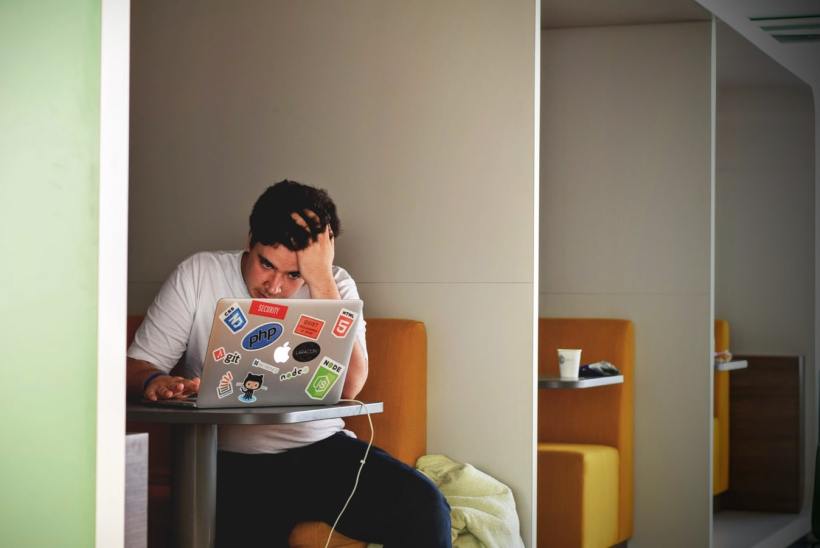
Image by Wortflow from Pixabay